of Chemical
Engineering
ISSN 0104-6632 Printed in Brazil www.scielo.br/bjce
Vol. 35, No. 02, pp. 575 - 586, April - June, 2018 dx.doi.org/10.1590/0104-6632.20180352s20160172
DEPENDENCY OF NANOFLUID RHEOLOGY
ON PARTICLE SIZE AND CONCENTRATION OF
VARIOUS METAL OXIDE NANOPARTICLES
Kerim Yapici
1*, Ozge Osturk
2and
Yusuf Uludag
31 Department of Chemical Engineering, Suleyman Demirel University, 32260 Isparta,
Turkey
2 Department of Chemical Engineering, Cumhuriyet University, 58140 Sivas, Turkey
3Department of Chemical Engineering, Middle East Technical University, 06800
Ankara, Turkey
(Submitted: March 14, 2016; Revised: December 8, 2016; Accepted: January 20, 2017)
Abstract - Impact of the nanoparticle size and concentration on the rheology of ethylene glycol based nanofluids containing nanoparticles of five different metal oxides is investigated. Particle mass concentrations ranged from
5 to 20 wt %. Types of the nanoparticles and their particle size are TiO2 (30 nm, 50 nm), MgO (20 nm, 40 nm), ZnO (10-30 nm, 35-45 nm, 80-200 nm), SiO2 (20-30 nm, 60-70 nm) and CuO (40 nm, 80 nm). A stress
controlled rheometer fitted with a cone-and-plate system is employed for the rheological characterization of the nanodispersions at temperatures between -5˚C and 35˚C. The non-linear measurements reveal that nanofluids
of CuO (40 nm), ZnO (10-30 nm, 35-45 nm) and MgO (20 nm, 40 nm) particles exhibit non-Newtonian shear thinning behavior at particle mass concentrations higher than 5 %. No appreciable shear thinning is observed for the dispersions of TiO2 (30 nm, 50 nm) and SiO2 (20-30 nm, 60-70 nm) particles. Strong dependency between relative viscosity of the suspensions and particle size and loading is observed. Temperature, on the other hand, plays a marginal role in the relative viscosity of the suspensions. The shear viscosity measurements indicated
the presence of particle size and concentration dependent apparent yield stress for CuO and ZnO nanofluids. Investigated nanofluids do not exhibit any thixotropy during their rheological characterization. Finally, viscoelastic measurements suggest that nanofluids are free of gel formation.
Keywords: Rheology, nanoparticles, size effect, nanofluids, non-Newtonian fluid.
INTRODUCTION
Due to their unique properties and potentially wide range of application (Wong and Leon, 2010; Taylor
et al., 2013) the number of studies on nanofluids has
increased in recent years. Most of these studies are
devoted to the measurement of thermal behavior of
nanofluids in order to cultivate their superior heat transfer properties compared to conventional fluids
(Eastman et al., 2001; Xuan and Li, 2003). Since
application of the nanofluids involves their flow,
knowledge of their rheological properties become
also crucial in the design or operation of such systems. In a recent review by Mahbubul et al. (2012), the
effects of parameters including particle size and shape, particle concentration and temperature on nanofluid
viscosity are covered. Similarly, in his review study, Rudyak (2013) considered the dependence of the
nanofluid viscosity on particle concentration, size and
temperature. He reported that the size of the particles
had the strongest impact on the nanofluid rheology. The effect of nanoparticle size on nanofluid viscosity
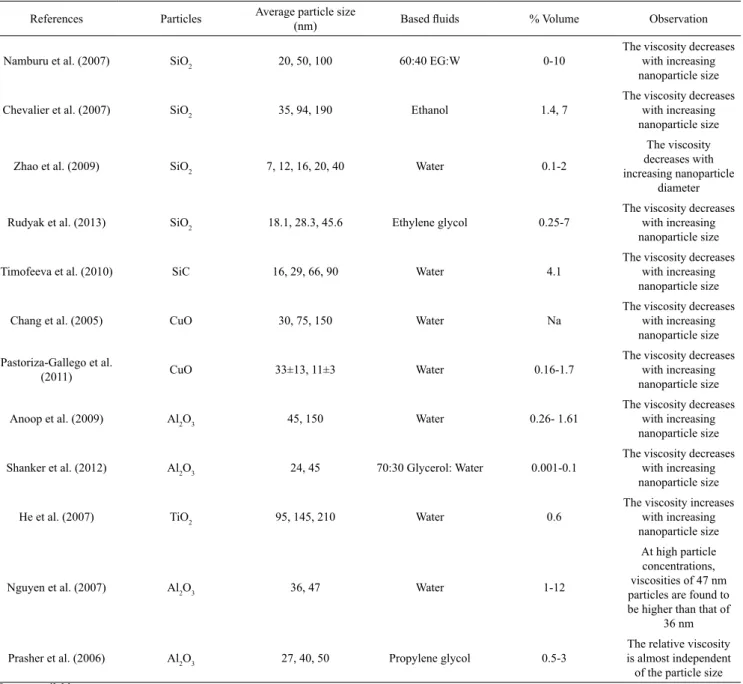
has been the subject of many studies, as shown in Table 1, along with material, size and concentration of the particles, and dispersion medium. It is possible to deduce the following conclusions from Table1. Among
the investigated metal oxides, SiO2 and Al2O3 are most widely used in the studies. In the majority of the studies, nine out of the twelve to be exact, a reduction
in nanofluid viscosity with increasing nanoparticle
size was observed. Meanwhile, it should be noted that
investigating nanofluid rheology is not the primary
objective of a number of studies in the Table. For instance, in the experimental studies conducted by
Anoop et al. (2009) and He et al. (2007) the effect
of particle size on the convective heat transfer in the laminar developing region was considered. For this purpose, Anoop et al. (2009) employed Al2O3/water
nanofluids with the average particle size of 45 nm and
150 nm. Their experiments revealed that the relative
Table 1. Summary of earlier studies on the dependence of nanofluid viscosity on nanoparticle size.
References Particles Average particle size
(nm) Based fluids % Volume Observation
Namburu et al. (2007) SiO2 20, 50, 100 60:40 EG:W 0-10
The viscosity decreases with increasing nanoparticle size
Chevalier et al. (2007) SiO2 35, 94, 190 Ethanol 1.4, 7
The viscosity decreases with increasing nanoparticle size
Zhao et al. (2009) SiO2 7, 12, 16, 20, 40 Water 0.1-2
The viscosity decreases with increasing nanoparticle
diameter
Rudyak et al. (2013) SiO2 18.1, 28.3, 45.6 Ethylene glycol 0.25-7
The viscosity decreases with increasing nanoparticle size
Timofeeva et al. (2010) SiC 16, 29, 66, 90 Water 4.1
The viscosity decreases with increasing nanoparticle size
Chang et al. (2005) CuO 30, 75, 150 Water Na
The viscosity decreases with increasing nanoparticle size
Pastoriza-Gallego et al.
(2011) CuO 33±13, 11±3 Water 0.16-1.7
The viscosity decreases with increasing nanoparticle size
Anoop et al. (2009) Al2O3 45, 150 Water 0.26- 1.61
The viscosity decreases with increasing nanoparticle size
Shanker et al. (2012) Al2O3 24, 45 70:30 Glycerol: Water 0.001-0.1
The viscosity decreases with increasing nanoparticle size
He et al. (2007) TiO2 95, 145, 210 Water 0.6
The viscosity increases with increasing nanoparticle size
Nguyen et al. (2007) Al2O3 36, 47 Water 1-12
At high particle concentrations, viscosities of 47 nm particles are found to be higher than that of
36 nm
Prasher et al. (2006) Al2O3 27, 40, 50 Propylene glycol 0.5-3
viscosity and heat transfer coefficient of the nanofluid
containing 45 nm particles were higher than those of 150 nm particles. An opposite trend was observed
for the thermal conductivity of the nanofluids, i.e.,
lower thermal conductivity in the case of the smaller particles. However, there is no universal trend in the dependence of various thermophysical properties on the nanoparticle. For example, He et al. (2007)
reported viscosity and heat transfer coefficient trends with respect to the changing particle size different than
those of Anoop et al. (2009). They investigated the heat
transfer behavior of water-based nanofluids containing
TiO2 with powder mean diameters of 20, 95, 145 and
210 nm. They concluded that the effective thermal
conductivity decreases with increasing particle size, while viscosity follows a reverse pattern. Interestingly,
the convective heat transfer coefficient appeared to be
virtually independent of the particle size. The other
contradictory result for the dependence of nanofluid
viscosity on nanoparticle size was reported by Nguyen et al. (2007). They observed that the viscosity of Al2O3/water nanofluids containing 36 nm particles is smaller than that of the 47 nm particles provided that the particle volume fraction exceeds 5 %. In another report published by Prasher et al. (2006), results
associated with the effect of particle diameter, particle
volume fraction and temperature on the viscosity of Al2O3/propylene glycol nanofluids are included. They
suggest that the use of particles with different sizes of
27, 40 and 50 nm appears to have a negligible impact
on the relative viscosity of the nanofluids.
In all of the other studies in Table 1, the nanofluid
viscosity decreases with increasing particle size. For example Zhao et al. (2009) examined the viscosity of a SiO2/water nanofluid with different particle diameters and pH values. They stressed the importance of
nanoparticle size on the viscosity of nanofluids.
They found that, as the nanoparticle size decreases,
the viscosity of nanofluids increases. Namburi et al. (2007) investigated the viscosity and specific heat of
dispersions of 20, 50 and 100 nm SiO2 nanoparticles in ethylene glycol and water mixture with a weight ratio of 60:40, respectively. The experiments were
performed at temperatures ranging from -35˚C to 50˚C. They observed a non-Newtonian shear thinning
behavior for the 50 nm SiO2 nanofluids at 6 volume % particle loading and at temperatures lower than
-10˚C. Moreover, they obtained nanofluids of the
lowest viscosity with the largest particles, 100 nm, at any temperature. Dispersions of the SiO2 nanoparticles with a wide particle diameter range from 7 nm to 190
nm were also examined by different research groups
cited in Table 1 (Chevalier et al., 2007; Zhao et al.,
2009; Rudyak et al., 2013). Interestingly, the nanofluids
exhibit similar behavior of decreasing viscosity with respect to increasing particle size in spite of the
different base fluids (ethanol, ethylene glycol, water,
ethylene glycol and water mixture) employed.
In the studies listed in Table 1, the results of the viscosity measurements are not supplemented by possible mechanisms behind the dependence of the dispersion viscosity on the nanoparticle size, apart from the studies by Timofeeva et al. (2010) and Rudyak (2013). In their study Timofeeva et al. (2010) investigated the impact of the use of SiC particles
having different diameters between 16 and 190 nm on
the viscosity, thermal conductivity and heat transfer
characteristics of SiC/water nanofluids. They observed
that suspensions of smaller particles had higher viscosity than those of larger particles. They suggested that this phenomenon could stem from an
electro-viscous effect in connection with the effective volume
of the particles in the suspension. They reported that the higher surface/volume ratio of smaller particles
results in higher effective volume of the particles than larger particles. They concluded that higher effective
particle volume of the smaller particles gives rise to the elevated viscosities compared to those of larger particle sizes.
Rudyak (2013), on the other hand, reported that, even at low particle concentrations, the distances between nanoparticles in suspension are on the order of their size. Hence, their hydrodynamic interactions should also be considered if an accurate model for
nanofluid viscosity is to be developed. In his study
Rudyak (2013) then proposed a model to capture the
dependency of nanofluid viscosity on nanoparticle size and physical characteristics of the base fluid.
Almost all of the studies cited in Table 1 are devoted
to the dependence of the nanofluid viscosity on the
nanoparticle size. On the other hand, comprehensive
studies of nanofluid rheology on particle size are
lacking in the literature to the best of the knowledge of the authors. Hence, the objective of this study is to
investigate the effect of various parameters including
material type, particle size and temperature, on the
rheology of nanofluids. The ethylene glycol based nanofluids used in this study were produced by using
metal oxides of various sizes as tabulated in Table 2. The particle concentration and temperature ranges
EXPERIMENTAL
The nanoparticles employed in this study are SiO2, CuO, MgO, ZnO and TiO2. They were all commercially supplied by US Research Nanomaterial Inc. and used
as purchased. Table 2 includes the specifications of
the particles in terms of mean particle size, purity and
specific surface area, all provided by the supplier. The base fluid, ethylene glycol (EG), was obtained from
Sigma Aldrich.
To ensure stable dispersion and to prevent initial agglomeration of the nanoparticles in ethylene glycol, suspensions were agitated in an ultrasonic bath (Jeiotech, US-05, Korea) operated at 280 W and 40 kHz for six hours. No dispersal agent was used in the suspensions. All rheological measurements were carried out by means of a stress controlled rheometer
(Malvern Kinexus Pro, UK) fitted with a cone-and-plate
system. Diameter and angle of the cone were 60 mm and 1º, respectively. The gap between the
cone-and-plate was fixed at 0.05 mm during all measurements.
A Peltier plate assembly was used for the temperature
controlled measurements with ± 0.1˚C precision.
Through the non-linear viscoelastic measurements,
flow curves for the shear dependent viscosity of the nanofluids, temperature dependency of the viscosity, yield stress and thixotropic behavior of the nanofluids
were probed. The yield stress value of the suspensions
was determined by fitting the results to the
Herschel-Bukley (HB) model given in Eq. (1).
(1)
where τ0 is the yield stress (Pa), K is the consistency index (Pa sn) and n is the flow behavior index.
Hysteresis loop areas were exploited to deduce any possible thixotropic behaviour of the suspensions (Benchabane and Bekkour, 2008). These experiments were performed in the shear rate range of 1 to 4000 s-1. The linear viscoelastic experiments for creep and
recovery measurements were carried out at 0.05 Pa stress applied for 120 s. Creep measurements were recorded after another 120 s of recovery period at a
constant temperature of 25˚C.
RESULTS AND DISCUSSION
In this study the effect of nanoparticle size on the rheology of ethylene glycol based nanofluids containing five different oxide nanoparticles are
investigated by linear and non-linear viscoelastic
measurements. All of the nanofluids examined in this
study were formulated over a 5-20 wt % particle mass fraction range. To compare our results with those available in the literature, particle mass fractions were converted to particle volume fractions and their
Table 2. Specifications of the nanoparticles used in this study.
Particles Mean particle size (nm) Purity SSA (m2/g)
SiO2
20-30
99 % 180-600
60-70 160-600
CuO 40 99 % 20
80 >18
MgO 20 99 % >60
40 25
ZnO
10-30
99 %
20-60
35-45 65
80-200 4.8-6.8
TiO2 30 99.9 % 35-60
50 20-40
SSA: Specific surface area
Table 3. Mass and corresponding volume percentages of the nanoparticles used.
% mass % volume
SiO2 CuO MgO ZnO TiO2
5 2.37 0.90 1.61 1.03 1.36
10 4.88 1.89 3.33 2.15 2.83
15 7.54 2.96 5.19 3.38 4.42
20 10.36 4.15 7.19 4.72 6.15
K
n0
corresponding values for the nanofluids are tabulated
in Table 3.
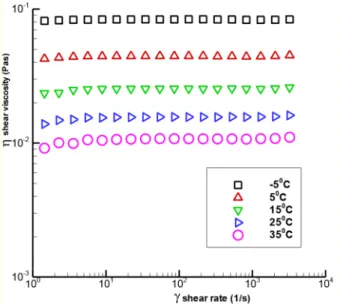
Within the range of temperature studied, -5˚C to 35˚C, ethylene glycol (EG) exhibits Newtonian
behavior, characterized by a constant viscosity with respect to shear rate, as shown in Fig. 1. Moreover, the viscosity of EG decreases with increasing temperature as expected. The impact of temperature
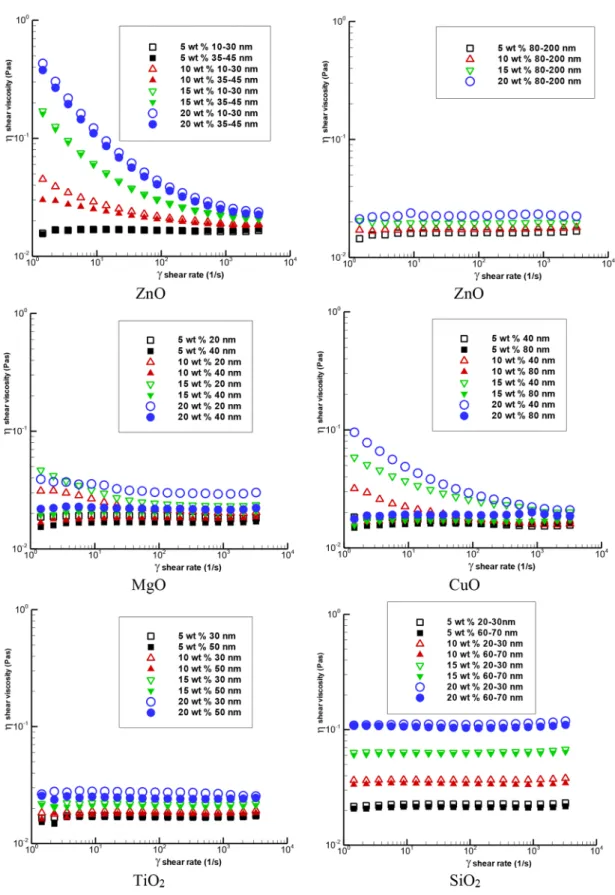
CuO and MgO are used. On the other hand, attractive forces between particles of TiO2 and SiO2 seem to be
insufficient to form aggregates, at least to a degree
necessary to result in non-Newtonian dispersions in the studied ranges of particle size and concentration. The results depicted in Fig. 2 also signify the crucial role of particle size and concentration on the rheology of the dispersions. Clearly, an increasing concentration of particles translates into stronger impact on the
flow behavior of the dispersions. Therefore, it is not
a coincidence that the non-Newtonian nature of ZnO/ EG, CuO/EG and MgO/EG dispersions becomes more pronounced at higher concentrations, as shown in Fig. 2. This trend is very strong for ZnO/EG and CuO/EG, while the overall change in the rheology of MgO/EG dispersions remains relatively modest. When large particles are used, e.g., 80-200 nm ZnO particles, no change in the dispersion viscosity is observed with respect to shear rate in the 5 to 20 wt % particle concentration range.
The aggregation tendencies of the dispersions can be used to infer their stability. The likelihood of dispersions with lower aggregation degree being stable may be higher than those with a stronger aggregation tendency. In this case, dispersions of ZnO/EG and CuO/EG may turn out to be the least stable among the investigated oxides. No abrupt variation in the
shear flow curves for all studied mass fractions may
suggest that there was no stability issue for all particle loadings during the experiments. We believe that
this point needs further clarification through stability
experiments in the future.
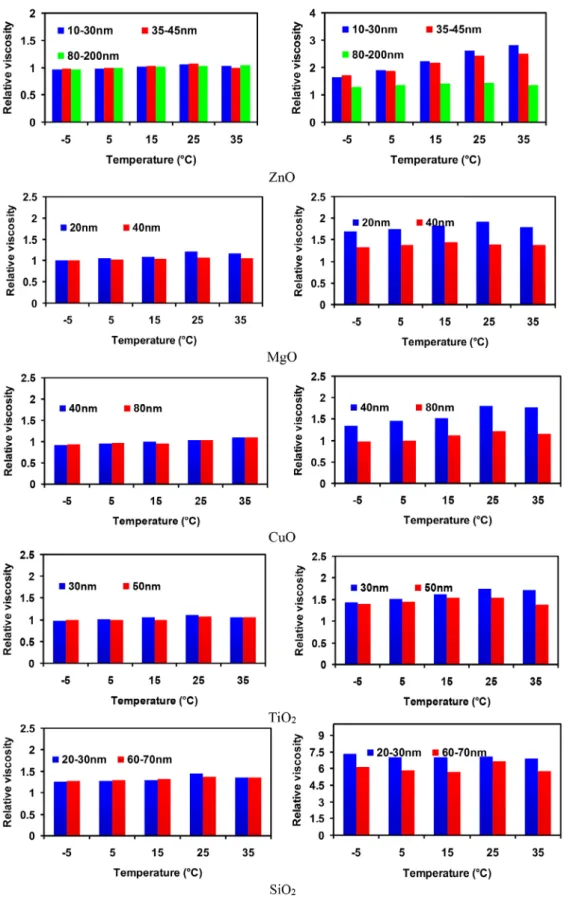
In order to clearly reveal the impact of particle loading on the rheology of the dispersions, the results in Fig. 2 are also presented in terms of relative viscosity in Fig. 3. Relative viscosity is the ratio between the
suspension and base fluid viscosities at a given flow
condition. Fig. 3 depicts the variation of the relative viscosity with respect to particle concentration and size and shear rate at 250C for the metal oxide dispersions
in ethylene glycol base fluid. The shear flow curves
in Fig. 2 show that suspensions containing ZnO, CuO and MgO nanoparticles exhibit non-Newtonian shear-thinning behavior. Hence, it is necessary to take the shear rate dependency of the relative viscosity into account. For this purpose relative viscosities of the
nanofluids are evaluated at shear rates of 100 s-1 and
1000 s-1 and then presented in Fig. 3. Similar to Fig.
2, an increase in relative viscosity at higher particle concentrations is captured in Fig. 3 for all particle
sizes. When the effect of the particle size is concerned, the figure clearly depicts an increasing trend in relative Figure 1. Shear viscosity versus shear rate for ethylene glycol as a function
of the temperature.
variation on viscosity becomes more pronounced at low temperatures.
The flow curves for shear dependent viscosity of the nanofluids containing five different metal oxide particles at 25˚C are shown in Fig. 2. Another
expected result is associated with particle size and
the concentration effect on the dispersion viscosity.
Smaller particles or higher particle loading translate into dispersions with higher viscosity. No such common feature is observed when the non-Newtonian behavior of the dispersions is considered. Earlier
studies on the shear flow curve of nanofluids indicated
that nanoparticle dispersions in Newtonian base
fluids exhibit either Newtonian or shear-thinning
behavior depending on the material, size, shape, particle concentration, temperature and type of the
base fluid (Mahbubul et al., 2012). Non-Newtonian feature of nanofluids can be attributed to the shear
induced breaking of the larger fractal-like aggregates
formed by sufficiently strong van der Waals forces
viscosity in the case of smaller nanoparticles for all
considered nanofluids. Impact of particle size becomes
apparent at particle mass concentrations equal to or greater than 10 %. Type of the metal oxide also
plays a role in the response of the nanofluid relative
viscosity to the variations in the particle size. For instance, minimum and maximum reduction in relative viscosity is observed for TiO2 and ZnO nanofluids, respectively. The particle size vs. relative dispersion viscosity results that are presented in Fig. 3 are in
agreement with most of the findings in earlier reports
in Table 1. The authors of the present study agree with the following account suggested by Timofeeva et al.
(2010) to explain the particle size effect on the relative
viscosity. At a given particle mass concentration, the relative viscosity increases with decreasing particle size due to higher interfacial area, favoring stronger
hydrodynamic interactions between solid and fluid
phases. Stronger hydrodynamic interactions in turn
result in higher resistance to flow or higher viscosity
compared to the dispersions of larger particles.
In Fig. 3, comparison between the relative viscosities at two distinct shear rates of 100 s-1 and
1000 s-1 reveals the shear thinning behavior for the
dispersions of ZnO, CuO and MgO in PE base fluid.
For the other metal oxides, i.e., TiO2 and SiO2, there is negligible, if any, variation in the relative viscosity underlying their Newtonian nature that is also depicted in Fig. 2.
Temperature is another important parameter
influencing viscosity of the nanofluids. In their review article on nanofluid viscosity studies, Mahbubul et al.
(2012) also considered the temperature dependence of
nanofluid viscosity. They pointed out that the viscosity of nanofluids decreases at elevated temperatures. It is
worthwhile to note that, in almost all of the studies
on the temperature effect, dispersion viscosity was
reported as opposed to the relative viscosity. Prasher et al. (2006) and Chen et al. (2007), on the other
hand, investigated the dependenc of the nanofluid
relative viscosity on temperature which turned out to
be very weak. Fig. 4 shows the temperature effect on
the relative viscosities of the dispersions of the metal
oxides for different particle sizes and loadings at the
shear rate of 100 s-1. The results are obtained by a series
of rheological measurements that were conducted
at temperatures ranging from -5˚C to 35˚C, with the increment of 10˚C. At low particle mass concentration,
5 %, relative viscosities remain nearly one, except for a modest increase in the case of TiO2 particles. With very limited impact of particles on the dispersion rheology, the relative viscosity becomes insensitive
to variations in both particle size and temperature,
as shown in the first column of Fig. 4 at low particle concentrations. On the other hand, at sufficiently
high particle loadings, such as 20 wt %, the relative
viscosity significantly increases for all metal oxide
dispersions within the studied range of experimental parameters. Furthermore, decreasing relative viscosities with increasing particle size are observed at 20 % particle concentrations. Only a small increase in the relative viscosities of ZnO/EG, CuO/EG and TiO2/ EG dispersions with respect to increasing temperature is observed, in spite of high particle loading, 20 wt %. Therefore, it can be concluded that temperature does
not play a significant role in the relative viscosity of
dispersion, a conclusion similar to those drawn in the earlier studies of Prasher et al. (2006) and Chen et al. (2007).
To further the rheological characterization of the suspensions, their yield stress properties were also
investigated. Fig. 5 shows logarithmic flow curves of
shear viscosity with respect to shear stress for ZnO (10-30 nm and 35-45 nm) and CuO (40 nm and 80 nm) nanoparticle dispersions in ethylene glycol up to 20 wt% concentration. The shear viscosity-stress curves in Fig. 5 suggest that the apparent yield stress gets stronger with decreasing particle size and increasing particle loading. Due to the observed shear thinning behavior and presence of apparent yield stress, the
shear rate dependence of the ZnO and CuO nanofluid
viscosities can be captured by the Herschel-Bulkley (HB) model. The model parameters that are predicted
by fitting to the experimental results are listed in Table
4 for the range of particle size and concentrations considered here. The predicted yield stress of ZnO
nanofluids increases as the particle size decreases,
particularly at the high particle loading, 20 wt%. The
flow behavior index, n, that indicates the degree of
dependence of viscosity on shear rate, is also tabulated in Table 4. The predicted values of n appear to be a weak function of particle size, as shown in Table 4.
Thixotropic behavior of the nanofluids was also
investigated by following the methodology suggested by Benchabane and Bakkour (2008). The results, not shown here, revealed no evidence of thixotropic behavior for any of the dispersions investigated in this study.
Finally, linear viscoelastic properties of the suspensions were examined in terms of creep test that measures time dependent deformation (Baek and Kim, 2011) by applying a shear stress of 0.05 Pa. Fig. 6
shows the creep compliance-time curve for nanofluids
Figure 5. Shear viscosity versus shear stress for dispersions including ZnO and CuO at 25oC.
Table 4. Variation of the predicted HB model parameters with respect to the particle size and mass percentage.
ZnO CuO
% mass 10-30 nm 35-45nm 40nm
20
τ0 (Pa) 0.6133 0.5293 0.1945
K 0.0436 0.0402 0.0272
n 0.9238 0.9272 0.9674
15
τ0 (Pa) 0.2745 0.2727 0.1385
K 0.0290 0.0276 0.0240
n 0.9586 0.9645 0.9778
J
J
J
J
100
120
120
240
D
=
Q
-Q
Q
V
V
V
(40 nm and 80 nm) nanoparticles at 20 wt% particle concentration. The compliance curves turned out to
be similar to those typical of viscous fluids with no
elasticity. Besides, the viscoelastic behavior of a
material can be quantified by calculating the recovery index ΔJ (Benchabane and Bekkour, 2008; Yapici et al., 2014) given in eq. (2). In this equation J(120) and J(240) refer to the values of the compliance at
the final recovery phase and at the final creep phase,
respectively.
(2)
A ΔJ value close to 100% is an indication a solid like structure, while decreasing values towards zero hint at increasing viscous material. The values of
ΔJ for ZnO and CuO nanofluids containing 20 wt%
particles are 0% indicating that the suspension exhibits
viscous fluid properties. Therefore, non-Newtonian
dispersions of ZnO and CuO do not appear to possess any gel structure that would otherwise manifest its presence through some degree of elasticity.
CONCLUSIONS
In this study effects of the nanoparticle size and
loading on the rheology of ethylene glycol based
nanofluids are presented. Nanoparticles of five different metal oxides were used over a 5-20 wt%
particle mass concentration range. The nanoparticles and their sizes are TiO2 (30 nm, 50 nm), MgO (20 nm, 40 nm), ZnO (10-30 nm, 35-45 nm, 80-200 nm), SiO2 (20-30 nm, 60-70 nm) and CuO (40 nm, 80 nm). All rheological measurements were carried out by a stress controlled rheometer equipped with a cone-and-plate
system over a temperature range from -5˚C to 35˚C.
The following conclusions can be drawn from the results of the measurements.
• The non-linear measurements reveal that among
the nanofluids considered, only suspensions
containing CuO (40 nm) and ZnO (10-30 nm, 35-45 nm) exhibit appreciable non-Newtonian shear thinning behavior at particle mass concentrations higher than 5 wt%. Moreover, weak shear thinning is observed for
the nanofluids of the smallest MgO particles (20 nm). These findings indicate that shear-thinning behavior of nanofluids depends on the
type of the material, particle diameter, as well as particle mass concentration.
• Formation and shear induced breaking of
aggregates play a significant role in the shear
thinning behavior of the dispersions.
• At a given particle mass concentration, an increase in dispersion viscosity is observed when smaller particles are used. This is most likely due to the stronger hydrodynamic interaction between the solid and liquid phases associated with the higher interfacial area provided.
• For all nanofluids considered in the present study, the relative viscosity decreases with increasing particle sizes. This reduction in relative viscosity becomes stronger at particle mass concentrations higher than 5 wt%. In addition, the decay ratio of relative viscosity with particle size is dependent on the particle material type.
• Temperature variations have a limited effect on the relative viscosity of the suspensions.
• The shear viscosity measurements indicate the presence of an apparent yield stress for
nanofluids of CuO and ZnO nanoparticles. The
magnitude of the yield stress is observed to be dependent on both size and concentration of the nanoparticles.
• Among the nanofluids considered, no evidence of thixotropic behavior is observed at any particle concentrations.
• The results of the linear viscoelastic measurements do not suggest any elasticity or hence formation of a gel structure in any of the
investigated nanofluids.
ACKNOWLEDGEMENT
The authors would like to gratefully acknowledge
the funding from Scientific Research Project Fund
of Cumhuriyet University under the project number M-490.
REFERENCES
Anoop, K.B., Sundararajan, T., Das, S.K., Effect
of particle size on the convective heat transfer in
nanofluid in the developing region, International
Journal of Heat and Mass Transfer, 52(9-10), 2189-2195 (2009).
Benchabane, A. and Bekkour, K., Rheological properties of carboxymethyl cellulose (CMC) solutions, Colloid and Polymer Science, 286 1173-1180 (2008).
Chang, H., Jwo, C.S. Lo., C.H. Tsung, T.T. Kao, M.J. Lin, H.M., Rheology of CuO nanoparticle suspension prepared by ASNSS, Rev. Adv. Mater. Sci., 10 128-132 (2005).
Chen, H., Ding, Y., Tan, C., Rheological behaviour of
nanofluids, New Journal of Physics, 9, 367 (2007).
Chevalier, J., Tillement, O. Ayela, F., Rheological
properties of nanofluids flowing through
microchannels, Applied Physics Letters, 91, 233103 (2007).
Eastman, J.A., Choi, S.U.S., Li., S. Yu, W. Thompson,
L.J., Anomalously increased effective thermal conductivities of ethylene glycol-based nanofluids
containing copper nanoparticles, Applied Physics Letter, 78 718-720 (2001).
He, Y., Jin, Y. Chen, H. Ding, Y. Cang, D. Lu, H., Heat
transfer and flow behaviour of aqueous suspensions
of TiO2 nanoparticles (nanofluids) flowing upward through a vertical pipe, International Journal of Heat and Mass Transfer, 50 2272-2281 (2007). Mahbubul, I.M., Saidur, R., Amalina, M.A., Latest
developments on the viscosity of nanofluids,
International Journal of Heat and Mass Transfer, 55 874-885 (2012).
Namburu, P.K., Kulkarni, D.P. Dandekar, A. Das, D.K., Experimental investigation of viscosity and
specific heat of silicon dioxide nanofluids, Micro &
Nano Letters, 2 67-71 (2007).
Nguyen, C.T., Desgranges, F., Roy, G., Galanis, N., Maré, T., Boucher, S., Angue Mintsa, H., Temperature and particle-size dependent viscosity
data for water-based nanofluids - Hysteresis
phenomenon, International Journal of Heat and Fluid Flow, 28(6) 1492-1506 (2007).
Pastoriza-Gallego, M.J., Casanova, C., Legido, J.L.,
Piñeiro, M.M., CuO in water nanofluid: Influence
of particle size and polydispersity on volumetric behaviour and viscosity, Fluid Phase Equilibria, 300(1-2), 183-196 (2011).
Prasher, R., Song, D., Wang, J., Phelan, P., Measurement
of nanofluid viscosity and its implications for
thermal applications, Applied Physics Letters, 89(13), 133108 (2006).
Rudyak, V.Y., Viscosity of nanofluids-Why it is not
described by the classical theories, Advances in Nanoparticles, 2 266-279 (2013).
Rudyak, V.Y., Dimov, S.V., Kuznetsov, V.V. and Bardakhanov, S.P., Measurement of the viscosity
coefficient of an ethylene glycol-based nanofluid
with silicon di-oxide particles, Doklady Physics, 58 173-176 (2013).
Shanker, N.S., Reddy, M.C.S., Basava Rao, V.V., On
prediction of viscosity of nanofluids for low volume
fraction of nanoparticles, International Journal of
Engineering Research & Technology, 1 1-10 (2012).
Taylor, R., Coulombe, S., Otanicar, T., Phelan, P., Gunawan, A. Lv, W., Rosengarten, G., Prasher, R., Tyagi, H., Small particles, big impacts: A review of
the diverse applications of nanofluids, Journal of
Applied Physics, 113, 011301 (2013).
Timofeeva, E.V., Smith, D.S., Yu, W., France, D.M. Singh, D., and Routbort, J.L., Particle size and
interfacial effects on thermo-physical and heat transfer characteristics of water-based α-SiC nanofluids, Nanotechnology, 21(21), 215703
(2010).
Wong, K.V., Leon, O.M., Application of nanofluids:
current and future, Advances in Mechanical Engineering, 2, 519659 (2010).
Xuan, Y., Li, Q., Investigation on convective heat
transfer and flow features of nanofluids, Journal of
Heat Transfer, Transaction of the ASME, 125 151-155 (2003).
Yapici, K., Cakmak, N.K., Ilhan, N., Uludag, Y., Rheological characterization of polyethylene glycol based TiO2 nanofluids, Korea-Austrialia Rheology Journal, 26 335-363 (2014).
Zhao, J.F., Luo, Z.Y., Ni, M.J., Cen, K.F., Dependency
of nanofluid viscosity on particle size and pH value,