Analysis of β´(Cu
4Ti) Precipitation During Isothermal Aging of a Cu-4wt.%Ti Alloy
Victor Manuel Lopez-Hirataa* , Felipe Hernandez-Santiagoa, Maribel Leticia Saucedo-Muñoza,
Hector Javier Dorantes-Rosalesa, Ana Maria Paniagua-Mercadoa
Received: February 17, 2018; Revised: May 10, 2018; Accepted: July 04, 2018
This work analyzed experimental and numerically the growth kinetics of β´precipitation of a Cu-4wt.%Ti alloy after aging at 400, 500 and 600 °C for times from 0.0166 h to 200 h. Results indicated that the precipitation process is almost controlled by nucleation and growth during aging at 400 °C,
originating a slow growth kinetics of precipitation. In contrast, the coarsening of precipitates dominates
the precipitation process during aging at 500 and 600 °C. The interfacial energy of interface between the a matrix phase and β´ precipitates was determined to be about 0.1135, 0.0980 and 0.0725 Jm-2 for aging at 400, 500 and 600 °C, respectively. These values suggest a coherent interface which is in agreement with the flat faces of β´ cuboid precipitates. Calculated Time-Temperature-Precipitation diagram for the β´ precipitation indicated good agreement with experimental results. Precipitation
hardening was higher for the slower growth kinetics of precipitation.
Keywords: Cu-Ti alloys, precipitation, growth kinetics, numerical simulation.
*e-mail: [email protected].
1. Introduction
Cu-Ti alloys are prone to have precipitation hardening
after isothermal aging for alloy compositions of about
1-5wt.% Ti1-4. Age-hardenable Cu-Ti alloys have high tensile strength and good formability and they are used as connector materials in electronic and electrical components5,6;
nevertheless, its conductivity is less than the half of that
corresponding to Cu-Be alloys. Therefore, the application of Cu-Ti alloys has been focused on mechanical properties. In order to obtain good mechanical properties, Cu-Ti alloys are solution treated above 800 ºC and then quenched and the aging process is carried out at temperatures of 400-500 ºC. As a result of aging, the fcc Cu-rich supersaturated solid
solution decomposes spinodally to form a disordered fcc
Ti-rich phase and then become order to form the metastable tetragonal β´Cu4Ti phase which is responsible for the good
mechanical properties of these alloys1,7,8. After prolonged
aging, the cellular precipitation of the stable orthorhombic
β Cu4Ti phase takes place by nucleation and growth on
grain boundaries which is the main cause for the decrease in the mechanical strength in the later stage of aging1. The
mechanical strength of Cu-Ti alloys has been improved either by the addition of a third alloying element such as Chromium,
zirconium, carbon, nitrogen or hydrogen9-11 or by using cold work previously to the aging treatment12,13. In the former case,
the precipitation sequence was similar to that observed in the binary alloy; however, the presence of a different precipitates
such as titanium chromide, nitride, carbide or hydride was also reported to occur during aging9-11. In the latter case, the
cold work, used after solution treatment and quenching, has
been reported12,14 to promote the precipitation of titanium on
dislocations and to inhibit the precipitation of the β´ Cu4Ti
and β Cu4Ti phases during aging.
Recently, TC-PRISMA software has been used to analyze the precipitation process of different aged alloys15. This
software is based on the solution of the Langer-Schwartz (LS) and modified LS (MLS) theories and the Kampmann and Wagner numerical model (N model)16, and it has been
used to analyze the precipitation kinetics of different phases
during aging in steels and nonferrous alloys16-18. This software permits, for example, to determine the size, distribution size, density number and composition of precipitated phases, as
well as the Time-Temperature-Precipitation (TTP) diagram
in multiparticles, multiphases and multicomponents alloy
systems. Besides, the nucleation site can be selected among
grain boundaries, bulk and dislocations. Thus, the use of
Thermo-Calc PRISMA would be a good alternative to complement the precipitation analysis of β´phase in the aged Cu-Ti alloys.
Thus, the purpose of this work is to study experimental
and numerically the growth kinetics of β´phase precipitation in an isothermally aged Cu-4wt. % Ti alloy in order to obtain the Time-Temperature-Precipitation (TTP) diagrams, as well as the determination of the interfacial energy between the α matrix and β´precipitates.
2. Experimental Method
A Cu-4wt.% Ti alloy was melted with an electric furnace using 99.99 % purity titanium and 99.999 % purity copper
in an alumina crucible under an argon gas atmosphere.
The alloy ingot was homogenized at 950 ºC for one week
aEscuela Superior de Ingeniería Química e Industrias Extractivas (ESIQIE), Instituto Politecnico
and subsequently cold rolled to obtain plate specimens of about 30 x 10 x 5 mm. These specimens were encapsulated in air-evacuated and Ar gas filled quartz tube and then solution treated at 900 ºC for 1 h in an electrical resistance furnace, and subsequently quenched in ice-water in order
to obtain solution treated specimens. These specimen were
aged at temperatures of 400, 500 and 600 ºC for times up to 200 h. The Transmission Electron Microscope (TEM) disc specimens of approximately 3 mm were thinned using the twin-jet electropolishing technique in a solution of 75 vol. % methanol and 25 vol. % nitric acid at -60 ºC. TEM specimens were mounted on a Be-specimen holder and observed with a TEM JEM-2000FX-II at 200 kV, equipped with a Noran EDXS. Vickers hardness test was determined
in all the heat treated specimens using 10 determinations with 500 g and 12 s.
3. Numerical Method
Thermo-Calc software was used to analyze the stability
of phases and the coarsening constant and interfacial energy
γ between matrix and precipitates. Likewise, the analysis of precipitation was pursued in the aged Cu-4wt. % Ti alloy employing the Thermo-Calc (TC) PRISMA software. The
kinetic and thermodynamic data was determined from the
Thermo-Calc databases for CUDEMO and MCUDEMO15. A
homogeneous nucleation was assumed for the precipitation simulation in the austenite matrix, named bulk nucleation
in TC-PRISMA. The precipitate shape was considered to be cuboid considering a cube elastic-strain energy for the α phase matrix and precipitate with the following elastic
constants: c11= 168.4 GPa, C12=121.4 GPa and c44=75.4 GPa.
4. Results and Discussion
a) Temporal Evolution of Precipitation
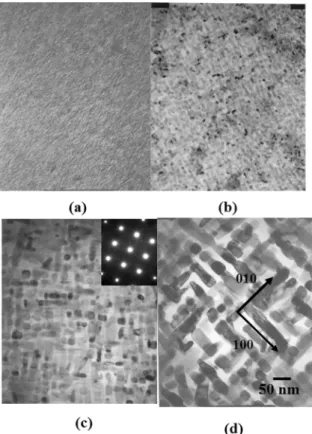
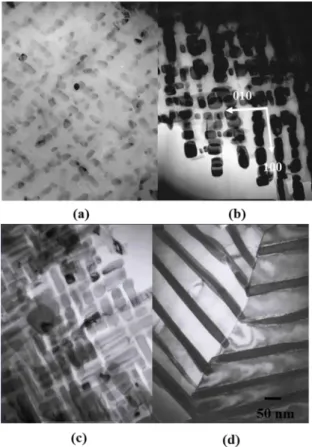
The temporal evolution of precipitation of β´ phase in the Cu-rich α phase matrix is illustrated in the Bright-Field (BF) Transmission Electron Micrographs corresponding to the Cu-4wt.%Ti alloy aged at 400, 500 and ºC for different times, as shown in Figs. 1-3, respectively. The β´ precipitates
has a cuboid morphology and they are aligned on the <100>
direction of the α phase matrix for all aging temperatures because of its low value of elastic-strain energy7,19. As aging progresses, the morphology changes to plates also aligned
with respect to the matrix phase, Figs. 1(d), 2(d) and 3 (c). The electron diffraction pattern, shown in Fig. 1 (c), indicates clearly the presence of supereflections spots between those corresponding to the matrix phase which confirms that the β´phase has a Cu4Ti crystalline structure. Table 1 shows the
average equivalent radius and its corresponding dispersion error determined for the β´precipitates after aging at 400, 500 and 600 ºC for different times. An increase in precipitate
Figure 1. BF-TEM micrographs of Cu-4wt. % Ti alloy aged at
400 °C for (a) 5 h, (b) 25 h, includes its corresponding electron diffraction pattern, (c) 100 h and (d) 200 h.
Figure 2. BF-TEM micrographs of Cu-4wt.%Ti alloy aged at 500
radius can be noted with aging time and temperature. The
discontinuous or cellular precipitation of the β´phase can be noted clearly for the alloy specimen aged at 600 ºC, Fig. 3 (d). This type of precipitation was also observed to be present after aging at 400, 500 and 600 ºC for 100, 0.5
and 0.166 h, respectively
b) Thermo-Calc analysis of precipitation
The Thermo-Calc calculated amount of all phases
versus temperature is shown in Fig. 4. This plot indicates
clearly that the α and β´phases are present at temperatures between 500 and 840 ºC. This figure also suggests that the
precipitation reaction:
(1)
It may occur after aging at those temperatures. The
volume fraction of β´precipitates increases with the decrease
in temperature.
Table 2 shows the Thermo-Calc calculated values of interfacial energy for the interface of α matrix and β´ precipitate. This value decreases with the increase in
temperatures, as expected in the case of free energy due to the increase in entropy16. The magnitude order, 0.03 Jm-2,
suggests a coherent interface20. This table also indicates the
values of coarsening constant k for 400, 500 and 600 ºC. Unsurprisingly, this parameter increases with temperature because of the increase in atomic diffusion16.
c) Thermo-Calc PRISMA analysis of precipitation
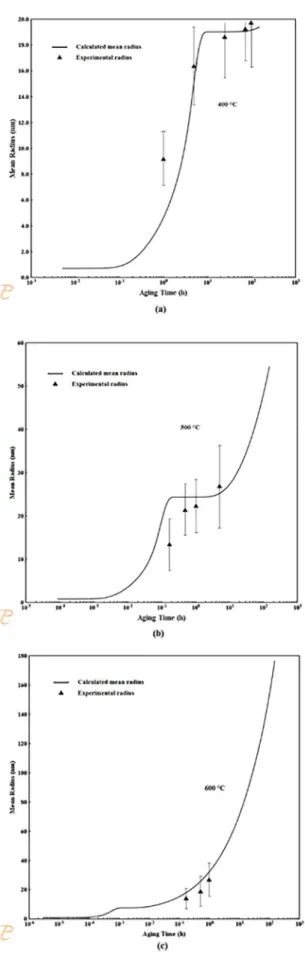
The experimental and calculated variation of equivalent radius for β´ precipitates with time are shown in Figs. 5 (a-c) for the Cu-4wt. % Ti alloy aged at 400, 500 and 600 ºC. The
continuous line and triangle points correspond to the calculated and experimental values, respectively. The error bar of
radius measurements is also shown in Figs. 5 (a-c) which
indicates, in general, a good agreement between calculated and experimental values. This plot of shows clearly three characteristic stages: a continuous and slow increase in
precipitate radius for short aging times, Fig. 5(a), because
of the rise of nucleation rate with time. The number density
Table 1. Variation of precipitate equivalent radius with time for
aging at 400, 500 and 600 ºC
Time (h) Radius (nm)
400 ºC 500 ºC 600 ºC
0.166 --- 13.3±5.0 14.1±4.0
0.5 --- 21.4±6.0 18.8±7.1
1 9.2±2.5 22.06±8.2 26.6±9.0
5 16.3±2.9 26.8±10.1
---25 18.6±3.2 ---
---100 19.8±5.1 ---
---200 22.2±6.0 ---
---Figure 3. BF-TEM micrographs of Cu-4wt.%Ti alloy aged at 600
°C for (a) 0.0166 h, (b) 0.166 h, (c) 1 h and (d) 5 h.
Figure 4. Thermo-Calc calculated plot of amount of all phases
versus temperature.
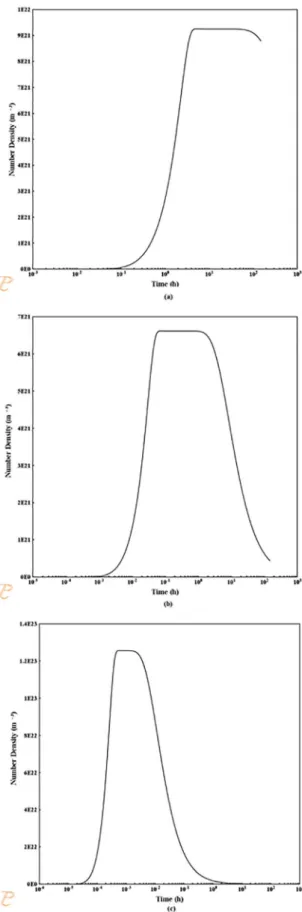
of precipitates also increases with aging time, as shown
in Fig. 6(a). Then, the radius increases more rapidly after
1 h of aging time, following a parabolic law of t1/2 which can be attributable to the growth stage. The nucleation
rate subsequently becomes zero because either the solute
sss
"
supersaturation turns into zero or all nucleation sites are used16,21. As a result of this, the number density and the
precipitate radius remain constant, as shown in Fig. 6(a-c) and 5 (a), respectively. As aging progresses, the number
density starts decreasing with time, following a t-1 power law, and the growth kinetics of precipitate radius with time
follows a slope of 1/3, t1/3. That is, the growth kinetics corresponds to the coarsening stage of precipitates and it
follows the Lifshitz-Slyozov-Wagner theory for
diffusion-controlled theory16. According to the previously mentioned
explanation, most of the experimental points for the growth
kinetics of precipitates at 400 ºC are located in the nucleation
and growth stage, while the experimental points at 500 and
600 ºC corresponds to the coarsening stage. It is important to mention that the interfacial free energy γ was changed in order to find the best fit of experimental values with the
calculated curves. They are shown in Table 2 and decrease as aging temperature increases. These values are higher
than the Thermo-Calc determined ones. The low values calculated by Thermo-Calc can be attributed to the fact that
the calculation of interfacial energy uses thermodynamic data and assumes a complete coherent interface; however, the interfacial energy is also dependent on several factors
such as crystallographic misorientation, elastic misfit strains,
degree of coherency, and solute segregation21, which may
cause higher energy values. These values between 0.07 and 0.11 Jm-2 show are in good agreement with the values
of 0.1-0.2 Jm-2 reported for coherent β´ precipitates in the literature7,17,22, and it suggests that the interface between
matrix and precipitates should be coherent20, which is in
agreement with the cuboid morphology of β´ precipitates, as shown in Figs. 1-3.
The TC-PRISMA calculated Time-Temperature-Precipitation TTP diagram of the Cu-4wt. % Ti alloy is shown in Fig. 7. This was calculated using an average value of 0.0946 Jm-2 determined from the experimental ones shown in Table 2.
This figure shows that the fastest precipitation kinetics corresponds to an aging at about 500 ºC for 0.01 h. This figure
also includes the TEM micrographs for the alloy specimens
aged at 400 ºC for 5 h, and 500 and 600 ºC for 0.166 and 1 h. These TEM images suggests that the start of β´ precipitation is very similar for aging at 500 and 600 ºC which is in good
Table 2. Thermo-Calc calculated interfacial energy between
precipitate and matrix and coarsening constant, and experimental interfacial energy for aging temperatures
Thermo-Calc Experimental
T (ºC) γ (Jm-2) k (m3s-1) γ (Jm-2)
400 0.0339 1.1041 x 10⁻³¹ 0.1135
500 0.0325 2.2334 x 10⁻²⁹ 0.0980
600 0.0309 1.2776 x 10⁻²⁷ 0.0725
Figure 5. TC-PRISMA calculated plot of mean radius of β´
agreement with the growth kinetics of precipitation shown
in the calculated TTP diagram. Nevertheless, the growth kinetics of precipitation at 400 ºC is much faster than that
detected experimentally, Fig. 1. This can be attributable to
the constant value of interfacial energy, 0.0946 Jm-2, used for the present calculation. That is, the energy value should
be higher at 400 ºC which might cause a higher activation energy for nucleation and consequently the nucleation rate
would be expected to be slower20 than that of the TTP diagram.
d) Aging curves
Figure 8 shows the aging curves, plot of hardness as
a function of aging time, for the Cu-4wt. % Ti alloy aged at 400, 500 and 600 ºC. The aging curves corresponding to 500 and 600 ºC show an increase in hardness, then the hardness peak is reached and finally this decreases as a result
of the discontinuous precipitation and coarsening process
Figure 6. TC-PRISMA calculated plot of number density of β´
precipitate versus time for Cu-4wt.%Ti alloy aged at (a) 400 ºC, (b) 500 ºC and (c) 600 ºC.
Figure 7. TC-PRISMA calculated TTP diagram.
Figure 8. Aging curves of Cu-4wt. % Ti alloy aged at 400, 500
of precipitates. In contrast, aging at 400 ºC presents a slow increase in hardness and the hardness peak, 370 VHN, is
obtained after aging for 200 h, not shown in Fig. 8. The highest and lowest hardness peaks correspond to the alloy
specimens aged at 400 ºC and 600 ºC. The hardness peaks of aging at 500 and 600 ºC were reached more rapidly than that at 400 ºC which agrees very well with the faster
growth kinetics of precipitation, as shown in the calculated
TTP diagram.
5. Conclusions
The numerical and experimental analysis of β´ precipitation during aging at 400, 500 and 600 ºC permitted to state the
following conclusions:
1. The numerical analysis of precipitation indicated that the nucleation and growth stage is dominant
during aging at 400 ºC, while the precipitation during aging at 500 and 600 ºC is mainly controlled
by the coarsening stage.
2. The interfacial energy between matrix and precipitates
was determined to be about 0.1135, 0.0980 and
0.0725 Jm-2 for aging at 400, 500 and 600 ºC, respectively, which is agreement with the coherent
interface of cuboid β´ precipitates.
3. Calculated TTP diagram showed a good concordance
with the experimental results. The slowest growth
kinetics at 400 ºC promoted the highest precipitation
hardening, while the fastest kinetics causes the lowest hardness.
6. Acknowledgements
The authors wish to acknowledge the financial support from Conacyt and SIP-IPN.
7. References
1. Soffa WA, Laughlin DE. High-strength age hardening
copper-titanium alloys: redivivus. Progress in Materials Science.
2004;49(3-4):347-366.
2. Semboshi E, Inamoto E, Iwase A. Age-hardening behavior of a single-crystal Cu-Ti alloy. Materials Letters. 2014;131:90-93. 3. Nagarjuna S, Srinivas M, Balasugramanian K, Sarma DS. On the
variation of mechanical properties with solute content in Cu-Ti
alloys. Materials Science and Engineering: A. 1999;259(1):34-42.
4. Nagarjuna S, Balasubramanian K, Sarma DS. Effect of Cold Work on Precipitation Hardening of Cu-4.5 mass % Ti Alloy. Metallurgical Transactions. 1995;36(8):1058-1066. 5. Nagarjuna S, Balasubramanian K, Sarma DS. Effect of prior
cold work on mechanical properties and structure of an
age-hardened Cu-1.5wt % Ti alloy. Journal of Materials Science.
1997;32(13):3375-3385.
6. Saji S, Hornbogen E. Combined recrystallization and precipitation
reactions in Cu-4%Ti alloys. Zeitschrift fur Metallkunde.
1978;69:741-746.
7. Hernandez-Santiago F, Cayetano-Castro N, Lopez-Hirata VM, Dorantes-Rosales HJ, Cruz-Rivera JJ. Precipitation
Kinetics in a Cu-4 mass % Ti Alloy. Materials Transactions.
2004;45(7):2312-2315.
8. Hameda AA, Blaz L. Microstructure of hot deformed Cu-3.45wt
% Ti alloy. Materials Science and Engineering: A. 1998; 254:
83-89.
9. Ikeda J, Semboshi S, Iwase A, Gao W, Sugawara A. Precipitation Behavior and Properties of Cu-Ti Alloys with Added Nitrogen. Materials Transactions. 2015;56(3):297-302.
10. Semboshi S, Nishida T, Numakura H. Microstructure and mechanical properties of Cu-3 at. % Ti alloy aged in a hydrogen
atmosphere. Materials Science and Engineering: A.
2009;517(1-2):105-113.
11. Wang F, Li Y, Wakoh K, Koizumi Y, Chiba A. Cu-Ti-C alloy
with high strength and high electrical conductivity prepared
by two-step ball-milling processes. Materials and Design.
2014;61:70-74.
12. Markandeya R, Nagarjuna S, Sarma DS. Precipitation hardening
of Cu-Ti-Cr alloys. Materials Science and Engineering: A.
2004;371(1-2):291-305.
13. Donoso E. Influence of cobalt and chromium additions on the
precipitation processes in a Cu-4Ti alloys. Revista de Metalurgia.
2010;46(6):542-547.
14. Nagarjuna S, Srinivas M. Grain refinement during high
temperature tensile testing of prior cold worked and peak aged
Cu-Ti alloys: Evidence of superplasticity. Materials Science and Engineering: A. 2008;498(1-2):468-474.
15. Thermo-Calc Software. Cudemo-Mocudemo. In: Thermo-Calc Software Package Version 2017b. Solna: Thermo-Calc Software;
2017.
16. Kostorz G, ed. Phase Transformations in Materials. Weinheim:
Wiley-VCH; 2001.
17. Saucedo-Muñoz ML, Ortiz-Mariscal A, Lopez-Hirata VM, Villegas-Cardenas JD, Soriano-Vargas O, Avila-Davila EO. Precipitation analysis of as-cast HK40 steel after isothermal
aging. International Journal of Minerals, Metallurgy and Materials. 2017;24(10):1125-1133.
18. Costa e Silva A, Nakamura L, Rizzo F. Application of
computational modelling to the kinetics of precipitation of aluminum nitride in steels. Journal of Mining and Metallurgy, Section B: Metallurgy. 2012;48(3):471-476.
19. Hernandez-Santiago F, Lopez-Hirata VM, Saucedo-Muñoz ML, Dorantes-Rosales HJ. Gibbs-Thomson relationship for
the precipitation in Cu-Ti Alloys. Materials Characterization.
2007;58(3):303-306.
20. Porter DA, Easterling KE. Phase Transformations in Metals and Alloys. New York: Chapman and Hall; 1992.
21. Janssens KGF, Raabe D, Kozeschnik E, Miodownik MA, Nestler
B. Computational Material Engineering. London: Academic
22. Miyazaki T. A New Evaluation Method of Phase Decomposition by Utilizing the Macroscopic Composition Gradient in Alloys.