CUIDADO É FUNDAMENTAL
UNIVERSIDADE FEDERALDO ESTADODO RIODE JANEIRO. ESCOLADE ENFERMAGEM ALFREDO PINTO
R E V I S T A O N L I N E D E P E S Q U I S A
PESQUISA
CUIDADO É FUNDAMENTAL
UNIVERSIDADE FEDERALDO ESTADODO RIODE JANEIRO. ESCOLADE ENFERMAGEM ALFREDO PINTO
DOI: 10.9789/2175-5361.2017.v9i4.946-954
DOI: 10.9789/2175-5361.2017.v9i4.946-954 | Azevedo C; Amaral ALM | Aesthetic trials: taking care of oneself, of the other...
Aesthetic trials: taking care of oneself, of the other and of the
environment in which we live
Experimentações estéticas: o cuidado de si, do outro e do ambiente em
que vivemos
Ensayos estéticos: el cuidado de sí mismo, de unos a otros y del entorno
en que vivimos
Cláudio Azevedo1, Augusto Luis de Medeiros Amaral2
How to quote this article:
Azevedo C, Amaral ALM. Aesthetic trials: taking care of oneself, of the other and of the environment in which we live. Rev Fun Care Online. 2017 out/dez; 9(4):946-954. DOI: http://dx.doi.org/10.9789/2175-5361.2017.v9i4.946-954
ABSTRACT
Objective: to present an intervention-research developed by the authors in the form of artistic and educational
activities, called aesthetic experiments, analyzing them and their effects as a practical-theoretical set focused on oneself, to the other and to the environment. Methods: it was built from the authors’ experience with research practices inspired by studies of The Three Ecologies and Socialpoetics methodology, being used in the analysis the face-to-face writing of the participants during the workshop and their answers to the questions sent by e-mail. Results: they point to the overcoming of their inner fears and the discovery of personal potentialities to face challenges; the sensibility of the look and the involvement with the other as a fundamental element in the exercise of confidence in daily relationships. Conclusion: the experimentation process indicates that there is a power in the meeting, the exchange and the sensibility when we privilege knowledge that is learned with the body in motion, relating to the other and to the world.
Descriptors: Aesthetic trials; Body; Environmental Intervention.
RESUMO
Objetivo: Apresentar a pesquisa-intervenção desenvolvida pelos autores em forma de atividades artístico-pedagógicas, denominadas
experimentações estéticas, analisando as mesmas e seus efeitos enquanto conjunto prático-teórico voltado ao cuidado de si, do outro e do
ambiente. Métodos: Construído a partir da experiência dos autores com práticas de pesquisa inspiradas nos estudos sobre As Três Ecologias e na metodologia Sociopoética, sendo utilizada na análise a escrita presencial dos participantes durante as oficinas e as respostas dos mesmos às questões enviadas por e-mail. Resultados: Apontam para a superação dos medos internos e a descoberta das potencialidades pessoais para enfrentar desafios. A sensibilidade do olhar e o envolvimento com o outro como elemento fundamental no exercício de confiança das relações cotidianas. Conclusão: O processo de experimentação indica que existe uma potência do encontro, dos intercâmbios e da
1 Doctor and Master in Environmental Education from the Federal University of Rio Grande - FURG (2013); degree in Visual Arts
from FURG (2005); and Post-Doctor in Visual Arts UFPel (2016). Professor at the Visual Arts Courses and the Post-Graduate Program in Visual Arts at UFPel.
2 Doctor in Environmental Education from the Federal University of Rio Grande - FURG (2013); Master in Physical Education from
the Federal University of Pelotas UFPel (2009); and degree in Social Sciences from UFPel (2003). Fellowships new doctor from the National Program Postdoctoral PNPD/CAPES, working as a researcher, developer teacher and advisor at the Graduate Program in Environmental Education FURG.
sensibilidade quando privilegiamos um conhecimento que se apreende com o corpo em movimento, relacionando-se com o outro e o mundo.
Descritores: Experimentações estéticas, corpo, intervenção socioambiental.
RESUMEN
Objetivo: presentar la investigación-intervención desarrollada por los autores en forma de actividades artísticas y educativas, llamadas experimentos estéticos, analizandolos y a sus efectos enquanto un conjunto práctico-teórico dirigido al cuidado de sí, de los demás y del medio ambiente. Métodos: construido a partir de la experiencia de los autores con las prácticas de investigación inspiradas en los estudios acerca de Las Tres Ecologías y en la metodología Sociopoética, siendo utilizados en el análisis los registros por escrito de los participantes durante el taller y las respuestas de los mismos a las preguntas enviadas por e-mail. Resultados: indica la superación de los miedos internos y el descubrimiento del potencial personal para enfrentar los desafíos. La sensibilidad del ojo y la implicación con el otro como un elemento fundamental en el ejercicio de la confianza de las relaciones cotidianas.
Conclusión: el proceso de experimentación indica que hay una potencia3
de lo encuentro, de los intercambios y de la sensibilidad cuándo es privilegiado un conocimiento que se capta con el cuerpo en movimiento, en relación con los demás y el mundo.
Descriptores: Experimentos estéticos; Corpo; Intervención Socioambiental.
INTRODUCTION
The present article was developed from a research-intervention, inspired by the Sociopoetic approach¹-², a
method in which, rather than applying a procedure, one needs to create a path by walking it, while the researcher is open to the unexpected and track some steps strictly defined. The Three Ecologies³ and the Institutional Analysis
are also research supports studies.4 The approaches are
complementary and propose self-management processes and self-analysis groups in the production of shared knowledge. What will be described below are the steps started in two days, with an approximate total duration of twelve hours, combining practical and theoretical reflections, as well as some of the consequences of activities undertaken by the group, formed by coordinators, called facilitators, and others who participate in activities via voluntary agreement. In order to meet the comission placed by the demands of the contracting institution, the agents, authors, facilitators of social and environmental intervention process organize a series of activities entitled aesthetic trials - aimed at taking care of oneself, of others and of the environment. In these activities, developed in workshop-form in the intervention field, they use several resources, including: air-conditioned room with adequate heating and insulated structures, stereo, video camera, computer, blackboard, mats, A4 sheets, pens, fruits and various seasonings, cosmetics, containers with ice cubes and hot water.
3 Intervention Field is the "perimeter that will delimit the space in
which strategies, logistics, tactics and techniques will be planned and executed which, in turn, must operate in this specific scope to transform it according to the proposed goals. It is in close dependence on the field of analysis, from which it will be understood, thought out. It only intevenes when one understands it, and one understands it as one intervenes." 5:140
METHODS
Part I: relaxation technique for the body and
the production of knowledge.
After the environmental spatial organization where the intervention takes place, a brief presentation circle is done before the start of the relaxation activity. By being open to everything that emerges from the field analysis,4 facilitators
seek to be aware of the skills and abilities reported in this step, as well as in informal talks before the workshop. If the following image (Figure 1), the body stretching was conducted by a physical education teacher, workshop participants invited by the facilitators.
Figure 1 – relaxation led by Flavio Alves, first day.
Source: collection of the research group.
The group members are instructed not to perform by only saying who they are, but also expressing who they want to become, for example, who would like to transform themselves in the near or distant future. Soon after, there are some considerations, an anthropological one, about the importance of the human being becoming what is not yet, reinventing yourself in line with the demands and lived events. Further reflection is requested (meditate/mute) to scour the deepest feelings, the strongest wills in search of courage, self-assurance and forcefulness of each one, i.e. certain capacities that accompany the human since ancient times, allowing the species to perpetuate to this day.
It is not about searching universal psychic structures or understanding mental phenomena from a repository of symbols and meanings, but to open up and allow the body to be crossed by certain forces that accompany human since time immemorial, previous history and language.
4 By Analysis Field, it is understood “the perimeter chosen as object
to apply the conceptual apparatus available to understand the field of intervention ... This conceptual apparatus may consist of very heterogeneous theoretical materials, depending on its efficiency to make the ‘reading’ of the field of intervention“.5:139-140
Anyhow, it is already stated in the first moments of aesthetic trials that it takes a strong desire to access becomings and develop a more sensitive and careful perception in relation to ourselves (Mental Ecology), others (Social Ecology) and the world (Environmental Ecology) around us. The workshop is presented as a intersected process of sensations, emotions, feelings, perceptions that feeds itself by the search processes and individual trajectories of the group itself, in order to broaden the knowledge of themselves from the expansion of the constellation of relationships lived by each one , while the senses are triggered in an unusual way so that they experience other dimensions of human relations (with oneself, with another and the environment), depriving the vision and using the other senses, in Part I, and exploring other ways of looking, touching, feeling and perceiving in Part II.
After the presentation a relaxation activity with incense burning (palo santo5) and use of rattles6 (one emits sounds
of water) are carried out, while some predefined songs are played in the background, among which: Osho New Age - Tibetan Meditation Bells; Deva Premal - The Essence; and Yaël Naim - Yashanti with sounds of birds singing, running water and other sounds of nature.
Aesthetic trials function as the device that combines visual aids with techniques used in sociopoetic and training of actors. They have as a goal to provide access to certain immemorial memories, remote desires, forming process images (ghosts), updating experiences and awakening unspeakable feelings.
The devices are analyzers, artificial or natural, which promote the questioning of environmental issues and provide clues of how you can deal with such issues. When invented and deployed, these can “make use of any resource (artistic, political, dramatic, scientific procedures, etc.), any assembly that makes manifest the play of forces, desires, interests and ghosts”.5:135 Gilles Deleuze (2005)6:89
says that devices:
have as components the lines of visibility, enunciation lines, power lines, subjectivity lines, gap lines, crack, fracture, that intersect and mix, one ending with another to result in other or raise other by means of variations or even agency changes.
The device goes in the direction indicated by Deleuze (2005) when it proposes that, with blindfolded (or closed) eyes, each uses the other senses to contact with the materials placed in their hands by the facilitators. In the workshop (Figure 2), sea shells, tree branches, dried leaves, pieces of wood (one wet and one dry), powdered cinnamon, various stones, ground cloves, cool bag with hot water, ice cubes in 5 The palo santo, also known as Andean incense, is a natural
aromatic wood used in shamanistic rituals as a means of protection, purification and spiritual cleansing.
6 The rattle consists of a hollow container containing small objects
inside. The sound is produced by shaking the instrument, so that the internal objects collide with the inner walls.
a plastic bag, ginger, potatoes, eggplant, kiwi (peeled and unpeeled), passion fruit (cut in half), mango and peeled ripe banana, honey in a plastic cup and spices (oregano and granulated garlic) were used. And the following cosmetic products: gel for hair (Indian Hemp / Hair and Scalp), nail polish (Impala Creamy) and hand cream (Avon and Avon Charming Naturalis Anise).
Figure 2 – Technique of the senses, first day.
Source: collection of the research group.
As the participant experiences touching, smelling, licking these materials, they are affected by them, the sensations they cause - unique for each of them. Specific songs are used in the completion of the technique of the senses, as facilitators organize the room by collecting the materials used in the previous stage, and participants remain with eyes closed, wiping their hands and listening to Celtic music from Voyager album Mike Oldfield: “The Song of The Sun”, “Celtic Rain”, among others.
The technique of the senses has the potential to offer clues of what may be preventing or hindering the desire to come into being, provides elements that allow contact with wishes hitherto unknown, indicating powers able to boost human in the direction of its own desires. The closure of the first part is made with a farewell in which participants are still in a meditative state and leave the classroom in silence, being encouraged to get into emotional contact with what is experienced during the trial.
Finally, the sociopoets insist on the ethical, political, noetical and spiritual responsibilities of the group-researcher, at all times of the research process, which is not property of the ‘professional’ researchers, which is not only targeted towards the academic world, but should interfere with the needs and desires of the groups that receive the research. The latter orientation favors the deconstruction of the bodies as well as the emergence of desires and unpredictable becomings.1:05
The technique involves leaving the confort zone, change the position, experience and body constellations, feeling life differently and expanding the knowledge of oneself, especially with regard to the limits and the human potential.
The challenge7 is to reinvent oneself by experiencing other
forms of relating to the outside, taking in the outer reality via senses barely used in everyday life, believing in intuitions, accessing becomings, expressing itself as it feels, acting and thinking with the whole body, putting oneself in non-normal situation (with respect to normalities instituted), living provisional and sucesssional imbalances and rebalances , dealing with unexpected events. Anyway, venturing beyond the safe and comfortable places.
Part II - Looking, videorecording, feeling, talking...
It is slowly emerging in human thought the idea that ethics does not extend only to humans, but also encompasses the animal world. In this way, we get to say that ethics is respect for life. 8:88From the concept of ethics in regard to existence as a whole, we work the idea of care with the various forms and expressions of life and, like that, we intend to contribute to the establishment of a human less alienated of oneself, of each other and of the environment in which it lives and where its body moves.
To deepen this perspective, we show some videos; among them we can mention “Dare”7 and “Elephant Gun”8,
promoting a discussion of the views of each person regarding these audiovisuals.
Gradually they list (Figure 3) a series of becomings that can be triggered by the submitted videos, such as: becoming-child, becoming-mad, becoming the sea, becoming-out, becoming-beast etc. Finally, the various possibilities of becoming other.
Figure 3 – Audiovisual device, second day.
Source: collection of the research group.
7 Available on: <http://www.youtube.com/watch?v=xk-xI_nY2Co>.
Acess: May 13, 2011.
8 Available on: <http://www.youtube.com/watch?v=SWSz_PAfgNc>.
Acess: May 13, 2011.
It is a multiple subjectivity production device, which operates through the direct stimulation of the senses (tactile, olfactory, tastes etc.) and through the effects produced in those who watch and discusses the audiovisuals, capable of activating emotional, affective, imaginative and intuitive human dimensions, beyond rational understanding, promoting other ways of perceiving reality while instability waves are generated and the senses are sharpened.
An artistic and pedagogical device that puts in doubt environments that hinder the meeting of the bodies, which reduce the tact, the contact and the interaction between these and the other with the space, resignifying environments from different assumptions in order to strengthen powers and desires, wishes and aspirations, as workshop participants experience other ways of feeling, understand and relate to.
In all individual and collective scales, in what concerns both the daily life as the reinvention of democracy - urbanism registry, creative arts, sports etc. - it is, each time, to look into what could be the subjectivity production devices, going towards individual re-signification and/or collective, instead of going towards a machining by the media, synonymous of desolation and despair. (...) Social ecosophy consist, therefore, to develop specific practices that tend to modify and reinvent ways to be within the couple, the family, the urban context, the work etc. (...) The question will be literally rebuild all the modes of being-in-group. And not only by the “communicational” interventions but also existential mutations that concern the essence of subjectivity. In this area, we would not stick to the general recommendations but would do effective work of trial practices in both the microsocial levels as in major institutional scales. Mental ecosophy, in turn, will be brought to reinvent the subject’s relationship with the body, with the ghost, with time passing, with the “mysteries” of life and death.3:15-16
The videos try to arouse a becoming-other and set out different forms of relationship. From the dancing communion between the human elephants at Elephant Gun case, cited above, extrapolating the common relationship of domination for an affective interaction between humans and animals, until the fear of facing new and difficult circumstances, “Dare”, which is converted into self-assurance to face them, expanding the questioning on the importance of the invention of new ways of relating with oneself and the world in that it is accessed a becoming-animal.
As methodological research resource, it was sent an email to participants after the workshop, requesting that they make a brief report on the possible contributions of intervention in order to detect and reverberate in their lives audiovisual and other activities carried out. In view
of our request in e-mail9 sent on December 24th, 2014, we
highlight one in which the desire to challenge and learn to deal with unusual situations that increase existential territories appears as active force potentially capable of promoting the search for other ways to live and relate:
The workshop helped me to find out what are my inner fears, my vanities and concerns, to reflect on what I have achieved in my life and what I did to win, as well as that I did not yet conquered and why couldn’t I achieve these yet!!! I visualized my challenges and my potential; I could reflect and know me better. (...) I was born with wings ... To uncover new grounds, empowering those around me, my family and becoming someone who is able to face new constant challenges, to achieve new goals for happiness! These were some of the answers I found ... but I need to remember to take care of myself and learn every day to say no, thinking about my family, my life and what I still want to win and I can also conduct myself as a person and as a professional, helping young people, children, families, friends and other things that I will meet and stumble through this life! This, I believe, is my mission ... because I’ll get to be a musical articulator which, metaphorically, besides showing that it is still an internal will in me, that I really have to learn to play a musical instrument, I also must become more political, linking new work and life projects!!! (Notes from the Field Journal)
In another e-mail sent in response to our questions about the workshop contributions, as a result from the socio-environmental intervention, the participant reports that aesthetic trials provided clues about what they would like to transform and perform in the near future, helping them in the following aspects:
Believe in myself, experience the new / be the new, live without fear, overcoming obstacles, feel like changing, assess what has been accomplished, think about the prospect of change. Remember what I said about being a musician, I got the guitar, but delayed the project by “guilt” of you [referring to the workshop coordinators], after our conversation I decided to try the professional master’s degree and am studying for the selection in February. (Notes drawn from the Field Journal)
9 In the e-mail sent to the participants of the “Aesthetic Trials of Care”
workshop, the following question was asked: “So that we can deepen the analysis of our interventions, we request that... you send us a brief report on the possible contributions of the workshop in your lives. For this, we would like you to answer the following questions and send them to our e-mail: 1) What clues has the workshop provided about what can drive you to become what you would like to become in the near or distant future? 2) What clues has the workshop provided about what may be preventing / hindering you from meeting your wants and desires?”
Participants’ responses indicate that we have much to learn from children and animals, such as the videos “Dare” and “Elephant Gun”, mentioned above, encourage. Raise the importance of expressing ourselves according to feelings and emotions, trust in intuition, in the beauty of unexpected events and little surprises, we believe in life and treasure every encounter, every detail, every moment lived. The goal is to develop ways to access a becoming-other, creating imaginative possibilities that allow contact with the needs and deepest desires of the human.
The perspective of otherness and of the different, at times, put a distancerather than approximate, but just get involved a bit more to find out a new world, new perspectives, other ways of dealing with the same problems, other ethical-aesthetic relations³ and human development possibilities in a broader sense.
Part III - Working techniques of a caregiver
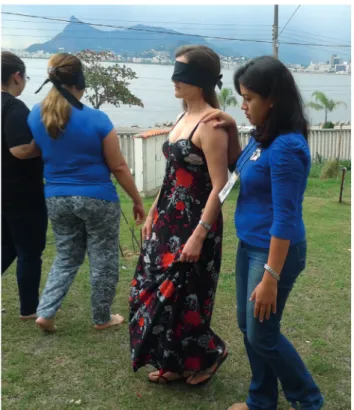
From the exercise of perception of different becomings based in our videos, we continue to experiment with other techniques with the group. Initially, the techniques for caregiver exercises are carried out of the room, preferably in contact with nature, with the group divided into pairs. A person of the duo is blindfolded and the other leads in silence (Fig. 04). The pair walks by open spaces, outdoors, and in the case of the image below, in the locality of the building where the workshop took place. Then the duo switch positions, that is, the one who is blindfolded starts conducting and the one who leads becomes the conducted one. This exercise aims to work the trust in the partner and the care of this for who he leads; after all, they will soon exchange rolesFigure 4: doubles, second day.
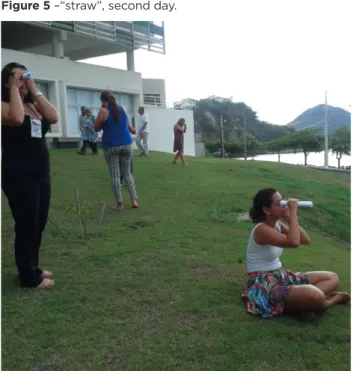
Then the participants crafted straws with A4 size sheets (Figure 5). Everybody walk on the space guided only by the sight of one eye through the straw because the other eye remains closed. The technique provides a constriction of the view as the field of view is restricted by the “straw”. This limitation can, paradoxically, broaden the look, that will see a cut in great detail of the observed environment.
Figure 5 –“straw”, second day.
Source: collection of the research group.
From the use of these techniques, we observe that “this vision shows that something new was added to this experience. An aesthetic that springs from a cutout of a new one that comes with the limitation of the gaze and that, paradoxically, extends this vision”.9:59 Although some
reported increased discomfort imposed by the restricted vision, the fact that such a condition amplifies the attention to detail of space, causing the participants to act with more care and concern before what is happening.
This technique, which came to us by means of the teacher Alfredo Guillermo Martin Gentini,10 is inspired by
an argument proposed by Felix Guattari about “crossover coefficient”. He suggests the following:
Let’s put in a closed field horses with adjustable blinders and say that the “crossover coefficient” is precisely this regulation of visors. Imagine that from the moment the horses are completely blind, some kind of traumatic encounter will happen. As we open visors, one can imagine that the circulation will be held more harmoniously.10:96
10 Alfredo Guillermo Martin Gentini is an adjunct professor at the
Federal University of Rio Grande - FURG. He holds a bachelor’s degree in Psychology - Universidad Catolica Nuestra Señora de La Asunción, Paraguay and postdoctoral degree (2007) in Education Sciences - Université de Paris VIII, France.
So we started experimenting with blindfolded in double teams; then, we regulate this eye opening so that the coefficient is the annulment of the physiological conditionof vision. Next, the “straw” paper becomes the setting for a closer view, however with far-reaching depth of field, promoting a change in the distance, moving his gaze between what is close and what is far away.
The eyes closed and the “straw” function as this visor for horses and are capable of producing the same “crossover coefficient” advocated by Guattari. This transversality “is a dimension that intends to overcome two impasses, the pure verticality and horizontality “.10:96 In other words,
the transversality promotes something opposite to a vertical hierarchies and a horizontal structure in which “things and people settle down as they can in the situation they experience” 10:96. The transversality will provide a
disaccommodation from our perspective and a hierarchical breakdown that enables the rhizome interaction.
At the end of the experiment, each participant is asked to write a brief report on each of the two situations experienced. To lead and be led, reports on the bond and the relationship of trust established with the other are common. Regarding the paper straw perspective, the comments are focused on difficulty of seeing and anguish felt during the activity, depending on the disaccommodation of perspective. However, in this transversality process, there are those that describe the opportunity to look “details and wealth of things and their movements” or “knowing gradually, slowly, it may be more intense than looking at everyone at once” or see “objects in long distance also produces the sharpening of the senses, especially hearing. There are the noises that prevent clashes between people, being necessary to have a larger circular drive for displacement” (Notes drawn of the Field Journal).
So we promote an activity that seeks to achieve new dimensions of seeing, feeling and sensing, other “crossover coefficients”, that provoke certain hierarchical breakdown of the senses and provide participants to experience other possibilities to relate with themselves, with others and with the environment in which they are inserted.
RESULTS AND DISCUSSION
The video-forum – discussing relationships
As last proposed activity, three volunteers among the participants are invited to submit a short theatrical skit. This proposal is developed using the video forum technique11 andwill be described below.
In order to exemplify the proposal, we assume that the workshop is directed to a health group area, where, in the drama, one will act as a nurse, another as a technician in nursing and a third participant as a patient. It consists on exploring the use of subjective camera (Fig. 06), but the look in question is not the nurse or nursing technique, but the look of the patient. Subjective camera is “when the viewer or the actor has the camera view, or moves according to the camera perspective. Widely used
in actor’s shifting scenes, the camera in the hand of the operator is the actor’s point of view on the move”.12:33 There
is no need to deeply discuss the audiovisual technique, it will be unveiled throughout the experiment, only briefly talked to the participants about the subjective camera and its function before the start of the activity.
Figure 6 – Subjective camera.
Source: Cinema and Production by Chris Rodrigues, 2002.
The activity has approaches to the Theatre of the
Oppressed13 of Augusto Boal, as for example, the forum
theater techniques and theater-image, jeopardizing some of the power relations that are established in daily life and crystallize in the social fabric, questioning them from the oppressor-oppressed relationship.
In the proposal to stage a regular day-to-day, in the case of hospital context, participants were very close to the theater-forum.14 However, in our technique, it is a hybrid,
as we conjugate both the forum theater and theater-picture video. In this experiment, the public interacts not taking the place of “actors” on the scene, as in the Theatre of the Oppressed - which can happen in other social and environmental interventions that promote , yet he interaction between the video and the public is given after the staging, when the group assists the audiovisual material recorded during the dramatization. At the time of trial, the idea is to explore the use of video to check the rigidity of certain roles and stereotyped behaviors in relations reproduced in the hospital between health staff and patients.
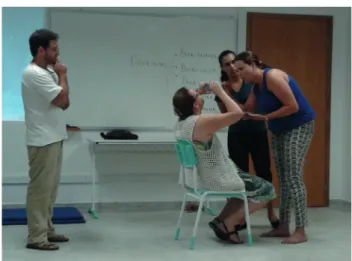
The activity makes possible that, in the first moment, the three volunteers talk quickly, separately, about what they will propose for improvisation, which will be presented to the workshop colleagues. Next, they start the staging (Fig. 07).
Figure 7 – video-forum, second day.
Source: collection of the research group.
The technique recommends that facilitators stay tuned to the dialogues developed until they realize a clear situation of oppression, involving automatic repetition of behaviors and clichés, which should not exceed five minutes. At that time, it is said to stop!
Soon after, each volunteer comment on the trial, and, after that, the group watches the video footage. At that moment, a mirrored process takes place not only in images and sounds, but of the postures and certain clichés that inevitably arise in this type of activity.
The aesthetic trial, in order to boost certain changes taking place in the life of each participant, is guided by the production of everyday images and its analysis/self-analysis. It seeks to encourage improvisation and self-management in the progress of the dialogues and discussions around what the volunteers conceived and staged.
Images recorded in the subjective camera show the volunteer look that sat in the patient condition in a chair in front of a white wall, contextualizing the hospital atmosphere. The other volunteers were positioned in front of her, standing (see Fig. 7). The patient looked at the nurse and the nursing technique through the camera’s LCD screen, as they sought to look straight into her eyes, but through the camera lens.
From there, we guide the volunteer who performed the patient role on how to trigger the camera’s recording mode and how to stop it. Then, we are ready to start recording. Just like in the direction of a film, recalling the role of the director, one of the facilitators says: Action! The story is being told from the subjective view of the patient.
The video produced by the group cannot last more than ten minutes and it is desirable thet this video incites the deepening on the questioning of human relations established in the hospital setting, in this example.
Some participants, after watching the video from the perspective of the patient, comment on their vision in relation to the nursing staff. A bottom-upview , what we call low camera in the audiovisual field. That’s when the camera is capturing a bottom-up view when it comes to narrating
relations; these images tend to connote inferiority and oppression of who appears on the scene.
During our conversation about the experience, many participants of the “IV Forum of Professional Masters in Nursing” (Niteroi/RJ), where it happened this workshop, report that what they have seen the companion reproduce is precisely what they witness daily in the hospital. It is a type of frequent relationship between health staff and patients. Discussions are taking place between the team, sometimes happening in front of the patient, without having the proper care for the one who needs special attention because of their vulnerability.
The process enabled a mirror of stereotypes of established relationships, uncovering and bringing to the conscious the subjectivitive production forms of daily life. With this experiment, we developed an intervention by means of the education process view, a view more ethical and aware of the importance of human relationships grounded in care.
CONCLUSION
Triggering becomings and transiting between
places
The trial process indicates that there is a power in the encounter, of human relations and exchanges of sensitivity, when we can leverage various forms of expression and privilege unconscious sources of learning - knowledge that is learned with the body in movement, linking up with each other and with the world, seeking alternatives, daring, creating solutions.
Our research-intervention seeks to call into question certain established roles and irrefutable truths created in institutional spaces, which shall be comprehended as natural, as if “always were like that and will always be.” In these spaces we plan and execute our strategies, logistics, tactics and techniques, and the responses of the participants, both during the workshops and on the questions sent by e-mail, have indicated the effectiveness of the aesthetic trial in that emerges a problematization field able to raise interference with transforming potential in the investigated environments.
To design the intervention field as the proper object of research, we have learned to cope with the destabilization of our own convictions, without dispensingan multifocused attention, able to accommodate unforeseen and proliferate intensities. This allows us to find out what we do not know. It is a type of analysis implied that allows us to understand our various involvements in research while we switch the positions of subjects and research objects, calling into question the objectivity of postulates, neutrality and impartiality which support classical science.
The back and forth between practice and theoretical reflection, between what happens inside and outside the closed classroom space, between form and what is in process of formation, between the natural and the artificially created by human, indicates the existence of potential inventive in-between spaces.
The access to certain remote memories, constitution images (spectra), and distant desires, meaning processes, updates and indescribable sensations signal the importance of becomings regarding the perception of change and attitude towards reality.
The intervention sought to remain faithful to the discontinuities and process upsets that reveals in the intervention field, putting these vectors in the flow of events, seeking to include varied expressions and reflections around an artistic-pedagogical experimentation group. Spread it as a practice of taking care of oneself, others and the world is one way to describe human relations and contribute to the deepening of issues related to personal and collective development.
The development of devices like this, that, in this research, involves the technic of senses, the questioning around the audiovisual, technical look of the caregiver and the video forum has made us believe that those who go through the trial process live certain strangeness and discomforts, not because they are breaking their own axes, but because it is misaligned with respect to the long axis that turns any social paraphernalia.
Aesthetic trials make us think of an ethic of continuous reinvention of oneself and the world, proposing that the human is capable of doing a search in an attempt to transform the environment in which its body is inserted. It urges us to search certain possibilities of exchange with the environment that are open to becomings: becoming-water-becoming plant, becoming-water-becoming-animal, becoming-water-becoming-inhuman; this is not a passive process at all, for the human always becomes transformed.
The work done in the workshops shows that this is possible when the senses are sharpened and the body transforms itself - generating waves of instability and intensification, when put a established order into disorder and denounce the incompatibility of the society of control15 - with the powers
and multiple possibilities of the human body.
The socio-environmental intervention highlights the importance of learning to deal with our strengths and weaknesses, to work cooperatively, to creatively deal with oppression, to feel and perceive life from other angles and perspectives.
During the processes developed in the field of intervention, moments that allowed us to learn a little more about the strength of the emotions, impulses and feelings are experienced. Important moments trigger the body, putting it into action, creating conditions of possibility to express their sensitive and aesthetic capabilities.
REFERENCES
1. Gauthier J. Sociopoética: o livro do iniciante e do orientador. Edição Eletrônica; 2009.
2. Gauthier J. O oco do vento: metodologia da pesquisa sociopoética e estudos transculturais. Curitiba (PR): Editora CRV; 2012.
3. Guattari F. As Três Ecologias. 4ª ed. Campinas (SP): Papirus; 1990. 4. Lourau R. Análise Institucional e práticas de pesquisa. Rio de Janeiro
Received on: 29/05/2015 Required for review: No Approved on: 04/08/2015 Published on: 25/10/2017
Contact of the corresponding author:
Cláudio Azevedo Rua Ana Pernigotti, 438A
Bairro Bolaxa, Rio Grande – RS, Brazil ZIP-code: 96217-010 E-mail: <[email protected]>
5. Baremblitt G. Compêndio de Análise Institucional e Outras Correntes: teoria e prática. 6ª ed. Belo Horizonte (MG): Editora Instituto Félix Guattari; 2012.
6. Deleuze G. O mistério de Ariana. 2ª ed. Lisboa: Veja; 2005. 7. Amaral ALM. Teatralidade Humana: estudos sobre a relação
corpo-ambiente em um processo cartográfico na Educação Ambiental. [tese]. Rio Grande (RS): Programa de Pós-Graduação em Educação Ambiental, Universidade Federal do Rio Grande – FURG; 2013. 8. Vilaró CP. Albert Schweitzer en el reino de los Galoas. Montevideo:
Artes gráficas integradas SRL; 1996.
9. Bemfica VTS, Azevedo CT. A educação estética ambiental do olhar e do escutar: do estranhamento à criação. Revista Brasileira de Educação Ambiental – REVBEA. 2012 jul; 7(1): 50-62.
10. Guattari F. Revolução molecular: pulsações políticas do desejo. São Paulo (SP): Editora Brasiliense; 1985.
11. Azevedo CT. Por uma Educação Ambiental Biorrizomática: cartografando devires e clinamens através de processos de criação e poéticas audiovisuais. [tese]. Rio Grande (RS): Programa de Pós-Graduação em Educação Ambiental, Universidade Federal do Rio Grande – FURG; 2013.
12. Rodrigues C. O cinema e a produção. Rio de Janeiro (RJ): DP&A; 2002. 13. . Boal A. Teatro do Oprimido e outras poéticas. Rio de Janeiro (RJ):
Civilização Brasileira; 1988.
14. Boal A. Stop: C’est Magique! Rio de Janeiro (RJ): Civilização Brasileira; 1980.
15. Deleuze G. Conversações. Tradução de Peter Pál Pelbart. Rio de janeiro (RJ): Editora 34; 1992.