Modeling and Simulation of Healthcare Pharmaceutical
Environments: A Petri Nets Approach
Filipe Gonçalves Pereira
Relatório de Estágio para Obtenção do Grau de Mestre
em Engenharia Industrial
Ramo da Engenharia Electrotécnica
Orientador: José Gonçalves
Co-Orientador: Paulo Leitão
Supervisor Empresa: José Luis González Sánchez (Fundacion
CARTIF)
P a g e | i
“A great mind is one that is neither ancient nor modern; it is neither ashamed of the old nor afraid of the new. It thinks neither in terms of old traditions nor in terms of new fashions. It is only concerned with the true and the
workable.” -N. Eldon Tanner
Dedico este trabalho acima de tudo e de todos aos meus pais, os
verdadeiros “culpados” e responsáveis daquilo que sou e faço, quem me
permitiu sempre tomar as minhas próprias decisões e ficou á minha espera para me apoiar caso corresse mal, e me felicitou com uma certa naturalidade caso corresse bem, como se não esperassem outra coisa:
Ao mestre André que ao longo de todos estes anos tem sido muito mais que um Pai, um professor, um patrão e um amigo, é um exemplo de vida e de homem que espero para sempre conseguir dignificar e orgulhar.
Á mãe mais preocupada, cuidadora, trabalhadora e dedicada que alguma vez podia pedir. Nem sei como retribuir o apoio incondicional, a fé que sempre depositaste em mim, a maneira como esperavas sempre mais e
melhor. Tanto amor me deste que te devo tudo que sou e virei a ser… Elisinha… I love you too.
P a g e | ii
Abstract
This study examines the drug distribution procedure in hospital, based
on a bibliographic research and an interview with the pharmacy director of
“Hospital del Rio Ortega” in Valladolid, Spain. It was necessary to elaborate a theoretical flux-gram of the medication distribution procedure describing the
various stages in the process, as well as the objectives of the system, and its critical issues. All these steps depend on various health care providers and
health care assistants directly linked. This systemization allowed the observance of the critical knots, understood as the processes and elements with critical impact over the quality of the distribution system. The
understanding of the possible causes of the system‟s problems serves here as the basis for the formulation issues that make the evaluation possible.
There are two basic known types of drug distribution systems:
collective and individual. The collective system is the most pri mitive, although there are hospitals worldwide that adopt this system, considered to
be the simplest and lowest in cost of deployment. The individual distribution system is more complex, it needs more professional pharmacists and a
hospital pharmacy working around the clock and has as main features the fact that the product or drug is dispensed per patient, and not for the sector in
which one may find himself hospitalized. The research of medication errors due to the type of distribution system adopted by hospitals has created a
debate on the advantages and disadvantages of the existing systems. The use of a system model for distribution of medicines will provide a more
appropriate reduction in risk of errors and foremost a reduction in hospital costs. One objective of this study is to show the best method of distribution of
medicines in a hospital pharmacy, that is, the method of distribution in which the chance to experience a medication error would be smaller, and
distribution times as well as staff needs were reduced to a minimum.
The main objective of this work is to model the medication distribution
P a g e | iii information from those models through simulation, to support the decision
making relating human resource availability.
This work was done during a stage at the Cartif Foundation in Valladolid
Spain, with the cooperation of the Valladolid University‟s School of Industrial Engineering.
P a g e | iv
Resumo
Este estudo examina o procedimento para distribuição de medicamento s
dentro de um hospital, baseado numa pesquisa bibliográfica e uma entrevista com o director da farmácia do hospital “Hospital del Rio Ortega” em
Valladolid, Espanha. Foi necessário elaborar um fluxogram teórico do
procedimento de distribuição de medicamentos descrevendo os vários passos do processo, e ainda os objectivos do sistema e os seus pontos críticos. Todos
estes passos dependem de vários assistentes e auxiliares de saúde directamente ligadas. Esta sistematização permitiu observar os pontos críticos, compreendido como os elementos com impacto critico na qualidade do sistema de distribuição. A compreensão das possíveis causas dos problemas
do sistema servem de base para formular questões que tornam possível a sua avaliação.
Existem dois sistemas básicos de distribuição de medicamentos: Colectivo e Individual. O sistema colectivo é o tipo de distribuição mais
primitivo, mas apesar disso existem muitos hospitais do mundo que adoptam este sistema por ser considerado o mais simples e de implementação mais
barata. O sistema individual é mais complexo e necessita de mais profissionais qualificados, nomeadamente farmacêutico e\ou técnico de farmácia, a
trabalhar 24 horas por dia, tendo como principal característica o facto de que cada produto ou medicamento é dispensado por pessoa e não por sector ou
andar em que um possa estar hospitalizado. A pesquisa de erros médicos devido ao tipo de distribuição de medicamentos adoptado pelos hospitais tem
criado debate sobre as vantagens e desvantagens dos sistemas existentes. O uso de um modelo para a distribuição de medicamentos levará á redução de
erros e acima de tudo pode contribuir para a redução de custos do hospital. Um dos objectivos deste estudo é mostrar o melhor método de distribuição de
medicamentos de uma farmácia hospitalar, isto é, o método de distribuição em que se minimiza o risco de erros de medicação, tempos de distribuição
P a g e | v O objectivo principal deste trabalho é modelar o processo de
distribuição de medicamentos em ambiente hospitalar, usando o formalismo das Redes de Petri, e extrair informação desses modelos através de simulação
para apoiar tomadas de decisão relativas á disponibilidade de recursos humanos.
Este trabalho foi desenvolvido durante uma estadia na Fundação Cartif de Valladolid em Espanha com a cooperação da Escola de Engenharias
P a g e | vi
Acknowledgements
I would like to begin thanking my coordinators José Gonçalves and
Paulo Leitão from IPB not only for the guidance, support and information these past few months to help me overcome this challenge, but also for being
great teachers and friends throughout my college years.
I wish to thank D. Juan Carlos Fraile and D. José Luis González for five months of work, information, fun, study travels and doing everything they
could to make me feel comfortable in a different country and culture.
I must also thank my room-mates Anildio and João who always had an incentive to work or an idea to try and help out when things got “strange”. Last but not least, I thank my friends and family that supported me and
always encouraged me to do more and try harder all these years.
P a g e | vii
Acronyms
IPB Polytechnic Institute of Bragança
ECTS European Credit Transfer and Accumulation System
HdRO Hospital “del Rio Ortega”
UDMDA Unit Dose Medication Distribution System
KM Kardex Megamat (Logistic Support Unit)
PSS Pyxis Supply Station
WH Warehouse
EDSPNs Extended Deterministic Stochastic Petri Net‟s SCPNs Stochastic Colored Petri Net‟s
GUI Graphical User Interface
GSPN Generalized Stochastic Petri Net
CG Care Giver
VASADU Vertical Automated Storage and Automatic Dispensing Unit
P a g e | viii
Table of Contents
Abstract ... ii
Resumo... iv
Acknowledgements ... vi
Table of Contents ... viii
Table of Figures...ix
1 - Introduction ... 1
1.1 - The problem ... 2
1.2 - Objectives and contributions ... 3
1.3 - Document organization ... 4
2 - Concept of hospital logistics ... 5
2.1 - Internal logistic sub-systems... 6
3 - Medication ordering and dispending ... 9
3.1 - Unit-dose medication ... 9
3.3 – Types of prescription ... 14
3.3.1 - Emergency\occasional prescription ... 14
3.3.2 - Regular\daily prescription ... 15
3.3.3 - Pyxis automatic request ... 16
3.3.4 - Medicine cabinet request ... 16
3.4 - Distribution block diagram ... 17
3.5 - Distribution flux-graph ... 18
4 - Stochastic Petri nets ... 25
4.1 - Timed Petri nets ... 26
4.1.1 - Location of delay ... 27
4.1.2 - Type of delay ... 27
4.1.3 - Pre-selection versus race semantics ... 28
4.1.4 - Capacity, priority, and queuing policy ... 29
4.1.5 - Analysis of timed nets ... 29
4.2 - Stochastic timing ... 30
4.3 - Invariants in Petri nets ... 31
4.4 – TimeNet software tool ... 33
5 - Modeling medication distribution processes ... 36
5.1 – Single request type model ... 37
5.2 – Multiple request model ... 41
5.3 - Token game ... 43
6- Simulation of the Designed Models... 47
6.1- Deterministic simulation of the Petri net models ... 47
6.2 - Simulation of the designed models ... 53
6.3 - Medicine cabinet model and result graphs ... 53
6.4 - Full distribution system model and result graphs ... 58
6.4.1 - Simulation parameters ... 60
6.4.2 - Simulation results... 61
7 – Conclusions and future work ... 69
P a g e | ix
Table of Figures
Figure 1 - Hospital main activities ... 5
Figure 2 - Main logistic processes in each sub-system ... 8
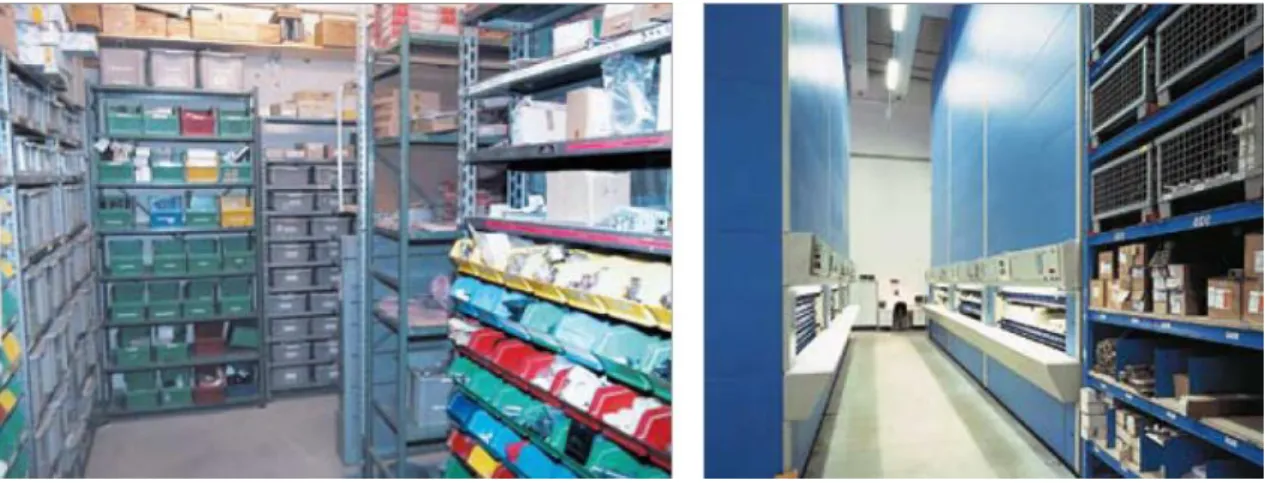
Figure 3 - Difference between shelf storage and KM storage system ... 12
Figure 4 - The basic Kardex Megamat structure ... 13
Figure 5 - Example of existing models of Pyxisss ... 13
Figure 6 - Block diagram for the distribution process ... 18
Figure 7 - Flux graph defining UDMDS steps... 20
Figure 8 - A Petri net example... 26
Figure 9 – Petri net example ... 31
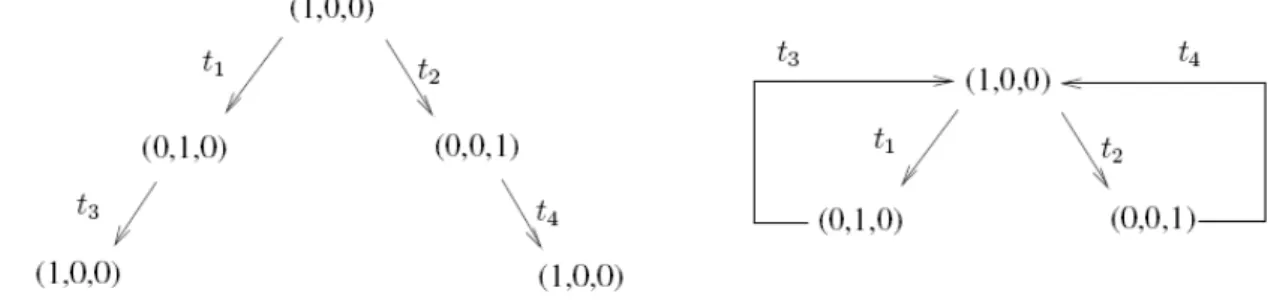
Figure 10 - Reachability tree and corresponding reachability graph ... 32
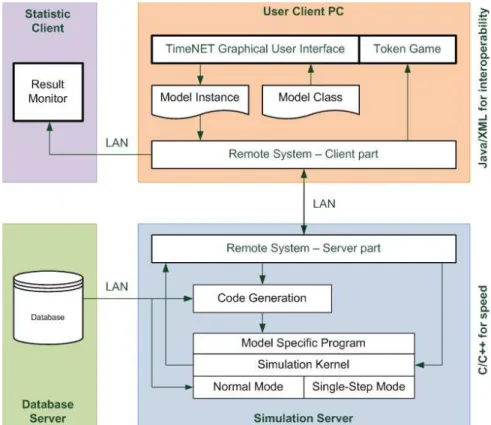
Figure 11 – Petri net model with infinite reachability set; Reachability tree . 32 Figure 12 - TimeNet system architecture ... 34
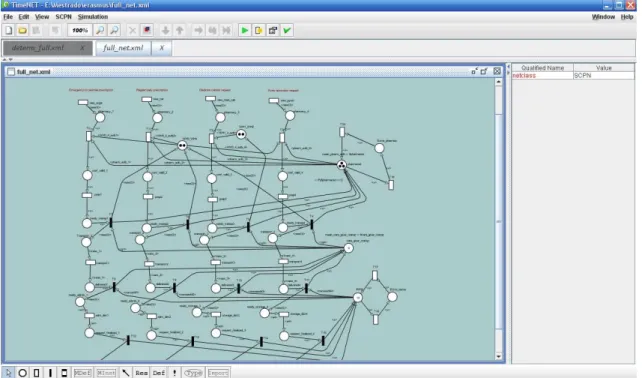
Figure 13- Time Net screenshot ... 35
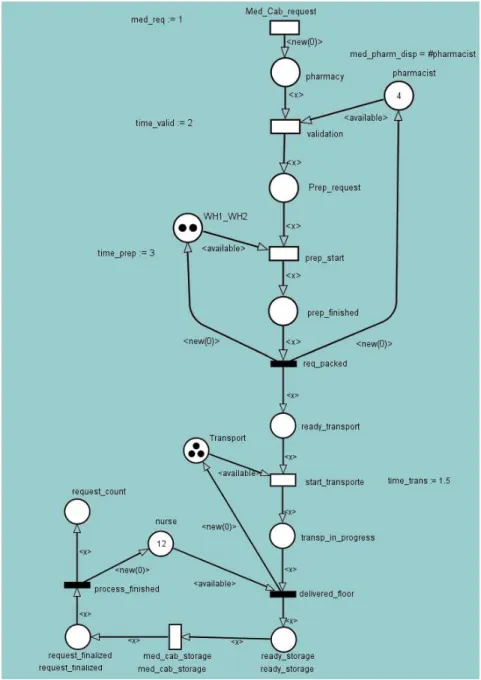
Figure 14 - Medicine cabinet request Petri net model ... 37
Figure 15 - Example definition of places, measures and tokens ... 38
Figure 16 - Example of resource availability check ... 40
Figure 17 - Model describing full distribution system... 42
Figure 18 - Token game part 1 ... 44
Figure 19 - Token game part 2 ... 44
Figure 20 - Token game part 3 ... 45
Figure 21 - Token game part 4 ... 45
Figure 22 - Token game part 5 ... 46
Figure 23 - Statespace result window... 48
Figure 24 - Traps result window ... 48
Figure 25 - Siphons result window... 49
Figure 26 - Structural analysis result window P-invariants... 49
Figure 27 - Extended Conflict Set result window... 51
Figure 28 - Probability graph varying the number of pharmacists ... 52
Figure 29 - Probability graph varying the number of nurses ... 52
Figure 30 - Graphs from first pair of simulations... 55
Figure 31 - Simulation with new resource availability... 56
Figure 32 - Time between the beginning & end of the request ... 57
Figure 33 - Full net model for simulation ... 59
Figure 34 - Human resource availability simulation... 62
Figure 35 – Mean number of care-givers graph ... 63
Figure 36 - Pharmacist & Nurse Alternative Work Loads ... 64
Figure 37 - Beginning and End graphs - Urgent request ... 65
Figure 38 - Resource availability- simulation 2 ... 67
P a g e | 1
1 - Introduction
This report was written in the context of the Final Project course of the Master degree in Industrial Engineering, specialization of Electrical
Engineering, from the Polytechnic Institute of Bragança. The Final Project course is one year long and worth 42 ECTS, the first six months were focused
on the preparation for the internship which consisted in the student preparing
himself on the subject and tools that would be studied and used in the second phase which started on March 1st and lasted five months, until the 30th of
July 2010. The project was done at the Cartif Foundation of Valladolid, Spain, with the supervision and cooperation of D. Juan Carlos Fraile and D. José Luis González, both professors at the University of Valladolid and representing the Cartif Foundation, which is a non-profit organization, dedicated to research
and development in various areas including automation and control.
The internship activities were focused on modeling, extraction of
information and knowledge of the Petri nets to support the mo nitoring and decision-making in the drug distribution procedure verified at the local
hospital “Hospital del Rio Ortega” (HdRO).
The dispensing of medication is a technical and scientific activity
directed towards the patient, of great importance for the success of the pharmaceutical and therapeutic treatment, which should only be carried out
by qualified professionals, in this case a pharmacist. A rational distribution of medication consists in assuring consumers to receive the right product, in the
right quantity and specifications, and in a reasonable time, obtaining the best cost efficiency [1].
The drug distribution procedure has various stages, starting with a prescription and ending with the administration of the drug to the patient. All
the steps along the procedure depend on the various health care professionals, and are directly connected. Thus, the prescription is the
Doctor‟s responsibility, the dispensing is the pharmacist‟s responsibility, the distribution or delivery to the floor or sector where the drug is needed is the
P a g e | 2 The type of drug distribution system chosen and applied in a hospital is
one of the sensitive aspects that can cause grave and dangerous errors in medication, having as consequences harmful results in patients [2].
1.1 - The problem
The organization or the reorganization of the logistic chain constitutes
a major stake for the public health establishments, because its improvement
is one of the main reserves for saving money in this sector. In this direction, the optimization of the pharmaceutical logistic chain is very important: from
the pharmaceutical product‟s arrival, till the moment it reaches the patients
bed [3].
The rational organization of the pharmacy [4] may be seen as a necessary evolution. However, major difficulties appear during this evolution,
because the hospital pharmacy has such a large diversity of stored products. Within the same pharmacy, the system must be able to manage several areas
dedicated to different kinds of storage: an area can be intended for the articles to store at low temperature (cold room) and another, for example,
for dangerous products (safe room). This division in areas can also be relevant according to the rate of inventory turnover of certain products. Indeed, the
frequency of restocking varies in an important way from one care unit to another.
The organization of the arrangement of the pharmaceutical products and their installation must satisfy a certain number of aims such as the
accessibility to the stored articles, the improvement of the working conditions, the reduction in time and the preparation errors. These objectives
involve the definition of criteria of internal organization of pharmacy [5] such as the products availability, the management policy, the storage cost,
ergonomics, as well as the constraints to be respected such as the climatic conditions of the buildings and available surfaces. Although the advantages
are easy to recognize (reduce in medication related errors, active participation from the pharmacy staff, and cost reduction related with
P a g e | 3 fulfill its objectives, which are the rationalization of medication costs, and
enough safety that assures the process errors due to drug distribution are reduced. Obviously, the objective of this work is not to point out answers or
final solutions for these problems, but to approach them in a way that can be very useful in the future understanding and developing of similar case
situations.
In this work, the object of study is, only, the drug distribution process,
considering of course, all the respective process participants. This leads to the study of the different types of prescriptions or possible drug requests from
the doctor figure to the pharmacy, which can have different priorities or procedures, depending on the type of order.
1.2 - Objectives and contributions
The main objective of this work is to model the medication distribution process in Health-care environments, using the Petri Net formalism, and to
extract information and knowledge from those models through simulation, to support the decision making aiming to improve distribution times and costs.
Petri Nets formalism [20] is a modeling tool with a well defined mathematical background and a good graphical environment that allows an
easy understands. Combining these two qualities makes Petri Nets a powerful and suitable design tool to building mathematical models describing the
system behavior of event-driven systems, as the medication distribution process is.
For this purpose, a case study based on the medication distribution process of the HdRO hospital will be used. The Petri nets models and posterior
simulation will be performed by using the TimeNet software tool. It is a very powerful tool that allows users to create either deterministic or stochastic
Petri nets, (in this particular work stochastic nets were used). The models will be simulated under different scenarios (e.g., number of people dispatched to
P a g e | 4
1.3 - Document organization
This document is divided in eight chapters, the present one being the
first and containing an introduction to the approached theme, a brief explanation of the problem as well as the objectives of the study and the
contributions that support the study.
Chapter two entitled “Concepts of Hospital Logistics” presents the
hospital logistic main activities as well as the internal sub-systems considered to be crucial to the correct functioning of the distribution process.
Chapter three, entitled “Medication ordering and dispending”, presents and explains the medication distribution system supported by a flux graph to
show the necessary steps for all types of prescription\request considered in
this case study, and then describes all the steps taken by the medications along the process.
Chapter four, entitled “Stochastic Petri nets”, introduces the basic concepts of stochastic Petri nets as well as their time delays and marking conditions, and invariants in Petri Net models. It also introduces the Time Net software tool.
The fifth chapter, entitled “Modeling medication distribution
processes”, explains how the Petri net model for the medication distribution process is achieved by using the TimeNet software and shows how the Petri net model evolves, using the token game function from the TimeNet software
to exemplify how tokens move along the net.
The sixth chapter, entitled “Simulation of the Designed Models”,
presents the variables used for simulation, both for the medicine cabinet request as well as the full Petri net model, defining the time delays as
constants and the number of available resources as the exit variables that provide information in the form of a graph corresponding to each place or
transition being watched. The resulting graphs are also analyzed in this chapter as they are presented.
P a g e | 5
2 - Concept of hospital logistics
For years, public hospital managers and directors have been realizing that the services not directly connected with health-care (laundry, kitchen,
maintenance and logistic activities), have excellent potential for improvement. With a revision and re-structuring of the way these operations
are practiced, without reducing at all the quality of the clinical service. One
of these services is the hospital logistics, aiming to effectively supply all health care products, as well as the necessary medication(s) for correct
patient treatment.
A hospital‟s activities can be arranged in a group of central activities where all the internal processes of the hospital can be considered in groups. The patient support and treating is only the main activity, making the human
resources, all the materials, the medical testes (x-ray‟s etc.) and all the clinical processes (diagnosing, medication etc.) support for the main activity.
The correct balance of all these activities is what allows an institution to offer a good clinical service to the sick or chronically ill [5].
The basic activities developed in a hospital [13] are shown in Figure 1, and after, a short description of each of these activities is given.
P a g e | 6 Internal Logistics’- Is the group responsible for acquiring, receiving, storing and distributing the products necessary for the hospital‟s internal processes, which are referred to as Hospital Logistics.
Demand Management- Consists in analyzing, planning and assigning resources necessary to acquire goods and services.
Operational Services- Considers all the internal processes and activities that support the patients stay in the hospital.
External Logistics’- Is associated with the activities of clinical or medical
follow up of the patient‟s condition.
Secondary\Auxiliary Services- Groups all the activities taken place inside the hospital and includes services like restaurants, stores, religious support etc.
Even though none of these can be disconnect from the others, internal
logistics serve a more important role in controlling the processes tha t can lead the hospital to an improvement of its resources. The re-considering of
activities in health care centre‟s or hospitals to improve the way these
resources are applied, increasing efficiency, should allow better cost control,
assuring global service quality to the patient.
2.1 - Internal logistic sub-systems
The internal logistics of a hospital can be considered to consist of four sub-systems, which are production, storage, transport and handling, and
information gathering along the process. All these elements should interact to fulfill one objective: satisfy the internal demands with as much quality and as
less costs as possible. In other words, assure management satisfaction. Each stage of the sub-process and the activities that should be developed to
P a g e | 7
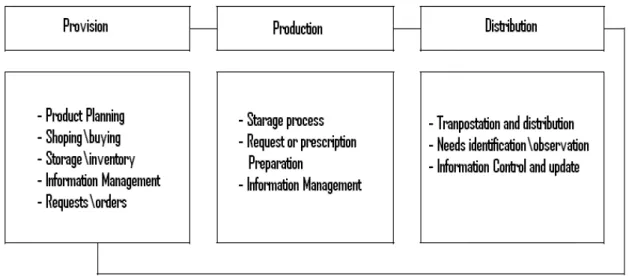
Provision: this sub-system is in charge of activities related with shopping\buying functions, orders, inventories, storage, transport, product planning, and information management. This sub-system
includes all the processes that provide the necessary material‟s that the productive sub-system needs to complete its functions.
Production: is the sub-system that comprehends the intermediate storage of products, either in the central pharmacy or in storage spaces and medicine cabinets throughout the hospital, as well as the
prescription preparation, maintenance and technical support. This sub-system serves to optimize the physical movement process of the
materials in the hospital.
Distribution: manages and distributes all products since they leave the general warehouse, until they reach their destiny, or point of consumption. The objective is to consider the internal transportation
and distribution frequencies, to try to synchronize the demand from each service with the production, to try and reduce delivery times and
warehouse stock.
From a logistic point of view, a hospital is no more than a production centre where numerous internal logistic processes occur (Figure 2). Starting
with the planning and acquiring of goods, and including the design of the distribution system up to the point of consummation, all the sub-processes
that intervene in the hospital logistics‟ process should be planned and
executed as precisely as the logistic plan is designed. For example, in the provisions sub-system, the acquiring function includes search and demand from a supplier of the necessary materials for the production centre, which
means all the raw materials the production sub-system will need. What to order, in what amount and when to order it should be based on a previous
study of the consumed materials individually, to try and make an accurate
prediction of the system needs. Nowadays, very few hospitals or health centers create an elaborated study of what in fact they need, and b ase their
planning on consumption history and educated guesses about the future needs
P a g e | 8 much easier to comprehend the supply needs which in turn allow establishing
a stock level closer to the hospital‟s reality and needs, liberating funds to be spent in other sectors.
Figure 2 - Main logistic processes in each sub-system
The most important aspect within the production sub-system is the preparation of the request or prescription. This phase contemplates the
selection and gather of all the products from their storage location, as well as the preparation for transport and distribution to consumers. The time spent in
this sub-system affects the “response time” verified by the “costumer” (person waiting for medication). Aside from hospital, like HdRO that have
installed automated dispensing units, most hospital warehouses do not have any type of automation in the request preparation. The most usual model
found is one where the pharmacist or pharmacy technician move around the warehouse and gather the different medications as they go while considering
the quantities available and take notes of the ones that need to be corrected to fulfill the minimum number of av ailable doses. There are associated costs
with this process, not only the personnel but also warehouse related costs (cleaning, maintaining, repairing), utility costs (water, electricity, gas etc.)
and safety costs (insurance, surveillance). These and other costs that may seem insignificant, if reduced or even eliminated, may represent a
considerable amount of money to one of the largest sectors in worldwide
P a g e | 9
3 - Medication ordering and dispending
This chapter describes the basis for the unit-dose medication distribution system, as well as give an inside view of how medication is
ordered, dispensed and transported throughout the hospital case study used in this work, the HdRO. Four basic types of
prescription-preparation-administration procedures were distinguished for modeling, to adequately
describe how the global procedure for drug distribution takes place. These four procedures as well as the logistic support machinery that can be found in
the pharmacy or anywhere else in the hospital are also described.
3.1 - Unit-dose medication
The dispensing of medication is a pharmaceutical action associated with the delivery of an informed prescription by a qualified professional (Doctor), for a specific patient. One of the dispensation types introduced recently in hospitals as an effective way to reduce errors in the
prescription-preparation-administration process drugs go through in a hospital is the unit-dose medication distribution system (UDMDS). This system consists in
delivering a prescribed drug in an individually prepared and packaged form, to be administrated along a certain period of a treatment [7].
The objectives of the UDMDS is essentially to ensure the maximum security and efficiency when dispending medication, reducing medication costs and allowing the pharmacist to integrate, in a substantial way, the health-care team, and finally to be able to track and detect any problem
related with a drug since it was prescribed up to the moment it is delivered to a nurse for patient administration.
The service a pharmacy provides dispending medications when
presented with a prescription is guaranteed to be safe and fast thanks to automatic dispensing machines, but also very important is the education and information given about the medication and it‟s appropriate use. This results
P a g e | 10 follows through of the patients and their conditions and reactions to the
treatment.
The central medication dispensing area is inside the HdRO pharmacy, and has the internal physical boundaries defined and with all the necessary resources to fulfill the medication dispensing in an easy opportune manner.
The traditional system is one that provides a box or case with a certain number of medications to the nursing staff, whom then prepares each
patients respective dose. This system has the disadvantages of requiring much more dedication by the nurses, not allowing an adequate control over which
medications are stored in each section of the hospital. It leaves more possibilities for self-medication and can generate money loss, since no
medications are returned even though they are not going to be consumed in that section of the hospital, despite they could be needed for other patients.
The UDMDS offers the opportunity of a follow -through of the medication therapy effects on the patient which allows closer monitoring of the patient reaction to the drug from a pharmacy\therapeutic point of view. It has been shown, in numerous studies ([21], [22]) that this system is the safest for the
patient, most effective from an economic point of view, and simultaneously it utilizes professional human resources much more effectively. Advantages of
the UDMDS compared to other techniques include:
- More certainty that the right medication goes to the right patient, since each prescription is destined to each patient individually.
- The efficient and rational use of human resources involved in distribution, including nurses who assume a more direct role in the patient care.
- Cost reduction through the spoil control, reduction of self-medication and medication recovery after a patient treatment that doesn‟t use the exact amount that would be supplied in a box.
- Error reduction in the prescription-preparation-administration procedure.
- More control by the pharmacist over the pharmacy personnel. - Reducing the number of nurse-responsibility medicine cabinets.
P a g e | 11 - Much easier to create a follow through profile of the patient response
to the drug, facilitating information on adverse affects or identifying interaction between different medications.
The pharmacist upon receiving a delivery of x amount of different
medications must then store them, either directly in a vertical automated storage and automatic dispensing unit (VASADU), or on the shelves destined
for medications in boxes. The shelves serve as a buffer between the automatic unit and the pharmacy staff. In some occasions the shelves might
allocate an excessive number of medications that didn‟t all fit in the
automated unit but will be used before the ones that were stored in the
system. In other occasions it may hold medications returned for some reason, and if there are more than a pre-determined number of those medications
they will then be placed back in the automated system. The VASADU and the shelves used to hold medications in boxes are referred to as WH1 (Warehouse 1) and WH2 (Warehouse 2) respectively. Since all the medication is received in bulk quantities, the unit-dose packaging must be done by the pharmacist,
who between orders packs a determined number of medications individually. They are then placed in another VASADU intended for unit-dose medications
only, or on shelves that serve as buffers between the automated system and the pharmacy staff, as described for WH2. These means of storing (VASADU)
and shelving unit-dose medications will further be referred as WH3 and WH4
respectively. Thus, upo n receiving an order or prescription, depending on its type, the pharmacist takes either the medications in boxes or the unit-packaged medications, from the VASADU system or the storing shelves and
fulfils the request or prescription.
3.2 - Logistic support
–
automated medication storage
To support the medication storage and facilitate the dispensation as well as make the process safer, the hospital pharmacy is equipped with
automated machinery, although traditional shelves and cabinets are also used, either as a buffer or simply a faster easier way to access medications
P a g e | 12 traditional shelves can however become confusing or even chaotic depending
on how many different types being stored.
The storage support used in the central pharmacy of the HdRO, also
found in many other logistic sectors (besides medication storage), is the
„Kardex Megamat®„ (Figure 4), which is a vertical automated storage and automatic dispensing unit that can be customized for the location where it is installed, in terms of height more than in terms of width since it can be up to
10m tall serving more than one floor and 4m long, but its maximum width is around 1.7 meters. The KM follows a “the product to the person” principle,
which uses a computer to very precisely and in a matter of seconds make available the trays with the chosen medications. The shortest path for these
trays is chosen, and since the motor has a frequency converter all the accelerating and braking done while rotating trays, is done very smoothly. All
the products stored in the KM are protected by a sheet of steel, except for the access panel which is at a reasonable height for people to work comfortably. This panel is also where the control elements are, ordered in a very clear way. The access panel can be closed with an elevati ng door
accessed manually.
P a g e | 13
Figure 4 - The basic Kardex Megamat structure
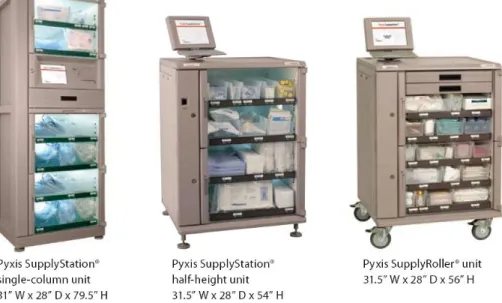
The other medication storage and distribution support system present in the hospital case study is the „pyxis supplystation®‟ system (PSS) (Figure 5).
Figure 5 - Example of existing models of Pyxisss
The PSS is physically similar to regular medication transport cars or fixed cabinets with its drawers or compartments, with the distinct difference
that the PSS is controlled by an on-board computer that monitors not only all the drawer access but also the number of available medications, and sends
regular updates to the central pharmacy with the number of available doses of each drug. This means that the on-board computer (battery powered) only
opens the drawer corresponding to the medication reference selected o n the touch-screen, and it only opens it enough, so that the corresponding amount
P a g e | 14 system can easily monitor the quantity of each drug at all times, and with
that information, via wireless access the system sends hourly updates on the number of doses of each medication present in the system to the pharmacy.
The pharmacists can then decide depending on the number of medications it contains, the best time to re-fill the system.
3.3
–
Types of prescription
Four basic types of medication request were recognized in the drug distribution system of the HdRO, which are:
Emergency/occasional prescription
Regular/daily prescription
Medicine cabinet request
Pyxis automatic request
These types of distribution will be described in detail in the next sections.
3.3.1 - Emergency\occasional prescription
The first type of order or prescription considered is the emergency or
occasional request. This type of order happens when in a sector of the hospital a determined medication is needed but it is not available in the pyxis
supply station or in the closest medicine cabinet. Due to the high cost of the PSS (limiting the number of units in the hospital), the limited number of different drugs it can contain, and the unpredictability of medication needs per sector, often, be it an emergency or simply an adjustment in the patient‟s treatment, a drug that wasn‟t predicted in the daily medication order and happens not to be in the PSS or the closest medicine cabinet, the wanted drug
must be ordered directly from the pharmacy and transported either by a care
-giver or in case of emergency the transport suction tube. This order being of urgent nature can be performed over the phone or in case of non-urgent needs by faxing to the central pharmacy the respective prescription. This type
of order happens in average once every hour or two, and takes approximately
P a g e | 15 suction tube or up to six minutes for a care-giver to transport depending on
which sector it‟s destined to. Administrating the drug in this case can be almost immediate since it‟s an urgent nature request, or a few minutes if not
and urgent situation. This type of prescription has the highest priority of all four types given its urgent nature.
3.3.2 - Regular\daily prescription
The regular or daily prescriptions are the ones which the nurses of each sector of the hospital order based on known treatments for the patients.
Every day depending on the number of patients and the previously prescribed treatments, an order is made for all the medications needed in a sector of the hospital, since there are three distinct sectors on each floor and four floors in total (in the case study HdRO) every day 12 sets of orders are sent to the
central pharmacy to be prepared. Each of these orders is then prepared and stored in a regular transport car with separate drawers with the respective
unit-dose medications for each patient.
After the preparation, the transport is performed by one of the
available care-givers who take the car to the respective sector, afterwards, the nurse or nurses in charge of administrating the medications to the
patients take over the delivery process, which then becomes a matter of distribution. The preparation of the daily prescriptions takes around five hours
for all twelve cars which represents about twenty-five minutes for each car, transport to the sector where it is needed can take anywhere between two
and seven minutes depending on how far from the pharmacy the sector is. Administrating the entire car full of medications to all the patients along a
sector can take up to sixty minutes. The daily prescription orders are second in order of priority since they absolutely have to go out every day at a
P a g e | 16
3.3.3 - Pyxis automatic request
An automatic update is sent, every hour, from each pyxis supply station to the central pharmacy, containing information about the number of
unit-doses of each drug that is in the system. Even though the PSS sends these hourly updates, the need to re-stock the system may not be critical until a
certain number of a determined medication reaches a minimum; this is why
the decision to re-stock the system is decided by the pharmacist depending on that minimum number of medications that should be present in the system.
The update that leads to the decision of re-stoking the PSS is what will be considered a pyxis request throughout this report. The PSS contains unit-dose packed medications and can be re-stocked with as many units as desired or as many as can fit in the system. Despite the hourly updates each PSS is usually
refilled three or four times a week, which represents an average of one order every forty-eight hours. Usually preparing the doses to refill the system takes
around ten minutes and transport is also made in a large box all the way to the nurse responsible for inserting the medications in the PSS, since it is
password protected and not just anybody can manipulate it.
3.3.4 - Medicine cabinet request
A medicine cabinet request is one that is destined to re-stock a specific medicine cabinet available in a certain sector of the hospital. Normally, medicine cabinets are located where there is no pyxisss available and vice-versa, where there is a PSS there are no traditional medicine cabinets. Unlike
all the other orders or prescriptions, medicine cabinet requests are for boxes or cases of medications and not unit-dose medications. When a nurse thinks
that a medicine cabinet is in need of more of a determined drug she will send an order to the pharmacy asking for the drug but instead of asking for X
amount of unit-doses the order is for Y amount of boxes of the drug. Latter on
depending on the sector‟s patient needs the medications will then be individually packaged by the nurse for distribution.
This type of order only happens two or three time a week, which
P a g e | 17 ten minutes to prepare (in the pharmacy). After the order is ready it is
transported by a care-giver in a big box to the corresponding sector of the hospital which takes the same average time of transportation as other
requests that is between two and seven minutes depending on what floor or section it has to be delivered to. The medications are then stored by a nurse
in the medicine cabinet, job that can take up to ten minutes depending on the size of the order. The medicine cabinet request, similarly to the pyxis
automatic request, is lower in priority since normally the orders are made before a product actually runs out, and if in fact there is an urgent need for a
drug that is not in the medicine cabinet or in the PSS, an emergency order is made and the drug will be immediately delivered to the section of the
hospital where it is needed.
3.4 - Distribution block diagram
The prescription types referred to in 3.3 can be described by a block diagram representing the basic steps in the distribution process. The
distribution process happens in two distinct ways, depending on the type of order, since there can be unit-dose medication requests (3.3.1, 3.3.2, 3.3.3)
or a request for boxes of medication to re-stock the medicine cabinets present in specific areas of the hospital (3.3.4). This means that three types
of orders must share the resources where the medications are stored (WH3 & WH4). After analyzing the necessary steps for each type of order to take
place, the following block diagram was made to illustrate in an easy and comprehensive way, not only the basic procedure for each type of order but
also to compare them and see what makes them alike or distinct. The block diagram shown in Figure 6, considers the four different order\prescription
types, and shows (describes) how each one dispenses and prepares medications for transport. It does not however specify the time involved in
each preparation or transport, these are aspects so relative that ca n vary so much from hospital to hospital, or in the same hospital from one week to
P a g e | 18 the procedure (doctor, nurse, care giver and in some cases the PSS) as well as
the pharmacist who has the main role in the preparation process. The bridge between the pharmacy and the section nurses is made by care-givers who
manually transport the medications from the central pharmacy to the nurse station that requested them (doctors make prescriptions and nurses make
orders for the medicine cabinet).
Figure 6 - Block diagram for the distribution process
3.5 - Distribution flux-graph
A flux-graph is a graphical representation of all the steps that constitute a process [8]. When monitoring a process it‟s important to have a
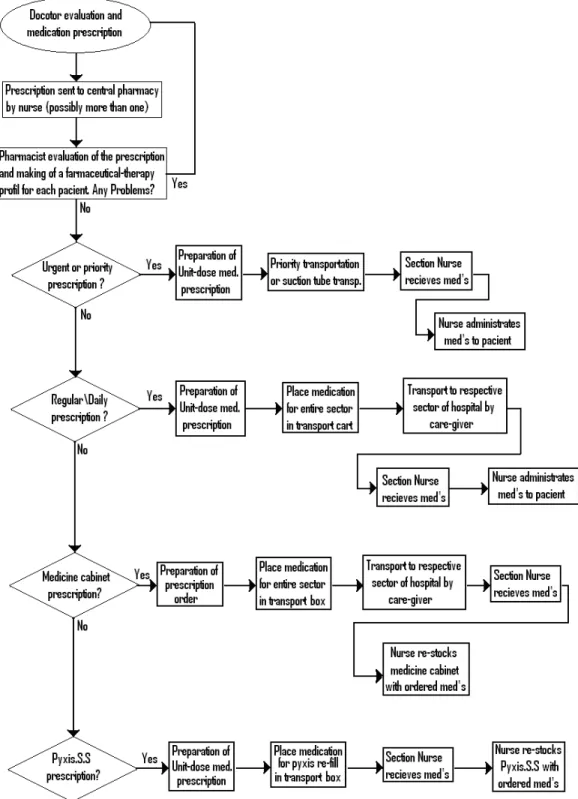
P a g e | 19 To make the proposed flux graph (Figure 7), initially a visit was made
to the case study Hospital HdRO to see in firsthand how the pharmacy service interacted with the rest of the hospital using the unit-dose medication
distribution system. This was a very important step in the study process because it made it easier to contrast the theoretical workflow that was
researched with the reality that took place in a public hospital. The flux graph presented ahead shows all the steps of the medication distribution process,
starting with the prescription, passing through the preparation and distribution from the pharmacy to distinct points of the hospital, and finishing
with the administration to the patient or the storage in one of the logistic support units. According to Malik & Schiesari [8], in a flux graph, a process or
action which is represented by a rectangle, usually only has one exit or flow direction, while the decision, represented by a diamond shape can have two
exits or flow directions. What this means is that a decision may involve an evaluation or a judgment that can mean returning to a previous state of the graph. After elaborating the flow graph, a description was made for each step of the graph, with the intent of facilitating the general comprehension of the
objectives of each stage of the distribution process and the points found to be critical to the process, as well as priority definitions between different types
P a g e | 20
Figure 7 - Flux graph defining UDMDS steps
As referred previously and quoted in the “Spanish society of hospital pharmacy” by Napal [9], when discussing the UDMDS, it is more important to
P a g e | 21 work philosophy, but also mandates the involving of the entire health care
team.
This philosophy or paradigm implicates the commitment of the
pharmaceutical team in the health-care quality clinically as well as management-wise. If these principles are so important from the philosophical
point of view, they should not be forgotten when describing de steps of the flow diagram, to approach them as much as possible to reality, increasing
safety and reducing medication related errors. It is also necessary to accept the fact that the UDMDS is a system in which the pharmacist intervenes,
previously checking and validating the doctor‟s prescription before continuing the distribution process.
The flow diagram‟s most significant aspects to be considered will now be described:
Prescription- This stage is executed by the doctor, who should complete the prescription process (manually or computerized), according to Lima [10], with enough information to create the patient‟s p harmaceutical-therapeutic profile (age, weight, diagnosis, admission date, room or bed
number etc.), which is one of the systems global objectives. In hospital‟s like HdRO, where the patients profile and prescription are computerized, some of
the stages of the evaluation process can be guaranteed to reduce human error like illegible entry data, abbreviations or initials among other things. A study
made by Silva [11] showed that 75% of medication errors related with the
prescription (in the hospital studied by Silva), where due to environmental issues like phone call interruptions, small spaces for allot of people, poor ventilation or work flow organization. The pharmaceutical profile is
elaborated when starting the patient‟s medication history, using data
collected with a prescription formulary or an interview with the patient by the pharmacist with a confidential information based relationship. Medication
P a g e | 22 made legible, it should use the generic medication name not use
abbreviations or initials, and apply the international unit measure system.
Sending the prescription- The prescription is taken to the pharmacy for the preparation of the unit-doses and the evaluations found relevant to the process, by the pharmacist. It can be sent by fax, photocopy, carbon
copy, or e-mail. When the sending is done in person, usually it will be by a pharmacy assistant, nursing auxiliary (care giver) or administration personnel.
Prescription evaluation- This is the stage where the pharmacist evaluates the prescription and checks for possible reactions or side-effects,
confirms the dosage, makes sure there are no duplicate doses or pharmaceutical classes. This is also the stage where the pharmaceutical
therapy profile is completed, where the medication being used by the patient will be evaluated, including the cross checking of the medication with
possible side-effects, and also a follow up of the medication treatment verifying if the treatment objectives are fulfilled. This is a very important stage in the UDMDS since one of the main goals of the system is to rationalize the medication usage, guarantee process quality and reduce the medication
errors or medication related problems. Medication related problems can be seen as any event experienced by the patient, and that involves or is
suspected to involve the medication therapy, interfering with the fulfillment of the expected objectives [12]. The pharmacist‟s intervention in this
evaluation stage can also be related with the medication substitution, either
by a corresponding generic or the “therapeutic substitution”, which switches one medication with another with a different active principle but with the same clinical indications. In this stage if a medication related problem is
detected the pharmacist should contact the (prescribing) doctor to adjust the
prescription. Some philosophic considerations exist in the difference between medication errors and medication related errors. Medication related errors
P a g e | 23 related to the medication therapy, from gross errors in the prescription (units
or quantities) to administrating errors or switched medications.
Medication distribution flow- Some medications can have a specific distribution flow due to pre-determined rules for their dispensing. Among
these are antimicrobial‟s that have a growing problem with bacterial resistance and demand a great amount of concern relating the irrational use of these drugs. Other types of medications included in these specific
distribution flows are drugs subject to a special type of control, or a set of sanitary rules (laws), and in some cases internal protocols depending on
specific needs.
Preparation of unit doses- For the preparation, it is necessary to calculate the quantities and verify the existence of the medications in the pharmacy stock, usually done by a pharmacy assistant, but can also be done
by the pharmacist. The unit-dose medications are in pre-determined quantities, dosage and concentration in the prescription are ready for patient administration are usually already packed in the pharmacy, being only necessary to separate the medications needed for 24 hours and transport
them to the sector that made the order. If not already available, the doses can be prepared when separating the pharmaceuticals. It‟s important to
remember that the most common drugs are separated and packed by the pharmacy technicians or assistants, then stocked until needed. In both cases
it‟s fundamental to have an adequate preparation area. This phase of the distribution process is very important to rationalize the costs related with medication, also creating a positive impact in security and quality of the system due to the dose precision. This group of factors avoids the spoiling of
doses and loss of medication or expired batches since the medications sent to
the nurse sector are already packed in the quantity, dosage and concentration determined by the doctor in the prescription. This can be found to be a
critical step in the process since the dividing and re-packing of the medication after being removed from its original package, requires a procedure that will conserve the integrity and characteristics of the medication.
P a g e | 24 pharmacy assistant, comparing the prescription with the doses gathered to fill
the prescription. This is also a very important stage, since it is one that aims to guarantee the process quality, as well as reduce medication errors, mainly
related with dispensing. The previously mentioned study by Silva [11], concluded that 20% of, medication errors related with the distribution, w ere
attributed to flaws in the reviewing and confirmation plan. If there are any inconsistencies, the doses can be recovered, and in cases where they can‟t
they are destroyed. If possible, a correction is made (label related errors for example), and the medication is then sent for transport to the nurse sector
where it was ordered from.
Transport to respective sector- After the pharmacist or the pharmacy
assistants are finished preparing and confirming all the ordered medication‟s,
a care-giver is in charge of the transportation of the medications, either in
the distribution cars (regular\daily prescriptions), or in a box, from the pharmacy to the sector of the hospital where they were ordered and delivers them to the nurse in charge of administrating the medications to the patients or re-stocking a medicine cabinet or the Pyxis support station.
Nurse reception and patient administration- The nurses upon receiving the ordered medications, once again compare the received drugs
with the ordered drugs in the prescription. If any inconsistency is found that can be pharmacy process flaws or prescription mistakes, then the medications
are returned to the pharmacy. The unit-dose medications are administrated
to the patients very easily since they come ready, and save nurses preparation time. They are also identified and the time-line for administration should be discriminated on the label, which gives the patient security and process
quality, reducing medication errors. In this stage it is necessary for the
nursing team to be conscious and cooperative with the system so that the package integrity of the unit-doses is preserved up to the moment of
P a g e | 25
4 - Stochastic Petri nets
The classical Petri net is a directed bipartite graph introduced by Carl Adam Petri in 1962 as the result of his PhD work [23]. The two types of nodes
are called places and transitions. In a Petri net, places and transitions are connected via arcs. While the places typically stand for the passive system
elements which may be interpreted as conditions, the transitions represent
the active system elements as events. Thus, every arc in the net connects an active and a passive element and since there are only direct arcs in Petri nets,
they are represented by arrows. In graphical representation, places are depicted as circles and transitions as rectangles. According to the arc direction, every place has a set of pre-transitions and a set of post-transitions. In turn, transitions without replaces (post places) are called input
(output) transition and are depicted as flat rectangles. The firing of an input transition is not restricted by the net, i.e., the event modeled by an input
transition that may take place represents an event, which is only enabled to take place when all the preconditions of that event are fulfilled. The
fulfillment of a condition is carried through the existing tokens in the places. If all pre-places of a transition are marked sufficiently with tokens (e.g., if
the corresponding biochemical components are available), this transition may fire (e.g., the reaction takes place). If a transition fires, one token is removed
from each of its places and added to each of its post-places. Thus, the tokens are the dynamic elements of the net. Altogether, arcs connect an event with
its preconditions which must be fulfilled to trigger this event, and with its post-conditions which will be fulfilled when the event takes place. Principally,
a place in a discrete net may carry any integer number of tokens, indicating different degrees of fulfillment, since the number of pre-places of a transition
generally has not to be equal to the number of post-places of this transition; the number of tokens in the whole net is not conserved [6].
In Figure 8, a Petri net example is shown. Places are referenced with p-and a number, p-and transitions by t-p-and a number. In this example two types
P a g e | 26
Figure 8 - A Petri net example
Note that both types of transitions respect the firing rule. In the Petri net depicted Figure 9, places p8 and p10 are marked. The transitions that are
enabled are t7 and t10. In particular, transition t11 is not enabled. If transition t10 would fire on basis of the token in p8, then t11 becomes enabled since a token would be added to p9. As a final remark, transitions t7 and t10 are said to be in conflict, as they compete for the same token to fire,
in cases like this priorities must be defined [15].
4.1 - Timed Petri nets
Petri nets were originally proposed as a causal model without any
notion of time or probability. In fact, the concept of time was intentionally avoided in the original proposal of Petri nets. The addition of time restricts
the behavior of the net, i.e., the dynamic behavior of the Petri net is only partially reflected by the network structure. However, for many practical
applications, the addition of time is a necessity. Without an explicit notion of time it is not possible to analyze the performance (e.g., throughput and
utilization) of the modeled system. Since the early seventies there has been a discussion within the Petri net community on the addition of time. More
theory-oriented researchers oppose or simply ignore timing issues. More application-oriented researchers advocate and investigate different timing
P a g e | 27
4.1.1 - Location of delay
There are many ways to introduce time into Petri net models. As explained in the previous section, a Petri net consists of places and transitions
connected via arcs. This means, time can be associated with places, transitions, or arcs. In most timed Petri net models, transitions determine
time delays. In only a few models, time delays are determined by places
and/or arcs. It seems that it is more natural to associate time to transitions: Transitions represent activities and activities take time. However, authors like
Sifakis [16] defend that it is more convenient to associate time to places since this leaves the original firing rule intact, i.e., enabling and firing are instantaneous.
4.1.2 - Type of delay
Independent of the decision on where to put the delay (i.e.,
transitions, places, or arcs), several types of delays can be distinguished. In this paper, we distinguish stochastic delays. Many of the older timed Petri net
models use deterministic delays, i.e., the delay assigned by a transition, place, or arc is fixed. Deterministic delays allow a simple analysis method but
have a limited range of applications. In real applications, delays correspond to the duration of activities which are typically variable. Therefore, fixed delays are often less appropriate. There are two ways to describe the inevitable variability. One is to assume constraints on delays (e.g. defining a minimum
time for an event to occur), which are non-deterministic delays. Another way is to assume a probability distribution for each delay, in other words, a
stochastic delay. Most of the timed Petri net models use stochastic delays. In these models each delay is described by a probability distribution. To make
simplify analysis, typically only a restricted set of probability distributions are allowed. Florin & Natkin [17] introduced a SPN model were only exponential
delays (i.e., delays described by a negative exponential probability density function) are allowed. Marsan [18] presented a widely used GSPN model that
P a g e | 28 timed transitions (i.e., transitions with exponential delays). Models allowing
for arbitrary probability distributions typically defy exact analytical analysis [14].
4.1.3 - Pre-selection versus race semantics
In a classical Petri net a transition is enabled if each of its input places contains enough tokens (typically 1). Only enabled transitions can fire, and
firing is instantaneous (i.e., the moment tokens are consumed from the input places, tokens are added to the output places). Transitions are in conflict if
they share input places. Firing one transition in conflict with another may disable some or all of these transitions. The choice between several enabled
transitions in conflict with each other is solved in a non-deterministic manner. When adding time to a Petri net the enabling and firing rules need to be
modified to specify how conflicts are resolved (i.e., the relation between enabling and firing) and whether firing is instantaneous or delayed. Clearly,
these two issues are related if we assume that transitions determi ne the delays and that firing is instantaneous, then it is necessary to associate time
to the enabling of a transition. If time is associated to the enabling, there is no need to explicitly define how conflicts are resolved, i.e., enabled
transitions “race” against each other and the one that is scheduled to fire first will fire. This firing/enabling semantics are called the race semantics or pre-selection semantics [14].
For example, priorities or probabilities are used to resolve conflicts. In
the pre-selection semantics there is no race between enabled transitions: The moment transitions become enabled one of the enabled transitions is
selected. For pre-selection semantics the delays can be associated to the firing of a transition or the minimum time a token spends in a place [16]. For
race semantics the delays are associated to the enabling time. Note that an enabled transition can be disabled by another transition in case of a conflict. Such a transition loses the race and will not fire. If the transition becomes enabled again, a new race starts. In this new race there are several
P a g e | 29
4.1.4 - Capacity, priority, and queuing policy
In a timed net, the capacity of a place or transition is relevant, since places can have a limited capacity restricting the number of tokens it can
hold instantly and transitions can limit the number of concurrent firings\enabling of the same transition. Considering a transition with one input
place containing three tokens, would this transition be enabled three times
under race semantics? Can the transition fire concurrent with itself under pre-selection semantics?
There are three types of capacity related semantics: single server semantics, multiple server semantics, and infinite server semantics [15].
For single server semantics the capacity of a place/transition is 1, for multiple server semantics the capacity of a place/transition is an integer k,
and with infinite server semantics there is no capacity restriction. Most timed Petri net models assume infi nite server semantics. Several timed net models
allow for a priority mechanism, which, if multiple transitions compete for the same token, fires the transition with the highest priority.
4.1.5 - Analysis of timed nets
As indicated in the previous section, there are many ways to introduce time in Petri nets. All timed Petri net models are executable, which means, it is possible to construct a trace of the modeled system by playing the token game. Therefore, simulation can be used to analyze the model. If all
non-deterministic measures are replaced by stochastic measures (i.e., delays and conflict resolution), the simulation can be used to obtain confidence intervals
for performance measures, such as utilization and throughput. Since simulation does not require difficult mathematical techniques, it is easy to
understand for people with a non-technical background. Simulation is also a very flexible analysis technique, since it does not set additional constraints.
P a g e | 30 general) it is not possible to use simulation to prove that the modeled system
has the desired set of properties [14].
4.2 - Stochastic timing
The majority of stochastic Petri net (SPN) models use a continuous time
domain. In these models, each delay is described by a probability density
function. For arbitrary probability density functions, only simulation or approximations are feasible analysis techniques. Therefore, many SPN models
impose restrictions on the type of delay distribution.
The GSPN (Generalized Stochastic Petri Net) model extends the SPN model with immediate transitions. Immediate transitions fire without any enabling time and have priority over timed transitions (i.e., transitions with
exponential enabling times under the race semantics). A marking is vanishing if an immediate transition is enabled. A marking is tangible if only timed
transitions are enabled.
The GSPN model distinguishes between these two types of markings:
only tangible markings consume time, in other words, the average waiting time of vanishing states is zero and the average waiting time of tangible
states is positive. Note that only the tangible states consume time. Therefore, the vanishing markings are not relevant for most performance measures. GSPN
also allows attributing a weight different than 1 to each arc. Each arcs weight defines its value compared to the other arcs and can represent a quantity or
the number of times something must be verified.
Mathematically, a stochastic process is a family of random variables
{x(t)} defined over the same probability space. Put differently, the values (also called states) that members of the family x(t) can take on, all belong to
the same set called the state space of x(t). Examples of stochastic processes are the number of persons on the beach as a function of the time of the day
or the number of processes executing on a computer as a function of time. You will come to suspect already that if we can describe the latter