Thank you for answering all my questions and providing me with the immobilized enzyme despite all the difficulties in obtaining it. My parents-in-law: Ulla & Matti, Mari & Janne, Riku & Rebekka, thank you for your love and support.
Propellanes and their synthesis
Cyclopropanes: marasmic acid, sterepolide
- Marasmic acid
- Sterepolide
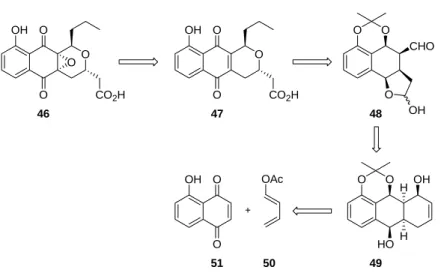
Retrosynthetic analysis of the synthesis (Scheme 1) shows that two of the groups, Woodward37-39 and Boeckman,40 used the Diels-Alder reaction as the key ring-forming step. Removal of the silyl protecting group then opened the anhydride and consequently closed the 5-membered lactone ring.

Epoxides: frenolicin B, dynemicin A, fusicogigantone A, SF 2315B, diepoxin
- Frenolicin B
- Dynemicin A
- Fusicogigantone A
- SF 2315B
- Diepoxin σ
- Arthrinone
The enediyne bridge could not be closed without the presence of the epoxide (e.g., compound 78); a similar observation was also made by the Myers group (Diagram 13 and discussion thereof). The Diels-Alder reaction of 126 and cyclopentadiene in the presence of borane and ligand 129 proceeded well, giving a yield of 94% ee and 72% of the cycloadduct.
Other propellanes with all-carbon quaternary stereocenters
Bukittinggine
Colombiasin A
The synthesis of the Nicolaou group starts with a catalytic asymmetric Diels-Alder reaction (scheme The reaction between diene 148 and quinone 149 in the presence of [(S)-BINOL-TiCl2] yielded the Diels-Alder adduct 147 after aromatization , methylation and desilylation in 94% ee and 85:15 regioselectivity.The Rychnovsky group used a Lewis acid-catalyzed Diels-Alder reaction between diene 152 and quinone 149 to initiate the synthesis of the colombiasin A ring system (Scheme 28). 115 The reaction gave a 1.7:1 mixture of 151 and 151' that could only be separated in the final step of the synthesis, despite previous attempts to do so. The final cyclization of diene 150 (and 150') was performed in the same manner as that used in the Nicolaou synthesis, followed by deprotection of the C16 methoxy group and separation of the diastereomers, yielding (–)-colombiasin A ( 145 ).
As the penultimate step, an intramolecular Diels–Alder reaction provided the tetracycle in a manner similar to the Nicolaou (Scheme 27) and Rychnovsky (Scheme 28) syntheses. They used an enantioselective double Diels–Alder approach to construct the tetracyclic framework of colombiasin A. As a source of chirality, they use sulfoxide 161, which, after the first enantioselective Diels–Alder reaction, eliminates to give the substrate for the second intramolecular Diels–Alder reaction.
Modhephene
- Acid catalyzed rearrangement
- Thermal rearrangement
- Photochemical rearrangement
- Anionic cyclization
- Radical reaction
Their strategy is similar to Rychnovsky's (Scheme 28), but differs in execution of the actual route. Due to the number of syntheses published, only the key ring-forming steps of each synthesis will be shown. The stereoselective installation of the C8 methyl group has been one of the greatest challenges in the synthesis of modhefene, further complicated by diastereomer separation problems.
It is interesting to note the similarity of the strategy to the Tobe group's synthesis of marasmic acid (4) in Scheme 4. An anionic cyclization has been used by three research groups during their synthesis of modhephene (Scheme 35). Kraus and Shi have published a formal total synthesis of modhephene using a rearrangement of the bridging bromide 192 with the dimethyl methyl phosphonate anion followed by a potassium hydride-mediated cyclization of the resulting potassium phosphonate.
Propellanes with lactones
Ginkgolide B
The first ring-forming step in the Corey group synthesis of xingolide B175,176,a was the internal cycloaddition of the ketene-olefin (Scheme Treatment of acid 217 with oxalyl chloride afforded the corresponding acid chloride (213, see Scheme 37), i which was then eliminated with tributylamine to form the ketene. The ketene immediately underwent cycloaddition followed by elimination of the anomeric methoxy group to give the tetracyclic ketone 212. Treatment of 219 with acid then provided the ABCDE ring fragment of xingolide B (211). , which also contains a [3.3 .3]propellant structure.
The first key ring-forming transformation in the Crimmins group's synthesis of ginkgolide B (Scheme) was a [2+2] photocycloaddition of enoate 216, which proceeded with remarkable efficiency and stereoselectivity to give a single cycloadduct 220 in quantitative yield. The E-ring of ginkgolide B was then closed via a sequence of silyl deprotection, mesylation, and acid-catalyzed cyclization.Next, the cyclobutane ring was opened with a retroaldol fragmentation via a one-pot selenylation-elimination sequence followed by epoxidation of the C10-C11 double bond to provide the dialdehyde hydrate 221.
Merrilactone A
Alder reaction of diene 228 and dimethylmaleic anhydride (229) (Scheme 41).184 After reducing the C14-carbonyl (merrilactone A) regioselectively, ozonolysis effected the opening of the 6-membered ring. This was followed by an aldol condensation to close the 5-membered ring to give enal 235. Reduction of the aldehyde gave way to the Johnson ortho ester variant of the Claisen rearrangement, which afforded a 1:1.8 mixture of esters (226). which was then hydrolyzed.
Selenylation at C10, bromoselenylation of the terminal vinyl group, and oxidative deselenylation gave the cyclization precursor 225. Exposure of vinyl bromide 225 to tributyltin hydride and AIBN then caused the formation of the [3.3.3]propellane 237 double bond by ex-isomeric bond. epoxidation and acid-catalyzed homo-Payne rearrangement following the procedure of Fukuyama and co-workers188 produced (±)-merrilactone A (224) in 71% yield over two steps.
Indole alkaloids
Kopsanone and lapidilectine B
The syntheses by the Natsume202,203 and Kuehne204 groups use the same methods to accommodate the [4.3.3]propelane ring system, so only the earlier synthesis by the Kuehne group is discussed in detail here (see Scheme 48). The Kerr group also published an approach to copsan alkaloids.205 A key step in the first published copsanone synthesis by Magnus et al. Lapidilectin B (270) was isolated from Kopsia lapidilecta in 1992208 and synthesized by Pearson's group (Scheme). The main features of the synthesis of this polycyclic indole alkaloid include the Smalley azido-enolate cyclization to form the indoxy core of the molecule.
In the Kuehne group synthesis of kopsanon (Scheme 50)204, the key pentacyclic intermediate 276 arose from a modification of a biomimetic secodin cyclization that they had extensively investigated.211 Benzylation of the indole nitrogen and oxidative elimination of the selenyl group yielded N-oxide . 267, which was ready for the Diels–. Heating of diene 267 with phenylvinyl sulfone effected the formation of hexacycle 277 upon reduction of the double bond and the sulfone with Raney nickel. Allylation of the ketone followed by oxidative cleavage of the diol and treatment with camphor sulfonic acid yielded methyl acetal 279. Removal of the Teoc group from the pyrroline nitrogen and treatment of the remaining salt with diisopropylethylamine yielded (±)-lapidilectin B (270).
Other alkaloids
Annotinine
Cepharamine and the hasubanan skeleton
In the Ibuka group's synthesis of cepharamine (290) (Scheme), the key ring-forming step was the formation of the CD ring system. In the formal total synthesis of cepharamine by the Tahk group (Scheme 53),219 the CD ring system was formed by treatment of cyclopropyl ketone 287 with methylamine to give the ring expansion product 288. The Schultz group's strategy for the synthesis of cepharamine differs significantly from the previous syntheses (Scheme 53).220 The key step in their synthesis was a radical cyclization of 293 followed by hydrolysis of the formate ester to give ABC- the ring fragment 294.
This alcohol was then converted in three steps into (+)-cefaramine, the unnatural enantiomer of the molecule. The key transformation in the Evans group approach is a Diels–Alder reaction between tetrahydrobenzindole 296 and sulfoxide 297, creating the tetracycle Bruderer et al. An acid-catalyzed cyclization then yielded tetracycle 302,229. The latest synthesis of the hasubanan skeleton by the Mulzer group involves an intramolecular 1,3-dipolar cycloaddition of 304 followed by a subsequent elimination of N to give aminoenone 306,230.
Bathrachotoxinin A
Summary
Synthesis of DEFG ring system of cneorin C
- Introduction: cneorins
- Synthesis of DEFG ring fragment: the early steps
- Enantioselective synthesis of furyl substituted allyl alcohol 321
- Enantioselective alkylation
- CBS reduction
- Kinetic resolution by Sharpless asymmetric epoxidation
- Enzymatic kinetic resolution
- Intramolecular cyclopropanation of diazomalonates
- Preparation of diazomalonates
- Model studies
- The actual substrates
- Synthesis of DEFG ring fragment: closing the rings
- The ethyl ester
- The t-butyl ester
- Synthesis of DEFG ring fragment: the quest to remove the sulfone
- Conclusions
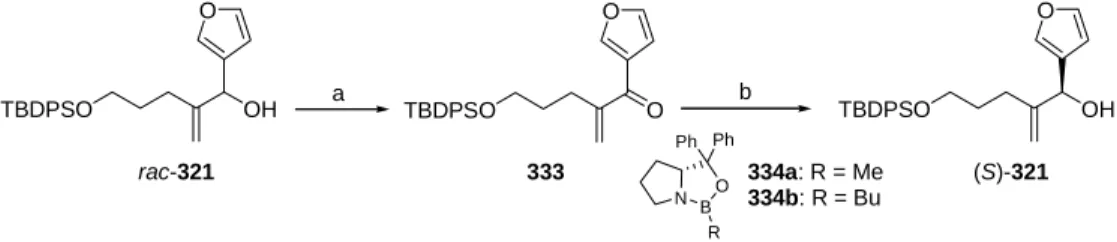
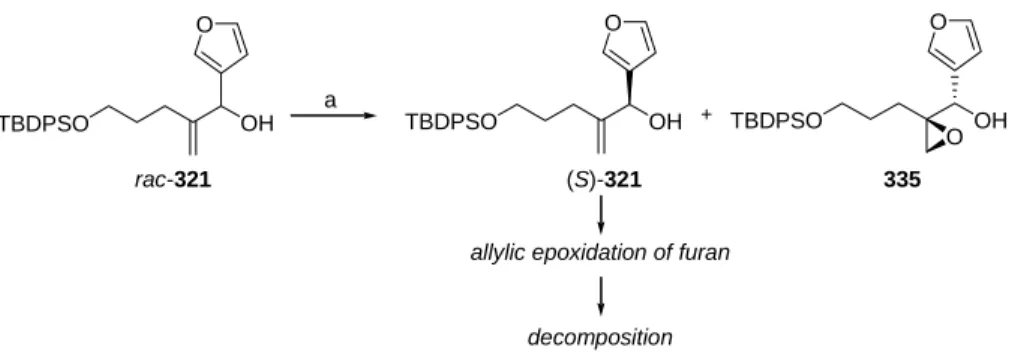
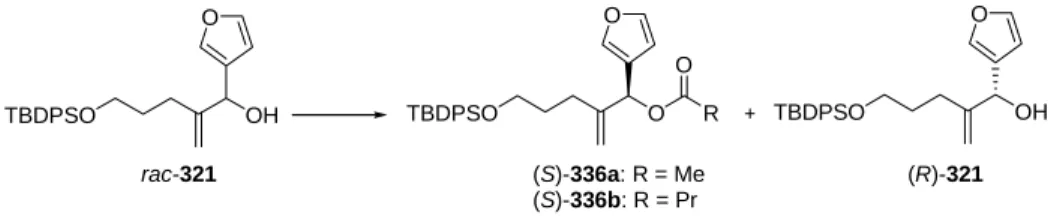
The synthesis of the DEFG ring system of cneorin C can thus be divided into three smaller sub-goals: (1) efficiently and enantioselectively securing access to the allylic alcohol (S)-321, (2) carrying out the cyclopropanation reaction to EFG ring to be delivered. fragment and (3) closing the D-ring to obtain the [4.3.1]propellan structure. The absolute configurations of the reduction and epoxidation products ((S)-321 and 335) and resolution products ((R)-321 and (S)-336) are based on Mosher ester analysis277-279 of (S)-321 (see the experimental section for details) and then on comparison with the corresponding peaks in the chromatogram. The effervescence of the reaction mixture served as a clear indicator of the formation of the carbenoid species.
Typically, heating of the reaction mixture increased until effervescence occurred, after which the reaction temperature was maintained. All that remained to be accomplished before the cyclization was the transformation of the protected hydroxyl unit in the cyclopropanol lactone to a sulfone. However, when the reductive removal of the sulfone was attempted, very disappointing results were obtained (Scheme 72).

Experimental section
General experimental
Synthesis of alcohol (S)-321
- Alcohol rac-321 from vinyl bromide 331
- General procedure for the CBS-reduction
- Resolution of rac-321 by Sharpless asymmetric epoxidation
- Resolution of rac-321 by lipase-catalyzed acylation
- Hydrolysis of butanoate (S)-336b
The aqueous layer was extracted with EtOAc (3 x 20 mL) and the combined organic extracts were washed with brine, dried, filtered and concentrated. The phases were separated, the aqueous phase was extracted with EtOAc (3 x 5 mL) and the organic extracts were washed with brine, dried, filtered and concentrated. After stirring for 30 min, the mixture was filtered through a cotton plug, the phases were separated and the aqueous phase was extracted with CH 2 Cl 2 (3 x 20 mL).
The reactions were typically performed as small-scale experiments at room temperature (22-24 °C), where the acyl donor (0.1 M) was added to the solution (0.05 M) of rac-321 in an organic solvent and one of the enzymes. preparations (25 mg/ml) were added to start the reaction. The aqueous layer was extracted with EtOAc (3 x 5 ml) and the organic extracts were washed with brine, dried, filtered and concentrated.
Analysis of stereochemistry of (S)-321 by the Mosher ester method
Model compounds for the intramolecular cyclopropanation
- General procedure for preparation of malonates
- Ethyl-2-methyl-1-phenylallyl malonate (342)
- Ethyl-1-furan-3-yl-2-methylallyl malonate (343)
- Ethyl-5-(tert-butyldimethylsilanyloxy)-1-furan-3-yl-2-methylenepentyl
- tert-Butyl-5-(tert-butyldimethylsilanyloxy)-1-furan-3-yl-2-methylenepentyl
- General procedure for preparation of diazomalonates
- Ethyl-2-methyl-1-phenylallyl diazomalonate (348)
- Ethyl-1-furan-3-yl-2-methylallyl diazomalonate (349)
- Ethyl-5-(tert-butyldimethylsilanyloxy)-1-furan-3-yl-2-methylenepentyl
- tert-Butyl-5-(tert-butyldimethylsilanyloxy)-1-furan-3-yl-2-
- General procedure for preparing the catalytic complexes for
- General procedure for cyclopropanation of diazomalonates
The phases were separated, the aqueous phase was extracted with EtOAc (3 × 10 mL) and the organic extracts were washed with brine, dried, filtered and concentrated. The aqueous phase was extracted with EtOAc (2 × 10 mL), washed with brine, dried, filtered, and concentrated. The residue was dissolved in Et2O and the resulting solution was washed twice with K2CO3 (10% aqueous solution), dried, filtered and concentrated.
The solution was heated to the temperature at which the mixture began to explode and turned brown. After all diazo compounds were consumed as judged by TLC, the solution was cooled to rt and concentrated. The residue was dissolved in MTBE, stirred with activated carbon for 5 min, filtered through a pad of Celite ® , and concentrated.
The route with TBDPS-protection and ethyl ester
- Ethyl-5-(tert-butyldiphenylsilanyloxy)-(1S)-furan-3-yl-2-methylenepentyl
- Ethyl-5-(tert-butyldiphenylsilanyloxy)-(1S)-furan-3-yl-2-methylenepentyl
- Ketosulfone 362
The aqueous phase was extracted with EtOAc (3 × 3 mL) and the organic extracts were washed with brine, dried, filtered and concentrated. 5 mL) and brine, dried, filtered and concentrated. NH4Cl (1 mL) was added, the biphasic mixture was concentrated, and the aqueous phase was extracted with 25% EtOH in CHCl3 (10 × 1 mL), dried, filtered, and concentrated. The aqueous phase was extracted with EtOAc (3 × 2 mL) and the organic extracts were washed with brine, dried, filtered, and concentrated.
The route with TBDPS protection and t-butyl ester
- tert-Butyl-5-(tert-butyldiphenylsilanyloxy)-(1S)-furan-3-yl-2-
- tert-Butyl-5-(tert-butyldiphenylsilanyloxy)-(1S)-furan-3-yl-2-
- Ketosulfone 362
- Methyl ketone 367
- Hydroxysulfone 371
- Vinyl sulfone 372
The aqueous phase was extracted with EtOAc (3 x 10 mL) and the organic extracts were washed with brine, dried, filtered and concentrated. The aqueous phase was extracted with CH 2 Cl 2 (3 x 3 mL) and the organic extracts were washed with brine, dried, filtered and concentrated. The aqueous phase was extracted with EtOAc (3 x 3 mL), washed with brine, dried, filtered and concentrated.
The aqueous phase was extracted with EtOAc (2 × 5 mL) and the organic extracts were washed with brine, dried, filtered and concentrated. The aqueous phase was extracted with CH2Cl2 (3 × 3 mL) and the organic extracts were washed with brine, dried, filtered and concentrated.