Reduction of industrial persistent organic pollutant chemicals in manufacturing and recycling sectors through life-cycle approaches in Georgia
Part I: Project Information GEF ID
11005 Project Type MSP
Type of Trust Fund GET
CBIT/NGI CBIT No NGI No Project Title
Reduction of industrial persistent organic pollutant chemicals in manufacturing and recycling sectors through life-cycle approaches in Georgia
Countries Georgia Agency(ies) UNIDO
Other Executing Partner(s)
Regional Environmental Centre for the Caucasus (REC Caucasus) Executing Partner Type
Others
GEF Focal Area Chemicals and Waste Taxonomy
Focal Areas, Chemicals and Waste, Persistent Organic Pollutants, New Persistent Organic Pollutants,
Influencing models, Strengthen institutional capacity and decision-making, Demonstrate innovative approache, Transform policy and regulatory environments, Stakeholders, Communications, Awareness Raising, Civil Society, Non-Governmental Organization, Private Sector, Large corporations, Beneficiaries, Type of Engagement, Information Dissemination, Gender Equality, Gender Mainstreaming, Sex-disaggregated indicators, Gender-sensitive indicators, Gender results areas, Capacity Development, Capacity, Knowledge and Research, Knowledge Generation, Knowledge Exchange, Learning, Indicators to measure change, Theory of change
Sector
Mixed & Others Rio Markers
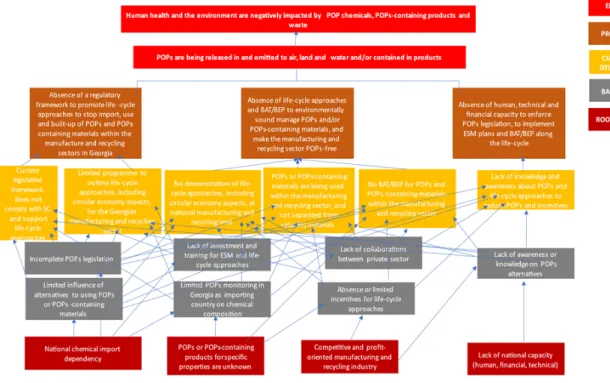
Climate Change Mitigation Climate Change Mitigation 0 Climate Change Adaptation Climate Change Adaptation 0
Submission Date 4/13/2022
Expected Implementation Start 7/1/2022
Expected Completion Date 6/30/2025
Duration 36In Months Agency Fee($) 190,000.00
A. FOCAL/NON-FOCAL AREA ELEMENTS Objectives/Programs Focal Area
Outcomes Trust
Fund GEF
Amount($) Co-Fin Amount($)
CW-1-1 Strengthen the sound
management of
industrial chemicals and their waste through better control, and reduction and/or elimination
GET 2,000,000.00 14,600,000.00
Total Project Cost($) 2,000,000.00 14,600,000.00
B. Project description summary
Project Objective
Protect human health and the environment through a lifecycle approach aimed at reducing import, use and build-up of industrial persistent organic pollutants (POPs) in manufacturing and recycling sectors.
Project Componen t
Financin
g Type Expected
Outcomes Expected
Outputs Trus
t Fun d
GEF Project Financing(
$)
Confirmed Co- Financing($)
Project Componen t
Financin g Type
Expected Outcomes
Expected Outputs
Trus t Fun d
GEF Project Financing(
$)
Confirmed Co- Financing($)
1. Policy strengthening by
integrating a life-cycle approach into the existing legislative framework to prevent future build- up of POPs in
manufacturin g and recycling sectors
Technical
Assistance 1. Enhanced national policy and regulatory framework to comply with the Stockholm Convention (SC) requirements on new POPs and
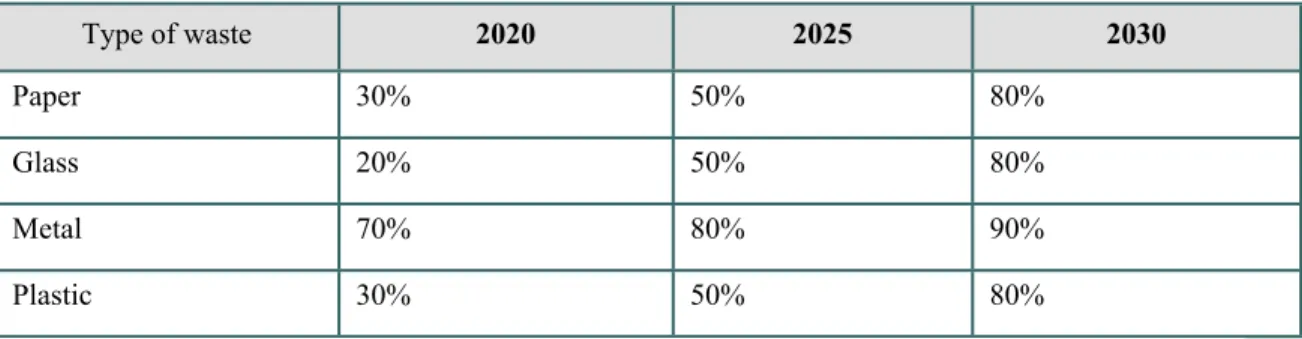
implement national circular economy tools in selected manufacturing and recycling sectors
1.1. New POPs integrated in the existing environmental regulation and in the
regulation on chemical management
1.2. Policy tools (e.g customs monitoring tools, EPR schemes), including financial mechanism, with a focus on phase out of industrial POPs developed for selected manufacturing sectors as one of the pillars of the
implementatio n of circular economy in Georgia
1.3 Country specific guidelines for the phase out of industrial POPs
throughout the life-cyle drafted
GET 590,000.00 2,200,000.00
Project Componen t
Financin g Type
Expected Outcomes
Expected Outputs
Trus t Fun d
GEF Project Financing(
$)
Confirmed Co- Financing($)
2. Life-cycle approaches and BAT/BEP for the reduction of POPs in the manufacturin g and recycling sectors implemented
Investmen
t 2. POPs
present in manufacturing or recycling sectors are disposed of using best available technologies (BAT) and best
environmental practices (BEP), and future POPs- containing material build-up prevented though life- cycle approaches reduction and phasing out of POPs in the manufacturing and recycling sectors implemented
2.1
Verification of
manufacturing sectors potentially using or releasing industrial POPs like HBCDD (EPS/XPS manufacturing, plastic), SCCP (paint
manufacturing ),
PFOS/PFOAs and PBDE (ELV recycling) carried out 2.2. Specific environmentall y sound management plans (ESM) for
manufacturing and recycling sectors to reduce POPs, recycle valuable materials and final disposal of POPs- containing waste 2.3 BAT and BEP for the reduction and final disposal of POPs in manufacturing and recycling sectors to facilitate the adoption of a circular approach for a POPs-free manufacturing and recycling industry, in at least one pilot facility
GET 760,000.00 6,700,000.00
Project Componen t
Financin g Type
Expected Outcomes
Expected Outputs
Trus t Fun d
GEF Project Financing(
$)
Confirmed Co- Financing($)
3. Capacity building and knowledge management
Technical Assistance 3
Environmenta l authority, manufacturing and recycling sectors are empowered to phase out industrial POPs releases with positive effect on the establishment of a circular economy approach along the lifecycle of products
3.1. Multi- stakeholder platform created to sustain the phasing out of industrial POPs and ensure the timely exchange of information and resources among business sectors and the regulators 3.2. Capacity- building training, including gender dimensions, for selected manufacturing sectors, governmental stakeholders carried out on POPs and circular economy, and custom authorities strengthened to prevent the import of POP containing materials 3.3.
Knowledge materials on POP management and their implication on circular economy developed and disseminated to wide range of
stakeholders, including business sector
GET 370,000.00 3,572,727.00
Project Componen t
Financin g Type
Expected Outcomes
Expected Outputs
Trus t Fun d
GEF Project Financing(
$)
Confirmed Co- Financing($)
Component 4:
Monitoring and evaluation through results-based monitoring
Technical
Assistance 4. Project implementatio n based on results-based management (RBM) and lessons learned/good practices documented and
disseminated
4.1. RBM system and adaptive management promoted through capturing key results of the project 4.2. Gender mainstreaming action plan and environmental and social management plan elaborated and
implemented 4.3. Gender- Sensitive Project Monitoring &
Evaluation Plan in place 4.4. Mid-term review and terminal evaluation conducted
GET 100,000.00 800,000.00
Sub Total ($) 1,820,000.0
0 13,272,727.0 0
Project Management Cost (PMC)
GET 180,000.00 1,327,273.00
Sub Total($) 180,000.00 1,327,273.00
Total Project Cost($) 2,000,000.00 14,600,000.00
Please provide justification
Please find project justification starting from paragraph 1 later in this document
C. Sources of Co-financing for the Project by name and by type Sources of
Co- financing
Name of Co-financier Type of Co- financing
Investment
Mobilized Amount($)
Recipient Country Government
Ministry of Environmental Protection and Agriculture of Georgia (MEPA)
In-kind Recurrent expenditures
450,000.00
Other REC Caucasus In-kind Recurrent
expenditures
2,050,000.00
Other REC Caucasus Equity Investment
mobilized 2,000,000.00 Private
Sector Eco Service Georgia In-kind Recurrent
expenditures 4,020,000.00 Private
Sector Medical Technology In-kind Recurrent
expenditures 6,030,000.00
GEF Agency UNIDO In-kind Recurrent
expenditures 50,000.00 Total Co-Financing($) 14,600,000.00 Describe how any "Investment Mobilized" was identified
Project co-financing was identified during consultation led by UNIDO and the REC Caucasus as the Project Executing Entity (referred to in the document as PEE or lead executing agency). "Eco Service Georgia" is a leading company in the field of waste management. The company provides waste disposal and recycling services to the private sector. The in-kind co-financing committed by the company for the three-year period of the Project implementation will be provided in the form of: - Human Resources Cost:
Companys?s personnel/staff time directly contributing to project activities - Travel and Subsistence Costs:
travel expenses (transportation and per diems) related to participation of Company?s personnel/staff in the Project meetings, conferences, workshops and field visits; - Office Space and Equipment Costs: use of Company?s office space and equipment for the Project?s needs. Ltd. "Medical Technologist" was established in 2010 and provides services to pharmaceutical, medical, industrial, chemical and other companies for waste disposal (incineration). The company also carries out treatment of hazardous waste, which can be treated as solid municipal waste. Company scope of activities include: de-mercurisation of mercury-containing waste, regeneration (recovery) of used oils, processing of electrical equipment, dismantling and processing of used vehicles, collection and disposal of pharmaceutical, laboratory and medical waste. The in-kind co-financing for the three-year period of the Project implementation will be provided in a form of: - office Space and equipment allocated for the project?s needs, - time spent by company?s employees for the planning and implementation of the project activities, - co-investment in
BAT/BEP for POPs-free manufacturing and recycling processes, - travel and accommodation cost of company staff participating in project?s events and steering committee meetings . REC Caucasus is currently implementing three projects: (i) ?Supporting the update of the National Waste Management Strategy 2016-2030 and Action plan 2022-2026? - ?European Union for Environment (EU4
Environment)?; (ii) ?Enhancing national capacities, reporting and synergies between Basel, Rotterdam, Stockholm and Minamata Conventions and SAICM for the sound management of chemicals and waste in Georgia? ? funded by Special Programme Trust Fund; (iii) ?Institutional capacity building for chemical safety and security in Georgia? ? funded by the State Department of USA. These three projects amount to a total of 2,000,000 USD, which will directly contribute to the activities and objectives GEF Project. In addition, REC Caucasus, will support project activities with a total of USD 2,050,000 in-kind co-financing in the form of voluntary labor, provision of meeting and office premises, use of vehicles and equipment.
D. Trust Fund Resources Requested by Agency(ies), Country(ies), Focal Area and the Programming of Funds Agenc
y Tru
st Fun d
Count
ry Focal
Area Programmi ng of Funds
Amount($) Fee($) Total($)
UNID
O GET Georgia Chemica
ls and Waste
POPs 2,000,000 190,000 2,190,000.
00
Total Grant Resources($) 2,000,000.
00 190,000.
00 2,190,000.
00
E. Non Grant Instrument
NON-GRANT INSTRUMENT at CEO Endorsement
Includes Non grant instruments? No Includes reflow to GEF? No
F. Project Preparation Grant (PPG) PPG Required false
PPG Amount ($)
PPG Agency Fee ($)
Agenc
y Trust
Fund Country Foca l Area
Programmin
g of Funds Amount($) Fee($
) Total($
)
Total Project Costs($) 0.00 0.00 0.00
Core Indicators
Indicator 6 Greenhouse Gas Emissions Mitigated Total Target Benefit
(At PIF)
(At CEO Endorsement)
(Achieved at MTR)
(Achieved at TE) Expected metric tons of
CO?e (direct) 0 0 0 0
Expected metric tons of CO?e (indirect)
0 81000 0 0
Indicator 6.1 Carbon Sequestered or Emissions Avoided in the AFOLU (Agriculture, Forestry and Other Land Use) sector
Total Target Benefit (At
PIF) (At CEO
Endorsement) (Achieved
at MTR) (Achieved at TE) Expected metric tons of
CO?e (direct)
Expected metric tons of CO?e (indirect)
Anticipated start year of accounting
Duration of accounting
Indicator 6.2 Emissions Avoided Outside AFOLU (Agriculture, Forestry and Other Land Use) Sector Total Target Benefit (At
PIF) (At CEO
Endorsement) (Achieved
at MTR) (Achieved at TE) Expected metric tons of
CO?e (direct)
Expected metric tons of
CO?e (indirect) 81,000
Anticipated start year of accounting
Duration of accounting
Indicator 6.3 Energy Saved (Use this sub-indicator in addition to the sub-indicator 6.2 if applicable)
Total Target Benefit
Energy (MJ) (At PIF)
Energy (MJ) (At CEO
Endorsement)
Energy (MJ) (Achieved at MTR)
Energy (MJ) (Achieved at TE)
Target Energy Saved (MJ)
Indicator 6.4 Increase in Installed Renewable Energy Capacity per Technology (Use this sub-indicator in addition to the sub-indicator 6.2 if applicable)
Technolog y
Capacity (MW)
(Expected at PIF)
Capacity (MW) (Expected at CEO Endorsement)
Capacity (MW)
(Achieved at MTR)
Capacity (MW) (Achieved at TE)
Indicator 9 Reduction, disposal/destruction, phase out, elimination and avoidance of chemicals of global concern and their waste in the environment and in processes, materials and products (metric tons of toxic chemicals reduced)
Metric Tons (Expected at PIF)
Metric Tons (Expected at CEO Endorsement)
Metric Tons (Achieved at MTR)
Metric Tons (Achieved at TE)
0.00 50.00 0.00 0.00
Indicator 9.1 Solid and liquid Persistent Organic Pollutants (POPs) removed or disposed (POPs type)
POPs type
Metric Tons (Expected at PIF)
Metric Tons (Expected at CEO
Endorsement)
Metric Tons (Achieved at MTR)
Metric Tons (Achieved at TE) SelectHexabromocyclodo
decane (HBCDD) 50.00
Indicator 9.2 Quantity of mercury reduced (metric tons)
Metric Tons (Expected at
PIF) Metric Tons (Expected at CEO Endorsement)
Metric Tons (Achieved at MTR)
Metric Tons (Achieved at TE)
Indicator 9.3 Hydrochloroflurocarbons (HCFC) Reduced/Phased out (metric tons) Metric Tons
(Expected at
PIF) Metric Tons (Expected at CEO Endorsement)
Metric Tons (Achieved at MTR)
Metric Tons (Achieved at TE)
Indicator 9.4 Number of countries with legislation and policy implemented to control chemicals and waste (Use this sub-indicator in addition to one of the sub-indicators 9.1, 9.2 and 9.3 if applicable)
Number (Expected at PIF)
Number (Expected at CEO Endorsement)
Number (Achieved at MTR)
Number (Achieved at TE)
Indicator 9.5 Number of low-chemical/non-chemical systems implemented, particularly in food production, manufacturing and cities (Use this sub-indicator in addition to one of the sub-indicators 9.1, 9.2 and 9.3 if applicable)
Number (Expected at
PIF) Number (Expected at CEO Endorsement)
Number (Achieved at MTR)
Number (Achieved at TE)
Indicator 9.6 Quantity of POPs/Mercury containing materials and products directly avoided Metric Tons
(Expected at
PIF) Metric Tons (Expected at CEO Endorsement)
Metric Tons (Achieved at MTR)
Metric Tons (Achieved at TE)
1,795.00
Indicator 11 Number of direct beneficiaries disaggregated by gender as co-benefit of GEF investment Number
(Expected at PIF)
Number (Expected at CEO Endorsement)
Number (Achieved at MTR)
Number (Achieved at TE)
Female 400
Male 600
Total 0 1000 0 0
Provide additional explanation on targets, other methodologies used, and other focal area specifics (i.e., Aichi targets in BD) including justification where core indicator targets are not provided
Part II. Project Justification
1a. Project Description
1) The global environmental and/or adaptation problems, root causes and barriers that need to be addressed (systems description);
1. Persistent organic pollutants (POPs) are organic compounds that are resistant to
environmental degradation through chemical, biological, and photolytic processes. They are toxic chemicals that adversely affect human health and the environment. The Stockholm Convention on Persistent Organic Pollutants, an international environmental treaty adopted in 2001, aims to eliminate or restrict the production and use of POPs. The initial meeting in 2001 made a preliminary list of twelve chemicals (the "dirty dozen?) that are classified as POPs.
2. After the initial 12 POPs, several ?new? POPs were listed in the Annexes A or B of the Stockholm convention, as summarized in the list below:
COP number COP date Substances
Dicofol COP 9 29/04 to 10/05 2019
Perfluorooctanoic acid, its salts and PFOA- related compounds
Decabromodiphenyl ether Short-chain chlorinated paraffins COP 8 24 April to 5 May 2017
Hexachlorobutadiene Polychlorinated naphthalenes Hexachlorobutadiene
COP 7 4 to 15 May 2015
Pentachlorophenol and its salts and esters
COP 6 28 April?10 May 2013 Hexabromocyclododecane
COP 5 25-29 April 2011 Endosulphan
Chlordecone Hexachlorobyphenil Pentachlorobenzene Lindane
Alpha hexachlorocyclohexane Beta hexachlorocyclohexane
Tetrabromodiphenyl ether and pentabromodiphenyl ether (commercial pentabromodiphenyl ether)
Hexabromodiphneyl ether and heptabromodiphenyl ether (commercial octabromodiphneyl ether)
COP 4 4-8 May 2009
Perfluorooctane sulfonic acid, its salts and perfluorooctane sulfonyl fluoride (PFOS)
3. Currently, the following may be considered as ?industrial POPs?, as they have been or are still used in industrial processes, including recycling of waste materials.:
? commercial PBDE mixtures (c-deca, c-tetra, c-penta, c-hexa and c-hepta BDE);
? Hexabromobiphenyl;
? Hexabromocyclododecane;
? Hexachlorobenzene;
? Hexachlorobutadiene;
? Pentachlorobenzene;
? PFOS and PFOAs;
? Short Chain Chlorinated Paraffins (SCCP);
4. With the exception of PFOS, (listed under annex B) all these chemicals are listed under Annex A of the Stockholm Convention (elimination) and should therefore be phased out from any industrial process.
5. The EU risk assessment documents and the Stockholm Convention Risk profiles identify, among others, polymers plastic, paint manufacturing and food packaging as potential sectors using POPs Brominated Flame Retardants, (including PBDEs, HBCDD), PFOS/PFOAs and SCCP. New POPs, like PFOS and SCCP are also used in other manufacturing sectors, like the electro-plating industry and the paint manufacturing industry.
6. For some POPs, one of the main issues in preventing industrial use is the variety of commercial names under which they are marketed. Moreover, these chemicals may be sold as mixtures. A number of commercial products, including paint and foam, do not contain information on POPs in their label or label verification review. Therefore, industries may not be aware that the chemicals they use contain POPs. This is the case, for instance, of the several brominated flame retardants classified as POPs, like the HBCDD, which is marketed with at least 40 different names; or the SCCP mixtures, which may contain different POPs chemicals and are sold with not less than 60 different commercial names . 7. Based on the Stockholm Convention risk profiles, around 18,000 tons of HBCDD were produced in 2010; around one million tons of chlorinated paraffins (inclusive of SCCP species not entirely classified as POPs) were produced in 2009. Based on a research carried out by Oeko Institute for ACEA (the European Association of Car Manufacturers, deca-BDE has been used in the manufacturing of specific car components (including cabling) until 2017, with a concentration range between 10 and 21%. SCCP may be used in certain products (like rubberized paints) in concentration ranging from 10% to 15%.
8. Moreover, POPs use or release in the manufacturing industry depends on each sector and national regulatory framework. For instance, in countries where fire prevention policies require strict flammability standards, the import, manufacture and use of brominated flame retardants, including POPs, is more likely to occur.
9. Similarly, in countries such as Georgia where the import of hazardous chemicals and POPs is not adequately controlled, the import of POP chemicals can still occur. Besides, there is a limited number of POPs which are still manufactured or used in industrial processes, like PFOS, PFOAs, some SCCP, HBCDD, whilst the production of other POPs has ceased almost everywhere. However, large chemical industries manufacturing brominated or chlorinated POPs, like HBCDD or SCCP, need now to reconvert their production to non- POPs chemicals, with significant impact on the manufacturing chain downstream. The issue of POPs in industry may therefore be summarized as follows:
a) The chemical industry is still producing POPs like SCCP, PFOS/PFOAs, HBCDD;
b) The manufacturing industry is still importing and using POPs including the limited amount of deca- BDE which may still be available, or PFOS, PFOAs, SCCP, HBCDD;
c) POPs like HBCDD, c-PBDEs, PFOS, PFOAs are present in end of life products recycled or reused in industrial processes.
10. Given the situation outlined above, and the fact that Georgia does not have any chemical industry manufacturing POP, the issue related to POPs in the manufacturing and recycling industry mostly relate to three areas:
? Import of POPs chemicals or POPs-containing products,
? Manufacturing of products using imported POPs chamicals or POPs-containing products (like insultaing foam in buildings using HBCDD, special paints using SCCP, food packaging or cookware with PFOS/PFOAs surface treatment),
? Presence of POPs in recycled materials (like POP-PBDEs in electronics and end-of-life vehicles).
11. COVID-19 situation strongly impacted Georgia and led to. negative short-term economic growth, decline in employment and foreign direct investments.
(https://www.un.org/development/desa/dpad/wp-
content/uploads/sites/45/publication/CDP_Comprehensive_Study_2021.pdf), leading to national lock- downs, restrictions and other COVID-19 related issues.
12. In line with UNIDO common response to COVID-19, UNIDO actively contributed to efforts of the international community, including the G20, and the United Nations. As a specialized agency of the UN, UNIDO?s mandate is to promote inclusive and sustainable industrial development.
UNIDO?s response framework is to prepare and contain, respond and adapt, and recover and transform. The UNIDO approach is strategically aligned and synergized with:
? The United Nations ?Framework for the immediate socio-economic response to COVID-19? to implement the Secretary General?s report ?Shared responsibility, global solidarity: Responding to the Socioeconomic impacts of COVID-19?
? The 2030 Agenda for Sustainable Development, and the UN Decade of Action calling for the acceleration of sustainable solutions to all the world?s biggest challenges
? The UN 75th Anniversary ?The World Needs Solidarity?, prioritizing the human family and how we can build a better future for all. Thus, the following applicable but revised COVID-19 measures related to this project will be applied:
13. Potential COVID-19 risks have also been incorporated into the risk table to ensure proper mitigation measures, in case the pandemic will continue to impact the participating countries during the project duration. COVID-19 risks and opportunities are described in the CEO approval risk section.
1.1. Root causes and barriers
14. Root causes and barriers of POPs chemicals and waste problems in Georgia is related to a large reliance on imports without sufficient policy and regulatory framework. Root causes are also linked to a lack of technical and financial capacity to implement life-cycle approaches, including environmentally sound final disposal, and circular economy approach for manufacturing and recycling sector.
15. The below problem tree presents the main barriers, which need to be addressed during the project, and their consequence (Figure 1):
Figure 1: Problem tree
? Incomplete POPs legislation related to new industrial POPs;
? Limited influence of alternatives to POPs or POPs-containing materials;
? Lack of investment and training for ESM and life-cycle approaches related to new industrial POPs;
? Limited POPs monitoring on the basis of chemical composition;
? Lack of collaboration within the private sector on finding environmentally sound ways to deal with industrial POPs;
? Absence of or limited incentives for life-cycle approaches dealing with industrial new POPs;
? Lack of awareness or knowledge on alternatives to new industrial POPs.
2. The baseline scenario and any associated baseline projects.
Baseline scenario
16. In the absence of the proposed GEF project, industrial POPs and POPs-containing materials will continue to be imported, used and built-up in the country, which does not have sufficient technical and financial capacity to reduce, separate, replace and dispose of POPs chemicals or POPs- containing materials in an environmentally sound manner. There is also not enough knowledge, expertise and training on BAT/BEP related to sound chemicals disposal, life-cycle approaches or substitution to POPs-free alternatives.
17. Georgia has not benefitted from a GEF-7 project on POPs chemicals, and the current situation may lead to severe build-up and negative impact on human health and the environment.
Workers, who are in direct contact with POPs or POPs-containing chemicals during the manufacturing or recycling process are particularly at risk.
Georgia as party of international conventions on Chemicals
18. Georgia signed the Stockholm convention (SC) on Persistent Organic Pollutants (POPs) on May 23, 2003 and ratified it in April 2006. The aim of SC is to take measures for reducing or eliminating POPs releases from intentional and unintentional production and use, including the releases from existing stockpiles and wastes.
19. Georgia has ratified several multilateral treaties and international conventions like the Basel, Rotterdam, Stockholm and Minamata Conventions. Georgia has also signed the association agreement with the EU which requires incorportating EU laws into national laws, including legislation related to POPs and chemicals and waste management. Detailed description of of the legislative situation can be found in Annex H.
20. In light of the above, Georgia has taken responsibility to develop a national legislation framework on waste and chemical management that would be in line with EU directives and provision of EU policies and legal framework.
21. EU defines circular economy as aiming to ? maintain the value of products, materials and resources for as long as possible by returning them into the product cycle at the end of their use, while minimising the generation of waste (?)This process starts at the very beginning of a product?s lifecycle:
smart product design and production processes can help save resources, avoid inefficient waste management and create new business opportunities.?
22. In general, waste is classified hazardous when it contains hazardous chemicals, whichcannot be directly recycled. POPs-containing waste cannot be recycled, and if the concentration of POPs exceeds the acceptable threshold value, waste cannot be landfilled but should be eliminated with proper technologies.
23. The first NIP of Georgia was developed by the project with financial support from GEF and technical assistance from UNDP and UNITAR in the framework of the project entitled ?on
?Preparation of the Persistent Organic Pollutants (POPs) National Implementation Plan under the Stockholm Convention??. The NIP was adopted by Decree No 907 of April 21, 2011, for the period 2011-2015.
24. Subsequently, in compliance with article 7 of the Convention, Georgia submitted, on May 23rd, 2018, the update and review of the NIP, including action plans for PCBs, POP pesticides, PBDEs, HBCDD, PFOS and related chemicals, and u-POPs. The NIP update does not include yet
inventory or action plans for POPs listed in the Convention after the COP 6, including PFOAs, SCCP, deca-BDE.
25. The estimates related to new POPs in the NIP are as follows:
- PBDE: Georgia has imported and is importing different (used) vehicles manufactured between 1975 and 2004 , which could have PUR foams and textiles containing POP-PBDE. A total amount of 91 tonnes of POP-PBDE, out of which 60 tonnes in passenger cars, 7 tonnes in trucks and 24 tonnes in buses has been estimated. It has been also estimated that around 10000 tons of PUR foam exist in vehicles, which could be partially contaminated by PBDE.
- the estimated amount of POP-PBDEs in cathode ray tube (CRT) electronic equipment (TVs or computer monitors) ranges between 4.4 tonnes to 12.9 tonnes. The total amount of polymeric fraction of the estimated CRTs containing POP-PBDEs is estimated to 5060 tonnes.
26. According to the inventory, HBCDD and PFOS and related chemicals are not produced in Georgia. However materials and products containing HBCDD, PFOS and related chemicals have been imported in Georgia, in particular:
- HBCDD mostly in insulating materials used in the construction sector and special protection uniform - PFOS/PFAS and related substances mainly in firefighting foams, textile, aviation hydraulic fluids and food packaging
27. The NIP inventory has also identified:
- 700 tonnes of insulation foam imported to Georgia containing an estimated amount of between 4000
? 20000 kg (years 2006?2012) of HBCDD,
- 1600 tonnes of special protection uniform imported to Georgia, amouting to 35324 to 240992 kg (years 2006?2014) of HBCDD
- For the period 2006?2014 6600 tonnes of aviation hydraulic fluids were imported to Georgia, amounting to 3338 to 6673 kg of PFOS and related substances ranges
- For the period 2006?2014 340 tonnes of firefighting foams were imported to Georgia amounting to 1647 to 19776 kg of PFOS and related substances ranges
Use of industrial POPs in Georgia.
31. Based on the inventory carried out under the NIP update, the following has been found in term of import / use of POPs:
32. PFOS/PFOAS and related chemicals are currently not manufactured in Georgia. Most of the consumer products and articles containing PFOS and PFOAS enter the country through import, for use or manufacturing of firefighting foams, aviation hydraulic fluids and food packaging.
33. The total estimated amount of PFOS and related chemicals in imported aviation hydraulic
fluids for the period 2006-2014 ranges from 3338 kg to 6673 kg. This estimate is a high estimate since only a minor part of the aviation hydraulic fluids contain PFOS after 3M phased out PFOS in 2002.
34. The total estimated amount of PFOS and related chemicals in imported firefighting foams (AFFF and related foams) for the period 2006-2014 ranges from 1647 kg to 19776 kg. This estimate is an upper estimate since it has not been confirmed that PFOS was actually included in the foams. Only a part of the firefighting foams contain PFOS since 3M stopped PFOS production in 2002 and only China produces PFOS with uses in firefighting foam. No export of PFOS and PFOS containing articles and products are considered for Georgia.
35. SCCP is used in significant quantities as additive in specialized paints like rubberized chlorinated paint used outdoor. SCCP-containing paint is still manufactured in India and China. In Georgia, small companies are active in the paint manufacturing industry. In most cases, paints are imported in Georgia, and SCCP most likely enter as product or mixture rather than as substance.
36. HBCDD: Georgia has never produced and used HBCDD but imports and uses expanded (EPS) and extruded (XPS) polystyrene insulation foam in the construction sector and the textile applications containing HBCDD.The total amount of HBCDD in insulation foam imported in Georgia (700 tonnes of polystyrene insulation foam imported during the period 2006 ? 2012) ranges between 4,000 and 20,000 kg. The estimation can be considered a high one since some of the EPS/XPS insulation material might not contain HBCDD. However, the total amount of imported XPS/EPS is likely higher today since imports also occurred before 2006.
37. HBCDD has been also imported in uniforms imported between 2006 and 2014, for an amount ranging between 35,324 and 240,992 kg. This amount is a high estimate since not all uniforms were treated with HBCDD and the amount could be considerable smaller.
38. PBDEs: Georgia has never produced PBDEs but has imported and used materials and products containing PBDEs such as electrical and electronics products, fire resistant materials, vehicles and possibly other appliances. Preliminary inventory results showed the presence of PBDEs in electrical and electronics products, in the transport sector and in environmental media and human milk.
High concentration of PBDEs have beeen detected in some products and and aroundlandfills and electronic waste recycling scrapyards. However, there is a lack of data on PBDE concentration in products and proper monitoring needs to be implemented.
39. The main challenge concerning PBDEs in Georgia is the end of life management of POP- PBDE containing materials from vehicles and electrical and electronic equipment (EEE) POP-PBDEs have been imported in particular in electrical and electronic equipment (EEE) and in used vehicles prior to 2004. Cathode ray tube (CRT) TVs or computers monitors are no longer on the market but are
still imported in significant quantities as second hand equipment or waste. Old EEE and vehicles produced and imported prior to 2004 also contain POPs and lead to management challenged when reaching end of life.
40. POP-PBDE are mostly found in the plastic casings of end of life cathode Ray Tubes and in PUR foam in used vehicles. In Georgia, there are approximately 675,000 CRTs containing 4.4 to 12.9 tons POP-PBDEs in 5060 tons plastic. The total estimated amount of POP-PBDEs in imported vehicles was 91 tonnes: 60 tonnes in passenger cars, 7 tonnes in trucks and 24 tonnes in buses. The total estimated amount of PUR foam in vehicles l is estimated to approx. 10,000 tonnes where only a share is impacted by PBDEs.
41. As vehicles manufactured before 2005 were not? exported from Georgia, the total number of imported vehicles manufactured before 2005 is the same as the registered number of vehicles currently in the country. Therefore, the total estimated amount of PUR foam and POP-PBDEs in imported vehicles is similar with the total estimated amount of PUR foam and POP-PBDEs in in-use vehicles.
The manufacturing sector in Georgia.
42. In Georgia, economic growth has been solid, averaging 5 percent per year between 2005 and 2019. Sound macroeconomic policies and improved governance led to the rapid decline of poverty, decreasing by half between 2007 and 2019. However, the economy has not created sufficient employment, and many Georgians still remain engaged in low-productivity agricultural activities. In the period 2010-2014, manufacturing grew 9% whilst construction grew at a 6% rate and agriculture 4%.
43. The relative importance of manufacturing sectors in Georgia is reported in the following table. Beside food processing, the five most important sectors in 2020 where manufacture of non metalling products, basic metals, chemicals and chemical products, rubber and plastic products (Table 1).
Economic sector Mil.
GEL (2000)
Mil. GEL (2020)
Growth rate (2020/2000)
% over manufacturing
2000
% over manufacturing
2020
Manufacturing 4,990.8 10,062.4 2.0 100.0 100.0
Manufacture of food
products 1,448.4 2,342.3 1.6 29.0 23.3
Manufacture of other non-metallic mineral
products 606.6 1,340.9 2.2 12.2 13.3
Manufacture of basic
metals 884.3 1,206.3 1.4 17.7 12.0
Manufacture of chemicals
and chemical products 362.0 486.4 1.3 7.3 4.8
Manufacture of rubber
and plastic products 116.8 395.2 3.4 2.3 3.9
Manufacture of wearing
apparel 60.7 315.3 5.2 1.2 3.1
Manufacture of paper and
paper products 45.0 145.8 3.2 0.9 1.4
Manufacture of wood and of products of wood and cork, except furniture;
manufacture of articles of straw and plaiting
materials 88.5 95.7 1.1 1.8 1.0
Manufacture of textiles 10.1 30.8 3.0 0.2 0.3
Manufacture of leather
and related products 22.1 21.9 1.0 0.4 0.2
Management of waste electric and electronic equipment and end of life vehicles.
44. There is currently no system for separate collection and disposal of waste from electrical and electronic equipment (WEEE) and End-of-life Vehicles (ELV) in Georgia As of 2016, there was no landfill for hazardous or special waste and only few landfills have separate cells for special waste, like asbestos waste. Out of the 2000 villages of Georgia, only 480 have waste service systems in place.
1520 villages do not benefit from waste collection services, and uncontrolled landfills can be found in each village. Such uncontrolled landfills are located in ravines, channels, river banks and the streets.
The environment pollution caused by uncontrolled dumping is critical. Waste prevention, reuse, recycling and recovery practices are underdeveloped, and only a limited number of recycling industry for paper, glass, plastic and other waste exist in Georgia (based on limited available data). Recycling is only carried out by private companies for which recycling produces secondary material lower than primary material.
45. Considering the lack of controlled landfills, materials potentially containing or contaminated by POPs may be dumped and subsequently openly burnt. The consequence of open burning, whether intentional or accidental, is the release of toxic fumes containing brominated and chlorinated dioxins, heavy metals, mercury, PAHs etc.
Waste management regulation and strategy in Georgia.
46. Georgia has recently embarked on an accelerated path towards a transition to a circular economy. With the concerted efforts of the government and international partners, Georgia initiated the development of a circular economy strategy and took some important steps to introduce the Extended Producer Responsibility (EPR) concept as part of the implementation of the National Waste Management Code.
47. EPR in Georgia is considered a key financial instrument to promote the implementation of waste management schemes, and the development of a circular economy. By introducing EPR, producers will take over the responsibility for collecting or taking back used goods and for sorting and treating them for potential recycling.
48. In Georgia, a new waste law entitled ?Waste Management Code? was adopted on 26 December 2014 and came into force in January 2015. Although the newly adopted Code is in line with the principles and approaches of the the EU-Georgia Association Agreement (AA) and best international practices, a number of secondary legislation must be developed for the full implementation of the Code. With the ?Waste Management Code?, the Government of Georgia seeks to improve waste management practices throughout the country by mandating higher design and operational standards consistent with the EU.
49. On 1 April, 2016, the Georgian Government approved (Resolution #160) the 2016-2030 National Waste Management Strategy and the 2016-2020 Waste Management Action Plan for Georgia.
The Strategy and Action Plan are an integral part of Georgia?s Waste Management policies. The National Waste Management Strategy aims at creating the solid foundations for modern waste management requirements in Georgia, taking into account best international practices. The Waste
Management Strategy complies with the Waste Management Code that sets out the Waste Management Hierarchy:
? Prevention
? Preparation for re-use
? Recycling
? Other recovery, including energy recovery
? Disposal.
50. Moreover, the Strategy complies with the Principles of Waste Management introduced by the Waste Management Code: Precaution, Polluter pays, Proximity, Self sufficiency. The Strategy is in harmony with key EU Environmental Management principles of Sustainable development, waste prevention, Best Available Technology and Extended Producer?s Responsibility and Integrated waste management.
51. The Waste Management Action Plan covers a period of 5 years (2016-2020). The action plan sets a number of actions needed to meet the objectives of the waste management strategy, including time targets, responsible institutions, related cost and potential source of funding.
52. The activities in the action plan are grouped according to the 9 general objectives of the strategy. Activities are designed considering the challenges accumulated in the waste management sector.
53. Achieving objectives and targets set by the strategy and action plan is quite costly. The main source of funding of the Action Plan is a waste management tariff for waste management services, in line with the Polluter pays principle. Beside the state budget, foreign investment and donors support is envisaged to ensure the proper implementation of the planned activities.
54. One of significant goals of the National Waste Management Strategy, within the capabilities, is to provide waste prevention, reuse, recycling and/or recovery. In this regard, ambitious indicators for reuse, recycling and recovery have been determined.
Table 1. The minimal indicators of paper, glass, metal and plastic waste recycling to be reached at the national level in Georgia
Type of waste 2020 2025 2030
Paper 30% 50% 80%
Glass 20% 50% 80%
Metal 70% 80% 90%
Plastic 30% 50% 80%
55. The Waste Management Code requires the municipalities to perform the function of municipal waste collection and transportation, as well as to implement waste recovery programs. Since 2019, the Code establishes that municipalities are under an obligation to implement waste separation practices. , By 2025, municipalities will have to establish waste separation system in immediate proximity for paper, plastic, glass and metal waste sources.
Extended Produced Responsibility in Georgia.
56. According to the Waste Management Code, manufacturers and legal entities who place products onto the market are responsible to ensure the reduction of the negative environmental impacts that may follow the production and use of the products and its waste recovery or disposal. Extended Producer Responsibility (EPR) is a new concept for Georgia and its introduction requires a relevant legal framework and adequate awareness of the public and private sector.
57. Generally, EPR is a mechanism that links the waste management to the design and production of products and seeks to close material loops at the end of life. EPR shifts the responsibility for waste management activities onto producers. By shifting the responsibility (financial and physical) for waste management to the party that has the most control over product design (i.e. manufacturers), there is a greater incentive to design out waste and produce easy-to-recycle products and material, to reduce costs associated with managing them at end-of-life. EPR is increasingly being seen as an important policy tool to drive the transition to a circular economy.
58. The Waste Management Code of Georgia introduces a concept of Extended Producer Responsibility (EPR) for the following 6 specific waste streams:
? packaging waste (plastic, paper/cardboard, wood, metal, glass),
? electrical and electronic equipment (WEEE),
? end-of-the life tires (ELTs),
? end-of-the life vehicles (ELVs) ,
? used oils,
? used batteries and accumulators.
59. The Ministry of Environmental Protection and Agriculture of Georgia (MEPA) elaborated respective Technical Regulations for each of the 6 specific waste streams:
? Technical Regulation on Packaging Waste;
? Technical Regulation on Used Batteries and Accumulators;
? Technical Regulation on End-of-the Life Vehicle (ELVs);
? Technical Regulation on Used Oil;
? Technical Regulation on End-of-life Tires (ELTs);
? Technical Regulation on Waste from electrical and electronic equipment (WEEE).
60. The purpose of the Technical Regulations is to establish regulatory and organizational framework for implementation of the Extended Producer?s Responsibility (EPR) in accordance to Article 9 of the Waste Management Code of Georgia.
61. In 2019, the Ministry (MEPA) organized series of meetings with producers and all stakeholders for each waste stream.
62. In 2020, the Ministry of Environmental Protection and Agriculture of Georgia has submitted the Technical Regulations with the draft Governmental resolutions for specific waste streams. These documents were processed by various ministries within 2 rounds of governmental hearings.
63. Out of 6 the following 4 Technical Regulations have already been adopted by the Government of Georgia so far:
? Technical Regulation on Used Batteries and Accumulators (Government of Georgia #324;
25.05.2020);
? Technical Regulation on Used Oil (Government of Georgia #327; 25.05.2020);
? Technical Regulation on End-of-life Tires (ELTs) (Government of Georgia #325; 25.05.2020);
? Technical Regulation on Waste electrical and electronic equipment (WEEE) (Government of Georgia #326; 25.05.2020).
64. A regulation on End of Life Vehicles has been drafted, however it has not yet been adopted yet.
Georgia and the control of the import and export of POPs substances.
65. The Harmonized Commodity Description and Coding System generally referred to as
"Harmonized System" or simply "HS" is a multipurpose international product nomenclature developed by the World Customs Organization (WCO). Georgia is a contracting party of the HS. Although for most POPs there are specific entries under the HS system, for a number of new POPs HS codes are not been established yet. These chemicals are often imported under generic HS codes.
66. For instance, there is no specific code for SCCP, and SCCP should be placed under one the following HS codes:
? 290319 Saturated chlorinated derivatives of acyclic hydrocarbons; n.e.s. in item no. 2903.1
? 51136 Other saturated chlorinated derivatives of acyclic hydrocarbons
67. For some new POPs, therefore, the situation concerning the import and export is uncertain.
Some POPs are still being manufactured in some countries, like India and China. If customs in Georgia have not established specific rules for the import and export of such substances, the industry is continuing to import and use these substances, facing the risk of production closure once the Stockholm Convention requirements concerning the import of POPs will be strictly enforced.
Associated baseline projects.
Projects related to the proposed intervention currently ongoing in the country are listed in Table 2 . Table 2: List of baseline projects
(i) Project ?Capacity Building for Sound Management of Chemicals.
Identification number: GE-2017-041-FO-41010. Total anticipated budget: 15 582 100 CZK; Implementation period:
2017 - 2023 Project location: Georgia. Sector: Bilateral Development Cooperation, Government and Civil Society.
Objective The project contributes to the fulfilment of Sustainable Development Goal 16.6 in Georgia: ?Develop effective, accountable and transparent institutions at all levels?. Objective of the project is to increase the number of transposed EU environmental legislation into Georgian national legislation in the field of sound management of chemicals. The preparation of the legislative framework and the strengthening of the implementation and control capacities of Georgian institutions will create prerequisites for a future systemic solution for the proper management of chemicals at a standard international level in line with EU rules.
Targeted results The project outlines the existing legislation and competencies of individual authorities on the management of chemical substances in Georgia, a concept for the harmonization of existing legislation with the requirements of the EU REACH and CLP regulations will be drawn up. Also a draft of Chemical Substances Act and a proposal for a methodology for effective control of obligations of these Regulations will be elaborated under the project. Within the project, the capacity of Georgian institutions and selected groups of manufacturers, users, importers and distributors of chemicals in the area of chemical marketing will be strengthened through training and workshops.
Contribution of the baseline project (i) to the planned intervention and the alternative scenario
Georgia has ratified several multilateral treaties and international Conventions, as well as the association agreement with the EU which requires incorporating EU laws into nationals legislation, including those related to POPs and chemicals and waste management. However, Georgian industry relies heavily on imports without sufficient policy and regulatory framework in place.
The above-described project will strengthen existing legislation and competencies on chemicals management in Georgia, in view of harmonizing existing legislation with EU reach and CLP regulations. This will directly contribute to Component 1 of the GEF-Project. A stronger legislation on chemicals management will be an added value to the GEF Project, which will further work on the integration of new POPs into the existing environmental regulations of the country. Regulation developed by the GEF-project will also apply to restricting imports and export of specific substances, setting maximum authorized concentration of POPs in certain products.
Furthermore, all policy work achieved by the Project ?Capacity Building for Sound Management of Chemicals? will be a strong basis to implement the funding mechanism that the GEF- Project aims to promote.
(ii) Project: Review of the existing National Waste Action Plan 2016- 2020 and development of a draft National Waste Action Plan 2022- 2026 for the implementation of a National Waste Management Strategy in Georgia
Project ID: SSFA/2021/3756 Implementation period: 2021- 2022 Project budget: USD 42,690
Objective UNEP is one of five partner agencies implementing a newly launched EU-funded EU4 Environment (2019 ? 2023). This regional programme will support six countries (Armenia, Azerbaijan, Belarus, Georgia, the Republic of Moldova, and Ukraine) in making policy planning and investment greener, stimulating the uptake of innovative products and technologies, and raising awareness about benefits of environmental action.
The application of strategic approaches to waste management can assist in addressing countries? overarching waste management challenges. To this end, within EU4Environment?s component 2.4 on ?The use of strategic approaches on waste management? UNEP will support countries in promoting development of comprehensive sustainable waste management policies and policy instruments.
Targeted results Addressing countries? overarching waste management challenges, it will contribute to develop comprehensive sustainable waste management policies and policy instruments, responding to the request of countries. Under Activity 2.4.1 Develop draft of action plan for national waste management, UNEP will provide technical assistance and stakeholder consultation in Georgia through providing a review of the existing National Waste Action Plan 2016-2020 and development of a draft National Waste Action Plan 2022-2026 for the implementation of a National Waste Management Strategy in Georgia. To assist UNEP in the implementation of the aforementioned activities, the Regional Environmental Centre for the Caucasus was selected as an implementing organization to carry out actions under Activity 2.4.1:
Contribution of the baseline project (ii) to the planned intervention and the alternative scenario
Baseline assessment in Georgia shows that a number of areas still do not benefit from waste collection services, and that uncontrolled landfills can be found. The environmental pollution caused by uncontrolled dumping is critical. Waste prevention, reuse, recycling and recovery practices are underdeveloped. Only a limited number of industries are active in the recycling of paper, glass, plastic and other waste in Georgia. The above-mentioned UNEP Project aims to promote sound waste management in Georgia. This will directly contribute to the activities of the GEF-Project under component 2 for life cycle approaches. Systematic and sound waste collection is the basis on which to build sound life-cycle approaches. Innovating recycling technologies can emerge when waste is properly segregated. Circular economy approaches including potential reverse logistics will be facilitated by services put in place for collection. Proper waste management will also contribute to segregating industrial or dangerous waste, potentially containing POPs, preventing their disposal in landfills.
(iii) Project ?Develop draft of action plan for national waste management in Georgia.?
Project objective: Organization of stakeholder consultation in Georgia through providing a review of the existing National Waste Action Plan 2016-2020 and development of a draft National Waste Action Plan 2021-2025 for the implementation of a National Waste Management Strategy in Georgia.
Objective Specific objectives of the assignment: Assess the progress in the implementation of specific actions under each target during a five-year period starting from 2016 as stipulated in Annex 1 of the National Waste Action Plan 2016-2020; Assessment of the current municipal waste management and infrastructure in Georgia, including: i) legal, administrative and organizational system of the current municipal waste management, EPR requirements/trend development in EPR in the future; ii) inspection and enforcement; iii) waste generated, import and export; iv) existing waste collection systems, landfills, recycling and recovery systems; v) hazardous waste management and existing handling of specific waste streams;
vi) contaminated waste disposals - illegal dumpsites; vii) cost- recovery mechanism; viii) waste data reporting; and ix) permit and registration for waste management activities; Identification of future needs - review the planned waste infrastructure development, including: i) waste generated in the future; ii) needs for future infrastructure systems (new landfills, future waste recovery systems); iii) closure of existing disposals (dumpsites and historical contaminations closed) and rehabilitation; iv) organization of waste management in the future; v) waste prevention; vi) cost-recovery mechanism; and vii) waste data reporting.
Contribution of the baseline project (iii) to the planned intervention and the alternative scenario
Baseline assessment in Georgia shows that a number of area still do not benefit from waste collection services, and that uncontrolled landfills can be found. The environmental pollution caused by uncontrolled dumping is critical. Waste prevention, reuse, recycling and recovery practices are underdeveloped. Only a limited number of industries are active in the recycling of paper, glass, plastic and other waste in Georgia. The above-mentioned Project aims to promote sound waste management in Georgia. This will directly contribute to the activities of the GEF-Project under component 2 for life cycle approaches. Systematic and sound waste collection is the basis on which to build sound life-cycle approaches. Innovating recycling technologies can emerge when waste is properly segregated. Proper waste management will also contribute to segregating industrial or dangerous waste, potentially containing POPs, preventing their disposal in landfills.. In addition, activities of the Project Develop draft of action plan for national waste management in Georgia? regarding EPR requirement would directly contribute to similar objective under Component 1 of the GEF Project. Regulatory and organizational requirement in place for EPR schemes would greatly contribute to replicate similar efforts specifically for hazardous waste management.
(iv) Project: Enhancing national capacities, reporting and synergies between Basel, Rotterdam, Stockholm and Minamata Conventions and SAICM for the sound management of chemicals and waste in Georgia
Reference Number: Special Programme/Fourth Round/Approved Project/04
Implementation period: 2018-2021
Sub-programme: 5. Chemicals, waste and air quality; Expected Accomplishment: a; Output: 5
Budget: USD 247,650
Objective The objective of the Project is to support country-driven institutional strengthening at the national level, in the context of an integrated approach to address the financing of the sound management of chemicals and wastes, taking into account the national development strategies, plans and priorities of each country, to increase sustainable public institutional capacity for the sound management of chemicals and wastes throughout their life cycle. Institutional strengthening under the Special Programme will facilitate and enable the implementation of the Basel, Rotterdam and Stockholm conventions, the Minamata Convention and the Strategic Approach to International Chemicals Management (SAICM).
Sub-programme to the project iv The Special Programme is part of the sub-programme 5 on chemicals and wastes in UNEP?s Programme of Work, in particular Project 515.2 Special Programme to support institutional strengthening at the national level to enhance the implementation of the Basel, Rotterdam and Stockholm conventions, the Minamata Convention and the Strategic Approach to International Chemicals Management (SAICM). It specifically addresses expected accomplishment (a) that countries increasingly have the necessary institutional capacity and policy instruments to manage chemicals and waste soundly including the implementation of related provisions in the multilateral environmental agreements (MEAs).
Following the fourth call for applications, the Government of Georgia submitted their application for funding from the Special Programme Trust Fund to strengthen their capacities for national implementation of chemicals and waste related international agreements. The Executive Board of the Special Programme, at the first session of its sixth meeting, which was held online, from 1-5 March 2021, approved the application submitted by Georgia.
Objective Objective of the project: The project aims to strengthen institutional capacities of the Government of Georgia and consolidate synergies between the Basel, Rotterdam and Stockholm Conventions, SAICM and promote practical implementation of the Minamata Convention at the national level through improving cooperation between government departments and agencies, industry, academic and civil society organizations in the field of chemicals and waste management.
This will be facilitated by 1) creating a permanent inter-agency working group on waste and chemicals management and facilitate necessary national arrangements and consultations for ratification of Minamata Convention; 2) undertaking a comprehensive gap analysis on coordination for sound management of chemicals and provide package of legal amendments on chemicals and waste management with due gender consideration; 3) establishing an integrated database as a new mechanism to systematize joint information and data gathering and sharing; and 4) conducting awareness raising and capacity-building activities including training-of-trainers on SAICM and implementation aspects of BRS and Minamata Conventions. The project will be carried out in line with the Project Description below, which is part of the application received from Georgia.
Contribution of the baseline project (iv) to the planned intervention and the alternative scenario
The above-mentioned project will strengthen existing legislation and competencies on chemicals management in Georgia, in view of harmonizing requirement of the Minamata, Basel and Stockholm Convention into national legislation. This will directly contribute to Component 1 of the GEF-Project. All activities planned on strengthening legal and regulatory framework will build on results obtained by the ongoing project.
Activities of the Special programme on the Basel convention will be very useful to the GEF-Project as results may help regulating import of hazardous chemicals. The GEF Project, through technical guidelines, ESM Plans and pilot initiatives will contribute to showcasing the use of alternative chemicals in the industrial sector. This will further support reduction efforts on imports of hazardous chemicals.
Any new requirement developed by the Special Programme on the Minamata Convention will be duly taking into account into ESM plans for hazardous waste management, in particular e- waste where mercury can be found.
3) The proposed alternative scenario with a brief description of expected outcomes and components of the project;
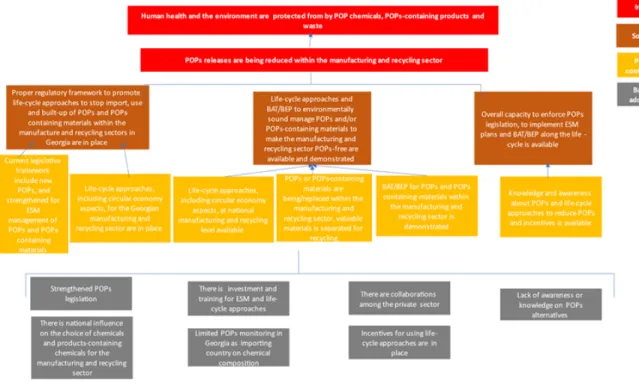
68. The project will build on the recent national efforts in the area of sustainable manufacturing (the ?upstream?) and waste management (the ?downstream?) to strengthen the environmentally sound management of POPs and POPs-containing material. This approach will contribute to sustainable manufacturing and recycling as well as effective management of end of life products, ensuring a higher rate of reuse and recycling. The project will strive to work on the sectors that will offer the greater potential of POP reduction, energy saving, and recycling potential. The objective tree for the project is presented in figure 2:
Figure 2: Objective tree
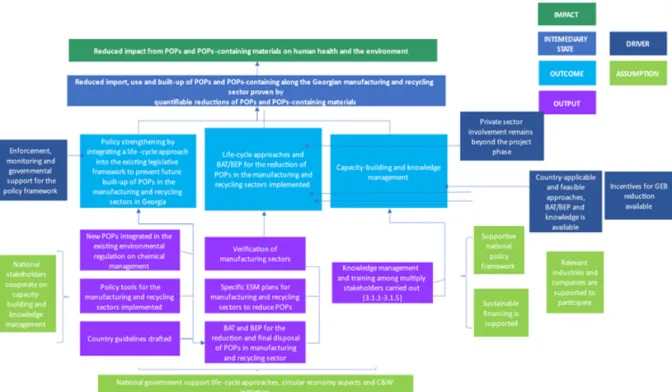
The project alternative scenario is proposed in response to the problem tree (Figure 1, baseline projects and objective tree. It should address the identified barriers using the logic of the Theory of Change (ToC), which is presented in Figure 3.
Figure 3: Theory of Change
Description of the Theory of Change:
69. Georgia is struggling with the reduction of import, use and build-up of POPs and POPs- containing materials within manufacture and recycling sectors. The project has been designed to address the barriers described in the previous section. Specifically, barriers faced by national stakeholders and the industrial manufacturing sector will be addressed by strengthening the regulatory framework related to chemicals and waste management, supporting sustainable funding mechanism for collection, treatment and final disposal of hazardous waste, and by promoting alternative material to POPs-containing chemicals and life cycle approaches for the industrial sector. The following outputs will be delivered to reach these outcomes:
? POPs integrated in the existing environmental regulations for a stronger regulation on imports,
? Waste management regulations to ensure that POPs-containing waste are disposed of in a sound manner,
? Customs monitoring tools,
? Financial mechanism for hazardous waste management,
? Specific ESM plans for the manufacturing and recycling sectors to reduce POPs
? BAT/BEP implementation for the reduction and final disposal of POPs in these sectors
? Strong knowledge management platforms and training for sustainability and scale-up