Brazil Sustaining Healthy Coastal and Marine Ecosystems Project
Part I: Project Information GEF ID
10190 Project Type FSP
Type of Trust Fund GET
CBIT/NGI CBIT No NGI No Project Title
Brazil Sustaining Healthy Coastal and Marine Ecosystems Project Countries
Brazil Agency(ies) FAO
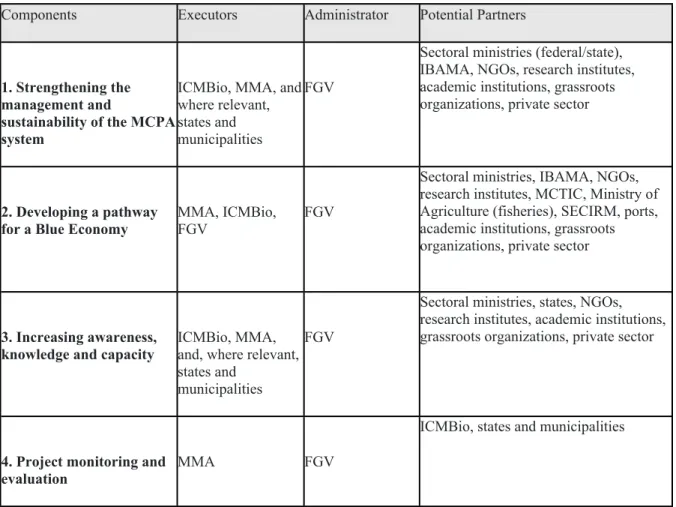
Other Executing Partner(s)
Ministry of the Environment (MMA), Instituto Chico Mendes de Conserva??o da Biodiversidade (ICMBio), Funda??o Get?lio Vargas (FGV)
Executing Partner Type Government
GEF Focal Area Biodiversity Taxonomy
Biodiversity, Focal Areas, Transform policy and regulatory environments, Influencing models, Demonstrate innovative approache, Strengthen institutional capacity and decision-making, Beneficiaries, Stakeholders, Indigenous Peoples, Local Communities, Gender Mainstreaming, Gender Equality, Enabling Activities, Capacity, Knowledge and Research, Capacity Development, Knowledge Exchange
Rio Markers
Climate Change Mitigation Climate Change Mitigation 0 Climate Change Adaptation Climate Change Adaptation 0
Submission Date 4/16/2021
Expected Implementation Start 7/1/2021
Expected Completion Date 6/30/2026
Duration 60In Months Agency Fee($) 1,303,101.00
A. FOCAL/NON-FOCAL AREA ELEMENTS Objectives/Programs Focal Area
Outcomes Trust
Fund GEF
Amount($) Co-Fin Amount($)
BD-1-1 Mainstream biodiversity
across sectors as well as landscapes and
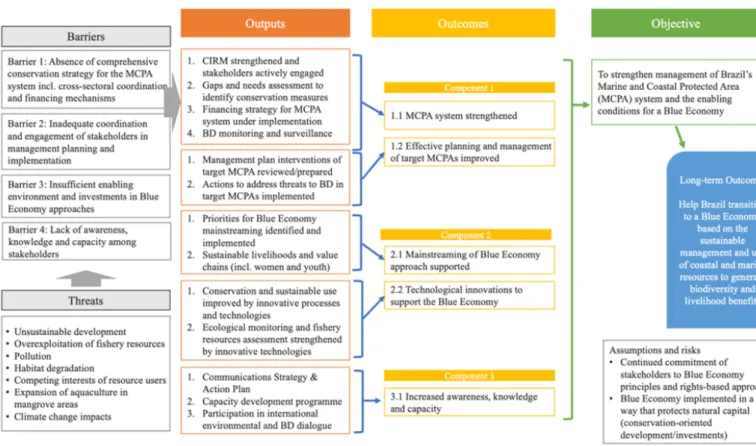
seascapes through biodiversity mainstreaming in priority sectors
GET 7,000,000.00 43,302,425.00
BD-2-7 Address direct drivers to
protect habitats and species and Improve financial sustainability, effective management, and ecosystem coverage of the global protected area estate
GET 7,478,899.00 44,528,486.00
Total Project Cost($) 14,478,899.00 87,830,911.00
B. Project description summary
Project Objective
To strengthen management of Brazil?s Marine and Coastal Protected Area (MCPA) system and the enabling conditions for a Blue Economy
Project Compon ent
Financ ing Type
Expected Outcome s
Expected Outputs Tru
st Fu nd
GEF Project Financing
($)
Confirme d Co- Financing ($)
Project Compon ent
Financ ing Type
Expected Outcome s
Expected Outputs Tru
st Fu nd
GEF Project Financing
($)
Confirme d Co- Financing ($)
1.
Strengthe ning the managem ent and sustainabi lity of the Marine and Coastal Protected Area (MCPA) system
Investm
ent Outcome
1.1 MCPA system strengthene d
Outcome 1.2:
Effective planning and manageme nt of target MCPAs improved
1.1.1 Interministerial Commission for Marine Resources (CIRM)
strengthened and stakeholders actively engaged
1.1.2 Gaps and needs assessment undertaken to strengthen management and sustainability of MCPA system[1]
1.1.3 Updated financing strategy for MCPA system under implementation
1.1.4 Biodiversity monitoring, research, and surveillance strategies implemented (including community-based monitoring)
1.2.1 Management plan interventions of target MCPAs reviewed/prepared in alignment with priorities from threat reduction assessment
1.2.2 Actions to address threats to biodiversity in target MCPAs implemented
[1] Including identification of potential areas for community co-management, ecological mosaics, ecological corridors, Ramsar sites.
GE T
7,485,857.
00
78,959,39 9.00
Project Compon ent
Financ ing Type
Expected Outcome s
Expected Outputs Tru
st Fu nd
GEF Project Financing
($)
Confirme d Co- Financing ($)
2.
Developin g a pathway for a Blue Economy
Investm
ent Outcome
2.1:
Mainstrea ming of a Blue Economy supported
Outcome 2.2:
Blue Economy supported through technologic al
innovations
2.1.1 Priorities for creating an enabling environment for a Blue Economy identified through an inclusive, participatory process and implemented
2.1.2 Sustainable community- based livelihoods promoted and associated value chains enhanced through
investments
2.2.1 Conservation and sustainable use of marine and coastal resources improved by innovative processes and technologies
2.2.2 Ecological monitoring and fishery resources assessment strengthened by innovative technologies
GE T
4,047,000.
00
1,226,060.
00
Project Compon ent
Financ ing Type
Expected Outcome s
Expected Outputs Tru
st Fu nd
GEF Project Financing
($)
Confirme d Co- Financing ($)
3.
Increasing awareness ,
knowledg e and capacity to safeguard the Blue Economy
Technic al Assistan ce
Outcome 3.1:
Awareness, knowledge and capacity enhanced cross- sectorally from national to local levels
3.1.1 Communications Strategy & Action Plan designed and implemented to effectively raise awareness, target knowledge and share best practices and lessons learnt
3.1.2 Modular capacity development programme for conservation and sustainable use of marine and coastal zones updated, implemented and institutionalized
GE T
1,935,000.
00
2,636,968.
00
4. Project monitorin g and evaluation
Technic al Assistan ce
Outcome 4.1:
Project implement ation and its adaptive manageme nt informed by M&E system
4.1.1 Project M&E system established and implemented in alignment with gender mainstreaming and adoption of a ?one health? approach
GE
T 321,571.0
0 826,060.0 0
Sub Total ($) 13,789,42
8.00 83,648,48 7.00
Project Management Cost (PMC)
GET 689,471.00 4,182,424.00
Sub Total($) 689,471.00 4,182,424.00
Total Project Cost($) 14,478,899.00 87,830,911.00
C. Sources of Co-financing for the Project by name and by type Sources of
Co- financing
Name of Co-financier Type of Co- financing
Investment
Mobilized Amount($)
Recipient Country Government
Brazilian Institute of Environment and Renewable Natural Resources (IBAMA)
In-kind Recurrent expenditures
6,662,886.00
Recipient Country Government
ICMBio In-kind Recurrent
expenditures
8,187,565.00
Recipient Country Government
ICMBio Public
Investment
Investment mobilized
32,719,857.00
Recipient Country Government
MMA In-kind Recurrent
expenditures 9,260,603.00
Recipient Country Government
MMA Secretariat of the Amazon and Environmental Services
Public
Investment Investment
mobilized 30,000,000.00
GEF Agency FAO Grant Investment
mobilized 1,000,000.00 Total Co-Financing($) 87,830,911.00 Describe how any "Investment Mobilized" was identified
The investment mobilized was identified with Government counterparts during the project preparation phase and totals USD 63.7 million. This amount includes USD 32.7 million in planned public investments from ICMBio such as to improve infrastructure in the target conservation units. Furthermore, it includes USD 30 million from MMA?s Secretariat of the Amazon and Environmental Services in investments of the Floresta+ Program related to sustainable financing mechanisms, incentive systems and forest monitoring, funded by the Green Climate Fund (GCF). USD 1 million of FAO?s investment corresponds to a
programme that seeks to improve public policies and government programs that promote the inclusion of the most vulnerable rural productive population; and the sustainable management of forest resources, fisheries and aquaculture in Brazil. An exchange rate of 5.7:1 was used to convert from Brazilian real to USD in line with UN exchange rate on 1 April 2021.
D. Trust Fund Resources Requested by Agency(ies), Country(ies), Focal Area and the Programming of Funds Agenc
y Trust
Fund Country Focal
Area Programmin
g of Funds Amount($) Fee($)
FAO GET Brazil Biodiversity BD STAR
Allocation
14,478,899 1,303,101
Total Grant Resources($) 14,478,899.00 1,303,101.00
E. Non Grant Instrument
NON-GRANT INSTRUMENT at CEO Endorsement
Includes Non grant instruments? No Includes reflow to GEF? No
F. Project Preparation Grant (PPG) PPG Required false
PPG Amount ($) 200,000
PPG Agency Fee ($) 18,000
Agenc
y Trust
Fund Country Focal
Area Programmin
g of Funds Amount($) Fee($)
FAO GET Brazil Biodiversity BD STAR
Allocation 200,000 18,000
Total Project Costs($) 200,000.00 18,000.00
Core Indicators
Indicator 2 Marine protected areas created or under improved management for conservation and sustainable use
Ha (Expected at PIF)
Ha (Expected at CEO
Endorsement) Ha (Achieved at
MTR) Ha (Achieved at
TE)
1,626,811.00 13,404,976.00 0.00 0.00
Indicator 2.1 Marine Protected Areas Newly created
Total Ha
(Expected at PIF)
Total Ha
(Expected at CEO Endorsement)
Total Ha (Achieved at
MTR) Total Ha
(Achieved at TE)
0.00 0.00 0.00 0.00
Name of the Protecte
d Area WDP
A ID IUCN Category
Total Ha (Expected at PIF)
Total Ha (Expected at CEO
Endorsement)
Total Ha (Achieved at MTR)
Total Ha (Achieved at TE) Indicator 2.2 Marine Protected Areas Under improved management effectiveness
Total Ha
(Expected at PIF)
Total Ha
(Expected at CEO Endorsement)
Total Ha (Achieved at
MTR) Total Ha
(Achieved at TE)
1,626,811.00 13,404,976.00 0.00 0.00
Nam e of the Prot ecte d Area
WD PA
ID IUCN
Category
Tota l Ha (Exp ecte d at PIF)
Total Ha (Expec ted at CEO Endors ement)
Tota l Ha (Ach ieve d at MTR )
Tota l Ha (Ach ieve d at TE)
METT score (Baseli ne at CEO Endors ement)
MET T scor e (Ach ieve d at MTR )
MET T scor e (Ach ieve d at TE)
Nam e of the Prot ecte d Area
WD PA
ID IUCN
Category
Tota l Ha (Exp ecte d at PIF)
Total Ha (Expec ted at CEO Endors ement)
Tota l Ha (Ach ieve d at MTR )
Tota l Ha (Ach ieve d at TE)
METT score (Baseli ne at CEO Endors ement)
MET T scor e (Ach ieve d at MTR )
MET T scor e (Ach ieve d at TE) Akula
Natio nal Park APA Cana n?ia- Iguap e- Peru?
be
1256 89 1948 4
SelectProte cted Landscape/
Seascape
202,308 .00
49.00
Akula Natio nal Park APA da Balei a Franc a
1256 89 3517 16
SelectProte cted Landscape/
Seascape
154,8 67.00
154,867 .00
61.00
Akula Natio nal Park APA da Costa dos Corai s
1256 89 3136 31
SelectProte cted Landscape/
Seascape
404,2
89.00 404,289 .00
70.00
Akula Natio nal Park APA de Ferna ndo de Noron ha
1256 89 1160 96
SelectProte cted Landscape/
Seascape
154,4
06.00 154,406 .00
67.00
Nam e of the Prot ecte d Area
WD PA
ID IUCN
Category
Tota l Ha (Exp ecte d at PIF)
Total Ha (Expec ted at CEO Endors ement)
Tota l Ha (Ach ieve d at MTR )
Tota l Ha (Ach ieve d at TE)
METT score (Baseli ne at CEO Endors ement)
MET T scor e (Ach ieve d at MTR )
MET T scor e (Ach ieve d at TE) Akula
Natio nal Park APA de Guad alupe
1256 89 5556 3664 3
SelectProte cted Landscape/
Seascape
43,92
1.00
Akula Natio nal Park APA Delta do Parna
?ba
1256 89 1156 66
SelectProte cted Landscape/
Seascape
309,586 .00
46.00
Akula Natio nal Park APA Ponta da Balei a
1256 89 1154 33
SelectProte cted Landscape/
Seascape
345,5
60.00
Akula Natio nal Park APA Setib a
1256 89 5556 3662 5
SelectProte cted Landscape/
Seascape
12,47
6.00
Nam e of the Prot ecte d Area
WD PA
ID IUCN
Category
Tota l Ha (Exp ecte d at PIF)
Total Ha (Expec ted at CEO Endors ement)
Tota l Ha (Ach ieve d at MTR )
Tota l Ha (Ach ieve d at TE)
METT score (Baseli ne at CEO Endors ement)
MET T scor e (Ach ieve d at MTR )
MET T scor e (Ach ieve d at TE) Akula
Natio nal Park Monu ment o Natur al das Ilhas de Trind ade Marti m Vaz e do Mont e Colu mbia
1256 89 5556 3592 9
SelectNatu ral
Monument or Feature
6,915,5 36.00
26.00
Akula Natio nal Park Monu ment o Natur al do Arqui p?lag o de S?o Pedro e S?o Paulo
1256 89 5556 3592 8
SelectNatu ral
Monument or Feature
4,726,3 18.00
27.00
Nam e of the Prot ecte d Area
WD PA
ID IUCN
Category
Tota l Ha (Exp ecte d at PIF)
Total Ha (Expec ted at CEO Endors ement)
Tota l Ha (Ach ieve d at MTR )
Tota l Ha (Ach ieve d at TE)
METT score (Baseli ne at CEO Endors ement)
MET T scor e (Ach ieve d at MTR )
MET T scor e (Ach ieve d at TE) Akula
Natio nal Park PAR NA da Logo a do Peixe
1256 89 1944 8
SelectNatio
nal Park 36,72
2.00 36,722.
00
58.00
Akula Natio nal Park PAR NA Marin ho de Ferna ndo de Noron ha
1256 89 4108 7
SelectNatio
nal Park 10,92
9.00 10,929.
00
69.00
Akula Natio nal Park PAR NA Marin ho dos Abrol hos
1256 89 8106 0
SelectNatio
nal Park 87,94
2.00 87,942.
00
76.00
Akula Natio nal Park PEM da Areia Verm elha
1256 89 5556 8237 9
SelectNatio
nal Park 260.0
0
Nam e of the Prot ecte d Area
WD PA
ID IUCN
Category
Tota l Ha (Exp ecte d at PIF)
Total Ha (Expec ted at CEO Endors ement)
Tota l Ha (Ach ieve d at MTR )
Tota l Ha (Ach ieve d at TE)
METT score (Baseli ne at CEO Endors ement)
MET T scor e (Ach ieve d at MTR )
MET T scor e (Ach ieve d at TE) Akula
Natio nal Park PEM Parce l de Manu el Lu?s
1256 89 7100 9
SelectNatio
nal Park 45,13
2.00
Akula Natio nal Park PEM Risca do Meio
1256 89 3521 85
SelectNatio
nal Park 3,716
.00
Akula Natio nal Park REBI O do Atol das Roca s
1256 89 46
SelectStrict Nature Reserve
35,18 6.00
35,186.
00
65.00
Akula Natio nal Park RESE X Aca?- Goian a
1256 89 3540 06
SelectProte cted area with sustainable use of natural resources
6,677.0 0
44.00
Akula Natio nal Park RESE X Cass urub?
1256 89 4784 27
SelectProte cted area with sustainable use of natural resources
100,5
78.00 100,578 .00
67.00
Nam e of the Prot ecte d Area
WD PA
ID IUCN
Category
Tota l Ha (Exp ecte d at PIF)
Total Ha (Expec ted at CEO Endors ement)
Tota l Ha (Ach ieve d at MTR )
Tota l Ha (Ach ieve d at TE)
METT score (Baseli ne at CEO Endors ement)
MET T scor e (Ach ieve d at MTR )
MET T scor e (Ach ieve d at TE) Akula
Natio nal Park RESE X Coru mbau
1256 89 3517 37
SelectProte cted area with sustainable use of natural resources
89,99
7.00 89,997.
00
60.00
Akula Natio nal Park RESE X de Cana vieira s
1256 89 3518 29
SelectProte cted area with sustainable use of natural resources
100,6
88.00 100,688 .00
51.00
Akula Natio nal Park RESE X do Batoq ue
1256 89 3517 70
SelectProte cted area with sustainable use of natural resources
601.00
44.00
Akula Natio nal Park RESE X do Mandi ra
1256 89 3517 19
SelectProte cted area with sustainable use of natural resources
1,178.0 0
58.00
Akula Natio nal Park RESE X Marin ha da Lago a do Jequi
?
1256 89 3517 53
SelectProte cted area with sustainable use of natural resources
10,197.
00
35.00
Nam e of the Prot ecte d Area
WD PA
ID IUCN
Category
Tota l Ha (Exp ecte d at PIF)
Total Ha (Expec ted at CEO Endors ement)
Tota l Ha (Ach ieve d at MTR )
Tota l Ha (Ach ieve d at TE)
METT score (Baseli ne at CEO Endors ement)
MET T scor e (Ach ieve d at MTR )
MET T scor e (Ach ieve d at TE) Akula
Natio nal Park RESE X Marin ha do Delta do Parna
?ba
1256 89 3517 75
SelectProte cted area with sustainable use of natural resources
27,022.
00
43.00
Akula Natio nal Park RESE X Prain ha do Canto Verde
1256 89 4784 25
SelectProte cted area with sustainable use of natural resources
29,807.
00
48.00
Akula Natio nal Park REVI S Ilha dos Lobos
1256 89 1084 3
SelectNatu ral
Monument or Feature
142.0 0
142.00
61.00
Indicator 11 Number of direct beneficiaries disaggregated by gender as co-benefit of GEF investment Number
(Expected at
PIF) Number (Expected at CEO Endorsement)
Number (Achieved at MTR)
Number (Achieved at TE)
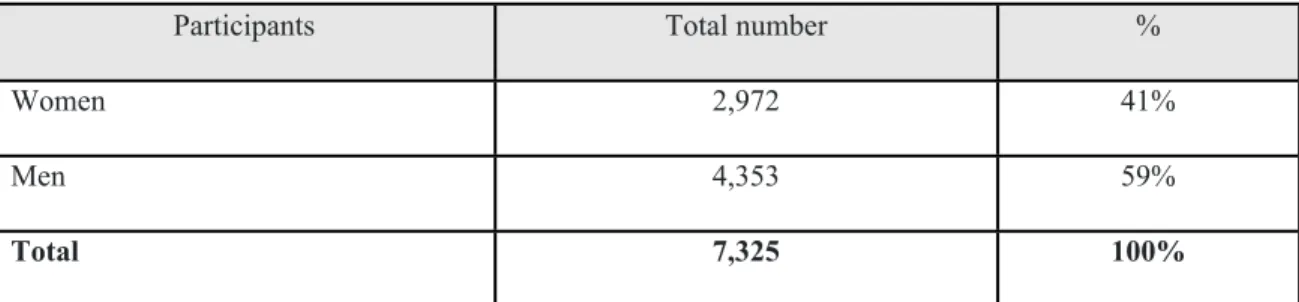
Female 1,500 1,500
Male 1,500 1,500
Total 3000 3000 0 0
Provide additional explanation on targets, other methodologies used, and other focal area specifics (i.e., Aichi targets in BD) including justification where core indicator targets are not provided
METT scores: Please note that the following six State MCPAs had been included at PIF stage, but were removed at CEO ER stage based on consultations with key partners and stakeholders. Consequently, no METT score is entered for these six areas. -- 1 -- APA de Guadalupe 555636643 V 43'921 2 -- APA Ponta da Baleia 115433 V 345'560 3 -- APA Setiba 555636625 V 12'476 4 -- PEM Risca do Meio 352185 II 3'716 5 -- PEM da Areia Vermelha 555682379 II 260 6 -- PEM Parcel de Manuel Lu?s 71009 II 45'132
Part II. Project Justification
1a. Project Description
1) Global environmental and/or adaptation problems, root causes and barriers that need to be addressed (systems description)
A. Country Context
1. Brazil?s economy has endured intense volatility over the past five years. After a deep recession in 2015 and 2016, the country struggled to recover, managing just 1.3 percent real GDP growth in 2018 and 1.1 percent in 2019. Job creation improved with unemployment declining from a peak of 13.6 percent in March 2017 to 11.0 percent in 2019. Due to the COVID-19 pandemic, GDP growth declined further in 2020, and the unemployment rate reached 13.3 percent in June 2020. Given the uneven recovery and continuing fiscal challenges that limit expansion of public support, Brazil?s poverty index is likely to decline only gradually over the next few years. Poverty continues to be concentrated in rural areas, with particularly high rates along the coastline.
2. An important tool that Brazil could employ against these trends is to accelerate
productivity to boost long-term growth. The total factor productivity (TFP) growth between 1996 and 2015 increased per capita income of Brazilians only by 0.7 percent per year. That is half the average of OECD countries. With limited space for fiscal stimulus, increasing productivity remains key to sustaining long-term economic expansion. Meeting this challenge will help lift the living standards of Brazilians, in particular poor rural communities, women, and indigenous populations. Women make up only 23.2 percent of the Brazilian workforce, hence enhancing their inclusion in the economy will also bring great benefits.
3. Brazil?s vast marine and coastal assets offer an opportunity for economic diversification, increased productivity, strengthened resilience against socio-economic and public health shocks and inclusive sustainable growth. Coastal resources that provide a wide array of ecosystem goods and services help fuel the economy, generating roughly 30 percent of Brazil?s GDP. Such goods and services include seafood, tourism and recreation, oil and gas, transportation, and coastal protection and resilience for reefs and mangroves. However, this natural capital is seriously threatened by increasing development, overexploitation, pollution, and competing interests for its use. Responsible management
of this natural capital?protecting the integrity and health of ecosystems?will open the way for the development of a sustainable ocean economy or ?Blue Economy.?
B. Brazil?s coastal and marine resources
4. Brazil?s coastal and marine natural assets include approximately 8,500 km of coastline and 3.2 million km2 of Exclusive Economic Zone (EEZ). The country?s EEZ is equivalent to 37 percent of Brazil?s terrestrial territory and is comparable in size to the Brazilian Amazon.[1]1 The coastline hosts an immense variety of environments including the only coral reefs in the Southern Atlantic, dune fields, coastal lagoon complexes, wetlands, restingas (sandy coastal plain vegetation), and flood plains. The northern coast has one of the longest continuous stretches of mangrove ecosystems in the world, providing important ecological services such as global nursery sites, natural biofiltration and carbon sinks. The Brazilian coast is part of three of the 66 internationally recognized Large Marine Ecosystems (LMEs), one shared with the country?s northern neighbours, French Guiana, Suriname, Guyana, and Venezuela (North Brazil Shelf LME), and two exclusively within its own national territory (East Brazil Shelf and South Brazil Shelf LMEs).
5. The marine and coastal ecosystems of Brazil provide food and income to millions of people through fisheries, tourism, transportation, oil and gas, amongst other economic activities. It also provides natural barriers to protect coastal communities and livelihoods, contributing to their resilience to climate change. The coastal zone of the country has 50.7 million inhabitants; that is 26.6 percent of the national population.[2]2 The zone?s population is distributed across 463 municipalities and 21 of Brazil?s 74 metropolitan regions.[3]3,[4]4 An estimated 19 percent of Brazil?s GDP is derived from marine-based activities such as oil and gas, transportation, fisheries, underwater cables, and tourism.
6. Fishing along Brazil?s coastal zones has been historically one of the most important sources of protein for thousands of families. The country?s fisheries and aquaculture sector is projected to grow by 104 percent by 2025.[5]5 Aquaculture?particularly the cultivation of shrimp and
molluscs?will play a central role in this expected growth, especially in Brazil?s northeast region.[6]6
Tourism, meanwhile, is expected to continue to be a major driver of economic growth, especially in protected coastal and marine areas.
7. The extensive mangrove forests in Brazil?they are the largest in the Americas and make up about eight percent of the world?s total?offer an example of the benefits that the project could bring.
Though under pressure from development, the forests still cover about 1,265,000 hectares. Their dense root systems trap sediments flowing down rivers and off land. This helps stabilize the coastline, prevents erosion by waves and storms and increases social and environmental resilience against climate change (Sim?es 2018). The forests also provide carbon sequestration and nursery habitat for a wide- ranging diversity of species (Sarhan and Tawfik 2018). Direct economic benefits of mangrove forests include timber, fish, and tourism.
8. Aquaculture, particularly shrimp farming, has been the main cause of destruction of mangrove forests in the recent past. Shrimp farming, known as mariculture, began in Brazil in the 1970s and is now widely practiced, primarily along the coasts of northeastern states such as Cear? and Rio Grande do Norte. Conservation of mangroves is vital for protecting ecosystems goods and services.
The protection of the remaining mangrove forests could help reduce emissions of blue carbon (carbon in coastal and marine ecosystems) and mitigate climate change (McLeod et al. 2011, Siikam?ki et al.
2012, and Duarte et al. 2013). A new study has found that the Amazon?s mangroves store twice as much carbon per acre than its rainforests and ten-fold more than tropical dry forests (Boone et al.
2018).
9. Establishing terrestrial and marine protected areas can protect mangrove forests and their services and benefits. This approach is more economically efficient than restoring mangroves (Webber et al. 2014). Brazil has 162 MCPAs that cover part of its territorial sea (extending out 12 nautical miles). Of these, 123 have mangrove areas, constituting more than 70 percent of the country?s total mangrove surface area. In contrast, many other mangrove-rich countries, such as Indonesia, Nigeria, Myanmar, and Papua New Guinea, are protecting only a very low proportion (UNEP 2014).
C. MCPAs and associated biodiversity in the target areas
10. With support from the GEF-financed Marine and Coastal Protected Areas project (GEF MAR1), Brazil expanded its marine protected area in 2018 from 1.57 percent to 26.34 percent of its EEZ.[7]7 The MCPAs now cover a total of 96 million hectares, consisting of 84 million hectares for
sustainable use (IUCN Categories V?VI) and 12 million hectares under more restricted conservation regimes (IUCN Categories I?III).[8]8 This milestone surpassed the CBD?s Aichi 2020 Target of protecting 10 percent of the national marine environment. It represents a significant national
investment?not only for the environment but also for future development?that will curb the collapse of fish stocks and foster livelihoods in multiple sectors. In addition, the joint management of these areas by government environmental institutions and the Brazilian Navy is an effective strategy for the sustainable use and monitoring of the Brazilian EEZ, safeguarding this important natural capital.
Box 1: Setting the stage with the Marine Protected Areas Project (GEF MAR1)
The Marine and Coastal Protected Areas project, also known as GEF MAR1 (GEF ID 4637), helped strengthen the sustainable management of Brazil?s coastal and marine assets. The five-and-a half year project (2014-2020), financed with USD 18.2 million from the GEF, is the precursor to GEF MAR2, the current project.
GEF MAR1 set out to enlarge a globally significant, representative, and effective Marine and Coastal Protected Area System in Brazil and to identify mechanisms for its long-term financial sustainability. Its signature accomplishment was expansion of the area under protection status to a total of 96 million hectares. Of these, 1.6 million hectares, representing 16 Marine and Coastal Protected Areas across the country, were placed under enhanced biodiversity protection including with biodiversity tracking measures.[9]9 Other key achievements were:
1) Creation of first marine endowment fund as a mechanism for the long-term financing of MCPAs (the Marine Fund).
2) Design and facilitation of a participatory process that included regular training and community- strengthening activities, involving a total of 5,630 people across the spectrum of MCPAs.
3) Promoting marine spatial planning in southern regions of the country and introducing the Brazilian Blue Initiative,[10]10 which has foreshadowed the need to foster a Blue Economy in Brazil to align conservation efforts and economic growth within a sustainable development framework.
4) Preparation or updating of management plans for 13 federal and state MCPAs.
5) Evaluation of the conservation status of 257 marine species along with the elaboration, evaluation, and monitoring of National Conservation Plans for marine threatened species.
6) Development of a national monitoring strategy, and a training course for multipliers of the Monitora program.[11]11
11. Brazil currently has 190 MCPAs covering an area of 96 million hectares. The list of target MCPAs of the MAR2 project is shown in Table 1 below. About half (11) of the 21 target MCPAs shown in Table 1 have developed management plans; the remaining 10 do not currently have a management plan. They have, however, annual operating plans/action plans.
Table 1: List of 21 MCPAs targeted by the GEF MAR2 project,[12]12 with the four focal areas highlighted in green**
MCPA Area Name NGI Area (ha) UF OG
Federal MCPAs
1. RESEX[13]13 de Canavieiras 100,688 BA ICMBio
2. RESEX Cassurub?* 100,578 BA ICMBio
3. RESEX Corumbau 89,997 BA ICMBio
4. APA da Baleia Franca* 154,867 SC ICMBio
5. REVIS Ilha dos Lobos 142 RS ICMBio
6. PARNA da Lagoa do Peixe* 36,722 RS ICMBio
7. APA da Costa dos Corais* 404,289 PE ICMBio
8. PARNA Marinho dos Abrolhos* 87,942 BA ICMBio
9. PARNA Marinho de Fernando de Noronha* 10,929 PE ICMBio
10. APA de Fernando de Noronha ? Rocas ? S?o Pedro e S?o Paulo*
NGI Fernando de Noronha
154,406 PE ICMBio
11. REBIO do Atol das Rocas* 35,186 RN ICMBio
12. Monumento Natural das Ilhas de Trindade, Martim Vaz e do Monte Columbia
NGI Trindade
- Martim Vaz 6,915,536 ES ICMBio
13. Monumento Natural do Arquip?lago de S?o Pedro e S?o Paulo
NGI S?o Pedro - S?o Paulo
4,726,318 PE ICMBio
14. RESEX Aca?-Goiana 6,677 PB, PE ICMBio
15. Reserva Extrativista Marinha da Lagoa do Jequi? 10,197 AL ICMBio 16. ?rea de Prote??o Ambiental Delta do
Parna?ba* 309,586 MA,
CE, PI ICMBio 17. Reserva Extrativista Marinha do Delta do
Parna?ba
NGI Delta do Parna?ba
27,022 MA, PI ICMBio
18. RESEX do Batoque 601 CE ICMBio
19. RESEX Prainha do Canto Verde
NGI Batoque
29,807 CE ICMBio
20. APA Canan?ia-Iguape-Peru?be* 202,308 SP ICMBio
21. RESEX do Mandira*
NGI Canan?ia- Iguape-
Peru?be 1,178 SP ICMBio
Subtotal: 13,404,976 21
*Denotes MCPAs with management plans prepared before or during GEF MAR1.
**Note: The four focal areas are the sites in and around which the main project interventions will take place; project approaches and interventions will be first applied in the four focal MCPAs, and replicated in a further 17 MCPAs. Most of the project outcomes aim to have a direct impact in all the 21 MCPAs, as summarized below:
Outcome Reach/impact
Outcome 1.1: Strengthening the MCPA system All 21 MCPAs Outcome 1.2: Improving effective planning and
management of target MCPAs Four focal MCPAs, with results scalable to the remaining 17
Outcome 2.1: Supporting the mainstream of a
Blue Economy All 21 MCPAs
Outcome 2.2: Supporting Blue Economy
through technological innovations Four focal MCPAs, with results scalable to the remaining 17
Outcome 3.1: Enhancing awareness, knowledge and capacity cross-sectorally
All 21 MCPAs
Map 1: Location of the 21 target MCPAs. Note: Areas of Focus (in orange) were defined to prepare detailed maps (see Annex D). Priority zones (in red) contain the four focal areas.
12. These 21 MCPAs ? including the four focal MCPAs ? represent a diversity of spatial scales, biomes and species. The four focal MCPAs are: (i) ?rea de Prote??o Ambiental Delta do Parna?ba; (ii) Reserva Extrativista Marinha do Delta do Parna?ba; (iii) ?rea de Prote??o Ambiental de Canan?ia-Iguape-Peru?be; and (iv) Reserva Extrativista Mandira. They represent two categories of Brazil?s MCPA system, APA (?rea de Prote??o Ambiental or Environmental Protection Area) and RESEX (Reserva Extrativista or Extractive Reserve). These four areas were selected based on their identified potential to engage and benefit local communities in the management and sustainable use of coastal and marine resources and address existing threats to ecosystems and biodiversity including pollution, overexploitation and habitat degradation. The areas cover various types of ecosystems including forests/mangroves, estuaries, and coastal marine zones. Lessons learned and approaches will be shared and replicated in the other 17 MCPAs.
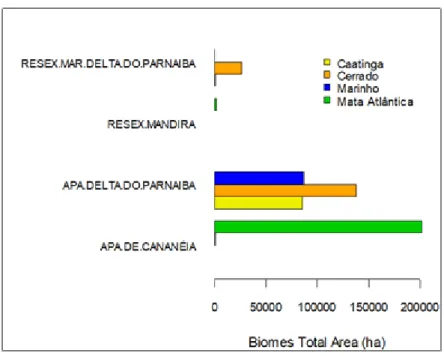
13. The target MCPAs are samples of marine, cerrado, caatinga and Atlantic rainforest biomes. The figure below shows the total area, in hectares, of the biomes represented inside the boundaries of the four focal MCPAs.
Figure 1: Distribution of biomes in Target Protected Areas
Map 2: Location of the four focal MCPAs in the priority zones and Areas of Focus defined in Map 1
14. The main ecosystems in these MCPAs are mangroves, forests, dunes, beaches, lagoons, wetlands and estuaries. A wide range of coastal and marine organisms, including a number of IUCN Red List species, and complex habitats represents the biodiversity of these areas. A summary of the main features of the four focal MCPAs and their objectives in relation to biodiversity is provided below.
Biodiversity features/objectives of focal MCPAs:
? APA Delta do Parna?ba: The management objectives of this APA are (i) to protect the deltas of the Parna?ba, Timonha and Ubatuba rivers, with their fauna, flora, remnants of alluvial forest, water resources, and complex of dunes, and (ii) to promote ecological tourism and environmental education.
The main values for which this APA was designated are: traditional communities, fishery resources, waters, rare, endangered and endemic species, diversity of environments, mangroves, and tourism.
Among the threatened species protected in this APA are the red-handed howler (Alouatta belzebul ululata) and smalltooth sawfish (Pristis pectinata). The APA is part of the National Action Plan for the conservation of the marine manatee (Trichechus manatus). According to the Instituto Tartarugas do Delta, the five species of sea turtles in Brazil (all classified in some threat category) use the coast of the APA Delta do Parna?ba for reproduction: loggerhead turtle (Caretta caretta), Hawksbill turtle
(Eretmochelys imbricata), olive turtle (Lepidochelys olivacea), green turtle (Chelonia mydas) and leatherback turtle (Dermochelys coriacea). The area also hosts species of sharks including the critically endangered Great hammerhead (Sphyrna mokarran), Scalloped Hammerhead (Sphyrna lewini), and Smalltail shark (Carcharhinus porosus); as well as seahorses (Hippocampus reidi), which are threatened by predatory capture and uncontrolled tourism in the estuaries.[14]14 Among the threats identified in this area are unsustainable fishing practices, uncontrolled expansion of urban areas and shrimp farms, unsustainable tourism activities, and the absence of basic sanitation and solid waste treatment. Together with other conservation units, this APA is part of the ?Amazon Estuary and its Mangroves? Ramsar site.[15]15
? RESEX Marinha do Delta do Parna?ba: In addition to promoting local culture, community- based tourism and protecting people?s livelihoods, this MCPA also aims to conserve nature and ensure the sustainable use of the natural resources. As APA Delta do Parna?ba, within which the RESEX is located, this PA protects, among other species, the red-handed howler (Alouatta belzebul ululata) and smalltooth sawfish (Pristis pectinata). Both the APA and the RESEX are located at the boundary of the North Brazil Shelf Large Marine Ecosystem (LME) with the East Brazil Shelf LME.
? APA Canan?ia-Iguape-Peru?be (APACIP): Situated in S?o Paulo and Paran? States, this APA is a representative wetland area of the Atlantic Forest. It is part of the ?Atlantic Forest South-East Reserves? World Heritage site and UNESCO Biosphere Reserve. The site was designated as a Ramsar Site in 2017. The main objectives of the site are to: (1) enable the cai?aras (fishing communities who live along the S?o Paulo and Paran? coasts) to perform their activities within the established historical- cultural patterns; (2) contain slopes subjected to erosion; and (3) protect and preserve ecosystems, from mangroves of the coastal zones, to fields in higher altitude regions; the endangered species; the seabirds nesting and migratory areas; archaeological sites; the remnants of the Atlantic Forest and the quality of water resources. The site has mangroves, estuaries, rivers, lagoon channels, coastal plains, waterfalls and marine and coastal islands. It also features sandbank forests, dunes and the most extensive and conserved stretch of Atlantic Forest in the country. This mosaic of wetland landscapes of great natural diversity and notable scenic beauty hosts threatened and endemic species such as the critically endangered black-faced lion tamarin (Leontopithecus caissara), the endangered Atlantic petrel
(Pterodroma incerta), the channel-billed toucan (Ramphastos vitellinus) and the Green turtle (Chelonia mydas). Agriculture, logging, fishing and pollution are among the main threats within the
site.[16]16,[17]17
? RESEX do Mandira: This area is located inside APACIP. Its objective is to ensure the sustainable use and conservation of renewable natural resources, protecting the livelihoods and culture of the local extractive population, enable traditional communities to carry out their activities, within the cultural standards developed historically. To conserve mangrove and estuaries areas, and to ensure the sustainable management for collect and catch of native oyster, fish, and crabs. The area presents high endemism in both fauna and flora species. It still has significant remnant areas of Atlantic Forest, namely mangroves and restinga forests. The reserve has demonstrated a high degree of conservation and, consequently, high biological productivity.
Among the main threats to this area are the unsustainable collection of oysters and crabs, which negatively impacts the food chain of the mangrove ecosystem in the reserve area. Some beneficiaries of the reserve have established an agreement for the sustainable exploitation of oysters, a model that can be replicated in other areas of the reserve and beyond.[18]18 Both APACIP and RESEX do Mandira are located in the South Brazil Shelf LME.
15. Among the key threats to biodiversity in these MCPAs are unsustainable exploitation, pollution, and habitat degradation. Improved coordination and management is required in these target areas, including improved connectivity/ecological corridors, in order to achieve their conservation objectives.
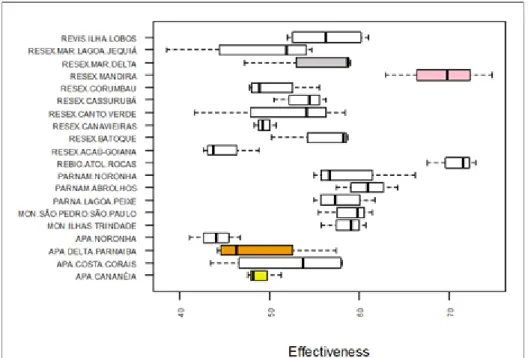
16. The figure below shows the distribution of the effectiveness index values available on SAMGe[19]19, from 2017 to 2020, per MCPA supported by GEF MAR1. The median effectiveness statistics highlighted the best status of this index for RESEX Mandira, among the target areas analysed (Figure 2). APA Delta do Parna?ba and APA Canan?ia-Iguape-Peru?be show lower median values.
The evaluation of the MCPA effectiveness in SAMGe is based on the indicators of territorial impact (called Results, Products and Services, and Context) and management (Planning, Inputs, and Processes).
Figure 2: Distribution of effectiveness index values obtained from 2017 to 2020 for 21 MCPAs supported by GEF MAR1 (the coloured boxes are the four focal areas and the white ones are the other
17 MCPAs). Raw data source: SAMGe.
17. The results of the indicators that make up the effectiveness index also show a different behavior, which highlights the different realities among certain MCPAs. However, it is observed, in the case of SAMGe, that the main vectors that influence effectiveness are those associated with the Planning of the Units and the Results scores. The different results on planning are also evidenced in the MEET data, demonstrating that small actions in certain Units can indicate a great advance for the overall effectiveness of the system.
18. Budget security is an aspect that requires attention, as shown in Figure 3, which
demonstrates that actions aimed at the financial sustainability of the MCPA system are fundamental for the continuity and improvement in the management.
Figure 3: Assessment of the budgetary security of Conservation Units (TT MEET base, 2020)[20]20
D. The Blue Economy
19. The Blue Economy concept seeks to promote economic growth, social inclusion, and the preservation or improvement of livelihoods while at the same time ensuring environmental
sustainability of the oceans and coastal areas. At its core it refers to the decoupling of socioeconomic development through oceans-related sectors and activities from environmental and ecosystems degradation.[21]21 While still in its inception in Brazil, the Blue Economy will, over the medium term, help boost economic growth, create jobs, reduce poverty, and build resilience to climate change and external shocks, while at the same time protecting the public good nature of the marine and coastal resources. Without proper planning (without intervention) for a Blue Economy, the projected growth of the different blue sectors will significantly intensify negative impacts on the coastal/marine areas.
Linked to the concept of Blue Economy is that of Blue Growth. Blue Growth is a strategic, innovative approach to improving the use of aquatic resources while simultaneously increasing social, economic and environmental benefits for communities dependent on fisheries and aquaculture.[22]22
20. Brazil needs a Blue Economy approach because the natural capital that sustains the current growth of fisheries, tourism, and other marine-related sectors is under intense human pressures, including overfishing, pollution, uncontrolled coastal development and climate change. The fisheries
sector, for example, is increasingly threatened by unsustainable practices that have overexploited 92 percent of economically important species.[23]23 Concerns about the sustainability of (blue) economic growth are exacerbated by the scarcity of reliable data and useful stock assessments (or even basic practices of fishery management), since the abolition of the national landings monitoring program.
Pollution from aquaculture, particularly the expanding shrimp-farming industry, threatens mangrove ecosystems and their associated biodiversity. In addition, agricultural runoffs, untreated sewage,[24]24 ballast water and solid waste are contaminating marine waters and harming the health of the
ecosystems that support tourism-based livelihoods. Erosion has also intensified along various regions in Brazil as evidenced by the loss of mangroves. These pressures together with the impacts of variability and climate change, exacerbate conflicts among sectors and industries that compete for resources and space to carry out their activities. Key sectors of the coastal economy are likewise rattled by external macro-economic shocks and the pandemic. These threats combined with unsustainable patterns of development, undermine future opportunities for growth and need urgent action to facilitate a pathway to a blue, resilient economy.
21. Strengthening the management of Brazil?s Marine and Coastal Protected Areas (MCPAs) will create the enabling environment for Brazil?s transition to a Blue Economy. Each dollar invested in Protected Area (PA) management generates about US$7 for the economy.[25]25 MCPAs can protect threatened fisheries stocks, preserving them as nursery areas and sources of mature individuals for recruitment and breeding stocks. They can enhance tourism opportunities by safeguarding unpolluted waters and beaches and by maintaining the marine biodiversity that attracts visitors. Additionally, MCPAs can mitigate the effects of climate change. MCPA managers need to deftly navigate local political environments so as to help reconcile conflicting views among local stakeholders about development and conservation. Additionally, more comprehensive biodiversity and ecosystem health monitoring systems are needed to measure the full benefits of MCPAs in an integrated manner. Well- managed MCPAs can deliver multiple benefits and adopt a multisectoral planning approach, such as Marine Spatial Planning (MSPs), to advance the vision of the Blue Economy.
22. Transitioning to a Blue Economy can help mitigate the social and economic effects of the COVID-19 pandemic. The economic recessions resulting from the pandemic, including in Brazil?s largest export markets, will certainly bring a major slowdown in the global economy. Well managed natural capital, through a blue lens, will incentivize local coastal economies to continue productive trends including supplying the country with nutritious seafood during this time of crisis, while ensuring local food security. The Brazilian population, including vulnerable groups who live along the 9,000 km of Brazilian coast, women, the disabled, the elderly, and indigenous communities, will stand to benefit from enhanced livelihoods fuelled by a healthy coastal and marine environment.
E. Root causes and barriers
23. Unsustainable economic development, natural resources overexploitation, lack of reliable temporal data series and pollution continue to pose a threat to Brazil?s coastal and marine resources.
Despite recent achievements in expanding the MCPA system, big challenges remain. Globally important biodiversity and ecosystems are under threat from competing and unsustainable resource uses, compounded by the impacts of climate change. The following barriers need to be addressed to tackle these root causes.
24. Barrier 1: Absence of a comprehensive conservation strategy for the MCPA system that includes cross-sectoral coordination and financing mechanisms. Although the Inter-ministerial Commission for the Resources of the Sea (CIRM) and other bodies that are in charge of coordination and management of marine and coastal resources exist, there is a lack of comprehensive coordination and a lack of participation of resource users as key stakeholders in this mechanism. Also, MCPAs lack a reliable budget to plan, design and implement environmental protection and demand-driven
sustainable development projects due, hence their need for a sustainable financing strategy. There is a need to further strengthen coordination of biodiversity monitoring efforts, in order for them to inform conservation management and decision-making. Community involvement and community-based biodiversity monitoring mechanisms also need to be strengthened.
25. Barrier 2: Inadequate coordination and engagement of stakeholders in management planning and implementation resulting in limited ownership and commitment to support
implementation of management plans and address threats to biodiversity. While management plans have been developed in most target MCPAs and some activities are financed to support their implementation, most conservation units lack coordinated and participatory actions to implement priorities outlined in the management plans to address threats to biodiversity. Community organizations and networks need to be strengthened to be able to support priority actions in the areas of sustainable fisheries, tourism, clean-up of waste, environmental education, etc. Similarly, mechanisms for monitoring and surveillance, emergency preparedness and contingency planning (such as for oil spills, waste at sea, conservation of endangered species) are lacking in the target MCPAs.
26. Barrier 3: Insufficient enabling environment and investments in Blue Economy
approaches. The Blue Initiative and the National Policy and Sectoral Plans for Marine Resources lay the foundations for a transition towards a Blue Economy. Nevertheless, the necessary incentive
systems, rights-based approaches, and systematic application of integrated planning approaches are still
lacking. Furthermore, incentives and investments in sustainable livelihoods and value chains, such as ecotourism/community-based tourism, organic handcrafting, aquaculture, beach reclamation, small- scale fishery landings, monitoring of coral reefs, innovative businesses to combat marine litter, value addition to traditional fisheries/aquaculture products, etc., are yet to be developed in a more systematic way. Ecosystem-based approaches and innovative technologies, focused on combating threats to the ecosystem while generating income and benefits for the community, are not yet widely promoted to support the goals of Blue Growth.
27. Barrier 4: Lack of awareness, knowledge and capacity among stakeholders of sustainable approaches to managing coastal and marine resources for a spectrum of purposes. Stakeholders from government, local communities and the private sector are often not aware of the opportunities that the Blue Economy and Blue Growth offer. They lack the knowledge of innovative approaches and technologies for integrated management of coastal and marine resources. They also lack the capacity for implementing community-based, participatory and rights-based approaches to MCPA management and sustainable livelihood development.
2) Baseline scenario and any associated baseline projects
A. National policies and plans
28. Brazil has already put in place several strategies for ecosystem management conducive to sustainable growth and in line with international commitments. In 1992, Brazil signed the Convention on Biological Diversity (CBD) and the United Nations Framework Convention on Climate Change (UNFCCC), and Congress ratified them in 1994. Since then, the Brazilian Federal Government, with the support of the Global Environment Facility (GEF) and other international organizations, has taken decisive steps to support CBD objectives by enhancing the country?s legal framework, building the institutional capacity of the Ministry of Environment, and establishing national policies, programs, and major projects. As part of Brazil?s commitment to the CBD, the government established in 2006 a National Policy for Biodiversity (Decree n?. 4339) and a National Protected Areas Strategic Plan (PNAP) (Decree n?. 5758). The latter provides for the establishment of a comprehensive system of terrestrial and marine protected areas that are ecologically representative and effectively managed.
29. Recognizing that conservation and sustainable use of coastal and marine areas require a multi-sectoral approach, the government established the Inter-ministerial Commission for the Resources of the Sea (CIRM) in 1974 (Decree no. 74.557/74). The CIRM coordinates the
implementation of the National Policy for Marine Resources (PNRM) (Decree no. 5377/05). The PNRM is implemented through Sectorial Plans for Marine Resources (PSRM), elaborated every four years to establish guidelines, objectives, and goals for the management of marine resources at a regional level. Technical groups from different ministries, under the coordination of the Brazilian Navy, support the implementation through the Secretariat of the Interministerial Commission for Sea Resources (SECIRM). Within the scope of the Tenth PSRM (2020-2023), a technical group under the coordination of the Ministry of Environment is working to improve the effectiveness and
representativeness of the Marine and Coastal Protected Areas System, increase protection of threatened marine species and tackle illegal fishing. This technical group is known as the Living Marine
Resources Assessing and Monitoring Group (Revimar).
30. The Brazilian Blue Initiative, announced in March 2018, aims at promoting the conservation of the country?s coastal and marine ecosystems under climate change and human pressure, through effectively managing and expanding coastal and marine protected areas. It is a strategic framework for a vision of sustainable development and conservation of marine and coastal zones. For Brazil?s vast coastal and marine ecosystems, this means enhanced safeguards within the context of larger mosaics of protected areas. The Initiative uses policies and strategies of coastal and marine ecosystem management to strengthen conservation of coastal and marine resources, including through protected areas and collaboration with local communities.
31. Furthermore, in 2019, the country developed an Integrated Coastal Marine Monitoring Strategy: National Biodiversity Monitoring Program (Estrat?gia integrada de monitoramento marinho costeiro: Programa Nacional de Monitoramento da Biodiversidade do ICMBio), called Monitora. The strategy was developed by the Chico Mendes Institute for Biodiversity Conservation (ICMBio), the agency responsible for managing the National System of Conservation Units. Its main scope is the articulation and improvement of initiatives for monitoring marine biodiversity and the definition of the main steps that lead to a robust advance in the management and availability of data on the subject.
32. In January 2021, the Federal Law No. 14.119/2021 came into force, which establishes the National Policy of Payments for Environmental Services (PNPSA). The policy aims at encouraging the conservation of ecosystems, water resources, soil, biodiversity, genetic heritage and associated traditional knowledge, valuing ecosystem services economically, socially and culturally. It focuses on actions for maintenance, recovery or improvement of vegetation cover in priority areas for
conservation, actions to combat habitat fragmentation and for the formation of biodiversity corridors and conservation of water resources.
33. The Brazilian Institute of Environment and Renewable Natural Resources (IBAMA) is the agency in charge of issuing environmental licenses, controlling the quality of the environment, and sanctioning, overseeing and controlling the use of natural resources. Environmental compensation mechanisms and fines have been established in recent years under the Federal Environmental Compensation Fund. However, the use of these funds to support MCPA management is not yet well established.
34. The 10th Sectoral Plan for Marine Resources was adopted in 2020.[26]26 The plan focuses on the following matters of interest, among others: (i) the promotion of scientific research and technological development, for surveying the potential of natural marine resources, living and non- living, (ii) the environmental monitoring of the oceans, marine biodiversity, (iii) the continuous training of human resources in Sciences do Mar and training in activities related to the oceans; (iv) contribution to the implementation of aspects of the 2030 Agenda related to the oceans and the coastal zone, as well as the assumed commitments related to the Sustainable Development Goals; (v) the contribution to the health of the oceans with the reduction of pollution, notably of solid waste in the marine environment, and with the mitigation of impacts resulting from overfishing, the introduction of invasive alien species and disordered tourism, among others; and (vi) the importance of the development and consolidation of the Blue Economy, based on a survey of the still unknown or unexploited potential of the Blue Amazon and international marine areas of interest.
35. Finally, the National Plan for Combating Marine Litter (PNCLM), informed by the results of a public consultation organized in 2018, was launched in 2019 and brought priority actions to tackle marine pollution in an integrated approach.
36. The COVID-19 pandemic, and the health policy response to it, have essentially resulted in two shocks for Brazil: an external shock, from a drastic fall in exports due to reduced demand as well as an increase in imported goods; and a second, not less important shock at the national level, as domestic demand and supply are affected by consumers? decisions to avoid physical interactions, and by the restrictions on economic activities imposed by the Government to prevent viral transmission. In addition, as a net oil exporter, Brazil has also been hit by the oil price shock. Since mid-March 2020, all borders were closed due to the COVID-19 pandemic and entry restrictions by land and sea remain in place.[27]27 Still weakened from the 2015-16 crisis, Brazil?s poorest 40 percent of the population is particularly vulnerable to the impacts of the COVID-19 pandemic. While the disease spreads faster in urban areas, rural populations, including many indigenous peoples, traditional, or forest-based and coastal communities, face additional barriers to seeking medical care during the pandemic, which also
places them at a higher risk.[28]28 Brazil has already put in place significant measures to address the economic crisis. In order to protect the poor, the government has expanded its wide conditional cash transfer program to over 1.2 million families. Significant financial support is availed to small and medium enterprises (SMEs). Beyond the immediate containment of the crisis, Brazil will need to focus on laying the groundwork for a speedy and equitable recovery. An ecosystem-based Blue Economy can greatly contribute to this recovery.
B. Baseline investments
37. In line with these policies, plans and initiatives, the Government is set to invest at least USD 86.8 million in baseline investments in the MCPA system and coastal and marine resources in the coming five years. Baseline investments include the following:
(i) IBAMA: Environmental inspection and enforcement; emergencies and environmental disasters response; prevention and direct combating of forest fires and provision of brigadiers to prevent and combat forest fires in the coastal area.
(ii) ICMBio: Implementation of policies related to the MCPA system and sustainable use of natural resources; management of federal MCPAs; implementation of sustainable fisheries management; biodiversity conservation and environmental education programmes; and infrastructure investments.
(iii) MMA: Development of national policies related to conservation and sustainable use of marine and coastal biodiversity; implementation of monitoring programmes.
(iv) MMA?s Secretariat of the Amazon and Environmental Services: Investments of the Floresta+ Program related to sustainable financing mechanisms, incentive systems and forest monitoring, with funding from the Green Climate Fund (GCF).[29]29
38. The Food and Agriculture Organization of the United Nations (FAO) is implementing a number of projects in Brazil that contribute to the GEF MAR2 goals. In particular, FAO is
implementing the Government of Brazil-funded Promotion of Public Policies for Regional Development programme (2018-2022, total budget USD 8.9 million) that seeks to improve public policies and government programs that promote the inclusion of the most vulnerable rural productive population; and the sustainable management of forest resources, fisheries and aquaculture in Brazil.
The anticipated results of this programme are aligned with the objective of the GEF MAR2 project by
contributing to sustainable regional development as well as sustainable value chains and rural
livelihoods, including fisheries. Additionally, the Support to the Improvement and Consolidation of the Brazilian National Policy on Food Security and Nutrition project (2013-2022) aims at strengthening Brazil?s National System for Food and Nutrition Security (SISAN), with emphasis on the
concretization of a supply policy and in actions turned to the overcoming of the extreme poverty.
39. In addition to these baseline investments, a variety of other initiatives complement the proposed project. Procosta is the National Programme for the Conservation of the Brazilian coastline, aimed at monitoring coastal-marine zones and mapping potential risks for the next 100 years. In addition to providing more accurate data on the Brazilian coastline, the Procosta is working to define strategies to prevent future disasters. The programme works with a set of federal agencies ? including the Ministries of Environment and Defence, the Brazilian Navy and the Brazilian Institute of
Geography and Statistics (IBGE), states and municipalities ? to improve monitoring and management of Brazil?s 7,367 km of coastline.[30]30
40. The Protection and Integrated Management of Marine and Coastal Biodiversity ? TerraMar project of the German Agency for International Cooperation GIZ[31]31 (2015-2021) is another initiative that supports an integrated approach to environmental and spatial planning, in the Costa dos Corais and Abrolhos regions of the country. These regions were selected based on their unique ecosystems as well as their importance for the conservation and sustainable use of coastal and marine biodiversity. The initiative works to strengthen local stakeholders? capacity for the sustainable management of coastal and marine resources. More than 500 specialists from ICMBio, the Ministry of Environment, states and local governments as well as civil society have received training related to environmental management in marine and coastal regions.
3) Proposed alternative scenario with a brief description of expected outcomes and components of the project and the project?s Theory of Change
41. The Theory of Change for the project includes, as building blocks, the sound management and sustainability of the existing MCPA system, protection of the natural capital for a Blue Economy, adoption of technological innovations at the local level, and strengthening of institutional capacity for better management of marine resources while simultaneously ensuring local livelihoods and the sustainable growth of economic sectors across the Blue Economy. Strengthening the sustainable
![Table 1: List of 21 MCPAs targeted by the GEF MAR2 project,[12] 12 with the four focal areas highlighted in green**](https://thumb-eu.123doks.com/thumbv2/pubdocnet/19825905.0/25.918.142.805.299.981/table-list-mcpas-targeted-mar2-project-focal-highlighted.webp)
![Figure 3: Assessment of the budgetary security of Conservation Units (TT MEET base, 2020)[20] 20](https://thumb-eu.123doks.com/thumbv2/pubdocnet/19825905.0/33.918.187.735.107.484/figure-assessment-budgetary-security-conservation-units-meet-base.webp)