Review and Update of the National Implementation Plan for the Stockholm Convention on Persistent Organic Pollutants (POPs) in Ethiopia, Malawi and Zambia
Part I: Project Information GEF ID
Project Type EA
Type of Trust Fund GET
CBIT CBIT No Project Title
Review and Update of the National Implementation Plan for the Stockholm Convention on Persistent Organic Pollutants (POPs) in Ethiopia, Malawi and Zambia
Countries
Regional, Ethiopia, Malawi, Zambia Agency(ies)
UNEP
Other Executing Partner(s) Executing Partner Type Others
GEF Focal Area Chemicals and Waste Taxonomy
Persistent Organic Pollutants, Chemicals and Waste, Focal Areas, Polychlorinated Biphenyls, New Persistent Organic Pollutants, Uninentional Persistent Organic Pollutants, Pesticides, DDT - Other, DDT - Vector Management, Open Burning, Industrial Emissions, Stakeholders, Local Communities, Civil Society, Non-
Governmental Organization, Academia, Community Based Organization, Beneficiaries, Communications, Awareness Raising, Public Campaigns, Indigenous Peoples, Gender Equality, Gender Mainstreaming, Gender- sensitive indicators, Women groups, Sex-disaggregated indicators, Gender results areas, Knowledge
Generation and Exchange, Capacity Development, Capacity, Knowledge and Research, Enabling Activities, Learning, Indicators to measure change, Theory of change, Knowledge Exchange, South-South, North-South, Innovation, Knowledge Generation, Training, Workshop
Sector
Enabling Activity Rio Markers
Climate Change Mitigation Climate Change Mitigation 0 Climate Change Adaptation Climate Change Adaptation 0
Type of Reports Submissio n Date
Expected Implementation Start
Expected Completion Date
Expected Report
Submission to Convention Stockholm National
Implementation Plan Update
4/12/2022 7/1/2022 2/28/2025 2/28/2025
Duration 44In Months Agency Fee($) 89,289.00
A. FOCAL/NON-FOCAL AREA ELEMENTS
Objectives/Programs Trust Fund GEF Amount($) Co-Fin Amount($)
CW-EA GET 939,900.00
Total Project Cost($) 939,900.00 0.00
B. Project description summary
Project Objective
Facilitate the implementation of the Stockholm Convention in participating countries through the
development, review and update of the NIPs and submission to the Conference of the Parties (COP) of the Convention
Project
Component Expected
Outcomes Expected
Outputs GEF Project
Financing($) Confirmed Co- Financing($) Component 1:
Political support and stakeholder involvement for NIP development, endorsement and future implementatio n (funded through project 10785)
1. Developed, reviewed and updated NIPs are endorsed by the national government and roadmaps are adopted by key
stakeholders
1.1. Parties are engaged and regularly informed on project progress
1.2 Draft national legislation or mechanism established and roadmap for adoption developed for POPs data collection and management
1.3 NIPs are successfully linked to national development priorities
1.4 Strengthened national and international science-policy interfaces
Project Component
Expected Outcomes
Expected Outputs
GEF Project Financing($)
Confirmed Co- Financing($) Component 2:
Development of NIP review and update system and related tools;
capacity built to use them (funded through project 10785)
2. Strategic approach used and capacities built lead to timely NIP development, review and update
2.1
Methodologies for POPs inventory and other
assessments needed for NIP development are available and user friendly; can be easily
accessed; and sectoral approaches to POPs inventories are explored
2.2 Report on the global
production, use and trade of newly listed chemicals developed
2.3 National expertise to review and update the NIP is built
2.4 Standard structure for national data management system identified and increased cooperation and coordination among different stakeholders owning data
2.5 Strengthened capacity to use POPs inventory and monitoring data
2.6 Parties are informed on how to access alternatives to POPs to
reduce/eliminate their presence in articles/products and implement BAT and BEP to reduce uPOPs emissions
2.7 Strengthened capacity for action plan costs development
2.8 Strengthened capacity to fundraise internally and externally for NIP
implmentation
2.9 NIP quality is checked and final document is validated
15,000.00
Project Component
Expected Outcomes
Expected Outputs
GEF Project Financing($)
Confirmed Co- Financing($) Component 3:
NIP
development, review and update (Art. 7) in coordination with national reporting (Art.
15)
3. Parties are compliant with Article 7 and 15 of the Stockholm Convention
3.1 Developed or updated NIPs are endorsed by national
stakeholders and submitted to the SC Secretariat
3.2 National reports submitted to the SC Secretariat
882,000.00
Component 4:
Knowledge management and
information sharing (funded through project 10785)
4. Knowledge sharing led to improvement in the NIP development, update and implementatio n processes
4.1 New knowledge products and tools are developed and disseminated to target countries and all Parties to the SC
4.2 Knowledge platforms at the regional and global levels established and operational
4.3 Knowledge transferred and information exchanged using communities of practice and online
training/webinars on key issues
Project Component
Expected Outcomes
Expected Outputs
GEF Project Financing($)
Confirmed Co- Financing($) Component 5:
Monitoring and evaluation
5. Project successfully implemented with
satisfactory performance
5.1 Status of project
implementation and probity of use of funds accessed on a regular basis and communicated to the GEF
5.2 Independent terminal review conducted and made publicly available
6,000.00
Sub Total ($) 903,000.00 0.00 Project Management Cost (PMC)
36,900.00
Sub Total($) 36,900.00 0.00
Total Project Cost($) 939,900.00 0.00
Please provide justification
Africa Institute, Stockholm Conventions Regional Centre, South Africa
C. Source of Co-Financing for the Project by Name and by Type Sources of Co-
financing Name of Co-
financier Type of Co-
financing Investment
Mobilized Amount($) Total Co-Financing($)
Describe how any "Investment Mobilized" was identified
D. GEF Financing Resources Requested by Agency, Country and Programming of Funds Agenc
y Trus
t Fun d
Countr
y Focal
Area Programmi
ng of Funds Amount(
$) Fee($) Total($)
UNEP GET Ethiopia Chemica
ls and Waste
POPs 313,300 29,763 343,063.00
UNEP GET Malawi Chemica
ls and Waste
POPs 313,300 29,763 343,063.00
UNEP GET Zambia Chemica
ls and Waste
POPs 313,300 29,763 343,063.00
Total Gef Resources($) 939,900.0
0 89,289.0
0 1,029,189.
00
Part II. Enabling Activity Justification
A. ENABLING ACTIVITY BACKGROUND AND CONTEXT
Provide brief information about projects implemented since a country became party to the convention and results achieved
A.1 Background and Context on the Stockholm Convention
The Stockholm Convention (SC) on Persistent Organic Pollutants (POPs) was adopted in May 2001 with the objective of protecting the human health and the environment from POPs. It entered into force on 17 May 2004, initally listing twelve chemicals as POPs. However, from 2009 to 2019, the Conference of Parties (COP) amended the list several times to include the following additional eighteen chemicals into the Annexes, totalling at 30 POPs:
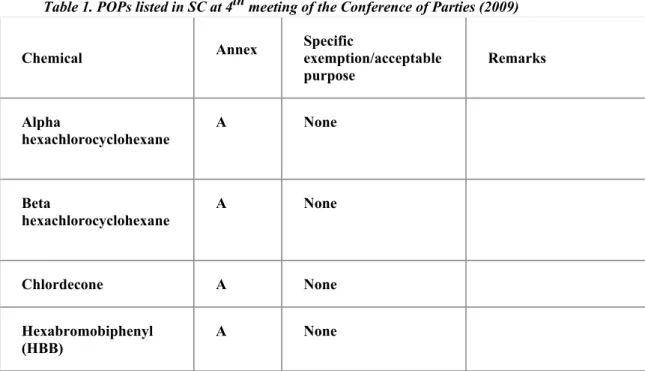
At its 4th meeting of the Conference of Parties (COP) in May 2009, the Stockholm Convention was amended to include the following 9 new POPs (SC-4/10 to SC-4/18). The amendments entered into force for most of the SC Parties on 26 August 2010.
Table 1. POPs listed in SC at 4th meeting of the Conference of Parties (2009)
Chemical Annex Specific
exemption/acceptable
purpose Remarks
Alpha
hexachlorocyclohexane A None
Beta
hexachlorocyclohexane A None
Chlordecone A None
Hexabromobiphenyl (HBB)
A None
Hexabromodiphenyl ether and
heptabromodiphenyl ether
A Use: Articles in accordance with the provisions of Part IV of Annex A
In accordance with paragraph 2 of part IV of Annex A to the Convention, at its sixth ordinary meeting and at every second ordinary meeting thereafter the Conference of the Parties evaluates the progress that Parties have made towards achieving their ultimate objective of elimination of hexabromodiphenyl ether and
heptabromodiphenyl ether contained in articles and review the continued need for this specific exemption. This specific exemption shall in any case expire at the latest in 2030.
Lindane A Use: Human health
pharmaceutical for control of head lice and scabies as second line treatment
These specific exemptions have a limited timeframe and shall expire five (5) years after the date of entry into force of the Convention with respect to that particular chemical (paragraph 4 of Article 4), unless an earlier date is indicated in the Register by the Party or an extension is granted by the Conference of the Parties under paragraph 7 of Article 4.
Pentachlorobenzene
(PeCB) A and
C None
Tetrabromodiphenyl ether and
pentabromodiphenyl ether
A Use: Articles in accordance with the provisions of Part IV of Annex A
In accordance with paragraph 2 of part IV of Annex A to the Convention, at its sixth ordinary meeting and at every second ordinary meeting thereafter the Conference of the Parties evaluates the progress that Parties have made towards achieving their ultimate objective of elimination of tetrabromodiphenyl ether and
pentabromodiphenyl ether contained in articles and review the continued need for this specific exemption. This specific exemption shall in any case expire at the latest in 2030.
Perfluorooctane sulfonic acid (PFOS), its salts and
perfluorooctane sulfonyl fluoride
B Production:
Acceptable purpose:
In accordance with part III of this Annex, production of other chemicals to be used solely for the use below.
Production for uses listed below.
Specific exemption:
None Use:
Acceptable purpose:
In accordance with part III of this Annex for the following acceptable purpose, or as an intermediate in the production of chemicals with the following acceptable purpose:
Insect baits with sulfluramid (CAS No: 4151-50-2) as an active ingredient for control of leaf-cutting ants from Atta spp.
and Acromyrmex spp. for agricultural use only
Specific exemption:
Metal plating (hard- metal plating) only in closed-loop systems Fire-fighting foam for liquid fuel vapour suppression and liquid fuel fires (Class B fires) in installed systems, including both mobile and fixed systems, in
accordance with paragraph 10 of part III of this Annex
As revised by Decision SC-9/4 adopted at COP 9 in 2019.
These specific exemptions have a limited timeframe and shall expire five (5) years after the date of entry into force of the Convention with respect to that particular chemical (paragraph 4 of Article 4), unless an earlier date is indicated in the Register by the Party or an extension is granted by the Conference of the Parties under paragraph 7 of Article 4.
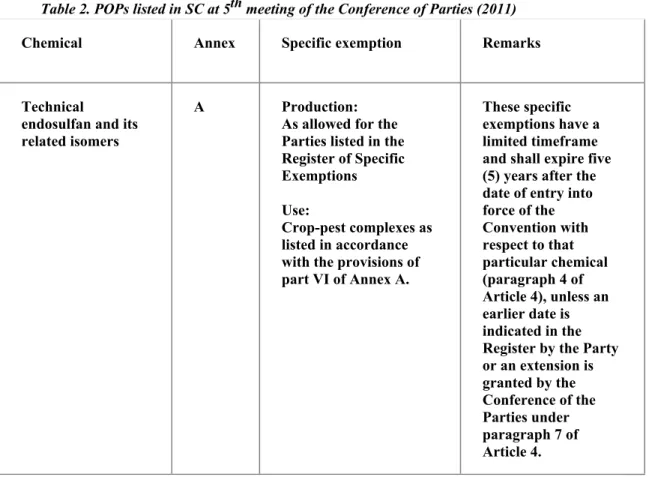
At its 5th meeting of the COP in April 2011, technical endosulfan and its related isomers (SC-5/3) was included in Annex A with specific exemptions for production and use. The amendment entered into force for most of the SC Parties on 27 October 2012.
Table 2. POPs listed in SC at 5th meeting of the Conference of Parties (2011)
Chemical Annex Specific exemption Remarks
Technical
endosulfan and its related isomers
A Production:
As allowed for the Parties listed in the Register of Specific Exemptions Use:
Crop-pest complexes as listed in accordance with the provisions of part VI of Annex A.
These specific exemptions have a limited timeframe and shall expire five (5) years after the date of entry into force of the Convention with respect to that particular chemical (paragraph 4 of Article 4), unless an earlier date is indicated in the Register by the Party or an extension is granted by the Conference of the Parties under paragraph 7 of Article 4.
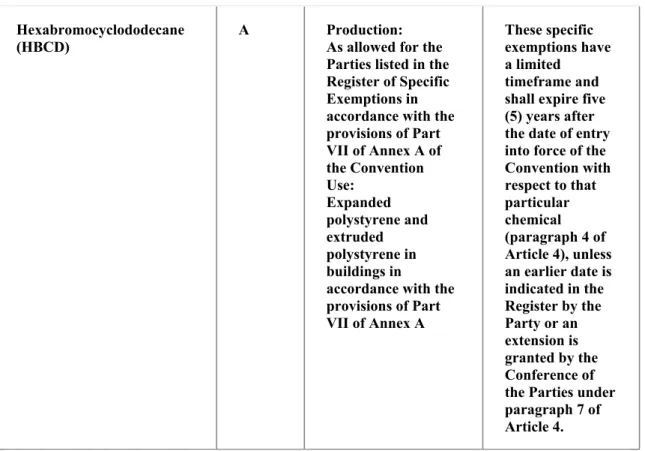
At its 6th meeting in May 2013, COP decided to include Hexabromocyclododecane (HBCD) in the Convention?s Annex A (SC-6/13) for elimination, with specific exemptions for production for use. The amendments entered into force for most of the SC Parties on 26 November 2014.
Table 3. POPs listed in SC at 6th meeting of the Conference of Parties (2013)
Chemical Annex Specific exemption Remarks
Hexabromocyclododecane
(HBCD) A Production:
As allowed for the Parties listed in the Register of Specific Exemptions in accordance with the provisions of Part VII of Annex A of the Convention Use:
Expanded polystyrene and extruded polystyrene in buildings in
accordance with the provisions of Part VII of Annex A
These specific exemptions have a limited timeframe and shall expire five (5) years after the date of entry into force of the Convention with respect to that particular chemical (paragraph 4 of Article 4), unless an earlier date is indicated in the Register by the Party or an extension is granted by the Conference of the Parties under paragraph 7 of Article 4.
the 7th meeting of the COP in May 2015, adopted the amendments of the SC to list the following chemicals:
Hexachlorobutadiene (HCBD) - Annex A (SC-7/12), without specific exemptions/acceptable purposes;
Pentachlorophenol (PCP) and its salts and esters - Annex A (SC-7/13), with specific exemptions for production and use;
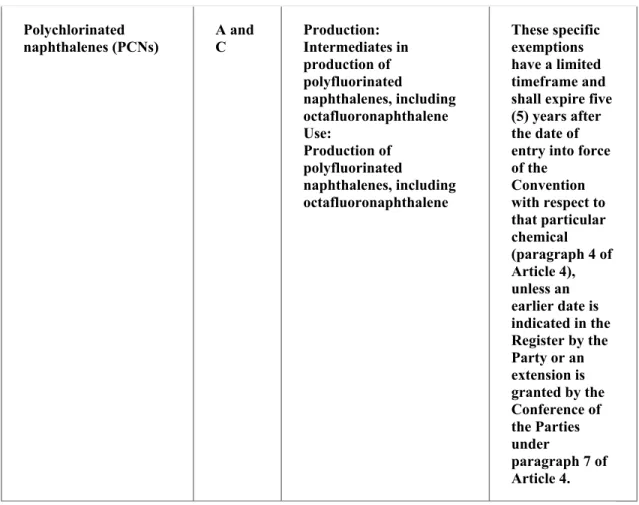
Polychlorinated naphthalenes (PCNs) - Annex A (SC-7/14), with specific exemptions for production and use; and Annex C to the Convention.
The amendments entered into force for most of the SC Parties on 15 December 2016.
Table 4. POPs listed in SC at 7th meeting of the Conference of Parties (2015)
Chemical Annex Specific exemption Remarks
Hexachlorobutadiene
(HCBD) A None
Pentachlorophenol (PCP) and its salts and esters
A Production:
As allowed for the Parties listed in the Register of Specific Exemptions in accordance with the provisions of Part VIII of Annex A
Use:
Pentachlorophenol for utility poles and cross- arms in accordance with the provisions of Part VIII of Annex A
These specific exemptions have a limited timeframe and shall expire five (5) years after the date of entry into force of the
Convention with respect to that particular chemical (paragraph 4 of Article 4), unless an earlier date is indicated in the Register by the Party or an extension is granted by the Conference of the Parties under
paragraph 7 of Article 4.
Polychlorinated
naphthalenes (PCNs) A and
C Production:
Intermediates in production of polyfluorinated
naphthalenes, including octafluoronaphthalene Use:
Production of polyfluorinated
naphthalenes, including octafluoronaphthalene
These specific exemptions have a limited timeframe and shall expire five (5) years after the date of entry into force of the
Convention with respect to that particular chemical (paragraph 4 of Article 4), unless an earlier date is indicated in the Register by the Party or an extension is granted by the Conference of the Parties under
paragraph 7 of Article 4.
In May 2017, the 8th meeting of the COP made decision to amend Annexes A and C to list:
Short-chain chlorinated paraffins (SCCPs) ? Annex A (SC-8/11), with specific exemptions for production and use;
Decabromodiphenyl ether (deca-BDE) ? Annex A (SC-8/10), with specific exemptions for production and use;
Hexachlorobutadiene (HCBD) - Annex C Part I (SC-8/12).
The amendments entered into force for most of the SC Parties on 18 December 2018.
Table 5. POPs listed in SC at 8th meeting of the Conference of Parties (2017)
Chemical Annex Specific exemption Remarks
Hexachlorobutadiene
(HCBD) C None
Decabromodiphenyl
ether (deca-BDE) A Production:
As allowed for the Parties listed in the Register
Use:
Additives in the production of transmission belts in the natural and synthetic rubber industry Spare parts of rubber conveyor belts in the mining and forestry industries
Leather industry, in particular
fatliquoring in leather lubricant additives, in particular for engines of automobiles, electric generators and wind power facilities, and for drilling in oil and gas exploration, petroleum refinery to produce diesel oil tubes for outdoor decoration bulbs , waterproofing and fire-retardant paints
Adhesives metal processing Secondary plasticizers in flexible polyvinyl chloride, except in toys and children?s products
These specific exemptions have a limited timeframe and shall expire five (5) years after the date of entry into force of the Convention with respect to that particular chemical (paragraph 4 of Article 4), unless an earlier date is indicated in the Register by the Party or an
extension is granted by the Conference of the Parties under paragraph 7 of Article 4.
Decabromodiphenyl
ether (deca-BDE) A Production:
As allowed for the Parties listed in the Register of Specific Exemptions Use:
In accordance with the provisions of Part IX of Annex A
These specific exemptions have a limited timeframe and shall expire five (5) years after the date of entry into force of the Convention with respect to that particular chemical (paragraph 4 of Article 4), unless an earlier date is indicated in the Register by the Party or an
extension is granted by the Conference of the Parties under paragraph 7 of Article 4.
In May 2019, the 9th meeting of the COP made the decision to list:
Dicofol - Annex A (SC-9/11), without specific exemptions;
Perfluotooctanoic acid (PFOA), its salts and PFOA related compounds - Annex A (SC-9/12), with specific exemptions for production and use.
The amendments entered into force for most of the SC Parties on 03 December 2020.
Table 6. POPs listed in SC at 9th meeting of the Conference of Parties (2019)
Chemical Annex Specific exemption Remarks
Dicofol A None
Perfluotooctanoic acid (PFOA), its salts and PFOA related
compounds
A Production:
a) Fire-fighting foam: None b) For other production, as allowed for the Parties listed in the Register in accordance with the provisions of part X of this Annex
Use:
In accordance with the provisions of part X of this Annex:
? Photolithography or etch processes in semiconductor manufacturing
? Photographic coatings applied to films
? Textiles for oil- and water-repellence for the protection of workers from
dangerous liquids that comprise risks to their health and safety
? Invasive and implantable medical devices
? Fire-fighting foam for liquid fuel vapour suppression and liquid fuel fires (Class B fires) in installed systems, including both mobile and fixed systems, in accordance with paragraph 2 of part X of this Annex
? Use of
perfluorooctyl iodide for the production of perfluorooctyl bromide for the purpose of producing pharmaceutical
products, in accordance with the provisions of paragraph 3 of part X of this Annex
? Manufacture of polytetrafluoroethylene (PTFE) and
polyvinylidene fluoride (PVDF) for the production of:
o High-performance, corrosion-resistant gas filter membranes, water filter membranes and membranes for medical textiles o Industrial waste heat exchanger equipment
o Industrial sealants capable of preventing leakage of volatile organic compounds and PM2.5 particulates
? Manufacture of polyfluoroethylene propylene (FEP) for the production of high- voltage electrical wire and cables for power transmission
? Manufacture of fluoroelastomers for the production of O- rings, v-belts and plastic accessories for car interiors
These specific exemptions have a limited timeframe and shall expire five (5) years after the date of entry into force of the Convention with respect to that particular chemical (paragraph 4 of Article 4), unless an earlier date is indicated in the Register by the Party or an extension is granted by the
Conference of the Parties under paragraph 7 of Article 4.
g) At its thirteenth, fourteenth and fifteenth meetings that concluded in October 2019, the POPs Review Committee (POPRC), pursuant to paragraphs 6 and 7 (a) of Article 8 of the Convention, completed the?risk profile?and?risk management evaluation?for?perfluorohexane sulfonic acid (PFHxS), its salts and PFHxS-related compounds.?
The Committee, in accordance with paragraph 9 of Article 8 of the Convention, adopted a decision recommending that the Conference of the Parties consider listing PFHxS, its salts and PFHxS in Annex A to the Convention without specific exemptions (decision POPRC-15/1).?
In order to support Parties and observers and to facilitate the identification of substances, an initial indicative list of PFHxS, its salts and PFHxS-related compounds has been prepared as set out in document?UNEP/POPS/POPRC.15/INF/9.
h)Currently, the POPRC is evaluating Dechlorane Plus, Methoxychlor, UV-328 for listing to the Convention. POPRC has not concluded that Dechlorane Plus and UV-328 warrant global action. Methoxychlor is at the risk management evaluation stage.
In accordance with Article 7 of the SC, Parties are required to develop a National Implementation Plan (NIP) describing the measures on how the country will implement its obligations under the SC. Parties are required to transmit their NIPs to the COP within two years of the date the SC entered into force for that country.
Parties are also required to review and update their NIPs regularly, as specified by Article 7 of the Convention. The addition of chemicals to the Annexes of the SC is one of the principal factors triggering the review and update of the NIP for a Party. With the addition of 18 new chemicals to the SC, participating countries are now requesting additional financial support from the GEF, technical support from the Basel and Stockholm Convention Regional Centres, with UNEP as the Implementing Agency, to undertake their NIPs development, review and update. The revised NIPs aim to include all 30 chemicals currently listed in the Convention, but this will depend on the specific situation of each country included in this project.
According to Article 15 of the SC, each Party shall report to the Conference of the Parties, every 4 years, on the measures it has taken to implement the provisions of this Convention and on the effectiveness of such measures in meeting the objectives of the Convention. Therefore, the NIPs development, review and update also take into consideration the data needs and collect the qualitative and quantitative data to enable participating countries to complete and submit their Article 15 reports.
A.2 Key challenges in the NIPs development/update processes and national reporting
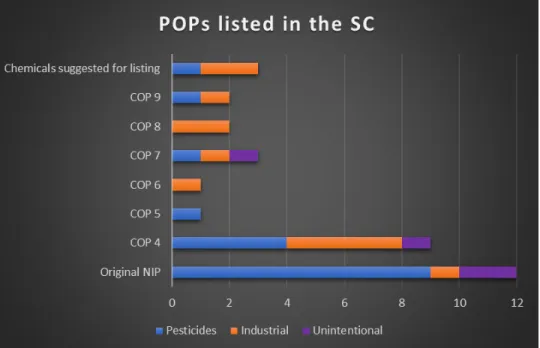
As illustrated in the graph below, an increase in the number of industrial POPs among the POPs listed in the Annexes of the Convention has brought new challenges to Parties of the SC. Challenges are related mostly to the development of POPs inventories and the access to alternatives for these chemicals. Developing countries have difficulties managing products containing the newly listed POPs chemicals, including tracking imports and exports of POPs-containing products and collecting accurate and valid information needed for the POPs inventories.
Figure 1. POPs listed in the Stockholm Convention
In addition, as new chemicals are consistently added to the Convention, there is an unrealistic expectation to rapidly and continuously update NIPs. As such, Parties to the Convention that have recently submitted NIPs covering the chemicals listed at COPs 4, 5 and 6 are still technically non- compliant with the Convention because the deadline for the transmission of NIPs including COP 7 and 8 chemicals has already passed (on December 2018 and December 2020 respectively). Even though the SC Secretariat is developing methodologies to prepare POPs inventories after every listing within the SC, many countries struggle to use the POPs inventory guidance to review and update NIPs. Therefore, rather than implementing already developed NIPs, national human resources are being mobilized to continuously update the NIPs instead. This has resulted in "NIP fatigue" among Parties to the SC.
The inventories on new industrial POPs are usually organised in three tiers:
Tier 1: Initial assessment - is carried out to obtain an overview of the relevant uses of POPs and stakeholders to be contacted in the key sector(s) under investigation. Tier I methods usually rely on available literature and statistics in combination with calculations based on already existing information. Developing countries often develop initial assessments that are not sufficiently detailed and precise to plan the SC implementation or to identify global environmental benefits for the development of future GEF projects to support in-country implementation of NIPs.
Tier II: Main inventory - the objective is to generate data on the main sectors through interviews and questionnaires to the national stakeholders, and further identify missing information. The poor rate and quality of answers to questionnaires from key stakeholders is usually the main obstacle to developing the Tier II inventory.
Tier III: In-depth inventory - includes sampling and analysis. In most cases, developing countries have no capacity to conduct in-depth inventories of POPs.
Currently, information on the global production, use and trade of newly listed chemicals and their products is still not available, and this poses a significant barrier for developing countries conducting their initial assessments (Tier 1).
Furthermore, Parties face challenges in engaging and obtaining full political support at the national level; validation and endorsement of NIPs and NIP updates often take so long that Parties are delayed in fulfilling their obligations under the Convention. In some instances, POPs management may conflict with other priorities in a country's development agenda. Additionally, many countries that have already undertaken multiple NIP updates still do not have a sustainable system in place to conduct further updates and as such continue to require international assistance and funding, further complicating and delaying the process.
Other than the issues related to data collection and management of collected data, analysis/validation is hampered by the low capacity of national and regional laboratories. When data quality is poor and not well managed, NIPs cannot assist policy makers in making meaningful and effective decisions.
Finally, there has been very minimal assistance provided to countries to conduct and complete their national reporting. This has resulted in delays and/or inaccuracies and missing information on the data submitted; for example, discrepancies have been found between NIPs/NIP updates and national reporting data. As a result, an even greater burden is placed on the countries and the Secretariat which in turn negatively impacts the evaluation of the effectiveness of the Convention.
A.3 Completed and Ongoing NIP Projects
UNEP's first global NIP project focused on the initial 12 POPs in 2002 (GEF ID1016). The project assisted 12 pilot countries to develop their original NIPs. The main objective of the global component was to propose guidelines for NIP development. Since then, UNEP's support to countries in the review and update of NIPs have been based on the guidance adopted by the SC Secretariat and approved by the COPs.
Projects developed from GEF 2 to GEF 4 only had a national component and followed the 5 steps of the NIP guidance:
Establishment of coordinating mechanisms and organisation of process (Step 1) Establishment of a preliminary POPs inventory (Step 2)
Priority setting and determination of objectives (Step 3)
Formulation of National Implementation Plan and Action Plans on specific POPs (Step 4) Endorsement of National Implementation Plan by stakeholders (Step 5)
However, these projects lacked a component on lessons learnt and would have benefitted from a platform to share information among countries, especially within a region.
During GEF 5, when the COP 4 chemicals were listed to the Convention, UNEP developed the umbrella projects GEF ID 5307 and GEF ID 5525. Both projects had a global and a national component.
The national component followed the 5 steps of the NIP guidance. The global component was developed to support sharing of information and evaluating NIPs updating with the specific objective to continue strengthening the quality and sustainability of the project through the delivery of specific and additional assistance to participating countries. The expected outcome was to enhance communication and information-sharing to enable Parties to compare and harmonize data and identify lessons learned and good practices. The component had the following outputs:
Identify and disseminate lessons learned
Identify initial needs and opportunities for exchange of information and expertise Provision of regional/ global training support and encourage information exchange
As a result of this global component, the following outputs were achieved (since the projects are still ongoing, some outputs are not yet complete):
Lessons learned have been identified and compiled in a report and published in December 2018;
Data on DDT, PCB and PFOS were transferred to an Excel, harmonized and geo-localised in cooperation with MAPx (a platform for data sharing, analysis and visualization developed by UNEP to use new digital technologies and cloud computing to sustainably manage natural resources) to facilitate POPs data management and risk assessments;
A roster of global, regional and national experts was developed to facilitate access to POPs experts globally;
Several trainings and webinars were delivered mostly on new POPs inventories;
POPs data incorporated into the SC clearinghouse to facilitate access to the information collected in the NIP inventories; and
A guide on incorporating gender dimensions into national strategy setting in the context of chemicals management and implementation of NIPs was prepared and is currently under peer- review (managed by UNEP Knowledge and Risk Unit).
On November 2017, the project (GEF ID 9884) "Integrated SC Toolkit to Improve the Transmission of Information under Articles 7 and 15" was approved for implementation. The objective of the project is to "facilitate the development, transmission, access and use of data contained in National Implementation Plans (NIP, Article 7) and National Reports (Article 15)". Addressing one of the issues mentioned in section A2 above. For this, an integrated electronic toolkit linking the information needed for the development of National Implementation Plans (Article 7) and the National Reports (Article 15) of the SC has been developed and is currently in trail by selected number of countries. Access to guidance materials is also provided through the toolkit which will be available for use by all Parties in December 2021. However, the roll out of the toolkit, including capacity training for Parties and full operation within the NIP and NIP update process is still lacking.
Based on previous NIP development and update experiences, especially through national executed arrangements, heavy reliance on international funding and expertise have resulted in insufficient use of resources and unexpectedly long period to complete the process. In addition, regional capacity is not built and coordination not improved. Therefore, in order to align with the objective of the BCRCs- SCRCs and to reduce transaction costs, a regional and more harmonized approach is needed for project implementation. Countries should and need to work more closely with BCRCs-SCRCs to strengthen regional capacity, to increase data sharing and exchange of experiences, as first steps to shift toward effective and efficient use of international resources. Furthermore, a knowledge platform (at both regional and global levels) should be tasked with delivering regular trainings and maintaining a database of available documents including lessons learnt from previous projects. The platform would also be linked with the forthcoming electronic toolkit to allow access to NIP data so that regional trends can be identified to develop new interventions. Finally, the platform can provide a workspace where countries can raise questions and seek responses from peers. These areas of work will also foster country to country learning and problem identification /resolution.
Based on the above identified lessons learnt, a global project (GEF ID 10785) was developed and approved in June 2021 covering 21 countries and with extensive global components. This project will be executed by six different BCRCs-SCRCs and a knowledge platform will be developed by the Green
Grown Knowledge Partnership (GGKP) that would be linked with existing initiatives and tools. The new project is an addendum to the global NIP update project supporting additional countries in meeting their obligations to the Convention. The addendum countries will be closely linked to the global NIP project and will be implemented and executed in close coordination.
A.4 Participating Country Baseline
The following considerations were used to select countries to be part of the project:
Ratified the Convention amendments; non-Parties are eligible for the initial 12 POPs only;
Not currently involved in an active NIP development or update process;
With known large quantities of wastes potentially contaminated with POPs such as electronics, textiles and end of life vehicles;
Not a fragile State or country in conflict;
Geographical balance among regions;
Shown positive experiences in previous NIP updates; and
Availability and interests of regional centers to work with the countries and vice versa.
Baseline assessments for three countries i.e. Ethiopia, Malawi, Zambia are presented in Appendix K.
Information is extracted mainly from previous NIP update reports and gender baseline information is provided when available.
B. ENABLING ACTIVITY GOALS, OBJECTIVES, AND ACTIVITIES
The proposal should briefly justify and describe the project framework. Identify also key stakeholders involved in the project including the private sector, civil society
organizations, local and indigenous communities, and their respective roles, as applicable. Describe also how the gender equality and women?s empowerment are considered in project design and implementation
For the purposes of comprehensiveness, descriptions of the global component (component 1,2 and 4) that are funded through project 10785 are also included.
B.1 Description of the project (goals, objectives and components)
The proposed project aims at assisting participating countries to comply with their NIP-update and national reporting obligations under the SC while addressing challenges identified in Section A.2 and building on regional expertise and UNEP?s experience as well as integrating the new tools developed in project 9884. The project would also complement to the global NIP project (10785) and activities will be closely linked; details are provided in relevant sections.
The overall goal of the Enabling Activity is to reduce the dependency of external expertise and resources to develop NIP and NIP updates through strengthening the political environment and technical capacities of participating countries. Lessons learned and tools/practices developed through this EA can be shared and applied to all Parties of the Convention.
The objective is to facilitate the implementation of the Stockholm Convention in participating countries through the development, review and update of their respective NIPs and submission to the SC COP.
The project is designed with five (5) components:
1) Build political support and stakeholder involvement for NIP development, endorsement and future implementation (funded through project 10785);
2) Develop tools and methodologies to be used by all Parties to the SC to facilitate the NIP development, review and update process and its implementation (funded through project 10785);
3) Support Parties in the development, review and update of their respective NIPs and complete their national reporting following the methodologies development by the SC Secretariat and approved by the COP;
4) Ensure development of knowledge products, sharing of knowledge, development of platforms for information exchange and training / familiarisation, knowledge management and reporting at the global level is reached (funded through project 10785); and
5) Ensure effective monitoring and evaluation.
Relevant national, regional and international stakeholders will be consulted and involved throughout the project implementation process. The developed, updated and endorsed NIPs will provide a basis to identify activities and implement post-NIP projects in accordance with the requirements of the SC.
With the challenges identified and lessons learned from past and ongoing projects, the proposal is designed to benefit from the solid and robust regional and global component (components 1, 2 and 4) under the Global NIP update project (10785) and would address the identified barriers and facilitate future NIP development, review and update by Parties to the SC. The objective is also to contribute to the efforts initiated by the project GEF ID 9884 (integrated SC electronic toolkit) and facilitate the familiarisation process to utilize the toolkit in addition to access and use of data contained in NIPs.
The global component in previous NIP update projects have successfully supported countries globally on the development of their NIPs. As a result, a roster of international, regional and national experts on NIP development and implementation has been developed[1]1. As of February 2021, the roster listed more than 130 experts in diverse areas of POPs expertise and regional experience and this roster will be used for the project.
The global component will also organize trainings on data collection, data management, data analysis (including validation), data application, and NIP implementation in partnership with the SC Secretariat, thereby ensuring an efficient use of resources.
Furthermore, the project proposes the inclusion of an extensive knowledge sharing platform at both regional and global levels (building on the existing clearinghouse mechanism on the BRS website). The aim is to ensure linkages among countries and between regions are made, issues and challenges of common concern are identified and associated solutions are developed based on validated and objective data.
In order to further strengthen regional cooperation and build on regional expertise rather than rely on international experts, the project will involve BCRCs-SCRCs as executing agencies. The Centres will ensure NIP guidance is implemented according to the guidance of the Stockholm Convention and obligations under the Basel and Rotterdam Conventions are also considered when relevant. They will also ensure that key national stakeholders are consulted throughout the project and the project team has a strong political support to facilitate access to information for NIP development. The objective is to capacitate national governments to review and update their NIPs (independently if feasible) in the future rapidly with national resources. By working with the Centres, regional expertise will be built to assist other countries in the future.
The national component (component 3) of the project should follow the NIP guidance as approved by the COPs. As part of the NIP update process, countries will conduct a review of past and ongoing interventions that sought/seek to manage/dispose POPs so that inventories developed from this project will take into account chemicals that have already been managed and disposed.
Finally, chemicals that are currently under consideration for listing in the Stockholm Convention (PFHxS, its salts and PFHxS-related compounds) will be included as part of the training and inventory activities in the project. Specifically, training related to background, usage, and inventory methods of these chemicals will be included in component 2 while the national NIP update in component 3 will cover inventories of these chemicals. National specificities will be applied as appropriate.
For more detailed information, please refer to Section C below and the project logical framework (Appendix A).
B.2 Project Stakeholders
At the international and regional level the project will include:
? UNEP Chemicals and Health Branch: UNEP is the only United Nations organization with a mandate derived from the General Assembly to coordinate the work of the United Nations in the area of environment and whose core business is the environment. UNEP Chemicals and Health is the UNEP Branch that works specifically to minimize the adverse effects of chemicals and waste on human health and the environment. The implementation of this project contributes directly to reach the main mandate of the Branch;
? UNEP Regional Offices: UNEP has six regional offices supporting different groups of countries in their efforts towards sustainable development. The UNEP Regional Offices will identify opportunities for regional synergies and areas of cooperation. Some examples may include: coordination of regional information exchange and provision of documents and inventories from other countries in the region, identification of regional experts, etc;
? The Stockholm Convention Secretariat based in Geneva, Switzerland, exerts the Secretariat role of the Stockholm Convention according to Article 20. The Stockholm Convention Secretariat will be regularly informed on the progress in the implementation of the project to be able to identify opportunities to facilitate assistance to Parties in the implementation of the Convention;
? The World Health Organization (WHO) works to achieve better health for everyone, everywhere.
Some of the Persistent Organic Pollutants are among the list of ten chemicals of major public health concern developed by WHO; and this Organization has responded to this health and environmental issue of concern through the development of studies, tools and guidance materials. The UNEP Chemicals and Health Branch will facilitate the access to these materials and will also inform the WHO on identified needs for additional support;
? The International Labour Organization (ILO) brings together governments, employers and workers to set labour standards, policies and devise programmes promoting decent work for women and men. ILO has already supported initiatives to address the impact of e-waste in relation to occupational safety and health issues. These social aspects will be taken into account in the NIP updating;
? The Basel and Stockholm Convention Regional Centres (BCRCs-SCRCs) - The Stockholm Convention has established a network of 16 regional and subregional Centres to provide technical assistance and to promote the transfer of technology to developing country parties and parties with economies in transition relating to the implementation of their obligations under the Convention. The SCRC Czech Republic will act at executing agencies in this project.
? Green Growth Knowledge Partnership (GGKP) ? The GGKP is a global network of experts and organizations dedicated to providing the policy, business and finance communities with knowledge, guidance, data, and tools to transition to an inclusive green economy. GGKP?s three platforms, Green Growth Knowledge Platform, Green Industry Platform and Green Finance Platform, offer quick and easy access to the latest research, case studies, toolkits, learning products, principles, and protocols to empower policy makers and advisors, and investment community to make evidence based decisions about how to green their operations. Users can browse by sectors, regions, or cross setting themes, such as gender, jobs, climate change, circular economy, and natural capital. GGKP will be involved as the executing agency for Component 4 focusing on dissemination of information to both stakeholders part of and outside of the project, including organization of and reporting on all trainings/webinars, advise on the maintainance or re-invention of Communities of Practice portal as part of the clearinghouse mechanism and liaise with the SC Secretariat in providing information and tools to be integrated with existing materials and make them easily accessible and understandable by all Parties of the SC. GGKP will support the project through the global project.
The international partners will provide ongoing support to the project and their engagement will be discussed and agreed upon in the inception meetings.
National Stakeholders
In reference to national stakeholders, strong emphasis will be placed on the participation of the private sector and civil society to ensure their active involvement in the execution of the project and sensitization towards POPs issues. NGOs, including research groups and academic institutions, industrial and professional associations, will be invited to stakeholder?s consultations to contribute to the achievements of the project objectives. Special emphasis will also be placed on the participation of women, as one of the vulnerable groups to POPs, on the National Coordinating Mechanisms (NCMs) to ensure their active involvement throughout the project duration. Further, civil society organizations (CSOs) representatives will be involved in the NCMs as necessary. A preliminary and general list of national stakeholders has been identified below for each country. At a minimum, these agencies and organizations, or their equivalent, should be considered and invited to the NIP development and update process. Final list of national stakeholders will be adopted according to national specificities and previous NIP update experiences in participating countries.
National stakeholder preliminary list include: Ministry of Environment, Ministry of Energy, Ministry of Industry, Ministry of Health, Ministry of Agriculture, Ministry of Trade, Ministry of Finance, Ministry of Planning, Ministry of Labor, Academia, Ministry of Education, Ministry of Science, Private Sector (e.g.
manufacturing sector, importers, retailers), Professional Associations (e.g. farmers and agricultural associations), Customs, Port Authorities, Municipal governments (e.g. electricity, mining, statistics), and NGOs. The project will also strongly recommend the formation of permanent inter-ministerial working groups in each country that would facilitate future data collection and amendments under the Stockholm Convention. Countries with established designated Chemical Units (developed through the Special Programme), will include them as part of the national stakeholders coordinating mechanism to streamline national chemical management process.
B.3 Gender Dimensions
In practice, gender mainstreaming means identifying gaps in gender equality using sex disaggregated data, developing strategies to close those gaps, putting resources and expertise into implementing strategies for gender equality, monitoring and implementation and holding individuals and institutions accountable for results. Gender mainstreaming is not an end in itself; it?s a process whose goal is to achieve gender equality (Sustainable Development Goal 5).
Gender or vulnerable populations are not explicitly mentioned in the Convention text. Nevertheless, several decisions of the Convention?s bodies have referred to gender. For instance, in 2013 the BRS Secretariat released the BRS Gender Action Plan with the vision that ?gender equality should be an integral part of the implementation of the Basel, Rotterdam and Stockholm Conventions?.
The level of exposure to POPs chemicals and its related impacts on human health are determined by social and biological factors. Women, children and men might be exposed to different kinds, levels and frequency of new POPs chemicals (e.g. in the household, agriculture, industry, school, etc.). The Stockholm Convention Global Monitoring Plan have bio monitored persistent organic pollutants in human milk, in recognition to the fact that women are particularly impacted by the poor management of hazardous chemicals and wastes.
This project aims at contributing to the Stockholm Convention Action Plan through the development and implementation of a gender analysis and a gender strategy with SMART indicators to mainstream gender throughout the project. It?s recommended that the focal point of the Stockholm Convention follow a training on gender equality for a better understanding of the topic before working on the strategy. The project will follow the guide on incorporating gender dimensions into national strategy setting in the context of chemicals management (this is a deliverable from ongoing GEF ID 5307 and 5525 umbrella projects for NIP updates). Below are some of the elements that have been considered and will be carried out during implementation:
Project Design
? Include the findings of the gender context analysis;
? Ensure strong stakeholder engagement in design and analysis, including women groups and government departments responsible for women and gender;
? Determine the level of financial resources required for gender-responsive design, implementation, monitoring and evaluation activities;
? Determine the problem in which the gender perspective is reflected. For example, for an objective that is intended to address poor uptake of mercury-free or POPs-free technologies by occupational workers, a gender aspect to be considered might be the limited capacity of women to adopt these technologies because of low access to education; and
? Use human rights frameworks or other industry guidelines to inform gender issues and ensuring women?s rights in project design.
Project Planning and Activities
? Seek gender parity while setting project management unit;
? Ensure a gender-balanced leadership and decision making in project planning and implementation, this includes technical teams in various government bodies tasked with developing and implementing the NIP;
? Align project activities with national and regional gender protocols which can be used as benchmarks;
? Build capacity on gender issues among partners and beneficiaries;
? Develop and integrate mechanisms to ensure gender-balanced representation and women?s participation in project activities; and
? Capture the voices of women and men and develop gender-sensitive communication plans.
[1] http://informea.pops.int/NIPsRoster/index.html
C. DESCRIBE THE ENABLING ACTIVITY AND INSTITUTIONAL FRAMEWORK FOR PROJECT IMPLEMENTATION
Discuss the work intended to be undertaken and the output expected from each activity as outlined in Table A