Comparative Performance Assessment of
different Solar PV Module Technologies
Vishakha Baharwani, Neetu Meena
(M. Tech. Student)Centre for Energy and Environment
Malaviya National Institute of Technology Jaipur Rajasthan, India
Arvind Sharma, Richie B. Stephen, Parimita Mohanty
(Research Fellow)The Energy and Resources Institute, New Delhi, India
Abstract: At the present flash in time, renewable energy sources have achieved great worth for modern day society. The main reason for this boom is the need to use substitute sources of energy to fossil fuels which are free of CO2 emissions and contamination. Among the current renewable energy sources, the growth of solar PV has been spectacular. The PV Module itself accounts for around half of total PV system costs. The continuous reduction in PV Modules cost is therefore a key element of improving the competiveness of PV. Therefore different module technologies developed. While crystalline Si is the most mature PV technology but is more expensive whereas thin film technology is cheaper and has additional advantages but has less efficiency than crystalline. So it is important to know the suitable module technology as well as the electronic circuitry as per requirement. The objective of the present study is to assess the suitability of different PV technologies under Indian climatic conditions. This paper deals with the comparative analysis of two different module technologies i.e. polycrystalline and CdTe of same rating, both technologies are first used with MPPT based charged controller and then the same technologies are used with PWM charge controller. Along with this the performance of poly-crystalline silicon type PV modules has been investigated at different tilt angles. This paper is mainly divided into four sections, first section presents the overview of photo voltaic technologies used, section second represents the experimental setup and equipment used for the experiment, section third shows the methodology of test, whereas the discussion of result is represented in section fourth.
Keywords— MPPT Charge controller, CO2 emission, Polycrystalline, CdTe PV Module.
I. INTRODUCTION
condition. Carr [5] compared the performance of five different PV technology modules: c-Si, p-Si, amorphous triple junction silicon (a-3j-Si), CIS and the laser grooved buried contact (LGBC) c-Si, in the temperate climate of Perth, Western Australia over a year. The result shows variation in behavior and output of different technologies. Huld [6] estimated the energy yield of photovoltaic (PV) modules at arbitrary locations in a large geographical area for three different PV technologies: crystalline silicon, CuInSe2 and CdTe based thin-film technology in order to map their performance in fixed installations across most of Europe and to identify and quantify regional performance factors and shows the difference in module technologies. Makrides [7] evaluated the performance of thirteen different PV technology systems with nominal power 1 kWp each under the high irradiance and hot climatic condition of Cyprus. The outcome of the study indicates that the energy yield range between 1600 and 1700 (kWh/kWp), the highest energy yields have been produced by the technologies having lowest temperature coefficient of maximum power (Pmax) indicating the importance of the temperature losses due to hot climate. Skoplaki [8] explained the operating temperature plays a central role in the photovoltaic conversion process; the electrical efficiency and the power output of a PV module depend linearly on the operating temperature. Also it is known that the yearly optimum tilt angle of flat plate PV modules to collect the maximum yearly incident solar energy is equal to the local latitude [11]. In some applications, it may be difficult to install the PV arrays with their optimum tilt angle and orientation due to the nature of the application or the site in which the application will be used. So, it is very important to study the performance of PV arrays at different tilt angles and orientations [12].
These site-specific assessment studies have helped in identifying suitable technologies for those locations. Therefore, the main objective of this study is to evaluate the performance of different PV technologies and the electronic circuitry under Indian conditions which are as follows:
1. Poly Crystalline Technology:Poly Crystalline technology is the most matured technology started early in 1940s when a P-N junction was obtained by growing N-type Si from melt on P-type Si. The current market of the poly crystalline technology is. A big question mark for the future is the source of highly purified silicon for solar cells. Fifty percent of the cost of a module is due to the cost of processed silicon wafers[9]. The present technology is relatively mature but several studies have shown that it still has a large cost reduction potential. As for other industrial products, manufacturing cost follows a learning curve which indicates that for every doubling of manufacturing volume, cost drops by 20%.
2. Cadmium telluride (CdTe) Technology:The first solar cell based on CdTe/CdS has been reported in 1972 with an efficiency of 6%. Since then, significant improvement has been made in the cell and the highest efficiency of 16.5% has been reported. Cadmium telluride (CdTe) based modules have been successful lately due to their low cost position [14]. Their market share increased from 1% in 2005 to 9% in 2009. But the manufacturing process of this technology is still immature. CdS/CdTe has also been known for their stability for a longer time [10]. However, this technology faces some problem such as environmental related and problem with telluride (Te) raw material [13].
II. EXPERIMENTAL SETUP AND APPARATUS USED
An experimental photovoltaic outdoor test facility with two different photovoltaic technology module arrays: p-Si and CdTe (Thin Film) have been set up at Solar Lighting Lab, TERI (The Energy and Research Centre), New Delhi (Latitude 28°37N, Longitude 77°04E). SLL is an independent testing and evaluation center for solar lighting. The lab is supported by Ministry of New and Renewable Energy (MNRE) for testing and long term performance assessment of solar lighting system.
Figure.1. Block diagram of experiment Figure.2. Outdoor experimental Setup
Three tests were conducted to evaluate the performance of both crystalline and CdTe. The first test is to calculate performance parameter for both Crystalline and CdTe by using MPPT based charge controller. The second test is to calculate the performance parameter by using a PWM charge controller. The third test is done to evaluate the effect of different tilt angle on the same polycrystalline module. Hence comparison is made between the two technologies for both type of charge controllers i.e., with and without MPPT. The specifications of the modules and equipment used are given in Table 1 and Table 2.
TABLE.1. SPECIFICATION OF MODULES
Module
Type Voc(V) Isc(A) Pmax(Wp) Area(m2)
p-Si 21 5.08 80 0.62
CdTe 60.8 1.88 80 0.72
TABLE.2. APPRATUS USED
S.No. Equipment Specification
1. Modules(CdTe and p-Si) 80 Wp
2. Multi meter 0-100V
3. Solar Power meter 0 - 1999W/m2
4. Battery 12V/100Ah
5. Load(Street light) 29 W
6. Charge Controller(MPPT
and without MPPT) 12/24 V, 0-10A
7. Thermocouple -40 - 10000
C
8. Clamp meter 0 - 10A
III. METHODOLOGY
same test is repeated for PWM charge controller. Five cycles of each test is performed. For the third experiment five cycles of charging and discharging with different tilt angle (18° and 28°) for same polycrystalline module has also been done. The purpose of these tests is to find the total power generation of crystalline and thin film module throughout the day operation when used for battery charging application and its applicability in the solar lighting application. A comparison is also done between MPPT based charge controller and PWM charge controller to estimate the role of electronic circuits. While charging the battery from the different modules, observations such as the global radiation, back temperature of modules, ambient temperature and electrical specifications are noted down at every half an hour for analysis purpose. Performance parameters evaluated as follows:
Performance Parameters:
a) Total Energy Generated: is the total Wh generated by the module in a day while charging and is represented by:
t
Where Etis energy generated in each hour t= time (1 to 7).
b) Efficiency: is the ratio of output energy to the input power.
Efficiency (%) = Output Energy (Wh) *100 (1) Insolation* Area
c) Solar Operational Efficiency: is the ratio of practical output to the rated output of the module.
Solar Operational Efficiency (%) = Output power (Wh) *100 Rated power (Wh)
IV. RESULTS AND DISCUSSIONS
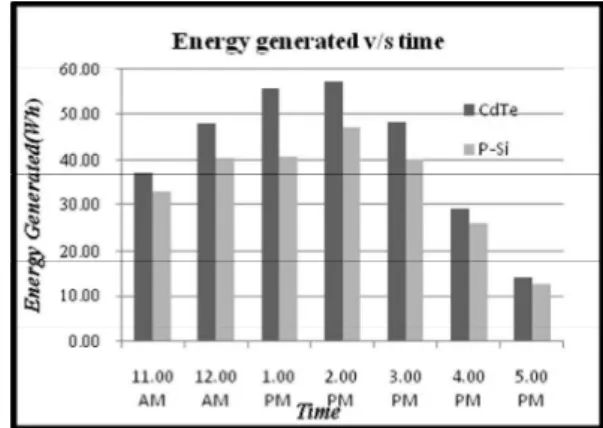
This paper investigates comparison of the average conversion efficiency, average produced energy and average operational efficiency on the performance between two different module technologies by using two different charge controllers. Five cycles of charging and discharging has been done with MPPT and PWM charge controller for CdTe as well as Polycrystalline module and parameters are evaluated. The result shows that CdTe module performed better as compared to Polycrystalline module when it was used with MPPT charge controller while when it was used with PWM charge controller, performance of P-Si module was good. With PWM charge controller average energy generated in a day from p-Si and CdTe module was 225 and 132Wh respectively. When it was used with MPPT charge controller the average energy output of the p-Si and CdTe module was 239.33 and 289.78 Wh respectively, represented in fig. 3 and fig. 4. This difference is due to the reason that open circuit voltage of the CdTe module is much more than crystalline module in the range of 50 to 60 V while it is 19 V for p-Si module. For charging 12 V batteries there is a large difference in battery voltage and open circuit voltage of CdTe module that is why the performance of CdTe module is diminished when it was used with MPPT charge controller, i.e., mismatching losses are reduced when CdTe is used with a MPPT based charge controller whereas PWM charge controller is not able to reduce the mismatching losses of CdTe technology.
With MPPT charge controller the CdTe module performed well with average energy generated 289.78 Wh compared to p-Si with 239.33 Wh although efficiency of CdTe was less i.e. 9.62% as compared to p-Si i.e. 11.71% . The maximum energy generated in a day was 48.8 Wh for p-Si and 27.8 Wh for CdTe module when used with PWM charge controller while it has gone up to 72.89 and 54.23 Wh for CdTe and p-Si module, respectively when used with MPPT charge controller. Also from figures we can see that the in the peak sunshine time of the day more energy is generated i.e. from 12 to 3 PM.
Figure.3. Energy generation using PWM Charge Controller Figure.4. Energy generation using MPPT charge Controller
Figure.5. Operational efficiency using PWM charge controller Figure.6. operational efficiency using charge controller with MPPT
Figure.7. Energy generation at different tilt angle
V.CONCLUSION
The performance of two modules polycrystalline and CdTe (Thin film) is examined and compared at the same climatic condition with two different types of charge controllers that is MPPT and PWM. The major conclusions are as follows:
1. CdTe module performed better when it was used with MPPT charge controller because of its high open circuit voltage while for PWM charge controller polycrystalline module is fine.
2. Average Energy generated throughout the day and Average operational efficiency is more for CdTe module compared to polycrystalline.
3. The tilt angle and orientation of the PV modules are important factors that affect the performance of PV modules.
4. The optimum tilt angle and orientation of the PV modules are equal to its local latitude and south facing, respectively.
VI. WAY FOREWARD
The test was conducted at Solar Lighting Lab (TERI). For more comprehensive study of performance of solar modules there are some additional important factors that should be considered for e.g. long term degradation of modules, role of electronic circuitry in PV system, effect of temperature. These experiments are conducting at Solar Lighting Lab, TERI. The present study is to be continued for the detailed analysis of performance of the different type of PV modules.
REFERENCES
[1] M. Z. Kadir, Y. Rafeeu, N. M. Adam “Prospective scenarios for the full solar energy development in Malaysia”; Renewable and Sustainable
Energy Reviews 14 (2010) 3023–3031.
[2] N. Sharma, P. K. Tiwari, Y. Sood, “Solar energy in India: Strategies, policies, perspectives and future potential”; Renewable and
Sustainable Energy Reviews 16 (2012) 933– 941.
[3] M. Peters, T. S. Schmidt, D. Wiederkehr, M. Schneider, “Shedding light on solar technologies—A techno-economic assessment and its
policy implications”; Energy Policy 39 (2011) 6422–6439.
[4] V. Sharma, A. Kumar, O.S. Sastry, S.S. Chandel, “Performance assessment of different solar photovoltaic technologies under similar
outdoor conditions”; Energy 58 (2013) 511e518.
[5] A. J. Carr, T.L. Pryor, A comparison of the performance of different PV module types in temperate climates; Solar Energy 76 (2004) 285–
294.
[6] T. Huld, R. Gottschalg, H. G. Beyer, M. Topic, “Mapping the performance of PV modules, effects of module type and data averaging”;
Solar Energy 84 (2010) 324–338
[7] G. Makrides, B. Zinsser, M. Norton, G.E. Georghiou, M. Schubert, J.H. Werner. “Potential of photovoltaic systems in countries with high
solar irradiation”; Renewable and Sustainable Energy Reviews 2010;14:754e62.
[8] E. Skoplaki, J.A. Palyvos, “On the temperature dependence of photovoltaic module electrical performance”: A review of efficiency/power
correlations; Solar Energy 83 (2009) 614–624.
[9] A. Goetzberger, J. Luther, G. Willeke, “Solar cells: past, present, future”; Solar Energy Materials & Solar Cells 74 (2002) 1–11.
[10] K.W. Boer. “Cadmium sulfide enhances solar cell efficiency. Energy Conversion and Management” 2011;52:426–30. [11] JA Duffie, WA Beckman. Solar engineering of thermal processes. New York: John Wiley and Sons; 1991.
[12] H.M.S. Hussein, G.E. Ahmad, H.H. El-Ghetany, “Performance evaluation of photovoltaic modules at different tilt angles and orientations”, Energy Conversion and Management 45 (2004) 2441–2452
[13] Critical materials for sustainable energy applications. Resnick Institute Report California September 2011.
<www.resnick.caltech.edu/learn/docs/ri_criticalmaterials_report.pdf>.