Accelerated Growth Rate and Increased
Drought Stress Resilience of the Model Grass
Brachypodium distachyon
Colonized by
Bacillus subtilis
B26
François Gagné-Bourque1☯, Boris F. Mayer1☯, Jean-Benoit Charron1
*, Hojatollah Vali2,
Annick Bertrand3, Suha Jabaji1*
1Department of Plant Science, Macdonald Campus of McGill University, 21,111 Lakeshore Rd. Ste-Anne-de-Bellevue, Québec, CANADA, H9X 3V9,2Facility of Electron Microscopy Research (FEMR) McGill University, 3640 University Street, Montréal, Québec, CANADA, H3A 0C7,3Soils and Crops Research Development Center, Agriculture and Agri-Food Canada, 2560 Hochelaga Boulevard, Québec City, Québec, CANADA, G1V 2J3
☯These authors contributed equally to this work.
*[email protected](SJ); [email protected](JBC)
Abstract
Plant growth-promoting bacteria (PGB) induce positive effects in plants, for instance, increased growth and reduced abiotic stresses susceptibility. The mechanisms by which these bacteria impact the host plant are numerous, diverse and often specific. Here, we stud-ied the agronomical, molecular and biochemical effects of the endophytic PGBBacillus subti-lisB26 on the full life cycle ofBrachypodium distachyonBd21, an established model species for functional genomics in cereal crops and temperate grasses. Inoculation ofBrachypodium
withB.subtilisstrain B26 increased root and shoot weights, accelerated growth rate and seed yield as compared to control plants.B.subtilisstrain B26 efficiently colonized the plant and was recovered from roots, stems and blades as well as seeds ofBrachypodium, indicat-ing that the bacterium is able to migrate, spread systemically inside the plant, establish itself in the aerial plant tissues and organs, and is vertically transmitted to seeds. The presence of
B.subtilisstrain B26 in the seed led to systemic colonization of the next generation of Brachy-podiumplants. InoculatedBrachypodiumseedlings and mature plants exposed to acute and chronic drought stress minimized the phenotypic effect of drought compared to plants not har-bouring the bacterium. Protection from the inhibitory effects of drought by the bacterium was linked to upregulation of the drought-response genes,DREB2B-like,DHN3-likeand LEA-14-A-likeand modulation of the DNA methylation genes,MET1B-like,CMT3-likeandDRM2-like, that regulate the process. Additionally, total soluble sugars and starch contents increased in stressed inoculated plants, a biochemical indication of drought tolerance. In conclusion, we show a single inoculation ofBrachypodiumwith a PGB affected the whole growth cycle of the plant, accelerating its growth rates, shortening its vegetative period, and alleviating drought stress effects. These effects are relevant to grasses and cereal crops.
a11111
OPEN ACCESS
Citation:Gagné-Bourque F, Mayer BF, Charron J-B, Vali H, Bertrand A, Jabaji S (2015) Accelerated Growth Rate and Increased Drought Stress Resilience of the Model GrassBrachypodium distachyonColonized byBacillus subtilisB26. PLoS ONE 10(6): e0130456. doi:10.1371/journal. pone.0130456
Academic Editor:Zhulong Chan, Chinese Academy of Sciences, CHINA
Received:March 10, 2015
Accepted:May 20, 2015
Published:June 23, 2015
Copyright:© 2015 Gagné-Bourque et al. This is an open access article distributed under the terms of the Creative Commons Attribution License, which permits unrestricted use, distribution, and reproduction in any medium, provided the original author and source are credited.
Data Availability Statement:All relevant data are within the paper and its Supporting Information files.
Funding:This work was supported by The natural Sciences and Engineering Council of Canada (NSERC) grants 137135 and 386537 to SJ and JBC. The authors also acknowledge the support of FRQNT-Regroupment Strategique-Centre SEVE Grant RS-144 to both SJ and JBC.
Introduction
Plant-growth promoting bacteria (PGB) are mainly soil and rhizosphere-derived organisms that are able to colonize plant roots and positively influence plant growth or reduce disease [1]. Several strains ofBacillusspecies, representing typical PGB have been widely studied and applied as commercialized products for efficient control of disease [2].Bacillusspp. stimulate plant growth, increase yield and reduce pathogen infection without conferring pathogenicity [1]. The proposed mechanisms for plant growth promotion include increased nutrient avail-ability, synthesizing plant hormones and production of volatiles [3–5]. Considerable progress has been made in understanding the mechanisms underlyingBacillus-mediated tolerance to biotic stress [6–8] however, information onBacillusstrains mitigating abiotic stress symptoms is limited [9,10] and the mechanisms underlying abiotic tolerance are largely elusive because most of the studies focus on evaluating plant growth promoting effects [11].
It has been demonstrated that a range of bacterial endophytes, the majority of which are derived from the rhizosphere, colonize the plant’s interior and many of them have been reported to improve plant growth [12]. Following rhizosphere establishment, endophytes may colonize various plant organs [12–14].Bacillusspecies, considered as root colonizing rhizo-sphere competent bacteria are often also found as colonizers of internal tissues of plants [14,15]. Reports on the endophytic colonization ofBacillus subtilisare few focusing on the internal colonization of roots [16,17] and leaves of young seedlings [18] grown for a short period of time. However, no reports exist in which internal colonization, establishment and spread ofB.subtiliswere followed in vegetative and reproductive plant growth stages.
We previously reported on a strain ofB.subtilisB26, which was isolated from leaf blades and seeds of the bioenergy crop switchgrass (Panicum virgatumL.), and demonstrated that it is a growth enhancer of four-week-old switchgrass seedlings, as well as its ability to migrate from the roots to aerial parts of the seedlings [19], strongly suggesting that it behaves as a competent endophyte [12].B.subtilisB26 culture filtrate contains several well-characterized lipopeptide toxins and phytohormones [19]. These qualities suggest that the endophytic ability of this strain is a biological requirement for survival in nature and has strong potential as bio-inocu-lant for biomass enhancement of bioenergy crops and boosting the pbio-inocu-lant’s defence against abi-otic stress such as drought stress. In this study, we aim to investigate whether the internal colonization ofB.subtilisendophytic strain B26 might modulate gene expression in plants, and the genes so expressed provide clues as to the effects of B26 in plants, and trigger the plant defence mechanisms to enhance resistance against abiotic stress.
Studies based on defined model systems with reduced complexity will be important in eluci-dating the molecular mechanisms underlyingB.subtilis-mediated growth promoting abilities and the physiological changes enhancing their adaptation to abiotic stress.Brachypodium dis-tachyonis a temperate monocotyledonous plant of thePoaceaegrass family that is now estab-lished as the model species [20] for functional genomics in cereal crops and temperate grasses like switchgrass [21].Bachypodiumis an annual, self-fertile plant with a life cycle of less than 4 months and a small nutrient requirement throughout its growth [20]. Many mutant accession lines and genetic web base free tools are available.Brachypodiumhas proven particularly useful for comparative genomics and its utility as a functional model for traits in grasses including cell wall composition, yield, stress tolerance, cell wall biosynthesis, root growth, development, and plant-pathogen interactions had been recently reported [22,23]. Despite these advance-ments in the diverse utility ofBrachypodium, the usefulness ofBrachypodiumto study plant-bacterial endophyte interactions has not yet been explored.
plant leading to an acceleration of flowering, seed set times and senescence in inoculated plants. We also demonstrate that strain B26 colonizes intra- and intercellularly vegetative and repro-ductive tissues causing cellular structural changes. Moreover, in response to acute and chronic drought treatments, we show thatB.subtilisB26 does not only modulateBrachypodium
drought-responsive genes but also has an effect on the global DNA methylation and the genes that regulate the process. This study provides novel and interesting information about long-term effects of a PGB on plant development under normal and drought stress conditions con-tributing to the knowledge on these relevant biological interactions in grasses.
Results
Inoculation of
Bacillus subtilis
strain B26 improved production of
biomass and seeds
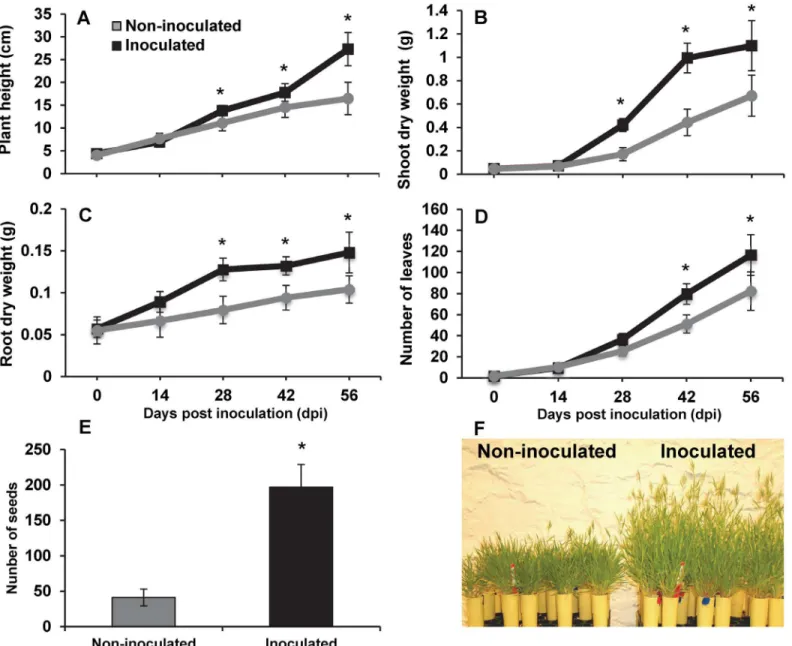
The model plantBrachypodium distachyonprovides many advantages for genomics in grasses. In this study, we sought to examine the ability ofB.subtilisB26 to promote growth of Brachy-podiumin growth chamber experiments. Starting at 28 days post inoculation (dpi), inoculated
Brachypodiumplants showed a significant (P<0.05) and steady increase in plant height, shoot
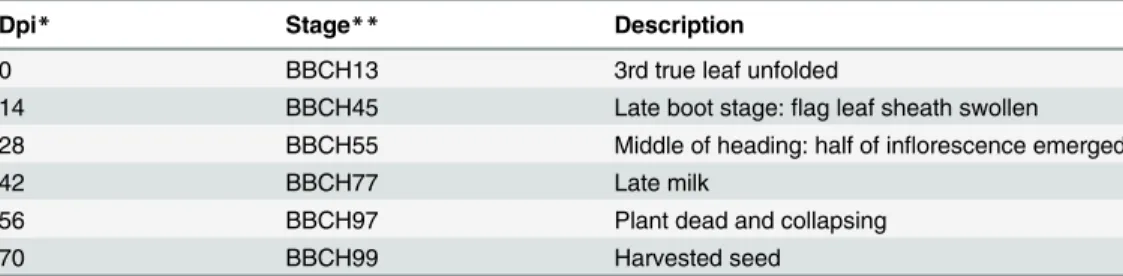
and root dry weights and number of leaves (Fig 1) when compared with control non-inoculated plants. At 56 dpi withB.subtilisB26, the BBCH97 stage (Table 1) [24] at whichBrachypodium
had seeds, significant growth promotion with a 65.8%, 63.79%, 42.29% and 41.50% increases in plant height (Fig 1A), shoot (Fig 1B) and root (Fig 1C) dry biomass and number of leaves (Fig 1D), respectively was observed, suggesting thatB.subtilisB26 behaved as a PGPR on Brachypo-dium(Fig 1F). Additionally, there was a significant difference in seed production between inoc-ulated and non-inocinoc-ulated plants (Fig 1E). Inocinoc-ulated plants produced 64% more seed heads than control plants (S1 Fig), indicating that more tillers became reproductive in inoculated plants. Notably, inoculated plants produced 121% more spikelets (S1 Fig) resulting in approxi-mately 377% increase in seed yield (Fig 1E). Concentrations of N, P, K and Mg in above ground tissues of inoculated plants were significantly lower at 42 dpi (S2 Table), indicating that the growth promoting ability is not related to increase in nutrients.
Successful and stable colonization of vegetative and reproductive
organs of
Brachypodium distachyon
by
B
.
subtilis
strain B26
The success of internal and systemic colonization ofBrachypodium distachyonbyB.subtilis
B26 was confirmed by culture-dependent and independent methods. Re-isolation and quantifi-cation ofB.subtilisstrain B26 by the plating method in different surface-sterilized tissues of first and second generations ofBrachypodiumplants after soil drench treatment withB.subtilis
Additionally, the presence ofB.subtilisB26 in different tissues ofBrachypodiumwas con-firmed by qPCR in inoculated plants (Fig 2A). An amplicon with the expected product size of 565 bp was successfully amplified using species-specific primers forB.subtilisB26 from DNA extracted from each tissue type (Fig 2B). Non-inoculated tissue samples tested negative for the presence ofB.subtilisB26 (Fig 2B). Absolute quantification by qPCR ofB.subtilisB26 copy numbers sustained the same numbers in the root at all growth stages and a small decrease in shoot tissue, with 10 times more copy inBrachypodiumshoots compared to roots (Fig 2A). Copy numbers in seeds ofB.subtilisB26 were the lowest of all tissues tested. Second generation plant tissue showed the highest concentration of endophyte in the root and a lower amount in the shoot than in the inoculated plants at corresponding growth stages.
Fig 1. Phenotypic effects of the endophyticbacteria Bacillus subtilisB26 on the life cycle ofBrachypodium.Effects of the inoculation of
Brachypodiumplants with strain B26 on: (A) plant height (B) shoot dry weight (C) root dry weight (D) number of leaves (E) number of seed, and (F) picture of non-inoculated and inoculated plants.*Represents a statistically significant difference.
doi:10.1371/journal.pone.0130456.g001
Table 1. Scale for phonological growth stages inBrachypodium distachyon.
Dpi* Stage** Description
0 BBCH13 3rd true leaf unfolded
14 BBCH45 Late boot stage:flag leaf sheath swollen
28 BBCH55 Middle of heading: half of inflorescence emerged
42 BBCH77 Late milk
56 BBCH97 Plant dead and collapsing
70 BBCH99 Harvested seed
*Days post inoculation.
**Biologische Bundesantalt Bundessortenamt and CHemische industrie (BBCH) growth scale [24].
doi:10.1371/journal.pone.0130456.t001
Fig 2. Dynamics ofB.subtilisB26 in the host plant.(A) CFU and DNA copy number ofB.subtilisB26 in roots, shoots, seeds and rhizosphere soil. Upper case letters represent differences in between time points of the same tissue/soil, and lower case letters represent differences between different tissues at the same time point. (B) PCR detection ofB.subtilisB26 in different tissues using species-specific primers. Lane 1, pureB.subtilisB26 DNA; Lane 2, no template; Lanes 3 to 5, non-inoculated plant tissues of root, shoot and seed at D63; Lanes 6 to 8, inoculated plant tissues of root, shoot, seed at D63; Lanes 9 and 10, root and shoot tissues of second generation plant at D28.
To assess whether the systemic colonization ofBrachypodium distachyonbyB.subtilisB26 triggers an immune response, we monitored the transcript accumulation levels of the patho-genesis-related gene in inoculated and non-inoculated plants using qRT-PCR. Since thePR1
gene is not fully characterized in theBrachypodiummodel, we first sought to determine if an exogenous application of salicylic acid (SA) could trigger a transcripts accumulation of the selectedBrachypodium PR1-like gene (S2 Fig). As expected,Brachypodiumplants sprayed with 5 mM solution of SA had 84 times morePR1-like transcripts than control plants at 24 hours after treatment. We then monitored thePR1-like transcript accumulation patterns during the early colonization stages ofBrachypodiumplants byB.subtilisB26. No difference inPR1 tran-scripts accumulation could be detected for most of the post inoculation time points tested (S2 Fig). However, a modest and transient increase inPR1transcripts could be measured at 72 and 96 h dpi (S2 Fig). Taken together, this result suggests thatBacillus subtilisB26 is mostly per-ceived as a non-pathogenic bacterium during the systemic colonization ofBrachypodium distachyon.
Structural changes in colonized plant tissues
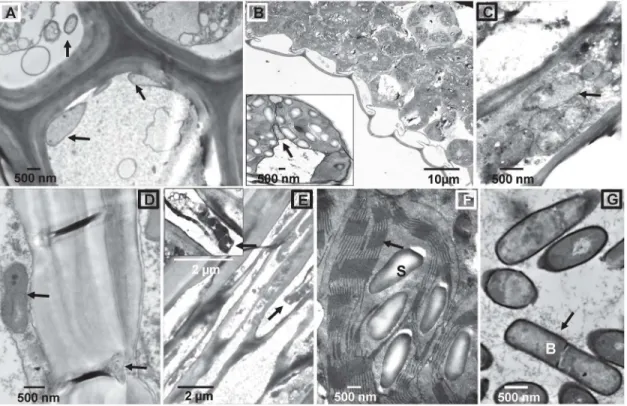
The interaction ofB.subtilisB26 withBrachypodiumwas followed using transmission electron microscopy (TEM). We examined the internalization and distribution ofB.subtilisB26 within roots, leaves, stems and seeds of colonized (14 and 28 dpi)Brachypodiumplants grown under gnobiotic and greenhouse conditions (Fig 3). TEM analysis of tissue sections confirmed the presence ofB.subtilisB26 cells inside xylem tissue of roots (Fig 3A), mesophyll cells and Fig 3. Transmission electron microscopy (TEM) micrographs of colonizedBrachypodiumtissues withB.subtilisB26.(A) Cross section of root xylem with numerous bacterial cells present inside the vessel elements (arrows). (B, C) Leaf mesophyll cells and bundle sheath (inset) with bacterial cells (arrows). (D) Vessel elements of xylem stem tissue showing B26 inside and outside the vessel elements. (E) Cross section of seed with B26 cells. (F) Cross section of chloroplast of a leaf bundle sheath cell from a colonized leaf. Notice the abundance of starch granules and the integrity of the thylakoids. (G)B.
subtilisB26 cells grown in pure culture.
doi:10.1371/journal.pone.0130456.g003
bundle sheath of leaves (Fig3Band3C) stems (Fig 3D) and also in seeds (Fig 3E). The mor-phology and size ofB.subtiliscells inside plant tissues are identical toB.subtiliscells grown in pure culture (Fig 3G). Mesophyll cells close to leaf veins of colonized plants show substantial accumulation of unusually large starch granules in the chloroplast interspersed in the stroma and sometimes separating the thylakoids (Fig 3Band inset). However, the outer membranes of the plastids were still intact (Fig 3F, arrow). Mesophyll cells of non-colonized leaf blades had little or no starch granules (data not shown). Sections of control samples were devoid of bacte-rial cells (data not shown), suggesting no indigenous colonization.
Colonized
Brachypodium
plants are more tolerant to water-deficit stress
An unexpected observation that inoculatedBrachypodiumplants uncared-for for several days were doing notably better than the non-inoculated ones prompts us to evaluate the contribu-tion ofB.subtilisB26 to the plant’s capacity to tolerate drought. Our initial assay consisted of an acute water-deficit stress applied by uprooting young non-inoculated and inoculated Bra-chypodiumseedlings grownin vitrofrom the culture medium and leaving them on an open bench for 1h. The leaf tips of non-inoculated plants showed clear signs of wilting while inocu-lated plants looked mostly unaffected (Fig4A–4C). We then performed a chronic drought treatment in a soilless potting mix with non-inoculated and inoculated plants at 28 dpi by with-holding water for 5 and 8 days. Again, inoculated plants showed less signs of wilting and ulti-mately died later than non-inoculated plants (Fig4D–4F).
B
.
subtilis
strain B26 modulates the expression of the plant
’
s drought
responsive genes
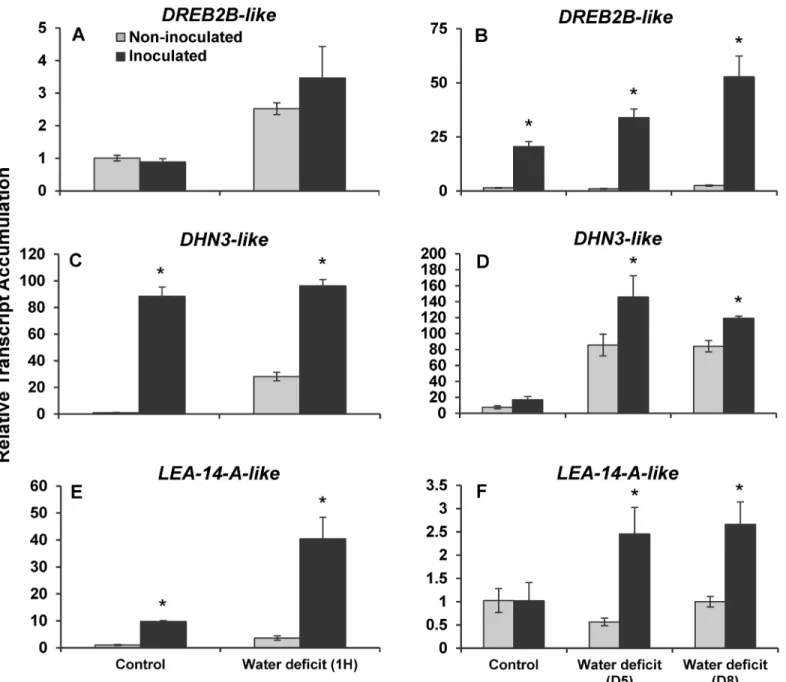
To determine the role ofB.subtilisB26 in the plant’s drought-response mechanism, we selected
Brachypodiumgenes with high sequence similarities to genes previously characterized to play active roles in the drought-stress response of plants (S1 Table) and conducted quantitative real-time PCR assays to monitor their transcript accumulation profiles. Inoculated and non-inoculatedBrachypodiumplants grownin vitrounder control conditions displayed similar accumulation profiles of theDREB2B-liketranscript (Fig 5A). However, a one-hour acute drought treatment triggered increases inDREB2B-liketranscripts accumulation of respectively 2.5 fold and 3 fold in non-inoculated and inoculatedBrachypodiumplants (Fig 5A). On the other hand, inoculated plants grown under normal conditions in soilless potting mix had 14-times moreDREB2B-liketranscript levels than non-inoculated plants grown under similar conditions (Fig 5B). In addition, chronic drought conditions, obtained by withholding water for 5 and 8 days, caused significant increases in the levels ofDREB2B-liketranscripts in inocu-lated plants while only a 1.7-fold increase was observed in non-inocuinocu-lated plants (Fig 5Band S3 Fig).
The transcription factor DREB2B has been shown to act upstream of structural proteins such as dehydrins inArabidopsisand other plants [25]. We thus sought to monitor changes in the expression profiles in response to acute and chronic drought stresses of twoBrachypodium
accumulation of the same messenger in non-inoculated plants (Fig 5D). A similar transcript accumulation pattern was also observed for theLEA-14-A-likegene (Fig5Eand5F).
Bacillus subtilis
B26 stimulates carbohydrate and starch accumulation
under drought stress conditions
Leaf tissues of inoculated and non-inoculatedBrachypodiumwere analyzed for carbohydrate and starch content at the end of 5 and 8 days of chronic drought stress. Stressed inoculated plants had almost 2-fold and 3-fold increase of total starch at the end of 5 and 8 days of drought stress respectively, compared to stressed but not-inoculated plants (Fig 6). Drought stress did not have any influence on the concentration of individual and total sugars of inoculated and non-inoculated plants after 5 days of stress (Fig 6A). Inoculated plants exposed to stress for 8 days had 1.4-fold more of total soluble sugars, and also 2.9-fold and 1.4-fold increase in glucose and fructose concentrations, respectively (Fig 6B).
Fig 4. Effects of drought stress on non-inoculated and inoculatedBrachypodiumplants. Non-inoculated (left) and Non-inoculated (right)Brachypodiumplants (A) before or (B and C) after one and two hours of acute drought stress. Pictures of non-inoculated (left) and inoculated (right)Brachypodiumplants were also taken at (D) 0 day, (E) 5 days and (F) 8 days after last watering.
doi:10.1371/journal.pone.0130456.g004
Bacillus subtilis
B26 triggers changes in DNA methylation in
Brachypodium
The changes in transcript accumulation observed inFig 5suggest thatB.subtilisB26 triggers important chromatin changes in the host plant. We thus measured global DNA methylation in inoculated and non-inoculatedBrachypodiumplants under normal and drought conditions (Fig 7).B.subtilisB26 triggered 6-fold and 1.5-fold increases in global DNA methylation in plants grown under normal conditions eitherin vitro(Fig 7A) or in soilless potting mix (Fig Fig 5. Relative transcript accumulation of drought-responsive genes.Relative mRNA abundance of (A, B)Dehydration-Responsive Element-Binding protein 2B-like(DREB2B-like); (C, D)Dehydrin 3-like(DHN3-like); and (E, F),Desiccation-related protein LEA-14-A-likein non-inoculated and inoculated plants before and one hour after uprooting (A, C, E) or before and after 5 and 8 days of chronic drought stress (B, D, F).*Represents a statistically significant difference.
7B). On one hand, after one hour of acute drought treatment, the global DNA methylation lev-els observed inin vitroinoculated plants returned to those of non-inoculated plants while this treatment had no effect on the global DNA methylation levels of non-inoculated plants (Fig 7A). On the other hand, clear reductions in global DNA methylation were observed in non-inoculated plants after five and eight days of chronic drought treatment (Fig 7B). These reduc-tions were not observed in inoculated plants exposed to similar drought stress condireduc-tions since an overall increase in global DNA methylation was observed after five days of chronic drought. These results suggest thatB.subtilisB26 can affect the epigenetic regulation ofBrachypodium distachyonbefore and during drought stress.
The drastic changes in global DNA methylation observed upon colonization of Brachypo-diumsuggest the involvement of several DNA methyltransferases in regulating that process. We thus monitored transcript accumulation changes in inoculated and non-inoculated plants in response to drought for three DNA methyltransferases:MET1B-like,CMT3-likeand
DRM2-like. As shown inFig 8, drought treatments had very little impact on the transcript Fig 6. Soluble sugars and starch content of inoculated and non-inoculated plants under water deficit conditions.(A) 5 days and (B) 8 days post watering.*Represents a statistically significant difference.
doi:10.1371/journal.pone.0130456.g006
accumulation of the three DNA methyltransferases tested in non-inoculated plants either grownin vitro(Fig8A,8Cand8E) or in soilless potting mix (Fig8B,8Dand8F). Similarly, inoculatedBrachypodiumplants grownin vitrounder control conditions did not show signifi-cant differences in accumulation of DNA methyltranferase transcripts (Fig8A,8Cand8E). On the opposite, inoculatedBrachypodiumplants subjected to one hour of acute drought stress showed increasedMET1B-likeandDRM2-liketranscript accumulations (Fig8Aand8E). In addition, inoculated plants grown in soilless potting mix under control conditions accumulated more of the three DNA methyltransferase transcripts than non-inoculated plants (Fig8B,8D and8F). Moreover, chronic drought conditions for five and eight days further increased the accumulation of these transcripts in inoculated plants but not in non-inoculated plants (Fig 8B,8Dand8F)
Discussion
The present study was aimed to determine the potential forBrachypodium distachyonto act as a model to the PGB,Bacillus subtilis, and also to ascertain whether this interaction might serve as functional model to study at the molecular level how plant genes of cereals and perennial Fig 7. Variation of global DNA methylation in inoculated and non-inoculatedBrachypodiumplants under control and water deficit conditions.(A) Before and after one hour of acute drought stress. (B) Before and after 5 and 8 days of chronic drought stress.*Represents a statistically significant difference.
bioenergy grasses are modulated by the presence of bacterial endophytes and the genes expressed provide clues as to the effects of endophytes in grasses. The results clearly demon-strate the compatibility of an intimate interaction betweenBrachypodiumandBacillus, which is of greatest relevance as a PGB and inducer of abiotic stress tolerance [11,26–28].
B.subtilisstrain B26 proved to be highly compatible toBrachypodiumgrowth stages. In pot experiments and under a gnotobiotic environment with all environmental parameters con-trolled, a single event of soil drenching during the seedling stage promoted both root and shoot growth, increased plant height and number of leaf blades, and remarkably promoted seed yield compared to the untreated plants. Numerous studies have reported on PGBs, particularly on
Bacillusspp. exerting a number of characteristics enabling to mobilize soil nutrients and syn-thesize phytohormones leading to plant growth promotion [8,12,29–33]. Indeed, growth Fig 8. Relative transcript accumulation of DNA methyltransferases in inoculated and non-inoculatedBrachypodiumplants under control and water deficit conditions.(A, B) Relative mRNA abundance ofMethyltransferase 1(MET1), (C, D)Chromomethylase 3(CMT3), and (E, F) Domains-RearrangedMethyltransferase 2(DRM2) before and one hour after uprooting non-inoculated and inoculated plants (A, C, E) or before and after 5 and 8 days following the last watering of non-inoculated and inoculated plants (B, D, F).*Represents a statistically significant difference.
doi:10.1371/journal.pone.0130456.g008
stimulation ofBrachypodiumis probably related to the production of indole-3- acetic acid (IAA) and the cytokinin zeatin riboside by strain B26 [19]. Growth stimulation by bacterial endophytes has also been related to phosphorus mobilization [31]. Our strain B26 is known to solubilize phosphorus [19], however in this study, the experimental design did not allow to test for P solubilisation since all plants were fertilized with readily available concentrations of NPK. Nutrient content of above ground tissues were significantly lower in inoculated plants com-pared to control plants 56 days after treatment when plants reached the late milk stage
(BBCH77) of seed development. Translocation of NPK from vegetative tissue to grain develop-ment in cereal grains has been reported [34,35], which may explain the overall reduction of NPK in vegetative tissues of inoculated plants and the copious numbers of seeds produced compared to control plants.
The ability of bacterial endophytes to colonize plants is a complex process requiring resis-tance to plant defence systems as well as the ability to initiate growth on plant surfaces, and develop internally inside the plant [32]. Indeed,B.subtilisB26 became intimately associated withBrachypodiumsince B26 could be isolated in reasonably high titres from rhizospheric soil, and surface sterilized roots, stems, leaf blades almost two months after initial treatment of Bra-chypodiumyoung seedlings. Moreover, vertical transmission of B26 from one generation to the next via the seeds was confirmed by culture-dependent and independent methods of young seedlings derived from surface sterilized seeds and grown in gnotobiotic environment. Presence of bacterial endophytes in vegetative and reproductive plant tissues has also been described for other bacterial endophytes with plant growth promoting effect [13,32,36–38]. In the rhizo-sphere soil strain B26 exhibited stable population densities ranging from log 3.63 to 3.68 log CFU per gram of soil after the onset of inoculation and maintained them overBrachypodim
growth stages. These densities are comparable to what had been reported for bacterial endo-phytes [39].
Although not frequently investigated, it is well known that endophytes may spread systemi-cally inside plants and colonize stems, leaves [12]. DNA copies and cultivable population den-sities of strain B26 inside roots and shoots increased over time with tendencies for B26 to accumulate more in the above ground tissues than in roots. Comparable cultivable population densities were reported forB.subtilisstrains in roots and leaves of wheat and mulberry [18,25,40].
Reports concerning the presence and role of bacterial endophytes in flowers, fruits and seeds are less numerous [14,32]. Interestingly, first generation seeds ofBrachypodium har-boured a smallB.subtilis B26population density of 2.47 log. This is not surprising, as it is known that endophyte densities of the same species decrease during seed dormancy [41]. An increase in population density of B26 in roots and above ground tissues of young plants grown from these seeds, and attaining similar densities inBrachypodiumof the same growth stage as those of the first generation is a strong indication that vertical transmission has occurred. Con-firmation of the vertical transmission of B26 was obtained by culture-independent methods using strain-specific primers. The existence of vertical transmission of strain B26 is very inter-esting as it enables a plant with an established endophytic community to pass bacteria with beneficial characteristics to their offsprings, and ensures the presence at early stages of seedling growth [42].
plant tissues was investigated by transmission electron microscopy (TEM). Cells ofB.subtilis
strain B26 were visualized and their migration and inter- and intracellular colonization of vege-tative and reproductive tissues ofBrachypodiumby strain B26 was confirmed. The ability to colonize the intercellular spaces near the vascular bundles shows that strain B26 can traverse the endodermis in roots. It is likely that strain B26 cells were able to pass through the endoder-mis and can secrete cell wall degrading enzymes allowing them to continue colonization inside the root [44] or alternatively may have passed passively during secondary root formation when the endodermis is often disrupted [45]. Following colonization of the root interior, strain B26 spread to the stems, leaf blades and seeds, is most probably via the perforated plates of the xylem vessels or by colonizing intercellular spaces form roots to aerial parts as commonly reported for other endophytes [46,47]. However, presence of B26 inside mesophyll cells sur-rounding leaf bundle sheath is a strong indication of intracellular colonization. How B26 cells were able to pass over several structural and cellular barriers is not known and remains to be unravelled. To exit xylem cells, strain B26 may cause rupture of the cell wall by chemical disso-lution of primary and secondary walls. Strain B26 is a strong producer of cellulases [19] rein-forcing the notion that the bacterium secretes cell wall degrading enzymes that will soften cell wall, thus facilitating the progression of the endophyte towards adjacent cells.
Drought is one of the most important abiotic stress limiting crop growth and productivity [48]. Studies on systemic tolerance to drought reported that inoculation with plant growth pro-moting rhizobacteria enhanced drought tolerance via the increased transcription of drought-response genes [49], affecting the phytohormonal balance [50] and sugar accumulation [51]. Here, we hypothesized that the establishment of strain B26 in the rhizosphere and roots of Bra-chypodiumrepresents the first line of defense against drought stress. The second defense bar-rier against drought stress might constitute the endophytic colonization of plant tissues that enhance the plant’s response at the gene and biochemical levels.
The establishment of these lines of defense correlates well with an increase in expression of severalBrachypodiumgenes associated with drought stress and changes at the epigenetic level as well as the accumulation of total soluble sugars and structural starch observed in inoculated
Brachypodiumplants. At the transcriptional level, B26 stimulated the induction of drought-responsive genes (DHN3 and LEA-14A) and also the transcription factor modulating dehydra-tion responsive element binding gene (DREB2B)under acute and chronic water stress. Depending on the gene, accumulation of transcripts was more than 14 fold and reached in some cases as high as 85 in inoculated plants. We believe that systemic colonization of Brachy-podiumby strain B26 reduces the drought stress phenotype, thus aggravating the need to express drought-signalling response. Supporting evidence on the enhancement of transcripts ofDREB2, dehydrins and other related drought-responsive genes in rhizobacteria-associated crops are provided by studies on sugarcane, mung beans andArabidopsis[49,52–54].
Changes in DNA methylation in the presence of the plant growth promoting bacterium
Burkholderia phytofirmanswere recently reported in potato [55]. In this study, we demon-strated that the colonization of theB.subtilisB26 caused an increased in the abundance of methyltransferases involved in the maintenance and regulation of DNA methylation and a hypermethylation ofBrachypodium’s genome. We further showed that during chronic drought stress, the inoculated plant’s global DNA methylation levels remained high when compared to those of non-inoculated plants suggesting thatB.subtilisB26 could potentially act at the epige-netic level to increase drought stress tolerance inBrachypodium. This agrees well with the fact that drought conditions have been shown to naturally induce DNA methylation changes in the plant [56] that in turn increase the plant resistance toward the stress by allowing the expression of protective genes involved in the drought response.
Osmoregulation in plants via accumulation of soluble sugars like glucose, sucrose and fruc-tose is a known mechanism for maintaining homeostasis in plants under drought stress condi-tions [57] and their metabolism play a significant role in drought and cold stress tolerance [57,58]. Imposition of drought stress toBrachypodiumsignificantly increased total soluble sugar and starch in above ground tissues ofBrachypodium-inoculated plants, which in turn could compensate for the drought effects and improve plant developments through among others, the enhanced production of soluble sugars resulting in a better absorption of water and nutrients form the soil. Similarly, increased biosynthesis rates of soluble sugars in corn inocu-lated with a plant growth promotingPseudomonasexposed to drought stress was also reported [51]. Incidentally, drought stressed and inoculated plants accumulated more starch than con-trol stressed plants. The greater amount of starch in these plants might be related to increased availability of photosynthates for storage in leaves during drought.
The latter observation ties well with copious accumulation of large starch granules in the stroma of chloroplasts of leaf bundle sheath cells of inoculated plants relative to control plants. The starch packing had no visible effects on the grana. To the best of our knowledge, this exten-sive loading of leaf chloroplasts with starch in response to bacterial endophytic colonization has not been reported. In addition to increased availability of starch as reserve to plants under stress, this modification could result in the enhancement of nutrient flow to bacterial cells, however more work is required to understand the effects of this starch accumulation.
Conclusions
Understanding the mechanisms behind PGB-plant interactions is important to improve strate-gies for the use of PGB in agriculture. Here, we provide evidence that endophytic colonization ofBrachypodiumbyB.subtilisstrain B26 affect the whole cycle of a plant, accelerating its growth and shortening its vegetative period. Also we demonstrate thatB.subtilisstrain B26 is able to colonize and multiply in the upper portion of the plant and is vertically transmitted from one generation to the next via seeds. Also, we described that strain B26 confers resistance against drought stress inBrachypodiumand this is linked to the upregulation of expression of several drought-responsive genes and the modulation of the DNA methylation process. Overall these findings contribute to a better understanding of plants and beneficial bacteria interac-tions in grasses and cereal crops, and provide novel information on the long-term effect of PGB on plant development.
Methods
Maintenance and preparation of
Bacillus subtilis
B26 inoculum
TheBacillus subtilisstrain B26, previously isolated from leaves of switchgrass cultivar Cave-in-Rock grown under field conditions, and fully characterized [19], was maintained on Luria Broth (LB) (1.0% Tryptone, 0.5% Yeast Extract, 1.0% NaCl) (Difco, Franklin Lakes, NJ, USA) with glycerol (25% final volume) and stored at -80C.B.subtilisB26 was revived on LBA (1.5% Agar) (Difco) plates. Inoculum was prepared by placing a single colony ofB.subtilisB26 in 250 ml of LB and incubated for 18 h at 37°C until an OD600 of 0.7 was reached on a shaker at 250 rpm to the mid-log phase, pelleted by centrifugation, washed and suspended in sterile distilled water [19].
Brachypodium
line, growth conditions and
B
.
subtilis
inoculation
them in solutions of 70% ethanol for 30 seconds and 1.3% solution of sodium hypochlorite for 4 minutes before rinsing them three times in sterile water [59]. Cone-tainer (Stuewe and Sons, Tanent, OR, USA) of 164 ml capacity were used to grow the plants. Prior to use, Cone-tainers were surface sterilized for 12 h in 0.1% NaOCl and rinsed with distilled water. Each Cone-tai-ner was filled with 1:1:1 part of sand (Quali-Grow, L’orignal, ON, Canada)/perlite (Perlite Can-ada, Lachine, QC, Canada)/Agro Mix PV20 (Fafard, Saint-Bonaventure, QC, Canada)
previously autoclaved for 3 h at 121°C on three constitutive days. Three Bd21 sterile seeds were planted in each Cone-tainer and stratified at 4°C for 7 days after which they were placed in a climatically controlled chamber (Conviron, Winnipeg, MB, Canada) under a 16–h photope-riod with a light intensity of 150μmoles/m2/s and a day/night temperature regime of 25/23°C.
Plants were watered three times per week with sterile distilled water and fertilized every 14 days with 40 ml of a solution of 2 g/liter of N-P-K fertilizer 20-20-20 (Plantprod, Laval, QC, Canada) per Cone-tainer. Plants were thinned to two per Cone-tainer after 14 days of growth, and at the same time each Cone-tainer received 5 ml ofB.subtilisB26 inoculum (106CFU/ml) or 5 ml of water (control). Inoculated and non-inoculated (control) Con-tainers were placed in growth chambers with identical growth parameters as previously described. Plants were harvested after 14, 28, 42 56 days post inoculation (dpi). Seeds collected from inoculated plants 56 days post inoculation were planted following the same growth conditions except that that they were not reinoculated with B26. Second generation plants were harvested after 28 days of growth.
In-vitroCulture Experiments. plant were grown in disposable culture tube 25 X 150 mm (VWR, Radnor, PA, USA) in 1X Murashige and Skoog medium with 0.3% sucrose supple-mented with GAMBORG’vitamins (Sigma-Aldrich Corp., St. Louis, MO, USA). Stratification, seed sterilization, growth conditions and inoculation were performed in a similar manner as those grown in growth chambers. Plants were inoculated with 5 ml ofB.subtilisB26 after 10 days of growth. Control plants received 5 ml of sterile distilled water
Monitoring of growth parameters of Bd21 line
Fourteen-day-old test and control Bd21 plant groups grown in controlled growth chambers were harvested at defined phenological growth stages (Table 1) using the BBCH numerical scale [24]. Harvesting was done at growth stage BBCH 13 prior to inoculation withB.subtilis
B26 (i.e., 0 dpi) and at the following dpi with their corresponding growth stage 14 dpi (BBCH45), 28 dpi (BBCH55), 42 dpi (BBCH77), 56 dpi (BBCH97). At each harvesting time point, a minimum of fourteen Bd21 plants from seven inoculated and non-inoculated Cone-tainers were monitored for root and shoot lengths, shoot and root dry weights, and number of leaves and tillers. Spikelet formation was recorded on a weekly basis while the number of seeds heads and viable seeds were recorded at the end of each experiment. Above ground nutrient content of N, P, K and Mg in vegetative above ground tissues was analyzed by Kjeldahl proce-dure using sulphuric acid and hydrogen peroxide digestion [60]. Values were estimated in mg per gram of dry weight of tissue. All experiments were replicated two times using different growth chambers in order to control the effects of microenvironment variation.
Growth conditions and drought stress
To investigate whetherB.subtilisB26 confer drought tolerance to Bd21, two types of drought stress were applied: chronic and acute water deficit stresses. Studies on the effect of chronic water deficit stress were carried out onBrachypodiumseedlings stratified and germinated as previously described but planted in 10 x 10 cm pots (ITML, Brantford, ON, Canada) filled with sterilized Agro Mix G6 (Fafard, QC, Canada) with three plants per pot. Plants were grown
under the same growth chamber conditions and were inoculated or not withB.subtilisB26 as previously described. Chronic water deficit stress was conducted on test and control plants at dpi 28 by withholding water from the inoculated plants while control plants were watered with 150 ml of sterile water 3 times per week. Plants were harvested on day 0, 5 and 8 of withholding water and leaf tissue was immediately frozen in liquid nitrogen and prepared for transcript accumulation analysis for drought responsive genes and starch and sugar content analysis. A total of 3 replicates per treatment were sampled at each time point. A replicate consisted of 3 plants. The experiment was repeated twice.
Acute water deficit stress was applied on young Bd21 seedlings grown in vitro cultures at 3 dpi, by uprooting the plants from the medium and left on an open bench for 1 hour before being flash frozen in liquid nitrogen. The entire plants were sampled, flash frozen in liquid nitrogen and subjected to transcript accumulation analysis. A total of 4 replicates per treatment were sampled and the experiments were repeated three times.
Distribution and colonization of
Brachypodium
by
B
.
subtilis
B26 using
culture-dependent and culture-independent methods
To ensure thatB.subtilisB26 successfully and systemically colonized different plant tissues of the accession Bd21 and its intracellular spread is sustained at variousBrachypodiumgrowth stages (i.e., early and late vegetative, and reproductive stage), bacteria cell numbers and DNA copy number were determined in tissue samples and rhizosphere soil of inoculated and control
Brachypodiumplants. Root and leave tissues of test and control plants (first generation) of dif-ferent growth stages were sampled at 14, 28 and 42 dpi, and entire youngBrachypodiumplants from second generation were sampled at 28 days of growth. All plants were surface sterilized as previously described [19]. 200 mg of tissue were pulverized to powder using a sterile mortar and pestle, serially diluted in sterile distilled water and plated on LBA. Bacterial enumeration of rhizosphere soil (1 gram) from inoculated and controlBrachypodiumplants was performed by serial dilution in sterile distilled water, shaken for 30 min and plated on LBA [61]. Plates were incubated at 37°C for 48 h. Colony forming units (CFUs) were determined and calculated to CFU per gram of fresh weight of tissue or soil. There were three biological replicates for each treatment and each replicate contained root, aerial systems or rhizosphere soil of 3 plants.
The presence ofB.subtilisB26 cells inside inoculated plants was also confirmed by quantita-tive real-time PCR (qPCR) assays. Surface sterilized plant tissues were reduced to powder in liquid nitrogen, and genomic DNA was extracted from 200 mg of powdered tissue using the CTAB method [62] and resuspended in 100μL of autoclaved distilled water. Genomic DNA
fromB.subtilisB26 colonies was extracted by direct colony PCR [63]. Briefly, single colonies were mixed with sterile distilled water, incubated at 95°C followed by centrifugation and the supernatant was used as template DNA in conventional PCR assays.
Transmission electron microscopy of endophytic colonization by
Bacillus
subtilis
B26
cut in section of 90–100 nm thick with an UltraCut E ultramicrotome (Reichert-Jung, Depew, NY, USA) and placed onto a 200 mesh copper grid. Samples were further stained with uranyl acetate for 8 min, followed by Reynold's lead for 5 min. Samples were observed using a FEI Tec-nai 12 120 kV transmission electron microscope (TEM) equipped with an AMT XR80C 8 megapixel CCD camera (Hillsboro, OR, USA). All reagents were purchased from Electron Microscopy Sciences, Hatfield, PA, USA, except for the osmium tetroxide and Epon that were supplied from Mecalab, Montreal, QC, Canada.
PCR amplification and quantification of
B
.
subtilis
B26 DNA copy
number in inoculated plant tissues and seeds
The presence ofB.subtilisstrain B26 within vegetative and reproductive tissues of first and sec-ond generationBrachypodiumplants was confirmed by PCR using strain-specific primers (S1 Table). PCR reactions along with no template controls were run under previously described conditions [19] using T100 Biorad thermal cycler (BioRad, Hercules, CA, USA). PCR products were separated on 1% agarose gels and visualized using Gel Logic 200 Imaging system from (Kodak, Rochester, NY, USA) under UV light.
Quantification ofB.subtilisB26 DNA copy number as a measure of colonization of vegeta-tive and reproducvegeta-tive organs ofBrachypodiumwas monitored at different growth stages and also in second generation plants grown from inoculated seeds using qPCR.B.subtilis ampli-cons were purified with a QIAquick PCR-purification kit and cloned into pDrive (Qiagen, Venlo, Netherlands). Plasmid DNA was purified and sent for sequencing at Genome Quebec. Sequencing results were compared to the Genbank accession Ref#JN689339. The copy number of plasmid was calculated based on the concentration of purified plasmid DNA and the molec-ular mass of the plasmid (vector plus amplicon). A standard curve forB.subtilisB26 was con-structed based on the following copy numbers: 109, 108, 107, 106, 105, 104, 103and 102which are the range ofB.subtilisB26 copy numbers in the different tissues of the plant. The amplification mixture reaction contained: 400 ng of template DNA, 12.5μL of 2x SYBRII
master mix (Agilent Technologies, Morrisville, NC, USA), 2.5μmol L-1of each primer and
2μmol L-1of ROX (Agilent Technologies) in a total volume of 25μl. To overcome the effects
of inhibitors present in the root DNA, 2.5 mg of BSA (Sigma-Aldrich) and 3% of DMSO (Fisher, Ottawa, ON, Canada) were added to each reaction. Amplification was performed in a Stratagene Mx3000P real-time thermal cycler (Agilent Technologies) under the following conditions: one cycle of initial denaturation at 95°C for 10 min, followed by 40 cycles of denaturation at 95°C for 30 s, annealing at 50°C for 45 s and extension at 72°C for 45 s. Standard curves and no template controls were run with each plate. All samples were performed in triplicate technical runs. Amplification results were expressed as the threshold cycle (Ct) value and converted to copy numbers by plotting the Ct values against the standard curve. The coefficient of variation was calculated for each sample to ensure repeatability of amplification. Samples with a coefficient of variation above 1 had their outliers removed.
RNA extraction, cDNA synthesis
Aerial parts of four inoculated and non-inoculated plants were pooled and reduced to fine powder in liquid nitrogen. Total RNA was extracted from 100 mg of powder using the Total RNA Mini Kit, plant (Geneaid, Shanghai, China) following the manufacturer’s protocol. All RNAs were treated with DNase I (Qiagen) to remove genomic DNA (Qiagen) cDNA was synthesised using the iScript cDNA Synthesis Kit (BioRad). The resulting cDNA samples were diluted to a final concentration of 2.5ng/μL for qPCR, and stored at -20°C. Parallel reactions
were run for each RNA sample in the absence of reverse transcriptase (no RT control) to assess any genomic DNA contamination.
Gene identification and primer design
UsingArabidopsis thalianaprotein sequences as query, identifiedBrachypodiumdistachyon’s orthologs of the following drought-responsive encoding genes;DREB2B,LEA-14, the defence encoding genesPR1, and the DNA methyltransferase encoding genesMET1,CMT3, and
DRM2were used. The drought responsive gene, DHN3-like was identified using a DHN3 pro-tein sequence fromHordeum vulgare(S1 Table). Primer sets were designed using Primer BLAST for specificity and synthesized by Integrated DNA Technologies, Inc. (Coralville, IA, USA). The primer pairs for 18S Ribosomal RNA and SamDC have been used previously [65,66].
RT-QPCR data analysis and relative quantification of stress-responsive
genes and PR1
Quantitative real-time PCR was performed using a CFX Connect Real Time system (BioRad), using Sso-advanced SYBR green Supermix (BioRad). Amplification was performed in an 11μl
reaction containing 1x SYBR Green master mix, 200 nM of each primer, 10 ng of cDNA tem-plate. The PCR thermal-cycling parameters were 95°C for 30 seconds followed by 40 cycles of 95°C for 5 seconds and 57.5°C for 20 sec (S1 Table). Three technical replicates were used and the experiment was repeated three times with different biological replicates. Controls without template were included for all primer pairs. For each primer pair, two reference genes (18Sand
SamDC) were used for normalisation. The RT-qPCR data was analysed following the Livak method [67].
Global DNA methylation assay
The global DNA methylation assay was performed using the Imprint Methylated DNA Quanti-fication Kit (Sigma-Aldrich) according to the manufacturer's recommendations with 200 ng/
μL of DNA per well. Each sample was measured in technical quadruplicate using a 680
Micro-plate reader (BioRad). Genomic DNA was extracted following the methods mention previously.
Starch and water-soluble sugar analysis
One hundred (100) mg of freeze-dried ground leaf tissues of inoculated or not plants subjected to drought or not were pooled and reduced to fine powder in liquid nitrogen. Soluble sugars were extracted with methanol/chloroform/water solutions and analyzed as described in Ber-trand and coworkers, [68] using a Waters High Performance Liquid Chromatography (HPLC) analytical system controlled by the Empower II software (Waters, Milford, MA, USA). Peak identity and quantity of raffinose, sucrose, glucose and fructose were determined by compari-son to standards. Total starch was extracted from the non-soluble residue left after the metha-nol/chloroform/water extraction and quantified as a glucose equivalent following enzymatic digestion with amyloglucosidase (Sigma-Aldrich) and colorimetric detection withρ
-hydroben-zoic acid hydrazide method of Blakeney and Mutton [69].
Statistical analyses
the treatments was determined via Tukey HSD with a magnitude of the F-value (P= 0.05). In the case of repeated experiment trials results were tested using Levene’s test for equality of vari-ance (P= 0.05) and pooled if permitted.
Supporting Information
S1 Fig. The effect ofB.subtilisB26 on seed production ofBrachypodium distachyonBd21. (A) Seed head and (B) spikelet number.Represents a statistically significant difference.
(TIFF)
S2 Fig. Relative transcript accumulation ofPR1-likegene inBrachypodium distachyon Bd21 plants.(A) Inoculated and non-inoculated plants from 0 to 168 hours post-inoculation withB.subtilisstrain B26. (B) Accumulation ofPR1-likein plants treated or not with Salicylic Acid (B).
(TIFF)
S3 Fig. Relative transcript accumulation ofDREB2B-likein non-inoculatedBrachypodium plants under control and chronic drought conditions.Relative mRNA abundance of Dehy-dration-Responsive Element-Binding protein 2B-like(DREB2B-like) in non-inoculated plants before after 5 and 8 days of chronic drought stress.Represents a statistically significant
differ-ence. (TIFF)
S1 Table. List of primers used in this study. (DOCX)
S2 Table. Nutrient analysis of above ground of control (C) and inoculatedBrachypodium withB.subtilis26 (B+).
(DOCX)
Acknowledgments
The authors thank J. Mui, Facility for Electron Microscopy Research for assistance with the TEM analysis. This work was supported by the Natural Sciences and Engineering Council of Canada (NSERC) Discovery grants to S. Jabaji and J.-B Charron.
Author Contributions
Conceived and designed the experiments: SJ JBC FGB BM HV AB. Performed the experiments: FGB BM. Analyzed the data: FGB BM SJ JBC AB. Contributed reagents/materials/analysis tools: SJ JBC AB HV. Wrote the paper: FGB BM SJ JBC.
References
1. Lugtenberg B, Kamilova F. Plant-growth-promoting rhizobacteria. Annu Rev Microbiol. 2009; 63: 541–
556. doi:10.1146/annurev.micro.62.081307.162918PMID:19575558
2. Pérez-García A, Romero D, De Vicente A. Plant protection and growth stimulation by microorganisms: biotechnological applications of Bacilli in agriculture.Curr Opin Biotech. 2011; 22: 187–193. doi:10. 1016/j.copbio.2010.12.003PMID:21211960
3. Farag MA, Ryu C-M, Sumner LW, Paré PW. GC—MS SPME profiling of rhizobacterial volatiles reveals prospective inducers of growth promotion and induced systemic resistance in plants. Phytochemistry. 2006; 67: 2262–2268. PMID:16949113
4. Mena-Violante HG, Olalde-Portugal V. Alteration of tomato fruit quality by root inoculation with plant growth-promoting rhizobacteria (PGPR):Bacillus subtilisBEB-13bs. Sci Hortic-Amsterdam. 2006; 113: 103–106.
5. Orhan E, Esitken A, Ercisli S, Turan M, Sahin F. Effects of plant growth promoting rhizobacteria (PGPR) on yield, growth and nutrient contents in organically growing raspberry. Sci Hortic-Amsterdam. 2006; 111: 38–43.
6. Choudhary DK, Johri BN. Interactions ofBacillus spp. and plants—with special reference to induced systemic resistance (ISR). Microbiol Res. 2009; 164: 493–513. doi:10.1016/j.micres.2008.08.007 PMID:18845426
7. Ongena M, Jacques P.Bacilluslipopeptides: versatile weapons for plant disease biocontrol. Trends Microbiol. 2008; 16: 115–125. doi:10.1016/j.tim.2007.12.009PMID:18289856
8. Van Loon L. Plant responses to plant growth-promoting rhizobacteria. Eur J Plant Pathol. 2007; 119: 243–254.
9. Arkhipova TN, Prinsen E, Veselov SU, Martynenko EV, Melentiev AI, Kudoyarova GR. Cytokinin pro-ducing bacteria enhance plant growth in drying soil. Plant Soil. 2007; 292: 305–315.
10. Wolter A, Schroeder F-G. Effect of drought stress on the productivity of ivy treated with Rhizobacterium
Bacillus subtilis. International symposium on soilless cultivation. 2012; pp. 107–113.
11. Dimkpa C, Weinand T, Asch F. Plant—rhizobacteria interactions alleviate abiotic stress conditions. Plant Cell Environ. 2009; 32: 1682–1694. doi:10.1111/j.1365-3040.2009.02028.xPMID:19671096
12. Hardoim PR, van Overbeek LS, Elsas JD. Properties of bacterial endophytes and their proposed role in plant growth. Trends Microbiol. 2008; 16: 463–471. doi:10.1016/j.tim.2008.07.008PMID:18789693
13. Compant S, Duffy B, Nowak J, Clément C, Barka EA. Use of plant growth-promoting bacteria for bio-control of plant diseases: principles, mechanisms of action, and future prospects. Appl Environ Microb. 2005; 71: 4951–4959. PMID:16151072
14. Hallmann J, Berg G. Spectrum and population dynamics of bacterial root endophytes. In: Schulz BE, Boyle CC, Sieber T, editors. Microbial Root Endophytes: Springer Berlin Heidelberg; 2006. pp. 15–31.
15. Rosenblueth M, Martinez-Romero E. Bacterial endophytes and their interactions with hosts. Mol Plant Microbe In. 2006; 19: 827–837. PMID:16903349
16. Huang B, Lv C, Zhuang P, Zhang H, Fan L. Endophytic colonisation ofBacillus subtilisin the roots of
Robinia pseudoacaciaL. Plant Biology. 2011; 13: 925–931. doi:10.1111/j.1438-8677.2011.00456.x PMID:21972966
17. Wulff EG, van Vuurde JWL, Hockenhull J. The ability of the biological control agentBacillus subtilis, strain BB, to colonise vegetable brassicas endophytically following seed inoculation. Plant Soil. 2003; 255: 463–474.
18. Ji X, Lu G, Gai Y, Zheng C, Mu Z. Biological control against bacterial wilt and colonization of mulberry by an endophyticBacillus subtilisstrain. FEMS Microbiol Ecol. 2008; 65: 565–573. doi: 10.1111/j.1574-6941.2008.00543.xPMID:18631174
19. Gagne-Bourgue F, Aliferis KA, Seguin P, Rani M, Samson R, Jabaji S. Isolation and characterization of indigenous endophytic bacteria associated with leaves of switchgrass (Panicum virgatumL.) cultivars. J App Microbiol. 2013; 114: 836–853.
20. Draper J, Mur LA, Jenkins G, Ghosh-Biswas GC, Bablak P, Hasterok R, et al.Brachypodium distach-yon. A new model system for functional genomics in grasses. Plant Physiol. 2001; 127: 1539–1555. PMID:11743099
21. Initiative TIB. Genome sequencing and analysis of the model grassBrachypodium distachyon. Nature. 2010; 463: 763–768. doi:10.1038/nature08747PMID:20148030
22. Brkljacic J, Grotewold E, Scholl R, Mockler T, Garvin DF, Vain P, et al.Brachypodiumas a model for the grasses: today and the future. Plant Physiol. 2011; 157: 3–13. doi:10.1104/pp.111.179531PMID: 21771916
23. Parker D, Beckmann M, Enot DP, Overy DP, Rios ZC, Gilbert M, et al. Rice blast infection of Brachypo-dium distachyonas a model system to study dynamic host/pathogen interactions. Nat Protoc. 2008; 3: 435–445. doi:10.1038/nprot.2007.499PMID:18323815
24. Hong SY, Park JH, Cho SH, Yang MS, Park CM. Phenological growth stages ofBrachypodium distach-yon: codification and description. Weed Res. 2011; 51: 612–620.
25. Liu Q, Kasuga M, Sakuma Y, Abe H, Miura S, Yamaguchi-Shinozaki K, et al. Two transcription factors, DREB1 and DREB2, with an EREBP/AP2 DNA binding domain separate two cellular signal transduc-tion pathways in drought- and low-temperature-responsive gene expression, respectively, in Arabidop-sis. Plant Cell. 1998; 10: 1391–1406. PMID:9707537
27. Nadeem SM, Ahmad M, Zahir ZA, Javaid A, Ashraf M. The role of mycorrhizae and plant growth pro-moting rhizobacteria (PGPR) in improving crop productivity under stressful environments. Biotechnol Adv. 2014; 32: 429–448. doi:10.1016/j.biotechadv.2013.12.005PMID:24380797
28. Yang J, Kloepper JW, Ryu C-M. Rhizosphere bacteria help plants tolerate abiotic stress. Trends Plant Sci. 2009; 14:1–4. doi:10.1016/j.tplants.2008.10.004PMID:19056309
29. Niu D-D, Liu H-X, Jiang C-H, Wang Y-P, Wang Q-Y, Jin H-L, et al. The plant growth-promoting rhizo-bacteriumBacillus cereusAR156 induces systemic resistance inArabidopsis thalianaby simulta-neously activating salicylate-and jasmonate/ethylene-dependent signaling pathways. Mol Plant Microbe In. 2011; 24: 533–542. doi:10.1094/MPMI-09-10-0213PMID:21198361
30. Ortíz-Castro R, Valencia-Cantero E, López-Bucio J. Plant growth promotion byBacillus megaterium
involves cytokinin signaling. Plant Signal Behav. 2008; 3: 263–265. PMID:19704649
31. Rodríguez H, Fraga R. Phosphate solubilizing bacteria and their role in plant growth promotion. Bio-technol Adv. 1999; 17: 319–339. PMID:14538133
32. Truyens S, Weyens N, Cuypers A, Vangronsveld J. Bacterial seed endophytes: genera, vertical trans-mission and interaction with plants. Environ Microbiol Rep. 2014; 7: 40–50
33. Wahyudi AT, Astuti RP, Widyawati A, Meryandini A, Nawangsih AA. Characterization ofBacillus spp. strains isolated from rhizosphere of soybean plants for their use as potential plant growth for promoting Rhizobacteria. J Microbiol Antimicrob. 2011; 2: 406–417.
34. Dordas C. Dry matter, nitrogen and phosphorus accumulation, partitioning and remobilization as affected by N and P fertilization and source—sink relations. Eur J Agron. 2009; 30: 129–139.
35. Muurinen S, Kleemola J, Peltonen-Sainio P. Accumulation and translocation of nitrogen in spring cereal cultivars differing in nitrogen use efficiency. Agron J. 2007; 99: 441–449.
36. Poupin MJ, Timmermann T, Vega A, Zuniga A, Gonzalez B. Effects of the plant growth-promoting bac-teriumBurkholderia phytofirmansPsJN throughout the life cycle ofArabidopsis thaliana. PLoS One. 2013; 8(7): e69435. doi:10.1371/journal.pone.0069435PMID:23869243
37. Reva ON, Dixelius C, Meijer J, Priest FG. Taxonomic characterization and plant colonizing abilities of some bacteria related toBacillus amyloliquefaciensandBacillus subtilis. FEMS Microbiol Ecol. 2004; 48: 249–259. doi:10.1016/j.femsec.2004.02.003PMID:19712408
38. Xu M, Sheng J, Chen L, Men Y, Gan L, Guo S, et al. Bacterial community compositions of tomato (Lycopersicum esculentumMill.) seeds and plant growth promoting activity of ACC deaminase produc-ingBacillus subtilis(HYT-12-1) on tomato seedlings. World J Microbiol Biot. 2014; 30: 835–845. doi: 10.1007/s11274-013-1486-yPMID:24114316
39. van Elsas JD, Dijkstra AF, Govaert JM, van Veen JA. Survival ofPseudomonas fluorescensand Bacil-lus subtilisintroduced into two soils of different texture in field microplots. FEMS Microbiol Lett. 1986; 38: 151–160.
40. Liu B, Qiao H, Huang L, Buchenauer H, Han Q, Kang Z, et al. Biological control of take-all in wheat by endophyticBacillus subtilisE1R-j and potential mode of action. Biol Control. 2009; 49: 277–285.
41. Cankar K, Kraigher H, Ravnikar M, Rupnik M. Bacterial endophytes from seeds of Norway spruce (Picea abiesL. Karst). FEMS Microbiol Lett. 2005; 244: 341–345. PMID:15766788
42. Ferreira A, Quecine MC, Lacava PT, Oda S, Azevedo JL, Araújo WL,et al. Diversity of endophytic bac-teria from Eucalyptus species seeds and colonization of seedlings byPantoea agglomerans. FEMS Microbiol Lett. 2008; 287: 8–14. doi:10.1111/j.1574-6968.2008.01258.xPMID:18710397
43. Reinhold-Hurek B, Hurek T. Living inside plants: bacterial endophytes. Curr Opin Plant Biol. 2011; 14: 435–443. doi:10.1016/j.pbi.2011.04.004PMID:21536480
44. James EK, Gyaneshwar P, Mathan N, Barraquio WL, Reddy PM, Yannetta PP, et al. Infection and colo-nization of rice seedlings by the plant growth-promoting bacteriumHerbaspirillum seropedicaeZ67. Mol Plant Microbe In. 2002; 15: 894–906. PMID:12236596
45. Gregory P. Roots, rhizosphere and soil: the route to a better understanding of soil science? Eur J Soil Sci. 2006; 57: 2–12.
46. Compant S, Clément C, Sessitsch A. Plant growth-promoting bacteria in the rhizo-and endosphere of plants: their role, colonization, mechanisms involved and prospects for utilization. Soil Biol Biochem. 2010; 42: 669–678.
47. Elbeltagy A, Nishioka K, Sato T, Suzuki H, Ye B, Hamada T, et al. Endophytic colonization and in planta nitrogen fixation by aHerbaspirillum spp. isolated from wild rice species. Appl Environ Microb. 2001; 67: 5285–5293. PMID:11679357
48. Chaves MM, Oliveira MM. Mechanisms underlying plant resilience to water deficits: prospects for water-saving agriculture. J Expe Bot. 2004; 55: 2365–2384. PMID:15475377
49. Sarma RK, Saikia R. Alleviation of drought stress in mung bean by strainPseudomonas aeruginosa
GGRJ21. Plant Soil. 2014; 377: 111–126.
50. Figueiredo MV, Burity HA, Martínez CR, Chanway CP. Alleviation of drought stress in the common bean (Phaseolus vulgarisL.) by co-inoculation withPaenibacillus polymyxaandRhizobium tropici. Appl Soil Ecol. 2008; 40: 182–188.
51. Sandhya V, Ali SZ, Grover M, Reddy G, Venkateswarlu B. Effect of plant growth promoting Pseudomo-nas spp. on compatible solutes, antioxidant status and plant growth of maize under drought stress. Plant Growth Regul. 2010; 62: 21–30.
52. Rocha FR, Papini-Terzi FS, Nishiyama MY, Vêncio RZ, Vicentini R, Duarte R, et al. Signal transduc-tion-related responses to phytohormones and environmental challenges in sugarcane. BMC Geno-mics. 2007; 8: 71. PMID:17355627
53. Sakuma Y, Maruyama K, Osakabe Y, Qin F, Seki M, Shinozaki K, et al. Functional analysis of an Arabi-dopsistranscription factor, DREB2A, involved in drought-responsive gene expression. Plant Cell. 2006; 18: 1292–1309. PMID:16617101
54. Timmusk S, Wagner EGH. The plant-growth-promoting rhizobacteriumPaenibacillus polymyxainduces changes inArabidopsis thalianagene expression: a possible connection between biotic and abiotic stress responses. Mol Plant Microbe In. 1999; 12: 951–959. PMID:10550893
55. Da K, Nowak J, Flinn B. Potato cytosine methylation and gene expression changes induced by a bene-ficial bacterial endophyte,Burkholderia phytofirmansstrain PsJN. Plant Physiol Bioch. 2012; 50: 24–
34. doi:10.1016/j.plaphy.2011.09.013PMID:22099516
56. Wang W-S, Pan Y-J, Zhao X-Q, Dwivedi D, Zhu L-H, Ali J, et al. Drought-induced site-specific DNA methylation and its association with drought tolerance in rice (Oryza sativaL.). J Exp Bot. 2010; 62: 1951–1960 doi:10.1093/jxb/erq391PMID:21193578
57. Valliyodan B, Nguyen HT. Understanding regulatory networks and engineering for enhanced drought tolerance in plants. Curr Opin Plant Biol. 2006; 9: 189–195. PMID:16483835
58. Livingston DP III, Hincha DK, Heyer AG. Fructan and its relationship to abiotic stress tolerance in plants. Cell Mol Life Sci. 2009; 66: 2007–2023. doi:10.1007/s00018-009-0002-xPMID:19290476
59. Vain P, Worland B, Thole V, McKenzie N, Alves SC, Opanowicz M, et al.Agrobacterium-mediated transformation of the temperate grassBrachypodium distachyon(genotype Bd21) for T-DNA inser-tional mutagenesis. Plant Biotech J. 2008; 6: 236–245.
60. Parkinson J, Allen S. A wet oxidation procedure suitable for the determination of nitrogen and mineral nutrients in biological material. Commun Soil SciPlan. 1975; 6: 1–11.
61. Skinner F, Jones P, Mollison J. A comparison of a direct-and a plate-counting technique for the quanti-tative estimation of soil micro-organisms. J Gen Microbiol. 1952; 6: 261–271. PMID:14927873
62. Porebski S, Bailey LG, Baum B. Modification of a CTAB DNA extraction protocol for plants containing high polysaccharide and polyphenol components. Plant Mol Biol Rep. 1997; 15: 8–15.
63. Woodman ME. Direct PCR of intact bacteria (colony PCR). Curr Protoc Microbiol. 2008; Appendix 3D. 1-A. 3D. 6.
64. Wilson SM, Bacic A. Preparation of plant cells for transmission electron microscopy to optimize immu-nogold labeling of carbohydrate and protein epitopes. Nat. Protoc. 2012; 7: 1716–1727. doi:10.1038/ nprot.2012.096PMID:22918389
65. Colton-Gagnon K, Ali-Benali MA, Mayer BF, Dionne R, Bertrand A, Do Carmo S, et al. Comparative analysis of the cold acclimation and freezing tolerance capacities of seven diploidBrachypodium dis-tachyonaccessions. Ann Bot-London. 2014; 113: 681–693. doi:10.1093/aob/mct283PMID:24323247
66. Hong S-Y, Seo PJ, Yang M-S, Xiang F, Park C-M. Exploring valid reference genes for gene expression studies inBrachypodium distachyonby real-time PCR. BMC Plant Biol. 2008; 8: 112. doi:10.1186/ 1471-2229-8-112PMID:18992143
67. Livak KJ, Schmittgen TD. Analysis of relative gene expression data using real-time quantitative PCR and the 2−ΔΔCT method. Methods. 2001; 25: 402–408.
68. Bertrand A, Tremblay G, Pelletier S, Castonguay Y, Bélanger G. Yield and nutritive value of timothy as affected by temperature, photoperiod and time of harvest. Grass Forrage Sci. 2008; 63: 421–432