PHYSICAL EDUCATION OF STUDENTS
MODELS OF PROFESSIONAL READINESS OF STUDENTS OF HIGHER MILITARY SCHOOLS OF THE ARMED FORCES OF UKRAINE
Sergienko Y.P. 1, Andreianov A.M. 2
National University of Tax Service of Ukraine1
Military Institute of Kiev Taras Shevchenko National University2
Annotation. Purpose: Creating models of professional readiness, namely, physical, mental, psycho-physiological and functional training based on the integral method developed. Material / Methods: The study involved 60 students of the fourth graduating class of 30 people in the control and experimental groups. To confirm the effectiveness of the developed method was used testing the physical qualities, psychological questionnaires, the study of cognitive processes, as well as functional tests. Results: It was established that at the beginning of the experiment between the control and experimental groups was not significant differences in all indicators. After the study of the experimental group experienced an improvement of performance as compared to the control group. So on average, in terms of physical fitness, they increased by 9.34 %, mental qualities to 21.25 %, physiological capacity of 14.7 % and a functional readiness to 21.13 %. The results obtained are reliable. Conclusions: The developed method allowed to increase the individual results of students to build models that characterize the professional readiness of future officers, as well as increase the adaptive processes of all systems to service and combat activities.
Keywords: professional readiness, cadets, military activities, models.
Introduction1
Modern combat requires from military officers great tension of mental and physical strength. Progressing of new weapons, satiation of army with highly technological arms and complex computer machinery do not mean reducing of such tension but, on the contrary, results in its intensification.
In this connection requirements to physical fitness of future military officers are continuously growing and become more complex as far as they condition successfulness of officers’ functioning in combat tasks.
Characteristic feature of modern combat functioning is complexity and quickness of changing of situation, in which officer shall take correct decisions and manage his sub-division expertly. This, in its turn, requires from a commander to have a complex of qualities; ability to take independent decisions, quickness and preciseness of actions, constant combination of his actions with solution of intellectual tasks against the background of physical and mental load. All these set such important requirements to physical fitness as education of future military officers’ initiative and quick wit, quickness in orientation and quickness of responsiveness, ability to act accurately and promptly in conditions of physical tiredness and nervous strain, ability to switch himself from one action to other [1, 3, 6, 13, 14-17].
At present there are certain works, devoted to problems of professional-applied physical training in military system of education of Ukraine (G.I. Sukhorada 2003; O.G. Piddubniy, 2003; Yu.A, Borodin, 2004; Yu.M. Antoshkin, Ант2006; V.M. Krasota, 2007; V.M. Romanchuk, 2007; O.A. Yareshenko, Ярещ2008; K.V. Prontenko., 2009; S.I. Dyakov, 2010) [2, 4, 7, 9-12, 14-17].
But practically there are no literature and scientific works, which would deal with integral fitness of cadets, videlicet: physical, mental, psycho-physiological and functional as an integral complex.
The present scientific research has been fulfilled as per scientific topic of department of special disciplines and organization of professional training of tax police faculty of National university of state tax administration of Ukraine for 2008-2013 by subject “Problems of professional functioning and safety of officers of state tax administration of Ukraine”, state registration No. 0108U004234.
Purpose, tasks of the work, material and methods
The task is creation of models of future military officers’ of Ukraine professional readiness on the base of integral methodic of cadets' physical, mental, psycho-physiological and functional fitness.
The methods of the research. For reaching of our purpose we applied the following methods of research: pedagogical observation, psycho-physiological testing, questioning, medical and biological methods, pedagogical experiment, methods of mathematical statistics [2, 5, 8].
Solution of our task was carried out by introducing of developed methodic in program of 4th, graduation, year
of study. The research involved 60 cadet (30 persons in experimental group and 30 persons in control one). The experiment took one year.
Results of the research
The existing system of cadets’ training is characterized by relative uniformity of physical education classes. It, in its turn, results in habit to standard situation that increases lability of adaptation processes in non-standard, extreme situations of combat functioning. That is why, we, in our methodic, were guided by the following principles, videlicet: depending on scope of cadets’ knowledge, their experience, level of physical, mental, psycho-physiological and functional abilities and requirements of combat functioning’s tasks, we simulated training classes. We created models, which were oriented on development of physical skill, manifestation of mental abilities in different situations, as well as models of integral character of manifestation of every commander’s personality.
stimulation of manifestation of psychological, personality’s qualities; development of cognitive qualities (observation, memory, thinking, attention); creation of motivation for achievement of goal; development od will and emotional stability at level of physical tiredness; formation of own significance in interests of collective interaction and consolidation of collective.
After experiment we carried out comparative characteristics of the obtained results of control and experimental groups before and after experiment. On the base of the obtained data we built models of physical, mental, functional and psycho-physiological cadets’ fitness.
Comparing indicators of control and experimental groups’ physical fitness at the beginning of experiment we stated absence of confident difference in tests of both groups, see table 1. As on the beginning of experiment percentage of difference between indicators was in 100metes’ run -0.5%, in 3 000 meters run – 0.4%, in chin ups – 2.2%, in complex-power exercise – 0.9% and in complex test for dexterity – 1%.
As we see, as on the beginning of experiment both groups were on the same level of fitness.
Table 1 Indicators of physical fitness of control (n=30) and experimental groups’ cadets (n=30)before and after experiment,
m X
Indicators CG Cadets’ groups EG t p
100 m, run, (sec.) before after 13.48±0.17 13.47±0.12 13.49±0.11 13.14±0.09 -0.05 3.85 р<0.001 р>0.05
3000 m, run, (sec.) before after 785.98±10.14 740.10±6.77 782.96±9.02 688.33±9.42 0.23 4.30 р<0.001 р>0.05
Chin ups (times) before after 13.43±0.51 14.53±0.54 18.13±0.44 13.13±0.4 -7.08 0.89 р<0.001 р>0.05
Complex-power exercise (sec.) before after 283.43±3.37 280.96±3.58 281.00±3.53 270.00±3.68 1.58 3.02 р<0.001 р>0.05
Test for dexterity (sec.) before after 69.90±0.62 70.33±0.7 64.00±0.57 71.03±0.6 11.71 -1.00 р<0.001 р>0.05
After experiment we received the following increment of experimental group’s indicators. Difference in 100 meter run increased up to 2.5%, in 3000 meters run – by 7%, in chin ups – 24.8%, in complex power exercise – by 4% and in complex test for dexterity – by 8.4%, see table 1.
Thus, experiment resulted in changes if experimental group cadets’ fitness, see fig. 1.
Fig.1. Model of cadets’ physical fitness before and after experiment (by Stiudent’s criterion): 1- 100 meter’ run; 2- 3000 meters’ run; 3- chin ups; 4- complex-power exercise; 5-complex test for dexterity.
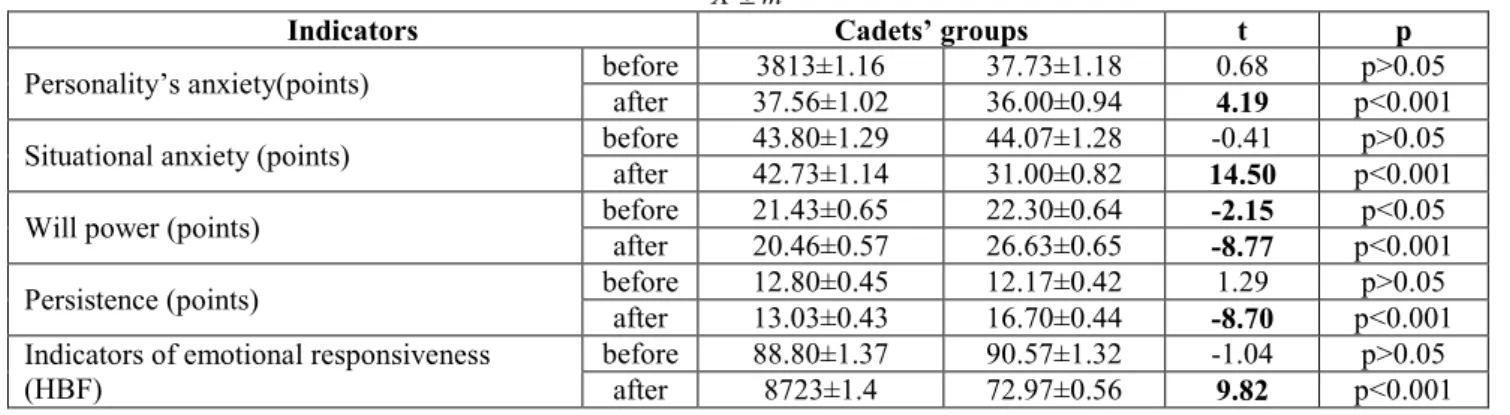
At the beginning of experiment there were also no confident differences between indicators of mental abilities, except indicator of will power (р<0.05), which was insignificantly higher in experimental group (see table 2).
Before experiment
PHYSICAL EDUCATION OF STUDENTS
Table 2 Indicators of mental abilities of control (n=30) and experimental groups’ cadets (n=30)before and after experiment,
m X
Indicators Cadets’ groups t p
Personality’s anxiety(points) before after 37.56±1.02 3813±1.16 37.73±1.18 36.00±0.94 0.68 4.19 р<0.001 р>0.05
Situational anxiety (points) before after 43.80±1.29 42.73±1.14 44.07±1.28 31.00±0.82 14.50 -0.41 р<0.001 р>0.05
Will power (points) before after 21.43±0.65 20.46±0.57 22.30±0.64 26.63±0.65 -2.15 -8.77 р<0.001 р<0.05
Persistence (points) before after 12.80±0.45 13.03±0.43 12.17±0.42 16.70±0.44 -8.70 1.29 р<0.001 р>0.05 Indicators of emotional responsiveness
(HBF) before after 88.80±1.37 8723±1.4 90.57±1.32 72.97±0.56 -1.04 9.82 р<0.001 р>0.05
Percentage of intergroup indicators at the beginning of experiment was in test for personality’s anxiety 1.05 %, situational anxiety – 0.62 %, will power – 4.1 %, persistence – 4.9 % and indicator of emotional responsiveness - 2 %. After experiment percentage between groups was: in personality’s anxiety 4.15 %, situational anxiety – 27.5 %, will power – 30.2 %, persistence – 28.1 % and emotional responsiveness - и 16,3 %.
Structural changes of mental qualities before and after experiment are shown in models (see fig.2).
Fig.2 Models of cadets’ mental fitness before and after experiment (by Stjudent’s criterion): 1- personality’s anxiety; 2- situational anxiety; 3- will power; 4- persistence; 5- emotional responsiveness.
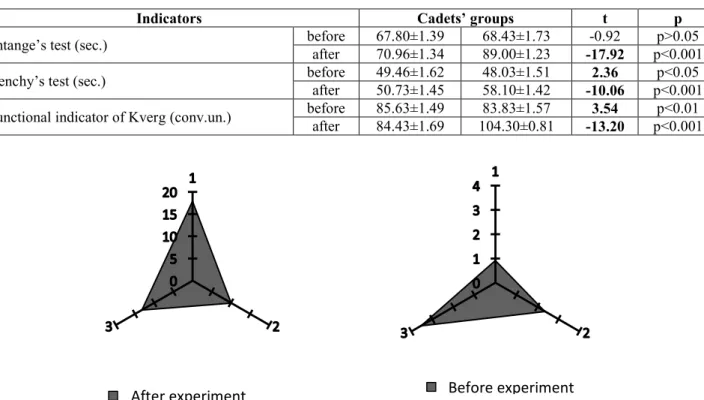
Analyzing results of cadets’ functional fitness before and after experiment we registered confident difference between two indicators of control and experimental groups, videlicet: Genchy’s test and functional indicators of Kverg (р<0,05), see table 3. In indicators of Shtange’s test there was no confidence. Percentage of Shtange’s test, before experiment, was 0.9%, Genchy’s test – 2.9%, functional indicators of Kverg – 2.1%.
Indicators of functional fitness of control (n=30) and experimental groups’ cadets (n=30)before and after experiment, m
X
Indicators Cadets’ groups t p
Shtange’s test (sec.) before after 67.80±1.39 70.96±1.34 68.43±1.73 89.00±1.23 -17.92 -0.92 р<0.001 р>0.05
Genchy’s test (sec.) before after 49.46±1.62 50.73±1.45 48.03±1.51 58.10±1.42 -10.06 2.36 р<0.001 р<0.05
Functional indicator of Kverg (conv.un.) before after 85.63±1.49 84.43±1.69 104.30±0.81 83.83±1.57 -13.20 3.54 р<0.001 р<0.01
Fig.3. Models of cadets’ functional fitness before and after experiment (by Stjudent’s criterion): 1- Shtage’s test; 2- Genchy’s test; 3- functional indicators of Kverg.
After finishing of experiment we found the following changes in percentage; in Shtange’s test difference was – 25.4%, in Gency’s test – 14.5% and in functional indicator of Kverg – 23.5%. The models of obtained indicators are given in fig.3.
At the beginning of experiment indicators of psycho-physiological abilities of control and experimental groups’ cadets had confident difference in test for perception of space and for operative thinking (р<0,05); in other tests there were no confident differences (see table 4).
Table 4 Indicators of psycho-physiological abilities of control (n=30) and experimental groups’ cadets (n=30)before and after
experiment, Xm
Indicators CG Cadets’ groups EG t p
Simple response to light (m.sec) before after 0.28±0.003 0.26±0.005 0.28±0.003 0.24±0.004 0.95 6.16 р<0.001 р>0.05
Simple response to sound (m.sec) before after 0.29±0.005 0.28±0.005 0.29±0.006 0.24±0.004 -0.26 7.51 р<0.001 р>0.05
Sense of time (sec) before after 54.46±1.94 54.94±1.72 54.63±2.01 58.13±1.82 -0.32 -5.12 р<0.001 р>0.05
Sense of space (cm) before after 6.07±0.32 6.45±0.31 6.30±0.31 8.85±0.32 -11.07 -2.49 р<0.001 р<0.05
Operative memory (%) before after 64.53±2.55 67.50±2.44 65.00±3.13 77.00±2.84 -0.42 -7.08 р<0.001 р>0.05
Scope of attention (%) before after 81.39±1.56 79.69±1.6 81.00±1.93 90.01±1.55 -0.96 -6.97 р<0.001 р>0.05
Operative thinking (%) before after 64.22±1.81 65.07±1.84 63.10±1.89 73.69±1.63 -10.56 2.76 р<0.001 р<0.01
Difference in mean indicators of cadets’ psycho-physiological abilities’ indicators before experiment was the
Before experiment
PHYSICAL EDUCATION OF STUDENTS
After experiment difference between control and experimental groups’ indicators was: in simple response to light – 7.7%; in simple response to sound – 14.3%; in sensing of time – 5.8%; in sensing of space – 37.2%; in operative memory – 14.1%; in scope of attention – 10.6%; in operative thinking -0 13.2%. As a result of experiment we built models of cadets’ psycho-physiological abilities, which are presented in fig.4, in which we reflected changes that took place during experiment.
Fig.4. Models of cadets’ psycho-physiological fitness before and after experiment (by Stjudent’s criterion): 1- simple response to light; 2- simple response to sound; 3- sensing of time; 4- sensing of space; 5- operative memory; 6- scope of
attention; 7- operative thinking.
Conclusions:
The received results permitted to determine models of physical, mental, psycho-physiological and functional fitness before and after experiment. As a result of experiment all models showed even increment of experimental group’s indicators in comparison with indicators of control group, that witness about formation of future military officers’ professional readiness to execution of combat tasks.
The offered by us integral methodic of formation of cadets’ professional readiness to future professional functioning witnesses about purposefulness of its introduction in academic process of senior years of study in order to increase adaptation to future professional functioning and accelerating the process of education.
Meanwhile, this methodic does not solve all aspects of problem of the research. Further development of these studies shall be oriented on expansion of researching of professional readiness components in order to ensure professional functioning in all power structures of Ukraine.
1 Andrieianov A. M. Teoriia i metodika fizichnogo vikhovannia i sportu [Theory and methods of physical education
and sport], 2007, vol.3, pp. 100 – 102.
2 Antoshkiv Iu. M. Vdoskonalennia profesijno-prikladnoyi fizichnoyi pidgotovki kursantiv vishchikh navchal'nikh zakladiv MNS Ukrayini [Improving vocational and applied physical training of students of higher education institutions Emergency Ukraine], Cand. Diss., Lviv, 2006, 261 p.
3 Ashanin V.S. Slobozhans'kij naukovo-sportivnij visnik [Slobozhansky scientific and sport bulletin], 2002, vol.5,
pp. 164 – 166.
4 Borodin Iu.A. Fizicheskaia podgotovka v sisteme psikho-fiziologicheskoj podgotovki kursantov
voenno-uchebnykh zavedenij [Physical training in the psycho-physiological training of cadets of military schools]. Fizicheskaia podgotovka voennosluzhashchikh [Physical training for military personnel], Kiev, NUPES, 2003, pp. 75-78.
5 Korobejnikov G.V. Psikhofiziologicheskaia organizaciia deiatel'nosti cheloveka [Psychophysiological
organization of human activities], White Church, 2008, 138 p.
6 Korol'chuk M.S., Krivoruchko P.P. Psikhologichne zabezpechennia profesijnoyi diial'nosti vijs'kovikh specialistiv
[Psychological support professional military experts]. Individual'ni psikhofiziologichni vlastivosti liudini ta profesijna diial'nist' [Individual physiological properties of human and professional activities], Kiev, Cherkasy, 1997, p. 66.
7 Krasota V.M. Special'na fizichna pidgotovka oficeriv chergovogo bojovogo rozrakhunku komandnogo centru
vijs'kovo-mors'kikh sil Ukrayini [Physical training officers next crew Command Center Naval Forces of Ukraine], Cand. Diss., Kharkiv, 2007, 22 p.
8 Rovnij A.S. Sensorni mekhanizmi upravlinnia tochnisnimi rukhami liudini [Touch control mechanisms of
exactness movements of the person], Kharkiv, KSAPC, 2001, 220 p.
9 Romanchuk V.M. Obgruntuvannia zmistu ta organizaciyi form fizichnoyi pidgotovki kursantiv vishchikh
vijs'kovikh navchal'nikh zakladiv tekhnichnogo profiliu [Justification of the content and form of physical training cadets of military schools technical profile], Cand. Diss., Lviv, 2007, 26 p.
10 Prontenko K.V. Udoskonalennia profesijnoyi pidgotovlenosti kursantiv operators'kikh special'nostej zasobami
gir'ovogo sportu na etapi pervinnogo navchannia [Improving professional training professions students operator means weight lifting at the stage of initial training], Cand. Diss., Lviv, 2009, 22 p.
11 Sukhorada G.I. Sportivno-masova robota u vishchikh vijs'kovikh navchal'nikh zakladakh [Mass sports work in
higher military educational institutions], Cand. Diss., Lviv, 2003, 20 p.
12 Iareshchenko O.A. Obgruntuvannia zmistu i organizaciyi special'noyi fizichnoyi pidgotovki kursantiv vishchikh navchal'nikh zakladiv MVS Ukrayini [Rationale for the content and organization of special physical training of students of higher educational establishments of Ukraine], Cand. Diss., Kharkiv, 2008, 24 p.
13 Finogenov Iu.S. Aktual'ni problemi fizichnoyi kul'turi i sportu [Contemporary problems of physical culture and
sports], 2005, vol.6-7, pp. 145 -151.
14 Bezpaliy S. M. Experimental verification of the program of improvement of physical training of
officers-instructors at higher educational establishment of the Ministry of Internal Affairs of Ukraine. Pedagogics, psychology, medical-biological problems of physical training and sports, 2013, vol.1, pp. 3-7. doi:10.6084/m9.figshare.106928
15 Olkhovy O.M. Model of future officers' availability to the management physical training. Physical Education of Students. 2012, vol.3, pp. 94 - 97.
16 Verenga Y.V., Prontenko K.V., Bondarenko V.V., Bezpaly S.M., Hutoryansky O.V. The physical condition for
the first time accepted the service of officers of internal affairs of Ukraine. Pedagogics, psychology, medical-biological problems of physical training and sports, 2013, vol.5, pp. 18-22. doi:10.6084/m9.figshare.707093
17 Williams B. Supporting Middle School Students Whose Parents Are Deployed: Challenges and Strategies for