
496 Brazilian Journal of Physics, vol. 36, no. 2A, June, 2006
Surface Morphology and Optical Characterization of OC
1
OC
6
-PPV Films
A. Marletta1∗, C. A. Olivati2, M. Ferreira2, M. L. Vega3, D. T. Balogh3, R. M. Faria3, and O. N. Oliveira Jr.3
1Instituto de F´ısica, Universidade Federal de Uberlˆandia,
Caixa Postal 593, 38400-902, Uberlˆandia, MG, Brazil
2Faculdade de Ciˆencias e Tecnologia, Universidade Estadual Paulista,
Caixa Postal 467, 19060-900, Presidente Prudente, SP, Brazil and
3Instituto de F´ısica de S˜ao Carlos, Universidade de S˜ao Paulo, Caixa Postal 369, 13660-970, S˜ao Carlos, SP, Brazil
Received on 4 April, 2005
We report optical and morphological properties of poly(2-methoxy-5-hexyloxy-p-phenylenevinylene) (OC1OC6-PPV) films processed by casting, spin-coating (SC) and Langmuir-Blodgett (LB) techniques. The
absorption spectra are practically the same, with an absorption maximum at approximately at 500 nm. For the photoluminescence (PL) spectra at low temperature (T=10K), a small but significant difference was noted in the cast film, in comparison with the LB and SC films. The zero-phonon transition shifted from 609 nm for the LB film to 615 and 621 nm for the SC and cast films, respectively. At room temperature, the PL spectra are similar for all films, and blue shifted by ca. 25 nm in comparison with the spectra at low temperature due to thermal disorder. Using atomic force microscopy (AFM) we inferred that the distinctive behavior of the cast film, proba-bly associated with structural defects, is related to the large thickness of this film. The surface roughness, which was surprisingly higher for the LB film, apparently played no role in the emission properties of OC1OC6-PPV
films.
Keywords: MH-PPV; Processing effect; Optical and topological properties
I. INTRODUCTION
Conjugated polymers are potential materials for poly-mer light emitting diodes (PLEDs) [1] and one main chal-lenge is to identify polymers that are solution processible. The phenylene-based OC1OC6-PPV, or poly(2-methoxy-5-hexyloxy-p-phenylenevinylene), meets this criterion, as it is soluble in organic solvents and may be easily processed in thin-solid films [2]. The optimization of the emission proper-ties, however, requires investigation of the processing condi-tions. For example, polymer-polymer interactions introduce structural defects causing the emission quantum efficiency to decrease [3-4]. In addition, electronic properties and the struc-tural arrangement of the polymer main chain may be strongly associated with the polymer-film processing technique.
In this work we investigate the effects from the film-forming techniques on the optical properties, absorption and emission, of OC1OC6-PPV films. Three techniques are used, namely casting, spin-coating (SC) and Langmuir-Blodgett (LB). Atomic Force Microscopy (AFM) is used to study the film morphology, and the data are analyzed with first-order statistics.
II. EXPERIMENTAL
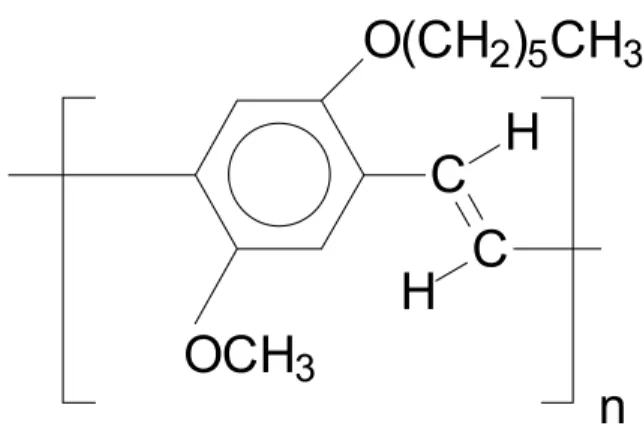
Figure 1 shows the chemical structure of OC1OC6-PPV synthesized as described in Ref. 2. All films were processed onto glass substrates, previously cleaned using the RCA pro-cedure [5], from polymer solutions in chloroform. The cast film was produced from a 0.5 mg/ml solution of OC1OC6 -PPV. The SC film was obtained using a photo-resist spin-ner (Hedway Research Inc-model:1-EC101DT-R484) at 2000 rpm during 90s and with a polymer solution of 0.5 mg/ml. The LB film was obtained following the procedure of Ref. [6],
with a polymer solution of 0.2 mg/ml. The films were dried and stored at room temperature, and protected from light to avoid photodegradation.
The photoluminescence (PL) spectra were recorded us-ing a SPEX-750M monochromator equipped with a Joban-Yvon CCD-detector (2000×800-3) in the temperature range between 10 and 300K. Excitation was performed with the 457.8 nm line of an Ar+ laser. The samples were kept in a closed helium cryostat at 10−4 torr. The UV-VIS. spec-tra were obtained with a Hitachi U-2001 spectrophotometer. AFM experiments were performed with a Nanoscope°RIIIa MultimodeT Mof Digital Instruments. The images were ob-tained under ambient conditions in the tapping mode. A com-mercial Si cantilever with a spring constant of 20 to 100 N/m was used, with free oscillation in the range between 250 and 300 KHz. The scanned area for the images was 10x10 µm2 and the scan rate was 0.7 Hz
O(CH
2
)
5
CH
3
C
C
H
H
n
OCH
3
A. Marletta et al. 497
FIG. 2: Absorbance of cast, SC and LB film of OC1OC6-PPV at room temperature.
FIG. 3: Photoluminescence spectra at 300K (a) and 10K (b) for Cast, SC and LB OC1OC6-PPV Films.
III. RESULTS AND DISCUSSION
Figure 2 shows the absorbance spectra of OC1OC6-PPV cast, SC and LB films. The curves were normalized tak-ing the peak intensity as one. For all films, the extended band above 350 nm is related to non-localized states (HOMO-LUMO transitions). The spectra for the cast and LB films were red shifted by ca. 10 nm at the maximum and by 3 nm at the band edge, in comparison to the SC film. According to the effective conjugation model, these results indicate that the SC
film possesses a distribution with slightly lower conjugation lengths than the other two films [7].
498 Brazilian Journal of Physics, vol. 36, no. 2A, June, 2006
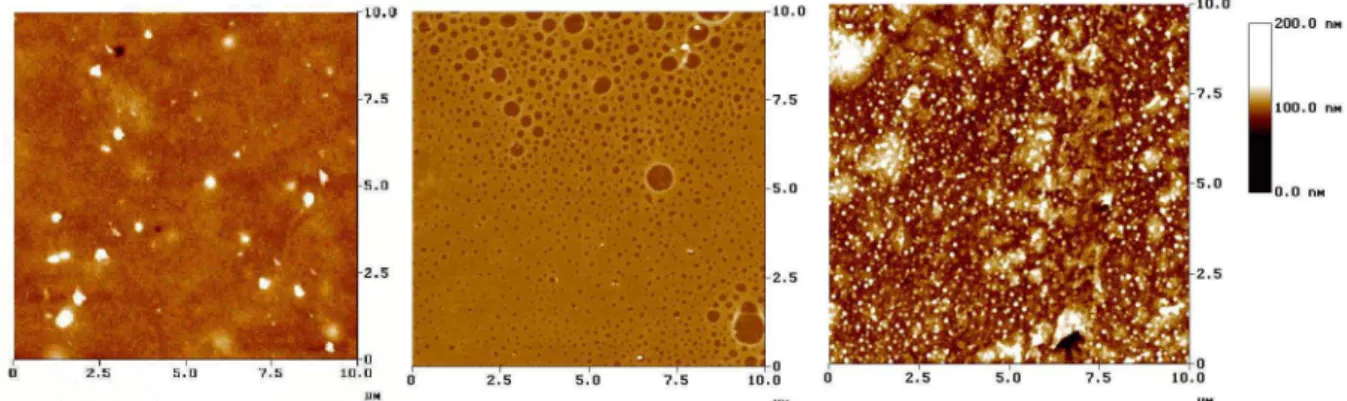
FIG. 4. AFM images of OC1OC6-PPV films processed via (a) casting, (b) SC and (c) LB technique.
the thermal disorder decreases and the PL spectra are similar for all films [8]. The shift to lower energy for the cast film is correlated to the interchain interaction due to the structural disorder.
According to the molecular exciton model and the effective conjugation degree [9], emission occurs at the long polymer segments. We therefore conclude that emission for SC and LB films takes place under basically the same polymer-polymer environment, i.e. with similar interchain interactions. [10]. That is to say, the molecular packing appears not to be influ-enced by the polymer solution concentration. The low value of the electron-phonon coupling (S∼I1/I0)[11] shows that the polymer chain is more rigid in these films. At low temperature (Fig. 3b), all films present the same S, as structural disorder becomes less important.
The small but significant difference in the PL spectrum for the cast film may be associated with morphological features. We have checked this hypothesis by obtaining AFM images, shown in Figures 4a-c. Using first-order statistics [12], we obtained the mean square roughness (σRMS)for the images, yielding the results in table 1. Though the LB film exhibits a higher roughness, which can be inferred from a visual in-spection of the AFM images, the main feature distinguishing the films is the thickness of the cast film. The higher thick-ness may have led to structural disorder affecting the emis-sion properties of the cast film (cf. Figure 3). On the other
hand, the organization that could be induced by the LB tech-nique [13] appears neither to lead to smooth films or affect the emission properties in comparison with the cast films.
TABLE I: AFM parameters of OC1OC6-PPV films.
Cast SC LB (41 layers)
σRMS(nm) 7.3 4.5 12.6 Thickness (nm) 230.2 8.6 70.5
IV. CONCLUSIONS
It has been demonstrated that the film morphology for OC1OC6-PPV depends strongly on the film processing tech-nique. For the systems investigated, the morphological feature that affected most the luminescence properties was the thick-ness, with the thick cast film displaying a distinct PL spectrum at room temperature, at which structural disorder plays an im-portant role.
Acknowledgements
This work was supported by the Brazilian agencies FAPESP, FAPEMIG, CNPq and IMMP/MCT.
[1] I. D. Parker, J. Appl. Phys. 75, 1656 (1994).
[2] F. M. Marconi, R. F. Bianchi, R. M. Faria, and D. T. Balogh, Mol. Cryst. Liq. Cryst. 374, 475 (2002)
[3] Y. Shi, J liu, Y. Yang, J. Appl. Phys. 87 (2000) 4254 [4] J. Liu, Y. Shi, Y. Yang, Appl. Phys. Lett. 79 (2001) 578 [5] W. Kern, Semicon. Int. 94-98 (1984).
[6] M. Ferreira, C. J. L. Constantino, C. A. Olivati, A. L. Vega, D. T. Balogh, R. F. Aroca, R. M. Faria, and O. N. Oliveira, Langmuir 19(21), 8835 (2003).
[7] A. Marletta, F. E. G. Guimar˜aes, and R. M. Faria, Braz. J. Phys
32(2), 570 (2002).
[8] H. S. Woo, O. Lhos, S. C. Grahan, D. D. C. Bradley, R. H. Friend, C. Quattrocchi, J. L. Bredas, E. Schenk, and K. Mullen,
Synth. Met. 59(1), 13 (1993).
[9] R. Chang, J. H. Hsu, W. S. Fann, K. K. Liang, C. H. Chiang, M. Hayashi, J. Yu, S. H. Lin, E. C. Chang, K. R. Chuang, and S. A. Chen, Chem. Phys. Lett. 317(1-2), 142 (2000).
[10] A. Marletta, V. C. Gonc¸alves, and D. T. Balogh, J. Lum, 116, 87 (2006).
[11] O. Narwark, A. Gehard, S. C. J. Meskers, S. Brocke, E. Thorn-Csanyi, and H. Bassler, Chem. Phys. 294(1), 17 (2003). [12] T. R. Thomas, “Rough surface” Imperial College Press (1999). [13] C. A. Olivati, M. Ferreira, A. J. F. Carvalho, D. T. Balogh, O. N. Oliveira, H. von Seggen, and R. M. Faria, Chem. Phys. Lett.

![Optical Properties of MEH-PPV and MEH-PPV/ [6,6]-Phenyl C61-butyric Acid 3-ethylthiophene Ester Thin Films](data:image/gif;base64,R0lGODlhAQABAIAAAP///wAAACH5BAEAAAAALAAAAAABAAEAAAICRAEAOw==)