Thermally activated dynamics of the tilts of the CuO
6octahedra, hopping of interstitial O,
and possible instability towards the LTT phase in La
2CuO
41dF. Cordero
CNR, Area di Ricerca di Tor Vergata, Istituto di Acustica ‘‘O.M. Corbino,’’ Via del Fosso del Cavaliere, I-00133 Roma, Italy and INFM, Italy
C. R. Grandini
Departamento de Fisica, Universidade Estadual Paulista, 17.033-360, Bauru, SP, Brazil
G. Cannelli
Dipartimento di Fisica, Universita` della Calabria, Arcavacata di Rende (CS), I-87036 Cosenza, Italy and INFM, Italy
R. Cantelli and F. Trequattrini
Dipartimento di Fisica, Universita` di Roma ‘‘La Sapienza,’’ P.le A. Moro 2, I-00185 Roma, Italy and INFM, Italy
M. Ferretti
Dipartimento di Chimica e Chimica Industriale, Universita` di Genova, I-16146 Genova, Italy and INFM, Italy ~Received 30 May 1997; revised manuscript received 25 September 1997!
The anelastic spectrum~dynamic Young’s modulus and elastic energy absorption!of La2CuO41dhas been
measured between 1 and 700 K with 0,d,0.02. The spectrum of stoichiometric La2CuO4 in the
low-temperature orthorhombic~LTO!phase is dominated by two intense relaxation processes which cause soften-ings of 16% around 150 K and 9% below 30 K at f;1 kHz. The relaxation at 150 K is attributed to the presence of a fraction of the CuO6octahedra which are able to change their tilted configuration by thermal
activation between orientations which are nearly energetically equivalent, possibly within the twin boundaries. The relaxation below 30 K is governed by tunneling, and involves a considerable fraction of the lattice atoms. It is proposed that the double-well potentials for the low-temperature relaxation are created by the tendency of the LTO phase to form low-temperature tetragonal~LTT!domains, which however are not stabilized like when La is partially substituted with Ba. On doping with excess O, the relaxation rates of these processes are initially enhanced by hole doping, while their intensities are depressed by lattice disorder; an explanation of this behavior is provided. Excess O also causes two additional relaxation processes. The one appearing at lower values of d is attributed to the hopping of single interstitial O22 ions, with a hopping rate equal to
t21
52310214exp(
25600/T) s. The second process is slower and can be due to O pairs or other complexes containing excess O.@S0163-1829~98!03210-X#
I. INTRODUCTION
The oxides of the La22xMxCuO41d series ( M5Sr, Ba!
display a complex structural and magnetic phase diagram, and several interconnected phenomena, like lattice instabili-ties and modulations, charge modulation and segregation, and suppression of the superconductivity at certain values of doping.
The structural phases of La22xMxCuO41d can be
de-scribed in terms of tilts of the CuO6 octahedra which com-pose the lattice around axes which lay in the CuO2planes;
1,2
since the CuO6 octahedra are relatively rigid and hinged to each other at their corners, the tilt of one of them propagates to the surrounding ones, resulting in a long-range-ordered pattern of tilts. It is usual to express the rotations in terms of the angles Q1and Q2 around the@110#and@110#axes~the
@100# direction in the tetragonal structure is parallel to the in-plane Cu-O bonds!. The possible phases are the high-temperature tetragonal ~HTT! with Q15Q250, the low-temperature orthorhombic ~LTO! with uQ1uÞQ250 or uQ2uÞQ150, the low-temperature tetragonal ~LTT! with uQ1u5uQ2uÞ0, equivalent to a rotation about the@100#axis,
and a phase intermediate between the LTO and LTT, gener-ally indexed as Pccn, withuQ1uÞuQ2uÞ0. The HTT phase transforms into the LTO at a temperature Td1, which is 530
K for stoichiometric La2CuO4 but strongly decreases on doping by substituting La31 with M21 ~Refs. 1,3!or intro-ducing interstitial O.4 It should be noted that in the new phase the octahedra are also distorted.5,6 The LTO phase tends to transform into LTT or Pccn at a lower temperature Td2 in La22xMxCuO41d ( M5Ba, Sr!, but the formation of
stable LTT domains seems to require a mismatch between the ionic radii in the La sublattice. In fact, when La is par-tially substituted with the much larger Ba ion, the LTT phase is stable below Td2,70 K; instead with Sr, having an intermediate size, the formation of LTT domains in La22xSrxCuO4 can only be stimulated by the simultaneous partial substitution of La with a smaller ion, like Nd.2,7This is explained by supposing that the distortion of the four oc-tahedra around a pair of Sr21 and Nd31 ions ~along c) induces a tilt pattern which is equivalent to the superposition of LTT and LTO domains.7 There is also a strong interplay between the rotations and distortions of the CuO6 octahedra
57
intermediate Pccn one.11,10 Both types of tilts have also been observed in the twin boundary regions of LTO La22xBaxCuO4~Ref. 3!, and it is under debate whether the formation of the LTT phase occurs through a widening of the domain walls12 or is mainly nucleated within the LTO domains.13
Signs of the tendency of the LTO lattice to form LTT domains also in La22xSrxCuO4 and even in La2CuO4 are the large anisotropic vibration amplitudes of the O atoms deduced by neutron diffraction,6the low energies of the pho-non modes involved in the rotations of the octahedra14 and a softening of the in-plane shear below 50 K in La1.86Sr0.14CuO4.15 In addition, there are indications6,16–19 that the octahedra can tilt in a variety of patterns which are different from the average structure observed by diffraction experiments; in particular, the tilts of the octahedra have been observed to persist in the HTT phase,16,19presumably with very low correlation lengths. Indeed, the instability of the M O6 octahedra against tilting and their tendency to dynamically distort, also forming so-called Jahn-Teller polarons, are features common to several perovskites, includ-ing manganites20–22and the superconductor Ba12xKxBiO3
~Ref. 23!.
In addition, indications exist of interplay between the or-dering of interstitial O and the tilt angles.24In fact, the inter-stitial O atoms are mobile down to 150 K~Refs. 4,25! and separate into O-rich and O-poor phases; superstructures have also been observed in the O-rich phase due to the segregation of the interstitial atoms in occupied layers spaced by n empty layers~staging!,26,27and the relationship between the oxygen phase separation and the hole phase separation has to be clarified.28 It appears that the modulations of the octahe-dral tilts, the ordering and aggregation of interstitial O, the electronic and magnetic phase separations and the supercon-ducting properties are all interconnected to each other.
In spite of the intense experimental activity on these sub-jects, no indication exists on the dynamics of the octahedral tilts. Regarding the O mobility, the estimates are of indirect type,25with the exception of preliminary NQR results.29All these phenomena are coupled to strain, and therefore their dynamical aspects can be studied by acoustic techniques. In fact, the elastic energy absorption and elastic constants, i.e., the imaginary and real part of the strain susceptibilities, are directly connected with the dynamic response of the system, and provide information on phase transformations and relax-ation processes. The acoustic investigrelax-ations on 214 oxides
similar features were found around 10 K in the supercon-ducting state.34
We present the anelastic spectra of La2CuO41dwith 0,d ,0.02 between 1 and 700 K, with four main thermally acti-vated relaxation processes not reported before. Two of them are due to the hopping of excess O in the form of single interstitial ions and pairs or clusters. When the material is outgassed from excess O, the elastic susceptibility of La2CuO4is not as flat as expected from a stoichiometric and defect-free crystal, but is dominated by an intense relaxation process with an activation energy of 0.23 eV, which we iden-tify as thermally activated flipping of a fraction of the CuO6 octahedra between nearly equivalent configurations, presum-ably within the twin boundaries. In addition, below 30 K still another intense relaxation process occurs, which we attribute to tunneling of lattice O atoms between metastable positions, possibly resulting from the tendency of the LTO lattice to form LTT domains. The dependence of these relaxation pro-cesses on doping and lattice disorder is also discussed.
II. EXPERIMENT
The samples of La2CuO4 and Nd2CuO4 were prepared from powders first treated for 18 h in air at 1050°C~90 h for Nd2CuO4, in order to have a single phase!, checked by x-ray diffraction, pressed and finally sintered for 18 h in air at 1050 °C. The ingots were cut as bars approximately 403430.4 mm3. In order to measure the real and imaginary parts of the dynamic Young’s modulus, they were suspended with thin thermocouple wires and electrostatically excited on their flexural modes; the vibration amplitude was detected by a frequency modulation technique. Since the resonant fre-quencies f of the flexural modes are proportional to the square root of the Young’s modulus Y , the dispersion of the real part of the elastic susceptibility was obtained from dY /Y5( f22f02)/ f02, where f0 is a reference frequency. The imaginary part is equal to the elastic energy-loss coefficient, Q21,~reciprocal of the mechanical Q of the sample!and was measured from the width of the sample resonance or from the rate of the free decay of the vibration. All the measure-ments were made on cooling at rates below 0.7 K/min.
F
Q21dY /Y
G
5F
Im ReG
S
dY
Y
D
5Yv0c~ l12l2! 2f1f2T
1 11~vt!2a
3
F
~vt!a21
G
~1!the imaginary part contributes to the elastic energy-loss co-efficient of the sample, while the real part contributes to the dispersion of the modulus; c is the molar concentration of the defects, f1and f2are the equilibrium fractions in the two configurations 1 and 2 between which relaxation occurs with a characteristic time t(T) which generally follows an Arrhenius law,t5t0exp(E/kT);liis the elastic dipole of the
defect in state i, i.e., the average macroscopic strain which the sample would have if each cell contained one defect in state i;v0is the cell volume. The contribution of a relaxation process to the absorption is peaked at the temperature at whichvt51; since t is a decreasing function of tempera-ture, the peak shifts to higher temperature if measured at higher v. At the same temperature, the modulus presents a negative step with an amplitude which is twice the peak height. The Fuoss-Kirkwood width parameter a is equal to unity for pure Debye relaxation, while it broadens the peak when it is less than unity.
The crystallinity of the samples and the absence of rel-evant quantities of spurious phases at the grain boundaries were checked by powder x-ray-diffraction spectra taken on some of the samples in the as prepared state. In addition, the resistivity of sample 2 of La2CuO41d after oxygenation
in 1 bar O2 was measured. The r(T) curve ~Fig. 1! was closely comparable with those reported, for example, in Ref. 4. The superconducting transition was centered at 34 K and the resistivity below 5 K was lower than 1 mV cm, indicat-ing a good connectivity between the grains.
The O stoichiometry of La2CuO41d was varied by two
methods: progressive outgassing in vacuum ~sample 3! and thermal treatments in static O2 atmosphere in a quartz tube with a volume of 2 liters connected with a UHV system
~sample 2!. In the second case, each oxygenation was pre-ceded by an outgassing at 700–750 °C, following the O evo-lution with a residual gas analyzer, in order to obtain an
initial reference state. The sample was then equilibrated at 620 °C for 90–120 min with a static atmosphere of pure O2 and rapidly cooled. The initial pressures of the treatments reported here were 0.4, 0.7, 1, 10, and 835 torr O2; in order to maximize the O uptake at the highest O stoichiometry, after equilibration at 820–835 torr, the sample was cooled slowly at20.2 °C/min. In this condition the O stoichiometry was estimated to be d;0.018 from the temperature of the HTT-LTO transformation ~see below!.
We mention that the values of d estimated from the amount of gas absorbed were several atomic percent, i.e., higher than the values generally accepted for oxygenation at these pressures. Discrepancies are often reported in the lit-erature between the values ofd deduced from the amount of gas absorbed and those deduced from the amount of holes doped in the CuO2planes~or from the mean valence of Cu!, under the hypothesis that each O dopes two holes. The rea-son for that may be the formation of O complexes which are partially covalently bonded, and therefore introduce less than two holes per O atom.24,38
It was also verified that the vacuum treatments did not cause any deterioration of the sample, by reproducing the same anelastic relaxation spectrum of sample 2 at the maxi-mum O stoichiometry after nine outgassing and oxygenation cycles.
III. RESULTS AND DISCUSSION
A. Interstitial oxygen
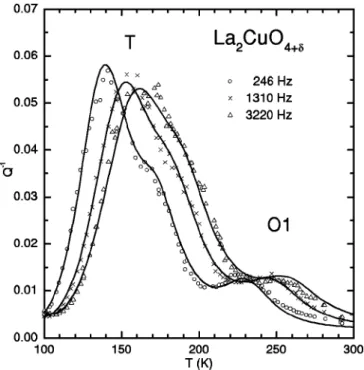
Figure 2 shows the elastic energy loss of sample 3 be-tween 100 and 400 K, after three outgassing treatments in vacuum up to progressively higher temperatures, as indicated in the figure. Three main maxima appear at 150, 230, and 305 K, labeled as T, O1, and O2, respectively. All of them shift to higher temperature at the higher vibration frequen-cies, denoting that they are due to thermally activated pro-cesses; this is shown in Fig. 3 for the case of intermediated. Peak T, which actually consists of two components, is fully developed when the sample is completely outgassed from excess O. The introduction of interstitial O depresses FIG. 1. Resistivity of sample 2 of La2CuO41d after
oxygen-ation in 1.1 bar O2at 600 °C and slow cooling. FIG. 2. Elastic energy loss of sample 3 after outgassing it in
peak T, and causes the rise first of O1 and then of O2, which finally becomes predominant.
The same phenomenology is observed in sample 2 ~Fig. 4!, whose stoichiometry was varied by equilibration with dif-ferent amounts of O2, as explained above. The Q21(T) curves of sample 2 in Fig. 4 extend the observations to higher values of d, at which peak O2 reaches a very high
lines in Fig. 3 are a fit with three peaks of the anelastic relaxation spectrum of sample 3 at intermediate concentra-tion, measured at the three vibration frequencies; each com-ponent is the imaginary part of the contribution of a relax-ation process to the dynamic elastic modulus@Eq. ~1!#.
The parameters describing peak O1 in Fig. 3 are
t05(260.5)3102
14s, E/k
5(56006120) K,a50.7; these values support the hypothesis of O hopping. The value oft0 is typical of atomic hopping with an attempt frequency close to that of the local phonon mode. Furthermore, the hopping rate t21 we estimate is in excellent agreement with the ob-servation that the mobility of the excess O is frozen below 140–150 K;25in fact, this is the temperature range in which the mean time t between subsequent jumps passes from 5 min to more than 1 h.41The activation enthalpy of O1 is also close to that reported for a relaxation process previously ob-served by NMR and attributed to O diffusion.29On the other hand, the width of the peak is considerably higher than ex-pected from the hopping of an isolated interstitial atom in a regular lattice, and can be explained by the variety of the arrangements of the octahedral CuO6 units, which would give rise to a distribution of local strains. The rearrange-ments of the lattice structural units may also mediate the interaction between different interstitials; an indication of a correlated dynamics of the O interstitials comes from the broadening of peak O1 at increasing O concentrations, and from its shift to higher temperature, which means a slowing of the relaxation dynamics.
Peak O2 is also certainly connected with excess O, both because of its dependence on d, and because the enormous intensity it can reach is more easily explained by hopping of atoms rather than small atomic rearrangements or polaronic distortions ~which generally have smaller Dl). The most simple mechanism that can be proposed for O2 is the forma-tion of relatively stable pairs of interstitial O atoms, whose local distortion is more anisotropic than that due to the two isolated atoms, and therefore whose reorientation produces intense anelastic relaxation. The reorientation of the pair would require its dissociation and therefore would be slower than the hopping of single interstitials, so justifying the higher temperature of O2 with respect to O1. Such pairs could also be identified with the interstitial O atoms with partially covalent bond, which have been invoked to explain a doping efficiency of less than two holes per excess O atom.24,38
In the doped samples we did not observe any clear sign of phase separation into O-rich and O-poor phases, nor of FIG. 3. Elastic energy loss of sample 3 after outgassing in
vacuum up to 596 K, measured exciting three flexural vibration modes. The continuous lines are fits with broadened Debye peaks, Eq.~1! ~with the same set of parameters for the three frequencies!; the values of the parameters are reported in the text.
staging26,27 within the O-rich phase, but it is possible that these transitions occurred and were masked by the intense relaxations O1 and O2.
B. Stoichiometric La2CuO4and comparison with Nd2CuO4
Excess oxygen is the main defect of La2CuO4 and after its removal one expects a flattening of the elastic susceptibil-ity below room temperature; on the contrary, we observe the appearance of the intense relaxation process T and the en-hancement of another process below 40 K. Figure 5 com-pares the elastic susceptibility of stoichiometric La2CuO4
~after O outgassing in vacuum at 750 °C for 75 min! with that of Nd2CuO4 ~also after annealing in vacuum up to 600 °C, which did not change much the anelastic spectrum compared to the as prepared condition!. Both samples were prepared under similar conditions, with comparable dimen-sions and grain sizes, but the elastic susceptibility of Nd2CuO4is practically flat at all temperatures, in sharp con-trast with that of La2CuO4. This fact evidently reflects the differences between the two structures: in Nd2CuO4 the O atoms are all stacked along the same lines in the c direction (T
8
phase!,42 so that there are no apical oxygens and CuO6 octahedral units, but only flat CuO2 planes. The featureless elastic susceptibility of Nd2CuO4 reflects the absence of any off-center atomic position, lattice instability, or structural phase transformation,43while the changes in the slope of the Q21(T)~and in the modulus at 20 K, not visible in the scale of Fig. 5!presumably reflect the changes in magnetic order-ing observed at 250, 30, and 20 K by neutron-scatterorder-ing experiments.43The flat anelastic spectrum of Nd2CuO4 con-firms the reliability of the measurements and the good qual-ity of the samples, in particular the absence of contributions from spurious phases at the grain boundaries.The anelastic spectrum of stoichiometric La2CuO4 is dominated by two processes, labeled as T around 150 K and L below 30 K. We will not consider here the minor peaks between 50 and 100 K. Acoustic losses at liquid-helium tem-perature are generally observed in amorphous materials con-taining atomic tunnel systems44 and even in polycrystalline metals which are not thoroughly purified and annealed.45 Such losses however never exceed Q21<1023, even in fully
amorphous samples, and therefore we exclude that peak L, whose intensity reaches Q21;1022, is due to tunnel sys-tems in spurious amorphous phases.
All the features of the susceptibility curves of La2CuO4 in Fig. 5 are shifted to higher temperature at the higher vi-bration frequency, indicating that they are all due to anelastic relaxation processes describable by Eq. ~1!, although the temperature shift of L is much less pronounced, as discussed later. The amplitudes of the steps in the modulus of both L and T are higher than twice the amplitudes of the imaginary peaks, and this is due to broad distributions of the relaxation parameters. In fact, the overlapping of processes with differ-ent temperatures produces a step in the modulus whose over-all amplitude is the sum of the amplitudes of the single com-ponents, whereas the height of the resulting peak of the imaginary part is smaller than the sum of the amplitudes of its components. Therefore, better estimates of the total relax-ation intensities are deduced from the amplitudes of the steps in the modulus, 12DY /Y;0.045 for L and 0.08 for T in Fig. 5. These values are unusually high, especially if one consid-ers that they are found in a stoichiometric material, and ap-parently do not occur in concomitance with structural phase transformations. In order to better appreciate this point, one should consider that a relative softening of 0.08 means that, on application of a tensile stress, the sample undergoes an additional extension of 8% due to the relaxation of the ‘‘de-fects.’’ For this reason, the relaxations L and T can only be accounted for by intrinsic mechanisms, which must be con-nected with the instability of the La2CuO4 lattice against certain types of deformations, like the tilting of the CuO6 octahedra, and the large vibration amplitudes of the O atoms observed by neutron diffraction.6
Figure 6 presents the whole relaxation spectrum of sample 2, from 1.4 to 700 K both in the O doped and undoped conditions. The HTT to LTO transition occurs at 530 K in the undoped state, as expected, and at 500 K after the maxi-mum oxygenation. According to the T,d phase diagram of Zhou et al.,4 a transition temperature Td15500 K corre-sponds to d50.018. The dissipation maximum just below FIG. 5. Elastic energy-loss coefficient, Q21
, and relative change of the Young’s modulus of La2CuO4 ~sample 1, 500 Hz and 6.2
kHz!and Nd2CuO4~840 Hz!.
FIG. 6. Complete elastic susceptibilities of undoped and O-doped (d;0.018) La2CuO41d. The temperatures of the HTT-LTO
octahedra in the plane, the marked departure from pure De-bye relaxation is a consequence of the static and dynamic interaction among these structural units.
However, the hypothesis that all the octahedra in the LTO phase may flip by thermal activation seems to be in contrast with the observation of static LTO domains with a long-range order. Actually, from a detailed neutron-diffraction study6on single crystals of La2CuO4 and La1.87Sr0.13CuO4 it results that the dynamic displacements of the O atoms in the directions of the tilts are even larger than the static ones at least down to 180 K, and remain comparable to the static displacements down to the lowest temperatures. This has been interpreted as a sign that the O atoms~particularly the apical ones!can switch configuration by thermal activation.6 The possibility that the relaxation processes L and/or T are directly related to the large dynamic displacements of O found by neutron diffraction is very attractive, and would also explain their extremely high intensities. Still, some care must be taken in directly identifying the dynamic displace-ments observed by neutron diffraction with the relaxation processes L and T, because the firsts are higher in the Sr-doped sample,6 while the intensity of the latter decreases with O doping. A direct comparison between the doping de-pendence of the Debye-Waller displacements and of the re-laxation processes L and T cannot be made yet, due to the lack of complete spectra of the imaginary part of the elastic susceptibility of Sr-doped samples.
If the relaxational dynamics producing T does not involve the whole lattice, but only particularly unstable regions, these can be identified with the twin boundaries. Zhu et al.3 found that the transition between two twin LTO domains occurs smoothly through extended LTT- and HTT-like twin boundaries in La22xBaxCuO4. These smooth domain walls can also be explained by constructing a model Landau free energy which reproduces the phase diagram of La22xBaxCuO4 and minimizing it along the twin boundary, with the tilt angles as order parameters.12 These authors found that their model free energy has a local minimum for the LTT distortion also in undoped La2CuO4.12 Then, it is possible that also in La2CuO4 the domain walls are wide and unstable against the formation of the LTT or HTT phase, and peak T can be due to the thermally activated switching of entire octahedra between the two nearly energetically equivalent configurations.
Note that this mechanism should be distinct from the movement of the twin walls, which produce a dissipation
ture, the elastic energy-loss coefficient becomes as high as 831023 due to the stress-induced motion of the domain walls.46
In La2CuO4, peaks in the low-temperature ultrasound ab-sorption have been attributed to the interaction of soft modes with the sound wave,47 and a minimum around 40 K in the c66 in-plane shear48 has been attributed to a relaxation pro-cess, possibly connected with the predicted highly anhar-monic tilting mode of the apical O.49More data are available for the material with La partially substituted by Sr or Ba, where the new types of tilts are better stabilized, and the Pccn and LTT domains have actually been observed. In La1.9Ba0.1CuO4 a step in the sound velocity was found at Td2550 K~Ref. 34!, when the LTO phase transforms into LTT, and in La1.475Nd0.4Sr0.125O4 two distinct dips in c66 were found at the transformations from LTO to Pccn and then to LTT.35 In La22xSrxCuO4, rises in the acoustic ab-sorption and elastic constants have been frequently observed below 10–30 K, and attributed to the appearance of a new phase,34,50,51to the occurrence of a glassy state31or to other causes.33,47In some cases no acoustic anomaly was observed below 60 K.52,53
Nohara et al.54 also studied the interplay between lattice instability and emergence of superconductivity. They found that c66@(c112c12)/2 in their HTT representation#starts soft-ening below 50 K in La1.86Sr0.14CuO4, and hardens again at the appearance of superconductivity; they could shift the on-set of superconductivity and therefore extend the region of softening by applying a magnetic field. These observations have been interpreted as evidence of a structural instability of the LTO phase which is suppressed by superconductivity; the authors also noted that the in-plane shear strain coupled to the softening is responsible for a differentiation of the otherwise equivalent O atoms in the CuO2 plane of the LTO phase, as for the LTT and Pccn phases.
temperature with O doping will be discussed in the next section. The inset also shows the linear correlation between the peak in the absorption and the negative step in the modu-lus, as expected from a relaxation process following Eq.~1!; the reference values of Y were chosen in order that the ex-trapolations of Y (T) coincide at T50 K.
Still, the tendency to instability of the LTO phase is ex-pected to play a role in a phenomenon which certainly in-volves a relevant fraction of the lattice. Since there are no signs of a precise temperature at which the acoustic disper-sion starts, we interpret process L as relaxation among off-center positions created by the lattice instability toward the LTT-like tilts. Whether this can occur only in particularly disordered or unstable regions like the twin walls or also within the LTO domains, is a question connected with the issue whether the LTT phase propagates from the twin walls12or also nucleates in the LTO domains.13
The extremely broad shape of the Q21(T) curves below 40 K and the fact that their shift to higher temperature at higher frequency is less marked than for the other processes, is not unusual at such low temperature, where the relaxation rate t21 is generally governed by quantum effects. Indeed, the broad shape of peak L cannot be reproduced witht obey-ing the Arrhenius law for overbarrier hoppobey-ing. We attempted to fit the Q21(T) curves below 40 K by assuming hopping over two types of barriers, both with a distribution function whose width is up to half of its mean value, but also in this
case the resulting curves consist of two well defined separate peaks, instead of the broad experimental curves. The only way to fit peak L by assuming overbarrier hopping with an attempt frequency of the order of the local atomic vibrations (t0;10214s!is to construct an ad hoc distribution of barri-ers P(E) which is maximum around E;100 K and has asymptotic behavior Em and E2n at low and high values of E, respectively, ~the high-temperature side of the peak re-quires n;1.5). A more physical picture is that the dynamics of relaxation L is dominated by tunneling. In fact, at progres-sively lower temperature the major contribution tot21 in a nonmetallic material comes from defect transitions involving two phonons and finally one phonon, which produce a tem-perature dependence much slower than the Arrhenius law (t21}T;7 for two-phonon55 and t21}T for one-phonon processes56!. Then the shape of the Q21(T) curve is also defined by the thermodynamic factor:
f1f2 T 5
1 T
c
cosh2~A/2kT!, ~2!
where A is the energy asymmetry between the two possible defect states, due to the nonequivalence of the configurations and to internal strains. The energy scale of the processes involving tunneling is comparable with the energy shifts A due to lattice disorder, causing a broadening of the relaxation function which further masks the temperature shift of the Debye function.
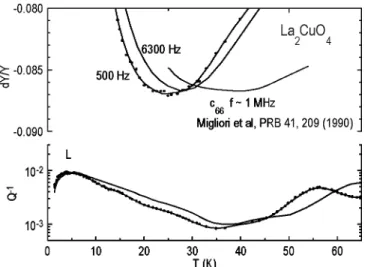
Support to the hypothesis that process L is of the relax-ation type comes from the comparison of our measurements with those of Migliori et al.,48who reported the elastic con-stants of a La2CuO4single crystal between 25 and 55 K. In Fig. 8 we put our data for stoichiometric La2CuO4, taken at 0.5 and 6.3 kHz, together with the temperature dependence of the c66constant around 1 MHz;
48
c66is the most sensitive to the distortions of the different phases of the 214 com-pounds, and is the most influential in determining the tem-perature dependence of the Young’s modulus of the polycrystals.57The three curves Y (T) and c66(T) are shifted in temperature according to the vibration frequency, as re-quested by the term containingvtin Eq.~1!. In addition, the FIG. 7. Dependence of the relaxation process L on oxygen
dop-ing. Curve 1: outgassed; curves 2–4: equilibrated at 620 °C with 10, 1, and 0.7 torr O2. The inset shows the linear correlation between
the modulus step and the intensity of the absorption peak. The vibration frequencies at T50 K were 510, 780, 840, and 890 Hz from curve 1 to curve 4.
FIG. 8. Comparison between the measurements on our undoped ceramic La2CuO4 and the temperature dependence of c66
Q21of the single crystal of Migliori et al. was reported to be of the order of 1023 around 40 K and to increase at lower temperature, in perfect agreement with our ceramic samples. The same authors attributed the minimum of c66(T) to a relaxation process possibly connected with highly anhar-monic phonon modes49or domain-wall motion.
E. Influence of doping
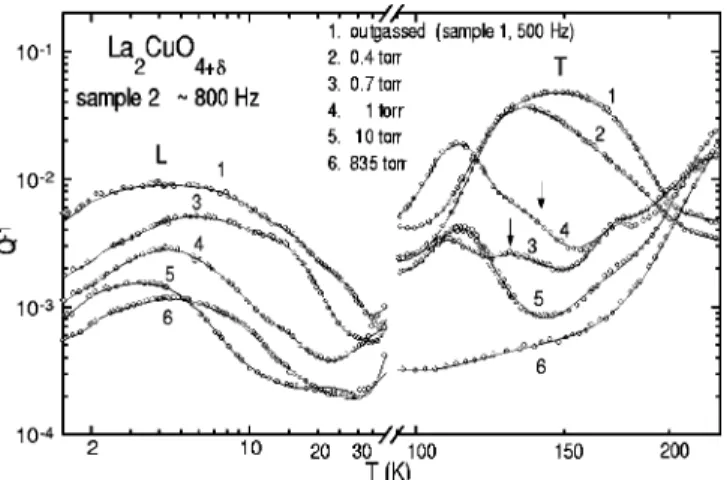
Figure 9 presents the evolution of the peaks L and T with increasing the O doping, 0<d&0.02. Both peaks have a similar behavior under the introduction of small quantities of excess oxygen: they are depressed and shift to lower tem-perature, but peak T is much more effectively inhibited than peak L.
Also the partial substitution of La with Sr or Ba seems to inhibit these processes, but the data available in the literature are somewhat contradictory and insufficient to determine this issue. In addition, a direct comparison between low-frequency and ultrasound experiments is sometimes difficult, for example, due to the scattering of the sound waves from the domain walls in the latter type of experiments.
We try now to interpret this behavior of peaks L and T in terms of lattice disorder and electronic effects connected with the doping of charge carriers. It has been proposed4that there is a mismatch between the bond lengths in the LaO planes and those in the CuO2 planes, so that the CuO2 planes are subjected to a compressive stress and become cor-rugated. This is considered as a cause of the tilting of the octahedra and therefore it has been identified as the driving force for the transition from HTT to LTO,4 although the observation of finite tilts also in the HTT phase16 indicates that the situation is more complex. Such a mismatch is de-scribed by the tolerance factor t5@La2O#/
A
2@Cu2O#,1, which would be 1 in the case of stress-free flat planes. The introduction of interstitial O increases t for two reasons:4~i!the interstitial atoms occupy tetrahedral sites between two
faster rate for the hopping between the possible configura-tions and therefore the maximum of the anelastic relaxation intensity, which occurs around vt51, is shifted to lower temperature. The same argument holds for peak L, even if the relaxation dynamics is not describable by the classical rate theory; also when tunneling dominates, a reduction of the barrier results in faster rates and therefore in a shift to lower temperature of the corresponding relaxation process. We conclude that the introduction of holes in the CuO2 planes reduces the barrier between the off-center configura-tions and therefore accelerates the relaxation dynamics.
On the other hand, the lattice disorder, both due to inter-stitial O and substitutional Sr and Ba, makes the double po-tentials more asymmetric. This results in a suppression of the relaxation when the induced asymmetry A is higher than kT, since the configuration with the highest energy is no more populated and the factor f1f2in Eqs.~1!and~2!goes to zero as exp(2A/kT). The fact that peak T is more markedly de-pressed than peak L is consistent with the hypothesis of a coordinated motion of entire CuO6 octahedra; since the oc-tahedra are correlated with each other, it is possible that the pinning due to a single interstitial oxygen propagates to sev-eral structural units, causing complete blocking already at low defect concentrations. Instead, the correlation is cer-tainly lower for single O atoms making transitions between tunneling states.
The measurement with the highest content of excess O seems to contradict the above picture, because peak L in curve 6 of Fig. 9 is lower in intensity than curve 5, but shifted to higher rather than to lower temperature. This can be explained by the occurrence of the phase separation into O-rich and O-poor phases, with the O-rich phase not contrib-uting to the relaxation process. In addition, it is possible that not all excess oxygen goes in the lattice as O22 ions, but partly forms covalent bonds,24,38 for example O222 pairs, which contribute less to the charge doping. Then, the unex-pected shift to higher temperature of peak L at the highest O contents may be explained by the formation of covalent pairs which contribute only partially to doping, and therefore to the acceleration of the relaxation dynamics, but are effective in creating disorder and therefore in suppressing the inten-sity.
The conclusion that O atoms in La2CuO41d may tunnel
and that their dynamics becomes faster on increasing doping poses the question whether this tunneling dynamics may play a role in the superconducting mechanism, since many models FIG. 9. Dependence of the relaxation processes L and T on
oxygen doping. Curve 1: sample 1 after outgassing in vacuum at 750 °C for 75 min; curves 2–6: sample 2 after 1–2 h equilibration in a quartz tube with an initial O2pressure indicated in the legend.
have appeared of strong electron-lattice coupling mediated by tunneling states.60,61 Experimental evidences of double-well potentials along the z axis for the apical O atoms in 123 and Tl-based oxide superconductors have been provided mainly by extended x-ray-absorption fine-structure measurements,62but are still controversial.63,64In the present case there is evidence of an extraordinarily intense relaxation involving tunnel states, but it also seems that this relaxation mechanism loses importance at the doping levels at which the material becomes metallic and superconducting, at least for doping with interstitial O. Additional acoustic experi-ments may clarify this point.
IV. CONCLUSIONS
The present measurements show the existence of four an-elastic relaxation processes in La2CuO41d which depend on
the O stoichiometry and may reach very high intensities. Two of them are clearly connected with the presence of ex-cess O, and from the analysis of the elastic energy loss peak due to hopping of single interstitial O atoms it has been possible to accurately determine their mobility.
It is also shown that, after eliminating the excess O, a relevant fraction of the lattice in the LTO phase presents relaxational dynamics on three different time scales, which is a manifestation of the intrinsic instability of the La2CuO4 lattice against certain types of deformations, like the tilting of the CuO6 octahedra. This is in sharp contrast with Nd2CuO4, which has a stable T
8
structure without CuO6 octahedra and a flat dynamic elastic susceptibility. Theonly transformation which is known to occur in undoped La2CuO4 is the HTT-LTO one, and the movement of the twin walls in the LTO domains cannot be responsible for three relaxation processes with widely different characteristic energies and temperatures~450, 150, and 5 K!. The slowest relaxation, observed below the HTT-LTO transformation temperature, is attributed to the motion of the twin bound-aries. The intermediate process, with relaxation times of the order of 1 ms around 150 K, is due to hopping over a barrier of;0.23 eV; it is identified with thermally activated flipping of unstable CuO6 octahedra, possibly in the domain bound-aries, and is easily blocked by the lattice disorder introduced by excess oxygen. The faster relaxation motion, which is less effectively blocked by the interstitial excess O, has charac-teristic times of the order of 1 ms around 5–10 K and is dominated by quantum tunneling. It is proposed that the double-well potentials for the low-temperature relaxation are due to the tendency of the LTO phase to nucleate LTT do-mains. In stoichiometric La2CuO4 however, these domains cannot be stabilized, as in the doped lattice, by the mismatch between the sizes of the La ions and those which partially substitute it, or by the commensurate charge-density wave when doping is ;1/8. Therefore, possibly near the twin walls, the O sublattice can locally assume an LTT-like pat-tern, which however remains localized and short lived.
ACKNOWLEDGMENT
C.R.G. is grateful to Fundac¸a˜o de Amparo a` Pesquisa do Estado de Sa˜o Paulo~FAPESP!for financial support.
1J. D. Axe, A. H. Moudden, D. Hohlwein, D. E. Cox, K. M.
Mohanty, A. R. Moodenbaugh, and Y. Xu, Phys. Rev. Lett. 62, 2751~1989!.
2M. K. Crawford, R. L. Harlow, M. McCarron, W. E. Farneth, J.
D. Axe, H. Chou, and Q. Huang, Phys. Rev. B 44, 7749~1991!.
3Y. Zhu, A. R. Moodenough, Z. X. Cai, J. Tafto, M. Suenaga, and
D. O. Welch, Phys. Rev. Lett. 73, 3026~1994!.
4J. S. Zhou, H. Chen, and J. B. Goodenough, Phys. Rev. B 50,
4168~1994!.
5J. L. Sarrao, D. Mandrus, A. Migliori, Z. Fisk, I. Tanaka, H.
Kojima, P. C. Canfield, and P. D. Kodali, Phys. Rev. B 50, 13 125~1994!.
6M. Braden, P. Schweiss, G. Heger, W. Reichardt, Z. Fisk, K.
Gamayunov, I. Tanaka, and H. Kojima, Physica C 223, 396 ~1994!.
7
M. Maki, M. Sera, M. Hiroi, and N. Kobayashi, Phys. Rev. B 53, 11 324~1996!.
8J. M. Tranquada, B. J. Sternlieb, J. D. Axe, Y. Nakamura, and S.
Uchida, Nature~London!375, 561~1995!.
9J. M. Tranquada, J. D. Axe, N. Ichikawa, A. R. Moodenough, Y.
Nakamura, and S. Uchida, Phys. Rev. Lett. 78, 338~1997!.
10Y. Koyama, Y. Wakabayashi, K. Ito, and Y. Inoue, Phys. Rev. B
51, 9045~1995!.
11C. H. Chen, S. W. Cheong, D. J. Werder, and H. Takagi, Physica
C 206, 183~1993!.
12Z. X. Cai and D. O. Welch, Physica C 234, 373~1994!. 13Y. Horibe, Y. Inoue, and Y. Koyama, Physica C 282/287, 1071
~1997!.
14T. R. Thurston, R. J. Birgenau, D. R. Gabbe, H. P. Jensen, M. A.
Kastner, P. J. Picone, N. W. Preyer, J. D. Axe, P. Bo¨ni, G. Shirane, M. Sato, K. Fukuda, and S. Shamoto, Phys. Rev. B 39, 4327~1989!.
15M. Nohara, T. Suzuki, Y. Maeno, T. Fujita, I. Tanaka, and H.
Kojima, Phys. Rev. B 52, 570~1995!.
16S. J. L. Billinge and G. H. Kwei, J. Phys. Chem. Solids 57, 1457
~1996!.
17P. C. Hammel, A. P. Reyes, S. W. Cheong, and Z. Fisk, Phys.
Rev. Lett. 71, 440~1993!.
18A. Bianconi, N. L. Saini, A. Lanzara, M. Missori, T. Rossetti, H.
Oyanagi, H. Yamaguchi, K. Oka, and T. Ito, Phys. Rev. Lett. 76, 3412~1996!.
19D. Haskel, E. A. Stern, D. G. Hinks, A. W. Mitchell, J. D.
Jor-gensen, and J. I. Budnick, Phys. Rev. Lett. 76, 439~1996!.
20G.-M. Zhao, K. Conder, H. Keller, and K. A. Mu¨ller, Z. Phys. B
100, 535~1996!.
21S. J. L. Billinge, R. G. DiFrancesco, G. H. Kwei, J. J. Neumeier,
and J. D. Thompson, Phys. Rev. Lett. 77, 715~1996!.
22P. G. Radaelli, M. Marezio, H. Y. Hwang, S. W. Cheong, and B.
Battlog, Phys. Rev. B 54, 8992~1996!.
23Y. Yacoby, S. M. Heald, and E. A. Stern, Solid State Commun.
101, 801~1997!.
24P. G. Radaelli, J. D. Jorgensen, A. J. Schultz, B. A. Hunter, J. L.
Wagner, F. C. Chou, and D. C. Johnston, Phys. Rev. B 48, 499 ~1993!.
Physica C 162-164, 460~1989!.
34T. Fukase, T. Nomoto, T. Hanaguri, T. Goto, and Y. Koike,
Physica B 165/166, 1289~1990!.
35S. Sakita, F. Nakamura, J. Takase, T. Suzuki, and T. Fujita,
Physica C 282/287, 1083~1997!.
36M. Gazda, B. Kusz, R. J. Barczynski, G. Gzowsky, I. Davoli, and
S. Stizza, J. Alloys Compd. 211/212, 270~1994!.
37A. S. Nowick and B. S. Berry, Anelastic Relaxation in Crystalline
Solids~Academic, New York, 1972!.
38Z. G. Li, H. H. Feng, Z. Y. Yang, A. Hamed, S. T. Ting, P. H.
Hor, S. Bhavaraju, J. F. DiCarlo, and A. J. Jacobson, Phys. Rev. Lett. 77, 5413~1996!.
39J. D. Jorgensen, B. Dabrowski, S. Pei, D. R. Richards, and D. G.
Hinks, Phys. Rev. B 40, 2187~1989!.
40C. Chaillout, S. W. Cheong, Z. Fisk, M. S. Lehmnann, M.
Marezio, B. Morosin, and J. E. Schirber, Physica C 158, 183 ~1989!.
41The authors in Ref. 25 estimate the activation energy for O
dif-fusion as E/k52810 K, from the time dependence of the mag-netic susceptibility at constant temperature. Such a low value of E would imply an anomalously low value of t021
, in order to yield a frozen mobility at 150 K, and may result from the indi-rect method used to estimate it.
42Y. Tokura, H. Takagi, and S. Uchida, Nature~London!337, 345
~1989!.
43M. Matsuda, K. Yamada, K. Kakurai, H. Kadowaki, T. R.
Thur-ston, E. Endoh, Y. Hidaka, R. J. Birgeneau, M. A. Kastner, P. M. Gehring, A. H. Moudden, and G. Shirane, Phys. Rev. B 42, 10 098~1990!.
51A. Al-Kheffaji, J. Freestone, D. P. Almond, G. A. Saunders, and
J. Wang, J. Phys.: Condens. Matter 1, 5993~1989!.
52P. Esquinazi, J. Luzuriaga, C. Duran, D. A. Esparza, and C.
D’Ovidio, Phys. Rev. B 36, 2316~1987!.
53Y. Horie, T. Fukami, and S. Mase, Solid State Commun. 63, 653
~1987!.
54M. Nohara, T. Suzuki, Y. Maeno, T. Fujita, I. Tanaka, and H.
Kojima, Phys. Rev. Lett. 70, 3447~1993!.
55Y. Kagan, J. Low Temp. Phys. 87, 525~1992!.
56W. A. Phillips, Amorphous Solids. Low Temperature Properties
~Springer, Berlin, 1981!.
57X. D. Xiang, J. Brill, and L. DeLong, Solid State Commun. 65,
1073~1988!.
58K. Yamada, M. Matsuda, Y. Endoh, B. Keimer, R. J. Birgeneau,
S. Onodera, J. Mizusaki, T. Matsuura, and G. Shirane, Phys. Rev. B 39, 2336~1989!.
59C. Rial, E. Mora`n, M. A. Alario-Franco, U. Amador, and N. H.
Andersen, Physica C 254, 233~1995!.
60L. Mihailov, M. Dimitrova-Ivanovich, and M. Georgiev, Physica
C 223, 249~1994!.
61
A. Bussmann-Holder, A. R. Bishop, and I. Batistic, Phys. Rev. B 43, 13 728~1991!.
62J. M. de Leon, S. D. Conradson, I. Batistic, A. R. Bishop, I. D.
Raistrik, M. C. Aronson, and F. H. Garzon, Phys. Rev. B 45, 2447~1992!.
63C. Thomsen and M. Cardona, Phys. Rev. B 47, 12 320~1993!. 64P. Bordet, C. Chaillout, T. Fournier, M. Marezio, E. Kaldis, J.