Initial experience with hand replantation
after traumatic amputation
in a nonspecialized center
Experiência inicial com reimplante de mão após amputação traumática
em um centro não-especializado
Cleinaldo de Almeida Costa1, Pedro Henrique Oliveira Cabral2, Paulo Laredo Pinto2, Manoel Jesus Coelho Pinheiro Júnior2, Neivaldo José Nazaré dos Santos3, Dário Birolini4
J Vasc Bras 2006;5(4):321-4.
Copyright © 2006 by Sociedade Brasileira de Angiologia e de Cirurgia Vascular.
321
Resumo
A amputação traumática de mão é uma lesão incapacitante, re-querendo tratamento cirúrgico hábil. Alcançar recuperação funcional além de salvar a extremidade amputada deve ser o objetivo da equipe médica, depois de resguardada a vida do paciente. Este é o relato dos cinco primeiros casos de reimplante de mão após amputações traumá-ticas completas na cidade de Manaus (AM), realizados no Hospital Pronto-Socorro Dr. João Lúcio Pereira Machado. Todos os pacientes eram homens jovens, média das idades de 22,8 anos, sendo admitidos na sala de emergência com amputação completa da mão por trauma inciso. Após medidas iniciais de acordo com o protocolo do AT LS®,
foram realizados os seguintes tempos cirúrgicos: heparinização dos vasos sangüíneos da extremidade amputada, fixação óssea, abertura ampla do túnel do carpo, anastomoses vasculares primárias e sutura de nervos e tendões. Em quatro casos, ocorreu recuperação parcial dos movimentos das mãos reimplantadas. O caso de insucesso foi de-vido à extensa trombose venosa.
A partir desta experiência inicial, podemos afirmar que o reimplante de mão pode ser realizado com sucesso em um hospital não-especializado e que os resultados ideais dependem de cuidados pré-operatórios adequados, tratamento cirúrgico multidisciplinar e assistência pós-operatória cuidadosa.
Palavras-chave: Traumatismos da mão, amputação traumática, reimplante, equipe de assistência ao paciente.
Abstract
Traumatic amputation of the hand is an incapacitating injury, requiring skilled surgical care. Achieving functional recovery in addition to salvage of the amputated extremity should be the goal of the patient care team, after the life of the patient is secured. T his is a report of the first five cases of hand replantation after complete traumatic amputation in Manaus (Amazonas, Brazil), carried out at Hospital Pronto-Socorro Dr. João Lúcio Pereira Machado. T he patients were all young males, mean age of 22.8 years, presenting at the emergency room with complete sharp amputation of the hand. After initial procedures according to the AT LS® protocol, the following surgical
actions were taken: heparinization of the blood vessels of the amputated extremity, fixation of the bones, wide opening of the carpal tunnel, primary vascular anastomoses and repair of nerves and tendons. In four cases, viability and partial functional recovery of the replanted hands were achieved. T he unsuccessful case was due to extensive venous thrombosis.
T hrough this preliminary experience, we can state that hand replantation can be performed successfully in a nonspecialized hospital and that optimal results depend on adequate prehospital care, multidisciplinary surgical treatment and careful postoperative assistance.
Keywords: Hand injuries, traumatic amputation, replantation, patient care team.
C
ASE REPOR
T
1. Mestre em Cirurgia Vascular, Universidade Federal de São Paulo – Escola Paulista de Medicina (UNIFESP-EPM), São Paulo, SP. Professor, Disciplina de Cirurgia Vascular, Universidade do Estado do Amazonas (UEA), Manaus, AM. Especialista em Cirurgia Vascular, SBACV.
2. Residentes de Cirurgia Geral, Universidade Federal do Amazonas (UFAM), Manaus, AM.
3. Mestre em Cirurgia Vascular, UNIFESP-EPM, São Paulo, SP. Professor, Disciplina de Cirurgia Vascular, UEA, Manaus, AM.
4. Professor titular, chefe da Disciplina de Cirurgia do Trauma, Faculdade de Medicina, Universidade de São Paulo (USP), São Paulo, SP. Este estudo foi realizado noHospital Pronto-Socorro João Lúcio Pereira Machado, Manaus, AM.
322 J Vasc Bras 2006, Vol. 5, Nº4
Introduction
T raumatic amputation of the hand is a complex and incapacitating injury. T he first successful hand
replantation was reported by Chen et al. in 1963.1
Since then, great advances in replantation and functional recovery of amputated extremities have been developed. After 4 decades of continuous studying and acquisition of experience in the field, the concept introduced by Chen remains appropriate: best efforts must be made to achieve functional rehabilitation and not only survival of the extremity,
after the life of the patient is secured.2-4
Case reports
T his is a report of the first five cases of hand replantation after traumatic amputation in Manaus (Amazonas, Brazil), carried out at Hospital Pronto-Socorro Dr. João Lúcio Pereira Machado from January 2001 to July 2005. All the patients had complete amputation of the hand at the level of the wrist and were operated on by the same vascular surgeon, undergoing standardized operative technique and similar preoperative and postoperative care.
Case 1
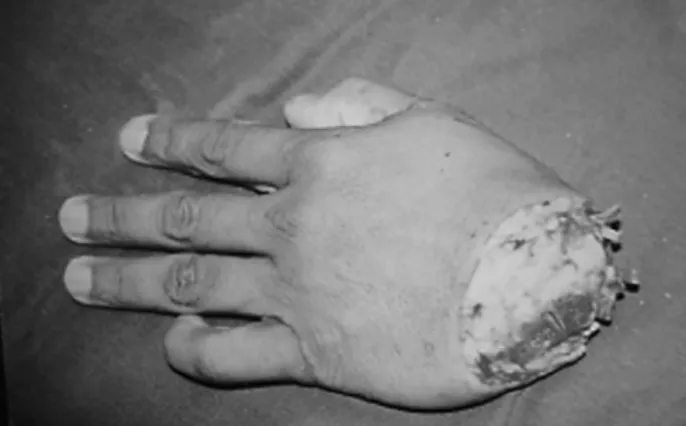
A 32-year-old male was admitted in grade II shock with the left hand amputated by a stab, after 30 min of warm ischemia (Figure 1). Pressure dressings were applied for bleeding control, vigorous parenteral hydration and preempted antibiotic (cefazolin) were initiated, and the patient was promptly taken to the operation room. Blood vessels of the amputated segment were flushed with a heparinized solution and hemorrhage was promptly controlled through clamping of the bleeding vessels of the forearm. After internal fixation of the carpal bones to the forearm and wide opening of the carpal tunnel, end-to-end vascular anastomoses were accomplished, first of three dorsal veins and then of the radial and ulnar arteries, by monofilament 7-0 polypropylene separated sutures, with 2 .5 x amplification lenses. After ascertaining adequate blood flow, repair of the nerves (radial, ulnar and median by epineurium approximation with monofilament 7-0 polypropylene separated sutures) and tendons (superficial and deep flexors and extensors) was performed (Figure 2).
T he patient received enoxaparin daily after the surgical procedure and was discharged from hospital on
the seventh hospitalization day after an uneventful postoperative period. He started physical therapy and was followed for 2 years, partially recovering movements of extension, flexion and opposition, in addition to tactile, thermal and painful sensation (Figure 3).
Case 2
An 18-year-old male presented to the emergency department in grade II shock, with traumatic amputation of the left hand produced by a stab after 2 h of warm ischemia and was operated on according to the operative technique described in case 1. O n the third postoperative day, he developed ischemic necrosis of the replanted hand and proximal amputation was necessary. Analysis of the specimen disclosed extensive venous thrombosis.
Figure 1 - Left hand amputated at the level of the wrist (case 1)
Figure 2 - Anastomoses of the radial and ulnar arteries (case 1)
J Vasc Bras 2006, Vol. 5, Nº4 323
Case 3
A 21-year-old male was admitted to the emergency department after having the right hand cut by a guillotine 11 h prior to admission, while at work. He came to M anaus by airplane with the hand appropriately conditioned in a plastic bag immersed on ice and had normal vital signs on admission. He was operated on according to the operative technique previously described. O n the third postoperative day, epidermolysis developed on the third finger, healing with local care. D ischarge from hospital came on the ninth hospital day. After 30 days of follow-up and physical therapy, he returned to his city with partial recovery of flexion and extension movements, but still unable to opposition.
Case 4
A 16-year-old male presented at the hospital in grade II shock 1 h after having the left hand amputated by a stab wound. He was operated on according to the operative technique described in case 1. One h after operation, while still in the post-anesthesia recovery room, marked edema of the replanted hand was noted. Reoperation revealed thrombosis of the radial artery and dorsal veins. T hese blood vessels were flushed again with a heparinized solution and the extremity could be salvaged due to close monitoring in the postoperative period. T he patient was discharged home for outpatient follow-up after 8 days of hospitalization. T wo years later, he had limited movements of flexion and extension, affirming to be satisfied with the procedure.
Case 5
A 27-year-old male had his left hand amputated by a stab 40 minutes before presenting to hospital. He was in grade II shock and was operated on according to the operative technique described in case 1. In the fourth postoperative day, necrosis of the distal phalanx of the index finger developed, requiring amputation. He was
discharged from hospital in the 19th hospitalization day
and 4 months after operation is satisfied with the procedure, with partial functional recovery of the replanted extremity.
Discussion
T he decision to attempt replantation, regardless of the limited experience of the surgical team in the field, arouse from the circumstance of the first patient entering the emergency room bringing his hand amputated. D ue to success rates approaching 90% and the great impact in the quality of life, hand replantation has been recommended in most
instances.2,5-7
In cases 1, 2, 4 and 5, the young age of the patients, the stable hemodynamic condition and also the mechanism of trauma, in which there was no crushing or burning of tissues, were determinant for success, since blunt trauma has been consistently reported as a
predictor of failure.2,3 Prehospital care, which is of
great importance for tissue preservation and viability of the hand after surgical reperfusion, was not taken in
these cases.3 As cooling attenuates reperfusion injury,
the amputated hand should be inserted in a plastic bag
and placed on ice.2,8 In case 3, despite 11 h of ischemia,
the adequate conditioning was fundamental for success, as cold ischemia prolongs the time until myonecrosis to
12 h.9
Although the procedures were long (ranged from 5 h and 30 min to 8 h and 40 min), there was special concern in reestablishing arterial and venous flow as soon as bone stabilization was achieved, based on the assumption that early revascularization also attenuates
reperfusion injury.8
In case 2, despite limb elevation, vigorous parenteral hydration and anticoagulation, there was extensive venous thrombosis. T his is a well-known early complication, independent of skilled operative technique, and caused necrosis and loss of the
replantation.3,5,6 T he inexperience of the patient care
Figure 3 - Left hand 10 months after replantation (case 1)
324 J Vasc Bras 2006, Vol. 5, Nº4
Correspondence:
Cleinaldo de Almeida Costa
Rua 24 de Maio, 220 / 719 – Centro CEP 69010-080 – Manaus, AM, Brazil T el.: +55 (92) 3633.5230
E-mail: [email protected]
References
1. Zhong-Wei C, Meyer VE, Kleinert HE, Beasley RW. Present indications and contraindications for replantation as reflected by long-term functional results. Orthop Clin North Am. 1981;12:849-70.
2. Schlenker JD, Koulis CP. Amputations and replantations. Emerg Med Clin North Am. 1993;11:739-53.
3. Raskin KB, Weiland AJ. Current concepts of replantation. Ann Acad Med Singapore. 1995;24:131-4.
4. Hazan A, Diogo LB, Vasconcelos CA. Reimplante de membros. In: Murilo R. T rauma vascular. Rio de Janeiro: Revinter; 2006. p. 662.
5. Gold AH, Lee GW. Upper extremity replantation: current concepts and patient selection. J T rauma. 1981;21:551-7. 6. Razana A, Hyzan MY, Pathmanathan V, Gill RS. Hand
replantation and revascularization - six years experience in Hospital Kuala Lumpur 1990-1995. Med J Malaysia. 1998;53 Suppl A:121-30.
7. Christo SFC, Miguel EV, Rosário RCV, T eixeira ELC. Amputação primário no trauma: indicações e aspectos legais. In: Murilo R. T rauma vascular. Rio de Janeiro: Revinter; 2006. p. 662.
8. al-Qattan MM. Ischaemia-reperfusion injury. Implications for the hand surgeon. J Hand Surg [Br]. 1998;23:570-3. 9. VanderWilde RS, Wood MB, Zu ZG. Hand replantation
after 54 hours of cold ischemia: a case report. J Hand Surg [Am]. 1992;17:217-20.
team with postoperative care of replanted patients probably contributed to the failure in this case.
As this measure improves functional recovery, the patients were engaged early in a physical therapy
program.3 Overall, although electromyography was
not performed, serial physical examination up to several months after replantation demonstrated satisfactory recovery of motor and sensitive function.
Regardless of the limited number of cases and absence of formal training of the team in hand surgery, the existence in the hospital staff of experienced vascular and orthopedic surgeons was essential for a success rate
similar to that of the literature.2
T his report reinforces two main concepts. Firstly, hand replantation can be performed with reasonable success at a nonspecialized hospital, providing there are skilled professionals available. Secondly, prehospital care, multidisciplinary surgical procedure and careful postoperative assistance, including nursing and physical therapy, are all important for a successful replantation and future rehabilitation of the patients.
Acknowledgements
We thank all the members of the patient care team (anesthesiologists, orthopedic surgeons, nurses and physiotherapists).