Submitted9 October 2016
Accepted 12 December 2016
Published26 January 2017
Corresponding author
Juan C. Opazo, [email protected]
Academic editor
John Ringo
Additional Information and Declarations can be found on page 12
DOI10.7717/peerj.2901
Copyright
2017 Opazo et al.
Distributed under
Creative Commons CC-BY 4.0
OPEN ACCESS
Evolution of gremlin 2 in cetartiodactyl
mammals: gene loss coincides with lack
of upper jaw incisors in ruminants
Juan C. Opazo1, Kattina Zavala1, Paola Krall2and Rodrigo A. Arias3
1Instituto de Ciencias Ambientales y Evolutivas, Universidad Austral de Chile, Valdivia, Chile
2Unidad de Nefrología, Universidad Austral de Chile, Valdivia, Chile
3Instituto de Producción Animal, Universidad Austral de Chile, Valdivia, Chile
ABSTRACT
Understanding the processes that give rise to genomic variability in extant species is an active area of research within evolutionary biology. With the availability of whole genome sequences, it is possible to quantify different forms of variability such as variation in gene copy number, which has been described as an important source of genetic variability and in consequence of phenotypic variability. Most of the research on this topic has been focused on understanding the biological significance of gene duplication, and less attention has been given to the evolutionary role of gene loss. Gremlin 2 is a member of the DAN gene family and plays a significant role in tooth development by blocking the ligand-signaling pathway of BMP2 and BMP4. The goal of this study was to investigate the evolutionary history of gremlin 2 in cetartiodactyl mammals, a group that possesses highly divergent teeth morphology. Results from our analyses indicate that gremlin 2 has experienced a mixture of gene loss, gene duplication, and rate acceleration. Although the last common ancestor of cetartiodactyls possessed a single gene copy, pigs and camels are the only cetartiodactyl groups that have retained gremlin 2. According to the phyletic distribution of this gene and synteny analyses, we propose that gremlin 2 was lost in the common ancestor of ruminants and cetaceans between 56.3 and 63.5 million years ago as a product of a chromosomal rearrangement. Our analyses also indicate that the rate of evolution of gremlin 2 has been accelerated in the two groups that have retained this gene. Additionally, the lack of this gene could explain the high diversity of teeth among cetartiodactyl mammals; specifically, the presence of this gene could act as a biological constraint. Thus, our results support the notions that gene loss is a way to increase phenotypic diversity and that gremlin 2 is a dispensable gene, at least in cetartiodactyl mammals.
SubjectsGenetics, Genomics
Keywords Gene loss, Tooth development, Differential gene retention, Gene duplication, Gene family evolution, Rate acceleration
INTRODUCTION
different forms of variability, and variation in gene copy number has been described as an important source of genetic variability. To date, most of the research on this topic has been focused towards understanding the biological significance of gene duplication, and less attention has been given to the evolutionary role of gene loss (Olson, 1999;Albalat &
Cañestro, 2016). In the literature, there are examples of gene loss being associated with
positive impacts on fitness. For example, the loss of the CCR5 gene in humans is associated with resistance to AIDS (Dean et al., 1996), and the loss of hair keratin genes in cetaceans is interpreted as an adaptation associated with the transition from terrestrial to aquatic life (Nery, Arroyo & Opazo, 2014;Yim et al., 2014). Thus, evolutionary studies of genes that possess a clear link to a given phenotype represent an opportunity to understand the phenotypic effects of gene loss and gene dispensability.
Gremlin 2, previously known as a protein related to Dan and Cerberus (PRDC), is a member of the DAN gene family, a group of extracellular bone morphogenetic protein (BMP) inhibitors, which was originally identified in a gene trap screen for developmentally significant genes (Minabe-Saegusa et al., 1998). Gremlin 2, as an antagonist of BMPs
(Kattamuri et al., 2012), plays a role in several developmental processes including
organogenesis, body patterning, and tissue differentiation. In embryonic stages, this gene is expressed in the reproductive, nervous, respiratory, musculoskeletal, and integumentary systems (Müller, Knapik & Hatzopoulos, 2006). Alternatively, during adulthood, it is a widely expressed gene found in high levels in ovaries, brain, and spleen (Sudo et al., 2004).
In the literature, it has been shown that gremlin 2 interacts with BMP2 and BMP4 by blocking their ligand-signaling pathway (Sudo et al., 2004). Human genetic studies have indicated that gremlin 2 variation can influence one’s susceptibility of having a common tooth malformation (Kantaputra et al., 2015). Mutational analysis in seven out of 263 patients with different dental anomalies has revealed the presence of mutations predicted to cause disease. Five patients of this study carried the same heterozygous mutations (Ala13Val) while the other two were carriers of two different heterozygous missense mutations (Gln76Glu and Glu136Asp) (Kantaputra et al., 2015). This genetic study supports the notion that inheritance of hypodontia is autosomal dominant, and this is related to gremlin 2. Despite this, the study also gives evidence of incomplete penetrance and variable expressivity. Genetic experiments provide further support for the role of gremlin 2 in tooth development (Brommage et al., 2014); it has been shown that gremlin 2 deficient mice have upper and lower incisor teeth with markedly reduced breadth and depth, and the upper incisors are more severely affected than lower ones (Vogel et al., 2015). According toVogel et al. (2015)no other significant phenotypic effects have been observed in grem2−/−
found during epibranchial placode development (Kriebitz et al., 2009). Within the same mammalian clade, other groups also have different dental morphologies. For example, ruminants do not possess incisors in the upper jaw; instead, they possess a dental pad. Canines are also absent in most ruminant species with the exception of elk and red deer. This particular dental phenotype has consequences in the way these animals process food, which is different compared to related species (herbivores) that possess incisors in the upper jaw (e.g., horse). Finally, pangolins and baleen whales, both edentulous (i.e., toothless) groups, represent the most extreme cases of dental modification in this group of mammals. The lack of teeth in these groups has been related to the inactivation of tooth-specific genes (e.g., C4orf26;Springer et al., 2016).
The main goal of this study was to investigate the evolutionary history of gremlin 2, a gene that plays a significant role in the tooth development, in cetartiodactyl mammals a group that possesses divergent tooth morphologies. Results from our analyses show that gremlin 2 has experienced a mixture of gene loss, gene duplication, and rate acceleration. Although the last common ancestor of cetartiodactyls possessed a single gene copy, pigs and camels are the only cetartiodactyl groups that have retained gremlin 2. According to the phyletic distribution of this gene and synteny analyses, we propose that gremlin 2 was lost in the common ancestor of ruminants and cetaceans between 56.3 and 63.5 million years ago as a product of a chromosomal rearrangement. Our analyses also indicate that the rate of evolution of gremlin 2 in pigs and camels has been accelerated, and the possession of gremlin 2 clearly differentiates these groups from all other cetartiodactyl mammals.
MATERIALS AND METHODS
DNA data collection and phylogenetic analyses
We annotated gremlin 2 genes in representative species of laurasiatherian mammmals. Our study included representative species from the orders Carnivora: cat (Felis catus), Siberian tiger (Panthera tigris), dog(Canis familiaris), ferret (Mustela putorius), Weddell seal (Leptonychotes weddellii), Pacific walrus(Odobenus rosmarus), panda (Ailuropoda melanoleuca); Perissodactyla: Przewalsk’s horse(Equus ferus), horse (Equus caballus), donkey (Equus asinus), Eulipotyphla: European hedgehog (Erinaceus europaeus); Chiroptera: Black flying fox (Pteropus alecto), Large flying fox(Pteropus vampyrus), Egyptian fruit bat(Rousettus aegyptiacus); Cetartiodactyla: pig(Sus Scrofa), alpaca (Vicugna pacos), dromedary(Camelus dromedarius) and Bactrian camel (Camelus bactrianus); and Pholidota (Manis javanica) (Table S1). Mouse and kangaroo rat sequences were used as outgroups. Amino acid sequences were aligned using the L-INS-i strategy from MAFFT v.6 (Katoh & Standley, 2013). Nucleotide alignment was generated using the amino acid alignment as a template using the software PAL2NAL (Suyama, Torrents & Bork, 2006). Phylogenetic relationships were estimated using maximum likelihood and Bayesian approaches. We used the propose model tool of IQ-Tree (Trifinopoulos et al., 2016) to select the best-fitting models for each codon position (TVMe+I, K2P+G4 and HKY+G4,
likelihood analysis to obtain the best tree using the program IQ-Tree (Trifinopoulos et
al., 2016); and nodes support was assessed with 1,000 bootstrap pseudoreplicates using
the ultrafast routine. Bayesian searches were conducted in MrBayes v.3.1.2 (Ronquist
& Huelsenbeck, 2003); two independent runs of six simultaneous chains for 20×106
generations were set, and every 2,500 generations were sampled using default priors. The run was considered to have reached convergence once the likelihood scores reached an asymptote and the average standard deviation of the split frequencies remained<0.01. We discarded all trees that were sampled before convergence, and we evaluated support for the nodes and parameter estimates from a majority rule consensus of the last 4,000 trees.
Assessments of conserved synteny
We examined genes found up- and downstream of gremlin 2 in the laurasiatherian mammal representative species. Synteny analyses were conducted for dog(Canis familiaris), panda(Ailuropoda melanoleuca), horse(Equus caballus), donkey (Equus asinus), European hedgehog (Erinaceus europaeus), Large flying fox (Pteropus vampyrus), Egyptian fruit bat (Rousettus aegyptiacus), alpaca (Vicugna pacos), dromedary(Camelus dromedarius), pig (Sus scrofa), sheep (Ovis aries), goat(Capra hircus), cow(Bos taurus), minke whale
(Balaenoptera acutorostrata), killer whale (Orcinus orca), baiji (Lipotes vexillifer), and Malayan pangolin (Manis javanica). Initial ortholog predictions were derived from the EnsemblCompara database (Herrero et al., 2016) and were visualized using the program Genomicus v85.01 (Muffato et al., 2010). In other cases, the genome data viewer platform from the National Center for Biotechnology information was used.
RESULTS AND DISCUSSION
Gremlin 2 is a protein-coding gene located on the reverse strand that has two exons, where the first is the one that possesses the information for the final protein. In most laurasitherian mammals and humans the length of the coding portion of the gene (507 bp) is well conserved while some variation is found in cetartiodactyl mammals.
Phylogenetic relationships
We constructed a phylogenetic tree in which we included representative species of laurasiatherian mammals (Fig. 1). Our phylogenetic analysis recovered the monophyly of each laurasiatherian order included in our sampling (Fig. 1). Although the phylogenetic relationships among laurasiatherian mammals at the ordinal level are still a matter of debate, the most important departures from current hypotheses detected here was the sister group relationship between Eulipotyphla and Carnivora (Fig. 1) and the sister group relationship between Pholidota and Cetartiodactyla. Specifically, in most studies, eulipotyphlan species appear sister to all other laurasiatherian mammals (Nery et al., 2012; Foley, Springer & Teeling, 2016), and Pholidota is recovered as sister to Carnivora (Meredith et al., 2011;Du
Toit et al., 2014). The synteny analysis provided further support for the identity of the
Cat
Siberian �ger
Ferret
Pacificwalrus
Weddellseal
Dog
Panda
Europeanhedgehog
Horse
Donkey Przewalskishorse
Megabat
Black flyingfox
Egyp�anfruitbat
Malayanpangolin
Pig
Pig
Alpaca
Bactriancamel
Dromedary
Mouse
Kangaroorat
0.06
Eulipotyphla
Ca
rn
iv
o
ra
P
eri
ss
o
d
a
ct
y
la
Ch
ir
o
p
ter
a
S
u
if
o
rmes
T
y
lo
p
o
d
a
Ce
ta
r
�
o
d
a
ct
y
la
Pholidota
Laur
asia
the
ria
98/0.99
86/0.99
83/0.98 94/0.99
92/0.99
100/1 93/0.99
-/0.66
-/0.81
GREM2
FMN2 POGK
Drome dary
*
Alpa ca
RGS7
Donk ey*
Hors e* Pand
a*
Dog Euro
pea n hed
geho g*
Egyp tian
fruit bat
Meg abat
FH TADA1
KMO
OPN3
GREM2
RGS7
FH
KMO
OPN3 RNF2 TRMT1L IVNS1ABP
SWT1
Pig
GREM2-T1
RGS7
FH
KMO FBXO27 YWHAZ WDR64
CHML
GREM2-T2
Shee p
Goa t
Min ke w
hale
RGS7 FH KMO CHML
XCL1 XCL2
ATP1B1 DPT
Cow Kille r wha
le
Baiji
OPN3
NME7
Mal ayan
pan golin
*
A)
B)
Figure 2 Patterns of conserved synteny in the genomic regions that harbor gremlin 2 genes in laurasiatherian mammals.(A) Genomic region that harbors gremlin 2 genes. (B) Conserved synteny in the genomic region that would be the putative location of the gremlin 2 gene in ruminants and cetaceans.
define the identity of this genomic region (Fig. 2). Although the genes found upstream were more variable, they were to some degree more conserved in the different groups (Fig. 2). For example, in both camelid species four upstream genes (RNF2,TRMT1L,SWT1and
IVNS1ABP) were detected that were well conserved (Fig. 2). Similar results were found for sheep, goat, cow, minke whale, killer whale, and baiji (Fig. 2).
Molecular rates in cetartiodactyls and pholidotans
M F W K I S M S L L L V A A L G K L E E I Q G A R P A G A I P S PRK D R G T N N S Q N W Q H - I R E V L S S S Q E A L V V T E RRY L R R D W C K T Q R L R Q T V R E E G CHS R
T V L N H F C Y G Q C N S F Y I P RP GG E G E G S G S F Q S C A F CRP Q R AA A LL V E L Q C P S R D P P V R LRK I Q K V K Q C R C M S V N LG A D E S
M F W K I S M S L L L V A A L G K L E E I Q G A R P A G A I P S PRK D R G T N N S Q N W Q H - I R E V L S S S Q E A L V V T E RRY L R R D W C K T Q R L R Q T V R E E G CHS R
T V L N H F C Y G Q C N S F Y I P RP GG E G E G S G S F Q S C A F CRP Q R AA A LL V E L Q C P S R D P P V R LRK I Q K V K Q C R C M S V N LG A D E S
M F W K I S M S L L L V A A L G K L E E I Q G A R P A G A I P S PRK D R G T N N S Q N W Q H - I R E V L S S S Q E A L V V T E RRY L R R D W C K T Q R L R Q T V R E E G CHS R
T V L N H F C Y G Q C T S S H T P RP GG E G E G S G S F Q S C A F CRP Q R AA A LL V E L Q C P S R D P P V R LRK I Q K V K Q C R C M S V N LG A D E S
M F W K L S V S L L L M A A L E K V E D A Q R A R P A G S I P S PRK D G S P E S T G R W Q L - I K E V L A S S Q E A L V V T E RRY L R S D W C K T Q P L R Q T V H E E G CHS R
T V L N R F C Y G Q C N S F F I P RP GG G S W - - G S F Q S C A F CRP Q R AA A LL V E L Q C P G R D P P F H LRK I Q K V K Q C R C M S V T LG S D E P
M F W K L S V S L L L M A A L E K V E D A Q R A R P A G S I P S PRK D G S P E S T G R W Q L - I K E V L A S S Q E A L V V T E RRY L R S D W C K T Q P L R Q T V H E E G CHS R
T V L N R F C Y G Q C N S F F I P RP GG G S W - - G S F Q S C A F CRP Q R AA A LL V E L Q C P G R D P P F H LRK I Q K V K Q C K C M S V T LG S D E P
M L R R L S L S V L L V A V L V E A A G A R K A R P A G A I P S PYK D G G S N A S E R W H H Q V K E V L A S S H E A L V V T E RKY L K S D W C K T Q P L R Q T V G E E G CRS R
T V L N R F C Y G Q C N S F Y I P RHAR A E E - - G S F Q S C A F CKP Q R AT S VL V E L E C P G L D P P F R LKK I Q K V K Q C R C M S V N LG D A G K P
M F W K L S L S L C L V A V L V K A A E A R K N R P A G A I P S PYK D G S S N H S E R W Q H Q I K E V L A S S Q E A L V V T E RKY L K S D W C K T Q P L R Q T V S E E G CRS R
T I L N R F C Y G Q C N S F Y I P RH VR K E E - - E S F Q S C A F CKP Q R VT S VL V E L E C P G L D P P F R LKK I Q K V K Q C R C M S V N LS D S D K Q
M F W K L S L S L C L V A V L V K V A E A R K N R P A G A I P S PYK D G S S N H S E R W Q H Q I K E V L A S S Q E A L V V T E RKY L K S D W C K T Q P L R Q T V S E E G CRS R
T I L N R F C Y G Q C N S F Y I P RH VR K E E - - E S F Q S C A F CKP Q R VT S VL V E L E C P G L D P P F R LKK I Q K V K Q C R C M S V N LS D S D K Q
M F W K L S L S L C L V A V L V K V A E A R K N R P A G A I P S PYK D G S S N H S E R W Q H Q I K E V L A S S Q E A L V V T E RKY L K S D W C K T Q P L R Q T V S E E G CRS R
T I L N R F C Y G Q C N S F Y I P RH VR K E E - - E S F Q S C A F CKP Q R VT S VL V E L E C P G L D P P F R LKK I Q K V K Q C R C M S V N LS D S D K Q
M F W K L S L S L C L V A V L V K A A E A R K N R P A G A I P S PYK - G S S N H S E R W Q H Q I K E V L A S S Q E A L V V T E RKY L K S D W C K T Q P L R Q T V S E D G CRS R
T V L N R F C Y G Q C N S F Y I P RH VR K D E - - E S F Q S C A F CKP Q R VT S VL V E L E C P G M D P P F R LKK I Q K V K Q C R C M S V N LS D S D K Q
M F W K L S L S L C L V A V L V K V A E A R K N R P A G A I P S PYK D G S S N H S E R W Q Q Q I K E V L A S S Q E A L V V T E RKY L K S D W C K T Q P L R Q T V S E E G CRS R
T I L N R F C Y G Q C N S F Y I P RH VR K E E - - E S F Q S C A F CKP Q R VT S VL V E L E C P G L D P P F R LKK I Q K V K Q C R C M S V N LS D S D K Q
M F W K L S L S L C L V A V L V K V A E A R K N R P A G A I P S PYK D G S S N H S E R W Q H Q I K E V L A S S Q E A L V V T E RKY L K S D W C K T Q P L R Q T V S E E G CRS R
T I L N R F C Y G Q C N S F Y I P RH VR K E E - - E S F Q S C A F CKP Q R VT S VL V E L E C P G M D P P F R LKK I Q K V K Q C R C M S V N LS D S D K Q
M F W K L S L S L C L V A V L V K V A E A R K N R P A G A I P S PYK D G S S N H S E R W Q H Q I K E V L A S S Q E A L V V T E RKY L K S D W C K T Q P L R Q T V S E E G CRS R
T I L N R F C Y G Q C N S F Y I P RH VR K E E - - E S F Q S C A F CKP Q R VT S VL V E L E C P G M D P P F R LKK I Q K V K Q C R C M S V N LS D S D K Q
M F W K L S L S L F L V A V L V K V A E G R K N R P A G A I P S PYK D G S S N N S E R W Q H Q I K E V L A S S Q E A L V V T E RKY L K S D W C K T Q P L R Q T V S E E G CRS R
T I L N R F C Y G Q C N S F Y I P RH VR K E E - - E S F Q S C A F CKP Q R AT S VL V E L E C P G L D P P F R LKK I Q K V K Q C R C M S V N LS D S D K Q
M L W K L S L S L F L V A V L V K V A E A R K N R P A G A I P S PYK D G S S N T S E R W Q H Q I K E V L A S S Q E A L V V T E RKY L K S D W C K T Q P L R Q T V S E E G CRS R
T I L N R F C Y G Q C N S F Y I P RH VK K E E - - E S F Q S C A F CKP Q R VT S VL V E L D C P G L D P P F R LKK I Q K V K Q C R C M S V N LS D S D K Q
M L W K L S L S L F L V A V L V K V A E A R K N R P A G A I P S PYK D G S S N T S E R W Q H Q I K E V L A S S Q E A L V V T E RKY L K S D W C K T Q P L R Q T V S E E G CRS R
T I L N R F C Y G Q C N S F Y I P RH VK K E E - - E S F Q S C A F CKP Q R VT S VL V E L D C P G L D P P F R LKK I Q K V K Q C R C M S V N LS D S D K Q
M L W K L S L S L F L V A V L V K V A E A R K N R P A G A I P S PYK D G S S N T S E R W Q H Q I K E V L A S S Q E A L V V T E RKY L K S D W C K T Q P L R Q T V S E E G CRS R
T I L N R F C Y G Q C N S F Y I P RH VK K E E - - E S F Q S C A F CKP Q R VT S VL V E L D C P G L D P P F R LKK I Q K V K Q C R C M S V N LS D S D K Q
M F W K L S L S L L L V A V L L K V G D A R K N R P A G A I P S PYK D G S S N T S E R W Q H Q I K E V L A S S Q E A L V V T E RKY L K S D W C K T Q P L R Q T V G E E G CRS R
T V L N R F C Y G Q C N S F Y I P RH VK K E E - - E S F Q S C A F CKP Q R VT S VL V E L E C P G L D P P F R LKK I Q K V K Q C R C M S V N LS D S D K Q
M F W K L S L S L L L V A V L V K V V D A R K N R P A G A I P S PYK D G S S N T S E R W Q H Q I K E V L A S S Q E A L V V T E RKY L K S D W C K T Q P L R Q T V G E E G CRS R
T V L N R F C Y G Q C N S F Y I P RH VK K E Q - - E S F Q S C A F CKP Q R VT S VL V E L E C P G L D P P F R LKK I Q K V K Q C R C M S V N LS D S D K Q
M F W K L S L S L L L V A V L V K V G D A R K N R P A G A I P S PYK D G S S N T S E R W Q H Q I K E V L A S S Q E A L V V T E RKY L K S D W C K T Q P L R Q T V G E E G CRS R
T V L N R F C Y G Q C N S F Y I P RH VK K E E - - E S F Q S C A F CKP Q R VT S VL V E L E C P G L D P P F R LKK I Q K V K Q C R C M S V N LS D S D K Q
1 10 20 30 40 50 60 70 80 90
100 110 120 130 140 150 160 170
Alpaca Bactriancamel Dromedary Pig Pig Malayanpangolin Siberian �ger Cat Dog Ferret Panda Pacificwalrus Weddellseal Europeanhedgehog Horse
Donkey Przewalskihorse Black flyingfox Egyp�anfruitbat Megabat Alpaca Bactriancamel Dromedary Pig Pig Malayanpangolin Siberian �ger Cat Dog Ferret Panda Pacificwalrus Weddellseal Europeanhedgehog Horse
Donkey Przewalskihorse Black flyingfox Egyp�anfruitbat Megabat
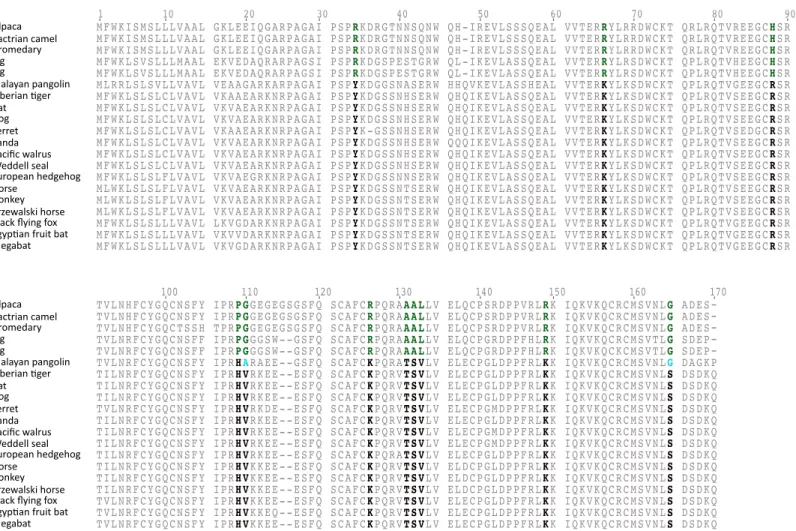
-Figure 3 An alignment of gremlin 2 amino acid sequences from laurasiatherian mammals.Amino acid positions in bold denote the 11 amino acid synapomorphies that define the sequences of pigs and camels.
amino acid alignment that included, in addition to the cetartiodactyl and pholidotan sequences, representative species of the laurasiatherian orders Perissodactyla, Carnivora, Chiroptera, and Eulipotyphla. From this, we found that there are 13 synapomorphies that define the gremlin 2 genes in cetartiodactyls (Fig. 3). Among these, we identified 11 amino acid changes and two deletions (Fig. 3). Of all of the amino acid substitutions, changes at positions 34 (Tyr to Arg), 109 (His to Pro), 131 (Thr to Ala), and 132 (Ser to Ala) represent changes affecting hydrophobicity (Fig. 3). Of the 13 synapomophies observed in cetartiodactyls, only one is shared with pholidotans (Ser165Gly) (Fig. 3). Amino acid 110 also represents a synapomorphy in pangolins however the amino acid identity is different from that of cetartiodactyls (Fig. 3).
Gene copy number variation and differential retention in cetartiodactyls
Most laurasiatherian species possess a single copy of the gene with the exception of pig (Sus scrofa) that has two copies on chromosome 10 (Fig. 4). As in all examined species, in pig, one of the copies (gremlin 2-T1) was found on the 5′
RGS7 (coding exons)
GREM2-T2 exon 13
exon 2
exon 3
exon 4
exon 5
exon 6
exon 7
exon 8
exon 9
exon 10
GRE
M2-T1
exon 1
exon 12
exon 11
exon 16
exon 15
exon 14
exon 17
FH
CHML
FBXO
27 FH
KMO
5´ 3´
YW HAZ
Pig Chr10
RGS7 FH KMO
GRE
M2-T1 CHML
FBXO 27 YW
HAZ
Figure 4 Schematic representation of the gremlin 2 syntenic region in pigs.One of the copies (gremlin 2-T1) is located on the 5′
side of the regulator of the G-protein signaling 7 gene (RGS7) whereas the sec-ond copy (gremlin 2-T2) is located within the RGS7 gene, specifically between exons 13 and 14.
signaling 7 gene (RGS7) (Fig. 2). The second copy (gremlin 2-T2) was found within the RGS7 gene, specifically between exons 13 and 14 (Fig. 4). At the amino acid level both copies differed in one amino acid (position 155); gremlin 2-T1 possessed an arginine, and gremlin 2-T2 possessed a lysine.
Among cetartiodactyls, we observed that gremlin 2 was differentially retained (Fig. 2). Species belonging to the suborders Tylopoda (the group that includes camels, alpacas, vicuñas, and guanacos) and Suiformes (the group that includes pigs and peccaries) were the only groups in which gremlin 2 was present (Fig. 2). In cetaceans and ruminants, gremlin 2 was not present. Thus, according to the phyletic distribution of gremlin 2 within the main groups of cetartiodactyls, the most likely scenario is that the deletion of the gene occurred between 56.3 and 63.5 million of years ago in the common ancestor of the clade that includes ruminants, hippopotamuses, and cetaceans (Fig. 5). However, until information regarding gremlin 2 in hippopotamuses is obtained, caution must be taken when interpreting these results. If, in the future, the hippopotamus genome is found to possess gremlin 2, we can determine that two independent gene losses occurred, one in the ancestor of ruminants and a second in the ancestor of cetaceans. For now, a single gene loss event is assumed.
To gain insight into the genetic mechanisms that gave rise to the deletion of gremlin 2, we compared the chromosomal location of genes found up- and downstream of gremlin 2 in human, cow, and sheep (Fig. 6). We identified a chromosomal region of approximately 12Mb, which in human was on the 5′
side of gremlin 2 (Fig. 6; pink box), while in cow and sheep it was found in a different chromosome in relation to other genes that are linked to gremlin 2 (Fig. 6; pink box). In cow, this region was moved from chromosome 16 to 28, while in sheep it was moved from chromosome 12 to 25 (Fig. 6). As a consequence of this chromosomal rearrangement, the regions that are located up- and downstream of the chromosome piece that was moved are now located together in both cow and sheep (Fig. 6). Thus, in these species, the gene that is found on the 5′
Cetaceans Hippopotamuses Camelids
Speciation Event
Gene Duplication
Pigs & Peccaries Ruminants
~ 64.8 mya ~ 63.5 mya ~ 56.3 mya ~ 53.8 mya Gre
m2 Gre
m2-T 1
Gre m2-T
2
Both gremlin 2 genes arose via duplication in the common ancestor of pigs and peccaries
Figure 5 An evolutionary hypothesis regarding the evolution of the gremlin 2 gene in cetartiodactyl mammals.According to this model, the last common ancestor of cetartiodactyls possessed a single copy of the gene. Species belonging to the suborders Tylopoda, the group that includes camels, alpacas, vicuñas and guanacos, and Suiformes, the group that includes pigs and peccaries, were the only groups that re-tained gremlin 2. According to the phyletic distribution of gremlin 2, we propose that this gene was lost in the common ancestor of ruminants, hippopotamuses, and cetaceans between 56.3 and 63.5 million of years ago as a product of a chromosomal rearrangement.
gene located on the 3′
HumanChr01 GREM2
CowChr28/SheepChr25
CowChr16/SheepChr12 CowChr16/SheepChr12
168.5 40 .765 169.3 96 .540 172.6 59 .018 173.2 07 .313 228.7 35 .077 229.3 05 .894 236.6 86 .454 241.9 59 .062 BLZF1 NME7 ATP 1B1 DP T XCL1 XC
L2
FASLGTN FSF1
8
TNFSF4 RG KMO
S7
FH OP
N3 WDR6
4 EXO1BEC
N2
FMN 2 CHRM3
MTRN R2 L11 MT1 HL1 RH OU TMEM7 8 RA B4 A AC TN2
MTR RYR2 ZP 4 RG S7 FH KMO WDR6 4 EXO1 BEC N2
CowChr28
CowChr16
BLZF1 NME7 ATP 1B1 DP T XC L1 XC L2 MA P1LC
3C
SheepChr25
SheepChr12
ACTN 2
MTR RYR2 ZP4 CH RM3 FMN
2
RA B4A
CCSA P
ACTA 1
CH ML
FASLGTN FSF1
8
TN FSF4
ACTN 2
MTR RYR2 ZP4 CH RM3 FMN
2
RAB4 A
CCSA P
ACTA 1 RH OU RG S7 FH KMO WDR6 4 EX O1 BEC N2 BLZF1 NME7 ATP 1B1 DP T XC L1 XC L2 MA P1LC
3C
CH ML
FASLGTN FSF1
8
TN FSF4
200 .7 75
421 .9
10 4.1
21.6 85 9.4 03 .2 02 12 .8 12.5
39 35 .6 98 .7 45 37 .8 60 .8 91 41 .0 27 .7 88 41 .7 09 .0 76
57.0 17
776 .0
63 3.1
10.8 18 9 .3 56 .5 75
12.7 05.8
24 33 .0 62 .6 15 35 .2 04 .8 48 38 .3 06 .9 75 38 .9 82 .6 49 240.4 75 .189
A)
B)
C)
Figure 6 Schematic representation of the chromosomal regions that harbor genes located up- and downstream of gremlin 2(A) Chromosomal region that harbors genes that are up- and downstream of gremlin 2 in humans. (B) Chromosomal regions (chrs 16 and 28) that harbor genes that are located up-and downstream of the putative location of gremlin 2 in cow. (C) Chromosomal regions (chrs 25 up-and 12) that harbor genes that are located up- and downstream of the putative location of gremlin 2 in sheep.
shows a similar pattern to that seen in ruminants, supporting the hypothesis that one gene loss occurred in the last common ancestor of cetaceans, hippopotamuses and ruminants (Fig. S1).
From a biomedical perspective, the loss of gremlin 2 (e.g., in cow, sheep, goat, dolphins, whales) represents a natural gene knockout (evolutionary mutant models according to
Albertson et al., 2009), thus presenting an outstanding opportunity to understand gremlin
gremlin 2 contributes to the divergent dental phenotype of ruminants and cetaceans. Ruminants do not have incisors in the upper jaw; instead they have a dental pad. With the exception of elk and red deer, canines are also absent in most species. This particular dental phenotype affects how ruminants eat, which differ from phylogenetically related species that have incisors in the upper jaw (e.g., horse). For example, cows use their tongue to wrap and pull leaves into their mouths between the incisors of the lower jaw and the dental pad; thus, plants are not clearly cut during feeding. This contrasts with the feeding method of phylogenetically related species that have upper and lower incisors; these species cut plants and graze deeply. Once the food is in their mouths, cows swing their heads to chew the food slightly and mix it with saliva before swallowing. This lateral chewing action is required to cut plant tissues because molars and premolars of the maxillary jaw are wider than those located on the mandibular jaw. Conversely, sheep use their lips and teeth as their primary tools for food prehension. Their lips are used to bring food into their mouths and the incisors of the lower jaw in combination with the dental pad allow them to cut leaves. As a consequence, sheep can bite closer to the ground and have the ability to be more selective.
The loss of gremlin 2 in cetaceans is more complicated to interpret considering that one subgroup (toothed whales) has teeth while another subgroup (baleen whales) does not. To further complicate this scenario, it has been argued that it is impossible to define teeth homology between toothed whales and non-cetacean mammals (Armfield et al., 2013). From a developmental perspective, it has been demonstrated that the pathway that controls tooth differentiation and number in cetaceans is different from the typical mammalian pattern (Armfield et al., 2013). Particularly interesting is that the expression pattern of BMP4, one of the main targets of gremlin 2, differs between cetaceans and non-cetacean mammals (Sudo et al., 2004). The case of hippopotamuses remains an open question until the genome is sequenced. However, we can speculate that, as has been shown in cetaceans, the tooth morphology of this group could be related to different regulatory pathways controlling teeth development as a consequence of the absence gremlin 2.
Concluding remarks
Our results show that in cetartiodatyl mammals gremlin 2 has experienced a mixture of gene loss, gene duplication, and rate acceleration. Although the last common ancestor of cetartiodactyls possessed a single copy of the gene, species belonging to the suborders Tylopoda (the group that includes camels, alpacas, vicuñas, and guanacos) and Suiformes (the group that includes pigs and peccaries) are the only groups that have retained gremlin 2 (Fig. 5). These groups also experienced acceleration in the rate of evolution of this gene, and it is this that, clearly differentiates them from all other laurasiatherians (Fig. 3). The fact that all amino acid changes that define the gremlin 2 gene in Tylopoda and Suiformes are present in both groups suggests that this gene and its corresponding protein were remodeled in the last common ancestor of cetartiodactyls and subsequently inherited by all descendant lineages (Fig. 5). After that gremlin 2 was probably lost in the ancestor of ruminants, hippopotamuses, and cetaceans between 56.3 and 63.5 million of years ago (Fig. 5). By removing a biological constraint imposed by the presence of gremlin 2, the lack of this gene could explain teeth diversity in these groups of mammals. Thus, the results presented here support the argument that gene loss is a way to increase phenotypic diversity (Olson, 1999;Albalat & Cañestro, 2016) and that gremlin 2 is a dispensable gene at least in this group of mammals.
ADDITIONAL INFORMATION AND DECLARATIONS
Funding
This work was funded by a grant from the Fondo Nacional de Desarrollo Científico y Tecnológico (FONDECYT 1160627) to JCO. The funders had no role in study design, data collection and analysis, decision to publish, or preparation of the manuscript.
Grant Disclosures
The following grant information was disclosed by the authors:
Fondo Nacional de Desarrollo Científico y Tecnológico: FONDECYT 1160627.
Competing Interests
The authors declare there are no competing interests.
Author Contributions
• Juan C. Opazo conceived and designed the experiments, performed the experiments,
analyzed the data, contributed reagents/materials/analysis tools, wrote the paper, prepared figures and/or tables, reviewed drafts of the paper.
• Kattina Zavala conceived and designed the experiments, performed the experiments,
analyzed the data, prepared figures and/or tables.
• Paola Krall analyzed the data, reviewed drafts of the paper.
• Rodrigo A. Arias reviewed drafts of the paper.
Data Availability
Supplemental Information
Supplemental information for this article can be found online athttp://dx.doi.org/10.7717/ peerj.2901#supplemental-information.
REFERENCES
Aberg T, Wozney J, Thesleff I. 1997.Expression patterns of bone morphogenetic
proteins (Bmps) in the developing mouse tooth suggest roles in morphogenesis and cell differentiation.Developmental Dynamics210(4):383–396.
Albalat R, Cañestro C. 2016.Evolution by gene loss.Nature Reviews Genetics17:379–391
DOI 10.1038/nrg.2016.39.
Albertson RC, Cresko W, Detrich HW, Postlethwait JH. 2009.Evolutionary mutant
models for human disease.Trends in Genetics25(2):74–81
DOI 10.1016/j.tig.2008.11.006.
Armfield BA, Zheng Z, Bajpai S, Vinyard CJ, Thewissen J. 2013.Development and
evolution of the unique cetacean dentition.PeerJ1:e24DOI 10.7717/peerj.24.
Brommage R, Liu J, Hansen GM, Kirkpatrick LL, Potter DG, Sands AT, Zambrowicz
B, Powell DR, Vogel P. 2014.High-throughput screening of mouse gene knockouts
identifies established and novel skeletal phenotypes.Bone Research2:14034
DOI 10.1038/boneres.2014.34.
Capizzo A, Moses E, Shirley E, Myers P. 2013.Dasypodidae. Animal Diversity Web.
Available athttp:// animaldiversity.org/ accounts/ Dasypodidae/ (accessed on 30 November 2016).
Dean M, Carrington M, Winkler C, Huttley GA, Smith MW, Allikmets R, Goedert JJ, Buchbinder SP, Vittinghoff E, Gomperts E, Donfield S, Vlahov D, Kaslow
R, Saah A, Rinaldo C, Detels R, O’Brien SJ. 1996.Genetic restriction of
HIV-1 infection and progression to AIDS by a deletion allele of the CKR5 structural gene. Hemophilia growth and development study, multicenter AIDS cohort study, multicenter hemophilia cohort study, San Francisco City Cohort, ALIVE study.
Science273:1856–1862DOI 10.1126/science.273.5283.1856.
Du Toit Z, Grobler JP, Kotzé A, Jansen R, Brettschneider H, Dalton DL. 2014.The
complete mitochondrial genome of temminck’s ground pangolin (Smutsia tem-minckii; Smuts, 1832) and phylogenetic position of the Pholidota (Weber, 1904).
Gene551(5283):49–54DOI 10.1016/j.gene.2014.08.040.
Foley NM, Springer MS, Teeling EC. 2016.Mammal madness: is the mammal tree of life
not yet resolved?Philosophical Transactions of the Royal Society of London. Series B: Biological Sciences371: 20150140DOI 10.1098/rstb.2015.0140.
Herrero J, Muffato M, Beal K, Fitzgerald S, Gordon L, Pignatelli M, Vilella AJ, Searle
SM, Amode R, Brent S, Spooner W, Kulesha E, Yates A, Flicek P. 2016.Ensembl
comparative genomics resources.The Journal of Biological Databases and Curation
Kantaputra PN, Kaewgahya M, Hatsadaloi A, Vogel P, Kawasaki K, Ohazama A,
Ketudat Cairns JR. 2015.GREMLIN 2 mutations and dental anomalies.Journal of
Dental Research94:1646–1652DOI 10.1177/0022034515608168.
Katoh K, Standley DM. 2013.MAFFT multiple sequence alignment software version
7: improvements in performance and usability.Molecular Biology and Evolution 30:772–780DOI 10.1093/molbev/mst010.
Kattamuri C, Luedeke DM, Nolan K, Rankin SA, Greis KD, Zorn AM, Thompson TB.
2012.Members of the DAN family are BMP antagonists that form highly stable
noncovalent dimers.Journal of Molecular Biology424:313–327
DOI 10.1016/j.jmb.2012.10.003.
Kriebitz NN, Kiecker C, McCormick L, Lumsden A, Graham A, Bell E. 2009.PRDC
reg-ulates placode neurogenesis in chick by modulating BMP signalling.Developmental Biology336:280–292DOI 10.1016/j.ydbio.2009.10.013.
Kumar S, Stecher G, Tamura K. 2016.MEGA7: molecular evolutionary genetics analysis
version 7.0 for bigger datasets.Molecular Biology and Evolution33:1870–1874
DOI 10.1093/molbev/msw054.
Meredith RW, Janecka JE, Gatesy J, Ryder OA, Fisher CA, Teeling EC, Goodbla A, Eizirik E, Simao TLL, Stadler T, Rabosky DL, Honeycutt RL, Flynn JJ, Ingram CM, Steiner C, Williams TL, Robinson TJ, Burk-Herrick A, Westerman M, Ayoub NA,
Springer MS, Murphy WJ. 2011.Impacts of the cretaceous terrestrial revolution and
KPg extinction on mammal diversification.Science 334:521–524
DOI 10.1126/science.1211028.
Minabe-Saegusa C, Saegusa H, Tsukahara M, Noguchi S. 1998.Sequence and expression
of a novel mouse gene PRDC (protein related to DAN and cerberus) identified by a gene trap approach.Development Growth and Differentiation40(3):343–353
DOI 10.1046/j.1440-169X.1998.t01-1-00010.x.
Muffato M, Louis A, Poisnel CE, Roest Crollius H. 2010.Genomicus: a database and
a browser to study gene synteny in modern and ancestral genomes.Bioinformatics
26(8):1119–1121DOI 10.1093/bioinformatics/btq079.
Müller II, Knapik EW, Hatzopoulos AK. 2006.Expression of the protein related to Dan
and Cerberus gene–prdc–during eye, pharyngeal arch, somite, and swim bladder development in zebrafish.Developmental Dynamics235(10):2881–2888
DOI 10.1002/dvdy.20925.
Nadiri A, Kuchler-Bopp S, Haikel Y, Lesot H. 2004.Immunolocalization of
BMP-2/-4, FGF-4, and WNT10b in the developing mouse first lower molar.Journal of Histochemistry and Cytochemistry52:103–112 DOI 10.1177/002215540405200110.
Nery MF, Arroyo JI, Opazo JC. 2014.Increased rate of hair keratin gene loss in the
cetacean lineage.BMC Genomics15:869DOI 10.1186/1471-2164-15-869.
Nery MF, Gonzalez DJ, Hoffmann FG, Opazo JC. 2012.Resolution of the laurasiatherian
phylogeny: evidence from genomic data.Molecular Phylogenetics and Evolution
64(3):685–689DOI 10.1016/j.ympev.2012.04.012.
Olson MV. 1999.When less is more: gene loss as an engine of evolutionary change.
Ronquist F, Huelsenbeck JP. 2003.Mr Bayes 3: Bayesian phylogenetic inference under mixed models.Bioinformatics19(12):1572–1574DOI 10.1093/bioinformatics/btg180.
Springer MS, Starrett J, Morin PA, Lanzetti A, Hayashi C, Gatesy J. 2016.Inactivation
ofC4orf26 in toothless placental mammals.Molecular Phylogenetics and Evolution 95:34–45DOI 10.1016/j.ympev.2015.11.002.
Sudo S, Avsian-Kretchmer O, Wang LS, Hsueh AJ. 2004.Protein related to DAN and
cerberus is a bone morphogenetic protein antagonist that participates in ovarian paracrine regulation.Journal of Biological Chemistry279:23134–23141
DOI 10.1074/jbc.M402376200.
Suyama M, Torrents D, Bork P. 2006.PAL2NAL: robust conversion of protein sequence
alignments into the corresponding codon alignments.Nucleic Acids Research
34(suppl_2):W609–W612DOI 10.1093/nar/gkl315.
Tajima F. 1989.Statistical method for testing the neutral mutation hypothesis by DNA
polymorphism.Genetics123:585–595.
Trifinopoulos J, Nguyen LT, Von Haeseler A, Minh BQ. 2016.W-IQ-TREE: a fast
online phylogenetic tool for maximum likelihood analysis.Nucleic Acids Research
44(W1):W232–W235DOI 10.1093/nar/gkw256.
Vogel P, Liu J, Platt KA, Read RW, Thiel M, Vance RB, Brommage R. 2015.
Malforma-tion of incisor teeth in Grem2−/−
mice.Veterinary Pathology52:224–229
DOI 10.1177/0300985814528218.
Yim HS, Cho YS, Guang X, Kang SG, Jeong JY, Cha SS, Oh HM, Lee JH, Yang EC, Kwon KK, Kim YJ, Kim TW, Kim W, Jeon JH, Kim SJ, Choi DH, Jho S, Kim HM, Ko J, Kim H, Shin YA, Jung HJ, Zheng Y, Wang Z, Chen Y, Chen M, Jiang A, Li E, Zhang S, Hou H, Kim TH, Yu L, Liu S, Ahn K, Cooper J, Park SG, Hong CP, Jin W, Kim HS, Park C, Lee K, Chun S, Morin PA, O’Brien SJ, Lee H, Kimura J, Moon DY, Manica A, Edwards J, Kim BC, Kim S, Wang J, Bhak J, Lee HS. 2014.
Minke whale genome and aquatic adaptation in cetaceans.Nature Genetics46:88–92