International Journal of
ELECTROCHEMICAL
SCIENCE
www.electrochemsci.org
Study of the Electrochemical Behavior of Histamine Using a
Nafion
®-Copper(II) Hexacyanoferrate Film-Modified Electrode.
Suely S. L. Castro1,*, Marcelo F. de Oliveira2 and Nelson R. Stradiotto3 1
Departamento de Química, FANAT – UERN, 59600-010 – Mossoró, RN – Brazil 2
Departamento de Química – Faculdade de Filosofia, Ciências e Letras de Ribeirão Preto, USP, 14040-901 – Ribeirão Preto, SP – Brazil
3
Departamento de Química Analítica, Instituto de Química – UNESP, 14800-900 – Araraquara,SP – Brazil
*
E-mail: [email protected]
Received: 29 July 2010 / Accepted: 19 August 2010 / Published: 1 October 2010
A study on the electrochemical behavior of histamine species in aqueous medium is described. A glassy carbon electrode chemically modified with copper(II) hexacyanoferrate (CuHCFe) film and covered with Nafion® film was employed. The interaction between the analyte and the CuHCFe film can be demonstrated by a decrease in both the cathodic and anodic peak currents at 0.68V (vs. Ag/AgCl), attributed to the film and the appearance of new peak current at 0.47V. Cyclic voltammetric parameters obtained for histamine indicate the formation of stable complex between histamine adsorbed at the electrode surface. The dependence of peak currents on the concentration of the analyte is not linear in the employed work range, indicating the presence of a coupled chemical reaction in the electrodic process.
Keywords: copper(II) hexacyanoferrate, histamine, voltammetry, Nafion, glassy carbon electrode
1. INTRODUCTION
N
N
CH
2
CH
2
NH
2
Figure 1. Chemical structure of histamine.
In this context, the electrochemical study of this kind of substance in different matrices (natural, biological, commercial, etc.) is justified. According to the literature, several chromatographic [7-10] and spectroscopic [11-15] methods have been employed for the determination of histamine and histidine, for example, in a broad spectrum of matrices with good accuracy and low detection limits. As an example, histamine can be determined in food samples by ultra-performance liquid chromatography (UPLC) [9] with spectrophotometric detection at 225 nm, with limits of detection (LOD) ranging between 0.032 and 0.098
In terms of clinical analysis, it is also crucial to cite the importance of electrochemical methods in the study of electrodic reaction mechanisms, in order to provide correlations between in vitro and in vivo analises. Histamine [16,17] has been extensively studied by means of voltammetric techniques. Moreover, histamine can be oxidized in aqueous medium using a polycrystalline, boron-doped diamond thin-film electrode [17]. Compared with carbon electrodes, better results in terms of reproduction and definition of cyclic voltammograms are obtained for histamine, at peak potential of 1.40 V vs SCE with a detection limit of 0.5 mmol L-1.
Despite the considerable literature data concerning electrochemical studies with histamine, it is possible to observe that these studies are frequently carried out using conventional metallic electrodes or carbon materials [16, 17].
Considering that the chemical modification of conventional electrode surfaces by inorganic films is an attractive approach in the development of electrochemical sensors due to their enhanced sensitivity and specificity, the chemically modified-transition metal hexacyanoferrate film electrodes (such as Prussian Blue and its analogues) consist in an important class of surface modifiers [18-26] with large application in clinical analysis.
The electrocatalytic oxidation of dopamine, for instance [18], has been studied using a cobalt hexacyanoferrate film-modified glassy carbon electrode with specificity in relation to ascorbic acid, with a detection limit of 8.9 10-6 mol L-1 , indicating the potential application of the technique in biological and pharmacological analyses.
2. EXPERIMENTAL
2.1. Solutions and reagents
All chemical reagents were of analytical grade: Copper sulfate (Vetec), potassium sulfate (Mallinckrodt), sulfuric acid (Merck), and histamine (Sigma). All solutions were prepared using deionized water. Histamine stock solutions were prepared by dilution of the proper mass in solutions of phosphate buffer 0.10 mol L-1 (pH = 7.0), which was previously prepared from K2HPO4 and KH2PO4.
2.2. Equipment
All voltammetric measurements were carried out using a model 273A EG&G potentiostat, under the control of an M270 EG&G electrochemical software. A three-electrode EG&G cell was employed with a CuHCFe-modified glassy carbon electrode (0.013 cm2), an Ag/AgCl (saturated aqueous KCl) reference electrode, and a platinum plate auxiliary electrode.
2.3. Preparation of the CuHCFe-chemically modified electrode
The CuHCFe films were electrochemically deposited onto the glassy carbon electrode surfaces by successive potential cyclings at a scan rate of 50 mV s-1, from 0.40 to 1.0 V vs. Ag/AgCl, in a 0.50 mol L-1 K2SO4 (pH = 1,0) solution containing 5.010-4 mol L-1 K3Fe(CN)6 and 5.010-4 mol L-1 CuSO4. Then, the electrode was rinsed with deionized water and dried. Next, a Nafion film was deposited over the CuHCFe film by immersion of the modified electrode into an alcoholic solution of Nafion 5% (m/m). The resulting electrode was subsequently dried at room temperature for 30 minutes, for complete solvent evaporation.
2.4. Eletrochemical behavior of the CuHCFe-chemically modified electrode
The Nafion-CuHCFe electrodes were immersed into a phosphate buffer solution (pH = 7.0) previously deaerated for 15 minutes. Their electrochemical behavior was investigated at different scan rates, in the potential range –0.5 to 1.0 V vs. Ag/AgCl. The stability of the modified electrode was also investigated by successive potential cycles in the same buffer solution, at a scan rate of 50 mV s-1. The amount of CuHCFe adsorbed at the electrode surface was calculated by integration of the obtained voltammograms.
2.5. Eletrochemical behavior of histamine
potential interruption. Additionally, voltammograms were obtained at successive potential cyclings and at different scan rates.
3. RESULTS AND DISCUSSION
3.1. CuHCFe film formation
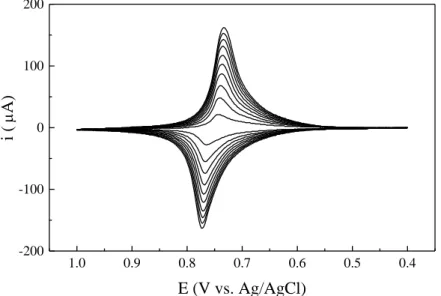
The electrochemical deposition of the CuHCFe film after successive potential cyclings is presented in Figure 2.
1.0 0.9 0.8 0.7 0.6 0.5 0.4 -200
-100 0 100 200
i (
A)
E (V vs. Ag/AgCl)
Figure 2. Cyclic voltammograms obtained during the formation of CuHCFe over the surface of the glassy carbon electrode. Supporting-electrolyte K2SO4 in 0.50 mol L-1 (pH = 1,0), containing 5.010-4 mol L-1 in K3Fe(CN)6 and 5.010-4 mol L-1 in CuSO4, = 50 mV s-1 (10 cycles).
A pair of symmetric current peaks is observed around 0.78 V vs. Ag/AgCl, and film growth can be demonstrated by the increase in both cathodic and anodic currents after each potential cycle. Consequently, the film thickness can be controlled by the choice of the number of cycles.
3.2. Electrochemical behavior of the CuHCFe chemically modified electrode
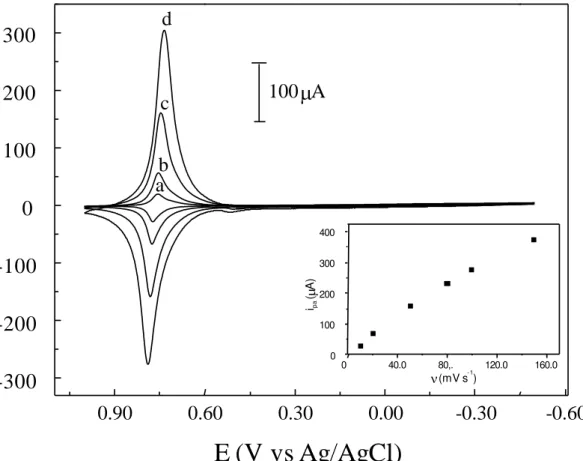
The voltammograms obtained for the CuHCFe film at different scan rates are shown in Figure 3. The well defined reversible pair of peak currents around 0.78 vs. Ag/AgCl can be represented by the following reaction:
0.90
0.60
0.30
0.00
-0.30
-0.60
-300
-200
-100
0
100
200
300
d
c
b
a
100
A
E (V vs Ag/AgCl)
0 40.0 80,. 120.0 160.0 0
100 200 300 400
ipa
(
A)
(mV s-1)
Figure 3. First cyclic voltammograms obtained for the CuHCFe film at different scan rates: (a) 10, (b) 20, (c) 50 and (d) 100 mV s-1 (phosphate buffer solution at 0.10 mol L-1 ; pH = 7.0). The graphi at the bottom indicates the linear dependence of the anodic peak on the scan rate.
The role of potassium ions consists in their incorporation into the zeolytic net of the film, in order to keep charge neutrality during the reaction. The anodic and cathodic peak current ratios are equal to unity for all scan rates, which corresponds to a reversible system.
The differences between both cathodic and anodic potential peaks tend to zero when lower scan rates are employed, which is also a typical behavior of a reversible redox system. The adsorption process is evidenced by the linear increase in peak currents in relation to the scan rate up to 100 mVs-1. For higher scan rates the linear dependence is not longer observed, indicating that these currents are influenced by the diffusion of potassium ions through the film.
Considering that both histamine act as cation at neutral pH values, which allows for its coordination, the voltammetric measurements were accomplished at pH 7.0. Despite the good stability of the CuHCFe films in this medium, the choice of Nafion film deposition over the CuHCFe films provides a considerable enhancement in film stability.
3.3. Electrochemical behavior of histamine
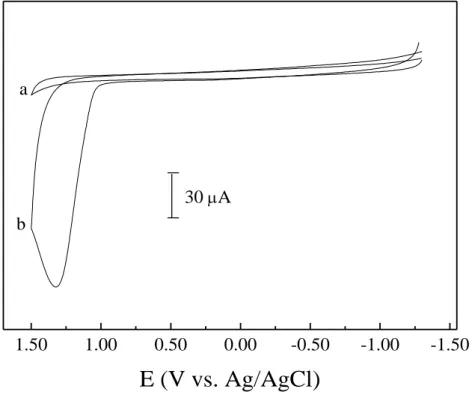
As observed in Figure 4, when histamine is studied in the proposed system (phosphate buffer solution at 0.10 mol L-1 and pH = 7.0), and non-chemically modified glassy carbon electrodes are employed, an oxidation peak current at +1.3 V vs. Ag/AgCl is detected for this analyte.
1.50 1.00 0.50 0.00 -0.50 -1.00 -1.50
b a
30 A
E (V vs. Ag/AgCl)
Figure 4. Cyclic voltammograms obtained for solutions of (a) supporting-electrolyte and (b) 5.010-4 mol L-1 in histamine, using a phosphate buffer solution (pH = 7.0), under a glassy carbon electrode. v = 50 mV s-1.
When the proposed Nafion-CuHCFe electrode is employed for histamine analysis in different concentrations (Figure 5), a decrease in the oxidation (1a) and reduction (1c) peaks is observed. Additionally, a small shift of peak potentials to less positive values suggests the formation of a complex between histamine and the CuHCFe film.
For histamine concentrations higher than 0.02 mol L-1 (curve d), a higher reduction in anodic and cathodic current peaks is observed for the film, followed by the appearance of a new cathodic peak current at 0.47 V vs. Ag/AgCl (2c).
This result is in agreement with the hypothesis that a complex is formed between the analyte and the film; i.e., the product of film oxidation reacts with the analyte, decreasing the reduction peak of this film. Subsequently, the formed product displays a reduction peak at a less positive peak potential, according to the proposed scheme:
1.00
0.75
0.50
0.25
0.00 -0.25 -0.50
3c3a 2c 1c
1a
50 A
a ( ) 0
b ( ) 0.001mol/L
c ( ) 0.01 mol/L
d ( ) 0.02 mol/L
e ( ) 0.04 mol/L
f ( ) 0.06 mol/L
E (V vs Ag/AgCl)
Figure 5. Cyclic voltammograms obtained for histamine at the Nafion-CuHCFe film. Absence (curve a) and presence (curves b - f) of histamine. = 50 mV s-1; phosphate buffer solution (pH = 7.0); v = 50 mV s-1.
1.00 0.75 0.50 0.25 0.00 -0.25 -0.50 50 A
3a
1a
3c 2c 1c
a ( )0 b ( )1 min. c ( ) 2 min.
E (V vs Ag/AgCl)
Besides the species which is reduced in 2c, a new redox process at 0.22 V is observed (3c). Considering the decrease in (2c), which is concomitant with the increase in peak current (3c), the process attributed to the redox pair 3c/3a could be represented by the following equation:
His{Cu3(II)[Fe(II)(CN)6]2} + e- His{Cu3(I)[Fe(II)(CN)6]2} (3)
These results agree with literature data [22, 23] in terms of the occurrence of a pair of peak currents between 0 and 0.3 V, which correspond to the redox pair Cu+/Cu 2+.
Similar effects were observed in the cyclic voltammograms at different scan rates using potential interruption at 1.0V vs. Ag/AgCl in a 0.01 mol L-1 histamine solution (Figure 6). It is possible to observe at curve (b) where, in presence of the analyte and after 1 minute of potential interruption at 1.0 V vs. Ag/AgCl, there is a decrease in the reduction peak of the film (1c) that is larger than the one observed in the study reported in Figure 5, using the same analyte concentration. When the potential interruption lasted 2 minutes, the peak (1c) was practically removed and the peak current (2c) was increased until its maximum limit value. These results indicate that potential interruption at 1.0V generates a higher amount of Cu3[Fe(III)(CN)6]2 species, allowing the formation of the complex that is reduced in (2c).
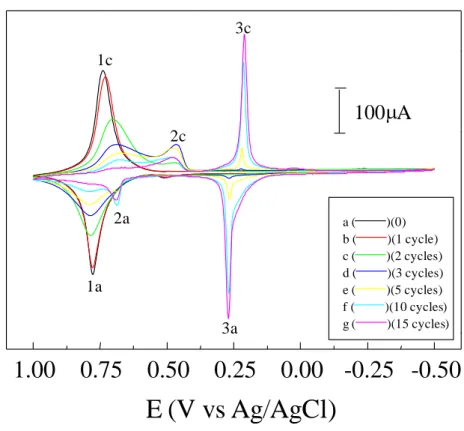
The same study at different scan rates performed with histamine can be visualized in Figure 7.
1.00
0.75
0.50
0.25
0.00 -0.25 -0.50
100
A
3a 3c
2a
2c
1a 1c
a ( )(0) b ( )(1 cycle) c ( )(2 cycles) d ( )(3 cycles) e ( )(5 cycles) f ( )(10 cycles) g ( )(15 cycles)
E (V vs Ag/AgCl)
When the analyte is added to the supporting-electrolyte solution, there is a decrease in the peak currents of the film (curves b – e; peaks 1a and 1c), with a subsequent increase in 2c until its maximum value and the appearance of a pair of peaks 3c and 3a. These results give support to the hypothesis that a complex between the film and the analyte is formed, being subsequently reduced at a less positive potential value (0.58V), represented by the 2c peak. Furthermore, this species is promptly reduced at 0.22V, generating a new complex represented by the pair 3a/3c. Figure 7 also shows the occurrence of a new cathodic peak at 0.69V VS. Ag/AgCl (2a), which can also be attributed to the oxidation process represented in equation 3.
Additionally, this study using different scan rates for histamine also reveals an increase in the current peaks 3a and 3c until a maximum limit value, suggesting saturation of the film, whose behavior is in accordance to that observed for adsorbed species. This fact is also evidenced in the study carried out at different scan rates (Figure 8), shows a linear increase in peak currents 3a and 3c in relation to the increase in scan rate up to 100mV s-1, being indication of the adsorptive character of this species.
0.90 0.60 0.30 0.00 -0.30 -0.60
3c
3a 2c
2a
d
c
b a 50 A
E (V vs. Ag/AgCl)
0.0 40.0 80.0 120.0 160.0 50.0
100.0 150.0 200.0 250.0
ipa
(
A)
(mV s-1)
Figure 8. Cyclic voltammograms of histamine in 0.010 mol L-1 in the CuHCFe electrode using a 0.10 mol L-1 phosphate buffer (pH = 7.0). (a) 10, (b) 20, (c) 50 and (d) 100 mV s-1. A linear dependence of the anodic peak current on the scan rate is observed.
4. CONCLUSIONS
The Nafion-CuHCFe film presented current control by adsorption, with good stability of the surface modifier. No catalytic activity for histamine was observed in our studies. However, a strong interaction between the modifier and the analyte was observed, as demonstrated by the considerable decrease of the film current and the appearance of new peak currents, attributed to the formation of new species. Considering that these initial studies do not evidence a linear dependence of peak currents of histamine on their concentrations, it is possible to observe one more evidence of a coupled chemical reaction in the electrodic process, which is in accordance to the proposed reaction mechanism.
ACKNOWLEDGEMENTS
The authors are grateful for the financial support of FAPESP - Fundação de Amparo à Pesquisa do Estado de São Paulo.
References
1. V. Pascoli, C. Boer-Saccomani, Jf Hermant, Psychopharmacology, 202 (2009) 141. 2. LC Tetlow, DE Woolley, Rheumatology Int. 26 (2005) 173.
3. E Dere, MA De Souza-Silva, RE Spieler et al., European J. Neurosci., 20 (2004) 1051. 4. W. Beghdadi, A Porcherie, BS Schneider, et al., Medecine Sci., 25 (2009) 377.
5. H. C. Freeman,; in G.L. Eichorn, “Inorganic Biochemistry”, Elsevier, New York, 1973.
6. M.N. Hughes, “The Inorganic Chemistry of Biological Processes”, 2nd Ed., Wiley, Chichester, 1981.
7. N. Garcia-Villar, S. Hernandez-Cassou, J. Saurina, J. Chrom. A, 1216 (2009) 6387. 8. H.M. Mao, B.G. Chen, X.M. Qian, et al. Microchem. J. 91 (2009) 176.
9. E. Dadakova, M. Krizek, T. Pelikanova, Food Chem., 116 (2009) 365.
10.K. Maeyama, K. Watanabe, M. Maldonado, J. Pharmacol. Sci. 10 (2006) 185P. 11.E. Schievano, K. Guardini, S. Mammi, J. Agric. Food Chem. 57 (2009) 2647. 12.Z.M. Wang, X.L. He, S.P. Wu et al. Chemia Analityczna, 54 (2009) 471. 13.C.G. Ruaux, J.M. Wright, J.M. Steiner et al. Am. J. Vet. Res., 70 (2009) 167.
14.H.M. Saleh, M.M. EL-Henawee, G.H. Ragab et al. Spectrochim. Acta Part A 67 (2007) 1284. 15.Liu, BP; Qin, HJ; Luo, X; et al., Chin. J. Anal. Chem., 35 (2007) 525.
16.V. Carralero, A. Gonza´lez-Corte´s, P. Ya´n˜ez-Seden˜o, J. M. Pingarron. Electroanalysis, 17 (2005) 289.
17.B. V. Sarada, T. N. Rao, D. A. Tryk, and A. Fujishima. Anal. Chem. 72 (2000) 1632. 18.S.S.L. Castro, R.J. Mortimer, M.F. de Oliveira, N.R. Sensors, 8, 1950-1959, 2008. 19.S. Thangavel, R. Ramaraj, J. Nanosci. Nanotech., 9 (2009) 2353.
20.M. Florescu, C.M.A. Brett. Rev. Roumaine Chim., 52 (2007) 969. 21.V.A. Pedrosa, M. Bertotti, Int. J. Electrochem. Sci., 2 (2007) 113. 22.L.M. Siperko, T. Kuwana, J. Electrochem., Soc., 130 (1983) 396.
23.D.R. Shankaran, S.S. Narayanan, Fresenius J. Anal. Chem., 364 (1999) 686 24.H Razmi, A. Taghvimi, Int. J. Electrochem. Sci., 5 (2010) 751.
25.M.O. Salles, T.R.L.C. Paixao, M. Bertotti, Int. J. Electrochem. Sci., 2 (2007) 248. 26.H. Razmi, M. Harasi, Int. J. Electrochem. Sci., 3 (2008) 82.