© Author(s) 2009. This work is distributed under the Creative Commons Attribution 3.0 License.
Geophysicae
STEREO/SEPT observations of upstream particle events: almost
monoenergetic ion beams
A. Klassen1, R. G´omez-Herrero1, R. M ¨uller-Mellin1, S. B¨ottcher1, B. Heber1, R. Wimmer-Schweingruber1, and G. M. Mason2
1Institut f¨ur Experimentelle und Angewandte Physik, Universit¨at Kiel, 24118 Kiel, Germany 2Applied Physics Lab, Johns Hopkins University, Laurel, MD, USA
Received: 17 July 2008 – Revised: 16 February 2009 – Accepted: 15 April 2009 – Published: 6 May 2009
Abstract. We present observations of Almost Monoen-ergetic Ion (AMI) events in the energy range of 100– 1200 keV detected with the Solar Electron and Proton Tele-scope (SEPT) onboard both STEREO spacecraft. The en-ergy spectrum of AMI events contain 1, 2, or 3 narrow peaks with the relative width at half maximum of 0.1–0.7 and their energy maxima varies for different events from 120 to 1200 keV. These events were detected close to the bow-shock (STEREO-A&B) and to the magnetopause at STEREO-B as well as unexpectedly far upstream of the bow-shock and far away from the magnetotail at distances up to 1100RE
(STEREO-B) and 1900RE (STEREO-A). We discuss the
origin of AMI events, the connection to the Earth’s bow-shock and to the magnetosphere, and the conditions of the in-terplanetary medium and magnetosphere under which these AMI bursts occur. Evidence that the detected spectral peaks were caused by quasi-monoenergetic beams of protons, he-lium, and heavier ions are given. Furthermore, we present the spatial distribution of all AMI events from December 2006 until August 2007.
Keywords. Interplanetary physics (Energetic particles; In-terplanetary shocks) – Magnetospheric physics (Energetic particles, precipitating)
1 Introduction
The presence of energetic ions (<1 MeV) upstream of the Earth’s bow–shock and in the Earth’s magnetosheath has been well known since the 1960s (e.g. Asbridge et al., 1968). Most of such upstream bursts were observed near the bow-shock at∼25RE (RE, Earth’s radius) (e.g. Krimigis et al.,
Correspondence to:A. Klassen ([email protected])
1978), at the libration point (L1) at∼240RE (Balogh et al.,
1978; Scholer et al., 1981; Klassen et al., 2008), but also using STEREO observations far away from the bow-shock at the distances up to 1100RE(M¨uller-Mellin et al., 2008a;
Desai et al., 2008).
The upstream ion bursts are often associated with ener-getic electrons (>30 keV) and were explained in two ways: (1) by the leakage of magnetospheric particles accelerated within the magnetosphere (e.g. Sarris et al., 1978; Krimigis et al., 1978), (2) by the acceleration at the bow–shock via Fermi or shock drift acceleration (e.g. Scholer et al., 1981; Burgess 2007, and references therein).
All these mechanisms predict power-law like energy spec-tra with a negative slope without any specspec-tral fine structures. Indeed such spectra were observed by different space mis-sions during the last 40 years (e.g. Desai, 2000). Lutsenko and Kudela (1999) first reported observations of 1, 2 or 3 nar-row peaks (△E/Emax≃0.15÷0.30) in spectra of upstream
ion events using observations with the DOK-2 instrument onboard the Interball-1 spacecraft (Lutsenko et al., 1998). These ion events have been called “AlmostMonoenergetic
Ions” (AMI) and were observed close upstream of the bow– shock and in the Earth’s magnetosheath (≃15RE from the
nose of the bow-shock), but not in the outer magnetosphere inside of the magnetopause. Because the energy ratios in 2 and 3 peak spectra were 1:2 and 1:2:(5–6), respectively, they proposed that these spectral peaks can be explained as H+,
He++ and CNO(5−6)+ ions accelerated in a bursty, strong
SEPT−A/AntiSun SEPT−A/North
SEPT−A/AntiSun SEPT−A/North
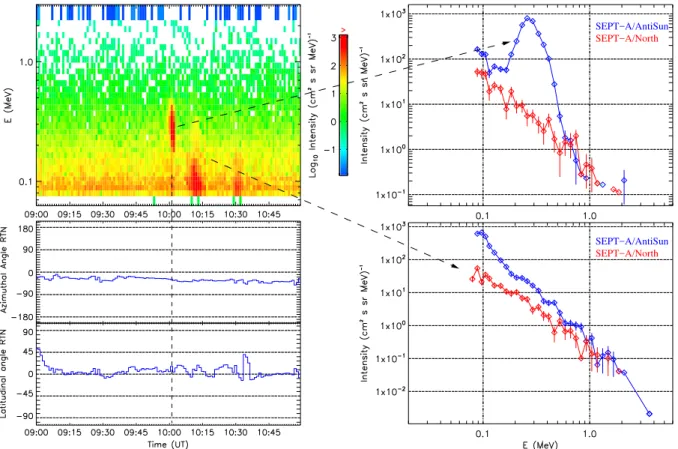
Fig. 1. Top-left, dynamic energy spectrum of an AMI event and two common upstream ion events in the range 0.1–1.2 MeV observed with SEPT-A/Antisun far upstream of the Earth’s bow–shock (656RE) on 27 February 2007. Top-right, AMI spectrum with a peak at 260 keV from SEPT-A/AntiSun (blue) and without a peak from SEPT-A/North (red) telescope. Bottom-right, for comparison the spectra of a common upstream event without any significant spectral structures. Bottom-left, the IMF components show only very small variations before and during the AMI event.
(Anderson, 1981; Decker, 1988) or by particles being accel-erated in the magnetosphere and leaking into the upstream region (e.g. Anagnostopoulos et al., 2000).
The first detections of AMI events close to the bow–shock and to the magnetosphere using observations at STEREO with the SEPT instrument were already reported by M¨uller-Mellin et al. (2008a).
In this paper we extend our observations of AMI events in the energy range of 100–1200 keV to August 2007, and to distances up to 1900RE and 1100RE from the Earth for
STEREO–A&B, respectively. We supply evidence for the acceleration mechanism and for the source of the multi-peak spectra. Furthermore, we present spatial distributions of all AMI events from December 2006 until August 2007.
2 Instruments and data selection
We report observations made with two instruments SEPT and SIT from the Solar Energetic Particle (SEP) suite of the STEREO IMPACT investigation. The Solar Electron and Proton Telescope (SEPT) consists of two dual double-ended
magnet/foil particle telescopes which separate and measure electrons in the energy range 30–400 keV and ions from 60 to 7000 keV (M¨uller-Mellin et al., 2008a). The energy range is divided into 32 logarithmically spaced channels with an energy resolution of≃10% in the range≤1200 keV where the AMI events were observed.
The Suprathermal Ion Telescope (SIT) is a time-of-flight mass spectrometer and is able to identify the elemental and isotopic composition of ions in the energy range from few 10s of keV/nucleon to several MeV/nucleon. The field of view is 44◦×17◦ and the boresight of the 44◦ cone is ori-ented towards the Sun 60◦west from the spacecraft–Sun line (Mason et al., 2008). Note that SEPT measures the total en-ergy of ions, but not its nuclear charge. Hence, the SEPT and the SIT spectra are presented on a total energy scale.
During 9 months from December 2006 until August 2007 60 AMI events were detected with SEPT using the follow-ing selection criteria (as an example see Fig. 1): a) the AMI peak is detected during two or more accumulation times (i.e.
≥2 min), and at least in two energy channels, b) the peak maximum intensity is at least 4σ above the pre–event back-ground (the mean intensity is taken during 40 min before the event), c) the peak maximum intensity in the spectrum is two error bars higher than the intensity at the lower energy limit of the structure. Note that at energies ≤300 keV the error bars are comparable with the diamond symbols in Figs. 1–5.
3 Observations
3.1 Examples of AMI events
AMI events were detected upstream and close to the bow– shock at both STEREO-A&B spacecraft as well as unex-pectedly far upstream of the bow–shock at distances up to 1900RE (STEREO-A) and in the magnetosheath, close to
the magnetopause and far away from the magnetotail at dis-tances up to 1100RE(STEREO-B).
Generally, the narrow peaks were detected at different en-ergies in the range 100–1200 keV, while the single peaks or the first peak in multi-peak events were detected below 370 keV. The events show a strong anisotropy and were only detected with telescopes directed towards the Earth, i.e. with SEPT/AntiSun telescope on STEREO-A and with SEPT/Sun telescope on STEREO-B.
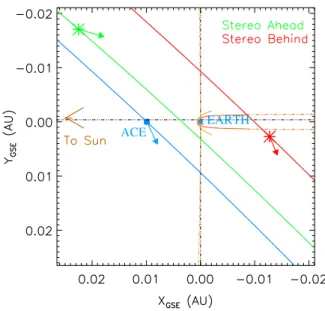
Figure 1 presents an example of the dynamic energy spectrum (top-left) and the energy spectra (top-right) of an AMI event occurring on 27 February 2007 at 10:00 UT and two subsequent common ion upstream bursts observed with SEPT-A looking towards the Earth/AntiSun direction. The spacecraft was located upstream of the Earth’s bow– shock and 656RE away from the Earth (Fig. 2). The
AMI event was detected during 4 successive accumulation times (4 min) and shows a narrow peak with a maximum at Emax=260 keV and a FWHM (Full Width at Half Maximum)
of△E=130 keV (△E/Emax=0.5). For comparison the
follow-ing “normal” ion bursts show a simple power-law spectrum without the peak structure. It can be excluded that this nar-row peak occurs due to a broken magnetic connection to the source because, at least locally close to the spacecraft, the interplanetary magnetic field (IMF) components do not show
ACE EARTH
Fig. 2.Position of STEREO-A and B during the event on 27 Febru-ary 2007 in relation to the Earth’s bow-shock and the magneto-sphere (orange lines). The arrows and the lines indicate the ecliptic IMF component and the nominal Parker spiral according to the solar wind speeds observed at both STEREO spacecraft and at ACE.
changes before, during and after the event (Fig. 1, bottom-left).
The AMI and two common events on 27 February 2007 show a strong anisotropy and they are streaming from the antisun/Earth direction, because the other three telescopes, directed towards the Sun, North, and South did not detect any enhancements (e.g. red line in Fig. 1 top-right). The vector of the IMF pointed towards the magnetosphere/magnetotail (green arrow in Fig. 2), suggesting that the observed parti-cles indeed were streaming from the magnetosphere along the magnetic field. Figure 2 shows the position of STEREO-A relative to the Earth’s bow–shock and the magnetosphere during the events presented in Fig. 1.
Figure 3 shows examples of AMI events with three-peaks (a), two-peaks (b), and one-peak (c) observed with STEREO-B when the spacecraft was at different positions far away from the magnetospheric tail (Fig. 3d).
The one-peak spectrum (Fig. 3c) was observed at a dis-tance of 0.047 AU (1100RE) from the Earth. During the
event SEPT-B was looking towards Earth/Sun and the space-craft was not connected to the magnetosphere or to the the bow-shock, but rather to the upstream region (red arrow in-dicates the ecliptic magnetic field component). For the two-and three-peak events (Fig. 3b two-and a) on 2 April two-and 6 March 2007, the distances between STEREO-B and the Earth were 656REand 270RE, respectively and the magnetic field
0 0 1 1 0 0 1 1
0 0 1 1
6−March−2007: 1144 UT (a)
2−April−2007: 2319 UT
27−April−2007: 1634 UT (b)
(c)
a
b
c ACE
(d)
EARTH
Fig. 3. AMI events observed at SEPT/STEREO-B far away from the magnetospheric tail:(a)three-peak spectrum on 6 March 2007;
(b)two-peak spectrum on 2 April 2007;(c)one-peak spectrum on 27 April 2007,(d)position of STEREO-B during events a, b, c in relation to the Earth’s bow-shock and the magnetosphere (orange lines). The red arrows indicate the ecliptic IMF component during the events. The red, green and blue lines show the nominal Parker spiral for event (b) according to the solar wind speeds measured at both STEREO and at ACE spacecraft, respectively.
0
0
1
1
0
0
1
1
0
0
1
1
Fig. 4. AMI event observed simultaneously with the SEPT (top panel) and SIT (bottom panel) instruments onboard STEREO-B on 31 January 2007. Both spectra show two peaks around 370 and 740 keV with the peak energy ratio of 1:2.
000 000 000 111 111 11100
1 1
0 0 0 0 0 0 0 0 0 0 0 0 0 0 0 0 0 0 0 0 0 0 0 0 0 0 0 0 0 0 0 0 0 0 0 0 0 0 0 0 0 0 0 0 0 0 0 0 0
1 1 1 1 1 1 1 1 1 1 1 1 1 1 1 1 1 1 1 1 1 1 1 1 1 1 1 1 1 1 1 1 1 1 1 1 1 1 1 1 1 1 1 1 1 1 1 1 1
0 0 1 1 000 000 000 111 111 111
00 00 00 00
11 11 11 11
00 00 11 11
ACE
SEPT−A/Sun
SEPT−A/AntiSun
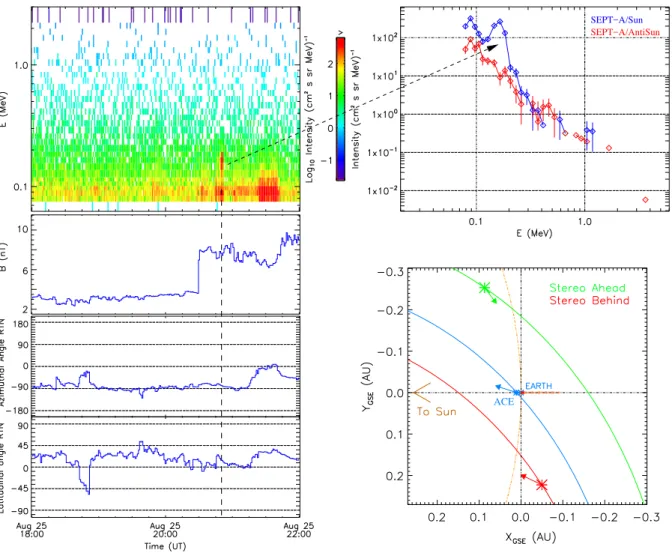
Fig. 5.AMI event on 25 August 2007 detected from the AntiEarth/Sun direction. It occurs 20 min after the passage of a CIR forward shock (second panel). Top-right, spectrum with a peak at 165 keV from SEPT-A/Sun (blue) and without a peak from SEPT-A/AntiSun telescope. Bottom-right, the position of STEREO-A (green) and the IMF ecliptic component during the event (arrow).
3.2 Comparison of AMI events observed with the SEPT and SIT
Lutsenko and Kudela (1999) suggested that due to the peak energy ratios in two and three-peak spectra as 1:2:(5–6) the AMI events could be explained as H+, He++ and
CNO(5−6)+ions accelerated in a burst of electrostatic field.
In order to explore direct evidence for this idea we compared AMI spectra observed simultaneously with the SEPT and SIT instruments at STEREO-B during the event on 31 Jan-uary 2007. In contrast to SEPT, the SIT instrument is able to distinguish between different species, e.g. H, He and CNO.
Figure 4 presents this comparison. We note that the abso-lute intensities reported by SEPT and SIT are not the same due to differing view cones, and uncertainties in the detec-tion efficiency for protons by SIT. There are two distinct nar-row peaks in SEPT and SIT spectra which match each other very well. The SEPT spectrum shows two peaks with
max-ima around 370 and 740 keV and the SIT instrument detects the first peak in H spectrum at 400 keV and the second peak in He at 760 keV total energy. The peak maximum ratio is close to 1:2 for both instruments which could be explained by accelerated solar wind H+ and He++ions. In addition
there is a small hump around 1200 keV in the SEPT spec-trum, which could be associated with enhanced counts of solar wind CO(5−6)+ ions. Unfortunately, this hump is not resolved in SIT CO spectra, most likely due to poor counting statistics. During the event STEREO-B was 115RE away
from the Earth, close to the magnetopause, at GSE coordi-nates:XGSE=−94RE,YGSE=+47REandZGSE=+48RE.
3.3 AMI events associated with a CIR shock
000 000 000 000 000 000 000 000 000 000 000 000 000 000 000 000 000
111 111 111 111 111 111 111 111 111 111 111 111 111 111 111 111 111
000 000 000 000 000
111 111 111 111 111
00 00 11
110000
00 00 00
11 11 11 11 11
00 00 00 00 00 00
11 11 11 11 11 11
00 00 11 11
000 000 111 111
1000
<200 1800 >6000
0 16
8 24
Number of events
32
2006−2007: 60 events
ACE
EARTH EARTH
E Distance to Earth, R STEREO Orbit − AMI Events STEREO Orbit − AMI Events
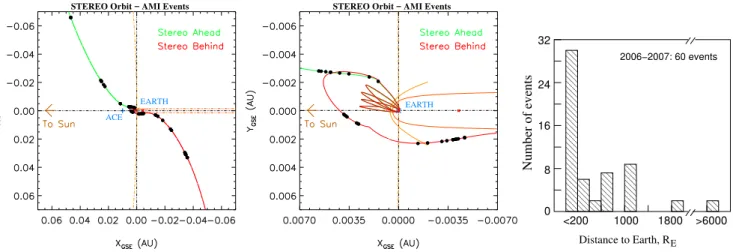
Fig. 6.The spatial distribution of AMI events observed along the both STEREO-A&B orbits (green and red lines) during the time interval from 15 December 2006 to 29 April 2007. Each event (black point) are shown in relation to the Earth’s bow-shock and the magnetopause (orange lines). The Sun is to the left. The right panel presents the number of AMI events as a function of radial distance from the Earth. Predominately, the AMIs occur at distances smaller than 200RE, but there are still events observed further than 1800RE. The two events near 6000REare associated with the passage of a IP shock.
direction. That is expected if the source of AMIs is located close to the Earth. Two exceptional events were observed on 25 August 2007 with the SEPT-A/Sun telescope, suggesting that these beams stream from the Sun direction. However, they were not associated with any activity at the Sun.
Figure 5 shows one of them when STEREO-A was 0.27 AU (6330RE) away from the Earth. The top-left
fig-ure presents the dynamic spectrum of the AMI event at 20:50 UT followed by a small normal event. The top-right figure presents the AMI spectra from the sunward (blue) and from the antisunward (red) directions. The blue one contains a narrow peak at 165 keV, while the red one shows a power-law spectrum without significant structures. The subsequent event at 21:30 UT shows a usual power-law spectrum with-out distinct anisotropy. As the AMI event occurs 20 min after a shock passage (Fig. 5, bottom-left) and as the IMF ecliptic components during and before the event do not show signifi-cant changes, it is suggested that this event is associated with the shock passage and is not an upstream event originating somewhere near to the Earth.
Nevertheless, we can not totaly exclude that the space-craft was connected to the Earth after all, if the magnetic field strongly twist around. Indeed, Stansberry et al. (1988) showed on ISEE-3 that local measurement of the IMF is not a reliable indicator of connection to the Earth. Desai et al. (2008) also confirmed this and suggested that upstream events were seen in connection with large-scale (0.03 AU) Alfven waves which facilitate the transport of upstream ions from the bow-shock. In our opinion such scenario is not very probable for this case, because the spacecraft was already 0.27 AU away from the Earth.
3.4 Spatial distribution of AMI events
Both STEREO-A&B spacecraft detected altogether 60 AMI events at different times and positions. The AMI’s occur not only upstream and close to the Earth’s bow–shock, but also far away from the Earth up to distances of 0.081 AU (1900RE) and 0.049 AU (1148RE) on STEREO-A&B,
re-spectively (Fig. 6). Furthermore, at STEREO-B the AMI events were detected also inside the magnetosheath, close to the magnetopause (Fig. 6, middle), and far away from the magnetotail. In the last case the observed AMI events do not represent the usual upstream events, but possibly a new class of events, because they were observed not upstream of the bow-shock. These events may not be associated with the Earth’s bow-shock and its upstream region.
The event distribution along the orbit of both spacecraft is not uniform and shows a distinct clustering, which reflects an association with solar wind high–speed streams and en-hanced geoactivity (e.g. Anagnostopoulos et al., 2000; Desai et al., 2000) rather than with the connectivity to the bow– shock and to the magnetosphere as for usual upstream events. The whole event distribution of number of events vs. distance is presented in Fig. 6 (right). About 50% of the events occur at distances≤200RE. Two events around 6000REare
asso-ciated with a CIR shock passage and were presumably not of magnetospheric origin (see Sect. 3.3).
3.5 Summary of observational results
The SEPT instruments on board both STEREO spacecraft detected AMI events whose energy spectra contain one, two, or three narrow peaks with mean △E/Emax=0.4. The main
0.1–1.2 MeV, observed from December 2006 to August 2007 are presented in Fig. 7a–d. The observational results of AMI’s are the following:
1. AMI events were observed not only close to or far upstream of the bow–shock and inside the magne-tosheath, but also far away from the Earth up to dis-tances of 0.081 AU (1900RE) and 0.049 AU (1148RE)
on STEREO-A&B, respectively. STEREO-A detected only one–peak spectra, while on STEREO-B spec-tra with one as well as with two or three peaks were observed. The multi-peak events were observed when STEREO-B was connected with the magne-topause/magnetotail, only. The distribution of peaks number is shown Fig. 7a.
2. On average the AMI duration is 4.3 min and lies in the range from few to 30 min. Some events with durations longer than 10 min occurred in groups (Fig. 7b). 3. The ratios of the peak energies for spectra with 2 or
3 peaks are about 1:2:(5–6). This may be explained as acceleration of H+, He++ and CNO(5−6)+ ions in a burst of electrostatic field to energies proportional to their charges Q (Lutsenko and Kudela, 1999).
4. Comparison of SEPT and SIT observations undoubtedly support the idea that the multi-peak spectral structures reflect the presence of monoenergetic beams of H, He and CNO ions (Fig. 4).
5. The relative FWHM of the peaks varied between 11– 75% with a mean of 40% (Fig. 7d).
6. Only two AMI events streaming from the Sun/antiEarth direction were detected with SEPT-A at distances 0.27 AU from the Earth and both were associated with the passage of a forward CIR shock. This suggests that the AMI generation process may also act at IP shocks or, what is less probable, the IP magnetic field strongly twists around, so that the event was detected from the unexpected “wrong” antiEarth direction.
7. Only 15% of 60 AMI events were observed about si-multaneously (±2 min) together with 45–100 keV elec-trons. However, these electron events do not display any peaks in their spectra. We suppose that these elec-trons are not really associated with the ion increases and are only chance coincidences, because the electrons should arrive always sooner due to velocity dispersion (see Sect. 3.1).
8. No obvious IMF structures (e.g. Fig. 1) coincides with the majority of AMI events, suggesting they are true iso-lated events and can not be explained as a consequence of dispersive propagation with intermittent connection to the source.
0 0 0 0 0 0 0 0 0 1 1 1 1 1 1 1 1 1 0 0 0 0 0 0 0 0 0 0 0 0 0 1 1 1 1 1 1 1 1 1 1 1 1 1 0 0 0 0 1 1 1 1 0 0 1 1 0 0 0 1 1 1 0 0 0 0 0 1 1 1 1 1 0 0 0 1 1 1 0 0 1 1 0 0 0 0 0 0 0 1 1 1 1 1 1 1 0 0 0 0 0 0 0 0 0 0 0 0 1 1 1 1 1 1 1 1 1 1 1 1 0 0 0 0 0 0 0 0 0 0 0 1 1 1 1 1 1 1 1 1 1 1 0 0 0 1 1 1 0 0 0 0 1 1 1 1 0 0 1 1 00 00 00 00 00 00 00 00 00 00 00 00 00 11 11 11 11 11 11 11 11 11 11 11 11 11 00 00 00 00 00 00 00 00 11 11 11 11 11 11 11 11 00 00 00 00 11 11 11 11 00 00 00 11 11 11 00 00 00 00 00 00 00 00 00 00 00 11 11 11 11 11 11 11 11 11 11 11 00 00 00 11 11 11 00 11 30 10 20 0
Number of peaks
100 200 300 >400
2006−2007: 60 events
Mean=260 keV 0 24 8 16 0
Number of peaks
0.2 0.4 0.6 0.8
0
Mean=0.41
1.0
2006−2007: 60 events
30
10 20
0 2
0 4 6
Number of events
Duration, min
>8
2006−2007: 60 events
Mean=4.3 min
0
Number of events
Number of peaks
10 30 50
1 2 3
2006−2007: 60 events
a b
c d
Peak energy (E_max), keV FWHM/E_max
Fig. 7. Distributions of AMI characterictics. (a)Number of peaks in spectra. In the majority of events (50 of 60) only one peak is detected. (b) Duration of AMI events. The mean duration is 4.3 min. Only events with duration ≥2 min are included in the statistics.(c)Distribution of peak energy and(d)the relative width (FWHM/Emax) for all events detected in the range 100–1200 keV. The majority of peaks occur at energies ≤200 keV with relative FWHM≤0.4. The mean values of the distributions are given in the plots.
4 Discussion
The last two mechanisms can under specific conditions produce one-peak spectra, but it is not clear how they can explain two- and three-peak spectra, in particular the peak energy ratio of 1:2:5–6. Furthermore, a lot of 1–3 peak AMI events were observed at STEREO-B, when the spacecraft was downstream of the bow-shock or close/far to the mag-netotail. In these regions the shock drift acceleration predicts near power-law distributions without peaks or humps (e.g. Decker, 1988).
The idea of quasi monoenergetic beams of ions acceler-ated in electrostatic fields can explain these features and is strongly supported by the comparison of SEPT and SIT ob-servations of narrow peaks in H and He spectra (Fig. 4). The main problem of this idea is to explain the origin of elec-trostatic fields in different places/sources, e.g. near bow- and CIR-shocks, and near the magnetosphere/magnetopause (but see Lutsenko, 2001).
The AMIs spectra can not be explained as a consequence of velocity dispersion and due to a short connection to the source even when the particles had a continuous power-law spectrum in the source. That is clear from the following sim-ple reasoning. For instance, the two-peak spectra of H+and He++were detected simultaneously (time resolution 1 min) and their onset time should be determined as:
tonsetH =tonsetH e = L VH
= L VH e
(1) where V is the velocity of ions and L is the path length from the source to the spacecraft. AssumingLis equal for both species, we getEH e/EH=4, but the observed ratio of
EH e/EH is 2. Therefore the detected spectral peaks are
re-ally narrow peaks in the acceleration source, too.
The trajectories of STEREO-A and STEREO-B are very different in relation to the magnetosphere and bow-shock. While STEREO-A ahead of the Earth could be mainly mag-netically connected to the bow-shock, STEREO-B was a short time in the upstream region, but most of the time close to the magnetopause and then further away from the mag-netotail region (see Fig. 6), i.e. it could be connected with these regions. Note, it is a big challenge to extrapolate the magnetic field connections to the source particularly at such large distances. In fact, small changes in the direction of IMF can strongly affect the magnetic connection (e.g. Giacalone et al., 2000).
Nevertheless, it is plausible to suppose that the AMI events originating in different sources should demonstrate also some different properties. Indeed, there is a difference in ocurrence of one-peak and multi-peak AMI events observed respectively by STEREO-A and STEREO-B. Upstream of the bow-shock, both spacecraft observed one-peak spectra only. Multi-peak spectra were observed only by STEREO-B when it was rather connected to the magnetopause in the magnetotail region. Therefore, we propose that the accel-eration mechanisms acting in these two sources are slightly different. Another hint towards the acceleration mechanism
modification is provided by the observation of the one-peak spectra on 25 August 2007. These particles were streaming from the Sun direction and not from the Earth. They were associated with a CIR forward shock being convected over the spacecraft (Fig. 5).
Why SEPT-A did not detect multi-peak spectra even though it was sometimes connected to the magnetotail is not clear yet. A simple explanation is based on low statistic of events observed with STEREO-A (only 18 AMI events), because at Interball-1 the multi-peaks were also observed upstream of the bow-shock. Another possible explanation is that the heavier ions of He++ and CNO(5−6)+
accel-erated somewhere inside the magnetosheath/magnetopause were modified by their passage through the bow-shock front so that only protons could pass the shock or that the com-position of H, He, and CNO are different in these regions. An alternative interpretation, is that the heavier ions may be more strongly influenced/affected by some kind of tur-bulence/wave activity during their passage through the fore-shock region (Desai et al., 2008). How all these mechanisms work in detail is not clear now, but, it appears from our obser-vations that the particles mass/charge ratio may play a crucial role.
In general, the detection of upstream events far away from the Earth by STEREO-B suggests that their origin can be explained in terms of leakage of magnetospheric particles rather than by Fermi acceleration at the Earth’s bow-shock, because the spacecraft was well connected to the magneto-spheric tail or sometimes to the dusk sector of the bow-shock and not to the quasi-parallel part of the bow-shock.
The events detected at the location of STEREO-B close to and far from the tail region of the magnetosphere possi-bly represent a new class of bursts – magnetospheric particle events (jets) (G´omez-Herrero et al., 2009) – which are not related to the shock upstream region.
5 Conclusions
We have presented observations of Almost Monoenergetic Ion (AMI) events containing 1–3 narrow peaks in their en-ergy spectra. We attribute the peaks to quasi monoener-getic beams of H+, He++and CNO(5−6)+accelerated at the shock, at the magnetopause or inside the magnetosheath in a burst of electrostatic field to energies proportional to their charges Q as proposed by Lutsenko and Kudela (1999). The AMI events were detected not only close to and upstream of the Earth’s bow–shock but also far away from the magneto-sphere up to distances of 1900RE. Additionally we have
to accelerate quasi monoenergetic beams of H+, He++ and
CNO(5−6)+ions.
Acknowledgements. This work was supported by Deutsches Zen-trum f¨ur Luft und Raumfahrt (DLR) under grants No. 50 OC 0105 and No. 50 OC 0004. The authors thank two anonymous referees for their comments and suggestions.
Topical Editor I. A. Daglis thanks two anonymous referees for their help in evaluating this paper.
References
Anagnostopoulos, G. C., Paschalidis, N., and Littas, A. N.: Energy time dispersion of a new class of magnetospheric ion events ob-served near the Earth’s bow shock, Ann. Geophys., 18, 28–41, 2000, http://www.ann-geophys.net/18/28/2000/.
Anderson, K. A.: Measurements of bow shock particles far up-stream from the Earth, J. Geophys. Res., 86, 4445–4454, 1981. Asbridge, J. R., Bame, S. J., and Strong, I. B.: Outward flow of
protons from the Earth’s bow–shock, J. Geophys. Res., 73, 5777– 5782, 1968.
Balogh, A., Hynds, R. J., van Rooijen, J. J., Stevens, G., Domingo, V., Sanderson, T. R., and Wenzel, K.-P.: Evidence for magneto-sphere proton bursts: First results from the low energy proton ex-periment on ISEE 3 (abstract), Eos Trans. AGU, 59, 1174, 1978. Burgess, D.: Particle acceleration at the Earth’s bow-shock, Lect.
Notes Phys. 725, 161–190, 2007.
Giacalone, J., Jokipii, J. R., and Mazur, J. E.: Small-scale gradients and large-scale diffusion of charged particles in the heliospheric magnetic field, Astrophys. J, 532, 75–78, 2000.
G´omez-Herrero, R., Klassen, A., M¨uller-Mellin, R., Heber, B., Wimmer-Schweingruber, R., and B¨ottcher, S.: Recurrent CIR-accelerated ions observed by STEREO SEPT, J. Geophys. Res., 114, A05101, doi:10.1029/2008JA013755, 2009.
Decker, R. B.: Computer modeling of test particle acceleration at oblique shocks, Space Sci. Rev., 48, 195–262, 1988.
Desai, M. I., Mason, G. M., M¨uller-Mellin, R., Korth, A., Dwyer, J. R., and von Rosenwinge, T. T.: The spatial distribution of upstream ion events from the Earth’s bow shock measured by ACE, Wind, and STEREO, J. Geophys. Res., 113, A08103, doi:10.1029/2007JA012909, 2008.
Desai, M. I., Mason, G. M., Dwyer, J. R., Mazur, J. E., von Rosenvinge, T. T., and Lepping, R. P.: Characteristics of ener-getic (≥30 keV/nucleon) ions observed by the Wind/STEP in-strument upstream of the Earth’s bow-shock, J. Geophys. Res., 105, 61–78, 2000.
Klassen, A., G´omez-Herrero, R., B¨ohm, E., M¨uller-Mellin, R., Heber, B., and Wimmer-Schweingruber, R.: COSTEP/SOHO observations of energetic electrons far upstream of the Earth’s bow-shock, Ann. Geophys., 26, 905–912, 2008,
http://www.ann-geophys.net/26/905/2008/.
Krimigis, S. M., Venkatesan, D., Barichello, J. C., and Sarris, E. T.: Simultaneous measurements of energetic protons and electrons in the distant magnetosheath, magnetotail, and upstream in the solar wind, Geophys. Res. Lett., 5, 961–964, 1978.
Lutsenko, V. N. and Kudela, K.: Almost monoenergetic ions near the Earth’s magnetosphere boundaries, Geophys. Res. Lett., 26, 413–416, 1999.
Lutsenko, V. N.: Almost Monoenergetic Ions: New support for Alfven Ideas on the Role of Electric Currents in Space Plasmas, Asbridge, J. Phys. Chem. Earth (C), 26, 615–619, 2001. Lutsenko, V. N., Kudela, K., and Sarris, E. T.: The DOK-2
experi-ment to study energetic particles by Tail Probe and Auroral Probe satellites in the Interball project, Cosmic Research, 36, 93–102, 1998.
Mason, G. M., Korth, A., Walpole, P. H., Desai, M. I., von Rosenvinge, T. T., and Shuman, S. A.: The Suprathermal Ion Telescope (SIT) for the IMPACT/SEP Investigation, Space Sci. Rev., 136, 257–284, doi:10.1007/s11214-006-9087-9, 2008. M¨uller-Mellin, R., G´omez-Herrero, R., B¨ottcher, S., Klassen, A.,
Heber, B., Wimmer-Schweingruber, R., Duvet, L., and Sander-son, T. R.: Upstream events and recurrent CIR-accelerated par-ticle events observed by Stereo/SEPT, Proc. of the 30th ICRC, edited by: Caballero, R., D’Olivo, J. C., Medina-Tanco, G., Nellen, L., S´anchez, F. A., and Vald´es-Galicia, J. F., Mexico, 2008, vol. 1, pp. 371–374, 2008a.
M¨uller-Mellin, R., B¨ottcher, S., Falenski, J., Rode, E., Duvet, L., Sanderson, T. R., Butler, B., Johlander, B., and Smit, H.: The Solar Electron and Proton Telescope for the STEREO Mission, Space Sci. Rev., 136, 363–389, 2008b.
Sarris, E. T., Krimigis, S. M., Bostrom, C. O., and Armstrong, T. P.: Simultaneous multispacecraft observations of energetic proton bursts inside and outside the magnetosphere, J. Geophys. Res., 83, 4289–4305, 1978.
Scholer, M., Hovestadt, D., Ipavich, F. M., and Gloeckler, G.: Up-stream energetic ions and electrons: Bow shock-associated or magnetospheric origin?, J. Geophys. Res., 86, 9040–9046, 1981. Stansberry, J. A., Gosling, J. T., Thomsen, M. F., Bame, S. J., and Smith, E. J.: Interplanetary magnetic field orientations associ-ated with bidirectional electron heat fluxes detected at ISEE 3, J. Geophys. Res., 93, 1975–1980, 1988.