OPTIMISATION OF
CHRONOMODULATED DOSAGE
FORM FOR ASTHMA USING FULL
FACTORIAL DESIGN
SARDA R.R*, NITURE N.T, KENDRE D.G, SATPUTE K.L.
*Department of Pharmaceutics, Dayanand College of Pharmacy, Latur
Email- [email protected]
ABSTRACT
Chronotherapy is growing treatment method in various diseases. Various diseases like asthma, hypertension, and arthritis show circadian variation, that demand time scheduled drug release for effective drug action. In Asthma like diseases which follow circadian rhythms, it is necessary to modulate the drug release in synchrony with the circadian rhythm of nocturnal asthma. Different polymers like Ethyl cellulose 10, 20, 45 cps, Compritol, Sodium alginate, Sodium CMC and LH-21 were tried. The combination of Eudragit RSPO and HPMC K4M was selected for the study based on lag time and release characteristics. On the basis of the trial batches and their evaluation parameters, concentrations of the polymers were decided and the 23 full factorial design was applied for the formulation of tablets. Lag time prior to drug release and cumulative percentage drug release at 3hrs and 6hrs were selected as responses. Results revealed that both, the coating composition and coating level, are significant factors affecting drug release profile.
KEYWORDS- Pulsatile, Full factorial design, Press coated, Asthma INTRODUCTION
Conventional modified and controlled release dosage forms deliver drugs at controlled rate as compared to conventional dosage forms. However, they do not provide relief from symptoms and protection from adverse events solely when necessary. Development of newer systems which provide a measured dose, at a controlled rate, at a decided time, to a targeted site is now a growing challenge.
Particular rhythms in the onset and extent of symptoms were observed in diseases such as, bronchial asthma, myocardial infarction, angina pectoris, rheumatic disease, ulcer, diabetes, attention deficit syndrome, hypercholesterolemia, and hypertension. In Asthma like diseases which follow circadian rhythms, it is necessary to modulate the drug release in synchrony with the circadian rhythm of nocturnal asthma. Salbutamol Sulphate is very highly used in chronic treatment. However, it has shortcomings like short half-life, high first pass metabolism and high tolerance rate. This makes it necessary to formulate it in Chronomodulated form which exposes the Salbutamol Sulphate when it is actually required. In the present research, we have attempted to develop a novel dosage form by using a chronopharmaceutical approach. Tablets were formulated by tablet in tablet technology. It is so programmed that a medication which is taken at 10.00 pm while sleeping will automatically give pulsed release at 4.00 am in the morning. Full factorial design was used to find the impact of various factors.
MATERIALS AND METHODS
Materials
Salbutamol Sulphate was obtained as a gift sample from Jayco chemicals, Mumbai. Eudragit RSPO was kindly gifted by Evonik Degussa pvt.ltd. HPMC K4M was kindly supplied by Colorcon Asia pvt.ltd. Micro Crystalline Cellulose, Croscarmellose Sodium, Sodium Starch Glycolate and Crosspovidone were kindly supplied by Maple biotech pvt.ltd. Magnesium Stearate was procured from J.P.fine chemicals. All chemicals used were of analytical grade.
Preparation of Core Tablets: 7, 8
Figure 1. Method to prepare press coated pulsatile tablets1
Selection of Polymer and polymer concentration for optimisation: 9, 10
Prior to selecting the suitable polymers some polymers like Ethyl cellulose 10, 20, 45 cps, Compritol, Sodium alginate, Sodium CMC and LH-21 were tried. The combination of Eudragit RSPO and HPMC K4M was selected for the study based on lag time and release characteristics.
For selecting the polymer blend ratio and to take these results as the basis for optimisation it was first necessary to use these polymers over wide concentration range. So, at first different concentrations were used to determine the concentration suitable for optimisation. Coating levels was also modified i.e. 250 mg and 300 mg.
Preparation of Press Coated Pulsatile Tablets: 6, 11, 12
The core tablets were press coated with polymer blend. Polymer blend was composed of HPMC K4M and Eudragit RSPO in different concentrations. Half of the coating material was placed in the die cavity, the core tablet was carefully positioned in the centre of the die and cavity was filled with the other half of the coating material. Coating materials was compressed around the core tablet using 10 mm punch.
FACTORIAL DESIGN 12, 13
On the basis of the trial batches and their evaluation parameters, concentrations of the polymers were decided and the 23 full factorial design was applied for the formulation of tablets. Experiments were carried out to determine the mathematical relationship between the factors acting on the system and the response of the system. The statistical evaluation of experimental outcomes was processed with Design Expert. The batches thus prepared by factorial design are evaluated and the effect of individual variable is studied by using percent drug release at 3 hrs, drug release at 6 hrs and lag time as dependent variables.
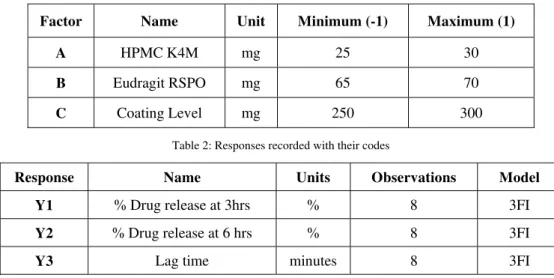
The concentrations of the variables used in the formulation of the tablets were decided on the basis of trial batches and their evaluation. The coded levels and the exact concentration of the variables used in different formulations are shown in table 1. Dependent variables that were selected are shown in table 2 with their coding. These responses were used to know the effect of independent variables.
Table 1: Coded levels and their values used in the formulation
Factor Name Unit Minimum (-1) Maximum (1)
A HPMC K4M mg 25 30
B Eudragit RSPO mg 65 70
C Coating Level mg 250 300
Table 2: Responses recorded with their codes
Response Name Units Observations Model
Y1 % Drug release at 3hrs % 8 3FI
Preparation of Final Batches for Optimisation Study 12, 13, 14
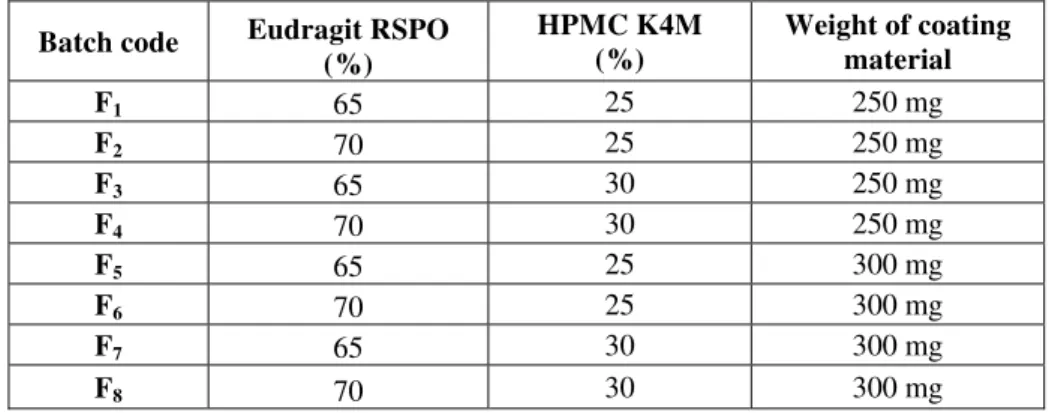
The final batches of the tablets were prepared according to the factorial design. The study was designed to study the effect of concentration of individual polymers. The remaining weight in polymer blend was adjusted by MCC. The various batches were prepared according to the concentrations as per shown in table 3.
Table 3: Formulation of optimisation (final) batches of Salbutamol Sulphate
Batch code Eudragit RSPO (%)
HPMC K4M (%)
Weight of coating material
F1 65 25 250 mg
F2 70 25 250 mg
F3 65 30 250 mg
F4 70 30 250 mg
F5 65 25 300 mg
F6 70 25 300 mg
F7 65 30 300 mg
F8 70 30 300 mg
Evaluation of tablets 15, 16, 17
All prepared tablets were evaluated for Thickness, Diameter, Weight Variation, Hardness, Friability, % Drug content etc. as per I.P. specifications.
In-Vitro drug release
The in vitro drug release from coated tablets was carried out using USP paddle apparatus at 50 rpm. HCl (0.1 N)
and phosphate buffer (pH 6.8) were used as the dissolution medium. Initially tablets were subjected to dissolution in 0.1 HCl for 2h and after that media were changed to phosphate buffer (pH 6.8). The samples were withdrawn at regular intervals and analyzed by UV spectrophotometer at 225 nm for the presence of the drug. Dissolution tests were performed in triplicate.
RESULTS AND DISCUSSION Evaluation of Final batches
Table 4: Evaluation of Final batches
Batch code
Thickness (mm)
Diameter (mm)
Weight Variation
Hardness
(kg/cm2) Friability (%) % Drug content
F1 2.32±0.24 10.04±0.03 319.2±0.5 5.2±0.3 0.433±0.022 99.71±0.20
F2 2.31±0.21 10.01±0.02 320.25±0.12 5.5±0.4 0.414±0.07 99.6±0.34
F3 2.32±0.22 10.05±0.01 322.54±0.31 5.7±0.1 0.419±0.036 99.64±0.43
F4 2.4±0.31 9.98±0.04 321.29±0.12 5.8±0.1 0.422±0.1 99.56±0.57
F5 2.97±0.12 10.01±0.03 371.17±0.19
5.5±0.4 0.427±0.053
99.97±0.65
F6 2.99±0.16 10.03±0.02 369.43±0.17
5.6±0.3 0.423±0.018
99.87±0.59
F7 3.02±0.17 10.02±0.05 370.11±0.27
5.5±0.4 0.439±0.012
99.28±0.16
F8 3.05±0.1 10.04±0.06 370.22±0.45
5.4±0.4 0.408±0.034
99.94±0.48
n=3
Drug Content Uniformity:
The results of mean percentage drug content uniformity of all the 8 formulations are shown in table no.6.13. The results show that the % drug content uniformity is within the range of 99.28±0.16 to 99.97±0.65. It insures that each tablet contains sufficient amount of drug as per stated limits.
In-vitro drug release and lag time:
mathema i.e. good model is Values o term. Hig paramete each poin the same Batch co F1 F2 F3 F4 F5 F6 F7 F8
Table 6 and atical models. d agreement b significant. T of "Prob > F"
gh R-square v ers are signific
nt in the desig in this model
Sou Mo A-HPM B-Eudrag C-Coatin A
ode % D
Fi
7 shows the The high valu etween the de There is only
less than 0.05 values sugges cant. PRESS ( gn. Smaller th l show a good
T urce odel MC K4M git RSPO ng Level AB F1 F2 170 23
Table 5: R
DR at 3 hrs
92.78 16.13 12.16 8.21 6.28 0 0 0
g. 2: Comparativ
ANO
results of the ues of correlat ependent and a 4.86% chan 500 indicate m st that these m (Predicted Res he PRESS stat d fit of the data
Table 6: ANOVA
Sum of Squares 66.85728 12.00995 9.556804 58.2589 7.051652 2 F3 30 275
Lag
Responses of Fin
% DR
e Lag Time of F1
OVA ANALY
e analysis of v tion Coefficie
independent nce that a "Mo model terms a models are si sidual Sum of tistic, the bett a points.
A analysis for Dru
Mean Squ 16.7145 12.0099 9.55680 58.258 7.05165 F4 F5 310 318
time
(m
nal Batches
R at 6 hours
90.23 92.3 93.5 94.7 93.28 94.11 12.24 9.96
1 to F8 Formulatio
YSIS
variance (AN nt for % Drug
variable. The odel F-Value" are significant ignificant. In f Squares) is a er the model
ug release at 3 hrs
uare F 52 9.5 95 6.6 04 5.5 9 21 52 5.9 F6 F7 350 37
min)
Lag tim 1 2 2 3 3 3 3 4 ons. NOVA), which g Release at 3 e Model F-val " this large co t. In this casethis case mod a measure of h
fits the data p
s. Value 515457 695555 526519 1.52295 918958 7 F8 75 410 me (min) 170 230 275 310 315 350 375 410
h was used to hrs indicates lue of 9.52 im ould occur due
C is significa del generated how well the m points. Small v
p-value Prob > F
Table 7: ANOVA analysis for various factors.
Factor Drug release at 3 hrs Drug release at 6 hrs Lag time
Std. Dev. 1.3395 0.79196 8.83
Mean 2.81336 72.54 304.375
C.V. % 47.6121 1.09175 2.90392
PRESS 38.2775 40.1408 25.0
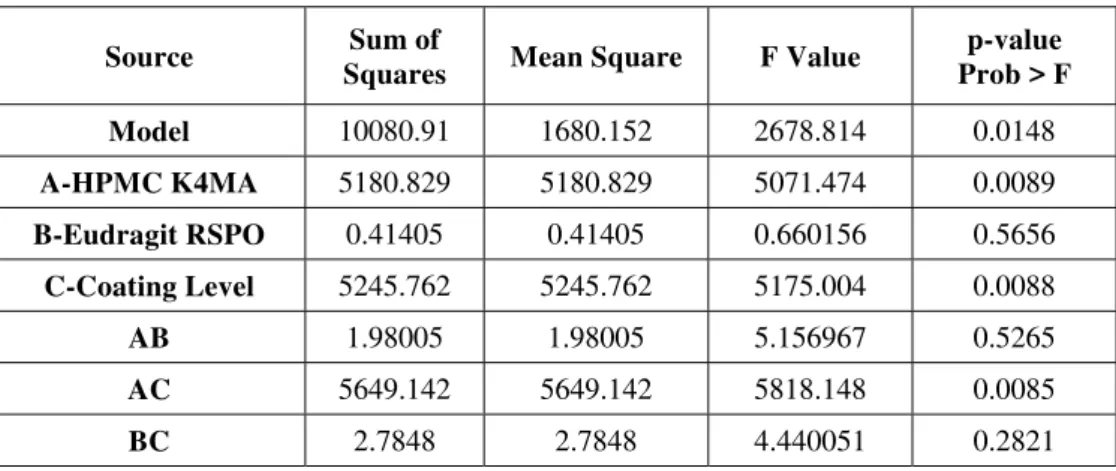
Table 8 shows the results of the analysis of variance (ANOVA), which was used to generate mathematical model. The high values of correlation coefficient for % Drug Release at 6 hrs indicate a good fit i.e. good agreement between the dependent and independent variable. The Model F-value of 2678.814 implies the model is significant.
Table 8: ANOVA analysis for Drug release at 6 hrs.
Source Sum of
Squares Mean Square F Value
p-value Prob > F
Model 10080.91 1680.152 2678.814 0.0148
A-HPMC K4MA 5180.829 5180.829 5071.474 0.0089
B-Eudragit RSPO 0.41405 0.41405 0.660156 0.5656
C-Coating Level 5245.762 5245.762 5175.004 0.0088
AB 1.98005 1.98005 5.156967 0.5265
AC 5649.142 5649.142 5818.148 0.0085
BC 2.7848 2.7848 4.440051 0.2821
The Model F-value of 2678.81 implies the model is significant. There is only a 1.48% chance that a "Model F-Value" this large could occur due to noise. Values of "Prob > F" less than 0.0500 indicate model terms are significant. In this case A, C, AC are significant model terms. High R-square values suggest that these models are significant. In this case model generated response parameters are significant. PRESS (Predicted Residual Sum of Squares) is a measure of how well the model fits each point in the design. Smaller the PRESS statistic, the better the model fits the data points. Small values for the same in this model show a good fit of the data points. ‘Adeq. Precision’ measures the signal to noise ratio. A ratio of 113.63 indicate the adequate signal.
Table 9 shows the results of the analysis of variance (ANOVA), which was used to generate mathematical model. The high values of correlation coefficient for lag time indicate a good fit i.e. good agreement between the dependent and independent variable. Model F-value of 109.22 implies the model is significant. There is only a 0.91% chance that a "Model F-Value" this large could occur due to noise. Values of "Prob > F" less than 0.0500 indicate model terms are significant.
Table 9: ANOVA analysis for Lag time.
Source Sum of
Squares
Mean
Square F Value
p-value Prob > F
Model 42665.65 8555.125 109.224 0.0091
A-HPMC K4MA 11628.15 11628.15 148.84 0.0067
B-Eudragit RSPO 5405.125 5405.125 45.56 0.0222
C-Coating Level 27028.15 27028.15 545.96 0.0029
AB 78.125 78.125 1 0.4226
significan of Square better the ‘Adeq. P
It was ob figure no Eudragit ammoniu permeabi polymer coat due between dependen compared HPMC K conclude burst nor
Fig. 3: 3
In this case A nt. In this cas es) is a measu e model fits th recision’ mea
All the data o bserved that f o. 3 and 4. Th RSPO effect um groups is 4 ility is less as allows less am to its gelling p these polyme nt on the con
d to Eudragit K4M while th ed that HPMC r will show ini
3D Response Sur Concentration o
A, B, C are se model gene
ure of how w he data points asures the sign
obtained was u for Y1 the con
he 3D plot for ts at the sam 4 to 7%. The a s compared to mount of disso property. The ers. This was n
ncentration of RSPO. The m he other side s C K4M is bette itial lag time e
rface Plot Showin on Drug Release
significant m erated respons well the model
s. Small value nal to noise rat
Table 10: R
Resp
% Drug Rele
% Drug Rele
Lag tim
RESPON
used to genera ncentration of r the response me extent in i ammonium gr o Eudragit RL olution mediu e curved lines not the case i f HPMC K4M more steep sid
shows the effe er retardant. H else it will sho
ng Effect of Polym at 3 Hours.
model terms. se parameters l fits each poi s for the same tio. A ratio of
R2 values for all th
ponse
ease 3 hrs (Y1)
ease 6 hrs (Y2)
me (Y3)
NSE SURFAC
ate 3D plots a f both the poly
e Y1 clearly re
initial release roups are pres LPO. This is b
m to pass. HP in contour plo n response Y2
M. The drug e in 3D plot a ect of Eudrag However it can
ow a sustained
mer Fig.
High R-squar s are significa int in the desi e in this mode f 30.53 indicat
he Responses R2 ) 0.925 ) 0.999 0.996 CE PLOTS
and contour pl ymers affect t eveals that the e of Salbutam sent as salts an because the E PMC K4M per ots prove that
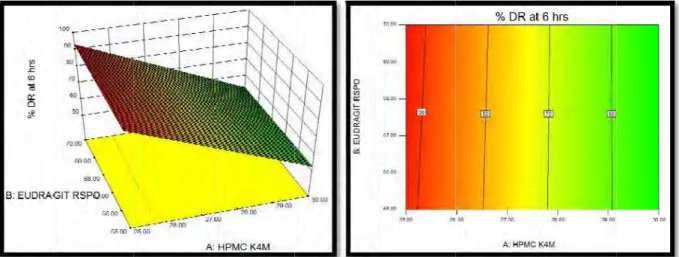
2. Drug releas
release was as shown in fi git RSPO whic
nnot be used a d type of drug
4: Contour plot S D
re values sug ant. PRESS (P gn. Smaller th el show a goo te the adequate
54
99
65
lots for the re the drug relea e concentratio mol sulphate. nd make the p Eudragit RSPO
rforms the wo there exists so se at 6 hours w
more retarde gure no.5 repr ch is less stee alone because
release.
Showing Effect of Drug Release at 3
ggest that the Predicted Resi
he PRESS sta od fit of the da
e signal.
sponses Y1, Y
ase. It was as on of HPMC Content of q polymers perm O being low p ork of holding
ome kind of in was prominen ed by HPMC resents the inf ep. Therefore, e the tablets w
f Polymer Concen Hours.
model is idual Sum atistic, the ata points.
Y2 and Y3.
shown in K4M and quaternary meable but permeable the tablet nteraction ntly found C K4M as fluence of , it can be will neither
Fig. 5: 3
Fig. 7: 3
observed concentra RSPO als
Y1= 2.813
Y2=72.54
Y3=304.3
enhancin
conclude hours lag 310 and 3
a greater HPMC K amount o RSPO co the polym
3D Response Sur Concentration o
3D Response Sur Concen
Comparativel d in initial 3 h ation of HPM so influence th
Equations gen 336 -1.22525 X 4 - 19.94X1 +
375+38.125X Negative sign ng or increasin From all the ed that batch F g time. The ot
318 minutes r
The results ob r role in retard K4M swells in of Salbutamol ontains quater mers permeab
rface Plot Showin on Drug Release
rface Plot Showin ntration on Lag tim
ly straight lin hours release. MC K4M incre he lag time bu nerated were a X1 -1.09298 X
0.2275X2 - 20
1+20.625X2+5
n in above eq ng effect on th above studies F6 could prov
ther batches w respectively.
btained from A ding the relea
ncreasing the l Sulphate dif rnary ammoniu ble but permea
ng Effect of Polym at 6 Hours.
ng Effect of Polym me.
nes were obs The effect on eases it increa ut less than HP
as follows: X2- 2.18686 X
0.1425X3-0.49
58.125X3-3.12
quation indicat he respected re s including ev vide the best p which could al
C
ANOVA anal ase of Salbutam e diffusional p
ffuses out prio um groups is ability is less
mer Fig.
mer Fig.
served in con n lag time wa ases lag time PMC K4M.
X3 + 0.937525
975X1X2 - 21.3
25X1X2-8.125
te the retardin esponses.
valuation of t possible drug lso be satisfac
CONCLUSIO
lysis, 3D plots mol Sulphate path length an or to lag time
4 to 7%. The due to very le
6: Contour plot S D
8: Contour plot S
ntour plots in as also similar sharply, beca
X1X2
3575X1X3-0.5
5X1X3
ng or decreas
tablets and ap release and la ctory include F
ON
s and trial bat . It is attribut nd its gelling e as it is high e ammonium g
ess content of
Showing Effect of Drug Release at 6
Showing Effect of Lag time.
ndicating no r as shown in ause of its gel
59 X2X3
ing effect and
pplication of s ag time as pe F4 and F5 as th
ches suggest t ted to high vis g nature holds
ly soluble. O groups are pre f ammonium g
f Polymer Concen Hours.
f Polymer Concen
interaction w figure 7 and lling strength.
d positive sign
statistical desi r the set obje hey provide la
that HPMC K scosity of the s the coat inta Other polymer esent as salts groups. Eudra
ntration on
ntration on
which was 8. As the . Eudragit
n indicate
ign it was ctive of 6 ag time of
has less influence on Salbutamol Sulphate release. But, Eudragit RSPO is necessary for bursting of tablets as it is less intact in the HPMC k4M network. As time passes inner core tablets bursts due to pressure generated in it by Crosscarmellose Sodium. It was found that formulation was time dependent and formulation bursts after following predetermined lag time.
REFERENCES
[1] Shan-Yang L, Kawashima Y. Review-Current status and approaches to developing press-coated chronodelivery drug systems, J. of Controlled Release 2012; 157: 331–353.
[2] Janugade BU, Patil SS, Patil SV, Lade PD., Pulsatile drug delivery system for chronopharmacological disorders: an overview, J. of Pharm. Res. 2009; 2(1): 1-7.
[3] Smolensky MH. and Peppas NA, Chronobiology, drug delivery, and Chronotherapeutics, Adv. Drug Del. Reviews 2007; 59: 828–851. [4] Sarasija S. and Stutie P. Chronotherapeutics: Emerging role of biorhythms in optimizing drug therapy, Indian J. Pharm. Sci 2005;
67(2): 135-40.
[5] Gwen SS. Nocturnal asthma: mechanisms and management, The Mount Sinai Journal of Medicine 2002; 69(3): 140-7.
[6] Sarda RR, Chaudhari PM and Kasture V. Formulation and evaluation of press coated pulsatile tablets of Salbutamol Sulphate. IJDFR 2012; 3(4): 78-88
[7] Janugade B, Patil S, Patil S, Lade P. Formulation and evaluation of press-coated Montelukast sodium tablets for Pulsatile Drug delivery system, Int. J. Chem. Res., 2009; 1(3): 690-691.
[8] Ghimire M, Fiona JM, David GW, Alexander B. In-vitro/in-vivo correlation of pulsatile drug release from press-coated tablet formulations: A pharmacoscintigraphic study in the beagle dog. Eur.J. Pharm. and Bioph. 2007; 67: 515–523
[9] Rujivipat S. Modified release from hydroxypropyl methylcellulose compression-coated tablets., Int J Pharma. (2010); 402: 72–77. [10] Rane A., Gattani S., Kadam V. and Tekade A., Formulation and Evaluation of Press Coated Tablets for Pulsatile Drug Delivery Using
Hydrophilic and Hydrophobic Polymers , Chem. Pharm. Bull., 2009, 57(11), 1213-1217.
[11] Hariharan M, and Gupta V. A Novel Compression-Coated Tablet Dosage Form, Pharmaceutical Technology Yearbook 2001: 14-19. [12] Patil S, Pund S, Joshi A, Shishoo C, Shahiwala A. Chronomodulated press-coated pulsatile therapeutic system for Aceclofenac:
optimization of factors influencing drug release and lag time, Chron Phy The. Feb 2011: 1-10.
[13] Design-Expert 8.0.7.1, User Guide, (Stat-Ease, Inc.2021 East Hennepin Avenue, Suite 480 Minneapolis)
[14] Prajapati BG, Patel GN and Solanki HK. Formulation and statistical optimization of time Controlled pulsatile release propranolol Hydrochloride compressed coated tablet, e-j. Of sci. tech., 2010; 4 (5): 1-7.
[15] Lachman L and Libermann H, Pharmaceutical Dosage form- Tablet, The Theory and Practice of Industrial Pharmacy, Varghese Publication House, 3rd ed., 185,209,215,293.
[16] Aulton ME. The Design and manufacture of Medicines, Churchill Livingstone Publications., 3rd ed., 336-360.
[17] Indian Pharmacopoeia 2007, Indian Pharmacopoeia Commission, Volume I, 107: 177-183.
[18] Mandal AS, Biswas N, Karim KM, Guha A, Chatterjee S. and Behera M. Drug delivery system based on chronobiology—A review, J. of Cont. Release 2010; 147: 314–325.
[19] Sarasija S. and Stutie P. Chronotherapeutics: Emerging role of biorhythms in optimizing drug therapy, Indian J. Pharm. Sci 2005; 67(2): 135-40.
[20] Gwen SS. Nocturnal asthma: mechanisms and management, The Mount Sinai Journal of Medicine 2002; 69(3): 140-7. [21] Korenma H. and Charles DP. New strategies in the medical management of asthma, American Family Physician 1998: 58(1). [22] National heart lung and blood institute. URL:http://www.nhlbi.nih.gov/health/health-topics/topics/asthma/Nocturnal asthma
[23] Fan T, Wei S, Yan W, Chen D. An investigation of Pulsatile release tablets with ethylcellulose and Eudragit L as film coating materials and cross-linked polyvinylpyrrolidone in the core tablets. J. Control. Release 2001; 43: 245-251.
[24] Sweetman CS, Martindale- The complete drug reference. Pharmaceutical press, 34th ed., 2005; 34: 791-3.
[25] Shan-Yang L, Mei-Jane L, and Kung-Hsu L. Hydrophilic Excipients Modulate the Time Lag of Time-Controlled Disintegrating Press-coated Tablets, AAPS PharmSciTech, 2004; 5 (4) 54: 1-5.