Ensaios Econômicos
Escola de
Pós-Graduação
em Economia
da Fundação
Getulio Vargas
N◦ 766 ISSN 0104-8910
Microfounded Forecasting
Wagner Piazza Gaglianone, João Victor Issler
Os artigos publicados são de inteira responsabilidade de seus autores. As
opiniões neles emitidas não exprimem, necessariamente, o ponto de vista da
Fundação Getulio Vargas.
ESCOLA DE PÓS-GRADUAÇÃO EM ECONOMIA Diretor Geral: Rubens Penha Cysne
Vice-Diretor: Aloisio Araujo
Diretor de Ensino: Carlos Eugênio da Costa Diretor de Pesquisa: Humberto Moreira
Vice-Diretores de Graduação: André Arruda Villela & Luis Henrique Bertolino Braido
Piazza Gaglianone, Wagner
Microfounded Forecasting/ Wagner Piazza Gaglianone, João Victor Issler – Rio de Janeiro : FGV,EPGE, 2015
45p. - (Ensaios Econômicos; 766)
Inclui bibliografia.
Microfounded Forecasting
Wagner Piazza Gaglianone
yJoão Victor Issler
zAbstract
Our focus is on information in expectation surveys that can now be built
on thousands (or millions) of respondents on an almost continuous-time basis
(big data) and in continuous macroeconomic surveys with a limited number
of respondents. We show that, under standard microeconomic and
econo-metric techniques, survey forecasts are an a¢ne function of the conditional
expectation of the target variable. This is true whether or not the survey
respondent knows the data-generating process (DGP) of the target variable
or the econometrician knows the respondent’s individual loss function. If the
econometrician has a mean-squared-error risk function, we show that
asymp-totically e¢cient forecasts of the target variable can be built using Hansen’s
(Econometrica, 1982) generalized method of moments in a panel-data context,
when N and T diverge or when T diverges with N …xed. Sequential
asymp-totic results are obtained using Phillips and Moon’s (Econometrica, 1999)
framework. Possible extensions are also discussed.
Keywords: Forecast Combination, Big Data, Common Features, Panel
Data.
The views expressed in the paper are those of the authors and do not necessarily re‡ect those of the Banco Central do Brasil or of FGV. Also, all data manipulations were executed by employees of the Banco Central do Brasil. We are especially grateful for the comments and suggestions given by Scott Atkinson, Robert Engle, Antonio Galvão, Ra¤aella Giacomini, Alain Hecq, Bo Honoré, Fabian Krüger, Marcelo Moreira, Rafael Santos, Mark Watson, and Whitney Newey. We also bene…ted from comments given by the seminar participants of the International Symposium on Forecasting (Seoul); International Panel Data Conference (London); Latin American Workshop in Econometrics (São Paulo); XVI Annual In‡ation Targeting Seminar of the Banco Central do Brasil (Rio de Janeiro); and The Conference of the International Association for Applied Econometrics (London). Any remaining errors are ours. Both Gaglianone and Issler gratefully acknowledge the support from CNPq, FAPERJ, INCT and FGV on di¤erent grants.
yResearch Department, Banco Central do Brasil. Email: [email protected]
zCorresponding Author. Graduate School of Economics, Getulio Vargas Foundation, Praia de
JEL Classi…cation: C14, C33, E37.
1
Introduction
Ang et al. (2007) argue that economists use four main methods to forecast in‡ation: time-series models of the ARIMA variety; structural models built upon the Phillips
Curve; methods using information embedded in asset prices – in particular, the term-structure of interest rates; and methods that employ survey-based measures provided by economic agents (consumers and/or professional forecasters). They …nd that
true out-of-sample survey forecasts (e.g. Michigan; Livingston) outperform a large number of out-of-sample single-equation and multivariate time-series competitors. Along the same lines, Faust and Wright (2013) argue that subjective forecasts of
in‡ation seem to outperform model-based forecasts in certain dimensions, often by a wide margin. They discuss some reasons why this is the case, which points out to the choice of boundary values and the fact that professional forecasters quite often
have access to econometric models and add expert judgment to these models. In a world where there is an increasing availability of reliable data provided electronically, it is interesting to examine how one could e¢ciently use this wealth of
information. Of course, there is already a large literature onbig data in statistics. It is certainly true that econometrics is currently bene…ting from it. However, what we see as lacking is interpretation – economic interpretation. One step in that direction
is to employ the tools of economics to be able to extend our current knowledge in an emerging …eld. This is one of the objectives of this paper.
In order to accomplish that, our focus is on the abundant information
con-tained in expectation surveys that can now be built on thousands (or millions) of respondents on an almost continuous-time basis. Using standard microeconomic and econometric techniques, we …rst ask what is the optimal survey response from the
point-of-view of a given respondent. As users of that information, it is important to us to consider an environment with three di¤erent setups: (i) when the survey respondent knows the data-generating process (DGP) of the response random
and users know what is the loss function being used; and (iii) when the respondent does not know the parameters of the DGP, the latter being approximated using a
location-scale model and quantile regression techniques, and the loss function being used by respondent is unknown to the users. Under these conditions, we show that the optimal forecast of a given survey respondent is an a¢ne function of the
condi-tional expectation of the target variable of the survey. Once we characterize this …rst layer of decision making, we can then ask how to use e¢ciently the informational content present in expectation surveys. Our answer uses structural microfounded
models, whereas the previous literature had focused on a reduced-form approach. If the …nal user of that information (the second layer of decision making) em-ploys a mean-squared-error (MSE) risk function, which is typically the case for the government, a central bank, a large risk-neutral …rm, etc., then, it is natural to extract from the survey the conditional expectation of the target variable1 – the
optimal forecast from the point-of-view of the …nal user, e.g., an econometrician.
Because we had an a¢ne model for the optimal respondent’s decision, the second-layer problem reduces to a signal-extraction problem, where potentially the number of respondents and of time-series observations is large, i.e., N and T grow without
bound. In this context, we show how to solve this problem using Hansen’s (1982) generalized method of moments (GMM) in the sequential asymptotic framework of Phillips and Moon (1999), i.e., our method identi…es and proposes consistent and
e¢cient estimates of the optimal forecast of the target variable under the MSE risk function. Moreover, we also propose a solution for the case in which T diverges but N is …xed, which applies to some long standing surveys with a …xed number of
respondents throughout time.2
Although the a¢ne model of the …rst-layer decision making is a function of a latent variable (the conditional expectation), we are able to substitute it for the
target variable itself minus a martingale-di¤erence sequence (MDS) error term, thus expressing the cross-sectional moment condition in terms of this MDS, where its unforecastable properties can then be exploited using GMM. So, the moment
con-dition can ultimately be cast only in terms of observables and parameters. In this
1Of course, di¤erent risk functions in the second layer would imply extracting a di¤erent target.
This is not a problem here, given that we have properly characterized the …rst-layer decisions.
2For example, theLivingston Survey of the Philadelphia FED, theWall Street Journal Survey
setting, we confront forecasts with realizations to be able to identify and estimate consistently functions of the parameters of the a¢ne model when the number of
time-series observations gets large – large T. Our results hold in two di¤erent con-texts regarding the number of survey responses: when they are large(N ! 1)and when N is …xed.
Obviously, our primary focus is on forecasting. As Einav and Levin (2013) put it, “The most common uses of “big data” by companies are for tracking business processes and outcomes, and for building a wide array of predictive models. While
business analytics is a big deal and surely has improved the e¢ciency of many organizations, predictive modeling lies behind many striking information products and services introduced in recent years.” However, since our techniques allow the
identi…cation and estimation of the conditional expectation of the target variable, it immediately allows for the identi…cation of economic shocks to these target variables, which are key variables especially in macroeconomics and …nance; see the discussion
in Diebold (2012).
We should stress that we avoid dealing with sparse-data issues in big data, e.g., Belloni and Chernozhukov (2011, 2013) and Belloni, Chernozhukov, and Wang
(2011), because our focus narrows down to the relationship between optimal fore-casts and the conditional expectation of the target variable in the survey. Implicitly, each survey respondent could use several di¤erent covariates to compute their
opti-mal forecast. Indeed, all of these may be unknown to the user in the second layer of decision making (the econometrician). Because the number of respondents diverge, our techniques bene…ts from the information implicit in all of these forecasts, and
could ultimately be interpreted as an optimal forecast-combination method. Thus, our approach to big data is not related to data reduction techniques – where the key issue is the availability of too many regressors (Varian, 2014) – but on how to
optimally combine information.
The ideas in this paper are related to research done in three di¤erent …elds. From econometrics, it is related to the common-features literature after Engle and
Kozicki (1993). Indeed, we attempt to bridge the gap between a large literature on common features applied to macroeconomics, e.g., Vahid and Engle (1993, 1997), Issler and Vahid (2001, 2006) and Vahid and Issler (2002), Athanasopoulos et al.
fac-tors or to forecast combination, perhaps best represented by the work of Bates and Granger (1969), Granger and Ramanathan (1984), Palm and Zellner (1992), Davies
and Lahiri (1995), Forni et al. (2000, 2005), Stock and Watson (2002a,b, 2006), Elliott and Timmermann (2004, 2005), Timmermann (2006), Patton and Timmer-mann (2007), Issler and Lima (2009), Gaglianone et al. (2011), Gaglianone and Lima
(2012, 2014), and Lahiri, Peng, and Sheng (2013). From the theoretical literature on the incentives leading to optimal forecasts, our paper is related to the work of Laster et al. (1999), Ottaviani and Sorensen (2006), and Batchelor (2007). In this
context, it is also related to the literature on the role of loss functions, e.g., Elliott et al. (2008) and Capistrán and Timmermann (2009), and to the novel literature on informational rigidities, e.g., Mankiw and Reis (2010), Coibion and Gorodnichenko
(2012), and Andrade and Le Bihan (2013). Frombig data econometrics it is related to the work of Diebold (2012), Einav and Levin (2013), Varian (2014), Warin and Sanger (2014), and Joseph et al. (2014), although we could not …nd papers dealing
directly on how to optimally combine forecasts in the context of big data. Indeed, most of this literature is interested in dimension-reduction techniques for poten-tial regressors, such as classi…cation and regression trees (CART), random forests,
penalized-regression techniques such as the least absolute shrinkage and selection operator (LASSO) and least-angle regression (LARS), and elastic nets.
The rest of the paper is divided as follows. Section 2 introduces a
microfounded-based framework to study the forecast error under risk functions more general than the usual MSE. Section 3 presents a real-time forecasting exercise with data from a survey of Brazilian in‡ation expectations using the methods proposed here,
compar-ing the out-of-sample performance of di¤erent bias-correction approaches. Section 4 concludes.
2
Econometric Setup
2.1
Microfounded forecasting under a general risk function
The techniques discussed in this section are appropriate for forecasting a weakly
stationary and ergodic univariate process fytg using a large number of forecasts.
are generated using econometric models, but then the econometrician that observes these forecasts has no knowledge of them.
We label individual forecasts of yt, computed using information sets lagged h
periods, by fh
i;t, i= 1;2; : : : ; N, and t= 1;2; : : : ; T. Therefore, fi;th areh-step-ahead
forecasts of yt, formed at period t h; and N is the number of respondents of this
opinion poll regarding yt. In this section, we show that, in a variety of interesting
cases, optimal forecasts are related to Et h(yt) – the conditional expectation of yt,
computed using information lagged h periods – by an a¢ne function of the form3:
fi;th = hiEt h(yt) +khi +"hi;t: (1)
As is well known, Granger (1969) was a pioneer in this literature. He considered that forecasters minimize a cost function, and that “cost functions that arise in
practice in economics and management situations are not likely to be quadratic in form, and frequently will be non-symmetric.” If the cost function is symmetric, and
additional regularity conditions hold for the density of yt, thenEt h(yt) is obtained
as the optimal forecast. In some special cases, optimal forecasts require a bias-correction term as in Et h(yt) +kih.
The subsequent literature on forecast optimization, e.g., Christo¤ersen and Diebold (1997), Elliott and Timmermann (2004), Patton and Timmermann (2007), and El-liott, Komunjer, and Timmermann (2008), have shown the inappropriateness of
using the conditional mean under a more general setup, which includes the use of an asymmetric loss function and even an unknown loss function.
In what follows, we consider a setup which has two layers of decisions to be
made. In the …rst layer, individuals (survey respondents) form their optimal point forecasts of a random variable yt by using a speci…c loss function under di¤erent
assumptions about knowledge of the DGP of yt. These optimal forecasts fi;th will
be available as survey results, where the number of respondents is potentially large, i.e., N ! 1, and these surveys can be periodically taken on a large number of di¤erent occasions, i.e., T ! 1. This setup describes reasonably well the current
abundance of knowledge in the big data literature. In the second layer of decisions, an econometrician will be the …nal user of this large number of forecasts. We
as-3Indeed, (1) is an encompassing model. Some results we derive below represent restrictions on
sume that she/he operates under an MSErisk function, but this assumption can be modi…ed if need be. However, we believe it covers reasonably well some interesting
cases, which are of practical importance, e.g., the government, a central bank, a large risk-neutral …rm, etc. Hence, her/his optimal forecast in this second layer of decision making is Et h(yt).
The challenge here is to uncover Et h(yt) – the optimal forecast of the second
layer of decision making – from a potentially large set of survey responses, where cases of potential asymmetries or unknown loss functions previously studied are
taken into account. We investigate the relationship between the optimal forecast and the conditional expectation, based on the following cases: (1) Loss function known to the econometrician and DGP known by individual i, where the DGP may
take an analytic parametric form; (2) Loss function known to the econometrician and DGP known by individual i, where the DGP is approximated by a location-scale model with known parameters; (3) Loss unknown to the econometrician and
parameters of DGP unknown by individual i, the latter being estimated by the individual using standard quantile-regression techniques and a location-scale model.
Loss and DGP known – (Cases (1) and (2))
Assume that there is an amount of individuals forecasting yt conditional on Ft h,
where Ft h is the sigma algebra of all the variables contained in the conditioning
set used by all the agents. Each individual chooses an optimal forecast feh i;t by
minimizing their respective expected loss function Li, e.g., Granger and Newbold
(1986). In this section, we assume that the agent in the second layer of decision making – the econometrician – has full knowledge of the Loss function used by individual agents. So, there is full disclosure not only of survey-forecast results but
also of the Loss function from the part of survey respondents. This last assumption will be relaxed in the next section.
Assumption A1 (Loss function) Li depends solely4 on the forecast error ei t;t h
yt fei;th, that is,Li = L(eit;t h).
4This is the same Assumption L1 of Patton and Timmermann (2007). According to them,
Therefore, the optimal (point) individual forecasts ofyt are obtained as follows:
e
fi;th arg min
f E
Li(yt;f)j Ft h (2)
where f 2 R are all possible choices of the i-th forecaster and E(: j Ft h) denotes
the conditional expectation given Ft h.
An important issue regarding the information set used by each agent is that all use the same information, which should be regarded as public information. Hence, there is no private information in our context, and di¤erent forecasts arise because agents use a di¤erent Loss function. Also, we treat public information as free, since the minimization problem in (2) has no constraints regarding its cost. These
features will have bearing when we discuss our theoretical results vis-à-vis those of the macroeconomics literature on forecasting.
A natural assumption about the shape of the agent’s loss function is that if one
forecasts without error, then no forecast loss arises, but, if there is an error, the larger it is, the greater will be the loss:
Assumption A2 (Shape of the Loss function) The loss function exhibits the fol-lowing properties: (i) Li(0) = 0; (ii) Li(e
i) is continuous, homogeneous and
non-negative 8ei 2R; and (iii) Li(ei) is monotonic non-decreasing (forei >0
or ei <0), and di¤erentiable at least twice almost everywhere.
In practical terms, the symmetry of the loss function might be a restrictive hypothesis to be considered by an econometrician. Granger and Newbold (1986, p.125) provide two examples of situations where nonsymmetrical cost functions arise.
In these cases, it would be interesting to check if the agent forecast is optimal under a broader class of loss functions. A simple way to consider an asymmetric function, and account for some "degree of asymmetry", is given by the following assumption:
Assumption A3 (Asymmetry of the Loss function) The loss function Li(e i) can
be decomposed as Li(e
i) = gi(ei)hi(ei), where gi(ei) is a non-negative and
symmetric function about ei = 0; gi0(ei) and gi00(ei) exist almost everywhere;
hi(e i) =
8 < :
i
1 ; ei <0 i
2 ; ei >0
Assumption A4 (DGP - stationarity and regularity of the CDF) The univariate time series yt is a weakly stationary and ergodic process and the conditional
cumulative distribution function (CDF) of yt, givenFt h (denoted byFt;t h( )
or Ft( j Ft h)), is absolutely continuous, with continuous densities ft;t h
uni-formly bounded away from0and 1at the pointsFt;t h1 ( );8 2(0; 1), where
denotes the quantile level with respect to the (conditional) CDF ofyt.
Assumptions A2 and A3 are standard in the literature (e.g. Granger and
New-bold, 1986; Patton and Timmermann, 2007). Note that A3 includes the symmetric case when 1 = 2. It is quite general, covering a great deal of loss functions commonly mentioned in the literature, such as: mean squared error (MSE), mean
absolute error (MAE), asymmetric linear (Lin-Lin), asymmetric quadratic, among many others. A4 is just a technical assumption on the DGP of yt.
Based on assumptions A1-A4, we next present Proposition 1, which generalizes
the results in Granger (1969) and states two important results: (i) asymmetric loss functions generate departures of the optimal forecast from the central tendency (e.g. median) of the conditional distribution of yt; and (ii) for the same DGP, the higher
the degree of asymmetry in the loss function the greater will be the distance between the optimal forecast and the conditional median.
Proposition 1 (Asymmetric Loss) Denote by M edt h(yt) the conditional median
of yt. If A1-A4 hold, then: (i) If 1 6= 2 then Ft;t h(fei;th)6= 0:5, where Ft;t h is the
conditional CDF of yt; (ii) If 1 > 2 then fei;th < M edt h(yt); (iii) If 1 < 2 then
e
fh
i;t > M edt h(yt); and (iv) for two forecasters iandj such that i1= i2 <
j
1=
j
2 <1, then, feh
i;t >fej;th > M edt h(yt):
Corollary 2 (Symmetric Loss) If A1-A4 hold, and 1 = 2, thenfeh
i;t =M edt h(yt).
Hence, without asymmetry, i.e., if 1 = 2, then, the optimal forecast is the
conditional median of yt. By considering additional assumptions on the DGP of yt,
we obtain the well-known optimality result of the conditional mean, due to Granger
(1969, Theorem 2).
symmetric function about its conditional mean Et h(yt) = 1
R
1
ytft;t h(y)dy, and if
1 = 2 then fei;th =Et h(yt).
It is interesting to note that an optimal forecast obtained from a symmetric loss function such as MSE implies that feh
i;t = Et h(yt). Moreover, the classical result
of Granger (1969), in which the optimal forecast equals the conditional mean of yt
under a MSE loss function, can be viewed as a special case of Proposition 1.
The exact relationship between the optimal forecast’s quantile level i, with
respect to the CDF of yt, and the parametersf 1; 2g can be obtained if one
con-siders a more restrictive assumption on the class of loss functions. The next corollary presents an example.
Corollary 4 (Granger and Newbold (1986): Linear loss function) If A1-A4 hold
and the loss function is a Lin-Lin function, i.e., if L(ei) =
8 > > < > > :
1ei ; ei <0
0 ; ei = 0
2ei ; ei >0
,
where 1; 2 >0, then, feh
i;t =Ft;t h1 ( i) in which i = 2=( 1+ 2).
Under a symmetric loss function such as the MSE, the only forecast that is
unbi-ased5is the optimal forecast given byfeh
i;t =Et h(yt). However, under an asymmetric
loss function, we should expect that the optimal forecast will di¤er from the con-ditional mean. Intuitively, an asymmetric loss with, say, 1 > 2, indicates that
the negative forecast errors are relatively more costly to the forecaster. Thus, an individual forecaster will choose an optimal forecast that corresponds to some low quantile of yt (i.e., i < 0:5) and therefore it is natural to obtain a result where
positive errors are more likely to be observed with historical data – which explains the forecast bias.
Granger (1969) argues that symmetry of both the loss function and the
condi-tional density of yt is not a su¢cient condition for the optimum predictor to be
equal to the conditional mean. In fact, he provides a counter-example in which the conditional mean would be sub-optimal under symmetric functions (both loss
and the PDF). In order to better understand the relationship between the optimal forecast and the conditional mean, we next assume speci…c parametric versions for the DGP, as follows:
Proposition 5 (DGP - parametric PDFs) If A1-A4 hold and the conditional PDF of yt is: (i) Gaussian, Two-piece Normal, or Logistic, then, fei;th = khi +Et h(yt);
(ii) Log-normal or Weibull, then, feh i;t =
h
iEt h(yt); (iii) Beta(a = 1; b > 0), then,
e
fh
i;t =khi + hEt h(yt); (iv) Beta(a >0; b = 1), then, fei;th = hi'(Et h(yt); i), where
'(Et h(yt); i) = exp(Et hln((iy)t)) and i Ft;t h(fei;th).
With the exception of case (iv) above, it is instructive to note that Proposition 5 delivers an encompassing result that:
e
fi;th = hiEt h(yt) +kih; (3)
where di¤erent parametric CDFs deliver di¤erent restrictions on either intercepts
and/or slopes of the a¢ne function (3). Di¤erent intercepts and slopes are usually a result of the interaction between the DGP and the Loss function, in some cases being linked to asymmetry of the Loss function. If both are asymmetric, as in (iv)
above, we do not obtain an a¢ne function, but a nonlinear factor model onEt h(yt).
Knowledge of the Loss function (by the econometrician) and the DGP (by the agent) is too stringent an assumption, making it of little practical interest. Thus, we
now turn into a more realistic case where we assume a location-scale model for the DGP of yt. This broad class of DGPs was used by Patton and Timmermann (2007),
among others. Several parametric DGPs belong to it, such as the Normal
distrib-ution, Elliptical, Cauchy, Uniform, Logistic, Student’s t, and Generalized extreme value. The class also includes most common volatility processes, such as ARCH and stochastic volatility. It is not only broad but also very convenient, because it can
naturally be investigated through the lens of the quantile-regression framework with linear conditional quantiles.6
Assumption A5 (DGP - location-scale) The DGP of yt follows a location-scale
model, with conditional mean and variance dynamics de…ned asyt =Xt;t h0 +
X0
t;t h t, in which ( tjFt h) i:i:d: F ;h(0;1), where F ;h(0;1) is some
distribution with zero mean and unit variance, which depends on h but does not depend on Ft h; Xt;t h 2 Ft h is a m 1 vector of covariates (which
includes the intercept, and that can be predicted using information available
6The linear quantile regression setup could be further extended to consider models with
at time t h) and = [ 0; 1;:::; m 1] and = [ 0; 1;:::; m 1] are m 1
vectors of parameters.7
Notice that no parametric structure is placed onF ;h( )and the covariates a¤ect
both the location and the scale of the conditional distribution of yt. Moreover, A5
implies that: (i) Q (yt j Ft h) = 0( ) + 1( )xt;t h for some 2 [0;1]; and (ii)
E(yt j Ft h) = Et h(yt) = 0 + 1xt;t h; where Q (:) is the conditional quantile
of yt, [ 0( ); 1( )] depends on ( ; ), Li and F ;h(0;1); and j
1
R
0
j( )d for
j = f0; 1g: The previous expressions for both the conditional quantiles and the conditional expectation of yt (under A5) will be exploited next to deliver a linear
connection between the optimal forecast and the conditional mean.
Proposition 6 (Location-scale model) If A1-A5 hold, then: (i) the optimal forecast is a linear function of the conditional mean of yt, so thatfei;th =khi + hiEt h(yt); (ii)
in the absence of scale e¤ects on the DGP ( 1 = 2 =:::= m 1 = 0)it follows that
h
i = 1, for all i, i.e., fei;th =khi +Et h(yt).
Here, scale e¤ects generate heterogeneity on the slopes of the a¢ne structure. On
the other hand, the intercept is a function of both scale and location parameters. We now turn into the case where the Loss function is unknown by the econometrician. Moreover, the DGP is also unknown by the agent and the econometrician. However,
it can be approximated using the location-scale model by the agent in forming her/his optimal forecast. In other words, the parameters and , associated with the location-scale model, can be consistently estimated as we shall see next.
Loss unknown and parameters of DGP unknown (Case (3))
So far, we have assumed that the Loss function is known by the econometrician and that the DGP of yt is known to the survey respondent who is forecasting yt. In
practice, only the survey respondent knows her/his own Loss function, but not the
econometrician. Moreover, it is not realistic to assume that either the respondent or the econometrician know the DGP. In this context, we consider the case where the econometrician only observes a survey of individual forecasts and the target variable
7For ease of notation, and without loss of generality, we assume that X0
t;t h = (1; xt;t h)is a
2 1 vector, = ( 0; 1)0, and = ( 0; 1) 0
yt, but has no information at all about the individual loss functions previously used in
the …rst layer of decision making. Moreover, in the …rst layer, the survey respondent
does not know the DGP and has to estimate the parameters of the location-scale approximation.
Now, an optimal forecast of the form:
e
fi;th =khi + ihEt h(yt); (4)
obtained in the previous section, is not feasible. Despite that, because the class of location-scale models is relatively broad, we assume that the unknown DGP falls
within this class (A5) and that survey respondents employ the location-scale model to approximate the unknown DGP, which parameters must then be estimated.
A natural way for survey respondents to estimate (4) is by using
quantile-regression techniques, pioneered by Koenker and Bassett (1978), with further devel-opments discussed in Koenker (2005). Indeed, under standard assumptions about
the data, which are likely to hold in our context, it is possible for the survey re-spondent to estimate consistently kh
i, hi, andEt h(yt). If we denote bykbih, chi, and
b
Et h(yt) the respective estimators of kih, hi, and Et h(yt), the optimal (feasible)
survey responses are:
fi;th =kbh
i +chiEbt h(yt); (5)
given the assumption that survey respondents use the location-scale model as an approximation.
Notice that we have made the distinction between the optimal forecast feh i;t and
its feasible counterpart fh
i;t which requires the estimation of khi, hi, and Et h(yt),
i.e., equation (4) versus (5). We now use a technical assumption that guarantees the existence of quantile-regression consistent estimates.
Assumption A6 De…ne[kbh
i;chi] = [b0( i) cc0
1b1( i);
b1( i)
c1 ], where[b0( i);b1( i)]
are the resulting estimates (intercept and slope) of a standard linear quantile
regression of yt onto[1;xt;t h]at quantile level i. In addition, let the average
coe¢cients bj = PKk=1bj( k) k, for j = f0; 1g, be computed as Riemann
sums over a grid ofK equidistant quantile levels k 2[ 1; 2; :::; K];such that
k = Kk+1 and k = K1+1 for k = [1; :::; K]. Also assume that regularity
continuous and Riemann-integrable on [0;1].
Proposition 7 If A1-A6 hold, then, the optimal (feasible) forecast ofyt conditioned
on Ft h is of the form: fi;th = khi + hiEt h(yt) +"hi;t, where "hi;t accounts for …nite
sample parameter uncertainty, and [kbh
i;chi] are consistent estimates of [kih; hi].
Notice that the case of unknown Loss function and DGP is similar to the two previous cases. Adding and subtracting kh
i + hiEt h(yt)to (5), leads to:
fi;th =kih+ hiEt h(yt) +"hi;t; (6)
where it becomes clear that "h i;t =
h b
kh i kih
i
+hchiEbt h(yt) hiEt h(yt)
i
re‡ects
the small-sample error in approximating the unknown DGP8. Indeed, with one
ex-ception, (6) encompasses all cases covered above, which are special cases re‡ecting speci…c parameter restrictions. Next, we will employ the encompassing model (6)
as a starting point to propose a way to identify and estimate consistently (and e¢ciently in a GMM context) the random variable Et h(yt).
As is clear from above, quantile-regression techniques allowed the estimation of
b
Et h(yt), kbih and c
h
i, but this is only available for the individual forecaster in the
…rst layer of decision making, since we assumed that only the survey respondent knows her/his own Loss function, but not the econometrician. The respondent will
deliver a bias and error ridden conditional expectation to the …nal user of the survey in the second layer – the econometrician, i.e., equation (6). So, from the point of view of the second layer, we are facing a typical signal-extraction problem, which
we solve exploiting the fact that forecasts are functions of Ft h, leading naturally to
errors that do not depend on Ft h. This can be the basis of a
generalized-method-of-moment estimate of Et h(yt)as we discuss next.
Identi…cation and GMM estimation of Et h(yt)
Consider an econometrician who only observes a survey of individual forecasts fh i;t
(all optimal and feasible, in principle) and the target variable yt, but has no
in-formation at all about the DGP and the individual loss functions previously used
8As it is clear from the text, an optimal forecast "approximation error" "h
i;t fi;th fei;th arises
in the …rst layer of decision making. Because the class of location-scale models is relatively broad, we assume that the econometrician will employ this class of models
to approximate the unknown DGP9. From our previous results, it is natural for the
econometrician to use:
fi;th =kih+ hiEt h(yt) +"hi;t: (7)
As argued above, this encompasses the previous cases of Loss and DGP known,
and of Loss and DGP unknown10. Equation (7) is a three-dimensional panel, with
t = 1; :::; T, i = 1; :::; N, and h = 1; :::; H. Although the horizon can in principle increase without bound, when forecasting one usually keeps H small. Recall that,
in a stationary-ergodic world, asH increases, conditional forecasts rapidly converge to their unconditional counterparts, making the case for large H unappealing. So, our framework entails two interesting cases. The …rst is T ! 1, N ! 1, and
small H, which applies to large surveys taken across time11. The second is T ! 1, with small N and H, which applies to some long standing surveys with an almost constant number of respondents throughout time, e.g., theLivingstonSurvey of the Philadelphia FED, available since 1959 on a biannual basis, the Survey of Professional Forecasters, available since 1968 on a quarterly basis, or theWall Street Journal Survey of Forecasters, available since 2003 on a monthly basis.
Even if H is small, the system of equations (7) has too many parameters when
N is large, which poses a problem for identi…cation ofEt h(yt). However, we do not
need the identi…cation of all kh
i and hi, i= 1; :::; N, to be able to identify Et h(yt).
Indeed, under suitable conditions, we only need to know their respective means.
Averaging (7) across i, assuming that N1
N
X
i=1
"h i;t
p
!0, allows identifying Et h(yt) as
as function of three means alone:
Et h(yt) = plim
N!1
0 B B B B @
1
N N
X
i=1
fh i;t N1
N
X
i=1
kh i
1
N N
X
i=1
h i
1 C C C C
A; (8)
9The use of the location-scale class can be generalized, in principle, but we leave this for future
research.
10There is one exception noted above.
11Examples include large cross-sectional repeated surveys, where individuals are re-sampled with
as long as all the terms in parenthesis in (8) converge in probability. The only
problem here is that kh = 1
N N
X
i=1
kh
i and h = N1 N
X
i=1
h
i are not known. Next, we
discuss their estimation.
Our proposed approach to identify and estimate Et h(yt) is to employ the
gen-eralized method of moments (GMM), relying on T asymptotics. However, the fact
that Et h(yt) is a latent variable is a serious drawback, since the moments used in
GMM estimation must be a function of observables and parameters alone. Following Issler and Lima (2009), one can always decompose the series ytintoEt h(yt)and an
unforecastable martingale-di¤erence component h
t, such thatEt h( ht) = 0, so that:
yt=Et h(yt) ht: (9)
Thus, combining (7) and (9) leads to:
fi;th = kih+ hi(yt+ ht) +"hi;t (10)
= kih+ hiyt+vhi;t; (11)
where vh
i;t hi ht +"hi;t is a composite error term. Notice that, by construction,
E ht j Ft h = 0, so, E vhi;t j Ft h = 0 if one assumes that E("hi;t j Ft h) = 0. In
the context where T; N ! 1, it is reasonable to expect that the approximation error "h
i;t vanishes.
Starting withE vh
i;t j Ft h = 0, using the law of iterated expectations and valid
observable instruments zt s, where zt s 2 Ft h, s h, we obtain:
E fi;th kih hiyt zt s = 0; (12)
which is valid for all i= 1; :::; N,t = 1; :::; T, andh= 1; :::; H. The system (12) has
2N H parameters and (at least)2N H moment conditions, provided thatdim(zt s)>
2, which is critical for identi…cation. Despite that, one problem remains: asN ! 1, the amount of parameters in (12) diverges, which goes against consistency. Notice, however, that T ! 1 poses no such problem.
time-series dependence. It relies on T-asymptotics and applies for the case where
N is …xed and the case where N ! 1. Notice that these are exactly the two
interesting cases alluded above. We …rst discuss T ! 1, N ! 1, with small
H. Driscoll and Kraay’s solution to the curse of dimensionality was to take cross-sectional averages of terms such as fh
i;t khi hiyt zt s. In their context, the
parameters to be estimated by GMM did not depend on i, although the data did. Here, both parameters and the data depend on i. Despite that, one can still use cross-sectional averages to reduce parameter dimensionality12, leading to:
E
h
fh
;t kh hyt zt s
i
= 0; (13)
t = 1; :::; T, and h = 1; :::; H, where fh ;t = N1
N
X
i=1
fh
i;t, kh = N1 N
X
i=1
kh
i and h =
1 N N X i=1 h
i, represent cross-sectional averages for each h.
As argued above, since we need not know the individual coe¢cientskh
i and hi,
but only their means to be able to identify and estimate Et h(yt) from a survey of
forecasts, and since Et h(yt) does not vary acrossi, averaging across i as in (13) is
an interesting strategy to recoverEt h(yt). As long as these cross-sectional averages
converge, GMM using time-series restrictions delivers consistent estimates of the
respective parameter means. Once one deals successfully with consistency, one can start worrying about e¢ciency in a GMM context.
One way to exploit all possible moment conditions implicit in (13) is to stack all
the restrictions across h (…nite) as:
E 2 6 6 6 6 6 4 0 B B B B B @ f1
;t k1 1yt
f2
;t k2 2yt
.. .
fH
;t kH Hyt
1 C C C C C A
zt s
3 7 7 7 7 7 5
= 0; (14)
where our problem collapses to one where we haveH dim(zt s)restrictions and2H
parameters to estimate. As before, over-identi…cation requires that dim(zt s)> 2.
Given a choice ofH, GMM estimation of (14) is e¢cient. A less e¢cient alternative
12Provided thatz
to estimate the whole stacked system (14) is to estimate separately (13) for every horizon h, which could also be attempted for computational reasons.
In the context of N; T ! 1, with H small, we now discuss the less stringent case where we …rst let N ! 1 and then let T ! 1, using the sequential as-ymptotic framework of Phillips and Moon (1999). Under suitable conditions, the
cross-sectional averages in (13) and (14) would converge in probability to a unique
limit as N ! 1, i.e., plim
N!1 1 N N X i=1 h
i = h, h 6= 0, h < 1, plim N!1 1 N N X i=1 kh
i = kh,
kh < 1, and plim N!1 1 N N X i=1 fh
i;t = fh;t, fh;t < 1, for all t = 1;2; ; T. Then, a
key condition for T-consistent estimation is that (13) and (14), evaluated at these limits are a unique solution for each of them respectively. Take now moments (13),
considering that N ! 1:
E fh;t kh hyt zt s = 0; or, (15)
E
"
h h
t +plim N!1 1 N N X i=1
"hi;t
!
zt s
#
= 0: (16)
If, in addition, N1
N X i=1 "h i;t p
!0, as N ! 1, (16) collapses to:
E h ht zt s = 0; (17)
t = 1; :::; T, and h = 1; :::; H, where (17) is attained by construction, since h t is a
martingale-di¤erence and must be orthogonal to all series dated t hor before. In this context, GMM provides a consistent estimate for parameter means as T ! 1. To prove it, …rst de…ne h = [kh; h]0 and consider the following assumptions:
Assumption A7 Let"ht = "h1;t; "h2;t; ::: "hN;t 0 be aN 1vector stacking the errors
"h
i;t associated with all possible forecasts. Assume that the vector process "h
t is covariance-stationary and ergodic for the …rst and second moments,
uniformly on N, and that E "h
i;t = 0 for all i and t, given h. Furthermore,
we assume that
lim N!1 1 N2 N X i=1 N X j=1
E "hi;t"hj;s = 0; (18)
Assumption A8 We assume that plim N!1 1 N N X i=1 h
i = h 6= 0, h <1, plim N!1 1 N N X i=1 kh i =
kh, kh <1, and plim N!1 1 N N X i=1 fh
i;t =fh;t, fh;t <1, for all t = 1;2; ; T.
Assumption A9 We assume that the identi…cation conditions for GMM estimation are met and that there is a unique set of values h0 = [kh
0; h0]0,h= 1;2; ; H,
that solve either (14) or (13) for each h separately13. We further assume
that the additional regularity conditions used by Hansen (1982) in proving
T-consistency of GMM estimates bh = [kbh;ch]0 are met as well.
Assumption A7 guarantees that the errors "h
i;t can be diversi…ed away, and that
cross-sectional dependence is not a problem. It is required in a GMM context in
order to ensure that Et h plim N!1 1 N N X i=1 vh i;t !
= 0. This serves as a basis to obtain
either (13) or (14), when N ! 1. Notice that, although this is an assumption here,
it can be tested using standard over-identifying restrictions tests. Assumption A8 just requires …nite convergence of di¤erent cross-sectional averages, which bounds the degree of cross-sectional and time-series dependence due to spatial dependence.
They are expected to hold on a stationary-ergodic context. Assumption A9 deals with GMM identi…cation and is standard in the literature. We can now state an important result, which allows for consistent estimation of Et h(yt).
Proposition 8 If A1-A9 hold, then, the feasible Extended BCAF (Bias Corrected Average Forecast) N1
N
X
i=1
fh i;t kch
ch , based onT-consistent GMM estimates
bh
=hkbh;chi0;
obeys plim (N;T!1)seq
1 N N X i=1 fh i;t kch
ch
!
= Et h(yt), where (N; T ! 1)seq denotes the se-quential asymptotic approach proposed by Phillips and Moon (1999), when we let …rst N ! 1, and then let T ! 1.
We now turn into the more complicated case where in the sequential asymptotics we let …rst T ! 1, and then N ! 1, or, that we let T ! 1 with N …xed. The critical issue of letting T ! 1…rst is that, when we take cross-sectional averages as
in (13) or (14), but N is not large, we have to guarantee that all possible ensemble
13Since the restrictions are linear, the h
averages are identi…ed. When we assume the opposite sequential order, we have only to worry about identi…cation of a single limit case.
An added complication is that N1
N
X
i=1
"h
i;t does not vanish in probability. Despite
that, A7 imposes that E "h
i;t = 0 for all i and t, given h. This is not su¢cient to
guarantee that moments (13) and (14) can be cast in terms of h
t alone. However,
employing the more restrictive assumption that E("h
i;t j Ft h) = 0 is su¢cient to
validate (13) and (14). Thus, we employ the following assumptions outlined next:
Assumption A10 Let"h
t = "h1;t; "h2;t; ::: "hN;t 0
be aN 1vector stacking the errors
"h
i;t associated with all possible forecasts. Assume that the vector process "ht is covariance-stationary and ergodic for the …rst and second moments,
uniformly on N, and that E("h
t j Ft h) = 0 for all t, givenh.
Assumption A11 De…ne N1
N
X
i=1
h
i = h and N1 N
X
i=1
kh
i =kh. We assume that, for
allN, the identi…cation conditions for GMM estimation are met and that there
is a unique set of values h0 = [kh
0;
h
0]0, h= 1;2; ; H, that solves either (14)
or (13) for eachhseparately. We further assume that the additional regularity conditions used by Hansen (1982) in proving consistency of GMM are met as
well.
We now turn to the analogous estimation result when we reverse the order of
sequential asymptotics: …rst T ! 1and thenN ! 1, or, that we letT ! 1with
N …xed.
Proposition 9 If A1-A6 and A10-A11 hold, then, the feasible Extended BCAF (Bias Corrected Average Forecast) 1
N N
X
i=1
fh i;t kch
ch , based on T-consistent GMM
esti-mates bh = kbh;ch 0
, obeys plim
T!1 1 N N X i=1 fh i;t ckh
ch
!
=Et h(yt), where we let T ! 1,
with N …xed. The convergence to Et h(yt) also happens when we let …rst T !
1 and later let N ! 1, that is, plim (T;N!1)seq
1 N N X i=1 fh i;t kch
ch
!
= Et h(yt), where
Notice that assumptions A10 and A11 su¢ce to provide T-consistent GMM estimates for all bounded N. Indeed, …xed N is a special case of (T; N ! 1)seq,
where we do not let N diverge afterT ! 1, the context being identical otherwise. So far, under double asymptotics, we discussed the sequential convergence ap-proach, either (N; T ! 1)seq or(T; N ! 1)seq, for the Extended BCAF estimator.
Next, we ask under which conditions we can establish a link between sequential convergence and joint convergence. Following Phillips and Moon (1999), we state the formal conditions for the sequential convergence to imply joint convergence in
our setup.
Assumption A12 Let …rst holdN,T, andh…xed, and de…neY1 = N1
N
X
i=1
fh i;t kch
ch
!
.
Letting now T ! 1, this de…nes plim
T!1
Y1 Y2 =
0 B B B @ 1 N N X i=1 fh i;t N1
N X i=1 kh i 1 N N X i=1 h i 1 C C C A. If
both N; T ! 1, this de…nes plim
N;T!1
Y1 Y3 = yt+ th = Et h(yt). We
as-sume that Y1, Y2, and Y3 are random variables on the same probability space ( ;F; P).
Assumption A13 lim sup
N;T
P fkY1 Y2k> "g= 0;8" >0;wherekAkis the
Euclid-ean norm (tr(A0A))1=2
.
Proposition 10 If A1-A13 hold, then, both feasible extended BCAFs N1
N
X
i=1
fh i;t ckh
ch
!
and N1
N
X
i=1
fh i;t kch
ch
!
, based respectively onT-consistent GMM estimates bh = kbh;ch 0
andbh =hkbh;chi;obey plim
(T;N!1) 1 N N X i=1 fh i;t ckh
ch
!
= plim (N;T!1)
1 N N X i=1 fh i;t kch
ch
!
=Et h(yt),
regardless of the order in which N and T diverge.
Under di¤erent assumptions, our results above imply that we can estimate con-sistently Et h(yt), respectively, as follows:
b
Et h(yt) =
1 N N X i=1 fh i;t kbh
ch , or,
b
Et h(yt) =
1 N N X i=1 fh i;t kbh
ch
depending on whether we let …rst N ! 1, and then let T ! 1, or, we either let …rst T ! 1, and then letN ! 1, or holdN …xed afterT ! 1. In any case,
esti-mation of kh; h
or ofhkh; hi is performed by GMM underT-asymptotics. These
estimates of Et h(yt) can be viewed as bias-corrected versions of survey forecasts.
If the mean kh or kh is zero and the mean h or h is unity, these estimates
converge to the same probability limit of the average (consensus) forecast N1
N
X
i=1
fh i;t,
which has a long history in the forecasting literature.
2.2
Discussion
When considering a survey of forecasts where the number of respondents and of time observations is large – big data, and also the case where the number of time observations is large but the number of respondents is …xed – standard continuous macroeconomic surveys, we apply the tools of the literature on optimal forecasts in the time-series dimension and model the forecasting decision of an individual from
…rst principles. This constitutes the …rst layer of decision making. In our con-text, heterogeneity is a consequence of agents using di¤erent Loss functions, which generate cross-sectionally diverse optimal forecasts. Despite that, each forecast is
related to the conditional expectation of the target variable in the survey by an
a¢ne structure, where there is an intercept and slope bias due to the interaction between an asymmetric Loss and knowledge of the DGP. This a¢ne factor setup
can be exploited as a structural model for the conditional expectation.
Focusing on the conditional expectation de…nes the object of the second layer of decision making, when the user of the …nal information in the survey has an MSE
risk function, e.g., central banks, the government, large …rms, etc. The way we identify the conditional expectation can be viewed as a combination of cross-sectional averages with standard GMM moment conditions along the time dimension, where
the a¢ne structure o¤ers natural orthogonality restrictions allowing the estimation of bias-correction terms. We circumvent the curse of dimensionality that arises from the factor structure (large N) by employing these cross-sectional averages. In
a big-data context, this allows the use of all the information contained in the survey, while entailing the estimation of a parsimonious factor model.
For instance, one could explore the panel-data model proposed by Bai (2009), which allows for the joint presence of additive and interactive e¤ects. In our notation, it
would be:
fi;th =Xi;t + +kih+ ht + hiEt h(yt) +"hi;t: (19)
One could think that our a¢ne structure could be viewed as a special case of Bai’s model, where Xi;t = 0 and = 0. However, identi…cation of Bai’s latent factor
(Et h(yt) here) requires constraining PNi=1
h
i = 0 and
PT
t=1Et h(yt) = 0. So,
although identi…cation is possible, Bai’s method imposes implausible restrictions either on structural parameters and/or on latent factors, which our method avoids14.
We extend the previous literature of forecasting within a panel-data framework, e.g., Palm and Zellner (1992), Davies and Lahiri (1995), Davies (2006), Issler and Lima (2009), Lahiri, Peng, and Sheng (2013), and Gaglianone and Lima (2014). Our
setup encompasses that of Davies and Lahiri (and Davies), reproduced below with our notation:
yt fi;th = khi + ht +"hi;t ; (20)
by imposing hi = 1 for alli = 1; :::; N and all h= 1; :::; H. Also, we generalize the results in Issler and Lima, where hi = 1for alli= 1; :::; N. Here, we have two sources
of bias correction: intercept and slope. Notice that both arise from a structural a¢ne function that links individual forecasts to the conditional expectation. In itself, this
provides a general framework that can be used whenever a panel of forecasts is available.
For a given horizonh, the orthogonality conditions (13) can be estimated using
instrumental variables (IV), considering the average forecastfh ;t = N1
N
X
i=1
fh
i;t as a
de-pendent variable and the target variableytand an intercept as explanatory variables,
where the elements in zt s are all valid instruments. Here, fh;t can be viewed as a
consensus forecast, where the IV regression recovers the average intercept and slope biases. One can also solve the IV regression for yt, obtaining an inverse regression
relating the latter withfh
;t, and apply the usual Mincer and Zarnowitz (1969) tests of
14Other possible route is the approach of Moreira (2009) which proposes a marginal likelihood
no bias involving zero intercept and unit slope. Estimation is usually done by least squares and can serve as a basis for “rationality” tests of survey expectations. It is
worth noting that our setup also allows a zero-bias test within a GMM framework. If the null of zero bias is not rejected we validate the use of the consensus forecast as a consistent estimate for the conditional expectation.
On the macroeconomic literature dealing withrational inattention and sticky in-formation, a key result is that inertia in updating information generates predictable forecast errors. Implicitly or explicitly, inertia is due to the cost of updating
infor-mation from the point-of-view of the agent producing forecasts. In our context, all information is public and free. So, there is no cost of acquiring it. Nevertheless, we still obtain predictable forecast errors. Take equation (10) for fh
i;t, subtract it from
yt, and take conditional expectations to obtain:
Et h fi;th yt =kih+ hi 1 Et h(yt);
which is nonzero unless the restrictions kih = 0 and hi = 1 are valid for all i and h.
In our setup, what generates predictable forecast errors is the interaction between an asymmetric Loss function and an unknown DGP, but not the cost of information,
which is nil. So, we conclude that …nding predictable forecast errors cannot be used to validate sticky information, since it also happens in models of costless information such as ours.
Still, in macroeconomics, being able to identify Et h(yt) is important for
iden-tifying economic shocks to yt, i.e., yt Et h(yt). Although we do not go to the
length of identifying structural shocks to yt, e.g.,supply ordemand shocks toyt, we
still identify shocks in a broader sense that can serve as a benchmark for alternative identi…cations schemes relying on speci…c economic models.
Finally, our method avoids dealing with sparsity inbig data in the sense of Bel-loni and Chernozhukov (2011, 2013) and BelBel-loni, Chernozhukov, and Wang (2011). The key issue is that one can think of our techniques as a combination device for survey information. Hence, agents are the ones dealing with sparse-model issues
generate missing data and unbalanced panels. Nonetheless, if surveys are a random sample on the cross-sectional dimension, such that all ensemble averages converge to
the same limit, sparsity will pose no problem to identify and estimate our structural parameters. We leave the discussion of the more complicated case of non-random sampling for future research.
3
Empirical Application
3.1
Data
The Focus Survey of forecasts is a unique panel database put together by the Central Bank of Brazil (BCB), which collectsdaily information from professional forecasters of commercial banks, asset management …rms, consulting …rms and non-…nancial
in-stitutions, followed throughout time with a reasonable turnover. As new participants are often added to the survey, and others drop out, the panel of survey forecasts is unbalanced. Thus, from a set of 254 registered institutions in the system, there
is a smaller active group of around 100 institutions that frequently update their nowcasts and forecasts. These are supplied over di¤erent forecast horizons and for a large array of macroeconomic time series; see Carvalho and Minella (2012).
Our target variable in this forecasting exercise is Brazilian in‡ation, as measured by the Broad National Consumer Price Index (IPCA), which is collected at the monthly frequency. IPCA in‡ation is a key variable for the Brazilian In‡ation-Targeting Regime, since it is the o¢cial in‡ation-target variable.
If the number of survey respondents were very large, this could potentially serve to approximate a large N; T environment, since our data covers forecasts collected
every working day from the period of January 2nd, 2006, to February 7th, 2014 (2;020 working days)15. However, since we must rely (with respect to nowcasts)
on the active group of about 100 institutions to comprise the cross section, the
framework here is that of a large T with …xed N, or, at best, one in which we let …rst T ! 1, and then letN ! 1.
In every working day considered within our sample, market agents, i= 1; :::; N,
15The Focus Survey database has been collected since 1999, the year in which the Brazilian
inform their expectations regarding in‡ation rates all the way up to the next 14 months. For instance, survey respondentiinforms on January 2nd, 2006 her
"back-cast" for the in‡ation rate of December, 2005 (only released on January 12th, 2006), as well as her "nowcast" for January, 2006, and the forecasts for the following 12 months, ending in January, 2007. Next working day, January 3rd, 2006, the same
agent may (or may not) update the forecasts for the same in‡ation rates, which are treated here as events.
On January 12th, 2006 – the day in which the in‡ation rate of December 2005 is
released – survey respondents start informing their forecasts for a di¤erent set of 14 events, now beginning in January, 2006, and ending in February, 2007. Thus, our sample covers forecasts for events (i.e. monthly IPCA in‡ation rates) from December
2005 to January 2014 (T = 98months or events), which represents a period of stable in‡ation in Brazil, and the forecast horizon h ranges from one day up to H = 400
days. Therefore, t= 1; :::; T, indexes months, whileh= 1; :::; H, indexes days.
The raw data contains forecasts for "…xed-events" and varying forecast horizons; see Bakhshi et al. (2005). To …t the setup discussed in (13) and (14), the original forecasts are re-organized to form time-series of …xed horizons h and time-varying
events (t= 1; :::; T = 98months). As a result, the dataset forms an unbalanced panel (N T H) containing an amount of2;732;827observations. The …nal dataset used in this paper contains 1;486;559 observations, since we only considered forecasts
from agents that participate on the survey in a regular basis forming a balanced panel. Decomposing our total of 1;486;559 observations into N, T, and H, gives the following breakdown: t = 1; :::; T = 98 months (or events), h = 1; :::; H = 400
days (or forecast horizons), and an average of i= 1; :::; N = 37:9 forecasters, when considering the full term-structure of 14 monthly forecasts. We must also stress that the great majority of survey respondents provided nowcasts and/or short-term
forecasts, but only a smaller set of respondents inform their forecasts for the full term-structure of forecasts, up to the longest horizon.
Despite not …tting exactly the largeN and T environment in big data, the fore-casting gains we report below are non-trivial, and should be expected to increase on a truly big-data framework. So, results here can serve as a benchmark to the lower bound of gains expected to be present on a big-data environment.
consecutive sub-periods: the …rst (t = 1; :::; T1) is labeled as “training sample”,
where realizations ofytare usually confronted with forecasts provided by the survey,
and potential bias-correction terms are estimated using either (13) or (14). We choose T1 = 60 months. The second sub-period is where genuine out-of-sample
forecasts are entertained. This period comprises the last P observations of our
sample(t =T1+1; :::; T)– whereP =T T1 = 38months. TheseP observations are
thus used to compare di¤erent forecasts, computing forecast-accuracy measures.16
To evaluate a given forecast method, we compute M SEh = P1 T
P
t=T1+1
yt fbth
2
,
where fbh
t is the h-step ahead forecast (of yt formed at period t h) of any given
method. Here, we considered four types of forecast methods. The …rst is the one proposed in this paper – which we have labelled the extended bias-corrected average forecast (BCAF), or extended BCAF for short. The second is the simple cross-sectional average forecast – average forecast (AF) for short. It has a long tradition in econometrics, all the way from Granger (1969), to Stock and Watson (2006), and Capistrán and Timmermann (2009), among others. The third is the bias-corrected average forecast – BCAF for short. It was proposed by Issler and Lima (2009) and performs an intercept correction of the average forecast. The last method is the AR(1) model. Within the ARMAclass of models, it is the best one-step ahead predictor of Brazilian In‡ation for our sample, according to several di¤erent measures of Information Criteria. It will be used here as our basic benchmark.
In constructing the extended BCAF, we used a set of instruments containing lagged in‡ation tand interestitrates (IPCA and Selic, respectively). Interest rates
are transformed by …rst-di¤erences of logs. The results are based on the following set of instruments: zt s = [1; t s; t s 2; t s 5; lnit s 5]0 with s = 14 months
for the longest horizon and s= 1 month for the shortest. In GMM estimation, the key averages of parameters in the extended BCAF were estimated by using (13) for each horizon (h), instead of using its stacked version – equation (14). In practice,
estimation of the stacked version (14) was not feasible. The empirical exercise was conducted using the R software (version 3.0.1), and the package "GMM" encoding
16We use a recursive estimation scheme (i.e., increasing training sample size). In this context,
each model is initially estimated using the …rstT1= 60observations (excepting the average forecast
method) and the out-of-sample point forecasts ofyT1+h,h= 1; :::; H, are generated. We, then, add
the "two step" approach of Hansen (1982) was employed, although the "iterative" procedure of Hansen et al. (1996) yielded very similar results.
3.2
Empirical Results
The results of our empirical exercise are next presented. Figure 1 shows monthly IPCA in‡ation as well as its respective 12-month moving average. Despite a spike
around 2003, in‡ation seems to conform to a stationary-ergodic process. For exam-ple, all tests for unit roots rejectI(1)ness. As noted before, within theARMAclass, in‡ation is best described by an AR(1) model with an estimated AR(1) coe¢cient
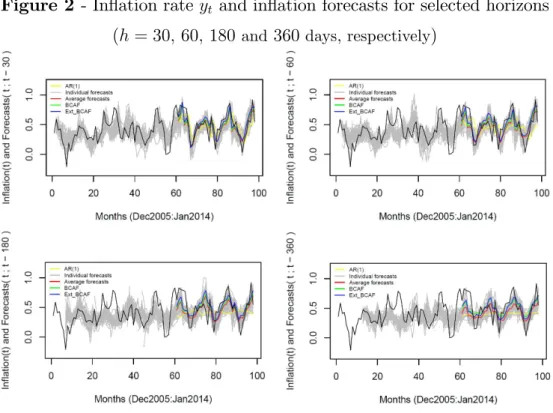
of 0:621 – estimated standard error of 0:068. Figure 2 plots monthly in‡ation and the respective daily forecast for survey respondents at horizons h = 30;60;180;360
days. It also presents the AR(1) forecasts, the average forecasts, the BCAF, and
the extended BCAF, at these same horizons.
Figure 1 - CPI in‡ation rate in Brazil (yt)
Monthly (left plot) and twelve-month (right plot) accumulated rates (%)
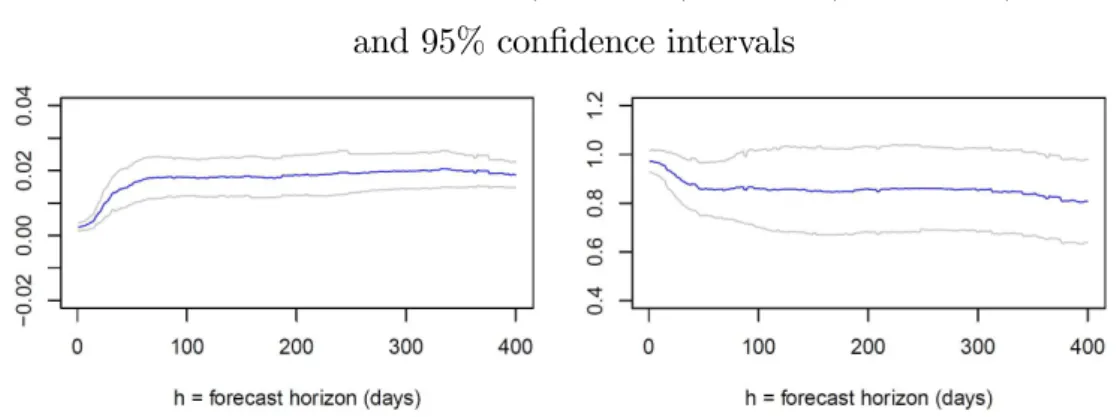
Table 1 reports GMM estimates for the extended BCAF. Although estimates of the average intercept are close to zero, and estimates of the average slope are close to unity, they are all highly signi…cantly di¤erent to zero at any given horizon.
A Wald-test for zero average intercept and unity average slope highly rejects the null at all horizons, showing the usefulness of the approach proposed in this paper. Figure 3 plots these two estimates across daily (working days) horizons with 95%
Figure 2 - In‡ation rate yt and in‡ation forecasts for selected horizons
(h= 30;60; 180 and 360 days, respectively)
Note: Yellow lines present the AR(1) forecasts. Gray lines show the forecastsfi;th of survey participanti
foryt made at periodt h: Red lines represent the average forecast, and the green and blue lines show,
respectively, the BCAF and the Extended BCAF forecasts. Black line is the in‡ation rateyt:
Table 1 - GMM estimation results
horizon h (days) kbh ch Wald test (p-value) OIR test (p-value)
10 0:0036
(0:0009) 0(0::96380276) 1:1E 13 0:7059
20 0:0071
(0:0016) 0(0::93120399) 3:0E 12 0:7038
30 0:0118
(0:0026) 0(0::89290481) 7:5E 16 0:6237
60 0:0173
(0:0033) 0(0::85410583) 9:6E 11 0:6532
90 0:0180
(0:003) 0(0::86470763) 1:8E 12 0:7095
180 0:0176
(0:003) 0(0::84860884) 2:8E 11 0:6884
360 0:0199
(0:0025) 0(0:8275:088) 2:9E 15 0:5893
Note: Robust standard errors in parentheses. Wald test refers toHo: [kh; h] = [0; 1]:
Figure 3 - Estimates kbh (left panel) andch (right panel)
and 95% con…dence intervals
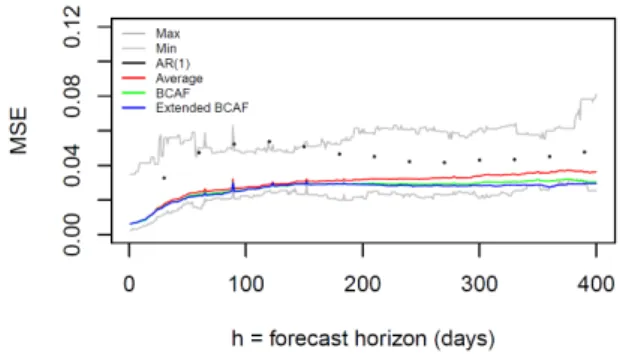
We compare the out-of-sample MSE of each of the four forecast methods em-ployed here: the AF, the BCAF, the extended BCAF and the AR(1) model as well
as the minimum and maximum MSEs across all survey respondents included in our sample. Figure 4 plots the daily results for these methods17. The …rst interesting
feature is the comparison between the AR(1) model and the forecast-combination
techniques discussed here – the AF, the BCAF, and the extended BCAF. Strikingly, notice that the AR(1) model is usually close to upper bound of the MSE, while the …rst three methods are all close to the lower bound. This shows that forecast
combi-nation works in practice – in our case, the optimal combicombi-nation of survey forecasts. These are exactly the results obtained by Ang et al. (2007) and Faust and Wright (2013).
Next, when we compare the MSE of the four methods discussed above there is an obvious pecking order: the extended BCAF is superior to the BCAF, which in turn dominates the AF, which in turn dominates the AR(1) model. This validates the
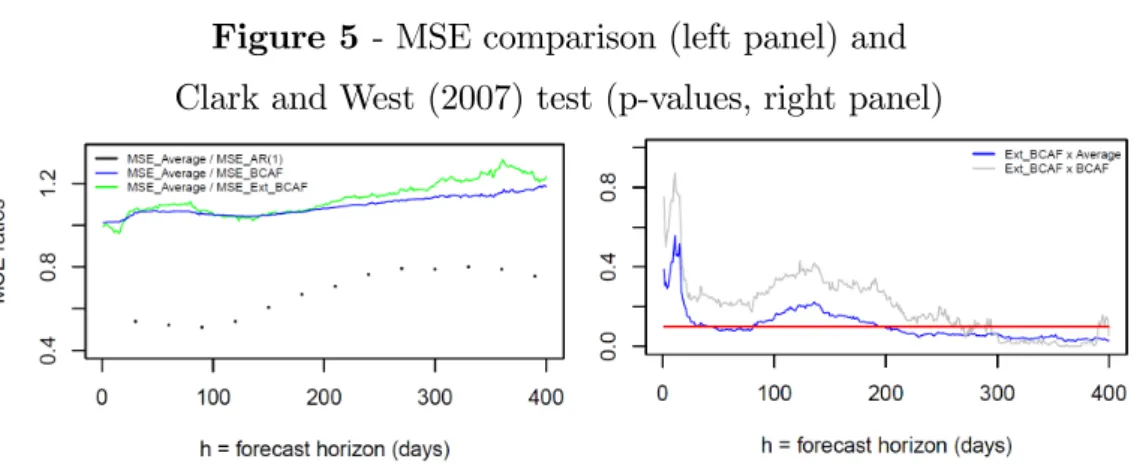
view that the bias corrections performed either by the BCAF, or by the extended BCAF, are a useful device for forecasting using surveys. As shown in Table 2 and Figure 5 (left panel), when we compare the extended BCAF, or the BCAF, with
the AF, forecasting MSE reductions can reach up to 25% at some horizons for the extended BCAF, and can reach up to 15% for the BCAF, although they are usually at the 10%-15% range. Reductions vis-à-vis the MSE associated with forecasts of
the AR(1) model for in‡ation can reach up to 50% for the extended BCAF.
Figure 4 - Mean Squared Error (MSE)
Note: Max (Min) denotes the maximum (minimum) MSE, for each horizon,
across all forecasters. Average refers to the MSE of the consensus forecast.
Table 2 - Mean Squared Error (MSE)
horizon h (days) AR(1) Average
Forecast BCAF
Extended
BCAF
30 0:0328
[0:000] 0(0:0177:105) 0(0:0166:247) 0:0164
60 0:0475
[0:001] 0:(00248:081) 0(0:0234:206) 0:0226
90 0:0523
[0:005] 0(0:0267:119) 0(0:0254:261) 0:0249 180 0:0466
[0:049] 0(0:0312:124) 0(0:0294:297) 0:0293 270 0:0415
[0:046] 0:(00328:056) 0:(00293:099) 0:0281 360 0:0452
[0:019] 0:(00357:028) 0:(00309:000) 0:0275
Notes: The second column shows [in brackets] the p-values of the equal variances’ test of Diebold-Mariano (1995)
between the AR(1) and the Extended BCAF. The third and fourth columns show (in parenthesis) the p-values
of the equal-predictive accuracy test of Clark and West (2007), which compares the Extended BCAF
and the forecast in each column. In all cases, * indicates a rejection of the null at a 10% level.
Finally, we test whether or not forecast errors di¤er in a statistical sense.
Fig-ure 5 (right panel) presents the equal-predictive-accuracy test of Clark and West (2007) for nested models at di¤erent horizons. Results suggest that, vis-à-vis the average forecast, both bias-correction devices (BCAF and the extended BCAF) can
statistically reduce (at the 10% signi…cance level) out-of-sample MSE for horizons above 9 months, and marginally reduce the MSE for h ranging between 1 and 3 months. The Clark-West test also indicates that the extended BCAF can
(h > 10 months). Comparisons of the extended BCAF with the AR(1) model us-ing a Diebold-Mariano test for equal variances shows that the former is statistically
superior to the latter (at the 10% signi…cance level) at all horizons.
Figure 5 - MSE comparison (left panel) and
Clark and West (2007) test (p-values, right panel)
Note: On the right panel, the red line represents a p-value of 0.10 and Ho: equal predictive accuracy.
4
Conclusion
In a world where there is an increasing availability of reliable data provided elec-tronically, it is interesting to examine how one could e¢ciently use this wealth of
information – big data. Our focus here is on the abundant information contained in expectation surveys that can now be built on thousands (or millions) of respondents on an almost continuous-time basis, and how it can be used e¢ciently for forecasting
purposes. We think of this problem as having two layers. In the …rst layer, there is the decision of survey respondents on what forecast should be supplied, consid-ering a given target variable of the survey. On the second layer, there is a user of
the survey who wants to forecast e¢ciently the target variable using all the survey information. We think of the latter as the econometrician.
For the decision in the …rst layer, we employ standard microeconomic and
econo-metric techniques to model the optimal survey response. Under suitable conditions that are standard in the literature, we show that the optimal forecast of a given survey respondent is an a¢ne function of the conditional expectation of the target
variable of the survey. Assuming that the …nal user of that information has a mean-squared-error (MSE) risk function, we show how to estimate the optimal forecast (conditional expectation) from the point-of-view of the econometrician. Our