Analytical
description
of
hadronic integral
spectra
of
cosmic-ray superfamilies
with Feynman
scaling breaking
J.
Bellandi,C.
G.
S.
Costa,R.
J.
M. Covolan,C.
Dobrigkeit,I .
M. Mundim, andC.
Salles Instituto de I"musica Gleb Wataghin, Universidade Estadual de Campinas, 13083-970,Campinas, Sao Paulo, BrasilInstituto de Ecsica Teorica, Universidade Estadual Paulista, 01/5-900, Sao Paulo, Sao Paulo, Brasil (Received 6 April 1994)
We describe charged hadronic energy spectra of the cosmic-ray superfamilies named Ursa Maior and P3'-C1-890,detected by the Chacaltaya and Pamir Emulsion Chamber Collaborations, respec-tively, using analytical solutions for the di6'usion equations. We obtain avery good description of these events incorporating Feynman scaling breaking in the multiparticle production model ofour cascading formalism. Centauro exotic events are also investigated.
PACS number(s): 13.85.Tp, 96.40.De
I.
INTRODUCTION
Superfamilies ofcosmic radiation [1]have
attracted
the attentionof
many emulsion-chamber experimental col-laborations [2,3],
because among them the most energetic shower events produced in the atmosphere are found [4], as well as the challenging and not yet well understood exotic events, such as Centauro events [1,5].
In the extremely high energy region (with energies in the laboratory system above 1000 TeV), the cosmic-ray families detected in emulsion chambers are &equently ac-companied by
a
"halo,"
i.e.
,auniform blackeningof
thex-ray film around the central core. The first observa-tion.
of
a
huge halo event was "Andromeda,"
detected in 1969at
Chacaltaya chamber No. 14 [6], whose to-tal visible (hadronic and electromagnetic) energy wasPE„";,
21000
TeV(y
s6.
5 TeV, in the center-of-mass system). This is still far beyond the energy re-gionof
the most powerful particle accelerators now in operation. However, there are superfamilies with a total visible energy(of
the off-halo part) at the frontiers now reached by colliders, such as the family "Ursa Maior,"
withg
E;,
=
2174 TeV(~s
=
2 TeV) detected by the Brazil-Japan Collaboration [7] and the event"P3'-Cl-B90,
"
withP
E„;,
=
1042TeV(~s
=
1.
4 TeV) detected by the Pamir Collaboration [3].These facts led
to
renewed interest in analyzing such cosmic-ray events, using accelerator-based parametriza-tions, with no need for extrapolations. Oneof
these parametrizations is the multiparticle production spec-trum proposed by Bellandi et al. [8],which was recently reviewed [9]to
fit charged-particle pseudorapidity den-sity distributions collected by the UA5 [10]and UA7 [11] Collaborationsat
the CERN collider, and is foundto
be consistent with collider detector
at
Fermilab(CDF)
measurements
at
the Tevatron collider [12],upto
~s
=
1.
8TeV. The pseudorapidity density parametrization re-Bects the fact that the Feynman scaling law is violated at accelerator energies above~s
=
60 GeV[13],
in both central and fragmentation regions[9].
Another crucial question of concern here is the in-elasticity problem.
It
is discussed in Ref. [9]that thecharged multiparticle distributions referred
to
above im-ply asmooth decreaseof
inelasticity with energy.It
has been shown that sucha
behaviorof
multiparticle produc-tion is not compatible with some cosmic-ray data, such as the altitude dependenceof
the intensityof
electromag-netic component [9], the energy spectrum of nucleonic component [14],and recent data from Fly's Eye experi-ment[15],
all ofthem concerning showers generated by a primary cosmic rayat
the topof
the atmosphere. How-ever, that question still remains unsolved for the case ofsingle-particle generated events, such as superfamilies. Partially, this isbecause there are several mathematical difBculties in solving the dift'usion equations for family shower development, in orderto
perform the proper anal-ysis. Generally, solutionsof
those diffusion equations are written as integrals in the complex plane, requiring ap-proximative methodsof
calculation, such as the saddle-point method(e.
g.,Ref.[16]).
We present in this paper
a
formalism, based on the Feynman procedureof
ordered exponential operators[17],
which enables usto
solve analytically the diffusion equations for the hadronic cascade induced by one sin-gle nucleon in the atmosphere, writing the final solution in the energy configuration space(Sec.
II).
With this solution, we examine inSec.
III
whether or not it is pos-sibleto
describe the hadronic integral spectra ofthe two cosmic-ray families mentioned above, "Ursa Maior" and"P3'-C1-B9Q.
"
First we adopt the Feynman scaling law,just to
see explicitly the problems that arise, and then we use the violationof
scaling as stated by the multiparticle production spectrumof
Ref.[9].
In the latter case, it is necessaryto
choose proper distributions forthe nucleonic and pionic elasticities. The formalism used to describe the two previous families is also appliedto
investigate the event "CentauroI.
"
Finally, inSec. IV,
we present our discussion and concluding remarks.II.
ANALYTICAL SOLUTION OF
SUPERFAMILY DIFFUSION EQUATIONS
In order
to
analyze the charged hadronic integral spec-trum for those family events by means of the50 ANALYTICAL DESCRIPTION OFHADRONIC INTEGRAL.
. .
6837 cal solutionsof
the dHFusion equations we assume herethat
(i)we have only nucleons and pions in the hadronic cascade; (ii) the leading particle model is adopted, and(iii) there is
a
consistency condition between the leading charged nucleon and the charged multiparticle produc-tion distributions, in the sense that the mean charged nucleon elasticity(o~)
is relatedto
the average inelas-ticity(K)
for the charged multiparticle production by(oiv)
+
(K)
=
1.
(iv) We neglect the productionof
pions by pions and the pionic decay.Let
F;(E,
Ep,t,
tp)dEdt
(withi=
N,7r) be thenucle-onic or pinucle-onic flux with energy between
E
and(E+
dE),
at
the detection level betweent
and(t
+
dt), for the cas-cade generatedat
atmospheric depth tp bya
single nu-cleon (here supposedto
bea
proton) with definite energyEp.
The diffusion equations aredoN
(Et
Eptt,
tp)=
—
F~(E,
Ep,tt tp)+
f
(trav) FN(E/a~t
Eptt,
tp)d& '
''
AN ' ' ' AN p &NdF
1 1 do~(E,
Ept,
tp)=
—
—
F
(E
Ept,
tp)+
—
f
(0' )F
(E/O,
Ep,t
'tp)
+
g~
(E,
E
)F~(E,
Ep,t
tp)dE',
N E (2)
where A;are the average interaction mean &eepaths, here assumed Aiv
=
80 g/cm2 and A=
120g/cm2;f(o';)
are the elasticity fiuctuation functions; and ger
(E,
Ep) is the multiparticle production functionof
charged pions by nucleons.The first (second) term on the right-hand side (RHS) of both Eqs.
(1)
and (2)correspondsto
the decrease (in-crease)of
the fiux dueto
the difFusionof
leading particles through the atmosphere; the third term on the RHSof
Eq.
(2)isrelatedto
the multiparticle production ofpions by nucleons.The diffusion equations
(1)
and (2) are solved under the boundary conditionsdpi
cr;F;(E,
Ep)=
f(rr;)
F;(E/rr;,
Ep)Eo
Z~F~(E,
Ep)=
g(E,
E
)Fiv(E
tEp)dE,
E
(8)
(9)
ofordered exponential operators
[17].
This is done com-bining the method already appliedto
the solutionof
the hadronic diffusion equations, subjectedto
a
power-law energy spectrum as boundary condition[18],
with that appliedto
solve the nucleonic cascade, induced by one single nucleon[19].
We first introduce the operators
0;
(i
=
N,7r) andZ~,
defined by
Frtr
(E,
Ep,t
=
tp)=
b'(E—
Ep),
F
(E,
Ep,t
=
tp)=
0.
(8)
(4) thesothat theform diffusion equations
(1)
and (2)are written inf
((r;)=
(1+
p;)
0~' (i=
N, 7r), so that the average elasticities are given by(5) Following condition (iii),we choose forthe charged nu-cleonic and pionic elasticity fluctuations the normalized distributions
BFN
(E,
Ep,t,
tp) BtBF
(E,
Ep,t,
tp) 1[1
—
o'iv]F~(E,
Ep,t,
tp),(10)
~N 1
—
—
[1—
0']F
(E,
Ep,t,
tp)A
+
ZitrFm(E, Eot,
to)N
(0;)
=
1+p;
'
(i
=
N,7r).2+P;
(6) which have the formal solutionsIn the special case
P~
=
0 the elasticity distribution is uniform, so the mean elasticity is equalto
0.
5, and therefore condition (iii) is not necessarily true, depend-ing on the value of(K).
To make sure condition (iii) is satisfied, we get for the parameterP~
the expression(t
t,
)—
t"to(R,
Ro,t,
to)=
expI
—
~N )1—
8'x])
x
F~(E,
Ep,t
=
tp);(12)
(t
—
z)(R, Eo,
tto)
=
dz exp ,—
Ite
)]
Cp(K(Ep))
—
2 (7)1
x
Z~Fjy(E
Ep z, tp).~N where
(K(E))
is the mean inelasticity for the chargedmultiparticle production.
The solutions of Eqs.
(1)
and (2) can be obtained with-out any approximations, usinga
Feynman-like procedureThe explicit solution for the nucleonic component was already calculated in Ref. [19]and, with little modifica-tions
to
include the more general elasticity distribution,T„(
E
5'+~"
F~(E,
Ep,t,
tp)=
e"
b(E
—
Eo)
+
EEo)
2
Ii
(up)1+
vo
where
Ii(u)
is the modified Bessel function offirst order andt
—
toTN
AN
uo
=
2[(1+
A)
T~ ln(Eo/E)]
~For the pionic component we note that the formal solution given by
Eq. (13)
can be written asF
(E,
Ep,t,
tp)=
dE"
exp—
(1
—
(T )b(E
—
E")
'
dz~'
„(t
—
z)tp
~
EEp
x
dE'
Zwb(E
—
E
)FN(E,
Eo,
z, to)Etr
We know, by
Eq. (14),
the solution forF~(E',
Ep, z, tp), making the changesE
mE'
andt
mz.
From the definition of the operatorZ~,
Eq. (9),
it is easy to see thatZ~ h(E"
—E')
=
g(E" —
E').
So, it is left
to
us to identify the term in curly brackets on the right-hand side ofEq.
(15).
But
it is exactly the expression of the formal solution for the nucleonic component,Eq. (12),
provided we make the substitutionsEo
-+E
t—
ZTN
~
PN~P.
Putting it all together and performing some integrations, we can finally write the explicit solution for the pionic component, in the energy configuration space, without any mathematical approximation:
F.
(E,
E„t,
t.
)=
gN(E,
E,
)[e-
-
—
e-
"
(1
~ ~ (
~)
( ) (
A~ A u
Eo dE(
E
i+Prv,
,
Aivz
E
(Eo)
&srT(z)
f
,
,
A~z
E"
z„E
qE")
+~-((E")
qE')
+~t
—
z z—
tp 2Ii(u
) 2Ii(uN)
(N
where we used
4
—
t,pT
T(z)
=—
+
Z to(1+P„)
'
'
»(E'/E)
A~
u
=
2(1+@
)ln(E'/E)
u~
=
2(1+/3~)
ln(E'/E")
~N
u
=
2(1+@
)ln(E"/E)
50 ANALYTICAL DESCRIPTION OFHADRONIC INTEGRAL.
. .
6839The integral Bux
of
hadrons is easily calculated from Eqs.(14)
and(16):
Ig()E,
Ep,t,
tp)=
dE'
[F~(E',
Ep,t,
tp)+
F
(E',
Ep,t,
tp)].
(i7)
III.
COMPARISION
WITH EXPERIMENTAL
DATA
A.
Multiparticleproduction
with Feynman scalingOhsawa and Yamashita [16]have proposed, in accor-dance with accelerator data on pp
-+
n'+
X
[20], anern-pirical expression for the production spectrum
of
charged pions in multiparticle production, respecting Feynman scaling[21].
It
can be written as5
E
dE
g~
(E,
Ep)dE
=
—
1—
3 0
This expression leads
to
a
constant mean inelasticity(K)
=
1/2.
Energy conservation imposes(0;)
=
1/2 and, in this case, the simplest choice is the uniform distribu-tion for the elasticities,f(o;)
=
1.
We compare now the integral energy spectrum of hadrons, calculated by
Eq.
(17),
with the experimental data for the family Ursa Maior, as shown inFig.
1.
The spectr»m is presented in fractional form, that is, asa
function
of
thetotal
hadronic visible energy:E~
h
E7
h-4
5
(Epi
(Epi
E
dE
ger
(E,
Ep)dE
=
—
IE
(Es)
(Ea
(20) The parameters used in
Eq.
(20) are those obtained by Ohsawa and Sawayanagi [9], adjusted to fit the pseudo-rapidity distribution dN/dry data measured at the accel-erator energies+a
=
53, 200, 546,630,
and 900 GeV:0,
=
0.
11)Eg
—
—
3.
4x
10 GeV,a'
=
0.
17,Ez
—
9.
6x
10 GeV.To compare the analytical result with experimental data we need
to
specify values for the parametersP;
in the elasticity nuctuation distributions. We choose three different situations, combining nucleonic and pionic dis-tributions.Case
(1)
"Uniform:"P~
=
P~=
0 so that (oN)=
oURSAMAIOR
———-Sculine%F
$rmling +peaking
100—
The hadronic visible energy E&~ is the energy
of
hadrons detected by means
of
the electromagnetic show-ers induced by p rays &om m decay.It
is relatedto
the actual energyof
the hadron Eh by the so-called gammainelasticity" k~, sothat 10—
Eh
—
A:~Eh(19)
(FS).We use here, for the gamma inelasticity, the mean value
(k,
)=0.
25.
The best fit calculation using Feynman scaling multi-particle production,
Eq.
(18),
is indicated by the dotted curve inFig.
1 (labeledFS).
TheSee
parameters were the primary nucleon visible energy Ez~ and the interac-tion height in the atmosphere(t
—
tp).We see that it is not possible
to
describe these emulsion-chamber family data adopting the Feynman scaling law,at
such high energies.B.
Violationof
Feynman scalingFor the violation
of
Feynman scaling in multiparticle production we take the parametrizationof
Bellandi et al. [8],(U)
(A)
10 10
fh=Eh IXEh
I
10 10
(~-)
=
1/2.
Case (2) "Asymmetric:"
P~
=
(~(&)~—
2andP
=
0 so that(o~)
=
1—
(K(Ee))
and(o'„)
=
1/2.
Case
(3)
"Symmetric:" Piv=
P
=
(~(& )~—
2 so that (oiv)=
(o )=
1—
(K(Eo)),
where the valueof
(K(Eo))
iscalculated consistently with the multiparticle production spectra [8]:(21)
We may now turn back
to Fig.
1 and compare our calculations with the hadronic integral spectrumof
Ursa Maior. There are three different full curves representing the best fitto
experimental data, for eachof
the three cases of elasticity distribution: (U)=
uniform, (A)=
asymmetric, and(S)
=
symmetric.Again the adjusted parameters are the primary particle visible energy
Eo,
which isrelatedto
the primary energy EobyEq.
(19),
and the interaction height (t—
te),
which describes the path developed by the cascade between the depthof
primary interaction, to, and the detection levelt
measured in units ofg/cm2. For
Mt.
Chacaltaya we havet
=
540 g/cm2. The results obtained by the fit for the different casesof
elasticity distributions are presented in TableI.
We realize that the introduction
of
scaling breaking in multiparticle production makes it possibleto
achieve a very good descriptionof
the experimental data, for all combinationsof
elasticity distributions. Even so, little differences amongy
values result froma y
minimiza-tion by using the CERN routine MINUIT (as indicated in TableI),
showing a slight preference for the symmet-ric case. In fact, the assumption thatf
(o~)
=
f
(o ) is in accordance with a previous analysis [18]of
Mt. Fuji Collaborationdata.
This casealso leadsto
the lowest pri-mary visible energy Ez~ ——4920 TeV, which correspondsin the
c.
m. system(c.
m.s.
)to
the primary particle en-ergyof
vts 6TeV. In TableI
we also see that all the fitsto
Ursa Maior data leadto
the same value of interaction height,(t
—
t&&)=
540 g/cm2, corresponding tothe wholeatmosphere above the emulsion chamber.
In
Fig.
2 we show the results for the familyP3'-C1-B90,
detectedat
Pamir(t
=
596 g/cm2). Again, the symmetric case leadsto a
lower primary visible energy,EJ =
1140
TeV (see TableI),
corresponding in thec.
m.s.
to the primary energy v/s
=
3 TeV. The interaction10 10
heights obtained by the fits range from (t
—
to)=
596 g/cm (the whole atmosphere above the detection level),to
(t—
to)=
402 g/cm (for the symmetriccase).
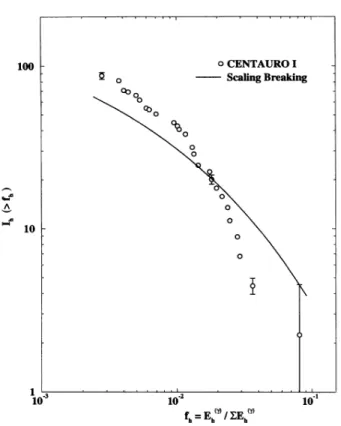
Although exceptional results obtained here for the emulsion-chamber superfamilies, with a total visible en-ergy around 2000 TeV, exotic events are not well de-scribed on the same basis, even iftheir total energies are not very high. In
Fig.
3 we show the experimental dataof
the event CentauroI,
detectedat
Mt. Chacaltaya by the Brazil-Japan Collaboration, which hasZE;, =
330 TeV, comparedto
the tentativeto
fit data adopting viola-tion of the scaling law, together with symmetric elasticity distributions.FIG.2. Integral energy spectrum ofhadrons for the cos-mic-ray family P3'-Cl-B90 (ZEz~
—
—
230 TeV), detected at Mt. Pamir (t=
596 g/cm).
Full curves are an analytical fit, with violation of the scaling law, for the three cases of elasticity distributions discussed in the text: (V)=
uniform, (A)=
asymmetric,(S)
=
symmetric.TABLE
I.
Parameters obtained from the fits to integral energy spectrum ofhadrons displayed in Figs. 1,2, and 3.Event Ursa Maior
P3'-C1-890 Centauro I
Scaling Uniform Asymmetric
Symmetric Uniform Asymmetric
Symmetric Symmetric
Es~ (TeV) 84200 23000 8680 4920 6730 2340 1140 2110
t
—
tp (g/cm )540 540 540 540 596 568 402 540
piv
0 0 1.35 1.23 0
1.
09 0.961.
07 p0 0 0
1.
23 0 0 0.961.
07x'
82.4
4.8
2.0 0.6 13.3
5.3
3.
4ANALYTICAL DESCRIPTION OP HADRONIC INTEGRAL.
.
.
68410
oCENTAURQ I
Sealing Breaking
10-1 10
I
10
f„=E„ /XE„
I
10
FIG.
3.
Integral energy spectrum ofhadrons for the cos-mic-ray event Centauro I (ZEz~—
—
330 TeV), detected at Mt. Chacaltaya. The full curve is the analytical fit, with viola-tion ofthe scaling law, for the symmetric case ofelasticity distributions.IV.
DISCUSSION
We have obtained analytical solutions for the diffu-sion equations
of
the hadronic cascade induced by one single nucleon in the atmosphere. With these solutions we calculated the hadronic integral spectrum in orderto
describe emulsion-chamber experimental data &om the superfamilies Ursa Maior
(Mt.
Chacaltaya) andP3'-Cl-B90 (Mt.
Pamir).We have also shown
to
what extent Feynman scaling combined with our cascading formalism failsto
describe these experimental data (curveFS
inFig.
1).
It
was also demonstrated that an excellent agreement between those cosmic-ray data and our analytical calculation can be achieved incorporating scaling breaking inthe rapidity density distributions. So, itbecomes clear &omthis anal-ysis that our formalism requires Feynman scaling break-ingto
describe ultrahigh energy events initiated by one single nucleon in the atmosphere.The multiparticle production model used here implies
a
smooth decreaseof
mean inelasticity with energy.It
must be emphasized that in this model the parametriza-tion for rapidity distributions was obtainedto
6t
data from the CERN Intersecting Storage Rings(ISR)
and Super Proton Synchrotron(SPS),
rexnaining consistent with data upto
Fermilab Tevatron energies. However, the behaviorof
the mean inelasticityat
superigh ener-gies isa
rather controversial subject and it is beyond the scopeof
this workto
face this question ina
detailed way(about this problem, see Ref. [22] and references quoted therein). In the present case, the reason for obtaining such agreement between our theoretical results and the experimental superfamily data is probably due
to
the en-hancementof
the leading particle effect, implied by the rapidity distributions borrowed from Ref.[9].
In fact, it can be seen &omFig. 1, Fig.
2, andFig.
3 that the experimental point with the highest fx, falls apart from the others in the energy spectr»m, indicating the exis-tenceof a
strong leading particle effect. This impliesa
large mean elasticity for the events. Our calculations reflect this fact in the values obtained forP.
From Ta-bleI,
we see that the values lie near (P)—
1,
in the symmetric case[f(a~)
=
f(0
)],
which is the most fa-vorable one. Accordingto Eq.
(5) this corresponds toa
linear growing distribution ofelasticity,
f(0)
2n, fa-voring collisions with high elasticities. Actually, &om an experimental analysisof
isodensitometric maps for huge halo events [3], it is concluded that these shower clusters are strongly penetrative, indicatinga
dominant leading particle effect.Finally, we mention that other high energy cosmic-ray families were tested and similar results were found provided the total visible energy
of
the event is around 2000 TeV so that the parametrization for the multi-particle production spectra remains within its validity range. However, we see that tentativesto
reproduce ex-otic events, such as CentauroI,
under the same basis stated above, were not successful. The reason is that those exotic events consist mostlyof
baryons, witha
still unexplained lackof
p rays, anda
more complex treat-ment hasto
be considered [23]. Remembering that the most energetic experimental point in the integral spec-trum of CentauroI
hasa
very large error bar, centered near Ih=
2 (seeFig.
3),
we suggest the possibility that there are two energetic nucleons inthe development of the cascade which could be treated analytically by introduc-ing the productionof
nucleons by nucleons. Another way offacing this problem should beto
consider Centauro-like events asa
resultof
the interactionof
heavier primaries with the atmosphere. In fact, the studyof
the chemical compositionof
the primary cosmic radiation around and above the "knee" of the spectrum (& 3000 TeV) suggestsa
mixed composition with higher &actionof
heavy nu-clei than at energies below this region[15].
In any case, both possibilities would require the development ofnew formalisms, modifying our premises ina
substantial way. In orderto
improve our knowledge and understanding about this subject, there is also the needof
more datato
be analyzed, mainly in the &agmentation region.
ACKNOWLEDGMENTS
We thank Professor Akinori Ohsawa (University of Tokyo) for useful coxnments on the multiparticle pro-duction model. This work was partially supported by
[1]
[2]
[3]
(4] [5]
[6]
(7)
(8)
[9] [10]
C.G.M. Lattes,
Y.
Fujimoto, andS.
Hasegawa, Phys. Rep.85,
151(1980).Pamir Collaboration, Mt. Fuji Collaboration and Cha-caltaya Collaboration,
S.
G.Bayburina eta/.,Nucl. Phys.B1$1,
1(1981).
Chacaltaya and Pamir Collaboration, L.
T.
Baradzei et al. Nucl. Phys.B370,
365(1992).S.Yamashita,
J.
Phys. Soc.Jpn. 54, 529 (1985). Brazil- Japan Collaboration,J.
A. Chinellato et al., inProceedings ofthe
XXI
International Cosmic Bay Con ference, Adelaide, Australia, edited by R.J.
Protheroe (Graphic Services, Northjeld, South Australia, 1990), Vol. 8,p. 259.Brazil Group,
C.
G.M. Lattes et cl.and Japan group, M. Akashi et al.,Prog. Theor. Phys. Suppl. 47,1(1971).
J.
A.Chinellato, Ph.D. thesis, Universidade Estadual de Campinas, 1981.J.
BellandiF-,
S.
Q. Brunetto,J.
A. Chinellato, C. Do-brigkeit, A.Ohsawa,K.
Sawayanagi, andE.
H. Shibuya, Prog. Theor. Phys.83,
58 (1990).A. Ohsawa and
K.
Sawayanagi, Phys. Rev. D 45, 3128 (1992).UA5 Collaboration, G.
J.
Alner et al., Z. Phys. C33,
1(1986).
UA7 Collaboration,
E.
Pare et al., Phys. Lett.B
242,531(1990).
[12]
F.
Abe et aL,Phys. Rev. D41,
2330(1990).[13]
J.
Wdowcsyk and A.Wolfendale, Nuovo Cimento A 54, 433(1979);J.
Phys. G10,
257 (1984);13,
411(1987). [14]J.
Bellandi, L.M. Mundim,J.
Dias de Deus, andR.
J.
M.Covolan,
J.
Phys. G18,
579 (1992).[15]
T.
K.Gaisser et al.,Phys. Rev. D 47, 1919(1993).
[16]A. Ohsawa and S.Yamashita, Prog. Theor. Phys.
77,
1411 (1987).
[17]R. P.Feynman, Phys. Rev.
84,
108(1951).
[18)
J.
BellandiF-,
S.Q. Brunetto,J.
A. Chinellato, R.J.
M. Covolan, C.Dobrigkeit, and M.A.Alves, Nuovo Cimento C14,
15(1991).
[19]
J.
Bellandi, R.J.
M. Covolan, C. Dobrigkeit, C.G.S. Costa, and L.M.Mundim,J.
Phys. G18,
1559(1992).[20)
J.
R.Johnson,R.
Kammerud,T.
Ohsugi, D.J.
Ritchie,R.
Shafer, D. Theriot,
J.
K.
Walker, andF.
E.
Taylor, Phys. Rev. D17,
1292 (1978).[21]R.P. Feynman, Phys. Rev. Lett.
23,
1415(1969).[22]