ACPD
11, 10403–10448, 2011Regional impacts on ozone in Tokyo
M. Yoshitomi et al.
Title Page
Abstract Introduction
Conclusions References
Tables Figures
◭ ◮
◭ ◮
Back Close
Full Screen / Esc
Printer-friendly Version Interactive Discussion
Discussion
P
a
per
|
Dis
cussion
P
a
per
|
Discussion
P
a
per
|
Discussio
n
P
a
per
|
Atmos. Chem. Phys. Discuss., 11, 10403–10448, 2011 www.atmos-chem-phys-discuss.net/11/10403/2011/ doi:10.5194/acpd-11-10403-2011
© Author(s) 2011. CC Attribution 3.0 License.
Atmospheric Chemistry and Physics Discussions
This discussion paper is/has been under review for the journal Atmospheric Chemistry and Physics (ACP). Please refer to the corresponding final paper in ACP if available.
Contributions of regional and
intercontinental transport to surface
ozone in Tokyo
M. Yoshitomi1, O. Wild2, and H. Akimoto3
1
Department of Earth and Planetary Sciences, Harvard University, Cambridge, MA, USA
2
Lancaster Environment Centre, Lancaster University, Lancaster, UK
3
Asia Center for Air Pollution Research, Niigata, Japan
Received: 16 December 2010 – Accepted: 17 March 2011 – Published: 1 April 2011
Correspondence to: M. Yoshitomi ([email protected])
ACPD
11, 10403–10448, 2011Regional impacts on ozone in Tokyo
M. Yoshitomi et al.
Title Page
Abstract Introduction
Conclusions References
Tables Figures
◭ ◮
◭ ◮
Back Close
Full Screen / Esc
Printer-friendly Version Interactive Discussion
Discussion
P
a
per
|
Dis
cussion
P
a
per
|
Discussion
P
a
per
|
Discussio
n
P
a
per
|
Abstract
Japan lies downwind of the Asian continent and for much of the year air quality is di-rectly influenced by emissions of ozone precursors over these heavily-populated and rapidly-industrializing regions. This study examines the extent to which oxidant trans-port from regional and distant anthropogenic sources influences air quality in Japan
5
in springtime, when these contributions are largest. We find that European and North American contributions to surface ozone over Japan in spring are persistent, averag-ing 3.5±1.1 ppb and 2.8±0.5 ppb respectively, and are greatest in cold continental outflow conditions following the passage of cold fronts. Contributions from China are
larger, 4.0±2.8 ppb, and more variable, as expected for a closer source region, and
10
are generally highest near cold fronts preceding the influence of more distant sources. The stratosphere provides a varying but ever-present background of ozone of about
11.2±2.5 ppb during spring. Local sources over Japan and Korea have a relatively
small impact on mean ozone, 2.4±7.6 ppb, but this masks a strong diurnal signal,
and local sources clearly dominate during episodes of high daytime ozone. By
ex-15
amining the meteorological mechanisms that favour transport from different source
re-gions, we demonstrate that while maximum foreign influence generally does not occur at the same time as the greatest buildup of oxidants from local sources, it retains a significant influence under these conditions. It is thus clear that while meteorological boundaries provide some protection from foreign influence during oxidant outbreaks in
20
Tokyo, these distant sources still make a substantial contribution to exceedance of the Japanese ozone air quality standard in springtime.
1 Introduction
Air pollution is now recognized as a global issue occurring over hemispheric scales through the intercontinental transport of air pollutants such as tropospheric ozone (O3),
25
ACPD
11, 10403–10448, 2011Regional impacts on ozone in Tokyo
M. Yoshitomi et al.
Title Page
Abstract Introduction
Conclusions References
Tables Figures
◭ ◮
◭ ◮
Back Close
Full Screen / Esc
Printer-friendly Version Interactive Discussion
Discussion
P
a
per
|
Dis
cussion
P
a
per
|
Discussion
P
a
per
|
Discussio
n
P
a
per
|
of greater than a week (Akimoto, 2003; Holloway et al., 2003; TF-HTAP, 2007). Rapid industrialization in China, India and other Asian countries has involved increased
en-ergy consumption, affecting regional-scale air quality in Asia and beyond now and into
the future (Prather et al., 2003; Dentener et al., 2006). Of particular concern is sur-face ozone, the abundance of which has increased to 40–50 ppb in remote continental
5
areas, a level at which it seriously affects air quality in many parts of the northern hemi-sphere (Pochanart et al., 2001, 2002; Lin et al., 2001; Fiore et al., 2002). Regional and
intercontinental transport affect surface air quality in downwind areas (Jacob et al.,
1999; Wilkening et al., 2000; Wild and Akimoto, 2001; Fiore et al., 2002; Jaffe et al.,
2003), particularly at mid-latitudes (Berntsen et al., 1999), and also affect the oxidizing
10
capacity of the atmosphere (Thompson, 1992) and regional climate (Berntsen et al., 1996; Mickley et al., 1999). It is now realized that intercontinental transport may affect local O3air quality, adding to the effects of regional transboundary transport and local
photochemical formation (TF-HTAP, 2007; Fiore et al., 2009). Previous atmospheric chemistry modeling studies have shown that increased precursor emissions in Asia
15
may be sufficient to offset reductions in American emissions and may thereby
counter-act the beneficial effects of air quality controls in the US (Jacob et al., 1999; Yienger et al., 2000; Heald et al., 2003). In addition, regional increases in surface background
O3 and episodic exceedances of O3 air quality standards are likely to damage
agri-culture and human health in China and East Asia, leading to economic damage (e.g.,
20
Mauzerall and Wang, 2001; Wang and Mauzerall, 2004) as many developed countries have already experienced (Lippmann , 1991). Thus, a quantitative understanding of the contributions of inter- and intra-continental transport may be as important for future
air quality policy-making as an understanding of the effects of local emission controls
(Wilkening, 2001; Fiore et al., 2003; Holloway et al., 2003).
25
Japan lies directly downwind of the Asian continent and is particularly susceptible to
emissions from China and other Asian countries. Increases in surface O3have been
ACPD
11, 10403–10448, 2011Regional impacts on ozone in Tokyo
M. Yoshitomi et al.
Title Page
Abstract Introduction
Conclusions References
Tables Figures
◭ ◮
◭ ◮
Back Close
Full Screen / Esc
Printer-friendly Version Interactive Discussion
Discussion
P
a
per
|
Dis
cussion
P
a
per
|
Discussion
P
a
per
|
Discussio
n
P
a
per
|
where measurements of total photochemical oxidants (Ox, predominantly O3) have
in-creased since the 1980s despite strong decreases in the main precursors, nitrogen
ox-ides (NOx=NO+NO2) and non-methane hydrocarbons (NMHCs) (Tokyo Metropolitan
Government, 2005). It is not clear to what extent increased emissions of O3precursors
over China (Irie et al., 2005; Ohara et al., 2007) have influenced this trend, but it is likely
5
that long-range transport of O3from the Asian continent has played a role. However, a
more complete attribution of these observed changes depends on a good understand-ing of the factors affecting O3 over the region, and on a reliable quantification of the
roles of inter- and intra-continental transport, stratospheric influence, and in situ
for-mation in controlling O3, and an understanding of how these factors are controlled by
10
meteorological processes.
The composition of air arriving over Japan is heavily influenced by regional meteorol-ogy. Direct transport of polluted air from the Asian mainland is strongest in springtime and is dominated by the passage of mid-latitude cyclones (Kaneyasu et al., 2000; Bey et al., 2001; Wild et al., 2003; Tanimoto et al., 2005). High levels of pollutants are
15
found in the boundary layer following these frontal systems (Carmichael et al., 1998; Liu et al., 2003; Liang et al., 2004; Sawa et al., 2007), and pollutants lifted by convec-tion and warm conveyor belts in these systems may be rapidly transported across the Pacific (Bey et al., 2001; Stohl, 2001; Heald et al., 2003; Miyazaki et al., 2003) and subsequently detected over North America (Jaffe et al., 2003; Jaegl ´e et al., 2003).
In-20
fluence from more distant sources such as Europe may affect Japan during periods of
post-frontal outflow from Asia (e.g., Liu et al., 2003; Lin et al., 2010), but the
magni-tude and timing of these events remains uncertain. Photochemical production of O3is
greatest in summertime, but over Japan exceedance of urban air quality standards is more common in spring, as the prevailing westerly flow brings continental air with much
25
higher levels of O3 than is present in the tropical marine air from the Western Pacific
ACPD
11, 10403–10448, 2011Regional impacts on ozone in Tokyo
M. Yoshitomi et al.
Title Page
Abstract Introduction
Conclusions References
Tables Figures
◭ ◮
◭ ◮
Back Close
Full Screen / Esc
Printer-friendly Version Interactive Discussion
Discussion
P
a
per
|
Dis
cussion
P
a
per
|
Discussion
P
a
per
|
Discussio
n
P
a
per
|
This study aims to determine how local, regional and distant sources contribute to
surface O3 over Japan in springtime and the extent to which they influence episodes
of high O3 over the Tokyo metropolitan area. We use observations of O3 and CO
from surface measurement sites in Japan and over the Western Pacific in spring 2001 to evaluate a global chemistry-transport model in Sect. 2, and then use the model to
5
determine the contribution of selected precursor emission sources to O3 over Japan
during this period. In Sect. 3 we focus on the mean contribution from these sources
and on their influence during key periods when O3air quality standards are exceeded.
We then examine the meteorological mechanisms that bring this air to Japan in Sect. 4,
focusing on the pathways and timing of transport from the different source regions from
10
a climatological perspective and during transport episodes of particular interest. We conclude by summarizing the influence that regional and intercontinental transport has on springtime air quality in Japan.
2 Model and evaluation against observations
This study uses the Frontier Research System for Global Change (FRSGC) version of
15
the University of California, Irvine (UCI) global chemistry-transport model (CTM) (Wild and Prather, 2000) with the configuration described in Wild et al. (2003). The CTM is driven with pieced-forecast meteorological fields generated with the European Centre for Medium-Range Weather Forecasts Integrated Forecast System (ECMWF-IFS) at a spectral resolution of T159L40 at 3-h intervals, and these data are used here at T63
20
(1.9◦×1.9◦) and T21 (5.6◦×5.6◦) resolution. The model was initialized in January 2000 and run for 16 months at T21 resolution, allowing a 1-yr spin-up and then covering winter and spring 2001. The period from January to April 2001 was repeated at the higher T63 resolution. The spring 2001 period was chosen to coincide with the NASA Transport and Chemical Evolution over the Pacific (TRACE-P) measurement campaign
25
ACPD
11, 10403–10448, 2011Regional impacts on ozone in Tokyo
M. Yoshitomi et al.
Title Page
Abstract Introduction
Conclusions References
Tables Figures
◭ ◮
◭ ◮
Back Close
Full Screen / Esc
Printer-friendly Version Interactive Discussion
Discussion
P
a
per
|
Dis
cussion
P
a
per
|
Discussion
P
a
per
|
Discussio
n
P
a
per
|
Global industrial and fossil fuel emissions of O3precursors used in this study are taken from version 2 of the EDGAR database (Olivier et al., 1996), and emissions for East Asia are updated from Streets et al. (2003); these and other emissions are described in more detail in Wild et al. (2003).
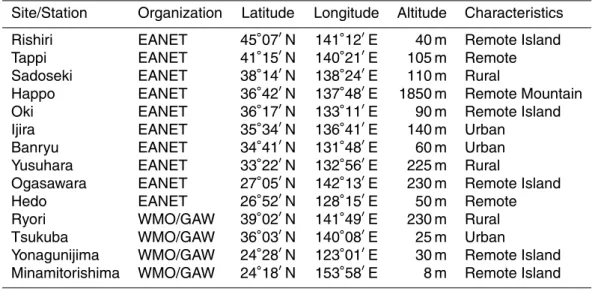
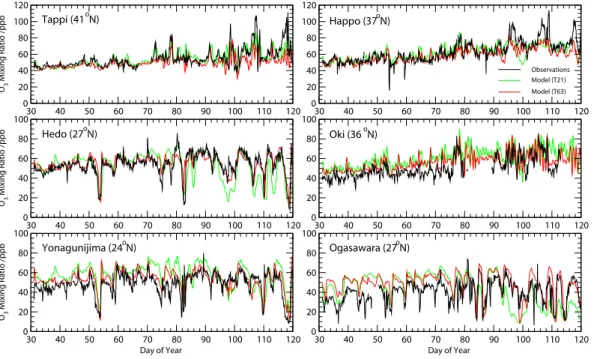
The performance of the model during spring 2001 is evaluated with hourly
observa-5
tional data for surface O3from 10 measurement sites in the Acid Deposition Monitoring
Network in East Asia (EANET) (Network Center for EANET, 2005) and with O3and CO
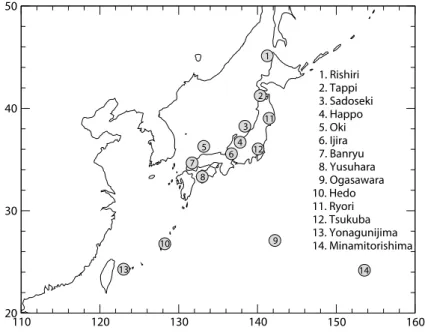
from four World Meteorological Organization/Global Atmosphere Watch (WMO/GAW) stations (Tsutsumi et al., 2006). The location of these measurement sites is shown in Fig. 1 and detailed in Table 1. The sites are loosely classified here as remote, rural or
10
urban based on their chemical environment. Eight clean coastal or mountain sites are categorized as remote, three sites showing strong pollution signatures are designated as urban, and the remaining three sites showing some influence from local sources are denoted as rural.
We first examine the model performance at remote sites which provide an effective
15
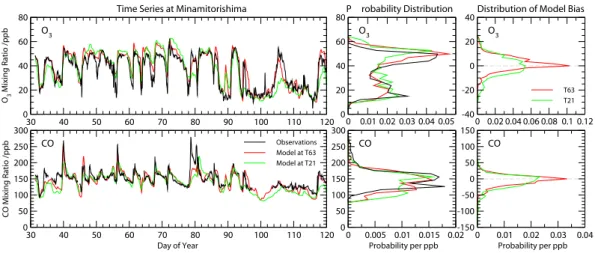
test of the ECMWF-IFS meteorology and the ability of the CTM to correctly represent the chemical environment in clean, background conditions. Figure 2 shows the hourly
timeseries of O3 and CO at Minamitorishima, a remote island lying almost 2000 km
southeast of Tokyo. The prevailing influence in early spring is from continental air masses that have crossed Asia, but this flow is increasingly punctuated by the arrival
20
of clean, marine air masses from the Central Pacific. The variability in O3 and CO in
springtime is largely driven by the interplay between these air masses, and the location and timing of the meteorological features controlling this variability are captured very
well by the ECMWF-IFS model. Surface O3in continental air averages about 50 ppb,
and in marine air averages about 15 ppb, and these abundances are reproduced well
25
ACPD
11, 10403–10448, 2011Regional impacts on ozone in Tokyo
M. Yoshitomi et al.
Title Page
Abstract Introduction
Conclusions References
Tables Figures
◭ ◮
◭ ◮
Back Close
Full Screen / Esc
Printer-friendly Version Interactive Discussion
Discussion
P
a
per
|
Dis
cussion
P
a
per
|
Discussion
P
a
per
|
Discussio
n
P
a
per
|
have shown (Liu et al., 2003; Sawa et al., 2007). The abundance of CO in these environments is captured well by the CTM. The results are not very sensitive to model resolution at this location, although the position of meteorological features is better resolved at T63 where there is less spatial averaging of the input meteorological data, and the model bias is consequently reduced.
5
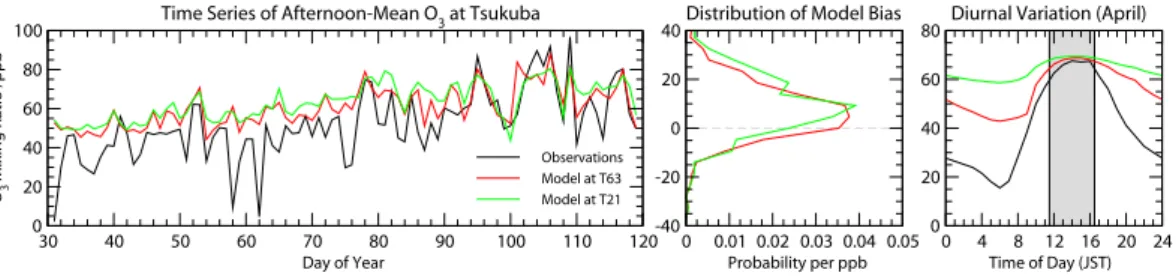
Polluted, continental conditions are more challenging to model but provide a more critical test of emissions, chemistry and deposition processes in the CTM. Figure 3
shows the time series of afternoon-mean surface O3at Tsukuba, a suburban site about
50 km northeast of Tokyo. There is a strong diurnal variation in the observations, with
very low nighttime O3 driven by both surface deposition and direct chemical removal
10
by freshly-emitted NO. Fast chemical removal in the stable nocturnal boundary layer is not reproduced well at the coarse model resolutions used here, but is notably better at T63 resolution (180 km scale) than at T21 (550 km scale) as the artificial mixing of fresh pollutants to the model grid scale is less extensive. The Tsukuba site lies in the same model grid square as Tokyo at both resolutions, but cannot be considered
15
representative of the whole urban area. To minimize the influence of nighttime removal we compare afternoon concentrations (12:00–16:00 h local time) which are dominated
by photochemical production of O3. These values are matched more closely by the
CTM, and while there is still overestimation of all but the highest daytime levels in
February and March, the main features and magnitude of urban O3 are reproduced
20
well in April.
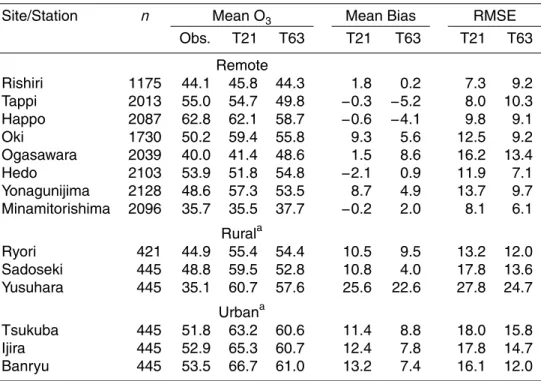
The performance of the model at other locations is shown in Fig. 4, and a statistical summary of the comparisons for the whole February–April 2001 period is given in Table 2. Where observational data are missing due to instrument failure or calibration errors, model data are also removed so that the sampling is identical, and the number
25
ACPD
11, 10403–10448, 2011Regional impacts on ozone in Tokyo
M. Yoshitomi et al.
Title Page
Abstract Introduction
Conclusions References
Tables Figures
◭ ◮
◭ ◮
Back Close
Full Screen / Esc
Printer-friendly Version Interactive Discussion
Discussion
P
a
per
|
Dis
cussion
P
a
per
|
Discussion
P
a
per
|
Discussio
n
P
a
per
|
removal is not captured. The remote site at Yonagunijima lies close to Taiwan and is strongly influenced by urban emissions from Taipei at the coarse model resolutions used here; similarly Oki and the coastal sites of Yusuhara, Sadoseki and Ryori are dominated by marine air flows but are artificially influenced by Japanese industrial
regions in the model. Tappi shows little variability in O3 in air from the continent in
5
February, but experiences high levels of O3 from Japanese sources in April as the
prevailing flow changes. Island sites south of Japan such as Ogasawara, Hedo and
Yonagunijima show the higher variability in O3 characteristic of frontal influence, as
seen at Minamitorishima, although there is a tendency to overestimate O3in continental
air, particularly at T21 resolution. Comparison with CO at the WMO/GAW stations,
10
summarized in Table 3, presents a similar picture, with synoptic features captured well, but there is a small negative mean bias, and CO is underestimated during pollution episodes, contributing to the higher RMS error.
The model run at T63 (1.9◦) resolution generally shows smaller mean biases and
RMS errors than the T21 (5.6◦) run as meteorological features are better resolved, see
15
Table 2. Mean O3 levels are lower at T63 reflecting an overestimation of regional O3
production and background continental O3inherent at the coarser T21 model resolution
(e.g., Wild and Prather, 2006), and the variability is captured better. The performance is poorer at only a few locations, notably at Tappi where the site is less representative
of the model grid box at T63 than at T21, and at Ogasawara, where overestimated O3
20
in continental air is compensated at T21 by too great a marine influence in April. Note that at T21 resolution some of the sites lie in the same model grid box (e.g., Ijira, Oki
and Yusuhara), and therefore show the same variation; these locations lie in different
grid boxes at T63. The following sections of this study focus on model simulations at T63 resolution only.
25
Two of the sites considered here, Oki and Happo, lie upwind of the major Japanese source regions, and may intercept outflow from the Asian mainland before it arrives
over Tokyo. Both sites are strongly influenced by pollution from China, and O3from this
ACPD
11, 10403–10448, 2011Regional impacts on ozone in Tokyo
M. Yoshitomi et al.
Title Page
Abstract Introduction
Conclusions References
Tables Figures
◭ ◮
◭ ◮
Back Close
Full Screen / Esc
Printer-friendly Version Interactive Discussion
Discussion
P
a
per
|
Dis
cussion
P
a
per
|
Discussion
P
a
per
|
Discussio
n
P
a
per
|
The sampling environment at these locations is very different, and O3is overestimated
in the marine boundary layer sampled at Oki but underestimated at the mountain site
at Happo, see Table 2. However, the variations in O3 at these sites and at Tsukuba
are well matched (the correlation between O3 data at Oki and Tsukuba is r2=0.46
in observations and 0.45 in the model; for Happo and Tsukuba, r2=0.53 and 0.52,
5
respectively), demonstrating that background O3 makes a substantial contribution to
the variation in O3 over Tokyo. The seasonal trend at Oki is also well matched, with
an increase in monthly mean O3of 15.3 ppb between February and April (14.6 ppb in
model), but is overestimated at the higher elevation of Happo (14.3 ppb in observations, 22.3 ppb in model) and underestimated in the more polluted conditions at Tsukuba
10
(25.4 ppb in observations, 15.4 ppb in model). During conditions of westerly flow there is a time lag in major features in CO of about 12 h between Oki and Tsukuba, reflecting the timescales for transport of polluted continental air between the sites.
3 Contributions to surface O3and CO over Tokyo
We evaluate the contribution of industrial and fossil fuel sources of O3 precursors to
15
O3 over Japan from five independent source regions: local emissions from Japan and
Korea (JP), regional emissions from China (CH) and southern Asia (SA), and remote emissions from the major source regions of Europe (EU) and North America (NA), see Fig. 5. In addition, biomass burning sources (BB) are considered for southern Asia where peak emissions occur in the February–April period examined here
(Dun-20
can et al., 2003; Streets et al., 2003). These originate from the same region as SA emissions, but the distribution of sources is different, as industrial emissions dominate over India while biomass burning sources are greatest over Thailand and Southeast
Asia. Source contributions are evaluated by removing emissions of NOx, CO and VOC
from each region in turn and comparing the resulting simulation with the control run.
25
ACPD
11, 10403–10448, 2011Regional impacts on ozone in Tokyo
M. Yoshitomi et al.
Title Page
Abstract Introduction
Conclusions References
Tables Figures
◭ ◮
◭ ◮
Back Close
Full Screen / Esc
Printer-friendly Version Interactive Discussion
Discussion
P
a
per
|
Dis
cussion
P
a
per
|
Discussion
P
a
per
|
Discussio
n
P
a
per
|
period was then repeated at higher resolution (T63), and the results from these runs are described here. This method provides a reasonable estimate of source contribu-tions, although non-linearities in O3chemistry prevent a full and accurate attribution of
all sources using this method (see, e.g., Wu et al., 2009). Stratosphere-troposphere
exchange (STE) is also an important source of O3in the northern hemisphere in
spring-5
time, and O3from this source is diagnosed by accounting for the chemical destruction
of O3transported from the stratosphere following the method of Roelofs and Lelieveld
(1997).
The modeled contribution of different source regions to surface O3and CO over the
Tokyo region is shown in Figs. 6 and 7. These results are representative of a 180 km
10
grid box covering a much wider region than the Tokyo metropolitan area, and while they do not capture the heterogeneity of chemical environments close to such a major source region, or nighttime removal, the mean photochemical environment is captured
sufficiently well to reproduce the day-to-day variability in O3 shown in Fig. 3. Ozone
shows an upward trend over the spring period as photochemistry becomes more
ac-15
tive, while CO is at its annual maximum and shows no trend over the period; however these trends are masked by large variability from both local and regional sources. This variability is driven largely by local emissions; for O3it is dominated by the
photochem-ical impacts of local NO emissions over Japan, which lead to production during the daytime and destruction at night, while for CO it is driven by local meteorology and
20
transport processes from sources over Japan. The contribution of Japanese sources
to O3increases from February to April as photochemical activity increases, and there is
also an increase for CO, as weakening of the northwesterly winter monsoon flow allows
increased influence from local sources. Chinese contributions to O3and CO
(averag-ing 4.0±2.8 and 23±13 ppb respectively) are strongly episodic in nature, reflecting
25
regional meteorological patterns, and episodes occur about twice a week on average.
The highest impacts reach 13–15 ppb for O3and 60–80 ppb for CO, and CO from
ACPD
11, 10403–10448, 2011Regional impacts on ozone in Tokyo
M. Yoshitomi et al.
Title Page
Abstract Introduction
Conclusions References
Tables Figures
◭ ◮
◭ ◮
Back Close
Full Screen / Esc
Printer-friendly Version Interactive Discussion
Discussion
P
a
per
|
Dis
cussion
P
a
per
|
Discussion
P
a
per
|
Discussio
n
P
a
per
|
sources like Europe and North America. Chinese contributions to O3and CO are well
correlated (r2=0.82), as shown in Fig. 8, highlighting the good relationship between
emissions of O3precursors and CO and the relatively short timescales for transport to
Japan. The correlation is much weaker for other source regions where O3destruction
and differing transport pathways mask the relationship. The O3/CO ratio from Chinese
5
sources increases from 0.17 to 0.29 between February and April as photochemical ac-tivity increases, similar to that observed over the North Atlantic in outflow from North America (Parrish et al., 1993).
European and North American contributions are less variable, reflecting the greater
transport distances from the source regions. European O3contributions average 3.5±
10
1.1 ppb and rise from 2.5 to 4.1 ppb between February and April, but the contribution
from North America is relatively constant at 2.8±0.5 ppb. Contributions of European
and North American sources to CO average 30 and 20 ppb respectively, and the vari-ability is again less for North American sources. The magnitude and trends of these
O3and CO contributions agree well with a previous study using different emission data
15
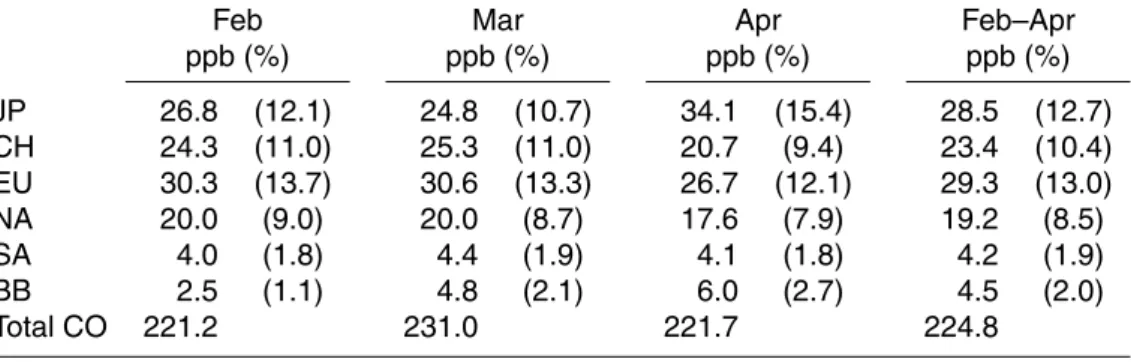
(Wild et al., 2004) and North American CO is similar to but slightly larger than that reported by Liang et al. (2004) who found contributions of up to 15 ppb at Ryori, Yon-agunijima and Minamitorishima in spring. The contribution of industrial and biomass burning emissions from South and Southeast Asia is small at this latitude, averaging
0.5 and 0.3 ppb for O3, respectively, and about 4 ppb each for CO. However, there
20
is one episode bringing 15 ppb of CO from biomass burning sources on 1 February.
In contrast to these surface sources, the contribution from stratospheric O3 is large,
11.2±2.5 ppb, and is highly variable from day to day, exceeding 20 ppb on two
occa-sions. The stratospheric contribution is larger in March than in April, indicating that the
positive trend in surface O3 seen over Japan in spring is driven largely by
photochem-25
ACPD
11, 10403–10448, 2011Regional impacts on ozone in Tokyo
M. Yoshitomi et al.
Title Page
Abstract Introduction
Conclusions References
Tables Figures
◭ ◮
◭ ◮
Back Close
Full Screen / Esc
Printer-friendly Version Interactive Discussion
Discussion
P
a
per
|
Dis
cussion
P
a
per
|
Discussion
P
a
per
|
Discussio
n
P
a
per
|
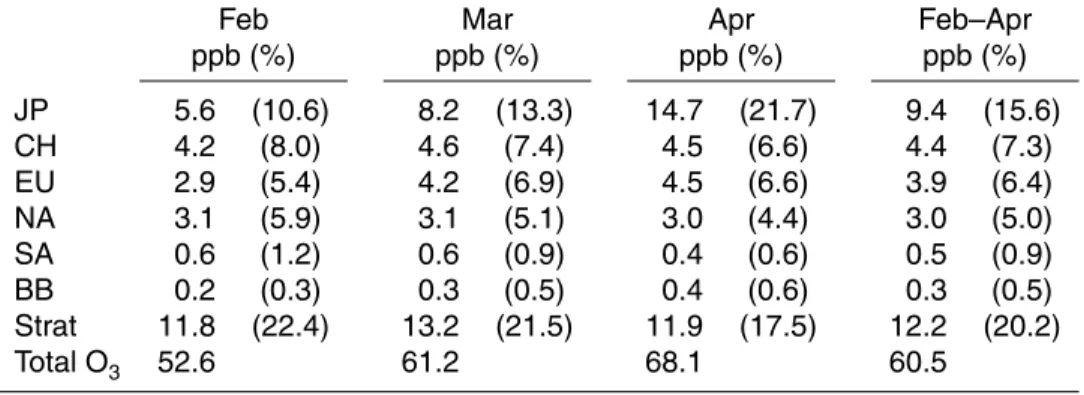
The monthly contributions of the selected source regions to CO and O3 over Tokyo
in spring 2001 are summarized in Tables 4 and 5. Local sources of CO and O3 over
Japan play an increasingly important role during the spring, as photochemistry picks
up and long-range transport from distant source regions weakens. For O3we consider
only the afternoon hours (12:00–16:00 JST) when photochemistry is most active and
5
the boundary layer is relatively deep to avoid the influence of nighttime removal. Local sources dominate, exceeding 20% in April, but this is only marginally larger than the influence of the stratosphere (18%) and the combined impacts of fossil fuel sources over China, Europe and North America (18%). These contributions are similar to those derived for March to May for the whole of Japan by Nagashima et al. (2010), who
10
found contributions from the stratosphere of 21%, from Japanese sources 22%, and from Chinese sources 12%, slightly greater than found here. It is thus clear that
long-range transport makes a large contribution to daytime O3over Tokyo on a mean basis
throughout the spring.
The source contributions are shown in Fig. 9 as a function of the total surface O3
15
to demonstrate their influence during episodes of high O3 over Tokyo. There is a very
high correlation between the Japanese contribution and total surface O3 (r
2
=0.83) indicating that local sources account for most of the variability in O3through their
con-trol over the diurnal cycle, and they also account for much of the day-to-day variability (r2=0.42) reflecting their control over local photochemistry. Chinese sources show a
20
weaker relationship (r2=0.15) but still contribute an average of 5.7 ppb during periods
when O3 exceeds the Japanese 1-hour air quality standard of 60 ppb. European and
North American sources both show a weak correlation, and contribute an average of
4.5 ppb and 3.1 ppb to episodes with O3 exceeding 60 ppb, respectively. These
con-tributions from distant sources are similar to those seen in the summertime boundary
25
layer over the US (Fiore et al., 2002). The stratospheric contribution to surface O3lies tightly between 15 and 33% over the spring period, and although there is a notable
decline when surface O3exceeds 50 ppb, the stratosphere still contributes an average
ACPD
11, 10403–10448, 2011Regional impacts on ozone in Tokyo
M. Yoshitomi et al.
Title Page
Abstract Introduction
Conclusions References
Tables Figures
◭ ◮
◭ ◮
Back Close
Full Screen / Esc
Printer-friendly Version Interactive Discussion
Discussion
P
a
per
|
Dis
cussion
P
a
per
|
Discussion
P
a
per
|
Discussio
n
P
a
per
|
During the highest episodes O3 was observed to exceed 80 ppb at Tsukuba for a
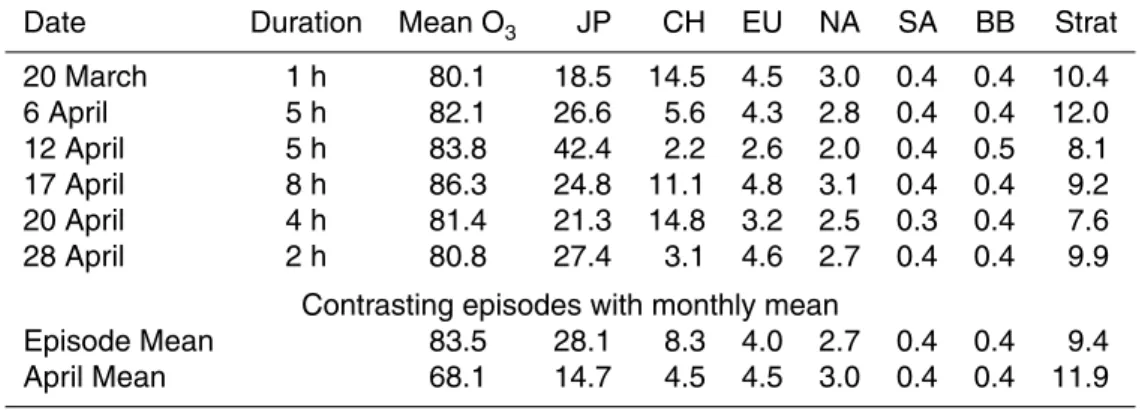
total of 48 h over the spring period, compared with 25 h in the model. The contribution of each source region during the modeled exceedance periods is shown in Table 6.
The six episodes shown differ substantially in nature. On 12 April (day 101), Japanese
sources contributed more than 50% of the O3peak, and industrial emissions from
Chi-5
nese, European and North American sources together accounted for less than 10%. However, during the 20 March (day 79) and 20 April (day 109) episodes Japanese
sources account for only about 25% of the O3, and Chinese sources account for more
than 18%. European and North American contributions remain significant during these periods, accounting for almost 10%. Regional trans-boundary transport contributed
10
significantly to the exceedance of air quality standards during these episodes. The re-maining three episodes lie between these extremes, with Japanese sources
account-ing for about one third of O3 and other industrial sources for 15–20%. The
strato-spheric source remains a consistent contributor during these episodes, accounting for 8–12 ppb (10–15%). Comparing contributions during episodes with mean
after-15
noon contributions for April, it is clear that while local Japanese sources play a much bigger role than normal during episodes, contributions from distant sources are only marginally smaller than average. This suggests that trans-boundary and intercontinen-tal transport may contribute significantly to O3levels over Japan during conditions that
favour O3build-up, and may thus impact attainment of air quality standards in Japan.
20
4 Transport pathways and meteorology
The large differences seen between high O3 episodes suggest that the source
con-tributions are very sensitive to meteorological conditions. We therefore examine how
regional meteorology controls the transport of oxidants from different source regions
to characterize better the composition of regional “background” air on which Japanese
25
ACPD
11, 10403–10448, 2011Regional impacts on ozone in Tokyo
M. Yoshitomi et al.
Title Page
Abstract Introduction
Conclusions References
Tables Figures
◭ ◮
◭ ◮
Back Close
Full Screen / Esc
Printer-friendly Version Interactive Discussion
Discussion
P
a
per
|
Dis
cussion
P
a
per
|
Discussion
P
a
per
|
Discussio
n
P
a
per
|
winter monsoon flow. This cold, dry continental air from over Eurasia meets warmer, more humid air over the Western Pacific, and leads to frequent and active cyclogenesis over the region. The wave cyclones that form travel northeastwards over Japan and typically increase in strength over the early spring period considered here. Continental pollutants may be rapidly swept out over the Western Pacific in the boundary layer
fol-5
lowing the associated cold fronts (e.g., Carmichael et al., 1998; Liu et al., 2003) or may be lifted into the free troposphere over the Western Pacific in the warm conveyor belt flow ahead of the front (e.g., Kaneyasu et al., 2000; Yienger et al., 2000; Miyazaki et al., 2003). Associated with these systems is a strong jet stream, and significant influx
of stratospheric O3may occur in dry air descending behind the cold front (e.g., Cooper
10
et al., 2002). The passage of these systems leads to frequent changes in air mass ori-gin over much of the Western Pacific, and there is a gradual transition in this variability as the marine flow strengthens. The meteorology of the region in 2001 is reasonably typical, influenced by a weak La Ni ˜na that decayed to neutral conditions in early spring (Fuelberg et al., 2003).
15
4.1 Meteorological controls on source region contributions
The juxtaposition or coalescence of air masses from different origins can be explored
by examining the relationships between the contributions of different sources with time.
Figure 10 shows these relationships for CO and O3 over Japan in February and April
2001. European and North American contributions to CO are well correlated,
indicat-20
ing that they arrive together in relatively well-mixed air masses. This signal is much
stronger in March and April than in February, highlighting differences in synoptic
con-ditions. The correlation for O3 differs somewhat from that of CO, as O3 production
is strongly influenced by meteorological conditions over the source region and by the
different timescales for transport. North American O3 correlates relatively well with
25
stratospheric O3 suggesting that they arrive by similar pathways following transport
ACPD
11, 10403–10448, 2011Regional impacts on ozone in Tokyo
M. Yoshitomi et al.
Title Page
Abstract Introduction
Conclusions References
Tables Figures
◭ ◮
◭ ◮
Back Close
Full Screen / Esc
Printer-friendly Version Interactive Discussion
Discussion
P
a
per
|
Dis
cussion
P
a
per
|
Discussion
P
a
per
|
Discussio
n
P
a
per
|
stratospheric O3 marginally less well, consistent with transport at lower altitudes than
North American air masses (Wild et al., 2004). Previous studies have suggested that European CO is mixed with CO from mainland Asian sources in post-frontal bound-ary layer outflow from China (Liu et al., 2003), but we find European and Chinese contributions are quite strongly anticorrelated in February, and only weakly correlated
5
in April. This suggests that over Japan the timing of major episodes differs
substan-tially; in February the relationship is strongest when European influence lags Chinese influence by about 48–60 h, reflecting changes in air mass origin driven by changing synoptic systems, while in April the relationship is strongest with a lag of about 6 h, likely reflecting Chinese influence in bands immediately behind frontal systems giving
10
way to European influence in the following cold continental outflow.
To determine the governing meteorological mechanisms and the dominant transport
patterns that bring air from different source regions to Japan in springtime we derive
correlation maps of the hourly time series at Tokyo to mean sea-level pressure over the region and relate these to the prevailing meteorological conditions. Figure 11 shows
15
this correlation map for the seasonal time series of Chinese, European and Japanese
influences on Tokyo. The correlation patterns for O3 and CO are similar for Chinese
sources, but the strong diurnal signal in O3 from Japanese sources and the lower
variability from European sources give a weaker response, and we therefore show cor-relations for CO which highlight the meteorological patterns more clearly. For Chinese
20
sources, the region of anticorrelation north of Japan indicates the climatological loca-tion of low pressure systems and associated cold fronts which bring higher influence from the continent to Japan, and the classic cyclonic “comma” shape is clearly visible. Applying a 24-h lag to the time series reveals the climatological position of the low
pressure one day earlier, over Korea, and demonstrates that high levels of O3 from
25
ACPD
11, 10403–10448, 2011Regional impacts on ozone in Tokyo
M. Yoshitomi et al.
Title Page
Abstract Introduction
Conclusions References
Tables Figures
◭ ◮
◭ ◮
Back Close
Full Screen / Esc
Printer-friendly Version Interactive Discussion
Discussion
P
a
per
|
Dis
cussion
P
a
per
|
Discussion
P
a
per
|
Discussio
n
P
a
per
|
The characteristic pattern produced by this analysis is similar to that shown by Liang et al. (2005).
The correlation map for European influence is notably different and indicates that
import of European air is favoured when there is higher sea-level pressure over the East China Sea along with low pressure systems northeast of Japan. This pattern
5
is associated with northwesterly flow from Northern Eurasia to Japan, and follows on from northerly flow one day earlier. The climatological pattern represents cold outflow around the eastern side of the high pressure systems that follow the passage of wave
cyclones. This is supported by an anticorrelation with humidity (r2=0.5, not shown)
which indicates that European influence is greatest in dry continental air masses.
10
The correlation maps for Japanese influence are very different, and the greatest
impacts on CO and O3are associated with a high pressure anomaly over the northern
Pacific and a low over Eastern China. This pattern reflects anticyclonic conditions over Japan governed by slow marine southwesterly flow, and these fair-weather conditions allow substantial build-up of local pollutants in the boundary layer. These conditions
15
are relatively short-lived in spring and are typically swept away by the frontal systems associated with the next cyclone building over Eastern China.
4.2 Case study of inflow to Japan
While climatological patterns provide good evidence for the role of particular meteoro-logical processes in governing transport on a seasonal basis, there is substantial
vari-20
ability between one synoptic system and the next. To demonstrate the key pathways for regional pollutant transport more clearly, we present a case study of the transport of continental Asian pollutants to Japan during 23–26 February 2001. Of the transport episodes we have examined, this case is reasonably typical of transport from China associated with frontal passage. Polluted air from China is transported eastwards over
25
the Pacific, bringing high levels of O3(12–14 ppb) to Japan, but is subsequently caught
ACPD
11, 10403–10448, 2011Regional impacts on ozone in Tokyo
M. Yoshitomi et al.
Title Page
Abstract Introduction
Conclusions References
Tables Figures
◭ ◮
◭ ◮
Back Close
Full Screen / Esc
Printer-friendly Version Interactive Discussion
Discussion
P
a
per
|
Dis
cussion
P
a
per
|
Discussion
P
a
per
|
Discussio
n
P
a
per
|
to a thin band along the cold front, as observed in previous studies (Kaneyasu et al., 2000; Sawa et al., 2007), with a significant proportion caught up in the warm sector ahead of it (e.g., Cooper et al., 2002). Continental boundary layer air with a greater abundance of European and North American oxidants is carried southeastwards in the cold outflow behind this front, but remains largely distinct from air of East Asian origin.
5
The passage of this system over Japan is associated with a drop in midday
tempera-ture of 10◦C between 23 and 25 February and a pressure drop of 14 hPa followed by
a rise of 30 hPa, see Fig. 13. The system first brings the footprint of Asian emissions to Tokyo in the warm sector, where Chinese CO reaches 80 ppb, and this is followed by 2–3 days of cold, dry continental outflow from higher latitudes with little influence
10
from Chinese sources (Chinese CO below 10 ppb). European influence is higher in the post-frontal outflow, with European CO rising from 15 to 45 ppb over the period and a
smaller rise for O3 of 2.2 to 3.5 ppb. While there is some mixing of air influenced by
European and East Asian sources in the post-frontal boundary layer outflow, as sug-gested by Liu et al. (2003), this episode demonstrates that the regional footprints can
15
remain distinct within the timescales for transport from the continent to Japan.
The lifting of pollutants in the warm conveyor belt ahead of the cold front is clearly visible in the right panel of Fig. 13, where it brings Chinese contributions of more than
18 ppb of O3 and 100 ppb of CO at 2–3 km altitude as it crosses Japan. At higher
altitudes in the warm sector above 4 km the southwesterly flow brings air from
south-20
ern and southeastern Asia, with O3 reaching 12 ppb and CO reaching 180 ppb, and
over Japan such high contributions from south Asian industrial and biomass burning sources are only seen under these conditions. The dry intrusion behind the cold front pushes this away and brings streamers of air down from the upper troposphere with
50–60 ppb of stratospheric O3 which persist for about a day. At the surface,
strato-25
spheric contributions average 12 ppb in the air behind the front compared with about
6 ppb ahead of it on 23–24 February. The lowest levels of surface O3 and CO over
ACPD
11, 10403–10448, 2011Regional impacts on ozone in Tokyo
M. Yoshitomi et al.
Title Page
Abstract Introduction
Conclusions References
Tables Figures
◭ ◮
◭ ◮
Back Close
Full Screen / Esc
Printer-friendly Version Interactive Discussion
Discussion
P
a
per
|
Dis
cussion
P
a
per
|
Discussion
P
a
per
|
Discussio
n
P
a
per
|
continental sources remains low. The highest levels occur on 23 February in the 24 h
before the system arrives, when surface O3exceeds 60 ppb for an 8-h period (for 5 h in
the observations) and peaks at more than 70 ppb. Although early in the year, the
fair-weather anticyclonic conditions contribute to substantial local O3 production (20 ppb
from Japanese sources) and the southwesterly flow brings as much as 14 ppb O3from
5
Chinese sources. While this episode is not as severe as the major air quality ex-ceedances later in spring shown in Table 6, it illustrates the transport mechanisms that allow substantial Chinese influence ahead of frontal systems where it may contribute to poor air quality over Japan. However, each synoptic system has a unique signature, and while this entrainment of continental air also occurred in the 20 March and 20 April
10
exceedances leading to significant Chinese influence, in other cases the position of the Pacific High does not allow for this entrainment, and Chinese influence remains low, as on 12 April and 28 April. It would be valuable to explore the sensitivity of air quality exceedances in Japan to the position of these meteorological features in future work
and to extend the period under consideration to account for the effects of interannual
15
variability.
5 Conclusions
We have shown how local, regional and distant sources contribute to surface O3 and
CO over Japan in springtime and explored the transport pathways that lead to this
in-fluence. On a seasonal basis the largest contribution to daytime surface O3is from the
20
stratosphere (20%), at a regional scale exceeding Japanese precursor sources (16%) which make a relatively small contribution in February but increase rapidly through the spring as photochemistry picks up. Local sources make relatively little net contribution
to day-mean O3 in this season due to strong O3 removal at nighttime over polluted
emission regions. Distant anthropogenic precursor emissions over China, Europe and
25
North America make small but significant contributions to surface O3(7%, 6%, and 5%
ACPD
11, 10403–10448, 2011Regional impacts on ozone in Tokyo
M. Yoshitomi et al.
Title Page
Abstract Introduction
Conclusions References
Tables Figures
◭ ◮
◭ ◮
Back Close
Full Screen / Esc
Printer-friendly Version Interactive Discussion
Discussion
P
a
per
|
Dis
cussion
P
a
per
|
Discussion
P
a
per
|
Discussio
n
P
a
per
|
the local contribution and almost matching that from the stratosphere. The pattern for surface CO is similar, although Japanese sources make a smaller contribution (13%)
and distant anthropogenic sources make a larger one (32%), with the largest effects
from Europe (13%) during the spring season.
We have shown that these source contributions are highly variable during springtime
5
and that clear meteorological signatures can be seen in both observed and modeled
O3and CO at locations over the Western Pacific such as Minamitorishima. Spatial
cor-relations with mean sea-level pressure and humidity indicate that on a climatological basis transport of pollutants from China to Japan occurs at low altitudes following the Pacific storm track, and is associated with the passage of cold fronts. Ozone
contri-10
butions from Chinese sources typically reach 10–15 ppb during these episodes, which occur on average once or twice per week. In contrast, European influence is greatest in northwesterly flow representing continental boundary layer air caught up in the cold
outflow some distance behind cold fronts. While O3 and CO from Chinese and
Euro-pean sources are both transported to Japan at low levels behind these frontal systems,
15
the influence from China is typically strongest in a band lying along the front, while that from Europe occurs later as cold continental air is entrained into the post-frontal outflow. Stratospheric contributions are largest above the capping inversions of anti-cyclones preceding (and following) these systems, but may reach as much as 20 ppb at the surface on occasions. However, examination of a number of case studies
indi-20
cates that there is considerable variation in transport pathways between one synoptic meteorological system and the next that is partly driven by the timing and location of cyclogenesis and partly by the location of the Pacific High. We recommend that further studies focus on a more detailed meteorological classification of these systems so that long-range impacts on atmospheric composition can be characterized more clearly.
25
While meteorological boundaries such as fronts provide a clear separation of air
from different nearby sources, the effects of more distant sources are more uniformly
distributed, and their contributions remain significant during episodes of high O3 over
ACPD
11, 10403–10448, 2011Regional impacts on ozone in Tokyo
M. Yoshitomi et al.
Title Page
Abstract Introduction
Conclusions References
Tables Figures
◭ ◮
◭ ◮
Back Close
Full Screen / Esc
Printer-friendly Version Interactive Discussion
Discussion
P
a
per
|
Dis
cussion
P
a
per
|
Discussion
P
a
per
|
Discussio
n
P
a
per
|
are typically close to their seasonal average during these episodes, contributions from China may often be substantially larger, although this is not always the case, depend-ing on meteorological conditions. This study has focused on 2001, but we note that emissions of ozone precursors from Northern China are increasing due to rapid in-dustrialization and increased vehicle ownership, and may already have increased by a
5
factor of two since 2001 (e.g., Irie et al., 2005; Ohara et al., 2007). Our results suggest
that this would account for an additional 2–4 ppb of daytime O3 over Tokyo in spring,
contributing to the observed trend. The magnitude of this O3 contribution suggests
that agencies regulating air quality in Japan should take account of long-range trans-port from the Asian mainland when examining exceedance of air quality standards in
10
future.
Acknowledgements. This work has been partially supported by the Global Environmental Re-search Fund (B051 and S-7) of the Ministry of the Environment of Japan.
References
Akimoto, H.: Global air quality and pollution, Science, 302, 1716–1719, 2003. 10405 15
Akimoto, H., Mukai, H., Nishikawa, M., Murano, K., Hatakeyama, S., Liu, C.-M., Buhr, M., Hsu, K. J., Jaffe, D. A., Zhang, L., Honrath, R., Merrill, J. T., and Newell, R. E.: Long-range transport of ozone in the East Asian Pacific rim region, J. Geophys. Res., 101, 1999–2010, 1996.
Berntsen, T. K., Isaksen, I. S. A., Wang, W.-C., and Liang, X. Z.: Impacts of increased anthro-20
pogenic emissions in Asia on tropospheric ozone and climate – a global 3-D model study, Tellus, 48, 13–32, 1996. 10405, 10410
Berntsen, T. K., Karlsdottir, S., and Jaffe, D. A.: Influence of Asian emissions on the composition of air reaching the Northwestern United States, Geophys. Res. Lett., 26, 2171–2174, 1999. 10405
25
Bey, I., Jacob, D. J., Logan, J. A., and Yantosca, R. M.: Asian chemical outflow to the Pacific: origins, pathways and budgets, J. Geophys. Res., 106, 23097–23114, 2001. 10406
ACPD
11, 10403–10448, 2011Regional impacts on ozone in Tokyo
M. Yoshitomi et al.
Title Page
Abstract Introduction
Conclusions References
Tables Figures
◭ ◮
◭ ◮
Back Close
Full Screen / Esc
Printer-friendly Version Interactive Discussion
Discussion
P
a
per
|
Dis
cussion
P
a
per
|
Discussion
P
a
per
|
Discussio
n
P
a
per
|
production and transport in the springtime in east Asia, J. Geophys. Res., 103, 10649– 10671, 1998. 10406, 10416
Carmichael, G. R., Tang, Y., Kurata, G., Uno, I., Streets, D. G., Thongboonchoo, N., Woo, J.-H., Guttikunda, S., White, A., Wang, T., Blake, D. R., Atlas, E., Fried, A., Potter, B., Avery, M. A., Sachse, G. W., Sandholm, S. T., Kondo, Y., Talbot, R. W., Bandy, A., Thorton, D., and Clarke, 5
A. D.: Evaluating regional emission estimates using the TRACE-P observations, J. Geophys. Res., 108(D21), 8810, doi:10.1029/2002JD003116, 2003.
Cooper, O. R., Moody, J. L., Parrish, D. D., Trainer, M., Ryerson, T. B., Holloway, J. S., H ¨ubler, G., Fehsenfeld, F. C., and Evans, M. J.: Trace gas composition of midlatitude cyclones over the western North Atlantic Ocean: A conceptual model, J. Geophys. Res., 107(D7), 4056, 10
doi:10.1029/2001JD000901, 2002. 10416, 10419
Dentener, F., Stevenson, D., Ellingsen, K., van Noije, T., Schultz, M., Amann, M., Atherton, C., Bell, N., Bergmann, D., Bey, I., Bouwman, L., Butler, T., Cofala, J., Collins, B., Drevet, J., Doherty, R., Eickhout, B., Eskes, H., Fiore, A., Gauss, M., Hauglustaine, D., Horowitz, L., Isaksen, I. S. A., Josse, B., Lawrence, M., Krol, M., Lamarque, J. F., Montanaro, V., M ¨uller, 15
J. F., Pauch, V. H., Pitari, G., Pyle, J., Rast, S., Rodriguez, J., Sanderson, M., Savage, N. H., Shindell, D., Strahan, S., Szopa, S., Sudo, K., Van Dingenen, R., Wild, O., and Zeng, G.: The global atmospheric environment for the next generation, Environ. Sci. Technol., 40, 3586–3594, 2006. 10405
Duncan, B. N., Martin, R. V., Staudt, A. C., Yevich, R., and Logan, J. A.: Interannual and 20
seasonal variability of biomass burning emissions constrained by satellite observations, J. Geophys. Res., 108(D9), 4040, doi:10.1029/2002JD002378, 2003. 10411
Fiore, A. M., Jacob, D. J., Bey, I., Yantosca, R. M., Field, B. D., Fusco, A. C., and Wilkinson, J. G.: Background ozone over the United States in summer: Origin, trend, and contribution to pollution episodes, J. Geophys. Res., 107(D15), 4275, doi:10.1029/2001JD000982, 2002. 25
10405, 10414
Fiore, A. M., Jacob, D. J., Liu, H., Yantosca, R. M., Fairlie, T. D., and Li, Q. B.: Variability in surface ozone background over the United States: Implications for air quality policy, J. Geophys. Res., 108, 4787, doi:10.1029/2003JD003855, 2003. 10405
Fiore, A. M., Dentener, F. J., Wild, O., Cuvelier, C., Schultz, M. G., Hess, P., Textor, C., Schulz, 30
ACPD
11, 10403–10448, 2011Regional impacts on ozone in Tokyo
M. Yoshitomi et al.
Title Page
Abstract Introduction
Conclusions References
Tables Figures
◭ ◮
◭ ◮
Back Close
Full Screen / Esc
Printer-friendly Version Interactive Discussion
Discussion
P
a
per
|
Dis
cussion
P
a
per
|
Discussion
P
a
per
|
Discussio
n
P
a
per
|
S., Hauglustaine, D., Holloway, T., Isaksen, I. S. A., Jacob, D. J., Jonson, J. E., Kaminski, J. W., Keating, T. J., Lupu, A., Marmer, E., Montanaro, V., Park, R. J., Pitari, G., Pringle, K. J., Pyle, J. A., Schroeder, S., Vivanco, M. G., Wind, P., Wojcik, G., Wu, S., and Zuber, A.: Multi-model estimates of intercontinental source-receptor relationships for ozone pollution, J. Geophys. Res., 114, D04301, doi:10.1029/2008JD010816, 2009. 10405
5
Fuelberg, H. E., Kiley, C. M., Hannan, J. R., Westberg, D. J., Avery, M. A., and Newell, R. E.: Meteorological conditions and transport pathways during the Transport and Chem-ical Evolution over the Pacific (TRACE-P) experiment, J. Geophys. Res., 108(D20), 8782, doi:10.1029/2002JD003092, 2003. 10416
Heald, C. L., Jacob, D. J., Fiore, A. M., Emmons, L. K., Gille, J. C., Deeter, M. N., Warner, 10
J., Edwards, D. P., Crawford, J. H., Hamlin, A. J., Sachse, G. W., Browell, E. V., Avery, M. A., Vay, S. A., Westberg, D. J., Blake, D. R., Singh, H. B., Sandholm, S. T., Talbot, R. W., and Fuelberg, H. E.: Asian outflow and transpacific transport of carbon monoxide and ozone pollution: An integrated satellite, aircraft and model perspective, J. Geophys. Res., 108(D24), 4804, doi:10.1029/2003JD003507, 2003. 10405, 10406
15
Holloway, T., Fiore, A., and Galanter Hastings, M.: Intercontinental Transport of Air Pollution: Will emerging science lead to a new hemispheric treaty?, Environ. Sci. Technol., 37, 4535– 4542, 2003. 10405
Holloway, T., Sakurai, T., Han, Z., Ehlers, S., Spak, S. N., Horowitz, L. W., Carmichael, G. R., Streets, D. G., Hozumi, Y., Ueda, H., Park, S. U., Fung, C., Kajino, M., Thongboonchoo, N., 20
Engardt, M., Bennet, C., Hayami, H., Sartelet, K., Wang, Z., Matsuda, K., and Amann, M.: MICS-Asia II: Impact of global emissions on regional air quality in Asia, Atmos. Environ., 42, 3543–3561, 2008.
Irie, H., Sudo, K., Akimoto, H., Richter, A., Burrows, J. P., Wagner, T., Wenig, M., Beirle, S., Kondo, Y., Sinyakov, V. P., and Goutail, F.: Evaluation of long-term tropospheric NO2 25
data obtained by GOME over East Asia in 1996–2002, Geophys. Res. Lett., 32, L11810, doi:10.1029/2005GL022770, 2005. 10406, 10422
Jacob, D. J., Logan, J. A., and Murti, P. P.: Effect of rising Asian emissions on surface ozone in the United States, Geophys. Res. Lett., 26, 2175–2178, 1999. 10405
Jacob, D. J., Crawford, J. H., Kleb, M. M., Connors, V. S., Bendura, R. J., Raper, J. L., Sachse, 30
ACPD
11, 10403–10448, 2011Regional impacts on ozone in Tokyo
M. Yoshitomi et al.
Title Page
Abstract Introduction
Conclusions References
Tables Figures
◭ ◮
◭ ◮
Back Close
Full Screen / Esc
Printer-friendly Version Interactive Discussion
Discussion
P
a
per
|
Dis
cussion
P
a
per
|
Discussion
P
a
per
|
Discussio
n
P
a
per
|
Jaegl ´e, L., Jaffe, D. A., Price, H. U., Weiss-Penzias, P., Palmer, P. I., Evans, M. J., Jacob, D. J., and Bey, I.: Sources and budgets for CO and O3in the northeastern Pacific during the spring of 2001: Results from the PHOBEA-II Experiment, J. Geophys. Res., 108(D20), 8802, doi:10.1029/2002JD003121, 2003. 10406
Jaffe, D. A., McKendry, I., Anderson, T., and Price, H.: Six “new” episodes of trans-Pacific 5
transport of air pollutants, Atmos. Environ., 37(3), 391–404, 2003. 10405, 10406
Kajii, Y., Someno, K., Tanimoto, H., Hirokawa, J., Akimoto, H., Katsuno, T., and Kawara, J.: Evi-dence for the seasonal variation of photochemical activity of tropospheric ozone: Continuous observation of ozone and CO at Happo, Japan, Geophys. Res. Lett., 25, 3505–3508, 1998. 10413
10
Kaneyasu, N., Takeuchi, K., Fujita, S., Uno, I., and Sasaki, H.: Outflow patterns of pollutants from east Asia to the North Pacific in the winter monsoon, J. Geophys. Res., 105, 17361– 17377, 2000. 10406, 10416, 10419
Lee, S.-H., Akimoto, H., Nakane, H., Kurnosenko, S., and Kinjo, Y.: Lower tropospheric ozone trend observed in 1989–1997 at Okinawa, Japan, Geophys. Res. Lett., 25(10), 1637–1640, 15
1998. 10405
Liang, Q., Jaegle, L., Jaffe, D. A., Weiss-Penzias, P., Heckman, A., and Snow, J. A.: Long-range Transport to the Northeast Pacific: Seasonal variations and transport pathways of carbon monoxide, J. Geophys. Res., 109(D23), D23S07, doi:10.1029/2003JD004402, 2004. 10406, 10413
20
Liang, Q., Jaegle, L., and Wallace, J. M.: Meteorological indices for Asian outflow and transpacific transport on daily to interannual timescales, J. Geophys. Res., 110, D18308, doi:10.1029/2005JD005788, 2005. 10418
Lin, C.-Y. C., Jacob, D. J., and Fiore, A. M.: Trends in exceedances of the ozone air quality standard in the continental United States, 1980–1998, Atmos. Environ., 35, 3217–3228, 25
2001. 10405
Lin, M., Holloway, T., Carmichael, G. R., and Fiore, A. M.: Quantifying pollution inflow and outflow over East Asia in spring with regional and global models, Atmos. Chem. Phys., 10, 4221–4239, doi:10.5194/acp-10-4221-2010, 2010. 10406
Lippmann, M.: Health effects of tropospheric ozone, Environ. Sci. Technol., 25, 1954–1962, 30
1991. 10405
ACPD
11, 10403–10448, 2011Regional impacts on ozone in Tokyo
M. Yoshitomi et al.
Title Page
Abstract Introduction
Conclusions References
Tables Figures
◭ ◮
◭ ◮
Back Close
Full Screen / Esc
Printer-friendly Version Interactive Discussion
Discussion
P
a
per
|
Dis
cussion
P
a
per
|
Discussion
P
a
per
|
Discussio
n
P
a
per
|
Res., 108, 8786, doi:10.1029/2002JD003102, 2003. 10406, 10409, 10416, 10417, 10419 Mauzerall, D. L. and Wang, X.: Protecting Agricultural Crops from the Effects of Tropospheric
Ozone Exposure: Reconciling Science and Standard Setting in the United States, Europe and Asia, Annu. Rev. Energ. Env., 26, 237–268, 2001. 10405
Mauzerall, D. L., Narita, D., Akimoto, H., Horowitz, L., Walters, S., Hauglustaine, D. A., and 5
Brasseur, G.: Seasonal Characteristics of Tropospheric Ozone Production and Mixing Ra-tios Over East Asia: A Global Three-dimensional Chemical Transport Model Analysis, J. Geophys. Res., 105, 17895–17910, 2000.
Mickley, L. J., Murti, P. P., Jacob, D. J., Logan, J. A., Rind, D., and Koch, D.: Radiative forc-ing from tropospheric ozone calculated with a unified chemistry-climate model, J. Geophys. 10
Res., 104, 30153–30172, 1999. 10405
Miyazaki, Y., Kondo, Y., Koike, M., Fuelberg, H. E., Kiley, C. M., Kita, K., Takegawa, N., Sachse, G. W., Flocke, F., Weinheimer, A. J., Singh, H. B., Eisele, F. L., Zondlo, M., Tal-bot, R. W., Sandholme, S. T., Avery, M. A., and Blake, D. R.: Synoptic-scale transport of reactive nitrogen over the western Pacific in spring, J. Geophys. Res., 108(D20), 8788, 15
doi:10.1029/2002JD003248, 2003. 10406, 10416
Nagashima, T., Ohara, T., Sudo, K., and Akimoto, H.: The relative importance of various source regions on East Asian surface ozone, Atmos. Chem. Phys., 10, 11305–11322, doi:10.5194/acp-10-11305-2010, 2010. 10414
Naja, M. and Akimoto, H.: Contribution of regional and long-range transport to the Asia-Pacific 20
region: Analysis of long-term ozonesonde data over Japan, J. Geophys. Res., 109, D21306, doi:10.1029/2004JD004687, 2004. 10405
Network Center for EANET: EANET Data on Acid Deposition in the East Asia Region, Acid Deposition and Oxidant Research Center (ADORC), Niigata, Japan, available at: http://www. eanet.cc/, 2005. 10408
25
Ohara, T. and Sakata, T.: Long-term variation of photochemical oxidants over Japan, J. Japan Soc. Atmos. Environ., 38, 47–54, 2003 (in Japanese). 10405
Ohara, T., Akimoto, H., Kurokawa, J., Horii, N., Yamaji, K., Yan, X., and Hayasaka, T.: An Asian emission inventory of anthropogenic emission sources for the period 1980–2020, Atmos. Chem. Phys., 7, 4419–4444, doi:10.5194/acp-7-4419-2007, 2007. 10406, 10422
30
ACPD
11, 10403–10448, 2011Regional impacts on ozone in Tokyo
M. Yoshitomi et al.
Title Page
Abstract Introduction
Conclusions References
Tables Figures
◭ ◮
◭ ◮
Back Close
Full Screen / Esc
Printer-friendly Version Interactive Discussion
Discussion
P
a
per
|
Dis
cussion
P
a
per
|
Discussion
P
a
per
|
Discussio
n
P
a
per
|
10440
Parrish, D. D., Holloway, J. S., Trainer, M., Murphy, P. C., Fehsenfeld, F. C., and Forbes, G. L.: Export of North American ozone pollution to the North Atlantic Ocean, Science, 259, 1436– 1439, 1993. 10413
Pochanart, P., Hirokawa, J., Kajii, Y., Akimoto, H., and Nakao, M.: Influence of regional-scale 5
anthropogenic activity in northeast Asia on seasonal variations of surface ozone and carbon monoxide observed at Oki, Japan, J. Geophys. Res., 104(D20), 3621–3361, 1999. 10413 Pochanart, P., Akimoto, H., Maksyutov, S., and Staehelin, J.: Surface ozone at the Swiss Alpine
site Arosa: the hemispheric background and the influence of large-scale anthropogenic emis-sions, Atmos. Environ. 35, 5553–5566, 2001. 10405
10
Pochanart, P., Akimoto, H., Kinjo, Y., and Tanimoto, H.: Surface ozone at four remote island sites and the preliminary assessment of exceedances of its critical level in Japan, Atmos. Environ., 36, 4235–4250, 2002. 10405
Prather, M. and Ehhalt, D.: Atmospheric Chemistry and Greenhouse Gases, Climate Change 2001, edited by: Houghton, J. T., Ding, Y., and Griggs, D. J., 349–416, Cambridge Univ. 15
Press, Cambridge, 2001.
Prather, M., Gauss, M., Berntsen, T., Isaksen, I., Sundet, J., Bey, I., Brasseur, G., Dentener, F., Derwent, R., Stevenson, D., Grenfell, L., Hauglustaine, D., Horowitz, L., Jacob, D., Mickley, L., Lawrence, M., von Kuhlmann, R., Muller, J.-F., Pitari, G., Rogers, H., Johnson, M., Pyle, J., Law, K., van Weele, M., and Wild, O.: Fresh air in the 21st century?, Geophys. Res. Lett., 20
30(2), 1100, doi:10.1029/2002GL016285, 2003. 10405
Roelofs, G. J. and Lelieveld, J.: Model study of the influence of cross-tropopause ozone trans-ports on tropospheric ozone levels, Tellus, Ser. B, 49, 38–55, 1997. 10412
Sawa, Y., Tanimoto, H., Yonemura, S., Matsueda, H., Wada, A., Taguchi, S., Hayasaka, T., Tsuruta, H., Tohjima, Y., Mukai, H., Kikuchi, N., Katagiri, S., and Tsuboi, K.: Widespread 25
pollution events of carbon monoxide observed over the western North Pacific during the East Asian Regional Experiment (EAREX) 2005 campaign, J. Geophys. Res., 112, D22S26, doi:10.1029/2006JD008055, 2007. 10406, 10409, 10419
Stohl, A.: A 1-year Lagrangian “climatology” of airstreams in the Northern Hemisphere tropo-sphere and lowermost stratotropo-sphere, J. Geophys. Res., 106, 7263–7279, 2001. 10406 30