Tribology in Industry
www.tribology.fink.rs
Acid Aging Effects on Surfaces of PTFE Gaskets
Investigated by Thermal Analysis
C. Fragassa
a,c, L. Giorgini
b,c, A. Pavlovic
c, G. Zattini
b,caDepartment of Industrial Engineering, University of Bologna, viale Risorgimento, 2, Bologna, Italy,
bDepartment of Industrial Chemistry "Toso Montanari", University of Bologna, viale Risorgimento 4, Bologna, Italy, cInterDept. of Industrial Research on Advanced Mechanics and Materials, University of Bologna, via Terracini 22,
Bologna, Italy.
Keywords:
Polymeric materials PTFE
Gaskets
Ultrasonic cleaning process Surface Degradation TGA
DSC
A B S T R A C T
This paper investigates the effect of a prolonged acid attack on the surface of PTFE by Thermogravimetric Analysis (TGA) and Differential Scanning Calorimetry (DSC). PTFE is very non-reactive, partly because of the strength of carbon–fluorine bonds and for its high crystallinity, and, as a consequence, it is often used in containers and pipework with reactive and corrosive chemicals. The PTFE under analysis is commercialized by two alternative producers in form of Teflon tapes. These tapes are adopted, as gaskets, in process plants where tires moulds are cleaned by acid solutions inside a multistage ultrasonic process. In this case, PTFE shows, in a relatively short operation time, inexplicably phenomena of surface degradation, which could be related, in general terms, to an acid attack. But, even considering the combined effect of ultrasonic waves, temperature, humidity and acid attack, the PTFE properties of resistance nominally exclude the risk of the extreme erosion phenomena as observed.
The present experimental research aim at investigating this contradiction. A possible explanation could be related to the presence in the cleaning solution of unexpected fluorides, able to produce fluorinating agents and, thus, degrade carbon-fluorine bonds. Considering more the 300 chemical elements a tire compound consists in, it is really complex to preserve the original chemical composition of the cleaning solution. In this research PTFE samples have been treated with different mixtures of acids with the aim at investigating the different aging effects. The thermal analysis has permitted the experimental characterization of PTFE surface properties after acid attack, providing evidence of the degradation phenomena. In particular, the different acid treatments adopted for accelerating the aging of gaskets have highlighted the different behaviour of the PTFE matrix, but also differences between manufacturers.
© 6 Published by Faculty of Engineering
Corresponding author:
Cristiano Fragassa
Department of Industrial Engineering, University of Bologna,
viale Risorgimento 2, Bologna, Italy.
E-mail: [email protected]
R
E
S
E
A
R
C
1. INTRODUCTION
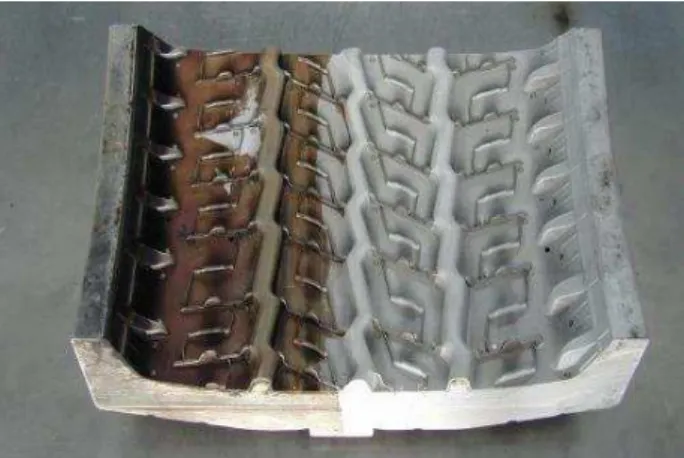
This experimental study is part of a larger investigation aiming at improving the process efficiency in the case of innovative production plants used for the surface treatment and cleaning of tires moulds. Mould cleaning and maintenance are of major concern for the tire industry. Cleaning process has to remove fouling and residues of rubber from sensitive surfaces of mould avoiding wear or damage effects (Fig. 1).
Fig. 1. Effects of the cleaning processes on moulds.
Several technologies are used, each one with specific advantages and limits in applications. A comparative assessment of tire mould cleaning solutions is presented in [1], detailing aspects as productivity, cost effectiveness, quality finishing, eco-sustainability, safety, etc.
It is also reported that the so called Mould
Ultrasonic Cleaning Systems (UMCS) represents a preferable choice in terms of efficiency and flexibility especially in the presence of very complex and fragile geometries.
The UMCS technology consists in a cleaning process where ultrasonic waves, in combination with temperature and acids, remove rubber scraps and other physical residuals from interstices of the moulds. Tire moulds and their parts are immersed in a sequence of washing baths, where chemical compounds attack the residues, cleaning the mould surfaces.
Useful information referring this technology, including several technical details regarding the proper way to manage UMCS plants are available in [2]. In particular, the guideline emphasises the attention to be focused by final users toward a constant monitoring of the chemical solutions.
Even if this document represents the guideline for a specific UMCS, similarities emerge with other plant manufactures. It depends on the fact that a precise chemical composition for solutions seems to be a relevant aspect in cleaning efficiency. On the contrary, it results evident that a residue from treatments tends to accumulate as sediments on the bottom of the basin [3].
Other investigations suggest that specific elements from this leftover could be dissociated in the cleaning solution modifying its chemical compositions and properties. This aspect has been always considered by manufacturers in terms of loss in process efficiency or quality. And, for this reason, a periodical action of renovation for basins and solutions is regulated.
Nevertheless, recently, minor failures, as drops of solution from washing basins in relatively
new plants, highlighted an unexpected
deterioration of seals. In particular, Teflon tapes, used as gaskets in the most concentrated acid
basins, exhibits degradation theoretically
incompatible with normal conditions of use [3].
In fact, according to the material datasheets [4,5] or independent researchers [6-9], Teflon, better identified as Polytetrafluoroethylene (PTFE), reveals a deep thermal and chemical stability that make this material a valid choice in a large number of challenging applications, including UMCS. Referring to [10-12], it is stated that only under very uncommon circumstances PTFE degrades.
use in UMCS by means of mechanical tests and micrographs. It showed a not negligible difference between the two situations [16].
Table 1. Acid compositions (in accordance with
accelerated aging procedure detailed in [17]).
# H2O Sol. I Sol. II
%wt
1 50 40 10
2 90 10 0
3 80 20 0
4 87.5 10 2.5 5 77.5 20 2.5 6 67.5 30 2.5
7 85 10 5
8 75 20 5
9 65 30 5
10 70 30 0
Then, a comparative study on the PTFE surface properties, after accelerated aging in controlled environment was also realized and detailed in [17-19]. In particular, it [17] describes the aggravated conditions of heat, acid attack (with an almost pH 1 solution composed by a mixture of sulfamic, hydrochloric and hydrofluoric acids, and, simultaneously, a temperature between 70
and 80 °C) used to speed up the normal aging
processes of PTFE gaskets in the way to correctly represent their utilisation inside the
UMCS plants. Besides, [18] describes the effects
of aging on PTFE chemical surfaces by Fourier
Transform Infrared Spectroscopy (FT-IR)
permitting preliminary considerations regarding the use of PTFE in UMCS conditions and its aging mechanisms. The current research intends to merge further experimental results by useful thermal analysis. With the aim at allowing a quick comparison with the previous results, all conditions used in the former experiments (e.g. for accelerating the PTFE chemical surface degradation), are maintained and summarized in Table 1.
2. MATERIAL AND METHODS
In Table 1 are reported the different chemical compositions used to speed up the aging processes by acid attack. Different combinations for Sol. I (sulfamic acid 15%wt, hydrochloric acid
0.1%wt) and Sol. II (hydrofluoric acid 1%wt)
have been evaluated with the aim to compare the effects of the two solutions in different ratios. For each of these combinations, PTFE specimens by
two different manufacturers, one Italian (IT) and
one Chinese (CH), have been investigated.
Specimens have been immersed in the solution
and maintained in oven at 80 °C for . hr. This
approach was intended to reproduce the worst process situation represented in the process line by the most aggressive acid bath, with almost pH 1 solution of sulfamic, hydrochloric and
hydrofluoric acids and, simultaneously, a
temperature between 70 and 80 °C.
With the aim at reducing the number of experiments, two specific combinations of acid
attacks have been investigated (#6, #9). A
comparison with new, untreated samples (#0)
have been also implemented (Table 2). These samples have been selected representing respectively the most and least aggressive treatment as preliminary identified by the microscopic observations performed by a Hirox 3D Multifocal Microscope Model HX7700 (Fig. 2) and by the Fourier Transform Infrared Spectroscopy (FT-IR) investigation [18].
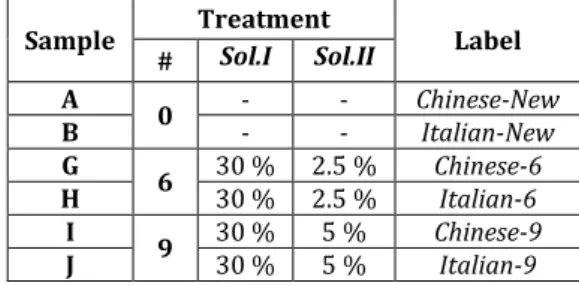
Table 2. List of samples analysed by TGA and DSC.
Sample Treatment Label
# Sol.I Sol.II A
0 - - Chinese-New
B - - Italian-New
G
6 30 % 2.5 % Chinese-6 H 30 % 2.5 % Italian-6
I
9 30 % 5 % Chinese-9 J 30 % 5 % Italian-9
At the end of the aging treatment, the specimens were extracted from oven, cleaned, dried and investigated by Thermogravimetric Analysis (TGA) and Differential Scanning Calorimetry (DSC).
a) b)
c) d)
Fig. 2. Examples of micrographs used for a preliminary selection of treatments and samples under investigation:
a) Italian #6; b) Italian #9; c) Chinese #6; d) Chinese #9.
This information has been useful for completing
the chemical analysis and corroborating
alternative hypothesis on the material
structures.
By Differential Scanning Calorimetry (DSC), it is possible to analyse the difference in the amount of heat required to increase the temperature of samples and references (as a function of temperature). By observing this difference, it has been possible to measure the amount of heat absorbed during thermodynamic transitions, investigating subtle physical changes (phase changes, melting) [23-25].
The untreated and treated gaskets have been sampled both on the surface and in the core. TGA has been performed on 6-8 mg of material, using a TA Q600 instrument, set to a heating rate of 10
°C/min, from room temperature to °C.
Analyses have been realized in inert atmosphere (N2, mL/min until °C, and then the
atmosphere has been switched to air in order to oxidize any eventual organic residue [26].
The choice of the inert atmosphere has been made to avoid the introduction of thermo-oxidative phenomena during the analysis. DSC has also performed under nitrogen atmosphere, on 4-5 mg of polymeric material, using a TA Q2000 instrument, set to run two heating scans
from - °C to °C at a heating rate of 10
°C/min. Only experimental results from the second scan have been used for the purposes of this work [27].
3. RESULTS
3.1Untreated samples (#0)
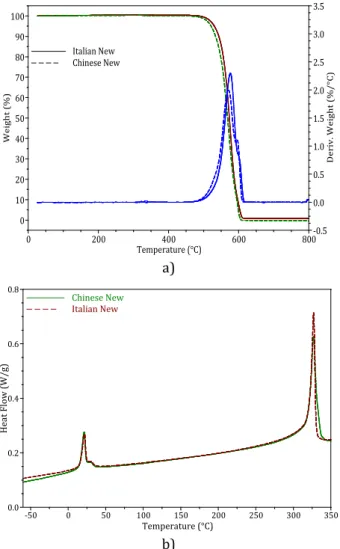
thermal decomposition to a slightly higher temperature (Fig. 3a), according to the DTG (Derivative Thermogravimetric Analysis) curves obtained (expressed as maximum degradation rate temperatures). A DSC result also shows a very similar behaviour between the two materials (Fig. 3b). Both the samples exhibit two partly overlapped crystalline phase transitions, typical of
PTFE at atmospheric pressure centred at / °C
and °C, in agreement with literature [28,29].
-0.5 0.0 0.5 1.0 1.5 2.0 2.5 3.0 3.5
D
er
iv. W
ei
gh
t %/
°C
0 10 20 30 40 50 60 70 80 90 100
W
e
igh
t (%)
0 200 400 600 800
Temperature °C Italian New
–––––––
Chinese New – – – –
a)
0.0 0.2 0.4 0.6 0.8
Hea
t F
lo
w
(W
/g)
-50 0 50 100 150 200 250 300 350
Temperature °C
Chinese New
–––––––
Italian New – – – –
b)
Fig. 3. TGA (a) and DSC (b) thermograms of Chinese
and Italian untreated samples (#0) (exo-down).
In Table 3, onset temperature and total enthalpy change are reported considering the two thermal transitions as a single event. The second
thermal event observed in both manufacturer s
samples, centred at °C, is the main melting of PTFE according with literature [30]. The difference in the onset melting temperature could be considered negligible.
Chinese sample shows a fairly higher enthalpy value for both events (phase transitions and
melting), that could be associated with a slightly
higher degree of crystallinity. In fact,
crystallization and melting enthalpy in PTFE are supposed to be directly proportional [31].
Table 3. Thermal analyses results of new samples.
Manufacturer Chinese Italian
A (#0) B (#0)
TG
A Decomposition T
°C, peak 571 576
°C, onset 543 551
Weight Loss %wt 100.0 99.5
Residue @ °C %wt 0.00 0.87
DS
C Ph
a
se
tr
a
nsiti
o
ns
Onset T °C 15 16
1st peak T °C 21 22 2nd peak T °C 30 30
H J/g 8.4 7.9
M
elti ng
Onset T °C 319 321 Peak T °C 327 327
H J/g 34.2 32.2
Results obtained by thermal analyses of the new untreated gaskets are reported in Table 3.
3.2Treated samples (#6, #9)
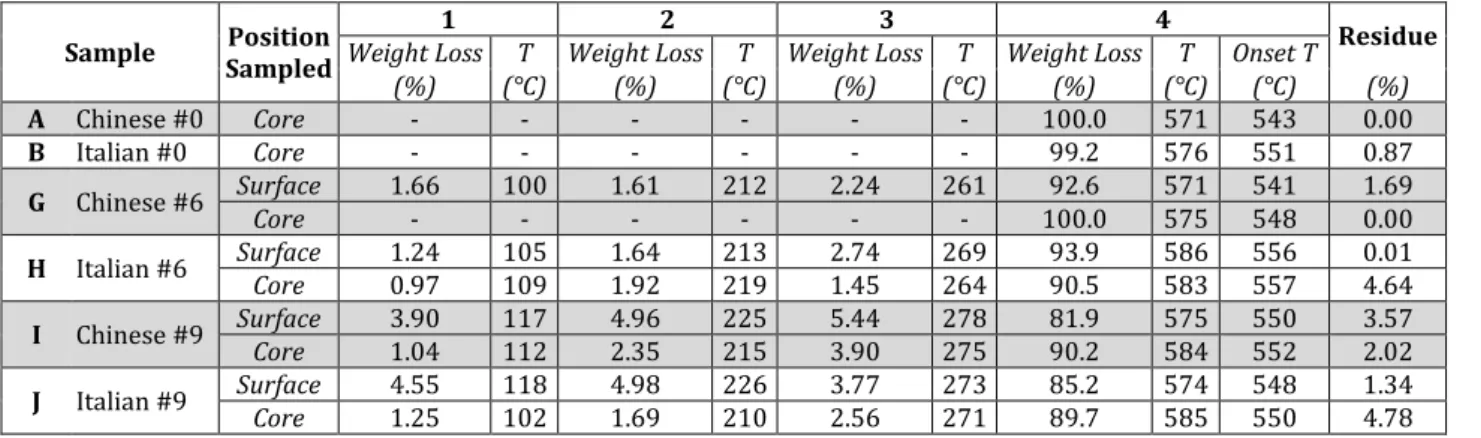
Samples subjected to acid treatment #6 and #9 were analysed both at the surface and in the core of the gaskets. TGA thermograms (Fig. 4 and Table 4) show four different weight losses, with the first three that could be probably attributed to compositional changes due to the acid treatments. The last one is, instead, due to the complete pyrolytic decomposition of the PTFE chain, via depolymerisation at monomers. In Table 4, TGA analysis results are summarized. The first three weight losses show different trends depending on the acid treatment applied.
Amongst samples subjected to treatment #6 (#G and #H), the surface samples behave in a very
similar manner, both in weight losses
temperatures and entities. The Italian core and surface samples show the same weight loss temperatures, but their entities are generally slightly lower (Figs. 4a and 4b). The principal observation regards the core of the Chinese sample subjected to treatment #6, which undergo one single weight loss, in the same manner to what happens to the related Chinese new untreated sample. This fact is consistent
with the FT-IR analysis previously executed,
Samples subjected to treatment #9 (#I and #J) show a similar trend. The core samples exhibit lower weight loss entities which occur at slightly lower temperatures when compared to the surface samples. Comparing Chinese and Italian samples, the weight loss temperatures of Chinese core sample are higher than the Italian one, while the entities do not seem to have a particular trend (Figs. 4c and 4d).
The last and more abundant weight loss, attributable to the depolymerisation of PTFE at its monomer, varies in entity from 81.9 to 100 %wt according to the previously three weight
losses. Residue at °C also varies between
and 4,78 %wt.
Samples treated with acid attack #6 do not exhibit a precise trend (Figs. 4a and 4b). Chinese core sample behave similarly to the related untreated sample, and exhibits lower residue than the surface sample. The Italian core and
surface samples show instead similar behaviour. Temperatures of this main weight loss are quite consistent between core and surface but differs
of to °C between Chinese (lower T) and Italian (higher T). In any case, both onset and peak temperature measured are generally higher than those of new samples.
Samples subjected to treatment #9 show coherent values for Chinese and Italian samples, both in entities and temperatures (peak and onset) of the weight loss, which are all very similar between the two manufacturers (Figs. 4c and 4d). Even in this case, all the degradation temperatures measured are higher than those of untreated samples.
The simultaneous higher residue and lower entity of the last weight loss (related to the PTFE decomposition) exhibited by the samples subjected at #9 treatment, seems to indicate that the aforementioned acid attack resulted in a more aggressive aging rather than #6 treatment.
0 10 20 30 40 50 60 70 80 90 100
W
e
igh
t (%)
0 100 200 300 400 500 600 700 800 Temperature °C
Chinese New
–––––––
Chinese 6, Surface –– –– –
Chinese 6, Core
– – – –
0 10 20 30 40 50 60 70 80 90 100
W
e
igh
t (%)
0 100 200 300 400 500 600 700 800 Temperature °C
Italian New
–––––––
Italian 6, Surface –– –– –
Italian 6, Core
– – – –
a) b)
0 10 20 30 40 50 60 70 80 90 100
W
e
igh
t (%)
0 100 200 300 400 500 600 700 800 Temperature °C
Chinese New
–––––––
Chinese 9, Surface –– –– –
Chinese 9, Core
– – – –
0 10 20 30 40 50 60 70 80 90 100
W
e
igh
t (%)
0 100 200 300 400 500 600 700 800 Temperature °C
Italian New
–––––––
Italian 9, Surface –– –– –
Italian 9, Core
– – – –
c) d)
Fig. 4. TGA thermograms of Chinese samples (left) and Italian samples (right), subject to treatment #6 (upper)
Tab. 4. Summary of TGA and DTG results for both treated and new samples.
Sample Position
Sampled
1 2 3 4
Residue
Weight Loss T Weight Loss T Weight Loss T Weight Loss T Onset T
(%) °C (%) °C (%) °C (%) °C °C (%)
A Chinese #0 Core - - - 100.0 571 543 0.00
B Italian #0 Core - - - 99.2 576 551 0.87
G Chinese #6 Surface 1.66 100 1.61 212 2.24 261 92.6 571 541 1.69
Core - - - 100.0 575 548 0.00
H Italian #6 Surface 1.24 105 1.64 213 2.74 269 93.9 586 556 0.01 Core 0.97 109 1.92 219 1.45 264 90.5 583 557 4.64
I Chinese #9 Surface 3.90 117 4.96 225 5.44 278 81.9 575 550 3.57 Core 1.04 112 2.35 215 3.90 275 90.2 584 552 2.02
J Italian #9 Surface 4.55 118 4.98 226 3.77 273 85.2 574 548 1.34 Core 1.25 102 1.69 210 2.56 271 89.7 585 550 4.78
Tab. 5. DSC results of new untreated and treated samples.
Sample Position
1 (phase transitions) 2 (melting)
T peak T onset H T peak T onset H
°C °C (J/g) °C °C (J/g)
A Chinese #0 Core 21 15 8.4 327 319 34.2
B Italian #0 Core 22 16 7.9 327 321 32.2
G Chinese #6 Surface 21 15 6.4 326 319 25.6
Core 22 16 6.9 328 319 31.4
H Italian #6 Surface 22 16 7.1 327 321 29.8
Core 21 15 7.1 326 321 31.0
I Chinese #9 Surface 21 16 7.0 327 319 28.1
Core 21 15 8.0 327 317 33.0
J Italian #9 Surface 22 16 7.6 327 321 28.0
Core 22 16 7.5 327 321 29.3
0,2 0,4 0,6 0,8
0,2 0,4 0,6 0,8
-50 0 50 100 150 200 250 300 350
0,2 0,4 0,6 0,8
Chinese New
34,2 J/g
25,6 J/g
H
eat
F
lo
w
(W/g
)
Chinese 6, Surface
31,4 J/g
Temperature (°C) Chinese 6, Core
0,2 0,4 0,6 0,8
0,2 0,4 0,6 0,8
-50 0 50 100 150 200 250 300 350
0,2 0,4 0,6 0,8
Italian New
32,2 J/g
29,8 J/g
H
eat
F
lo
w
(W/g
)
Italian 6, Surface
31,0 J/g
Temperature (°C) Italian 6, Core
a) b)
0,2 0,4 0,6 0,8
0,2 0,4 0,6 0,8
-50 0 50 100 150 200 250 300 350
0,2 0,4 0,6 0,8
Chinese New
34,2 J/g
28,1 J/g
H
eat
Flow
(W/g
)
Chinese 9, Surface
33,0 J/g
Temperature (°C) Chinese 9, Core
0,2 0,4 0,6 0,8
0,2 0,4 0,6 0,8
-50 0 50 100 150 200 250 300 350
0,2 0,4 0,6 0,8
Italian New
32,2 J/g
28,0 J/g
H
eat
F
lo
w
(W/g
)
Italian 9, Surface
29,3 J/g
Temperature (°C) Italian 9, Core
c) d)
Fig. 1. DSC thermograms of Chinese (left) and Italian (right) samples subject to treatment #6 (upper) and #9
DSC analyses of treated samples show the same pattern recorded by new samples, with the presence of crystalline phase transitions peaks located at the same temperatures (both peak and onset), with significant variations in the
enthalpies (H) of both the 1st and 2nd thermal
events (Table 5 and Fig. 5). A decrease in these melting enthalpy values is related to a reduced crystallinity of the PTFE, which in turn could be the result of the presence of defects in the polymer chain due to degradation. The results reported in Table 5 show a relative pronounced variation in the phase transitions enthalpy of
Chinese samples centred at around 21- °C,
highlighting also a higher decrease in both surface samples enthalpy (treatment #6 and #9) with respect to the corresponding core samples.
Instead, Italian surface samples exhibit H
similar to their corresponding core samples. Furthermore, treated samples show slightly
lower values of H when compared with the
corresponding new samples.
Finally, the lower H associated to the first
phase transition has been measured for both Chinese and Italian samples subjected to treatment #6.
The measured melting enthalpies are much more variable in entity amongst the samples, but the trends are quite similar to those observed for the previously discussed phase transitions (Fig. 5). Melting enthalpies variation of the
treated samples, with respect to the
correspondent new untreated samples, are slightly higher for Chinese samples (1-7 J/g, Fig. 5, left) rather than for Italian ones (2-4 J/g, Fig. 5, right). However, a little difference could be pointed out in the behaviours exhibited by the samples of the two manufacturers in relation to the treatment: a Chinese sample seems to be more susceptible to treatment #6 (i.e. lower enthalpies), while Italian samples show slight
lower H values after treatment #9.
Finally, as general trend, all samples exhibit
melting H of the surfaces lower than that of the
cores.
4. CONCLUSIONS
This paper investigates the surface and core degradation of PTFE (Teflon) gaskets exposed to
different acid attacks. In particular, different
combinations for Sol.I (sulfamic acid 15%wt,
hydrochloric acid 0.1%wt) and Sol.II
(hydrofluoric acid 1%wt) have been considered as accelerating aging factors with the aim to compare the effects of the two solutions in different ratios. Experimental measures have been performed by Thermogravimetric Analysis (TGA) and Differential Scanning Calorimetry (DSC). Two series of PTFE gaskets, produced by two different manufacturers (one from Italy and other from China) have been treated and compared with new untreated samples. The samples have been analysed to evaluate different behaviours in response of the various acid treatments. Experimental TGA and DSC data have highlighted different behaviours for the PTFE matrix (core and surface), but also differences between Teflon manufacturers. These results denote a rather clear evidence of progressive degradation of PTFE by chemical attack. Specifically, thermogravimetric analysis (TGA) data seems to indicate a slightly higher amount of degradation in samples subjected to aging treatment labelled as #9, especially in the case of the Italian samples. DSC analysis shows that the treatment #6 is responsible of a generally higher decrease in phase transitions enthalpies, as well as of the melting enthalpies, particularly in the case of Chinese samples. In fact, the lower enthalpies exhibited by treated samples are sign of a more marked reduction of their crystallinity degree. This fact could be a consequence of a greater presence of defects in the polymer chains, possibly induced or enhanced by the chemical attack. These results are generally in accordance with those
previously obtained by FT-IR analysis on
samples treated in the same manner [18]. However, regarding the superficial and internal homogeneity, our experimental data suggest that in all cases Chinese samples exhibit a slightly inhomogeneous degradation after the treatments.
Acknowledgement
REFERENCES
[1] C. Fragassa and M. )ppoliti, Technology assessment of tire mould cleaning systems and
quality finishing , International Journal for Quality Research, vol. 10, no. 3, pp. 523-546, 2016. [2] Keymical, U.M.C.S. Keymical Ultrasonic Mould
Cleaning System (Model UMCS-&-PCR). Cleaning Process Handbook Chemical Maintenance Management, 2015.
[3] C. Fragassa and M. )ppoliti, Failure Mode Effects and Criticality Analysis (FMECA) as a quality tool to plan improvements in Ultrasonic Mould
Cleaning Systems , International Journal for Quality Research, vol. 10, no. 4, pp. 847-870, 2016.
[4] About Teflon (DuPont) available at: http://web.archive.org/web/20080229143203 /http://www2.dupont.com/PFOA/en_US/about _teflon/, accessed: 01.05.2016.
[5] Polytetrafluoroethylene, available at: https://en.wikipedia.org/wiki/Polytetrafluoroe thylene, accessed: 01.05.2016.
[6] J. Bickford, Gaskets and gasketed joints. CRC Press, 1997.
[7] N.K. Myshkin, S.S. Pesetskiiand and A.Ya.
Grigoriev, Polymer Tribology: Current and
Applications , Tribology in Industry, vol. 37, no. 3, pp. 284-290, 2015.
[8] D. Stamenkovic, M. Nikolic, M. Milosevic, M. Banic, A. Miltenovicand and M. Mijajlovic,
Tribological Aspect of Rubber Based Parts used in Engineering , Tribology in Industry, vol. 36, no. 1, pp. 9-16, 2014.
[9] P. Rae and D. Dattelbaum, The properties of poly (tetrafluoroethylene) (PTFE) in
compression ,Polymer, vol. 45, no. 22, pp. 7615– 25, 2004.
[10] K. Lunkwitz, U. Lappanand and D. Lehmann,
Modification of fluoropolymers by means of
electron beam irradiation , Radiation Physics and Chemistry, vol. 57, no. 3, pp. 373-376, 2000.
[11] A. Palova, H. Fujiib, Yu. Mankelevicha, T. Rakhimovaaand and M. Baklanovc, Modelling
degradation of PTFE under electron irradiation ,
Polymer Degradation and Stability, vol. 97, no. 5, pp. 802–809, 2012.
[12] Du Pont, Teflon PTFE fluoropolymer resin – Proprieties Handbook. US., 2006. Available at: http://www.rjchase.com/ptfe_handbook.pdf [13] F. Capelli, Relazione Tecnica Peritale Causa
Civile Keymical 2rsm Vs Ecotecne Srl. Tribunale Di Padova – Sezione Seconda Civile. Protocollo N. 12110/2014 r.g., 10/2015.
[14] Evans A. & R., The Composition of a Tyre: Typical Components. In The Waste & Resources Action Programme, England, Banbury, 2006.
[15] L. Giorgini, T. Benelli, C. Leonardi, L. Mazzocchetti, G. Zattini, M. Cavazzoni, I. Montanari and C. Tosi, Efficient recovery of non-shredded tires via pyrolysis in an
innovative pilot plant , Environmental Engineering and Management Journal, vol. 14, no. 7, pp. 1611-1622, 2015.
[16] M.C. Bignozzi, A. Saccani and C. Fragassa,
Experimental Evaluation of the Surface
Alteration of Gasket Samples under Operative
Conditions , Tribology in Industry, vol. 37, no. 4, pp. 482-490, 2015.
[17] C. Fragassa, )nvestigations into the degradation
of PTFE surface properties by accelerated aging
tests , Tribology in Industry, vol. 38, no. 2, pp 241-248, 2016.
[18] L. Giorgini, C. Fragassa, G. Zattini and A.
Pavlovic, Acid aging effects on surfaces of PTFE gaskets investigated by Fourier Transform
)nfrared Spectroscopy , Tribology in Industry, vol. 38, no. 3, pp. 286-296, 2016.
[19] G. Zattini, A. Pavlovic, C. Fragassa and L.
Giorgini, Characterization of solid residues
emerging during ultrasonic cleaning treatments
of tyre moulds , FME Transaction, vol. 45, no. 2, pp. 203-213, 2017.
[20] A.W. Coats and J.P. Redfern, Thermogravimetric Analysis: A Review , Analyst, vol. 88, pp. 906– 924, 1963.
[21] E. Bicciocchi, Y.K. Chong, L. Giorgini, G. Moad, E. Rizzardo and S.(. Thang, Substituent effects on RAFT polymerization with benzyl aryl trithiocarbonates, Macromolecular Chemistry and Physics, vol. 211, pp. 529-538, 2010.
[22] E. Poodts, G. Minak, L. Mazzocchetti and L.
Giorgini, Fabrication, process simulation and testing of a thick CFRP component using the
RTM process , Composites: Part B, vol. 56, pp. 673–680, 2014.
[23] H.W. Li, R, Termine, L, Angiolini, L, Giorgini, F. Mauriello and A. Golemme, High T-g, Nonpoled
Photorefractive Polymers , Chemistry of Materials, vol. 21, pp. 2403-2409, 2009.
[24] L. Angiolini, L. Giorgini, R. Bozio and D. Pedron, Reversible chirality inversion of photochromic methacrylic polymers upon irradiation with one-handed circularly polarized light , Synthetic Metals, vol. 138, pp. 375-379, 2003.
surfactants: two effective tools for the extraction of polyhydroxyalkanoates from microbial biomass, Green Chemistry, vol. 17, pp.
1047-1056, 2015.
[26] A. Bellusci, M. Ghedini, L. Giorgini, F. Gozzo, E.I. Szerb, A. Crispini and D. Pucci, 'Anion dependent mesomorphism in coordination networks based on 2, ′-bipyridine silver ) complexes , Dalton Transaction, vol. 36, pp. 7381-7389, 2009.
[27] M.J. O'Neill, The Analysis of a Temperature
-Controlled Scanning Calorimeter . Anal. Chem., vol. 36, no. 7, pp. 1238–1245, 1964.
[28] Fu, Z. Mo, P. Han, Y. Qi, S. Wu and D. Chen, CStudy on factors affecting room temperature
transition of polytetrafluoroethylene , Chinese Journal of Polymer Science, vol. 4, 1986.
[29] J. Blumm, A. Lindemann, M. Meyer and C.
Strasser, Characterization of PTFE Using
Advanced Thermal Analysis Techniques ,
International Journal of Thermophysics, vol. 31, pp. 1919-1927, 2008.
[30] Y.P. Khanna, The melting temperature of polytetrafluoroethylene, Journal of Materials Science Letters, vol. 7, pp. 817-818, 1988. [31] X. Huang, J. Martinez‐Vega and D. Malec,