ACPD
9, 26627–26651, 2009Nanoparticles in boreal forest and coastal environment
K. Lehtipalo et al.
Title Page
Abstract Introduction
Conclusions References
Tables Figures
◭ ◮
◭ ◮
Back Close
Full Screen / Esc
Printer-friendly Version
Interactive Discussion Atmos. Chem. Phys. Discuss., 9, 26627–26651, 2009
www.atmos-chem-phys-discuss.net/9/26627/2009/ © Author(s) 2009. This work is distributed under the Creative Commons Attribution 3.0 License.
Atmospheric Chemistry and Physics Discussions
This discussion paper is/has been under review for the journal Atmospheric Chemistry and Physics (ACP). Please refer to the corresponding final paper in ACP if available.
Nanoparticles in boreal forest and coastal
environment: a comparison of
observa-tions and implicaobserva-tions of the nucleation
mechanism
K. Lehtipalo1, M. Kulmala1, M. Sipil ¨a1,2, T. Pet ¨aj ¨a1, M. Vana1,3, D. Ceburnis4, R. Dupuy4,*, and C. O’Dowd4
1
Department of Physics, University of Helsinki, P.O. Box 64, 00014 Helsinki, Finland
2
Helsinki Institute of Physics, University of Helsinki, P.O. Box 64, 00014 Helsinki, Finland
3
Institute of Physics, University of Tartu, ¨Ulikooli 18, 50090 Tartu, Estonia
4
School of Physics & Centre for Climate and Air Pollution Studies, Environmental Change Institute, National University of Ireland Galway, Galway, Ireland
*
ACPD
9, 26627–26651, 2009Nanoparticles in boreal forest and coastal environment
K. Lehtipalo et al.
Title Page
Abstract Introduction
Conclusions References
Tables Figures
◭ ◮
◭ ◮
Back Close
Full Screen / Esc
Printer-friendly Version
Interactive Discussion Received: 23 November 2009 – Accepted: 30 November 2009
– Published: 11 December 2009
Correspondence to: K. Lehtipalo ([email protected])
ACPD
9, 26627–26651, 2009Nanoparticles in boreal forest and coastal environment
K. Lehtipalo et al.
Title Page
Abstract Introduction
Conclusions References
Tables Figures
◭ ◮
◭ ◮
Back Close
Full Screen / Esc
Printer-friendly Version
Interactive Discussion
Abstract
The detailed mechanism of secondary new particle formation in the atmosphere is still under debate. It is proposed that particle formation happens via activation of 1–2 nm atmospheric neutral molecular clusters and/or large molecules. Since traditional in-strumentation does not reach these sizes, the hypothesis has not yet been verified. By 5
directly measuring particle size distributions down to mobility diameters of about 1.3 nm with a pulse-height CPC we provide evidence of the nucleation mechanism in coastal environment (Mace Head, Ireland) and in boreal forest (Hyyti ¨al ¨a, Finland). In both places neutral sub-3 nm condensation nuclei (nano-CN) were continuously present, even when no new particle formation was detected. In Mace Head, however, the con-10
centration of the nano-CN was far too low to account for the particle formation rates during particle bursts. Thus the results imply that on coastal sites new particle for-mation initiates, as proposed earlier, via homogenous nucleation from biogenic iodine vapors. In contrary, activation of pre-existing nano-CN remains a possible explanation in the boreal forest, but the observed concentrations are not the limiting factor for the 15
particle formation events.
1 Introduction
Aerosol particles deteriorate air quality, atmospheric visibility and human health. Ad-ditionally, particles affect the climate both directly by scattering and absorbing solar radiation, and indirectly via cloud processes. Atmospheric aerosols have both natural 20
and anthropogenic sources. Natural new particle formation by gas-to-particle conver-sion has been frequently observed around the world (Kulmala et al., 2004). Conden-sational growth in the atmosphere can make the newly formed particles large enough to act as cloud condensation nuclei (e.g., O’Dowd, 2001; Laaksonen et al., 2005). Ac-cording to model simulations these particle formation events affect the particle budget 25
ACPD
9, 26627–26651, 2009Nanoparticles in boreal forest and coastal environment
K. Lehtipalo et al.
Title Page
Abstract Introduction
Conclusions References
Tables Figures
◭ ◮
◭ ◮
Back Close
Full Screen / Esc
Printer-friendly Version
Interactive Discussion the IPCC assigns the biggest uncertainty ranges in the radiative forcing estimates to
aerosols (IPCC, 2007). Hence, molecular level understanding of nucleation is needed for incorporate the secondary particle formation to the climate models.
Particles can nucleate homogeneously from one or several precursor vapors if the vapor concentrations are high enough. Generally lower supersaturations are needed, 5
when particles form heterogeneously on a pre-existing surface (e.g., Kulmala et al., 2007b). Heterogeneous nucleation on a 1–2 nm molecular clusters, also known as ac-tivation of clusters, is proposed as an explanation to particle formation events (Kulmala et al., 2000, 2006). Charged cluster ions are long known to exist in the atmosphere (e.g., H ˜orrak et al., 1998), and their recombination could produce electrically neutral 10
particles (Turco et al., 1998). Nucleation on a charged cluster is called ion induced nu-cleation (Yu and Turco, 2000), and the vapor concentrations required for activation of ions are lower than for neutral particles (Winkler et al., 2008). There is no consensus of how big fraction of atmospheric new particle formation is ion-induced or ion-mediated. Some studies have underlined the crucial role of ions (Yu et al., 2008; Yu and Turco 15
2008), whereas the conclusions of several other experiments show that the ion con-centrations are too low to explain the observed particle formation rates in the boundary layer (e.g., Laakso et al., 2004; Iida et al., 2006; Gagn ´e et al., 2008; Kulmala et al., 2007a).
Different particle formation mechanisms might be prevailing in different environmen-20
tal conditions. Here we compare measurements from two very distinct environments: the boreal forest in Hyyti ¨al ¨a, southern Finland, and the coast of the North Atlantic Ocean, in Mace Head, Ireland. In Hyyti ¨al ¨a new particle formation is observed on about 25% of days, most frequently in spring time (Dal Maso et al., 2005). However, parti-cles grow the fastest in the summer indicating that particle formation and growth are 25
ACPD
9, 26627–26651, 2009Nanoparticles in boreal forest and coastal environment
K. Lehtipalo et al.
Title Page
Abstract Introduction
Conclusions References
Tables Figures
◭ ◮
◭ ◮
Back Close
Full Screen / Esc
Printer-friendly Version
Interactive Discussion iodine-compounds (Hoffmann et al., 2001; Jimenez et al., 2003).
A reason for the lack of knowledge about the nucleation process has been the in-capability to detect or chemically identify the initial clusters. Recent development of measurement techniques (e.g., Mirme et al., 2007; Sipil ¨a et al., 2009) has provided us with tools to reach molecular sizes. Already Weber et al. (1995) detected molec-5
ular clusters when ultrafine particles were present. Continuous existence of a neutral cluster pool below 3 nm was first discovered in Hyyti ¨al ¨a by Kulmala et al. (2007a). The applicability of condensation particle counters (CPCs) to detect clusters was further studied by Sipil ¨a et al. (2008). However, CPC measurements alone can not resolve if the activated nanometer-size condensation nuclei (nano-CN) are nucleated particles, 10
molecular clusters or large molecules. In many former articles, they were simply called clusters.
In this article we look for similarities and differences in the characteristics of nano-CN concentrations between boreal forest and coastal environment. Since an analysis of the nano-CN in Hyyti ¨al ¨a has already been published by Lehtipalo et al. (2009) the focus 15
will be on describing the first nano-CN measurements in Mace Head using a pulse-height CPC. We compare the concentrations measured with different instruments to theoretical calculations and to each other. Thus we aim at resolving the possible nu-cleation mechanism and estimating the importance of clusters to new particle formation on both sites.
20
2 Materials and methods
2.1 Site description
Hyyti ¨al ¨a SMEAR II-station (61◦51′N, 24◦17′E) is situated in southern Finland about 60 km north-east from the city of Tampere. The nearest village with some industrial activity is ca. 10 km away, and the nearest buildings are by a small lake 500 m away 25
ACPD
9, 26627–26651, 2009Nanoparticles in boreal forest and coastal environment
K. Lehtipalo et al.
Title Page
Abstract Introduction
Conclusions References
Tables Figures
◭ ◮
◭ ◮
Back Close
Full Screen / Esc
Printer-friendly Version
Interactive Discussion dominated forest. All the measurements discussed in this article were done inside
the forest canopy. The station is equipped with extensive meteorological and aerosol instrumentation. For a more detailed site description see Hari and Kulmala (2005).
The Mace Head atmospheric research station (54◦19′N, 9◦54′W) is a GAW super-site situated on the west coast of Ireland facing North Atlantic ocean. The station is 5
located 100 m from the coastline surrounded by bare land (rocks, grass and peat bog) with no forest or trees in the surroundings. Few scattered single houses are located at the distance of 1 km or greater. The nearest city (Galway, 80 000 inhabitants) is located 60 km to the east/south-east of the station. The site is well exposed to clean marine westerly air masses associated with low pressure systems accounting for nearly 50% of 10
occurrences. Pollution outbreaks are related to high pressure synoptic scale conditions bringing polluted air from UK and continental Europe.
2.2 Instruments and measurements
Particle size distribution from ∼1.3 nm to 5 nm in mobility diameter was measured in Hyyti ¨al ¨a 1–31 May 2008 and in Mace Head 13 June–25 August 2008 by applying pulse-15
height analysis method (e.g., Saros et al., 1996) to a condensation particle counter (CPC). Pulse height analysis method has formerly been used in size distribution mea-surements between 3 and 10 nm (Weber et al., 1995), as well as to determine the composition of freshly nucleated nanoparticles (O’Dowd et al., 2002a).
The pulse-height CPC (PH-CPC) consists of a TSI 3025 CPC with modified optics 20
(Dick et al., 2000) and a multi-channel analyzer. The temperature difference between the CPC condenser and saturator was increased until homogenous nucleation of con-densing liquid, i.e. butanol occurred. The pulse-height analysis method allows distinc-tion between activadistinc-tion of nano-CN and homogenous nucleadistinc-tion (Sipil ¨a et al., 2008). Every other measurement was made through a diffusion tube, which enabled subtrac-25
ACPD
9, 26627–26651, 2009Nanoparticles in boreal forest and coastal environment
K. Lehtipalo et al.
Title Page
Abstract Introduction
Conclusions References
Tables Figures
◭ ◮
◭ ◮
Back Close
Full Screen / Esc
Printer-friendly Version
Interactive Discussion the exact size scale and detection efficiency depends on particle composition, charge
and background aerosol concentration (O’Dowd, 2004; Sipil ¨a et al., 2009). The data inversion to resolve particle size distribution between 1.3 and 5 nm is based on exper-imental calibrations with positive silver and Am241-charger generated ions. Detailed description of performance of the instrument and data inversion is presented in Sipil ¨a 5
et al. (2009).
Ambient ion size distribution was measured in Hyyti ¨al ¨a with a Balanced Scanning Mobility Analyzer (BSMA; Tammet et al., 2006), and in Mace Head with a Neutral Clus-ter and Air Ion SpectromeClus-ter (NAIS; Mirme et al., 2007; Manninen et al., 2009b). The mobility range of the BSMA is 0.032–3.2 cm2V−1s−1 (corresponding to
∼0.8–7.5 nm 10
in mobility diameter), and the NAIS 0.0013–3.2 cm2V−1s−1 (
∼0.8–40 nm). The NAIS has two operation modes: one for naturally charged ions, and one for neutral particles, which are charged by corona charger before mobility classification. The charging sets the lower detection limit for neutral particles to about 2 nm depending on polarity and concentration (Asmi et al., 2009). Aerosol size distribution between 3 and 500 nm was 15
measured using a twin-DMPS (Aalto et al., 2001) in Hyyti ¨al ¨a and a Scanning Mobility Particle Sizer (SMPS) in Mace Head.
2.3 Data analysis
For air mass analysis 24 h back-trajectories were calculated with a HYSPLIT model (Draxler and Rolph, 2003) to Mace Head at 500 m altitude. Based on these trajectories, 20
the data set from Mace Head was divided into air masses coming directly from the ocean (south to north-west sector) representing clean marine air, and air masses that had been over land area over the past 24 h.
The recombination products, a maximum estimate for the steady-state concentration of neutral particles produced by recombination of ion clusters, was calculated from 25
Nn,rec=
γαNi+N−
i
ACPD
9, 26627–26651, 2009Nanoparticles in boreal forest and coastal environment
K. Lehtipalo et al.
Title Page
Abstract Introduction
Conclusions References
Tables Figures
◭ ◮
◭ ◮
Back Close
Full Screen / Esc
Printer-friendly Version
Interactive Discussion where the subscript n refers to neutral clusters and i to ion clusters.γ is the fraction of
stable recombination products andα the ion-ion recombination coefficient. For α we used a value of 1.6×10⁻⁶cm3s−1(Tammet and Kulmala, 2005), and to obtain a maxi-mum estimate,γ was set to unity. The ion cluster concentrations were taken from ion spectrometer data so that only collisions between ions large enough to produce par-5
ticles about 1.5–3 nm in diameter were accounted for. The coagulation sink (CoagS) was calculated for 2 nm particles from DMPS/SMPS data as in e.g. Dal Maso et al. (2002).
3 Results
3.1 Concentrations
10
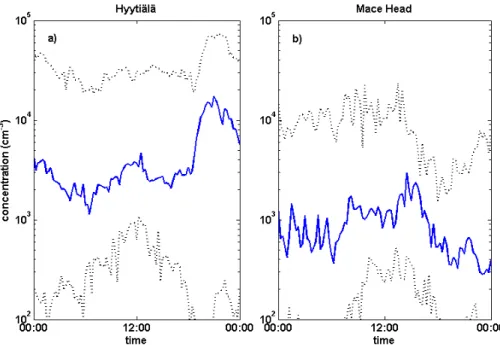
Measurements with a pulse-height CPC was performed at Hyyti ¨al ¨a in May 2008 and at Mace Head in summer 2008 as a part of the EUCAARI campaign (Kulmala et al., 2009). Hereafter we refer as nano-CN concentration to the sum of neutral particles smaller than 3 nm in mobility diameter measured with the PH-CPC. At Hyyti ¨al ¨a, the concentration of nano-CN exceeded 103cm−3almost constantly, sometimes reaching 15
values of 105cm−3(Fig. 1a). The highest concentrations were often measured shortly after sunset. A nighttime maximum was observed on 19 of 30 d in May, and the cluster ion concentration and mean size grew simultaneously. No growth to larger sizes was, however, observed in the nighttime. The average diurnal behavior of the nano-CN concentration was remarkably similar regardless of whether or not the new particle 20
formation events were observed (Lehtipalo et al., 2009).
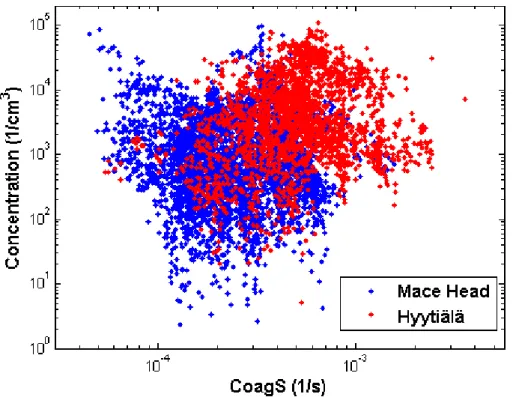
At Mace Head the nano-CN concentrations varied mostly between 102and 104cm−3 (Fig. 1b). During the day the overall concentration was lower by a factor of two and during the night almost one order of magnitude lower at Mace Head than in Hyyti ¨al ¨a. Small clusters and particles are effectively lost by coagulational scavenging (Kerminen 25
ACPD
9, 26627–26651, 2009Nanoparticles in boreal forest and coastal environment
K. Lehtipalo et al.
Title Page
Abstract Introduction
Conclusions References
Tables Figures
◭ ◮
◭ ◮
Back Close
Full Screen / Esc
Printer-friendly Version
Interactive Discussion to Mace Head cannot, however, be explained solely by differences in the coagulation
sink, as demonstrated by Fig. 2. It should be noted that we tend to underestimate the coagulation sink, especially in Mace Head, as the super-micron particles were not measured and thus lack from the calculated value. Nevertheless, the coagulation sink is generally lower in coastal conditions than in the forest (e.g., Dal Maso et al., 5
2002), and definitely not high enough to explain an order of magnitude difference in concentrations. This leads to the conclusion that the production rate of nano-CN needs to be higher in Hyyti ¨al ¨a.
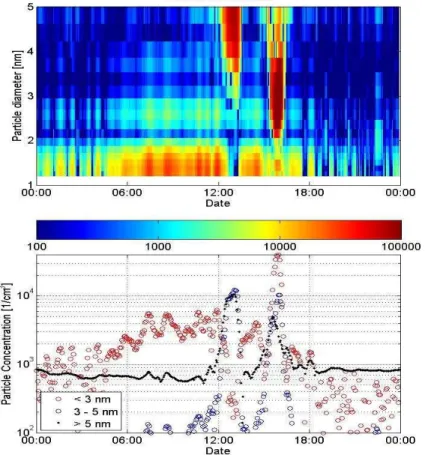
Figure 3 presents a 4-day time series (13–16 June) of total particle concentration between 1.5–3 nm and 3–5 nm. The measurements with the PH-CPC and the NAIS 10
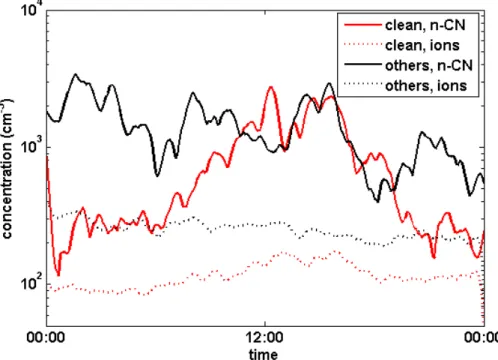
correspond well in both size classes. The 3–5 nm particles are mostly associated with particle formation bursts, and were thus observed in high quantities at daytime low tides. The 1.5–3 nm particles, however, had not a clear relation to the tidal cycle. Another type of divider was found: When the air mass trajectories originated directly from the ocean, i.e. from the clean sector without much of anthropogenic influence, 15
the nano-CN concentration was very low during the night, but peaked around noon (Fig. 4). These daytime maxima were not observed by the NAIS, indicating that the CN are very small and thus disguised by the charger ions in the NAIS. When the air mass advecting to the site had passed over land, no clear diurnal cycle could be distinguished. Especially the nighttime values were much higher than in the marine air 20
masses. On a few days a nighttime maxima were observed, but not as strong or as frequently as in Hyyti ¨al ¨a. The ion cluster concentrations in the same size range were pretty stable throughout the day, but, as also pointed out by Vana et al. (2008), their concentration is much higher in air masses from the land sector, probably due to radon, which is one of the main sources of small ions (the other being cosmic radiation, which 25
should be independent of the air mass origin).
ACPD
9, 26627–26651, 2009Nanoparticles in boreal forest and coastal environment
K. Lehtipalo et al.
Title Page
Abstract Introduction
Conclusions References
Tables Figures
◭ ◮
◭ ◮
Back Close
Full Screen / Esc
Printer-friendly Version
Interactive Discussion the same size range accounted on average for only a few percents of neutral nano-CN
in Hyyti ¨al ¨a, but more than a half of the measured concentration in Mace Head. The diurnal variation of both the ion ratio and the recombination ratio (Fig. 5) showed a min-imum in the evening for Hyyti ¨al ¨a and around midday in Mace Head. The ratios were a bit higher in Mace Head during clean, marine air masses. All in all, the contribution of 5
ions varied a lot from day to day in both places, but it seems that the ions have a much bigger contribution to the nano-particle concentration in Mace Head than in Hyyti ¨al ¨a.
Table 1 summarizes the characteristics of the measured concentrations in Hyyti ¨al ¨a and Mace Head during the EUCAARI campaign.
3.2 Particle formation
10
At Mace Head new particle formation usually occurs as strong bursts of nucleation mode particles during low tide (e.g., O’Dowd, 2002b; Vana et al., 2008). Figure 6 presents an example of PH-CPC data with two distinct particle formation bursts occur-ring at 12:30 and 15:30 LT, while tidal minima were around 03:30 and 16:00 LT. On the first particle burst most particles have grown to sizes over 3.5 nm before reaching our 15
measurement location, and to sizes over 2 nm on the second burst. No increase can be seen in the smallest size range prior or during the particle burst. However, a rapid change in total number concentration challenges our measurement technique as the supersaturation decreases in the PH-CPC due to vapor depletion and thus limits the reliability of measurements during intensive particle formation.
20
The formation rate of 1 nm particles during particle formation events in Mace Head has been estimated to be as high as 300–10 000 cm−3s−1, corresponding to cluster concentrations of 4×10⁴–7×106cm−3 (Dal Maso et al., 2002). Clearly, the measured concentrations, both neutral and charged, are too low for explaining these kind of parti-cle bursts. In Hyyti ¨al ¨a, the observed formation rate of 2–3 nm partiparti-cles varies between 25
ACPD
9, 26627–26651, 2009Nanoparticles in boreal forest and coastal environment
K. Lehtipalo et al.
Title Page
Abstract Introduction
Conclusions References
Tables Figures
◭ ◮
◭ ◮
Back Close
Full Screen / Esc
Printer-friendly Version
Interactive Discussion
4 Discussion and conclusions
Both in Hyyti ¨al ¨a and Mace Head neutral nanometer-size CN were observed contin-uously with a pulse-height CPC, even when no particle formation was detected with traditional instrumentation, like the DMPS/SMPS with a cut-off size at 3 nm. These clusters or molecules seemed to be more abundant in Hyyti ¨al ¨a, especially at nighttime. 5
The differences in diurnal variation and in charged fraction indicate that they have dif-ferent sources and therefore different chemical composition in Hyyti ¨al ¨a than in Mace Head.
The composition of nanoparticles is hard to measure directly, and is therefore not known. Proposed candidates for forming clusters include oxidation products of volatile 10
organic compounds (e.g., Bonn and Moortgat, 2003). For example monoterpenes and their oxidation products exhibit a similar diurnal variation in Hyyti ¨al ¨a than the mea-sured nano-CN (Rinne et al., 2005; Sellegri et al., 2005). The fact, that the nano-CN concentration follows solar radiation in Mace Head when air masses come form the ocean, implies that their formation includes some photochemical reactions. When the 15
air masses have passed over land area, VOCs emitted from the vegetation or anthro-pogenic emissions might explain the higher and more varying concentrations. At least the nano-CN seem not to consist of the same biogenic iodine compounds that make the nucleation mode particles, as they do not exhibit similar tidal cycle than the parti-cle formation events. The exact chemical composition of the nano-CN remains to be 20
solved in future studies.
A much bigger fraction of clusters can be explained solely by the ions in Mace Head than in Hyyti ¨al ¨a. The minimum in ion fraction at nighttime in Hyyti ¨al ¨a gives a reason to assume that we have a source of neutral nano-CN near ground. One should, however be careful when comparing the measurements with a CPC and an ion spectrometer, 25
since the size is determined with different methods, which might lead to discrepancies in the smallest sizes.
ACPD
9, 26627–26651, 2009Nanoparticles in boreal forest and coastal environment
K. Lehtipalo et al.
Title Page
Abstract Introduction
Conclusions References
Tables Figures
◭ ◮
◭ ◮
Back Close
Full Screen / Esc
Printer-friendly Version
Interactive Discussion for new particle formation. The measured nano-CN concentrations are easily large
enough to explain particle formation events via activation of the clusters. The nano-CN concentration does not, however, seem to be the critical factor determining whether a nucleation event occurs. The main process limiting particle formation is probably the competition between growth of particles and their loss by scavenging, rather than 5
the production of initial clusters (Riipinen et al., 2007). Maybe sulphuric acid, which is often connected to first steps of new particle formation (e.g., Weber et al., 1996; Sihto et al., 2006; Pet ¨aj ¨a et al., 2009; Nieminen et al., 2009) or some other vapor is needed for activation and/or growth of particles. The start of the particle formation is also related to meteorological conditions and boundary layer dynamics (Nilsson et al., 10
2001a,b; Sogacheva et al., 2008). In Mace Head the concentrations of the nano-CN and the cluster ions, even together, are too small to account for the observed formation rate of the nucleation mode particles. Thus it seems that the particles are formed by homogenous nucleation of the same vapor(s), which make them grow to sizes of a few nanometers before reaching our measurement location.
15
The apparently different nucleation mechanisms behind the new particle formation at Mace Head and Hyyti ¨al ¨a suggest that also in other environments, where the nucleation rate is high (over some tens in cm−3s−1) new particle formation happens via homoge-neous nucleation, and the activation type nucleation is probably dominating in places where the formation rate is of the order of unity.
20
Acknowledgements. This work has been partially funded by European Commission 6th Frame-work programme project EUCAARI, contract no 036833-2 (EUCAARI) and Academy of Finland Center of Excellence program (project number 1118615). Maj and Tor Nessling foundation, and EPA Ireland are acknowledged for financial support. NOAA Air Resources Laboratory (ARL) is acknowledged for the provision of the HYSPLIT transport and dispersion model and READY 25
ACPD
9, 26627–26651, 2009Nanoparticles in boreal forest and coastal environment
K. Lehtipalo et al.
Title Page
Abstract Introduction
Conclusions References
Tables Figures
◭ ◮
◭ ◮
Back Close
Full Screen / Esc
Printer-friendly Version
Interactive Discussion
References
Aalto, P., H ¨ameri, K., Becker, E., Weber, R., Salm, J., M ¨akel ¨a, J. M., Hoell, C., O’Dowd, C. D., Karlsson, H., Hansson, H.-C., V ¨akev ¨a, M., Koponen, I. K., Buzorius, G., and Kulmala, M.: Physical characterization of aerosol particles in boreal forests, Tellus B, 53, 344–358, 2001. Asmi, E., Sipil ¨a, M., Manninen, H. E., Vanhanen, J., Lehtipalo, K., Gagn ´e, S., Neitola, K., 5
Mirme, A., Mirme, S., Tamm, E., Uin, J., Komsaare, K., Attoui, M., and Kulmala, M.: Results of the first air ion spectrometer calibration and intercomparison workshop, Atmos. Chem. Phys., 9, 141–154, 2009,
http://www.atmos-chem-phys.net/9/141/2009/.
Bonn, B. and Moortgat, G. K.: Sesquiterpene ozonolysis: origin of atmospheric 10
new particle formation from biogenic hydrocarbons, Geophys. Res. Lett., 30, 1585, doi:10.1029/2003GL017000, 2003.
Dal Maso, M., Kulmala, M., Lehtinen, K. E. J., M ¨akel ¨a, J. M., Aalto, P., and O’Dowd, C. D.: Con-densation and coagulation sinks and formation of nucleation mode particles in coastal and boreal forest boundary layers, J. Geophys. Res. 107, 8097, doi:10.1029/20000JD000213, 15
2002.
Dal Maso, M., Kulmala, M., Riipinen, I., Wagner, R., Hussein, T., Aalto, P. P., and Lehti-nen, K. E. J.: Formation and growth of fresh atmospheric aerosols: eight years of aerosol size distribution data from SMEAR II, Hyyti ¨al ¨a, Finland, Boreal Environ. Res., 10, 323–336, 2005.
20
Dick, W. D., McMurry, P. H., Weber, R. J., and Quant, R.: White-light detection for nanoparticle sizing with the TSI ultrafine condensation particle counter, J. Nanopart. Res., 2, 85–90, 2000.
Draxler, R. R. and Rolph, G. D.: HYSPLIT (HYbrid Single-Particle Lagrangian Integrated Trajec-tory) Model access via NOAA ARL READY Website (http://www.arl.noaa.gov/ready/hysplit4. 25
html). NOAA Air Resources Laboratory, Silver Spring, MD, 2003.
Gagn ´e, S., Laakso, L., Pet ¨aj ¨a, T., Kerminen, V.-M., and Kulmala, M.: Analysis of one year of Ion-DMPS data from the SMEAR II station, Finland, Tellus B, 60, 318–329, 2008.
Hari, P. and Kulmala, M.: Station for measuring ecosystem-atmosphere relations (SMEAR II), Boreal Environ. Res., 10, 315–322, 2005.
30
ACPD
9, 26627–26651, 2009Nanoparticles in boreal forest and coastal environment
K. Lehtipalo et al.
Title Page
Abstract Introduction
Conclusions References
Tables Figures
◭ ◮
◭ ◮
Back Close
Full Screen / Esc
Printer-friendly Version
Interactive Discussion Environ. Res., 10, 357–369, 2005.
H ˜orrak, U., Salm, J., and Tammet, H.: Bursts of intermediate ions in atmospheric air., J. Geo-phys. Res., 103, 13909–13915, 1998.
Hoffmann, T., O’Dowd, C. D., and Seinfeld, J. H.: Iodine oxide homogeneous nucleation: an explanation for coastal new particle production, Geophys. Res. Lett., 28, 1949–1952, 2001. 5
Iida, K., Stolzenburg, M., McMurry, P., Dunn, M. J., Smith, J. N., Eisele, F., and Keady, P.: Contribution of ion-induced nucleation to new particle formation: methodology and its appli-cation to atmospheric observations in Boulder, Colorado, J. Geophys. Res., 111, D23201, doi:1029/2006JD007167, 2006.
IPCC: Summary for policymakers, in: Climate Change 2007: The Physical Science Basis, Con-10
tribution of Working Group I to the Fourth Assessment Report of the Intergovernmental Panel on Climate Change, edited by: Solomon, S., Qin, D., Manning, M., Chen, Z., Marquis, M., Averyt, K. B., Tignor, M., and Miller, H. L., Cambridge University Press, Cambridge, UK and New York, NY, USA, 2007.
Jimenez, J. L., Bahreini, R., Cocker III, D. R., Zhuang, H., Varutbangkul, V., Flagan, R. C., 15
Seinfeld, J. H., O’Dowd, C. D., and Hoffmann, T.: New particle formation from photooxidation of diiodomethane (CH2I2), J. Geophys. Res., 108, 4318, doi:10.1029/2002JD002452, 2003. Kerminen, V.-M., Pirjola, L., and Kulmala, M.: How significantly does coagulational scavenging
limit atmospheric particle production?, J. Geophys. Res., 106, 24119–24126, 2001.
Kulmala, M., Pirjola, L., and M ¨akel ¨a, J. M.: Stable sulphate clusters as a source of new atmo-20
spheric particles, Nature, 404, 66–69, 2000.
Kulmala, M., Vehkam ¨aki, H., Pet ¨aj ¨a, T., Dal Maso, M., Lauri, A., Kerminen, V.-M., Birmili, W., and McMurry, P. H.: Formation and growth rates of ultrafine atmospheric particles: a review of observations, J. Aerosol Sci., 35, 143–176, 2004.
Kulmala, M., Lehtinen, K. E. J., and Laaksonen, A.: Cluster activation theory as an explanation 25
of the linear dependence between formation rate of 3nm particles and sulphuric acid con-centration, Atmos. Chem. Phys., 6, 787–793, 2006,
http://www.atmos-chem-phys.net/6/787/2006/.
Kulmala, M., Riipinen, I., Sipil ¨a, M., Manninen, H., Pet ¨aj ¨a, T., Junninen H., Dal Maso, M., Mor-das, G., Mirme, A., Vana, M., Hirsikko, A., Laakso, L., Harrison, R. M., Hanson, I., Leung, C., 30
Lehtinen, K. E. J., and Kerminen, V.-M.: Towards direct measurement of atmospheric nucle-ation, Science, 318, 89–92, 2007a.
ACPD
9, 26627–26651, 2009Nanoparticles in boreal forest and coastal environment
K. Lehtipalo et al.
Title Page
Abstract Introduction
Conclusions References
Tables Figures
◭ ◮
◭ ◮
Back Close
Full Screen / Esc
Printer-friendly Version
Interactive Discussion Herrmann, E., Sipil ¨a, M., Riipinen, I., Manninen, H. E., H ¨ameri, K., Stratmann, F., Bilde, M.,
Winkler, P. M., Birmili, W., and Wagner, P. E.: The condensation particle counter battery (CPCB): A new tool to investigate the activation properties of nanoparticles, J. Aerosol Sci., 38, 289–304, 2007b.
Kulmala, M., Asmi, A., Lappalainen, H. K., Carslaw, K. S., P ¨oschl, U., Baltensperger, U., Hov, 5
Ø., Brenquier, J.-L., Pandis, S. N., Facchini, M. C., Hansson, H.-C., Wiedensohler, A., and O’Dowd, C. D.: Introduction: European integrated project on aerosol cloud climate and air quality interactions (EUCAARI) – integrating aerosol research from nano to global scales, Atmos. Chem. Phys., 9, 2825–2841, 2009,
http://www.atmos-chem-phys.net/9/2825/2009/. 10
Laakso, L., Anttila, T., Lehtinen, K. E. J., Aalto, P. P., Kulmala, M., H ˜orrak, U., Paatero, J., Hanke, M., and Arnold, F.: Kinetic nucleation and ions in boreal forest particle formation events, Atmos. Chem. Phys., 4, 2353–2366, 2004,
http://www.atmos-chem-phys.net/4/2353/2004/.
Laaksonen, A., Hamed, A., Joutsensaari, J., Hiltunen, L., Cavalli, F., Junkermann, W., 15
Asmi, A., Fuzzi, S., and Facchini, M.-C.: Cloud condensation nucleus production from nucleation events at a highly polluted region, Geophys. Res. Lett., 32, L06812, doi:10.1029/2004GL022092, 2005.
Lehtipalo, K., Sipil ¨a, M., Riipinen, I., Nieminen, T., and Kulmala, M.: Analysis of atmospheric neutral and charged molecular clusters in boreal forest using pulse-height CPC, Atmos. 20
Chem. Phys., 9, 4177–4184, 2009,
http://www.atmos-chem-phys.net/9/4177/2009/.
Manninen, H. E., Nieminen, T., Riipinen, I., Yli-Juuti, T., Gagn ´e, S., Asmi, E., Aalto, P. P., Pet ¨aj ¨a, T., Kerminen, V.-M., and Kulmala, M.: Charged and total particle formation and growth rates during EUCAARI 2007 campaign in Hyyti ¨al ¨a, Atmos. Chem. Phys., 9, 4077–4089, 2009a, 25
http://www.atmos-chem-phys.net/9/4077/2009/.
Manninen, H. E., Pet ¨aj ¨a, T., Asmi, E., Riipinen, I., Nieminen, T., Mikkil ¨a, J., H ˜orrak, U., Mirme, A., Mirme, S., Laakso, L., Kerminen, V.-M., and Kulmala, M.: Long-term field mea-surements of charged and neutral clusters using Neutral cluster and Air Ion Spectrometer (NAIS), Boreal Environ. Res., 14, 591–605, 2009b.
30
ACPD
9, 26627–26651, 2009Nanoparticles in boreal forest and coastal environment
K. Lehtipalo et al.
Title Page
Abstract Introduction
Conclusions References
Tables Figures
◭ ◮
◭ ◮
Back Close
Full Screen / Esc
Printer-friendly Version
Interactive Discussion Nieminen, T., Manninen, H., Sihto, S.-L., Yli-Juuti, T., Mauldin, R. L., Pet ¨aj ¨a, T., Riipinen, I.,
Kerminen, V.-M., and Kulmala, M.: Connection of sulphuric acid to atmospheric nucleation in boreal forest, Environ. Sci. Technol., 43, 4715–4721, 2009.
Nilsson, E. D., Rannik, ¨U., Kulmala, M., Buzorius, G., and O’Dowd, C. D.: Effects on continen-tal boundary layer evolution, convection, turbulence and entrainment, on aerosol formation, 5
Tellus B, 53, 441–461, 2001a.
Nilsson, E. D., Paatero, J., and Boy, M.: Effects of air masses and synoptic weather on aerosol formation in the continental boundary layer, Tellus B, 53, 462–478, 2001b.
O’Dowd, C. D.: Biogenic coastal aerosol production and its influence on aerosol radiative prop-erties, J. Geophys. Res., 106, 1545–1549, 2001.
10
O’Dowd, C. D., Aalto, P., H ¨ameri, K., Kulmala, M., and Hoffmann, T.: Atmospheric particles from organic vapours, Nature, 416, 497–498, 2002a.
O’Dowd, C. D., H ¨ameri, K., M ¨akel ¨a, J. M., V ¨akev ¨a, M., Aalto, P. P., de Leeuw, G., Kunz, G. J., Becker, E., Hansson, H.-C., Allen, A. G., Harrison, R. M., Berresheim, H., Kleefeld, C., Geever, M., Jennings, S. G., and Kulmala, M.: Coastal new particle formation: environ-15
mental conditions and aerosol physicochemical characteristics during nucleation bursts, J. Geophys. Res., 107(D19), 8107, doi:10.1029/2000JD000206, 2002b.
O’Dowd, C. D., Jimenez, J. L., Bahreini, R., Flagan, R. C., Seinfeld, J. H., H ¨ameri, K., Pirjola, L., Kulmala, M., Jennings, S. G., and Hoffmann, T.: Marine aerosol formation from biogenic iodine emissions, Nature, 417, 632–636, 2002c.
20
O’Dowd, C. D., Aalto, P. P., Yoon, Y. J., and H ¨ameri, K.: The use of the pulse height analyzer ultrafine condensation particle counter (PHA-UCPC) technique applied to sizing of nucleation mode particles of different chemical composition, J. Aerosol Sci., 35(2), 205–216, 2004. Pet ¨aj ¨a, T., Mauldin, III, R. L., Kosciuch, E., McGrath, J., Nieminen, T., Paasonen, P., Boy, M.,
Adamov, A., Kotiaho, T., and Kulmala, M.: Sulfuric acid and OH concentrations in a boreal 25
forest site, Atmos. Chem. Phys., 9, 7435–7448, 2009, http://www.atmos-chem-phys.net/9/7435/2009/.
Riipinen, I., Sihto, S.-L., Kulmala, M., Arnold, F., Dal Maso, M., Birmili, W., Saarnio, K., Teinil ¨a, K., Kerminen, V.-M., Laaksonen, A., and Lehtinen, K. E. J.: Connections between atmo-spheric sulphuric acid and new particle formation during QUEST III–IV campaigns in Heidel-30
berg and Hyyti ¨al ¨a, Atmos. Chem. Phys., 7, 1899–1914, 2007, http://www.atmos-chem-phys.net/7/1899/2007/.
ACPD
9, 26627–26651, 2009Nanoparticles in boreal forest and coastal environment
K. Lehtipalo et al.
Title Page
Abstract Introduction
Conclusions References
Tables Figures
◭ ◮
◭ ◮
Back Close
Full Screen / Esc
Printer-friendly Version
Interactive Discussion PTR-MS measurements of atmospheric concentrations of volatile organic compounds in
a European boreal forest ecosystem, Boreal Environ. Res., 10, 425–436, 2005.
Saros, M., Weber, R. J., Marti, J., and McMurry, P. H.: Ultra fine aerosol measurement using a condensation nucleus counter with pulse height analysis, Aerosol Sci. Tech., 25, 200–213, 1996.
5
Sellegri, K., Hanke, M., Umann, B., Arnold, F., and Kulmala, M.: Measurements of organic gases during aerosol formation events in the boreal forest atmosphere during QUEST, At-mos. Chem. Phys., 5, 373–384, 2005,
http://www.atmos-chem-phys.net/5/373/2005/.
Sihto, S.-L., Kulmala, M., Kerminen, V.-M., Dal Maso, M., Pet ¨aj ¨a, T., Riipinen, I., Korhonen, H., 10
Arnold, F., Janson, R., Boy, M., Laaksonen, A., and Lehtinen, K. E. J.: Atmospheric sulphuric acid and aerosol formation: implications from atmospheric measurements for nucleation and early growth mechanisms, Atmos. Chem. Phys., 6, 4079–4091, 2006,
http://www.atmos-chem-phys.net/6/4079/2006/.
Sipil ¨a, M., Lehtipalo, K., Kulmala, M., Pet ¨aj ¨a, T., Junninen, H., Aalto, P. P., Manninen, H. E., 15
Kyr ¨o, E.-M., Asmi, E., Riipinen, I., Curtius, J., K ¨urten, A., Borrmann, S., and O’Dowd, C. D.: Applicability of condensation particle counters to measure atmospheric clusters, Atmos. Chem. Phys., 8, 4049–4060, 2008,
http://www.atmos-chem-phys.net/8/4049/2008/.
Sipil ¨a, M., Lehtipalo, K., Attoui, M., Neitola, K., Pet ¨aj ¨a, T., Aalto, P. P., O’Dowd, C. D., and 20
Kulmala, M.: Laboratory verification of PH-CPC’s ability to monitor atmospheric sub-3 nm clusters, Aerosol Sci. Tech., 43(2), 126–135, 2009.
Sogacheva, L., Saukkonen, L., Dal Maso, M., Nilsson, E.-D., Schultz, D. M., de Leeuw, G., and Kulmala, M.: New aerosol particle formation in different synoptic situations at Hyyti ¨al ¨a, Southern Finland, Tellus B, 60, 485–494, 2008.
25
Spracklen, D. V., Carslaw, K. S., Kulmala, M., Kerminen, V.-M., Mann, G. W., and Sihto, S.-L.: The contribution of boundary layer nucleation events to total particle concentrations on regional and global scales, Atmos. Chem. Phys., 6, 5631–5648, 2006,
http://www.atmos-chem-phys.net/6/5631/2006/.
Tammet, H.: 2006 Continuous scanning of the mobility and size distribution of charged clusters 30
and nanometer particles in atmospheric air and the balanced scanning mobility analyzer BSMA, Atmos. Res., 82, 523–535, 2006.
ACPD
9, 26627–26651, 2009Nanoparticles in boreal forest and coastal environment
K. Lehtipalo et al.
Title Page
Abstract Introduction
Conclusions References
Tables Figures
◭ ◮
◭ ◮
Back Close
Full Screen / Esc
Printer-friendly Version
Interactive Discussion Aerosol Sci., 36, 173–196, 2005.
Turco, R. P., Zhao, J. X., Yu, F.: A new source of tropospheric aerosols: Ion-ion recombination, Geophys. Res. Lett., 25, 635–638, 1998.
Vana, M., Ehn, M., Pet ¨aj ¨a, T., Vuollekoski, H., Aalto, P., de Leeuw, G., Ceburnis, D., O’Dowd, C. D., and Kulmala, M.: Characteristic features of air ions at Mace Head on the 5
west coast of Ireland, Atmos. Res., 90, 278–286, 2008.
Winkler, P. M., Steiner, G., Vrtala, A., Vehkam ¨aki, H., Noppel, M., Lehtinen, K. E. J., Reischl, G. P., Wagner, P. E., and Kulmala, M.: Heterogeneous nucleation experiments bridg-ing scale from molecular ion clusters to nanoparticles, Science, 319, 1374–1377, 2008. Weber, R. J., McMurry, P. H., Eisele, F. L., and Tanner, D. J.: Measurement of expected nucle-10
ation precursor species and 3–500-nm diameter particles at Mauna Loa observatory, Hawaii, J. Atmos. Sci., 52, 2242–2257, 1995.
Weber, R. J., Marti, J., McMurry, P. H., Eisele, F., Tanner, D. J., and Jefferson, A.: Measured atmospheric new particle formation rates: implications for nucleation mechanisms, Chem. Eng. Commun., 151, 53–64, 1996.
15
Yoon, Y. J., O’Dowd C. D., Jennings, S. G., and Lee, S. H.: Statistical characteristics and predictability of particle formation events at Mace Head, J. Geophys. Res., 111, D13204, doi:10.1029/2005JD006284, 2006.
Yu, F. and Turco, R. P.: Ultrafine aerosol formation via ion-mediated nucleation, Geophys. Res. Lett., 27, 883–886, 2000.
20
Yu, F. and Turco, R.: Case studies of particle formation events observed in boreal forests: implications for nucleation mechanisms, Atmos. Chem. Phys., 8, 6085–6102, 2008,
http://www.atmos-chem-phys.net/8/6085/2008/.
Yu, F., Wang, Z., Luo, G., and Turco, R.: Ion-mediated nucleation as an important global source of tropospheric aerosols, Atmos. Chem. Phys., 8, 2537–2554, 2008,
25
ACPD
9, 26627–26651, 2009Nanoparticles in boreal forest and coastal environment
K. Lehtipalo et al.
Title Page
Abstract Introduction
Conclusions References
Tables Figures
◭ ◮
◭ ◮
Back Close
Full Screen / Esc
Printer-friendly Version
Interactive Discussion
Table 1.Characteristics of nano-CN concentrations in Hyyti ¨al ¨a and Mace Head (MH). Recom-bination ratio is the maximum estimate of recomRecom-bination products divided with neutral nano-CN. Ion ratio is the fraction of ions from all particles between 1.3–3 nm.
Hyyti ¨al ¨a MH (all data) MH (clean sector)
Nano-CN
– daytime (cm−3) 1000–40 000 500–20 000 500–10 000
– nighttime (cm−3) 1000–100 000 100–10 000 100–1000
Recombination ratio 3% 54% 62%
ACPD
9, 26627–26651, 2009Nanoparticles in boreal forest and coastal environment
K. Lehtipalo et al.
Title Page
Abstract Introduction
Conclusions References
Tables Figures
◭ ◮
◭ ◮
Back Close
Full Screen / Esc
Printer-friendly Version
Interactive Discussion
ACPD
9, 26627–26651, 2009Nanoparticles in boreal forest and coastal environment
K. Lehtipalo et al.
Title Page
Abstract Introduction
Conclusions References
Tables Figures
◭ ◮
◭ ◮
Back Close
Full Screen / Esc
Printer-friendly Version
Interactive Discussion
ACPD
9, 26627–26651, 2009Nanoparticles in boreal forest and coastal environment
K. Lehtipalo et al.
Title Page
Abstract Introduction
Conclusions References
Tables Figures
◭ ◮
◭ ◮
Back Close
Full Screen / Esc
Printer-friendly Version
Interactive Discussion
ACPD
9, 26627–26651, 2009Nanoparticles in boreal forest and coastal environment
K. Lehtipalo et al.
Title Page
Abstract Introduction
Conclusions References
Tables Figures
◭ ◮
◭ ◮
Back Close
Full Screen / Esc
Printer-friendly Version
Interactive Discussion
ACPD
9, 26627–26651, 2009Nanoparticles in boreal forest and coastal environment
K. Lehtipalo et al.
Title Page
Abstract Introduction
Conclusions References
Tables Figures
◭ ◮
◭ ◮
Back Close
Full Screen / Esc
Printer-friendly Version
Interactive Discussion
ACPD
9, 26627–26651, 2009Nanoparticles in boreal forest and coastal environment
K. Lehtipalo et al.
Title Page
Abstract Introduction
Conclusions References
Tables Figures
◭ ◮
◭ ◮
Back Close
Full Screen / Esc
Printer-friendly Version
Interactive Discussion