O R I G I N A L A R T I C L E UDC: 616.314-08-7:615.46 DOI: 10.2298/VSP1301021I
The flow of two zinc oxide-eugenol-based endodontic sealers
Napon te
þ
enja dva cink-oksid eugenolna endodontska silera
Dragan V. Iliü
Faculty of Dental Medicine, Clinic of Restorative Dentistry and Endodontics, Belgrade, Serbia
Abstract
Background/Aim. Endodontic sealers (ES) for obturation are usually prepared with a slight variation of their compo-nents both on purpose or unintentionally. Considering that fact, as well as a frequent use of compaction techniques with the applied force to gutta-percha and ES of 1–3 kg, the aim of this study was to investigate the flow of two zinc-oxide eugenol ES in regard to the applied force and a variation of sealer’s components. Methods. The experimental group samples of both ES were prepared according to the manu-facturer’s instructions, applied between pair of glass slabs and loaded by weights of 1 and 2 kg, respectively (American Na-tional Standard, Specification No. 57). Some samples of one ES were prepared as thick consistency with 10% more pow-der and some as thin mixture with 10% less powpow-der than the standard prescription. These semples had been exposed to the load of 2 kg. The control group included samples of both ES prepared as standard prescription but exposed to the weight of one glass slab only. The spread ES appeared as a regular circle 10 min upon mixing and weighting. Measuring of the circle diameter was done by an orthodontic ruler. The flow of the used ES was considered the function of its spread
diameter. Results. Application of 1 vs 2 kg load for both regularly mixed sealers in the scope of disk diameter (flow) was statistically insignificant (p > 0.05). This means that the stated null hypothesis that there would be no significant dif-ference in flow rate among the regularly mixed sealers at the level of ơ = 0.05 is accepted. The findings about difference in the disk diameter in regard to mixing variation of Endometh-asone indicate that the null hypothesis that there would be no significant difference in flow rate between the regular and thick mixed mass at the level of ơ = 0.05 is accepted. In the comparison of regular and thin mix a significant difference was noted and the null hypotesis is rejected (p < 0.01). The control group results displayed Roth 801 as less viscous than Endomethasone sealer (p < 0.01). Conclusion. Application of 1 or 2 kg pressure on the samples of both exposed sealers does not significantly affect the flow values as well as com-parison of the regular to thick consistency of Endomethasone while comparison of its regular to thin mass shows a signifi-cant difference.
Key words:
root canal filling materials; zinc oxide-eugenol cement; rheology; viscosity.
Apstrakt
Uvod/Cilj. Endodontski sileri (ES) za opturaciju kanala ko-rena zuba ÿesto se u praksi pripremaju sa varijacijama svojih komponenti. Uzimajuýi u obzir ovo, kao i ÿinjenicu da se sve ÿešýe koriste metode kompakcije gutaperke i ES sa primen-jenim pritiscima od 10 do 30 N, cilj ovog rada bio je ispiti-vanje napona teÿenja (flow) dva ES na bazi cink-oksid euge-nolnih silera. U tom smislu je planirano ispitivanje promene napona teÿenja kod ES sa i bez primene optereýenja kao i sa minimalnim odstupanjima gustine materijala od regularno zamešane preskripcije (gušýa i reĀa konzistencija). Metode. U eksperimentalnoj grupi uzorci dva cink-oksid eugenolna ES pripremljeni su prema uputstvu proizvoĀaÿa, a zatim nane-šeni izmeĀu staklenih ploÿica i optereýeni tegovima od 1 i 2 kg (American National Standard, Specification No.57). Deo uzorka jednog silera bio je pripremljen kao gušýa i reĀa kon-zistencija (mešavina sa ± 10% praha od preporuÿene raz-mere) izloženih sili od 2 kg. Kontrolnu grupu ÿinili su uzorci oba ES zamešanih prema uputstvu proizvoĀaÿa bez
optere-ýenja, izloženi samo težini jedne staklene ploÿice. Veliÿina napona teÿenja posmatrana je u funkciji preÿnika razlivenog silera kao parametra napona teÿenja izmeĀu para ploÿica. Re-zultati. PoreĀenjem uzoraka (preÿnika razlivenih silera)
op-tereýenih sa 1 prema 2 kg kod oba materijala, naĀena je sta-tistiÿki neznaÿajna razlika (p > 0,05). Nalazi u vezi preÿnika razlivenih silera u pogledu varijacije ± 10% praha kod ES En-domethasone N ukazuju na to da ne postoji znaÿajna razlika u naponu teÿenja izmeĀu standardno i gušýe zamešane mase (p > 0,05), dok je razlika bila znaÿajna poreĀenjem uzoraka standardno zamešane mase prema onima sa reĀom konzis-tencijom (p < 0,01). Zakljuÿak. Promena sile sa 1 kg na 2 kg kod uzoraka oba silera ne utiÿe znaÿajno na napon teÿenja kao ni poreĀenje standardno i gušýe zamešanog Endometh-asone, dok je poreĀenjem njegove standardne i reĀe zamešane mase utvrĀena znaÿajna razlika.
Kljuÿne reÿi:
Introduction
The main function that a root canal sealer and gutta-percha should meet during obturation are lubrication and setting the master and auxiliary gutta-percha cones acting as intermediary and sticky-adhesive substance in a labyrinthine depulpated space. The outcome of endodontic therapy might depend on sealers’ properties whether they are biological, chemical or physical ones. The flow of endodontic sealer (ES) is affected by its viscosity as well as temperature and humidity. By the way, it is obvious that sealer’s flow de-pends on the shape, width and taperness of the root canal.
An adequate consistency is required whether to use a paste carrier (Lentulo spiral filler) or soaked gutta-percha point. The endodontists often adjust the powder/liquid ratio to the appropriate consistency of the sealer, usually in eugen-ate sealer meugen-aterials. The most desirable consistency should be chosen considering the 2 aims: not to overfill the apical canal portion when thicker consistency is required (wide open apical foramen, unfinished root growth), and on the contrary, weak consistency, is desirable when last millimeter of canal is not to be well obturated, i.e. strongly curved/narrow canals.
Some authors advocate for cleaning of smear layer as the important condition for ES flow and its penetration into the dentine tubules 1. On the other hand, during the use of compaction techniques by the instruments and devices for
obturation mass, sealer or gutta-percha cones pressing, high values of exposed pressure act as hydrodynamic pump to the root-canal walls. A result of compaction forces should be visible in filling all the canal irregularities, accessory ones as well as apical delta due to high exposed values of lateral and vertical forces. Some authors apply the force of 2 kg (~19.6 N) imitating clinical compaction stress, while the others use zinc-oxide eugenol ES and real clinical obturation force of 10, 15, 20 and the 25 N in studies on the quality of apical seal 2–3. Their exams were based on the study where the av-erage manual force during obturation ranged 10–30 N among eight endodontists 4. Application of heat in some obturation techniques may also influence the flow characteristic of a sealer 5.
Various devices have been used in evaluation the rheological properties of ES. This might be the reason for not having any important laws and conclusions about flow prop-erties of sealers. In the study on temperature influence on sealer custom-made capillary rheometer 5, 6, and cone-and-plate geometry were used 5.
ES flow rate has been studied by some investigators using a vertical glass plate 7 or a 2-plate system 5, 8–12. Some
investigation of ES flow was done through notification of microleakage into the lateral canals or tubules 13–17. The as-pect of contact angles at 4 ES points out the correlation on their flow properties 18.
Japanese authors 19 compared the two testing device values (vertical plate and two-plate system) of the flow on the same sealers. Extrusion viscometer 20 or free extrusion of ES through the bore 21 has been used for research on the rheological characteristic.
Considering the aforementioned, the aim of this study was to investigate the rheology features by influence of powder: liquid ratio and the two forces applied to the zinc-oxide eugenol (ZOE) ES. The first null hypothesis was that there would be no significant difference in flow rate among the regularly prepared sealers at the level of Į = 0.05 and re-gardless the applied load of 1 and 2 kg at the level of Į = 0.05. The second null hypothesis was that there would be no significant difference in flow regardless the sealer consis-tency and in comarison to regularly prepared mix consider-ing the level of Į = 0.05.
Methods
The root canal sealers
The two ZOE preparations as ES were tested for the study whose approximate contents according to the manu-facturer are given in Table 1 22, 23.
The study groups
The study involved the experimental and the control group.
The experimental group involved the samples of a regular and variated mixture of the two aforementioned ZOE ES (Table 1). Regular mixtures of Endomethasone (12 sam-ples) and Roth 801 (10 samsam-ples) were subjected to the load of 1 kg and 11 samples per each sealer to the load of 2 kg. The variated Endomethasone samples were prepared as thick and thin consistency (11 samples of each) and exposed to the load of 2 kg.
The control group included 3 samples of each used sealer regulary prepared. They were exposed to the weight of only one mixing slab (100 g).
The load exposure time was 10 min for all samples in the experimental and control groups.
The components ratio
Endomethasone N was prepared as regular prescription with ratio: one spoonful of powder to two drops of liquid 22. Thick consistency contained 10% more powder (by weight)
Table 1 The approximate composition /main ingredients/ of the used zinc oxide-eugenol (ZOE) endodontic sealers
ZOE endodontic sealers Ingredients
Endomethasone N (Septodont) powder zinc-oxide, magnesium stearate, thymol iodide, barium sulphate, hydrocortisone acetate, excipients liquid: eugenol, excipients 22 Roth 801 (Roth Inter Limit.) powder zinc-oxide, staybelite resin, bismuth subcarbonate, barium
than regular mix. Thin consistency had 10% less powder than regular mix. The reason to choose so minimal deviation of standard proportion (± 10% of powder) was reality of clinical situation where many times ES is prepared by such a variated proportion unintentionally or intentionally, as well as that no up-to-date literature data appeared of such study concept.
Roth’s 801 sealer was prepared as regular prescription to the consistency of petrolatum gel by the powder liquid ra-tio of 0.13 g : 0.03 g 21.
The adjustment of components was done by digital scale device with accuracy of 0.001g (Mettler PE 360, Ger-many).
The protocol and the experimental device for the experimental and control groups
The experiment methodology was based mostly on the 2-glass-plate geometry system (ADA specification No 57).
The ES were mixed according to the directions of a cor-responding manufacturer and variated for Endomethasone samples 24. The same amount of sealer (0.06 mL) was placed immediately after mixing by graduated syringe to the center of glide mixing plate and spread for 1 min by dental probe forming the circle of approximately 10 mm diameter. An-other glass plate weighing 100 g was then gently placed over the first 3 min after initiation of mixing. An extra load of 1 and 2 kg was added for the samples in the experimental group. A 2-glass-plate system was then fixed laterally to pre-vent minimal moving. All 4 brinks of the 2-glass-plate unit
were fixed by ten tangentially placed 4 cylindrical metal weights of 1 kg. Measurements were done at the stable lab temperature of 22 ºC and 65% humidity.
There was no load application except the weight of mixing slab of around 100 g in the control group samples.
The measuring
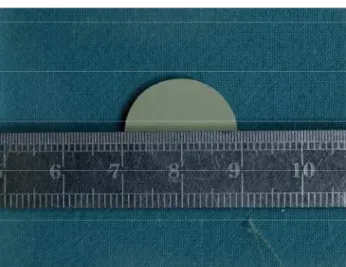
Measuring of values of the two perpendicular diameters were done in both experimental and control group 10 min after sealer application by the help of an orthodontic ruler of 0.5 mm raster and error of 0.025 mm (Figure 1). The values were recorded as the average estimation of two measured diameters summing the maximal and minimal values by the help of 4 u magnifying glass. The sample was discarded if the difference in the two recorded diameters per sample was more than 1 mm.
The Student’s t-test was used for recording the differ-ences in disk diameters among experimental samples in re-gard to the applied pressures (weight), in the cases of
varia-tions of two components in Endomethasone N samples as well as for comparison between Endomethasone N and Roth 801 viscosity values for regular mix and load of 2 kg.
Results
The mean disk diameter values of spreading regular and variated prepared mixed mass of sealers upon exposing the load of 1 and 2 kg are presented in Table 2 for the experi-mental and in Table 3 for the control group.
Table 3 The disk diameter and coefficient of variation (CV) values of
spread sealer mass without extra load (control group)
Sealer Mean diameter (mm) CV (%)
Endomethasone N 15.7 8.2
Roth 801 22.4 2.5
The difference in disk diameters of the mixed mass spread by exposing the load of 1 kg weight vs. 2 kg for both regularly prepared sealer mixture was not statistically sig-nificant (p > 0.05).
A significant statistical difference in disk diameters values was found in comparison of Endomethasone N and Roth 801 sealer when regularly mixed and used 1 or 2 kg load (p < 0.01).
Comparison of disk diameters values for 2 kg load of the regular and thick Endomethasone N preparation failed to show statistically significant difference (p > 0.05).
Fig.1 – The disk diameter of spread sealer measured by orthodontic ruler
Table 2 The disk diameter mean and coefficient of variation CV (%) values of spread regular and varied mixtures of sealers
be-tween the glass slabs upon exposing to the extra load of 1 and 2 kg (experimental group)
Mixtures
Regular prepared Varied
1kg 2kg thick (2kg) thin (2kg)
Sealer
ʉ (CV) ʉ (CV) ʉ (CV) ʉ (CV)
---A statistically significant difference in disk diameter was found in comparison of the regular Endomethasone N mixture to the thin mixed mass (p < 0.01), as well as in thick vs thin Endomethasone N mixed mass (p < 0.01).
The disk diameters in the control group within each sealer of no extra load were recorded as vary near values for both materials, thus provided the reliable parameters for sta-tistical analysis (Table 3). Those mean values of disk di-ameters point out that the load of only one glass plate to ex-posed Roth 801 as sealer give provide statistically signifi-cantly bigger diameters than Endomethasone N (p < 0.01) cases.
Discussion
The obtained coefficient of variation (CV) values for samples in this study for both experimental and control group were far below 30%, ie in the ranges of 8.5%–17.7% and 2.5%–8.2%, respectively, what characterized them as statistically homogenous groups very suitable for a precise statistical analysis.
In this study two glass plates were used on the same way as Grossman did in his 1976 study 25. The reason to choose this method is its simplicity as well as the presence of comparable literature data. The flow investigation under ISO specifications 26 on ZOE endodontic sealers (Canals, Showa) and sealer with other ingredients displayed diameter values higher than 20 mm (39.2–46.2 mm) thus satisfied ISO re-quirements 19. A study on 3 sealer flow in a 2-plate system under ADA conditions exposed mean diameter values in the range of 32.7–37.9 mm whith the highest values for ZOE sealer 11. In the flow study of Endomethasone authors did not required the ADA specification No. 57, although of limited value (20 mm disk diameter) and ISO standard by the value of only 11 mm diameter 13. The present study results satisfied ADA specification No. 57 of sealer with the mean diameter values higher than 20 mm (21.9–32.8 mm).
One can say that all aforementioned results were in the range of d 20 mm. The variation might be explained by a slightly performed deviation of the experimental conditions such as weight of a glass slab (30, 80, 100, 120, 450 or 500 gr), or extra load (1, 2 or 2.5 kg) the amount of the applied sealer on the plate (0.05, 0.06, 0.1 or 0.5 mL) and load expo-sure time (30 sec, 7 or 10 min).
In this study the comparison of Endomethasone N thick versus thin mix by glass plates revealed the significant dif-ference in disk diameters. The difdif-ference of powder satura-tion between these two consistencies was around 20%. In comparison of the two ZOE ES with the deviation of around 30% of median consistency French authors noted the similar results 12.
Although some authors used the powder increase of 50% in Grossman ZOE ES they did not obtain a significant difference in diameter values among thick and thin mix, as well as to Tubliseal ZOE ES, most probably due to negli-gence of both ADA and ISO specification. However, it is amazing that their study noted disk diameters larger than 20 mm for all sealers thus required the ADA conditions 6!
The hypothesis that the flow is comparable with the penetration degree into dentinal tubules checked by SEM stated the authors who noted the ZOE Pulp Canal Sealer as low potential sealer in regard to resin-based sealer 16.
The compaction force of 1.0 kg was applied in the study to imitate the Schilder plugger for compaction during obturation in test of various viscosity mixture 27. According to the noted force values during compaction in the range of 8–35 N 2, 3 the aim of this study was to compare those authors’ results themselves. This is the reason to chose the load for of 10.0 and 20.0 N in this study.
An increase in intracanal pressure during the rise in sealer viscosity is noted both with more or less thick con-sistency 27. This might be of high importance in thin roots due to the possible fracture 28.
It is sometimes very difficult to make the accurate proportion of the powder and liquid or two-paste system because double-syringe or accurate spoonful or bottle for all brands of ES are sometimes missing. That is another reason to believe in unintentional variation of ingredients in the amount of ± 10% of one component during preparation. It is questionable if a slight variation of one component might significantly influence the rise or decrease in sealer flow and thus cause an unwanted change in planned clinical consistency up to the concerned clinical endodontic situa-tion. The variation of sealer consistency was applied in this experiment due to the recommendation of the Endometh-asone N manufacturer allowing regular ratio of 1 : 2 of powder and liquid with deviation of around ± 50% 22. Ac-tually, the manufacturer allows the mixing variation in the sense of thicker and thinner consistency depending on the clinical situation. Using the variations in powder of Endo-methasone N of only ± 10% (clinical approved mixtur) and obtaining only a limited influence of the sealer’s rheology, this study is characterized as the novelty in the literature data. The result of French authors about the influence of powder variation of around ± 30%–50% to the rheology of the two ZOE ES, Pulp Canal sealer and Cortisomol re-vealed a significant flow change 12. Some authors obtained statistically significant differences in flow parameters com-paring the viscosity of the mixture much thicker than much thinner (± 10% of powder) and than regular ZOE sealer mix 5.
The noted flow rate in vertical glass plate experiment of two ZOE sealers, Endomethasone and Procosol, revealed significant difference where both of them were exposed to significantly lower flow than resin-based and Ca(OH)2 filler materials 7.
Sealer extrusion through the bore did not showed sig-nificant difference of flow between two ZOE sealers Roth 801 and Tubliseal EWT 21.
Observing literature data sometimes presented as hetero-geneous rheological characteristic of the ES obtained for the same materials but under slightly or largely changed condi-tions, point out to the need of strict following the standards in order to compare the results of investigators worldwide.
Conclusion
Application of 1 kg versus 2 kg load for both regularly mixed sealers in the scope of the obtained disk diameter (flow) was statistically insignificant (p > 0.05).
A significant statistical difference in disk diameters values (flow) was found in comparison of Endomethasone and Roth’s 801 sealers both regulary mixed for application of 1 kg or 2 kg load (p < 0.01).
The obtained difference in disk diameter in mixing variation of Endomethasone N and 2 kg load points out sta-tistical insignificance in flow rate between regular and thick mixtures (p > 0.05). A significant difference was found in comparison of regular and thin mixtures by the load of 2 kg (p > 0.01).
R E F E R E N C E S
1. Calt S, Serper A. Dentinal tubule penetration of root canal seal-ers after root canal dressing with calcium hydroxide. J Endod 1999; 25(6): 431î3.
2. Hatton JF, Ferrillo PJ Jr, Wagner G, Stewart GP. The effect of condensation pressure on the apical seal. J Endod 1988; 14(6): 305î8.
3. Joyce AP, Loushine RJ, West LA, Runyan DA, Cameron SM. Photoelastic comparison of stress induced by using stainless-steel versus nickel-titanium spreaders in vitro. J Endod 1998; 24(11): 714î5.
4. Harvey TE, White JT, Leeb IJ. Lateral condensation stress in root canals. J Endod 1981; 7(4): 151î5.
5. Lacey S, Pitt Ford TR, Yuan XF, Sherriff M, Watson T. The effect of temperature on viscosity of root canal sealers. Int Endod J 2006; 39(11): 860î6
6. Lacey S, Pitt Ford TR, Watson TF, Sherriff M. A study of the rheological properties of endodontic sealers. Int Endod J 2005; 38(8): 499î504.
7. Kaplan AE, Ormaechea MF, Picca M, Canzobre MC, Ubios AM. Rheological properties and biocompatibility of endodontic sealers. Int Endod J2003; 36(8): 527–32.
8. Bernardes RA, de Amorim Campelo A, Junior DS, Pereira LO, Duarte MA, Moraes IG, et al. Evaluation of the flow rate of 3 endodontic sealers: Sealer 26, AH Plus, and MTA Obtura. Oral Surg Oral Med Oral Pathol Oral Radiol Endod 2010; 109(1): e47î9.
9. Siqueira FJ Jr, Fraga RC, Garcia PF. Evaluation of sealing ability, pH and flow rate of three calcium hydroxide-based sealers. Endod Dent Traumatol 1995; 11(5): 225î8.
10.Siqueira JF Jr, Favieri A, Gahyva SM, Moraes SR, Lima KC, Lopes HP. Antimicrobial activity and flow rate of newer and estab-lished root canal sealers. J Endod 2000; 26(5): 274î7.
11.Gambarini G, Testarelli L, Pongione G, Gerosa R, Gagliani M. Ra-diographic and rheological properties of a new endodontic sealer. Aust Endod J 2006; 32(1): 31î4.
12.Camps J, Pommel L, Bukiet F, About I. Influence of the pow-der/liquid ratio on the properties of zinc oxide-eugenol-based root canal sealers. Dent Mater 2004; 20(10): 915î23.
13.Almeida JF, Gomes BP, Ferraz CC, Souza-Filho FJ, Zaia AA. Filling of artificial lateral canals and microleakage and flow of five endodontic sealers. Int Endod J 2007; 40(9): 692î9. 14.Weis MV, Parashos P, Messer HH. Effect of obturation
tech-nique on sealer cement thickness and dentinal tubule penetra-tion. Int Endod J 2004; 37(10): 653î63.
15.Ordinola-Zapata R, Bramante CM, Graeff MS, del Carpio Perochena A, Vivan RR, Camargo EJ, et al. Depth and percentage of penetration of endodontic sealers into dentinal tubules after root canal obturation using a lateral compaction technique: a
confocal laser scanning microscopy study. Oral Surg Oral Med Oral Pathol Oral Radiol Endod 2009; 108(3): 450î7.
16.Mamootil K, Messer HH. Penetration of dentinal tubules by en-dodontic sealer cements in extracted teeth and in vivo. Int En-dod J 2007; 40(11): 873î81.
17.Karabucak B, Kim A, Chen V, Iqbal MK. The comparison of gutta-percha and Resilon penetration into lateral canals with different thermoplastic delivery systems. J Endod 2008; 34(7): 847î9.
18.Kontakiotis EG, Tzanetakis GN, Loizides AL. A comparative study of contact angles of four different root canal sealers. J Endod 2007; 33(3): 299î302.
19.Ono K, Matsumoto K. Physical properties of CH61, a newly de-veloped root canal sealer. J Endod 1998; 24(4): 244î7. 20.Negm MM, Lilley JD, Combe EC. A study of the viscosity and
working time of resin-based root canal sealers. J Endod 1985; 11(10): 442î5.
21.McMichen FRS, Pearson G, Rahbaran S, Gulabivala K. A com-parative study of selected physical properties of five root-canal sealers. Int Endod J 2003; 36(9): 629î35.
22. Endomethasone N Ciment d’obturation canglaire, Septodont. Available from: www.septodont.com.plat@EbookBrowse. (English)
23.Mazinis E, Eliades G, Lambrianides T. An FTIR study of the setting reaction of various endodontic sealers. J Endod 2007; 33(5): 616î20.
24. ANSI/ADA Standard No. 57—Endodontic Sealing Material: 2000 (Reaffirmed 2006). Available from:
www.accessdata.fda.gov/.../cfstandards/detail [cited 2008 September 9]
25.Grossman LI. Physical properties of root canal cements. J En-dod 1976; 2(6): 166î75.
26. International Organization for Standardization ISO-6876 Dental Root Sealing Materials. Geneva: International Organi-zation for StandardiOrgani-zation; 2001.
27.Brooke KK, Grace MG. Relationship of intracanal pressure with viscosity of endodontic sealer during warm Gutta-Percha ver-tical compaction. Oral Surg Oral Med Oral Pathol Oral Radiol Endod 2000; 89(5): 618î22.
28.Holcomb JQ, Pitts DL, Nicholls JI. Further investigation of spreader loads required to cause vertical root fracture during lateral condensation. J Endod 1987; 13(6): 277î84.
29.Venturi M, Di Lenarda R, Breschi L. An ex vivo comparison of three different gutta-percha cones when compacted at differ-ent temperatures: rheological considerations in relation to the filling of lateral canals. Int Endod J 2006; 39(8): 648î56.