ISSN 1553-345X
© 2010 Science Publications
Corresponding Author: N. Babakhouya, Laboratoire de Génie alimentaire-Faculty of Engineer Science, University of Boumerdes, 35000, Boumerdes, Algeria
470
Kinetics and Thermodynamics of Cd(II) Ions Sorption on Mixed Sorbents
Prepared from Olive Stone and Date Pit from Aqueous Solution
N. Babakhouya, S. Boughrara and F. Abad
Laboratoire de Genie alimentaire-Department of environmental science,
Faculty of Engineer Science,University of Boumerdes, 35000, Boumerdes, Algeria
Abstract:Problem statement: The aim of this study is to remove Cd(II) ions from aqueous solutions by adsorption. Mixed sorbent prepared from olive stone and date pit, an agricultural solid by-product was used as adsorbent. Approach: The adsorption experiments of Cd(II) onto the mixture of olive stone and date pit were conducted at different parameters such as, percent of olive stone and date pit in the mixture, temperature, initial solution pH and initial Cd(II) concentration. Adsorption isotherms were obtained at different percent of olive stone and date pit in the mixture. Results: This adsorption data was fitted with the Langmuir. Kinetic studies revealed that the initial uptake was rapid and equilibrium was established in 20 min for all the studied metals and that the data followed the pseudo-second order reaction. The thermodynamic of Cadmium sorption on the mixed sorbent follows the Langmuir model and the sorption capacity for cadmium increases when we add a small amount of olive stone at date pits (90% of date pits in mixture and 10% of olive stone) and a small amount of date pits at olive stone (90% of olive stone and 10% of date pits in mixture. In addition, the thermodynamic parameters, standard free energy ( G°), standard enthalpy ( H°) and standard entropy ( S°) of the adsorption process were calculated. The sorption of Cd(II) onto the mixture of olive stones and dates pit is spontaneous and presents an endothermic nature. The characteristics of the mixture were determined by the analysis of infra red spectral analysis. Conclusion: The results show that the mixture sorbent from olive stone and date pit is an alternative low-cost adsorbent for removing Cd(II).
Key words: Cadmium ion, mixed sorbents, olive stone, sorption kinetics, spectral analysis, aqueous solution, sorption capacity
INTRODUCTION
The removal of toxic metals from wastewater is matter of great interest in the field of water pollution, which is a serious cause of environmental degradation. Besides the classical waste-water treatments, biosorption of heavy metals is an alternative technique, primarily because it utilizes inactive dead biological materials as sorbents which are generally available at low cost, non hazardous and abound in nature (Veglio and Beolchini, 1997; Volesky, 2001). In the last years, certain raw waste products from industrial or agricultural operations i.e., pine bark (Al-Asheh and Duvnjak, 1998), grape stalks (Villaescusa et al., 2004), crop milling waste (Saeed et al., 2005; Krim et al., 2006; Kula et al., 2008) have been tested for decontamination of metal-containing effluents.
Date pits constitute roughly 10% of the date palm (Alama and Mahmoud, 1994). In Algeria, which is the largest date pits producer in the world, more than a
of view (Fiol et al., 2006) would be very interesting to be find out an application to reuse the mixture of olive stone waste and date pits in their native form. In this study, experiments have been carried out to study the sorption of cadmium ion from aqueous solution using the mixture of olive stone waste and date pits waste (Babakhouya, 2010). The factors studied include the influence of initial cadmium ion concentration, percentage of olive stone waste and date pits waste in the mixture and temperature on the sorption capacity. A Langmuir model (Langmuir, 1916) was developed and used to analyze the data for the sorption of cadmium ions by mixture of olive stone waste and date pits. The sorption kinetics may be described as being pseudo-second-order
MATERIALS AND METHODS
Materials and reagent: Date pits from southern Algeria and olive stones from northern Algeria were used as a starting material. They were thoroughly washed with distilled water to remove all dirt and then oven dried at 105°C. The dried olive stones and date pits were then crushed, milled and sieved into different particle sizes. Studies were focused on a size fraction of 0.5-1 mm.
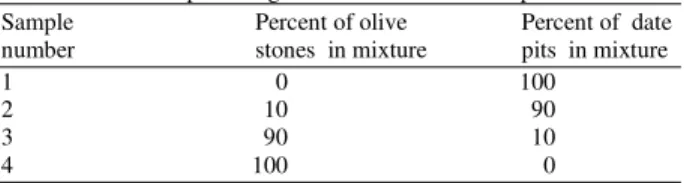
In order to obtain a homogenous sample of olive stone waste and date pits waste, we mix the olive stone waste and date pits at different percentage. For this we used four samples such that their compositions are given in Table 1.
The mixture of olive stones and date pits powder was impregnated with H3PO4 (2 g of acid per gram of
mixture). The mixture was refluxed at 100°C during 3 h. to eliminate the excess of H3PO4, the prepared
mixture has been washed with distilled water until a neutral pH was reached. The sample was dried at 105°C in an oven.
Infrared analyses (IR) spectral analysis: The effect of percentage of olive stones and date pit in the mixture on the characteristics of the mixture was determined by the analysis of infra red spectral analysis carried out through a standard Fourier spectrometer: Necolet 560 FTIR coupled to a digital calculator allowing the layout between 4000 and 400 cm−1, on the samples of the mixture sorbent.
Cd(II) removal experiments: Metal solution was prepared by dissolving appropriate amount of CdCl2 (s),
in distilled water. A volume of 15 mL of CdCl2 solution
with a concentration ranging from 17-81.8 mg L−1 was placed in a 250 mL conical flask; 0.3 g of the mixture of olive stone and date pits powder was accurately weighed and added to the solution. The conical flask was then shaken at a constant speed of 350 rpm at pH 5.6 at 20°C.
Table 1: Different percentage of olive stone and date pits in mixture
Sample Percent of olive Percent of date
number stones in mixture pits in mixture
1 0 100
2 10 90
3 90 10
4 100 0
Effect of temperature on the sorption of Cd(II) was studied using three different temperatures 20,30 and 40°C with different composition of the mixture of olive stone and date pits powder. The solution was filtered and the Cd(II) concentration of the filtrate was analyzed using SAA atomic absorption spectrophotometer. The amount of cadmium sorbet by weight of dry mixture wastes was calculated as qt = (Ci-Ct)V/m, where V(L) is
the solution volume, Ci and Ct (mg L−1) are the initial
and at time t metal solution concentration, respectively and m(g) is the dry weight of the sorbent (mixture).
RESULTS AND DISCUSSION
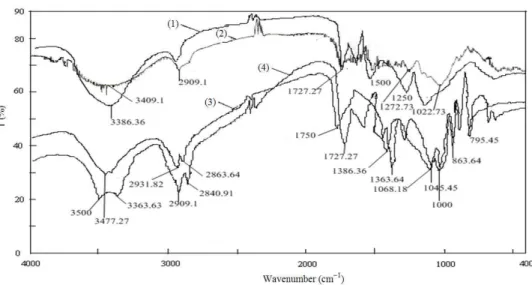
IR Spectra analysis: IR analysis of mixture was done to predict the functional groups of the mixture of date pits and olive stones for the adsorption process. The profiles by IR spectroscopy for olive stone, date pits and mixed sorbent (mixture of olive stone and date pit) is shown in Fig. 1. IR spectra of mixed sorbent denoted that main peaks observed for olive stone and date pit separately are preserved; nevertheless some perturbations are induced. The transmittance increases and some peaks change their wavenumbers. The peak around 3409 cm−1 (OH bond) shifted to higher frequencies (3477, 27 cm−1) in the case of mixed sorbent (10% of olive stone and 90 % of date pit), also the peak around 1727, 27 cm−1 (C = O) shifted to 2863, 64 cm−1. The peak around 1045, 45 cm−1 (C-OH primary alcohol) shifted to lower frequencies (1000 cm−1). This result suggested that the mixture of olive stone and date pit could be induce some perturbations functional groups towards olive stones and date pits separately.
472
Fig. 1: IR spectroscopy for olive stone, date pits and mixed sorbent (mixture of olive stone and date pit); (1): 100% OS, 0% DP; (2): 90% OS, 10% DP; (3): 90%DP, 10% OS; (4): 100% DP, 0% OS; (OS: Olive stone DP: date pit)
Fig. 2: Plot of sorbed amount versus time for Cd(II) by the mixed sorbent (C0(Cd+2) =17 mgL−1; T = 20
(pits date only) to 90% of date pits and 10% of olive stone in mixture; and increases from 0.510-0.825 mg g−1 when the mixed sorbent varies from 100% of olive stone (olive stone only) to 90% of olive stone and 10% of date pits in mixture. This indicates that with a mixture of sorbent, more surface area is made available and therefore the total number of sites increases.
In order to investigate the mechanism of adsorption, the adsorption reaction order of cadmium were determined using a pseudo-second-order mechanism expression (Ho and Ofomaja, 2005a; Ho and McKay, 2000). The sorption kinetics may be described as being pseudo-second-order. The differential equation is:
dqt/dt = k(qe-qt)2 (1)
Where:
k = The rate constant of sorption (g mg−1 min−1) qe = The amount (mg g−1) of cadmium ions sorbed
onto the surface of the mixture at any time
Separating the variables in the equation above gives:
dqt/(qe-qt )2 = kdt (2)
Integrating this for the boundary conditions t = 0 to t and qt = 0 to qt, gives:
1/( qe-qt ) = 1/qe + kt (3)
Equation 3 can be rearranged to obtain a liner form:
t/qt = 1/kqe2 + (1/qe)t (4)
When the experimental data were introduced into Eq. 4, straight lines for all cases were obtained by plotting t/qt against t, indicating that the process follows
Fig. 3: Pseudo-second order sorption kinetics of Cd(II) by the mixed sorbent (C0(Cd+2) = 17 mgL−1;
T = 20°C)
Table 2: Pseudo-second order kinetics model parameters for cadmium sorption onto the mixture of olive stone waste and date pit waste
Pseudo-second order kinetics
---
Composition of qe, exp qe, cal k (g mg−1
the mixture (mg g−1) (mg g−1) min) R2
100% DP, 0% OS 0.562 0.5633 0.1011 0.9936
90% DP, 10% OS 1.035 1.2410 0.0087 0.4706
100% OS, 0% DP 0.907 0.9132 0.0602 0.9891
90% OS, 10% DP 1.050 1.0510 0.1239 0.9983
OS: Olive Stone; DP: Date Pit
From the equation of the different obtained linear plots, the equilibrium metal sorption, qe, the values of
the rate constant, k and the coefficients, R2 at different percent of olive stone and date pit in the mixture, were calculated and are presented in Table 2.
In the view of these results (Table 2) it can be said that the pseudo-order kinetic model provided a good correlation for the adsorption of Cadmium on the mixed sorbent
When comparing the obtained values for the sorption rate, k, at different percent of olive stone and date pit in the mixture, 90% of olive stone and 10% of date pits in mixture>100% of olive stone (olive stone only).
Equilibrium isotherm models the nature of the adsorption reaction can be described by relating the adsorption capacity (mass of solute adsorbed per unit mass of adsorbent) to the equilibrium concentration of the solute remaining in the solution, such a relation is known as an adsorption isotherm. The sorption equilibrium data for the single metal systems were fitted by non-competitive Langmuir model:
qe = bCeqm/(1+bCe) (5)
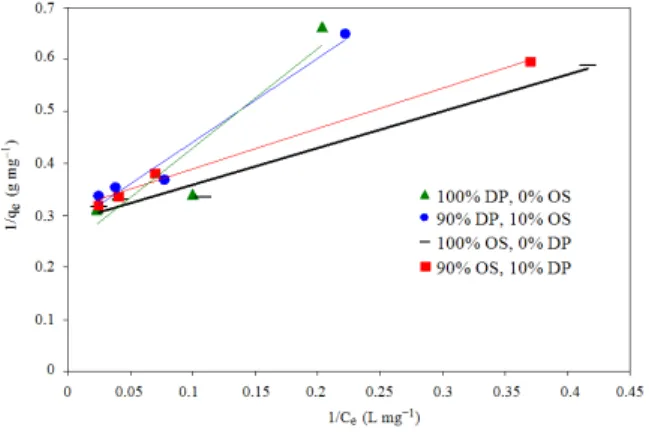
Fig. 4: Langmuir transformations of equilibrium sorption isotherms
The constants qm and b are the characteristics of the
Langmuir equation and can be determined from q linearised from of Eq. 5, represented by:
1/qe = 1/b Ceqmax + 1/qmax (6)
Where:
Ce = The metal concentration in solution at equilibrium (mg L−1)
qe = The amount of cadmium sorbed per unit weight of sorbent at equilibrium (mg g−1) qmax = qe for a complete monolayer (mg g−1)
b = Sorption equilibrium constant (L mg−1) qmax and b = Can be determined from the plot 1/qe
versus 1/Ce (Fig. 4)
The essential features of a Langmuir isotherm can be expressed in terms of a dimensionless constant separation factor or equilibrium parameter, RL which is
defined by Hall et al. (1966) as:
RL = 1/(1+bCo) (7)
The value of RL indicates the shape of the isotherms
to be either unfavorable (RL>1), linear (RL = 1),
favorable (0<RL<1) or irreversible (RL = 0). RL value
were varied from 0.012-0.047 with the varied of percent of olive stone waste and date pit waste in the mixture. RL value obtained using Eq. 7 for Cadmium sorption is
474
Table 3: Parameters of Langmuir isotherm model for cadmium sorption onto the mixture of olive stone waste and date pit waste
Langmuir parameters
---
Composition of the qmax
mixture (mg g−1) b R2 R
L×104
100% DP, 0% OS 0.486 9.633 0.9021 12.667
90% DP, 10% OS 1.266 2.578 0.9860 47.178
100% OS, 0% DP 0.575 6.769 0.9783 18.017
90% OS, 10%DP 1.410 2.470 0.9763 49.226
OS: Olive Stone; DP: Date Pit
waste and date pit waste in the mixture is (90% of olive stone, 10% date pit) and (10% date pit, 90% date pit) respectively.
Effect of composition of Mixed Sorbent: The equilibrium sorption capacity data, qe, obtained from
the study have been analyzed using Langmuir model. The correlation coefficients, R2, maximum sorption capacity qmax, were calculated and presented in Table 3.
The results show that the sorption capacity for cadmium increases from 0.486-1.266 mg g−1 when the mixed sorbent varies from 100 % of date pits (pits date only) to 90% of date pits and 10% of olive stone in mixture; and increases from 0.575-1.41 mg.g−1 when the mixed sorbent varies from 100 % of olive stone (olive stone only) to 90% of olive stone and 10% of date pits in mixture. This indicates that with a mixture of sorbent, more surface area is made available and therefore the total number of sites increases (Ho and Chiang, 2002).
Thermodynamic study: The thermodynamic parameters including change in the Gibbs free energy ( G°), enthalpy ( H°) and entropy ( S°) were determined by using following equations and represented in Table 4:
Kc = Cqe/CS (8)
G° = -RTlnKc (9)
lnKc = S°/R - H°/RT (10)
Where:
R = The gas constant Kc = The equilibrium constant
Cqe = The amount of Cd(II) adsorbed on the adsorbent
from the solution at equilibrium (mg L−1)
CS = The equilibrium concentration of Cd(II) in the
solution (mg L−1)
The qe of the Languimir model was used to obtain
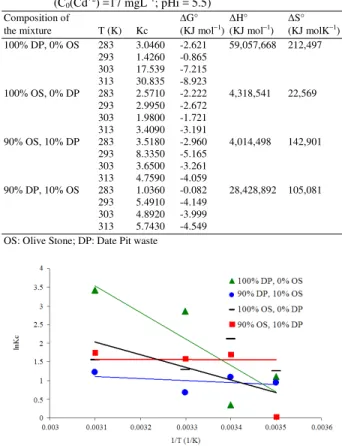
Cqe and CS. It was given the plot of lnK versus 1/T to
Eq. 10 and Fig. 5. H° and S° was calculated from this plot (Van’t Hoff plots). The results are given in Table 4.
Table 4: Value of the thermodynamic of adsorption at various temperatures and at different composition of mixture (C0(Cd+2) =17 mgL−1; pHi = 5.5)
Composition of ∆G° H° S°
the mixture T (K) Kc (KJ mol−1) (KJ mol−1) (KJ molK−1)
100% DP, 0% OS 283 3.0460 -2.621 59,057,668 212,497 293 1.4260 -0.865
303 17.539 -7.215 313 30.835 -8.923
100% OS, 0% DP 283 2.5710 -2.222 4,318,541 22,569 293 2.9950 -2.672
303 1.9800 -1.721 313 3.4090 -3.191
90% OS, 10% DP 283 3.5180 -2.960 4,014,498 142,901 293 8.3350 -5.165
303 3.6500 -3.261 313 4.7590 -4.059
90% DP, 10% OS 283 1.0360 -0.082 28,428,892 105,081 293 5.4910 -4.149
303 4.8920 -3.999 313 5.7430 -4.549 OS: Olive Stone; DP: Date Pit waste
Fig. 5: Relation between equilibrium constant (Kc) and temperature (C0(Cd+2) =17 mgL−1 ; pHi = 5.5)
Generally, the change of free energy for physisorption is between -20 and 0 kJ mol−1, however, chemisorption is a range of -80 to -400 kJ mol−1 (Atkins, 1990).
stone (90% of olive stone and 10% of date pits in mixture). The value of H° is positive, indicating that the sorption reaction is endothermic (Ho and Ofomaja, 2005b). The positive value of S° reflects the affinity of the mixed sorbent for Cadmium ions and suggests some structural changes in Cadmium and mixed sorbent. In addition, positive value of S° shows the increasing randomness at the solid/liquid interface during the sorption of Cadmium ions on mixed sorbent.
CONCLUSION
The equilibrium sorption capacity of Cd(II) onto the mixture of olive stones and dates pit is studied on the basis of Langmuir isotherm. The thermodynamic of Cadmium sorption on the mixed sorbent follows the Langmuir model. The pseudo-order kinetic model provided a good correlation for the adsorption of Cadmium on the mixed sorbent. The sorption capacity for cadmium increases when we add a small amount of olive stone at date pits (90% of date pits in mixture and 10% of olive stone) and a small amount of date pits at olive stone (90% of olive stone and 10% of date pits in mixture. The sorption of Cd(II) onto the mixture of olive stones and dates pit is spontaneous and presents an endothermic nature.
REFERENCES
Aioueche, F., H. Lounici, D. Belhocine, H. Grib and D.L. Piron et al., 2000. Electroactivation of granular of carbon from olive mill solid residue. Can. Environ. Technol., 21: 1215-1221. DOI: 10.1080/09593332108618148
Alama, H. and R. Mahmoud, 1994. Palm date seeds as an alternative source of dietary fiber in Saudi bread. Ecol. Food Nutr., 32: 261-270. http://ipac.kacst.edu.sa/eDoc/eBook/6215.pdf Al-Asheh, S. and Z. Duvnjak, 1998. Binary metal
sorption by pine bark, study of equilibria and mechanisms. Sep. Sci. Technol., 33: 1303-1329. DOI: 10.1080/01496399808544985
Atkins, P.W., 1990. Physical Chemistry. 4th Edn., Oxford University Press, London, pp: 884-890. Babakhouya, N., 2010. Adsorption of Cd(II) ions from
aqueous solution using Mixed Sorbents prepared from olive stone and date pit. Thesis, University of Boumerdes.
Bouchenafa-Saib, N., P. Gronge, P. Verhasselt, F. Addoun and V. Dubois, 2005. Effect of oxidant treatment of date pits active carbons used as Pd supports in catalytic hydrogenation of nitrobenzène. Applied Catalysis A: General., 286: 167-174. DOI: 10.1016/J.APCATA.2005.02.022
Fiol, N., I. Villaescusa, M. Martinez, N. Miralles and J. Poch et al., 2006. Sorption of Pb(II), Ni(II), Cu(II) and Cd(II) from aqueous solution by olive stone olive. Separat. Purificat. Technol., 50: 132-140. DOI: 10.1016/J.SEPPUR.2005.11.016
Hall, K.R., L.C. Eagleton, A. Acrivos, T. Vermeulen, 1966. Pore and solid diffusion kinetics in fixed bed adsorption under constant pattern condition. Ind. Eng. Chem Fundam., 5: 212-223. DOI: 10.1021/i160018a011
Hamada, J., I. Hashim and F. Sharif, 2002. Preliminary analysis of potential uses of date pits in foods. Food Chem., 76: 135-137. DOI: 10.1016/S0308-8146(01)00253-9
Ho, Y.S. and A.E. Ofomaja, 2005a. Effects of calcium competition on lead sorption by palm kernel fiber. J. Hazardous Mate., B120: 157-162. DOI: 10.1016/j.jhazmat.2004.12.027
Ho, Y.S. and A.E. Ofomaja, 2005b. Kinetics and thermodynamics of lead ion sorption on palm kernel fiber from aqueous solution. Process
Biochem., 40: 3455-3461. DOI:
10.1016/J.PROCBIO.2005.02.017
Ho, Y.S. and C.C. Chiang, 2002. Sorption studies of acid dye by mixed sorbents. Adsorption, 7: 139-147. DOI: 10.1023/A:1011652224816
Ho, Y.S. and G. McKay, 2000. The kinetics of sorption of divalent metal ions onto sphagnum moss peat. Water Res., 34: 734-742. ISSN: 0043-1354 Krim, L., S. Nacer and G. Bilango, 2006. Kinetics of
chromium sorption on biomass fungi from aqueous solution. Am. J. Environ. Sci., 2: 27-32. DOI: 10.3844/ajessp.2006.27.32
Kula, I., M. Ugurlu, H. Karaoglu and A. Et Celik, 2008. Adsorption of Cd(II) ions from aqueous solutions using activated carbon prepared from olive stone by ZnCl2 activation. Bioresour. Technol., 99:
492-501. DOI: 10.1016/J.BIORTECH.2007.01.015 Langmuir, I., 1916. The constitution and fundamental propreties of solids and liquids. Am. J. Chem. Soc.,
38: 2221-2295.
476 Molina Alcaid, E. and A. Nefzaoui, 1996. Recycling of
olive oil by products possibilities of utilization in animal nutrition. Ind. Biodet. Biodegr., 38: 227-235. Doi: 10.1016/S0964-8305(96)00055-8
Saeed, A., M. Iqbal and M.V. Akhtar, 2005. Removal and recovery of lead (II) from single and multimetal (Cd,Cu, Ni, Zn) solutions by crop milling waste(back gram husk). J. Hazard. Mate., B117: 65-73.
Veglio, F. and F. Beolchini, 1997. Removal of metals by biosorption: A review. Hydrometallurgy,
44: 203-316. DOI: 10.1016/S0304-386x(96)00059-X
Villaescusa, I., N. Fiol, M. Martinez, N. Miralles and J. Poch et al., 2004. Removal of copper and nickel from aqueous by grape stalks wastes. Water Res.,
38: 992-1002.