Abstract—The method of multi-criteria assessment of virtual prototype that is used in KOMAG Institute of Mining Technology (Poland) was discussed. Scenario of virtual prototyping organizes the process of creation of virtual prototype and it consists of the following components: phase of mining machine’s life, assessment criterion, criterial state, criterial model. The scenario is realized by detailed methods. Scenario of prototyping, in which powered roof support is assessed using technical assessment criteria by Multi-body System (MBS) method and Finite Element Method (FEM), was presented. Assessment of the virtual prototype in the light of anthropotechnical criteria was given
Index Terms— virtual prototyping, anthropotechnical system, FEM, mining industry, simulation.
I. INTRODUCTION
Mining machines have big dimensions and weights. Due to that, their dislocation, testing and re-manufacturing is difficult. Mining machines often operate within the systems. Machines that belong to the same mining system are manufactured by different manufacturers located at distant places, who have no chance to test cooperation of machines in conditions similar to real ones. Complete mining systems are assembled and started up only underground. Due to more and more differentiated requirements of users for mining machines, the machines are manufactured in short series or as single copies. That is why the costs of material prototyping are not distributed on a larger number of manufactured machines [5]. Taking into account decreasing number of longwalls, and still increasing concentration of mining, every new copy of mining machine is treated as ready to be used without testing the material object. This puts high demands for designs of new mining machines.
So far virtual prototyping of mining machines was mainly based on selected, single detailed methods, which most often referred to technical assessment criteria. Especially it concerns the FEM [9]. Extension of prototyping by the conditions present during operation of mining machines requires consideration of human factor and implementation of multi-criteria assessment of virtual prototypes by use of prototyping scenarios.
Manuscript received June 18, 2010. This work was supported in part by the Polish Ministry of Science and Higher Education Grant 1547/T12/2005/28.
T. Winkler, KOMAG Institute of Mining Technology, 44-101 Gliwice, Pszczynska 37 Street, Poland (phone: +4832-2374-553, e-mail: [email protected]).
J. Tokarczyk, KOMAG Institute of Mining Technology, 44-101 Gliwice, Pszczynska 37 Street, Poland (phone: +4832-2374-419, e-mail:
A given scenario is realized with use of detailed numerical methods. These methods are implemented in many computer software, which is used in practice. Integration of these methods in such way that prototyping scenarios could be created for different states, in different phases of life cycle of mining machines, is needed).
II. COMPONENTS OF VIRTUAL PROTOTYPING SCENARIO
A. Phases of life cycle of mining machine
Virtual prototyping includes all phases of machine life. Phases of life cycle of mining machines can be divided into the following stages:
1) Designing.
2) Manufacturing and assembly. 3) Stand tests.
4) Installation at workplace. 5) Operation.
6) Withdrawal from operation.
Creation of virtual prototype most often takes place at the designing phase. At this stage decisions about future product can be taken freely. Use of virtual prototyping methods aids designing process, deciding about future costs of manufacturing [1] as well as about the quality of the product [6].
B. Criteria of assessment of virtual prototype
Criteria that determine requirements and limitations in a systematic way are the basis of assessment of virtual prototypes [2].
Virtual prototypes of mining machines are assessed in the light of the following criteria: strength, functional, ergonomic, safety and criterion of feasibility of machine’s operations. Strength and functional criteria are defined as technical criteria. Ergonomic and safety criteria and criterion of feasibility of operations belong to anthropotechnical criteria [8]. Analyses in the light of criterion of operational feasibility of the machine are characteristic for mine conditions. They concern assembly/disassembly operations in confined space in underground conditions.
1) Strength criterion
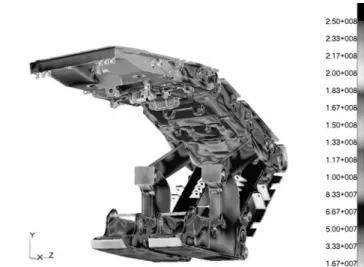
Durability (resistance) of virtual prototype for identified future loads, to which real object will be exposed, is assessed in strength criterion. Currently used numerical methods such as FEM enable simulation of many physical phenomena. The following values of: stresses, displacements, velocities, accelerations, strains, constrain forces, contact forces, friction forces, fatigue strength are the measure for assessment of virtual prototype of mining machine.
Multi-Criteria Assessment of Virtual Prototypes
of Mining Machines
Fig. 1. Assessment of machine in the light of strength criterion – map of reduced stresses [MPa].
The components of machines, its assemblies or entire machines (Fig. 1) are assessed in the light of strength criterion at the KOMAG Institute of Mining Technology.
Determination of quantitative range in computational model depends on specified objectives. Computational models of entire machines included in virtual prototyping enable obtaining the type of interactions between components of the machine. Powered-roof support, in which forces in pin joints depend on the height and method of support, is the example. The forces can be determined with use of other methods such as MBS. Computational models, which include only machine assembly or machine body, are sufficient in some cases, and interactions between other assemblies are realized according to superposition rule. Such method of building of computational tasks results from hardware or time limitations.
2) Functional criterion
In mining machines collision of cooperating machine components, which move against each other as well as required operational ranges, which result from kinematic relationships, are analyzed. Criterial models, which include only external geometrical features, are sufficient for such analyses. They can also include geometrical models of deformed structures. Functional tests of virtual prototype were carried out at KOMAG for the longwall system. Longwall shearer moves along entire longwall panel, changing direction at face ends, at drive end and return end of Armoured Face Conveyor (AFC). Position of drive end and return end requires using of so-called narrow shearer arms, which enable cutting of coal in the area of face ends. Operation of passing the arm and return end is critical, Fig. 2.
Clearance between arm and return end is so small that absolute displacement of arm end, which results from deformations of arm body and longwall shearer body, can be till 25% of initial distance between them.
Virtual prototyping consists in modelling of physical phenomena. Phenomena can be described by the set of features. Transient values of these features create transient states of the technical mean. These are so-called criterial states [7].
Fig. 2. Analysis of collision of longwall shearer arm model and return end of flight-bar conveyor.
C. Criterial conditions
Fig. 3. Division of criterial states for assessment of virtual prototype.
Selected exemplary critical sets of loads or supports can be the criterial states in strength criterion. Identification of criterial states takes place both during machine operation and at stand tests, Fig. 3.
Mining of hard coal is an example of operational state of longwall shearer. Loss of stability is an example of emergency state of powered-roof support. Other states include e.g. periodical dislocations of machines due to disassembly/assembly of longwall systems. Identification of criterial states is easy in experimental tests. Types of tests, values and types of loads as well as methods of support were strictly specified. For operational conditions identification of loads to the mining machines was realized during in situ measurements [4].
D. Criterial models
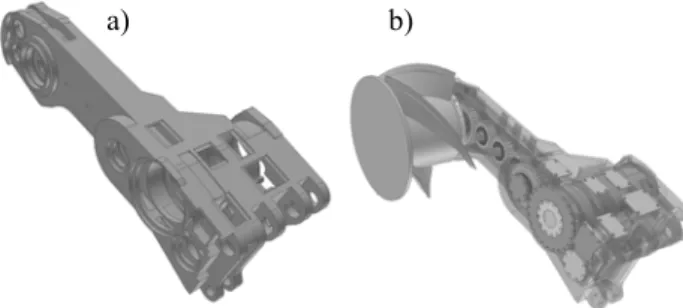
Fig. 4. Criterial models of longwall shearer arm.
Depending on accepted criterial model degree of precision changes. Assessment of virtual prototype in the light of accepted criteria can lead to changes in the design. Due to that, criterial model should be simple enough to allow determining range of eventual design changes, necessary to be entered to meet these criteria and to maintain conformity of the model to the design documentation, and at the same time it should explicitly show the place of making the changes. Fig. 4 presents criterial models of longwall shearer arm designed for:
1) FEM strength calculations of arm body, Fig. 4a.
2) Simulation of assembly operation or visualization of operation of main sub-systems of longwall shearer arm, Fig. 4b.
Degrees of precision, which are required for assessment of design in the light of technical and anthropotechnical criteria, are visible. Criterial models that are built for the purpose of visualization or testing the collision of the machine with surroundings have reduced number of internal details. At present this process is highly automated. Criterial models designed for assessment in the light of technical criteria belong to the simplified models, i.e. details that are not significant for a given criterion were removed from geometrical model or were omitted. Extended criterial models, which include geometrical models of technical means and models of anthropotechnical features, were used for anthropotechnical criteria of assessment.
E. Detailed methods
Condition for multi-criteria assessment of virtual prototype is its realization in dispersed environment of specialistic software based on detailed numerical methods. The following detailed methods are, among others, used at the KOMAG Institute of Mining Technology:
1) CAD geometrical modelling. 2) FEM.
3) MBS analyses.
4) Modelling of anthropotechnical features.
5) Computer Fluid Dynamics (CFD) and Fire Dynamics Simulator (FDS).
III. CREATION OF VIRTUAL PROTOTYPING SCENARIO
It was necessary to maintain homogeneity of data describing virtual prototype in dispersed software environment. In that way connection between each scenario stage and source, which is design documentation, was ensured. Criterial models that include features, which should be prototyped in the next phases of scenario, make realization
Table I. Scenarios of virtual prototyping.
of scenario easier, but every time they have to be taken from the same geometrical models.
Creation of virtual prototyping scenarios is based on a diagram presented in Table I.
These scenarios consist of the following classes of components:
1) Phases of mining machine’s life cycle: ph. 2) Criteria of assessment of virtual prototype: kr. 3) Criterial states of virtual prototype: s. 4) Criterial models: m. 5) Detailed methods: meth.
Scenarios of prototyping were put in the heterogeneous software environment. This is the commercial software that can be extended by applications written in programming languages available in this software. It can also be the software written individually. The same scenario can be realized with use of different software. It is especially noticeable in the case of prototyping for the strength criterion, where wide range of calculation software is at disposal. Scenarios can have a linear structure or branched structure. Linear scenario consists only of single components, which belong to the same class. Branched scenario consists of at least two components of the same class; e.g. when scenario includes prototyping according to several criteria at the same time.
IV. EXAMPLE OF SCENARIO OF VIRTUAL PROTOTYPING
Exemplary scenario of virtual prototyping for powered-roof support is presented in Table II.
The following two criterial states of powered-roof support were considered at the operational state, Fig. 5:
1) Symmetrical support of canopy. 2) Asymmetrical support of canopy.
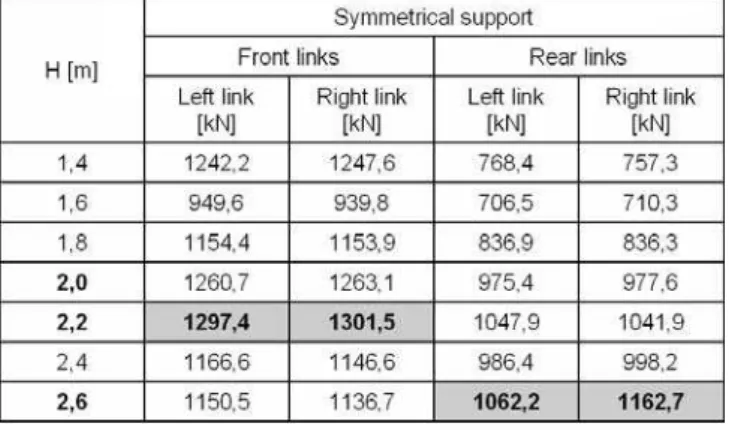
Values of reactions in pin joints of lemniscate links were determined at these criterial states. Maximal reactions in the whole range of support height were searched. Values of reactions correspond to values of forces in lemniscate links. Eighteen elastic-dumping elements were used for modelling of pin joints at both states. Method of load of powered-roof support corresponds to the method accepted at stand tests: setting to load powered-roof support between roof and floor by hydraulic legs. Forces in hydraulic legs and in tilt cylinder remained unchanged with changing the height.
Results obtained for and symmetrical support loads are included in Table III. Due to design reasons, it was assumed that diameters of pins of left and right links were the same. Only maximal values of forces in elastic-dumping elements, without partition into left and right side, at a given height of powered-roof support, are put in the Table III.
Table II. Scenario of virtual prototyping.
Scenario of prototyping
Object Powered-roof support
Case
Identification of load state of powered-roof support in a function of height. Strength verification for selected heights.
Phase of life
cycle Stand tests
Criteria Strength Criterial states Operational
Criterial models Models of geometrical features Computational models
Detailed methods CAD, FEM, MBS Tools
Autodesk Inventor, MSC.ADAMS, MSC.Patran/Nastran Verification of
virtual prototype Tests at test stand
Description of scenario
Values of reactions in pin joints of lemniscate links are read out for seven heights for two variants of support of powered-roof support. Maximal values of cutting forces in pin joints of lemniscate links show critical height of support.
Fig. 5. Boundary conditions of computational model in MBS. Table III. Forces in links versus the height of powered-roof support.
Identification of cutting forces for seven heights of powered-roof support showed that it was necessary to carry out strength tests for at least 3 following heights, at which maximal values of forces in links were obtained:
1) 2.0 m for asymmetrical support.
2) 2.2 m and 2.6 m for symmetrical support.
Only one method of asymmetrical support was considered in the analyzed case. However the standard [3] requires testing at other methods of asymmetrical support, for which maximal forces can be reached at other heights. Virtual
Fig. 6. Arrangement and change of coordinates of characteristic points of powered-roof support.
prototype of powered roof support includes, for different heights of support, the same models of systems discretized with 3D mesh, which are grouped in a systematic way. Reuse of the same mesh in the next prototyping procedures requires parameterization of position of mesh for machine assembly.
That was done by the developed Roof Support software that uses kinematic relationships of lemniscate system. The software cooperates with MSC.Patran pre-processor. In computational model a content of groups can not be duplicated, i.e. the same geometrical model, points, nodes, finite elements, MPC components included in one group can not be present in any of the rest groups.
Groups were defined during the first computational task for specified position of the machine units against each other. So-called characteristic points (A-F), coordinates of which were recorded in an external file, were marked in each next task for current and explicit position of machine units on the geometrical model. Roof Support software was started in the next step, where coordinates of characteristic points for required height of powered roof support were changed, Fig. 6.
New locations of points are re-entered to the pre-processor where, with use of generally available functions, previously created groups of computational model are dislocated, Fig. 7. Through repeated use of verified components of computational task it is possible to analyze higher number of cases of loads and support methods than it would be possible at individual formulation of computational tasks for each case separately.
Fig. 7. Modification of computational model due to change of height of powered-roof support.
V. ASSESSMENT OF ANTHROPOTECHNICAL CRITERIA
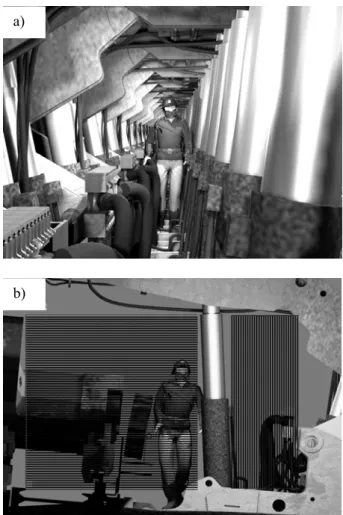
Method of determination of minimal passages for powered-roof support can be assessed in the light of ergonomic criterion. Virtual prototyping enables showing other difficulties during movement of mining team, which differs from those included in standards [3], where external geometrical parameters are the basis for determination of minimal passages for the mining team. The dimensions of passage are as follows:
1) 0.6 m – width. 2) 0.4 m – height.
Components of powered-roof support such as hydraulic hoses, which reduce width of passage for a given roof support, can be noticeable, Fig. 8a.
These components are not taken into account during determination of minimal space, in which mining team will move. So it happens that in mining conditions workers have to move in a danger zone (horizontal line hatch area), Fig. 8b. By taking anthropotechnical systems into account in the virtual prototyping process in the light of ergonomic criterion, it is possible to assess the conditions which are not included in the standards. Besides, the results can be used for personnel training.
Fig. 8. Assessment of virtual prototype in the light of anthropotechnical criteria.
VI. SUMMARY
Multi-criteria assessment of virtual prototype is realized in dispersed software environment and enables including of conditions present in operational and emergency states of mining anthropotechnical systems. Its use requires access to specialistic knowledge and software from many domains.
Use of criterial models enables to keep number of design features, recreated by them, at as low as possible level. Defining of criterial states enables modelling of complex processes during operation without a need of unreasonable extension of criterial models.
In mining anthropotechnical systems the work zone for people is determined by temporary position of cooperating machines. Anthropotechnical systems included in the virtual prototyping process enable assessing not only design features and operational parameters of machine, but also future work conditions. Use of extended scenarios of prototyping requires access to specialistic knowledge from many domains. Due to that, their use requires application of participatory mode of realization of computational tasks, which involves a group of specialists. Scenarios enable methodological approach to the problems of virtual prototyping, and they are especially realized in multi-criteria assessment of designed machine. At KOMAG Institute of Mining Technology, the suggested method is used during creation of state-of-the-art, innovative solutions for future mining machines.
REFERENCES
[1] B. Barnu , R. Knosala, ”Komputerowe wspomaganie procesu projektowania wyrobu zorientowane na minimalizację kosztów wytwarzania”. Transport Przemysłowy 2/2004, pp. 31-34.
[2] J. Dietrych, System i konstrukcja. Wydawnictwo Naukowo – Techniczne, Warszawa 1985.
[3] PN-EN 1804-1:2004, Maszyny dla górnictwa podziemnego. Wymagania bezpieczeństwa dla obudowy zmechanizowanej. Część 1: Sekcje obudowy i wymagania ogólne. Polish Standard.
[4] S. Szweda, Identyfikacja parametrów charakteryzujących obciążenie sekcji obudowy zmechanizowanej spowodowane dynamicznym oddziaływaniem górotworu. Zeszyty Naukowe Politechniki ląskiej: Górnictwo z. 259. Gliwice 2004.
[5] J. Tokarczyk, Metoda tworzenia wirtualnych prototypów na przykładzie maszyn górniczych. PhD Thesis. Gliwice 2006.
[6] Z. Weiss, Integracja procesu projektowania warunkiem szybkiego rozwoju wyrobu – metody i narzędzia. Targi Technologii Przemysłowych i Dóbr Inwestycyjnych. Poznań 2004.
[7] T. Winkler, Komputerowy zapis konstrukcji. Wspomaganie
komputerowe CAD CAM. Wydawnictwa Naukowo Techniczne.
Warszawa 1997.
[8] T. Winkler, Metody komputerowo wspomaganego projektowania układów antropotechnicznych na przykładzie maszyn górniczych. Prace Naukowe Głównego Instytutu Górnictwa, Katowice 2001. [9] O. C. Zienkiewicz, R. L. Taylor, J. Z. ZHU, The Finite Element
Method. Vol 1: Its Basis & Fundamentals. Sixth edition. Elsevier Butterworth – Heinemann, Oxford 2005.
a)