❊♥s❛✐♦s ❊❝♦♥ô♠✐❝♦s
❊s❝♦❧❛ ❞❡
Pós✲●r❛❞✉❛çã♦
❡♠ ❊❝♦♥♦♠✐❛
❞❛ ❋✉♥❞❛çã♦
●❡t✉❧✐♦ ❱❛r❣❛s
◆◦ ✹✽✻ ■❙❙◆ ✵✶✵✹✲✽✾✶✵
❋♦r❡❝❛st✐♥❣ ❊❧❡❝tr✐❝✐t② ❉❡♠❛♥❞ ❯s✐♥❣ ●❡♥❡r✲
❛❧✐③❡❞ ▲♦♥❣ ▼❡♠♦r②
▲❛❝✐r ❏♦r❣❡ ❙♦❛r❡s✱ ▲❡♦♥❛r❞♦ ❘♦❝❤❛ ❙♦✉③❛
❖s ❛rt✐❣♦s ♣✉❜❧✐❝❛❞♦s sã♦ ❞❡ ✐♥t❡✐r❛ r❡s♣♦♥s❛❜✐❧✐❞❛❞❡ ❞❡ s❡✉s ❛✉t♦r❡s✳ ❆s
♦♣✐♥✐õ❡s ♥❡❧❡s ❡♠✐t✐❞❛s ♥ã♦ ❡①♣r✐♠❡♠✱ ♥❡❝❡ss❛r✐❛♠❡♥t❡✱ ♦ ♣♦♥t♦ ❞❡ ✈✐st❛ ❞❛
❋✉♥❞❛çã♦ ●❡t✉❧✐♦ ❱❛r❣❛s✳
❊❙❈❖▲❆ ❉❊ PÓ❙✲●❘❆❉❯❆➬➹❖ ❊▼ ❊❈❖◆❖▼■❆ ❉✐r❡t♦r ●❡r❛❧✿ ❘❡♥❛t♦ ❋r❛❣❡❧❧✐ ❈❛r❞♦s♦
❉✐r❡t♦r ❞❡ ❊♥s✐♥♦✿ ▲✉✐s ❍❡♥r✐q✉❡ ❇❡rt♦❧✐♥♦ ❇r❛✐❞♦ ❉✐r❡t♦r ❞❡ P❡sq✉✐s❛✿ ❏♦ã♦ ❱✐❝t♦r ■ss❧❡r
❉✐r❡t♦r ❞❡ P✉❜❧✐❝❛çõ❡s ❈✐❡♥tí✜❝❛s✿ ❘✐❝❛r❞♦ ❞❡ ❖❧✐✈❡✐r❛ ❈❛✈❛❧❝❛♥t✐
❏♦r❣❡ ❙♦❛r❡s✱ ▲❛❝✐r
❋♦r❡❝❛st✐♥❣ ❊❧❡❝tr✐❝✐t② ❉❡♠❛♥❞ ❯s✐♥❣ ●❡♥❡r❛❧✐③❡❞ ▲♦♥❣ ▼❡♠♦r②✴ ▲❛❝✐r ❏♦r❣❡ ❙♦❛r❡s✱ ▲❡♦♥❛r❞♦ ❘♦❝❤❛ ❙♦✉③❛ ✕ ❘✐♦ ❞❡ ❏❛♥❡✐r♦ ✿ ❋●❱✱❊P●❊✱ ✷✵✶✵
✭❊♥s❛✐♦s ❊❝♦♥ô♠✐❝♦s❀ ✹✽✻✮
■♥❝❧✉✐ ❜✐❜❧✐♦❣r❛❢✐❛✳
Forecasting Electricity Demand Using Generalized Long Memory
Lacir Jorge Soares
Department of Electrical Engineering Catholic University of Rio de Janeiro
Leonardo Rocha Souza Graduate School of Economics
Fundação Getúlio Vargas
June 2003
Abstract. This paper studies the electricity hourly load demand in the area covered by a
utility situated in the southeast of Brazil. We propose a stochastic model which employs generalized long memory (by means of Gegenbauer processes) to model the seasonal behavior of the load. The model is proposed for sectional data, that is, each hour’s load is studied separately as a single series. This approach avoids modeling the intricate intra-day pattern (load profile) displayed by the load, which varies throughout days of the week and seasons. The forecasting performance of the model is compared with a SARIMA benchmark using the years of 1999 and 2000 as the out-of-sample. The model clearly outperforms the benchmark. We conclude for general long memory in the series.
1 – Introduction
Managing electricity supply is a complex task. The system operator is responsible for the hourly scheduling of the generators and aims foremost at balancing power production and demand. After this requirement is satisfied, it aims at minimizing production costs, including those of starting and stopping power generating devices, taking into account technical restrictions of electricity centrals. Finally, there must always be a production surplus, so that local failures do not affect dramatically the whole system. It is relevant for electric systems optimization, thus, to develop a scheduling algorithm for the hourly generation and transmission of electricity. Amongst the main inputs to this algorithm are hourly load forecasts for different time horizons. Electricity load forecasting is thus an important topic, since accurate forecasts can avoid wasting energy and prevent system failure. The former when there is no need to generate power above a certain level and the latter when normal operation is unable to withstand a heavy load. The importance of good forecasts for the operation of electric systems is exemplified by many works in Bunn and Farmer (1985) with the figure that a 1% increase in the forecasting error would cause an increase of £10 M in the operating costs per year in the UK.
There is also a utility-level reason for producing good load forecasts. Nowadays they are able to buy and sell energy in the specific market whether there is shortfalls or excess of energy, respectively. Accurately forecasting the electricity load demand can lead to better contracts. Among the most important time horizons for forecasting hourly loads we can cite: one to 168 hours ahead. This paper deals with forecasts of load demand one to seven days (24 – 168 hours) ahead for a Brazilian utility situated in the southeast of the country.
allowing improvements in the forecast accuracy. Although temperature is an influential variable to hourly loads, temperature records for the region in study are very hard to obtain and we focus our work on univariate modeling.
Long memory in stationary processes has traditionally two alternative definitions, one in the frequency-domain and the other in the time-domain. In the frequency-domain, this feature implies that the spectrum is proportional to |λ|-2d as the frequency λ approaches zero. In the time-domain, the autocorrelations decay hyperbolically, instead of geometrically as in ARMA processes (ρk ~ C|k|1-2d as k →∞, where k is the lag and C is a constant). In both cases, d is the long memory parameter and the above relationships characterize long memory and stationarity if d ∈ (0, 0.5). Good reviews of long memory literature are found in Beran (1994) and Baillie (1996). Hosking (1981) and Granger and Joyeux (1980) proposed at the same time the fractional integration, which has no physical but only mathematical sense. It is represented by a noninteger power of (1 – B), where B is the backward-shift operator such that BXt = Xt-1, and can generate long memory while still keeping the process
stationary. Generalized (seasonal) long memory can be generated by a noninteger power of the filter (1 – 2γB + B2) and the periodicity is implicit in the choice of the parameter
γ. Gray, Zhang and Woodward (1989) call such processes as Gegenbauer process, because they admit Gegenbauer polynomials in the MA(∞) representation. They explore the properties of Gegenbauer and related processes, which present the generalized long memory feature. The noninteger power of a finite polynomial filter is equivalent to an infinite polynomial filter, which can be obtained by a Binomial expansion.
forecasting, we conclude for the presence of generalized long memory in the data studied.
The plan of the paper is as follows. The next Section briefly explains ordinary and generalized long memory, both used in the modeling process. Section 3 describes the data and the model proposed to fit the load demand, while Section 4 shows the forecasting results of this modeling. Section 5 offers some concluding remarks.
2 – (Generalized) Long Memory 2.1 – Ordinary Long Memory
Stationary long memory processes are defined by the behavior of the spectral density function near the frequency zero, as follows. Let f(λ) be the spectral density function of the stationary process Xt. If there exists a positive function cf(λ), λ∈(−π,π], which varies slowly as λ tends to zero, such that d ∈ (0, 0.5) and
0 as )
( ~ )
(λ cf λ λ−2d λ→
f , (1)
then Xt is a stationary process with long memory with (long-)memory parameter d.
Alternatively, let ( )ρ k be the k-th order autocorrelation of the series Xt. If there exists a
real number d ∈ (0, 0.5) and a positive function c kρ( ) slowly varying as k tends to infinity, such that:
2 1 ( ) ~k c k kρ( ) d as k
ρ − → ∞ (2)
then Xt is said to have long memory or long range dependence.
Xt is said to follow an ARFIMA(p,d,q) model if Φ( )(B 1−B X)d t =Θ( )Bεt, where εt is a mean-zero, constant variance white noise process, B is the backward shift operator such that BXt = Xt-1, d is not restricted to integer values as in the ARIMA
specification, and Φ(B)= 1-φ1B-…-φpBp and Θ(B)=1+θ1B+…+θqBq are the autoregressive and moving-average polynomials, respectively. ARFIMA processes are stationary and display long memory if the roots of Φ(B) are outside the unit circle and d
unity circle and d > -0.5, the process is invertible. The autocorrelations of an ARFIMA process follow ρ(k) ~ Ck2d-1 as the lag k tends to infinity and its spectral function behaves as f(λ) ~ C|λ|-2d as λ tends to zero, satisfying thus (1) and (2). A non-integer difference can be expanded into an infinite autoregressive or moving average polynomial using the binomial theorem:
∞ = − = − 0 ) ( ) 1 ( k k d B k d
B , (3)
where ) 1 ( ) 1 ( ) 1 ( + − Γ + Γ + Γ = k d k d k d
and Γ(.) is the gamma function.
2.2 – Generalized Long Memory
Seasonal long memory is usually not defined in the literature, as different spectral behaviors bear analogies with the definition in (1) within a seasonal context. Rather, processes with these analogous properties are defined and their spectral and autocovariance behaviors explored. We in this paper work with Gegenbauer processes as in Gray, Zhang and Woodward (1989) and Chung (1996), but alternative models have been used by Porter-Hudak (1990), Ray (1993) and Arteche (2002), for example. The Gegenbauer processes were suggested by Hosking (1981) and later formalized by Gray, Zhang and Woodward (1989) and are defined as follows. Consider the following process
(
)
t td X B
B+ =ε
−2 2
1 , (4)
where |γ| ≤ 1 and εt is a white noise. This process is called a Gegenbauer process, because the Wold representation of (4) admits the important class of orthogonal polynomials called Gegenbauer polynomials as the coefficients (Gray et al., 1989). This Wold representation is achieved by using the binomial theorem as in (3), expanding the representation to an MA(∞). If |γ| < 1 and 0 < d < ½, the autocorrelations of the process defined in (4) can be approximated by
∞ →
= cos( ) − as k
)
(k C kν k2d 1
ρ (5)
{
}
df 2
2
cos cos
2 2 )
( = λ− ν −
π σ
λ (6)
behaving as λ→ν like
d
f(λ)~ λ2 −ν2 −2 (7)
for 0 ≤ λ ≤ π. Note that if γ = 1 then (4) is an FI(2d), or ARFIMA(0,2d,0), and that is why we can call these processes as having the “generalized” long memory property. Moreover, the (long memory) analogy of Gegenbauer processes with FI processes comes from the fact that the latter have a pole or zero at the zero frequency while the former have a pole or zero at the frequency ν, depending on whether d is respectively positive or negative. Note that the Gegenbauer processes can be generalized into k-factor Gegenbauer processes as in Gray et al. (1989) and Ferrara and Guégan (2001), by allowing that different Gegenbauer filters (1 – 2γiB + B2)di; i = 1, …, k; apply to Xt. We
work in this paper with a mix of Gegenbauer and ARFIMA process to model the detrended load after the calendar effect is removed.
3 – Data and model 3.1 - Data
their review of load forecasting papers, report that difficulties in modeling the load profile are common to (almost) all of them.
The hour-by-hour approach has been also tried by Ramanathan et al. (1997), who win a load forecast competition, but their modeling follows a diverse approach than ours. Unlike them, we use neither deterministic components to model the load nor external variables such as those related to temperature. This is a point to draw attention to, as some temperature measures (maximums, averages and others) could improve substantially the prediction if used, particularly in the summer period when the air conditioning appliances constitute great part of the load. The forecasting errors are in general higher in this period and we do not use this kind of data because it is unavailable to us. However, the temperature effect on load is commonly nonlinear as attested by a number of papers (see Hippert, Pedreira and Souza, 2001, p. 50), and including it in our linear model would probably add a nonlinear relationship to it.
3.2 – Model
A wide variety of models and methods have been tried out to forecast energy demand, and a great deal of effort is dedicated to artificial intelligence techniques, in particular to neural network modeling1. Against this tidal wave of neural applications in load forecasting, we prefer to adopt statistical linear methods, as they seem to explain the data to a reasonable level, in addition to give an insight into what is being modeled. The forecasting performance makes us believe the choice is correct for the data in study. A contemporaneous work of Soares and Medeiros (2003) analyses the same data set, adopting instead a deterministic components approach, modeling as stochastic only the residuals left after fitting these deterministic components. Their results are fairly comparable to ours (slightly better), but the deterministic components approach should not adapt well to the case where a structural break is present in the data, like during the 2001 Brazilian energetic crisis, when the electricity consumption was reduced by about 20%. On the other hand, our methodology is shown to yield good forecast results in this period (details in Souza and Soares, 2003).
The model for a specific hour is presented below, omitting subscripts for the hour as the specification is the same. Let the load be represented by Xt and Yt = log(Xt).
Then,
1
t t t t
t L WD H Z
Y = + +α + (8)
where Lt is a stochastic level (following some trend, possibly driven by macroeconomic
and demographic factors), WDt is the effect of the day of the week, Ht is a dummy
variable to account for the effect of holidays (magnified by the parameter α) and Zt is a
stochastic process following:
(
)
(
)
t t td d
Z B B
B
B+ − −φ =ε
−2 1 (1 )
1 2 1 2 , (9)
where εt is a white noise. The first multiplicative term on the left hand side of (9) takes the annual (long memory) seasonality into account, where γ is such that the period is 365 days and d1 is the degree of integration. The second refers to the pure long memory, where d2 is the degree of integration. The third refers to an autoregressive term, with seven different and static values of φt, one for each day of the week (rather than φt being a stochastic parameter).
No assumptions were made up on the trend driving the stochastic level, but it is reasonable to think it is related to macroeconomic and demographic conditions. Lt is
estimated simply averaging the series from half a year before to half a year after the date t, so that the annual seasonality does not interfere with the level estimation. It is forecasted by extrapolating a linear trend estimated by local regression on the estimated Lt. The calendar effect, in turn, is modeled by WDt and αHt, where the former is
constituted by dummy seasonals, Ht is a dummy variable which takes value 1 for
holidays, 0.5 for “half-holidays” and 0 otherwise, and α is its associated parameter. The days modeled as “half holidays” are part-time holidays, holidays only in a subset of the area in study or even for a subset of the human activities in the whole region, in such a way that the holiday effect is smooth. For two examples of “half-holidays”, one can cite the Ash Wednesday after Carnival, where the trading time begins in the afternoon; and San Sebastian’s day, feast in honor of the patron saint of one of the cities within the region in study (holiday only in this city). Ht could allow values in a finer scale (e.g.,
measuring out the “holiday intensity” of different holiday types), but there is a trade-off between the fit improvement and the measurement error in so doing. As it is, the huge forecast errors present when no account of the holiday effect is taken disappear. WDt
and α are estimated using dummy variables by OLS techniques. Seasonal and ordinary long memory are estimated using the Whittle (1951) approach, details of which2 are
2
found in Fox and Taqqu (1986) and in Ferrara and Guégan (1999) respectively for ordinary and generalized long memory. Chung (1996, p. 245) notes that when the parameter γ is known, as in the present case, the estimation of seasonal long memory is virtually identical to that of ordinary long memory. However, there are varied long memory estimators in the literature and we chose this one for its comparatively high efficiency. The weekly autoregressive terms are estimated with the remaining residuals, using for it OLS techniques.
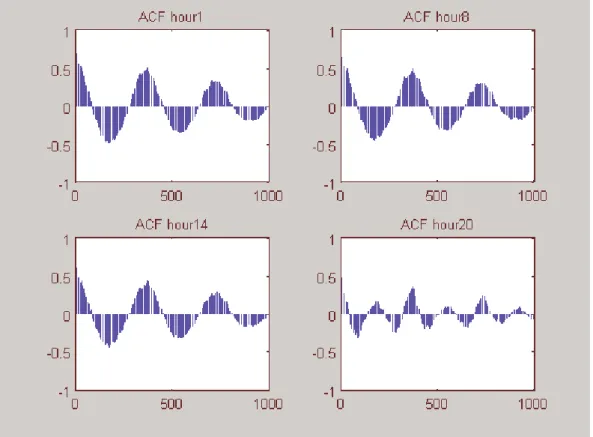
Figure 1 shows the autocorrelation function (ACF) of the series from December 26, 1990 to December 25, 1998 (eight years), for selected hours, after the trend and the calendar effects (weekdays and holidays) are removed. The form of the ACF, which resembles a damped sinusoid as in (5), with annual period, highly justifies using Gegenbauer processes to model Zt. The exception is hour 20, in which either there is a
sinusoidal component of semiannual period or there are two sinusoidal components, one with annual period and the other with semiannual period. This behavior does not occur with any other hour, being specific of hour 20. However, our modeling does not use a k-factor (k would equal to 2 in this case) Gegenbauer process as proposed by Gray et al. (1989) and studied by Ferrara and Guégan (2000, 2001) to model hour 20, obtaining good results though. In fact, hour 20 obtains the lowest errors, the exception being one and sometimes two steps ahead, where it is beaten by hour 21. Figure 2 shows the periodogram (raw and smoothed by a Parzen lag window with degree of smoothness 0.9, respectively represented by dots and a solid line) for the same series in log-log scale. Note the resemblance with the behavior described by (7). The eighth Fourier frequency, corresponding to an annual period as we use eight years of data, shows a sharp peak in the raw periodogram, whereas its vicinity shows a smooth decrease (in log-log scale) going farther to either side. The subfigure corresponding to hour 20 in Figure 2 is consistent with the ACF shown in Figure 1, since there are peaks at the eighth and the sixteenth Fourier frequencies, meaning that there may be one (semiannual) or two (annual and semiannual) Gegenbauer factors.
We chose working with logarithms as the weekly seasonality and the holiday effect can be modeled additively while they are multiplicative in the original series Xt.
very similar results. The choice of the logarithm transformation is thus only to be coherent to our beliefs and not result-oriented.
4 – Results
We run a forecasting exercise with the data specified in the previous section, comparing the results of model (8)-(9) to a benchmark. The benchmark used is a SARIMA, like the works of Darbellay and Slama (2000) and Soares and Medeiros (2003), for example. It is modeled and estimated using EViewsTM software package. The “seasonal” period considered for the SARIMA is one week, since there must be in general small variation between one week and the next within the context of annual seasonality. In fact the SARIMA performs quite well in the early hours, when the load is smoother. A different SARIMA is estimated for each hour of the day, as is done with model (8)-(9).
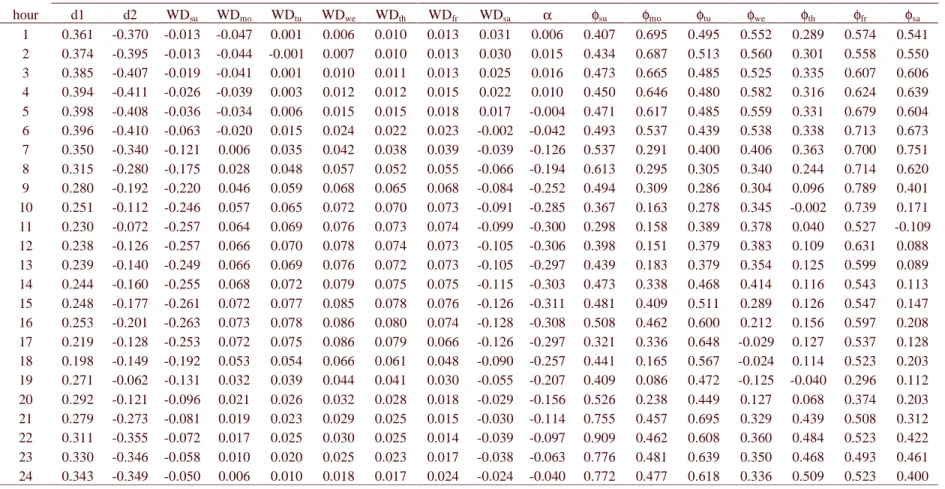
The period used to estimate the models begins four years before December 25, 1998, and ends on this date (in sample). That is, the model is estimated once using a four-year estimation window, as it seems to be enough. The estimated parameters for each hour are presented in Table 1. The degrees of fractional integration, both seasonal and ordinary, vary throughout the hours, though d1 is always positive (long memory) and d2 always negative (short memory). The (seasonal) long memory is stronger for the hours in the beginning and in the end of the day, coinciding with the hours where the load is smoother. The calendar effect, modeled by WDt and αHt, is also not the same for
for this year are likely to be worse than those for 1999. Indeed they are, as one can inspect by comparing Tables 2.1 and 3.1. The reason for this apparent break may relate to macroeconomic factors, being beyond the scope of this paper. In a practical application, it would be wise to frequently re-estimate the model, but in this illustration, not re-estimating the model allows one to observe that the model does not suffer from misspecification (remember the trend is forecasted as linear, but not modeled so).
The favorite measure of forecasting accuracy in the load forecasting literature (c.f. Darbellay and Slama, 2000, Park et al., 1991, and Peng et al., 1992) is the Mean Absolute Percentage Error (MAPE), which is defined below, as it measures the proportionality between error and load.
= +
+ + −
= n
i T i
i T i T
X X X
n MAPE
1 ˆ 1
, (10)
where Xt is the load at time t, Xˆ its estimate, T is the end of the in-sample and n is the t
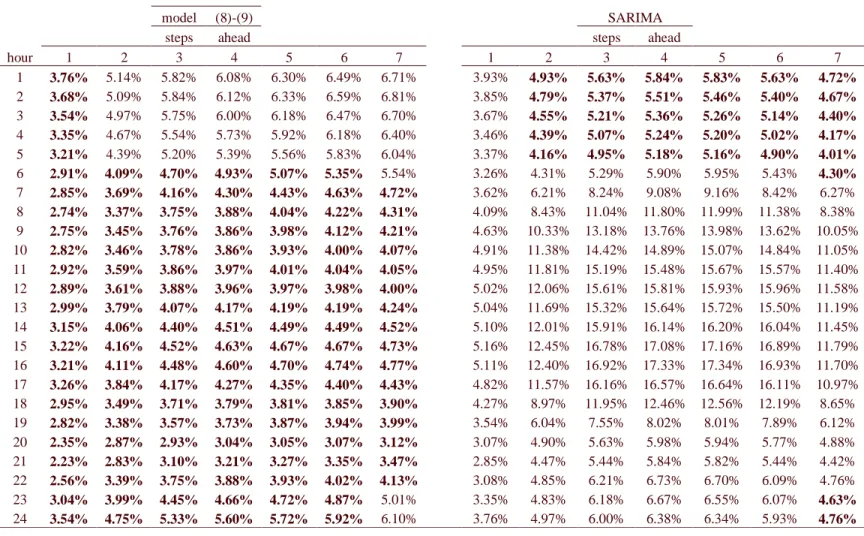
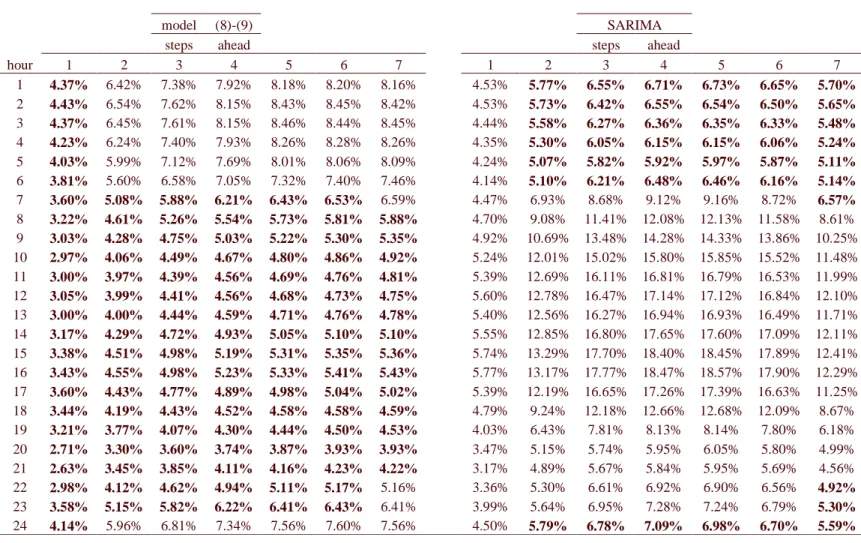
the highest in the day (but the proportional predictability is more accurate for both methods). Table 3 presents the same as Table 2, but for the year 2000. The results are slightly worse, mainly because the linear trend is not re-estimated but seems to suffer a break in 2000, as explained before. Even so, the results are good and are qualitatively equal to the year of 1999, the difference being that the SARIMA fares better also in the sixth hour for steps ahead higher than one. The worst MAPEs from the model (8)-(9), namely those for the first hours seven steps ahead, rise from below 7% in 1999 to above 8% in 2000. As to one step ahead results, the best MAPE rises from 2,23% in 1999 to 2,63% in 2000 (hour 21) and the worst from 3,76% (hour 1) to 4,43% (hour 2). The hour 20 is the best predictable hour for seven steps ahead using the MAPE as the criterion, yielding MAPEs of 3,12% in 1999 and 3,93% in 2000. It is important to note that when we speak of h steps ahead, we consider the sectional data and hence refer to days. As the primary data are hourly, one must interpret as 24h steps ahead, so that (1, 2, …, 7) daily steps ahead actually correspond to (7, 14, …, 168) hourly steps ahead. In practice, it would be interesting to use the model proposed here and the benchmark, each one for the hours and time horizons in which each one fares better, or even in a combined way. The combination is out of the scope of this paper.
Figure 3 illustrates with a typical week the one step ahead forecasting performance of the proposed model and the benchmark. This week goes from May 9, 1999 to May 15, 1999. One can notice that the forecasts from the proposed model fit more closely to the observed loads than those from the benchmark do, reflecting the smaller error obtained by (8)-(9) as presented in Table 2. However, both fits are reasonably good, and the benchmark is not a bad predictor for this horizon (24 hours ahead). Figure 4 illustrates the seven steps ahead forecasting performance of the proposed model and the benchmark, using the same week as Figure 3. The fits are looser than those for one step ahead, as expected, but the proposed model forecasts still track the realized loads. The benchmark forecasts, on the other hand, miss out the real loads too often for this horizon (168 hours ahead), corroborating the superiority of the proposed model.
5 – Final remarks
applied to other utilities presenting similar seasonal patterns, such as many in Brazil. The model explains the seasonality by generalized (seasonal) long memory using Gegenbauer processes, having in addition a stochastic level (driven by some trend), and a calendar effects component (consisting of dummy variables for the days of the week and for holidays). The Gegenbauer processes fit in well the form of the autocorrelations observed after the estimated level and calendar effects are removed.
A forecasting exercise against a SARIMA model (the benchmark) is highly favorable to our modeling. This exercise included the entire years of 1999 and 2000, forecasting one to seven days ahead (24, 48, …, 168 hours ahead), using models estimated up to the end of 1998. We conclude for the presence of seasonal long memory in the data in study and suggest that it may be present in the load demand of other utilities with similar seasonal behavior as well.
Acknowledgements
The authors would like to thank the Brazilian Center for Electricity Research (CEPEL) for the data; Dominique Guégan for providing some bibliographical work; and to Marcelo Medeiros and Reinaldo Souza for invaluable comments on a previous version of this work. The second author would also like to thank FAPERJ for the financial support.
References
Armstrong, J.S. and Collopy, F. (1992), “Error measures for generalizing about forecast methods: empirical comparisons”, International Journal of Forecasting 8, 69-80.
Arteche, J. (2002), “Semiparametric robust tests on seasonal or cyclical long memory time series”, Journal of Time Series Analysis 23, 251-285.
Baillie, R.T. (1996), “Long memory processes and fractional integration in econometrics”, Journal of Econometrics 73, 5-59.
Bakirtzis, A.G., Petridis, V., Kiartzis, S.J., Alexiadis, M.C. and Maissis, A.H. (1996), “A neural network short term load forecasting model for the Greek power system”, IEEE Transactions on Power Systems 11, 858-863.
Beran, J. (1994). Statistics for Long Memory Processes (Chapman & Hall, London). Bunn, D.W. and Farmer, E.D., Eds. (1985). Comparative Models for Electrical Load
Chung, C.-F. (1996), “Estimating a generalized long memory process”, Journal of Econometrics 73, 237-259.
Darbellay, G.A. and Slama, M. (2000), “Forecasting the short-term demand for electricity. Do neural networks stand a better chance?”, International Journal of Forecasting 16, 71-83.
Ferrara, L. and Guégan, D. (1999), “Estimation and applications of Gegenbauer processes”, working paper.
Ferrara, L. and Guégan, D. (2000), “Forecasting financial time series with generalized long memory processes: theory and applications”, in C. Dunis (ed.), Advances in Quantitative Asset Management, Kluwer Academic Press, 319-342.
Ferrara, L. and Guégan, D. (2001), “Forecasting with k-factor Gegenbauer processes: theory and applications”, Journal of Forecasting 20, 581-601.
Fox, R. and Taqqu, M.S. (1986), “Large-sample properties of parameter estimates for strongly dependent stationary Gaussian time series”, Annals of Statistics 14, 517-532.
Granger, C. W. G. and R. Joyeux (1980), “An introduction to long memory time series models and fractional differencing”, Journal of Time Series Analysis 1, 15-29. Gray, H.L., Zhang, N.-F. and Woodward, W.A. (1989), “On generalized fractional
processes”, Journal of Time Series Analysis 10, 233-257.
Hosking, J. (1981), “Fractional differencing”, Biometrika 68, 1, 165-176.
Hippert, H.S., Pedreira, C.E. and Souza R.C. (2001), “Neural networks for short-term load forecasting: a review and evaluation”, IEEE Transactions on Power Systems 16, 44-55.
Mandelbrot, B.B. (1977). Fractals: Form, Chance and Dimension (Freeman, San Francisco).
Park, D.C., El-Sharkawi, M.A., Marks II, R.J., Atlas, L.E. and Damborg, M.J. (1991), "Electric load forecasting using an artificial neural network", IEEE Transactions on Power Systems 6 (2), 442-449.
Peng, T.M., Hubele, N.F. and Karady, G.G. (1992), “ Advancement in the application of neural networks for short-term load forecasting”, IEEE Transactions on Power Systems 7 (1), 250-256.
Ramanathan, R., Engle, R., Granger, C.W.J., Vahid-Araghi, F. and Brace, C. (1997), “Short-run forecasts of electricity loads and peaks”, International Journal of Forecasting 13, 161-174.
Ray, B.K. (1993), “Long-range forecasting of IBM product revenues using a seasonal fractionally differenced ARMA model”, International Journal of Forecasting 9, 255-269.
Soares, L.J. and Medeiros, M.C. (2003), “Short-term load forecasting: a two-step modelling”, working paper.
Souza, L.R. and Soares, L.J. (2003), “Forecasting electricity load demand: analysis of the 2001 rationing period in Brazil”, working paper.
Table 1: Parameter estimates of model (8)-(9) for each hour.
hour d1 d2 WDsu WDmo WDtu WDwe WDth WDfr WDsa α φsu φmo φtu φwe φth φfr φsa
Table 2: MAPE for the entire year of 1999 (the best model in bold).
model (8)-(9) SARIMA
steps ahead steps ahead
hour 1 2 3 4 5 6 7 1 2 3 4 5 6 7
1 3.76% 5.14% 5.82% 6.08% 6.30% 6.49% 6.71% 3.93% 4.93% 5.63% 5.84% 5.83% 5.63% 4.72%
2 3.68% 5.09% 5.84% 6.12% 6.33% 6.59% 6.81% 3.85% 4.79% 5.37% 5.51% 5.46% 5.40% 4.67%
3 3.54% 4.97% 5.75% 6.00% 6.18% 6.47% 6.70% 3.67% 4.55% 5.21% 5.36% 5.26% 5.14% 4.40%
4 3.35% 4.67% 5.54% 5.73% 5.92% 6.18% 6.40% 3.46% 4.39% 5.07% 5.24% 5.20% 5.02% 4.17%
5 3.21% 4.39% 5.20% 5.39% 5.56% 5.83% 6.04% 3.37% 4.16% 4.95% 5.18% 5.16% 4.90% 4.01%
6 2.91% 4.09% 4.70% 4.93% 5.07% 5.35% 5.54% 3.26% 4.31% 5.29% 5.90% 5.95% 5.43% 4.30%
7 2.85% 3.69% 4.16% 4.30% 4.43% 4.63% 4.72% 3.62% 6.21% 8.24% 9.08% 9.16% 8.42% 6.27%
8 2.74% 3.37% 3.75% 3.88% 4.04% 4.22% 4.31% 4.09% 8.43% 11.04% 11.80% 11.99% 11.38% 8.38%
9 2.75% 3.45% 3.76% 3.86% 3.98% 4.12% 4.21% 4.63% 10.33% 13.18% 13.76% 13.98% 13.62% 10.05%
10 2.82% 3.46% 3.78% 3.86% 3.93% 4.00% 4.07% 4.91% 11.38% 14.42% 14.89% 15.07% 14.84% 11.05%
11 2.92% 3.59% 3.86% 3.97% 4.01% 4.04% 4.05% 4.95% 11.81% 15.19% 15.48% 15.67% 15.57% 11.40%
12 2.89% 3.61% 3.88% 3.96% 3.97% 3.98% 4.00% 5.02% 12.06% 15.61% 15.81% 15.93% 15.96% 11.58%
13 2.99% 3.79% 4.07% 4.17% 4.19% 4.19% 4.24% 5.04% 11.69% 15.32% 15.64% 15.72% 15.50% 11.19%
14 3.15% 4.06% 4.40% 4.51% 4.49% 4.49% 4.52% 5.10% 12.01% 15.91% 16.14% 16.20% 16.04% 11.45%
15 3.22% 4.16% 4.52% 4.63% 4.67% 4.67% 4.73% 5.16% 12.45% 16.78% 17.08% 17.16% 16.89% 11.79%
16 3.21% 4.11% 4.48% 4.60% 4.70% 4.74% 4.77% 5.11% 12.40% 16.92% 17.33% 17.34% 16.93% 11.70%
17 3.26% 3.84% 4.17% 4.27% 4.35% 4.40% 4.43% 4.82% 11.57% 16.16% 16.57% 16.64% 16.11% 10.97%
18 2.95% 3.49% 3.71% 3.79% 3.81% 3.85% 3.90% 4.27% 8.97% 11.95% 12.46% 12.56% 12.19% 8.65%
19 2.82% 3.38% 3.57% 3.73% 3.87% 3.94% 3.99% 3.54% 6.04% 7.55% 8.02% 8.01% 7.89% 6.12%
20 2.35% 2.87% 2.93% 3.04% 3.05% 3.07% 3.12% 3.07% 4.90% 5.63% 5.98% 5.94% 5.77% 4.88%
21 2.23% 2.83% 3.10% 3.21% 3.27% 3.35% 3.47% 2.85% 4.47% 5.44% 5.84% 5.82% 5.44% 4.42%
22 2.56% 3.39% 3.75% 3.88% 3.93% 4.02% 4.13% 3.08% 4.85% 6.21% 6.73% 6.70% 6.09% 4.76%
23 3.04% 3.99% 4.45% 4.66% 4.72% 4.87% 5.01% 3.35% 4.83% 6.18% 6.67% 6.55% 6.07% 4.63%
Table 3: MAPE for the entire year of 2000 (the best model in bold).
model (8)-(9) SARIMA
steps ahead steps ahead
hour 1 2 3 4 5 6 7 1 2 3 4 5 6 7
1 4.37% 6.42% 7.38% 7.92% 8.18% 8.20% 8.16% 4.53% 5.77% 6.55% 6.71% 6.73% 6.65% 5.70%
2 4.43% 6.54% 7.62% 8.15% 8.43% 8.45% 8.42% 4.53% 5.73% 6.42% 6.55% 6.54% 6.50% 5.65%
3 4.37% 6.45% 7.61% 8.15% 8.46% 8.44% 8.45% 4.44% 5.58% 6.27% 6.36% 6.35% 6.33% 5.48%
4 4.23% 6.24% 7.40% 7.93% 8.26% 8.28% 8.26% 4.35% 5.30% 6.05% 6.15% 6.15% 6.06% 5.24%
5 4.03% 5.99% 7.12% 7.69% 8.01% 8.06% 8.09% 4.24% 5.07% 5.82% 5.92% 5.97% 5.87% 5.11%
6 3.81% 5.60% 6.58% 7.05% 7.32% 7.40% 7.46% 4.14% 5.10% 6.21% 6.48% 6.46% 6.16% 5.14%
7 3.60% 5.08% 5.88% 6.21% 6.43% 6.53% 6.59% 4.47% 6.93% 8.68% 9.12% 9.16% 8.72% 6.57%
8 3.22% 4.61% 5.26% 5.54% 5.73% 5.81% 5.88% 4.70% 9.08% 11.41% 12.08% 12.13% 11.58% 8.61%
9 3.03% 4.28% 4.75% 5.03% 5.22% 5.30% 5.35% 4.92% 10.69% 13.48% 14.28% 14.33% 13.86% 10.25%
10 2.97% 4.06% 4.49% 4.67% 4.80% 4.86% 4.92% 5.24% 12.01% 15.02% 15.80% 15.85% 15.52% 11.48%
11 3.00% 3.97% 4.39% 4.56% 4.69% 4.76% 4.81% 5.39% 12.69% 16.11% 16.81% 16.79% 16.53% 11.99%
12 3.05% 3.99% 4.41% 4.56% 4.68% 4.73% 4.75% 5.60% 12.78% 16.47% 17.14% 17.12% 16.84% 12.10%
13 3.00% 4.00% 4.44% 4.59% 4.71% 4.76% 4.78% 5.40% 12.56% 16.27% 16.94% 16.93% 16.49% 11.71%
14 3.17% 4.29% 4.72% 4.93% 5.05% 5.10% 5.10% 5.55% 12.85% 16.80% 17.65% 17.60% 17.09% 12.11%
15 3.38% 4.51% 4.98% 5.19% 5.31% 5.35% 5.36% 5.74% 13.29% 17.70% 18.40% 18.45% 17.89% 12.41%
16 3.43% 4.55% 4.98% 5.23% 5.33% 5.41% 5.43% 5.77% 13.17% 17.77% 18.47% 18.57% 17.90% 12.29%
17 3.60% 4.43% 4.77% 4.89% 4.98% 5.04% 5.02% 5.39% 12.19% 16.65% 17.26% 17.39% 16.63% 11.25%
18 3.44% 4.19% 4.43% 4.52% 4.58% 4.58% 4.59% 4.79% 9.24% 12.18% 12.66% 12.68% 12.09% 8.67%
19 3.21% 3.77% 4.07% 4.30% 4.44% 4.50% 4.53% 4.03% 6.43% 7.81% 8.13% 8.14% 7.80% 6.18%
20 2.71% 3.30% 3.60% 3.74% 3.87% 3.93% 3.93% 3.47% 5.15% 5.74% 5.95% 6.05% 5.80% 4.99%
21 2.63% 3.45% 3.85% 4.11% 4.16% 4.23% 4.22% 3.17% 4.89% 5.67% 5.84% 5.95% 5.69% 4.56%
22 2.98% 4.12% 4.62% 4.94% 5.11% 5.17% 5.16% 3.36% 5.30% 6.61% 6.92% 6.90% 6.56% 4.92%
23 3.58% 5.15% 5.82% 6.22% 6.41% 6.43% 6.41% 3.99% 5.64% 6.95% 7.28% 7.24% 6.79% 5.30%
✚✟✼✾✽✱✼✸✿❀✸✼✸❁❃❂❅❄✛✢✜✶✸✹❆✹✻✶✸❄❇✹✻✼✾❈✎❉✟✺✡❊✸✺●❋✛❄❍❀✾❂■✺✜✹❏☛✌❑▲❑▲✿✶✸✹✌❈▼✠◆✼✸❖◗P✡✶✸✿✙✷✁✶❘✬❏❙✜✹✻✶✸P❚✏✓✶✸❑❯❑▲❱✡✼❘✴❲✪✫✼✸✹✻❳✸✺❨✷✁✶❬❩❪❭✁❭❪❩❴❫❵❩❪❛ ❜✁❝✸❞ ❑▲☎ ✁❪❩❪☎ ✝✟✳✥✒✟✞✡✞✫✏✓✒✟☛✌☞✎✚✟☛✌✏✓✭❯✞✡✠❡✔✗✢✫✚✕✔✗✪✫✏✓✞❃✝✕☛✝✕☛❋✛✞✫☞✎✔✥☞✎✭✆☛✤☞✦✞❃✬❏✒✲✏✓✒✕☛✤✚✟☛✌☞✎✍❢✴❣✢✡✹✻✼✸❁✡❤●✳✗☎✗✏✓✼ ❞ ✶✐❉✟✹✌❈✵✏✓✼✸P✡✿✺❦❥❪☎ ✪✫✺✡❁❧❂■✶✸❄❍✹❆✺♠✴♥✬❏❙✜✹✻❄❇✿▲✷✜✶▼❩❪❭✁❭❪❩✮✴♦❪ ❜✁❝✸❞ ❑▲☎
✁❪♣❪☎ ✔q✪✫✞✜✚✜✬❏☞✎☛✌✠✕✪✫✔q✪✫✔✥☞✎✞❃✝✜r❏✒✟☛✤✔q✖✙✞s✝✕✒✁✬❏☞✦✠✕✪✫☛✌✠✕✠✜t✮✔✉☞✙✬✯✞✡✚✟✔✗☞✦✔✥✪✫☛✬✯✈✥✒✜✬❏✠✕☛✌✭❯✞✡☛✤✒✜✬❲✏✓✇✥✠✜❫①✏✓✭❅✬❏☞✦✔
✒✟✞❃✬❏✭②✴♦✪✫✼✸✹✻❀✸✶✸✿✺③✢✡✶✸✹✻❁✡✼✸❁✡✷✜✶✸❑④❈⑤❉✟P✜✼✸❁♠✝✕✺✡✹✻✺♠✴♥✬❏❙✜✹✻❄❇✿▲✷✜✶▼❩✁❭❪❭❪❩✮✴♦♣✁♣ ❜✜❝✸❞ ❑❯☎ ✁❪❪☎ ✬⑥✒✟✔✥✈✙✘✛✠✜✝❚✏✓✔✓❋②✞✡✒✁✝✜⑦✉✏✓✒✟✔✥✢✡☛✤✭✆✞⑧✢✜✔✥✒❢✈✙✒✁✬②⑨⑩☛✌✭✐✘✗✠✕☛✌☞✎✍❡✪✫✘✛✭■✝✟☛✌✏✓✭❯✞❘✖⑤✬②✝✜✬❶✠◆✔✗✘✗✒✟✚✟✞✡✠❘✴q✢✡✹✻✼✸❁✡❀✸❄❍❑❯❀✸✺ ✳✗☎✁✍✗☎✁✢✡✶✸✹✻✹✻✶✸❄❇✹✻✼✾❈✙✏✓✶✾❂❅✶✸✹◆✭❯✼✸❁❃❷❸✺✡P❃❹✐❈✙✪✫✼✸✹❆❀✸✶✸✿✺③☞✎✶✸✹❆❄✾✴♥✬❏❙✜✹✻❄❇✿▲✷✜✶▼❩❪❭✁❭❪❩✮✴♦♣❪❛ ❜✁❝✸❞ ❑▲☎
✁❪❺❪☎ ✝✟✳✥✞❻✪✫☛✤✠✕✠◆☛✤☞✦✍ ✭✆☛✤☞✦❥❪❼❽✘✗✠✕☛✌☞✎✍❾✝✟✳✥✞❿☞✎✈✙✞✡✒ ✒✟✞✡✚✟✞✡✠◆✠✕☛✤✔✥☞ ☛✤☞✦✖✥☛✌✚✁✬②✝✕✔✗✒❻✝✟✔ ✚✟✔✥☞✎✠✡✝✟✒✟✘✗✚✁✝
✚✟✔✥☛✤☞✦✚✟☛✤✖✙✞✡☞✙✝❘✬✮☞✎✖❨✭❯✞❃✬❏✖✙☛✤☞✦✍❢☛✌☞✎✖✙☛✤✚✕✞✜✠✫✔✥✢◗✞✡✚✟✔✥☞✦✔✗✪✫☛✌✚❘✬✮✚✁✝✟☛❋②☛✝✁⑦❘✴●❉✄✺✡❊✸✺❏❋②❄❇❀✾❂❅✺✡✹✙☛✤❑❯❑▲✿✶✸✹✌❈✛✢✡✼✸✹✻❑▲➀✡❄❇✷
❋②✼✸➀✡❄❇✷➁✴♦✪✫✼✸❄❇✺③✷✁✶➂❩❪❭❪❭✁❩❏✴✫♣✄✂
❜✁❝✸❞ ❑▲☎
✁❪➃❪☎ ✠✕✏✓✞✡✚✟✘✗✭❅✬②✝✕☛❋✛✞➁✬②✝✜✝✁✬❏✚✕❥❪✠❴✔✥☞❡✖✥✞✡✈⑤✝✕✠✜➄✙✖✙✔✥✭❯✭■✬❏✒✟☛⑨✸✬②✝✟☛✌✔✗☞✫✬❏☞✦✖♦✔✗✏▲✝✕☛✤✪✫✘✗✪✧✚✟✘✛✒✟✒✕✞✜☞✦✚✁⑦✐✬❏✒✟✞❃✬❏✠③✴
✬❏✿✺✡❄❇❑▲❄❇✺♠✬❏✹✻✼✸P❃❷❸✺❃❈✙✪✫✼✸✹✻❀✸❄❇✼▼✭✆✶✸✺✡❁♠✴♦✪✫✼✸❄❇✺③✷✁✶▼❩✁❭❪❭✁❩❏✴♦➅✁
❜✜❝✸❞ ❑▲☎
✁❪➅❪☎ ❋②☛✌☞✙✝✜✬❏✍✥✞⑧✚✁✬❏✏✓☛✝✜✬❏✭■➄➆✖✙☛✤✠✡✝✟✔✥✒✁✝✕☛✤✔✥☞✎✠⑧✬❏☞✎✖q✖✙✞❃❋②✞✡✭✆✔✗✏✓✪✫✞✡☞✄✝⑧✴q✠✕✼✸❖✐P✜✶✸✿✁✷✁✶➇✬❏❙✁✹❆✶✸P❘✏✓✶✸❑▲❑▲✺✡✼✾❈➆✒✕✼✾➈➉✼✸✶✸✿
✒✟✺✡❙➁✴♦✪✫✼✸❄❇✺③✷✁✶▼❩✁❭❪❭✁❩❏✴♦✁♣ ❜✜❝✸❞ ❑▲☎ ✁❪❛❪☎ ✍✗✔✓❋✛✞✜✒✕☞✎✪✫✞✡☞✄✝❲✬❏✚✁✝✕☛✤✔✥☞✎✠✯✝✕✔➊✠◆✘✛✏✓✏✓✔✥✒✁✝➋✚✟✔✥✢✡✢✜✞✡✞➌✏✓✒✟✔✥✖✥✘✗✚✟✞✡✒✟✠➍✴⑥✬❏☞★☛✤☞✄❋②✞✡✠✜✝✕☛✤✍✓✬②✝✕☛✤✔✥☞❵✔✥✢ ✏✓✔✗✠◆✠✕☛✌✈✥✭✆✞➎✪✫✞❃✬❏✠✕✘✗✒✟✞✡✠❴✢✡✒✟✔✥✪➏✝✟✳✥✞➎✞✜✘✗✒✟✔✥✏✓✞❧✬✮☞➐✘✗☞✎☛✌✔✗☞✫✴❬✍✗✶✸✹❆❖ ❝ ❁➎✚✟✼✸✿➈➑✼✾❂✻❈✥✒✟✶✸❁✡✼✾❂❅✺➎✍✥☎❪✢✡✿❱✡✹✻✶✸❑➒❉✄✹✻☎ ✴♥❉✄P✡❁✡➀✡✺③✷✁✶➂❩❪❭❪❭✁❩❏✴✫♣❪❭ ❜✁❝✸❞ ❑▲☎
✁❪➓❪☎ ✬➔✪✫✔✗✖✙✞✡✭❦✔✥✢❚✚✁✬❏✏✓☛✝✁✬✮✭✐✬❏✚✟✚✟✘✗✪✫✘✛✭■✬②✝✕☛✤✔✥☞➍✬❏☞✦✖✯✒✟✞✡☞✄✝✁❫①✠✕✞✡✞✡❥❪☛✤☞✦✍➐✴✯✏✓✼✸P✡✿✺❨✈✙✼✸✹✻✶✸✿✿❄❈➂✠◆✼✸❖◗P✡✶✸✿✄✷✜✶
✬❏❙✜✹✻✶✸P③✏✓✶✸❑▲❑❯❱✜✼✦✴♥❉✄P✡❁✡➀✡✺③✷✁✶▼❩✁❭❪❭✁❩❏✴♦❺✁❭
❜✜❝✸❞ ❑▲☎
✁❺❪❭❪☎ ✝✟✳✥✞❻✪✫☛✤✠✕✠◆☛✤☞✦✍ ✭✆☛✤☞✦❥❪❼❽✘✗✠✕☛✌☞✎✍❾✝✟✳✥✞❿☞✎✈✙✞✡✒ ✒✟✞✡✚✟✞✡✠◆✠✕☛✤✔✥☞ ☛✤☞✦✖✥☛✌✚✁✬②✝✕✔✗✒❻✝✟✔ ✚✟✔✥☞✎✠✡✝✟✒✟✘✗✚✁✝
✚✟✔✥☛✤☞✦✚✟☛✤✖✙✞✡☞✙✝❘✬✮☞✎✖❨✭❯✞❃✬❏✖✙☛✤☞✦✍❢☛✌☞✎✖✙☛✤✚✕✞✜✠✫✔✥✢◗✞✡✚✟✔✥☞✦✔✗✪✫☛✌✚❘✬✮✚✁✝✟☛❋②☛✝✁⑦❘✴●❉✄✺✡❊✸✺❏❋②❄❇❀✾❂❅✺✡✹✙☛✤❑❯❑▲✿✶✸✹✌❈✛✢✡✼✸✹✻❑▲➀✡❄❇✷
❋②✼✸➀✡❄❇✷➁✴♥❉✄P✡❁✡➀✡✺③✷✁✶➂❩❪❭❪❭✁❩❏✴✫❩❪➓
❜✁❝✸❞ ❑▲☎
✁❺✄✂✆☎ ✭❯✞✡☞✦✖✙✞✜✒❵✭❯☛✬❏✈✙☛✤✭✆☛✝✜⑦→☛✤☞→✝✕✳✗✞➋✚✟✔✥☞✎✠◆✘✛✪✫✞✡✒✑✚✟✒✕✞✜✖✙☛✝❵✪◗✬✮✒✟❥❪✞❃✝➋✴➣✞✡✿❄❇❑▲✼✸❙✜✶✾❂✻❂❅✼↔☛✌✺✡❑▲❑▲✼✾❈✉✍✗❄❇P✡✿❄❇✼✸❁✡✼
✏✓✼✸✿P✡❖◗❙✜✺♠✴♥✬
❞
✺✡❑④❂❅✺③✷✜✶▼❩❪❭✁❭❪❩✮✴♦❩❪❭
❜✜❝✸❞ ❑❯☎
✁❺❪❩❪☎ ✖✙✞✜✚✕☛✤✠✕☛✌✔✗☞➐✒✟✘✛✭✆✞✡✠✐✬❏☞✦✖❨☛✌☞✎✢✡✔✥✒✟✪◗✬②✝✕☛✤✔✥☞✲✏✓✒✟✔✓❋✛☛✤✠✕☛✌✔✗☞✦❼✱✪✫✔✗☞✦☛✝✕✔✥✒✟☛✤☞✦✍●❋✛✞✡✒✟✠✕✘✗✠❴✪◗✬❏☞✦☛✤✏✓✘✗✭❅✬②✝✕☛✤✔✥☞
❫②✞✡✿❄❇❑❯✼✸❙✁✶✾❂✻❂■✼▼☛✤✺✡❑▲❑❯✼✾❈✙✍✥❄❍P✡✿❄❇✼✸❁✡✼▼✏✓✼✸✿P✡❖✐❙✁✺♠✴♥✬
❞
✺✡❑④❂■✺③✷✁✶▼❩✁❭❪❭✁❩❏✴♦♣✁➅
❜✜❝✸❞ ❑▲☎
✁❺❪♣❪☎ ✔✗☞ ✚✟✞✡✒✁✝✜✬❏☛✤☞ ✍✥✞✜✔✥✪✫✞❃✝✟✒✕☛✤✚↕✬✮✠✕✏✓✞✡✚✁✝✕✠➙✔✥✢➛✏✓✔✗✒✜✝✟✢✡✔✥✭❯☛✌✔ ✔✥✏▲✝✕☛✤✪✫☛✤✠✡✬②✝✕☛✤✔✥☞❾✰❶☛✝✕✳ ✳✥☛✤✍✥✳✥✞✜✒
✪✫✔✗✪✫✞✡☞✄✝✟✠③✴♦✍✥P✡❑④❂❅✼✾✽✱✺③✪✫☎✁✷✁✶✦✬②❂❅➀✡✼✾➜⑩✷✁✶✾❈✄✒✟✶✸❁✡✼✾❂❅✺③✍✗☎➝➈➑✿❱✡✹✻✶✸❑➆❉✟✹✻☎✆✴✫✠✕✶✾❂❅✶✸❖✐❙✁✹✻✺③✷✜✶▼❩✁❭❪❭❪❩✮✴♦❩✟✂
❜✜❝✸❞ ❑❯☎
✁❺❪❪☎ ✪✫✞✡☞✎✠◆✘✛✒✁✬❏☞✦✖✙✔ ✬ ✏✓✒✟✔✗✖✙✘✗➞✁t❏✔ ✚✟☛✤✞✡☞✄✝✟➟✌✢✜☛✌✚✁✬ ☛✌☞✙✝✕✞✡✒✟☞✙✬✮✚✟☛✤✔✥☞✙✬✮✭ ✞✡✪ ✞✡✚✟✔✥☞✦✔✗✪✫☛✬ ✖✙✞
✏✓✞✡✠✕➠✥✘✛☛✤✠✡✬❏✖✙✔✗✒✕✞✜✠➡✞❨✖✙✞✜✏▲✬✮✒✁✝✁✬✮✪✫✞✜☞✄✝✕✔✗✠➡✈✙✒✁✬❏✠◆☛✤✭✆✞✡☛✤✒✟✔✥✠❚❫✮❉✄✺✡❊✸✺●❋✛❄❇❀✾❂❅✺✡✹❏☛✤❑▲❑❯✿✶✸✹✌❈➆✝✕✼✾❂❅❄❇✼✸❁✜✼♦✚✟✼✸✿✷✁✼✸❑
✷✁✶➂✭❯❄❇❖◗✼✦✬❏❀✸➀✡➢▼✏✓❄❇✿✿✼✸✹✜✴✫✠✕✶✾❂❅✶✸❖✐❙✁✹✻✺③✷✜✶▼❩✁❭❪❭❪❩✮✴♦♣✁➓
❜✜❝✸❞ ❑❯☎
✁❺❪❺❪☎ ✢✡✔✗✒✟✞✡☛✌✍✗☞➋✖✙☛✤✒✟✞✡✚✁✝➌☛✌☞✙❋✛✞✡✠✜✝✕✪✫✞✡☞✙✝➌✠◆✏✓☛✤✭✆✭❯✔✓❋②✞✡✒✟✠◆❼✥✬❏✖✙✖✙☛✝✕☛✤✔✥☞✄✬❏✭✫✭❯✞✡✠◆✠✕✔✥☞✎✠❣✢✡✒✟✔✥✪➤✬➥✚✟✔✗✘✗☞✙✝✕✒✁⑦
✠✜✝✕✘✛✖⑤⑦❴❫➁✒✟✶✸❁✡✼✾❂❅✺⑧✍✗☎✕✢✜✿✺✜✹❆✶✸❑➇❉✄✹❍❈✦✪✫✼✸✹✻❄❇✼♥✏✓✼✸P✡✿✼♥✢✡✺✡❁❧❂■✺✜P✡✹✻✼✾❈➒✒✟✺
❞
➢✸✹✻❄❇✺❘✍✥P✡✶✸✹✻✹✻✼♥✠◆✼✸❁❧❂■✺✜❑✮✴q✠◆✶✾❂❅✶✸❖◗❙✜✹✻✺❘✷✜✶
❩❪❭✁❭❪❩✮✴♦♣❪❭
✞✡➠✗✘✱✬②✝✟☛✌✔✗☞❦❫⑩✰⑥❄❇✿➈➑✹✻✶✸✷✜✺③✭❯☎✁✪✫✼✸✿✷✁✺✡❁✡✼✸✷✜✺❧❈✄✳✗P✡❖◗❙✜✶✸✹✌❂❅✺③✪✫✺✡✹✻✶✸❄❇✹✻✼✦✴♦✠✕✶✾❂❅✶✸❖✐❙✁✹❆✺③✷✁✶▼❩✁❭❪❭✁❩❏✴➐✂➝
❜✜❝✸❞ ❑▲☎
✁❺❪➅❪☎ ✝✟✒✜✬❏✖✙✞ ✭❯☛✌✈✙✞✜✒✜✬❏✭❯☛⑨✸✬②✝✕☛✤✔✥☞➏✬❏☞✎✖➌✝✟✳✥✞ ✞❃❋②✔✥✭✆✘⑩✝✕☛✤✔✥☞✧✔✗✢ ✠◆❥❪☛✌✭❯✭✉✞❃✬❏✒✟☞✦☛✤☞✦✍✥✠❶✖✥☛✌✢✡✢✜✞✡✒✟✞✡☞✄✝✟☛✬❏✭✆✠❶☛✤☞
✈✙✒✁✬②⑨⑩☛✤✭➒❫➒✍✥P✡❑④❂❅✼✾✽✓✺ ✍✥✺✡❁ ✁ ✼ ❞ ✼✾❈✥☞✦✼✸➢✸✹✻❀✸❄❇✺➎✪✫✶✸❁✡✶ ✁ ✶✸❑➂✢✡❄❇✿➀✡✺❃❈✥✚✟✹✻❄❇❑④❂❅❄❇❁✡✼♠✝✕✶✸✹✻✹✻✼♠✴♦✠◆✶✾❂❅✶✸❖◗❙✜✹✻✺③✷✜✶▼❩❪❭✁❭❪❩✮✴♦♣✄✂ ❜✁❝✸❞ ❑▲☎ ✁❺❪❛❪☎ ✖✙✞✜✠◆✞✡✪✫✏✓✞✜☞✦✳✥✔➥✖✙✞➍✞✡✠✡✝✟☛✌✪◗✬❏✖✙✔✗✒✟✞✡✠↔✖✙✞✉❋②✔✥✭■✬②✝✟☛✌✭❯☛✌✖⑤✬❏✖✙✞➌☞✄✬➣✈✙✔✥✭❯✠✡✬➣✖✙✞✉❋⑩✬❏✭✆✔✗✒✕✞✜✠✵✖✙✞➌✠✡t❏✔ ✏▲✬❏✘✛✭✆✔♥❫②✈✙✶✸✹✻❁✡✼✸✹✻✷✜✺③✷✜✶▼✠ ❝ ✪✫✺❃❂❅✼✾❈✄✪✫✼✸✹✻❀✸✶✸✿✺③✢✡✶✸✹✻❁✡✼✸❁✡✷✁✶✸❑➒✴♦✔✥P❧❂■P✜❙✜✹✻✺③✷✜✶▼❩❪❭✁❭❪❩✮✴♦♣❪➅ ❜✜❝✸❞ ❑❯☎
✁❺❪➓❪☎ ✢✡✔✗✒✟✞✡☛✌✍✗☞➡✢✡✘✛☞✦✖✙☛✤☞✦✍❴✝✟✔❴✬✮☞ ✞✡✪✫✞✜✒✕✍✗☛✌☞✎✍❢✪◗✬✮✒✟❥❪✞❃✝✕❼✡✝✕✳✗✞✐✪✫✔✗☞✦✞❃✝✁✬✮✒✁⑦❬✏✓✒✟✞✡✪✫☛✤✘✗✪➋✝✕✳✗✞✡✔✥✒✁⑦❘✬❏☞✦✖
✝✟✳✥✞❣✈✙✒✁✬②⑨⑩☛✤✭✆☛✬✮☞★✚✁✬✮✠✕✞❃➄❨✂✆➓✁➓✄✂①❫✆✂✆➓✁➓❪❛q❫✫✚✟✼✸✹✻✿✺✜❑➐✳✗✼✸❖✐❄❇✿❂❅✺✡❁❚❋②☎➆✬❏✹✻✼✄✂❃❷❸✺❃❈⑧✒✟✶✸❁✡✼✾❂❅✺➡✍✥☎➂✢✡✿✺✡✹✻✶✸❑✫❉✄✹✻☎➆✴
✔✗P❃❂❅P✡❙✜✹✻✺③✷✜✶▼❩❪❭✁❭❪❩✮✴♦❪➃
❜✁❝✸❞ ❑▲☎
✁➃❪❭❪☎ ✒✟✞✡✢✡✔✗✒✟✪◗✬➌✏✓✒✕✞❧❋✛☛✤✖✙✞✡☞✦✚✟☛r❏✒✕☛✬❏❼✱✞✡✪✧✈✙✘✛✠✕✚✜✬❣✖✙✞ ☛✌☞✎✚✕✞✜☞✄✝✕☛❋✛✔✗✠ ✏▲✬❏✒✁✬❢✬②✝✕✒✁✬❏☛✌✒❦✔❘✝✟✒✁✬✮✈✓✬✮✭❯✳✓✬❏✖✙✔✗✒
✬❏✘⑩✝✆☎✥☞✎✔✥✪✫✔♦❫➁✠✕✼✸❖✐✼✸❁❧❂■➀✜✼➂✝✕✼✸✼✸❖➥✖✙✼✸✹✌❂❆❈✦✪✫✼✸✹✻❀✸✶✸✿✺⑧✚✟❱✡✹✌❂❅✶✸❑✐☞✎✶✸✹✻❄❈✦✢✡✿✼✾✽✱❄❇✺⑧✪✫✶✸❁✡✶
✁
✶✸❑➇✴❡☞✦✺❃✽✱✶✸❖◗❙✜✹✻✺⑧✷✜✶
❩❪❭✁❭❪❩✮✴♦❩❪❛
❜✁❝✸❞ ❑▲☎
✁➃✄✂✆☎ ✖✙✞✜✚✕✞✜☞✄✝➊✰⑥✔✥✒✟❥➏✬❏☞✦✖ ✝✕✳✥✞➔☛✌☞✎✢✡✔✥✒✟✪◗✬❏✭➏✠◆✞✡✚✁✝✟✔✥✒→☛✤☞ ✈✙✒✁✬②⑨⑩☛✤✭❣✴ ✪✫✼✸✹✻❀✸✶✸✿✺ ✚✟❱✡✹✌❂❅✶✸❑↔☞✦✶✸✹✻❄③✴
☞✎✺❃✽✱✶✸❖✐❙✁✹❆✺③✷✁✶▼❩✁❭❪❭✁❩❏✴➐✂✁✂✆❺
❜✁❝✸❞ ❑▲☎
✁➃❪❩❪☎ ✏✓✔✗✭✆➟✝✕☛✤✚✜✬➛✖✙✞❶✚✟✔✓✝✁✬❏✠ ✞❶☛✤☞✦✚✟✭✆✘✛✠✡t❏✔➏✝✟✒✜✬❏✈⑤✬❏✭❯✳✥☛✤✠✡✝✁✬✩✖⑤✬❏✠➋✏✓✞✡✠✕✠✕✔✓✬❏✠➋✚✟✔✥✪ ✖✙✞✡✢✡☛✤✚✟☛✞✝✜☞✦✚✟☛✬★❫
✪✫✼✸✹✻❀✸✶✸✿✺❦✚✕❱✜✹❍❂❅✶✸❑⑧☞✎✶✸✹✻❄❈✗✬❏✿✶✠✟⑩✼✸❁✡✷✁✹❆✶❴✏✓❄❇❁❃❂❅✺❦✷✜✶❴✚✟✼✸✹✌✽✓✼✸✿➀✡✺❧❈➁✳✗✶✸❑❯❑▲❄❇✼❴✍✥P✡❄❇✿➀✡✶✸✹✻❖◗✺❦✚✕✺✜❑❅❂❅❄❇✿✿✼➎✴➡☞✦✺❧✽✓✶✸❖◗❙✜✹✻✺
✷✁✶➂❩❪❭❪❭✁❩❏✴✫➃❪➅
❜✁❝✸❞ ❑▲☎
✁➃❪♣❪☎ ✠✕✞✡✭✆✞❧✝✕☛❋✛☛✤✖⑤✬❏✖✙✞❽✞↔✪✫✞✡✖✙☛✤✖⑤✬❏✠ ✖✙✞↔➠✥✘⑩✬❏✭✆☛✤✖⑤✬❏✖✙✞↔✖⑤✬ ✞✡✖✥✘✗✚✁✬❏➞✁t✮✔→✈✥✒✜✬❏✠✕☛✌✭❯✞✡☛✤✒✜✬ ✂➝➓❪➓❪❺➝❫■❩✁❭❪❭✄✂➐❫
✪✫✼✸✹✻❀✸✶✸✿✺③✚✟❱✡✹✌❂■✶✸❑s☞✦✶✸✹✻❄❈⑤✬❏✿✶✠✟⑩✼✸❁✡✷✜✹✻✶▼✏✓❄❇❁❃❂❅✺③✷✜✶▼✚✟✼✸✹✌✽✱✼✸✿➀✜✺♠✴✫☞✎✺❃✽✱✶✸❖✐❙✁✹✻✺③✷✜✶▼❩✁❭❪❭❪❩✮✴♦♣✁♣✄✂
❜✁❝✸❞ ❑▲☎
✁➃❪❪☎ ✈✙✒✁✬②⑨⑩☛✤✭✆☛✬✮☞ ✪◗✬❏✚✟✒✕✔✗✞✡✚✟✔✥☞✎✔✥✪✫☛✤✚✕✠➙✰⑥☛✝✕✳ ✬ ✳✥✘✛✪◗✬✮☞ ✢❃✬❏✚✟✞✡❼❽✪✫✞❃✝✕✒✟✔✗✏✓✔✥✭✆☛✝✜✬❏☞ ✚✕✒✟☛✤✠◆☛✤✠✜➄
✏✓✔✱❋✛✞✡✒✁✝✜⑦✐✬❏☞✦✖✫✠✕✔✥✚✟☛✬❏✭②✝✁✬❏✒✕✍✗✞❃✝✕✠➎✴♦✪✫✼✸✹❆❀✸✶✸✿✺③✚✟❱✡✹✌❂❅✶✸❑➇☞✎✶✸✹❆❄✾✴♦☞✎✺❃✽✱✶✸❖✐❙✁✹❆✺③✷✁✶▼❩✁❭❪❭✁❩❏✴♦➃✟✂
❜✜❝✸❞ ❑▲☎
✁➃❪❺❪☎ ✏✓✔✗✈✙✒✟✞❃⑨✸✬②➄ ✬②✝✕☛❋✛✔✗✠➋✞❲✠✡✬☛✡✛✖✙✞❲☞✦✔✧✈✙✒✁✬❏✠◆☛✤✭❚❫❨✪✫✼✸✹✻❀✸✶✸✿✺❲✚✕❱✜✹❍❂❅✶✸❑❣☞✎✶✸✹✻❄❈✐✰⑥✼
❞ ❁✡✶✸✹●✭❯☎➎✠◆✺✜✼✸✹❆✶✸❑❚✴ ✖✙✶ ✁ ✶✸❖◗❙✜✹✻✺③✷✜✶▼❩❪❭✁❭❪❩✮✴♦❩❪➓ ❜✁❝✸❞ ❑▲☎
✁➃❪➃❪☎ ☛✤☞✦✢✡✭❅✬❏➞✜t❏✔ ✞ ✢✡✭❯✞✌☞➆☛✌✈✥☛✌✭❯☛✌✖⑤✬❏✖✙✞★✠✡✬❏✭❅✬✮✒✟☛✬❏✭⑥❫⑥✪✫✼✸✹✻❀✸✶✸✿✺ ✚✟❱✡✹✌❂❅✶✸❑➥☞✎✶✸✹✻❄❈➍✪✫✼✸P✡✹✎✍❇❀✸❄❇✺ ✏✓❄❇❁✡➀✡✶✸❄❇✹✻✺↔✴
✖✙✶
✁
✶✸❖◗❙✜✹✻✺③✷✜✶▼❩❪❭✁❭❪❩✮✴➐✂✆➃
❜✁❝✸❞ ❑▲☎
✁➃❪➅❪☎ ✖✙☛✤✠✜✝✕✒✟☛✌✈✥✘✱✝✟☛❋②✞❚✞✜✢✡✢✡✞✡✚✁✝✜✝✟✠❣✔✥✢❢✈✙✒✁✬②⑨⑩☛✤✭✆☛✬✮☞❽✠✜✝✕✒✟✘✛✚✁✝✕✘✛✒✜✬❏✭✫✒✟✞✡✢✡✔✗✒✟✪✫✠❢❫✐✪✫✼✸✹✻❀✸✶✸✿✺❚✚✟❱✡✹✌❂❅✶✸❑✫☞✦✶✸✹✻❄❈
❉✄✺✡❑▲➢➂✪ ❝ ✹✻❀✸❄❇✺③✚✟✼✸❖◗✼✸✹ ❞ ✺♠✴♦✖✙✶ ✁ ✶✸❖✐❙✁✹✻✺③✷✜✶▼❩✁❭❪❭❪❩✮✴♦♣✁❛ ❜✜❝✸❞ ❑❯☎
✁➃❪❛❪☎ ✔❦✝✟✞✡✪✫✏✓✔q✖⑤✬❏✠❨✚✕✒✟☛✬❏☞✦➞✁✬❏✠❘❫♠✪✫✼✸✹✻❀✸✶✸✿✺❘✚✟❱✡✹✌❂❅✶✸❑ ☞✦✶✸✹✻❄❈➆✖✙✼✸❁✜❄❇✶✸✿✼◗✚✟✺✡❑④❂❅✼s✴✉✖✥✶
✁
✶✸❖◗❙✜✹✻✺❘✷✁✶◗❩❪❭❪❭✁❩➎✴❣✂✆
❜✁❝✸❞ ❑▲☎
✁➃❪➓❪☎ ✞✡✪✫✏✓✭❯✔✓⑦✄✪✫✞✡☞✄✝❬✬✮☞✎✖➡✏✓✒✟✔✥✖✙✘✛✚✁✝✕☛❋✛☛✝✜⑦✲☛✤☞❶✈✙✒✁✬②⑨⑩☛✌✭❘☛✤☞✲✝✕✳✗✞❦☞✦☛✤☞✦✞❃✝✟☛✌✞✡✠✫❫➆❉✟✺✜❑❯➢❴✪
❝
✹✻❀✸❄❇✺❦✚✕✼✸❖◗✼✸✹
❞
✺❃❈
✪✫✼✸✹✻❀✸✶✸✿✺③✚✟❱✡✹✌❂■✶✸❑s☞✦✶✸✹✻❄❈✙✪✫✼✸P✡✹✎✍❇❀✸❄❇✺③✚✟✺✡✹✌❂❅✶
✁ ✒✕✶✸❄❍❑➒✴♦✖✙✶ ✁ ✶✸❖✐❙✁✹✻✺③✷✜✶▼❩✁❭❪❭❪❩✮✴♦♣✁❩ ❜✜❝✸❞ ❑❯☎
✁➅❪❭❪☎ ✝✟✳✥✞❲✬❏✭✆☛✬❏✠◆☛✤☞✦✍ ✞✡✢✡✢✡✞✜✚✜✝✁➄ ✝✟✳✥✞❽✢✡✞❧❉✟✞✡✒❵❥❪✞✡✒✟☞✦✞✡✭ ✬❏☞✎✖➥✝✕✞✡✪✫✏✓✔✗✒✜✬❏✭❯✭■⑦ ✬❏✍✗✍✥✒✟✞✡✍✓✬②✝✟✞✡✖→✭✆✔✗☞✦✍
✪✫✞✡✪✫✔✗✒✁⑦❴✏✓✒✟✔✥✚✟✞✡✠✕✠◆✞✜✠③❫✛✭❯✶✸✺✡❁✡✼✸✹✻✷✜✺③✒✟☎❪✠◆✺✜P
✁
✼✦✴♥❉✄✼✸❁✡✶✸❄❇✹✻✺③✷✜✶▼❩❪❭✁❭❪♣✮✴♦♣❪❩
❜✁❝✸❞ ❑▲☎
✁➅✄✂✆☎ ✚✟✘✛✠✡✝✟✔q✖✙✞❘✚✟☛✌✚✟✭❯✔✉✞✡✚✟✔✥☞✏☎✗✪✫☛✌✚✟✔✉☞✎✔✉✈✙✒✁✬✮✠✕☛✤✭③✞✡✪★✘✛✪❵✪✫✔✥✖✙✞✡✭❯✔✉✚✟✔✥✪❵✒✕✞✜✠✡✝✟✒✕☛✤➞✁t❏✔❴✬✯✚✟✒✒✑✡✖✙☛✝✕✔
❫s✈
❝
✹❆❙✁✼✸✹✻✼➎❋②✼✸❑❯❀✸✺✡❁✜❀✸✶✸✿✺✜❑⑧✈✙✺✡✼✾✽✱❄❇❑④❂❅✼ ✷✁✼ ✚✟P✡❁✡➀✜✼✾❈➁✏✓✶✸✷✁✹❆✺❦✚✟✼✾✽✱✼✸✿❀✸✼✸❁❃❂❅❄✕✢✜✶✸✹❆✹✻✶✸❄❇✹✻✼ ✴❨❉✄✼✸❁✡✶✸❄❇✹✻✺❴✷✜✶ ❩✁❭❪❭✁♣◗✴
❩✄✂
❜✁❝✸❞ ❑▲☎
✁➅❪❩❪☎ ✝✟✳✥✞✧✚✟✔✥✠✜✝✕✠ ✔✥✢✧✞✡✖✙✘✛✚✁✬②✝✕☛✤✔✥☞✄➄➡✭✆✔✗☞✦✍✗✞❃❋✛☛✝✜⑦ ✬❏☞✎✖ ✝✟✳✥✞➊✏✓✔✓❋②✞✡✒✁✝✜⑦ ✔✗✢➊☞✄✬②✝✕☛✤✔✥☞✎✠➊❫➍✏✓✶✸✷✜✹✻✺
✏✓✞✡✒✟✢✡✞✜✚✜✝⑥✢✡✔✗✒✟✞✡✠◆☛✤✍✥✳✱✝⑥✪✫✔✥✖✙✞✡✭❯✠✲❫●✏✓✼✸P✡✿✺➐✈✥✼✸✹❆✶✸✿✿❄❈♥✠◆✼✸❖◗P✡✶✸✿➒✷✜✶✫✬✮❙✁✹✻✶✸P❡✏✓✶✸❑▲❑❯✺✡✼✫✴✵✢✡✶✾✽✱✶✸✹✻✶✸❄❇✹✻✺❡✷✜✶
❩❪❭✁❭❪♣✮✴♦➅
❜✜❝✸❞ ❑▲☎
✁➅❪❪☎ ✬❏✠⑥✭❯✞✡☛✌✠ ✖⑤✬❵✢❃✬❏✭ ✝✡☞✦✚✟☛✬✮❼➂✘✛✪◗✬➋✬❏✈✙✔✥✒✟✖⑤✬❏✍✥✞✜✪❻✞✡✚✟✔✥☞ ☎✥✪✫☛✤✚✁✬➋❫③✬❏✿✺ ✍❇❑❯❄❍✺➐✏✓✶✸❑▲❑❯✺✜✼❡✷✜✶♦✬❏✹❆✼✄✂❧❷❸✺♦✴
✢✡✶✾✽✱✶✸✹✻✶✸❄❇✹✻✺③✷✜✶▼❩❪❭✁❭❪♣✮✴♦❩❪❺
❜✁❝✸❞ ❑▲☎
✁➅❪❺❪☎ ✝✟✳✥✞❢✭✆✔✗☞✦✍✓❫■✒✟✘✗☞❽✞✜✚✕✔✗☞✦✔✗✪✫☛✌✚➍☛✌✪✫✏▲✬❏✚✁✝➌✔✥✢ ✬❏☛✌✖✥✠❢❫✐✏✓✶✸✷✜✹✻✺❢✚✟✼✾✽✱✼✸✿❀✸✼✸❁❧❂■❄②✍✗☎✦✢✡✶✸✹✻✹✻✶✸❄❇✹✻✼✾❈▼✠✕✼✸❖◗P✡✶✸✿✙✷✜✶
✬❏❙✜✹✻✶✸P③✏✓✶✸❑▲❑❯✺✜✼✦✴♦✢✡✶✾✽✱✶✸✹✻✶✸❄❇✹✻✺③✷✜✶▼❩❪❭✁❭❪♣✮✴♦♣❪❭
❜✁❝✸❞ ❑▲☎
✁➅❪➃❪☎ ✬ ✪✫✔✥☞✎✞❃✝✜✬❏✒✁⑦❵✪✫✞✡✚✟✳✱✬✮☞✎☛✌✠✕✪ ✢✡✔✥✒❵✠✕✳✓✬❏✒✟☛✌☞✎✍➣✚✁✬✮✏✓☛✝✜✬❏✭❯❼❴✖✥☛✬❏✪✫✔✥☞✎✖➔✬✮☞✎✖✑✖⑤⑦✟✈✓❋✛☛✤✍→✪✫✞✡✞❃✝
❥❪☛⑦✄✔✓✝✁✬❏❥✁☛➝✬✮☞✎✖◗✰⑥✒✕☛✤✍✥✳✱✝➎✴♦✒✟❄❇❀✸✼✸✹✻✷✜✺③✷✜✶▼✔✗☎✁✚✟✼✾✽✱✼✸✿❀✸✼✸❁❃❂❅❄✾✴✫✢✜✶✾✽✓✶✸✹✻✶✸❄❇✹✻✺③✷✁✶➂❩❪❭❪❭✁♣❏✴❡✂✆➃
❜✁❝✸❞ ❑▲☎
✁➅❪➅❪☎ ☛✤☞✄✬❏✖⑤✬➔✚✟✔✗☞✦✖✙☛✝✕☛✤✔✥☞✎✠✲☛✤✪✫✏✓✭■⑦❢✝✟✳✓✬②✝ ✏✓✒✟✔✗✖✙✘✗✚✁✝✟☛✌✔✗☞✵✢✡✘✛☞✦✚✁✝✟☛✌✔✗☞✵✪✫✘✛✠✡✝➡✈✙✞⑧✬✮✠✜⑦✄✪✫✏▲✝✕✔✓✝✟☛✌✚✁✬❏✭✆✭❅⑦
✚✟✔✥✈✥✈⑤❫①✖✥✔✥✘✛✍✥✭■✬❏✠➎❫✛✏✓✼✸P✡✿✺③✈✙✼✸✹✻✶✸✿✿❄❈✙✠◆✼✸❖◗P✡✶✸✿▲✷✜✶✎✬❏❙✜✹✻✶✸P③✏✓✶✸❑❯❑▲✺✡✼✎✴♦✪✫✼✸✹✻❳✸✺③✷✜✶▼❩✁❭❪❭❪♣✮✴♦
❜✁❝✸❞ ❑▲☎
✁➅❪❛❪☎ ✝✟✞✡✪✫✏✓✔✥✒✁✬❏✭✩✬❏✍✥✍✥✒✟✞✡✍✱✬②✝✕☛✤✔✥☞ ✬❏☞✦✖ ✈⑤✬❏☞✦✖✓✰❶☛✤✖⑤✝✟✳ ✠◆✞✡✭❯✞✡✚✁✝✕☛✤✔✥☞ ☛✤☞ ✞✡✠✜✝✕☛✤✪◗✬✛✝✟☛✌☞✎✍ ✭✆✔✗☞✦✍
✪✫✞✡✪✫✔✗✒✁⑦ ❫✛✭❯✶✸✺✡❁✡✼✸✹✻✷✜✺③✒✟☎❪✠◆✺✜P
✁
✼✦❫②✪✫✼✸✹✻❳✸✺③✷✜✶▼❩✁❭❪❭❪♣✮✴➐✂➝➓
❜✜❝✸❞ ❑❯☎
✁➅❪➓❪☎ ✬➊☞✦✔✓✝✟✞❢✔✥☞❽✚✟✔✥✭❯✞●✬❏☞✎✖✯✠✜✝✕✔✗✚✟❥✁✪◗✬❏☞✯❫✐✏✓✼✸P✡✿✺❢✈✙✼✸✹✻✶✸✿✿❄❈▼✠✕✼✸❖◗P✡✶✸✿✙✷✜✶⑧✬❏❙✜✹✻✶✸P❨✏✓✶✸❑▲❑▲✺✡✼❘✴➐✬✮❙✁✹✻❄❇✿✙✷✜✶
❩❪❭✁❭❪♣✮✴♦❛
❜✜❝✸❞ ❑▲☎
✁❛❪❭❪☎ ✬❲✳✥☛✤✏✓✇✓✝✕✞✜✠◆✞♥✖⑤✬❏✠♦✞✌☞➆✏✓✞✡✚✁✝✁✬✛✝✟☛❋◆✬❏✠♦☞✄✬❲✞✡✠✡✝✟✒✟✘✱✝✟✘✗✒✁✬❡✬➐✝✕✞✡✒✟✪✫✔✉✖✙✞s❉✄✘✗✒✟✔✗✠♦☞✦✔✉✈✙✒✁✬❏✠✕☛✌✭❯❼⑩✘✛✪◗✬
✬❏✏✓✭✆☛✤✚✁✬❏➞✜t❏✔➔✖✙✞❣✪✫✔✥✖✥✞✡✭✆✔✗✠✵✖✙✞✉❋⑩✬❏✭✆✔✗✒➏✏✓✒✟✞✡✠✕✞✡☞✙✝✕✞❢❫◗✬❏✿✶✠✟⑩✼✸❁✜✷✜✹✻✶➡✪✫✼✸❄❇✼ ✚✟✺✡✹✻✹❆✶✸❄❍✼✲✭❯❄❇❖◗✼✾❈➂❉✄✺✡❊✸✺
❋②❄❇❀✾❂❅✺✡✹◆☛✤❑▲❑❯✿✶✸✹✜✴✫✪✫✼✸❄❍✺③✷✜✶▼❩✁❭❪❭❪♣✮✴♦♣✁❭
❜✜❝✸❞ ❑❯☎
✁❛✄✂✆☎ ✔✗☞❶✝✕✳✗✞❦✰⑥✞✡✭✆✢❧✬✮✒✟✞q✚✟✔✗✠✡✝✟✠➍✔✗✢q✈✙✘✛✠◆☛✤☞✦✞✡✠✕✠✯✚✜⑦✄✚✟✭✆✞✡✠➍☛✌☞❶✝✕✳✥✞✉❩❪❭✆✝✕✳⑥✚✟✞✡☞✙✝✕✘✛✒✜⑦➐❫➇❉✄✺✡❊✸✺❴❋✛❄❍❀✾❂■✺✜✹
☛✤❑❯❑▲✿✶✸✹✌❈⑩✬②➈➑✺✡❁✡❑▲✺➇✬✮✹✻❄❇❁✜✺✡❑③✷✜✶✐✪✫✶✸✿✿✺◗✢✡✹✻✼✸❁✡❀✸✺❃❈✗✔✗❑❯❖◗✼✸❁✡❄➝✝✕✶✸❄✟⑩✶✸❄❇✹✻✼➎✷✁✶➎✚✟✼✸✹✌✽✓✼✸✿➀✡✺✐✍✥P✡❄❍✿✿➢✸❁❏✴❨✪✫✼✸❄❇✺ ✷✁✶➎❩❪❭✁❭❪♣
✴♦❩❪➓
❜✜❝✸❞ ❑❯☎
✁❛❪❩❪☎ ✒✟✞❃✝✟✔✥✒✟☞✦✔✗✠✲✬✮☞✎✔✥✒✟✪◗✬❏☛✌✠❶✞✲✞✡✠✜✝✕✒✁✬②✝✆✑✡✍✗☛✬❏✠❶✚✟✔✥☞✙✝✕✒✁r❏✒✟☛✬❏✠✲❫●✪✫✼✸✹✻❀✸✺✫✬❏❁❃❂❅✺✡❁✡❄❍✺❡✈✙✺✡❁✜✺✡❖✐✺❧❈✐☛✽✱✼✸❁✡✼
✖✙✼✸✿✿❇✬
❞
❁✜✺✡✿❅✴♥❉✄P✡❁✡➀✡✺③✷✁✶▼❩✁❭❪❭✁♣❏✴♦❩✁➅
❜✜❝✸❞ ❑▲☎
✁❛❪♣❪☎ ✞❃❋②✔✥✭❯✘✗➞✁t❏✔❡✖⑤✬⑥✏✓✒✟✔✥✖✥✘✱✝✟☛❋②☛✌✖⑤✬❏✖✙✞③✝✕✔✓✝✁✬❏✭➎✖✙✔✥✠❨✢❃✬②✝✕✔✗✒✕✞✜✠❬☞✄✬❶✞✡✚✟✔✥☞✎✔✥✪✫☛✬❲✈✥✒✜✬❏✠✕☛✌✭❯✞✡☛✤✒✜✬❏❼✟✘✛✪◗✬
✬❏☞✄r❏✭❯☛✌✠✕✞●✚✟✔✥✪✫✏▲✬❏✒✁✬②✝✕☛❋⑩✬➡❫②❋✛❄❍❀✾❂■✺✜✹➒✍✥✺✡❖◗✶✸❑❅❈✦✠✕✼✸❖◗P✡✶✸✿⑤✷✜✶➂✬❏❙✜✹✻✶✸P⑧✏✓✶✸❑▲❑❯✺✜✼✾❈ ✢✡✶✸✹✻❁✡✼✸❁✡✷✜✺③✬❶☎✁❋②✶✸✿✺✜❑❯✺▼✴
❉✄P✡❁✡➀✡✺③✷✁✶▼❩✁❭❪❭✁♣❏✴♦✁❺
❜✜❝✸❞ ❑▲☎
✁❛❪❪☎ ✪✫☛✤✍✥✒✁✬❏➞✁t✮✔✱➄✙✠◆✞✡✭❯✞✡➞✁t❏✔❬✞➎✖✙☛✤✢✡✞✡✒✟✞✡☞✎➞✁✬✮✠ ✒✟✞✡✍✥☛✤✔✥☞✙✬✮☛✤✠●✖✥✞③✒✕✞✜☞✦✖⑤✬➡☞✦✔♦✈✥✒✜✬❏✠✕☛✌✭➒❫✛✞✡❁✡✶✸❑④❂❅✺✡✹✕✷✜✼▼✒✟✺✡❑❯✼
✷✁✺✡❑③✠◆✼✸❁❧❂■✺✜❑♠❉✟P✡❁✜❄❇✺✡✹✌❈✛☞✎✼✸➢✸✹❆❀✸❄❍✺ ✪✫✶✸❁✡✶
✁
✶✸❑▼✢✡❄❇✿➀✡✺❃❈✛✏✓✶✸✷✜✹✻✺ ✚✟✼✾✽✱✼✸✿❀✸✼✸❁❃❂❅❄✜✢✡✶✸✹✻✹✻✶✸❄❇✹✻✼➁✴⑧❉✄P✡❁✡➀✡✺✐✷✜✶➎❩❪❭❪❭✁♣s✴❨❩❪♣
❜✁❝✸❞ ❑▲☎
✁❛❪❺❪☎ ✝✟✳✥✞⑥✒✟☛✤✠◆❥✵✏✓✒✕✞✜✪✫☛✌✘✛✪ ✔✥☞➣✈✙✒✁✬②⑨⑩☛✤✭✆☛✬✮☞➤✍✥✔✓❋②✞✡✒✟☞✦✪✫✞✡☞✙✝➔✖✙✞✡✈✓✝✜➄❡✂➝➓❪➓✁➃✆❫■❩✁❭❪❭✁❩❣❫●✬❏❁✡✷✁✹❆➢❲✠✕✺✡✼✸✹✻✶✸❑
✭❯✺✡P✡✹✻✶✸❄❇✹✻✺❃❈✙✢✡✶✸✹✻❁✡✼✸❁✡✷✁✺③✷✜✶▼✳✥✺✡✿✼✸❁✡✷✁✼▼✈✙✼✸✹✻❙✜✺✡❑▲✼✎❫⑧❉✟P✜❁✡➀✡✺③✷✜✶▼❩❪❭✁❭❪♣✮✴➐✂✆➃
❜✁❝✸❞ ❑▲☎
✁❛❪➃❪☎ ✢✡✔✗✒✟✞✡✚✁✬✮✠✜✝✕☛✤☞✦✍✲✞✡✭❯✞✡✚✁✝✕✒✟☛✌✚✟☛✝✜⑦q✖✙✞✡✪◗✬❏☞✎✖❡✘✛✠◆☛✤☞✦✍➐✍✥✞✡☞✎✞✡✒✁✬✮✭❯☛⑨⑩✞✜✖q✭✆✔✗☞✦✍❡✪✫✞✜✪✫✔✥✒✁⑦ ❫✮✭✆✼✸❀✸❄❍✹⑩❉✄✺✡✹
❞ ✶ ✠✕✺✡✼✸✹✻✶✸❑❅❈✙✭❯✶✸✺✡❁✡✼✸✹✻✷✜✺③✒✟✺✡❀✸➀✡✼▼✠✕✺✡P ✁ ✼✎✴♥❉✟P✡❁✜➀✡✺③✷✜✶▼❩❪❭✁❭❪♣✮✴♦❩❪❩ ❜✜❝✸❞ ❑❯☎
✁❛❪➅❪☎ ✘✛✠◆☛✤☞✦✍ ☛✤✒✕✒✟✞✡✍✗✘✗✭❅✬❏✒✕✭❅⑦ ✠◆✏▲✬❏✚✟✞✡✖ ✒✟✞❃✝✟✘✗✒✟☞✎✠❻✝✟✔ ✞✜✠✡✝✟☛✌✪◗✬②✝✕✞❻✪✫✘✗✭❅✝✕☛❫①✢❃✬❏✚✁✝✕✔✗✒ ✪✫✔✥✖✙✞✡✭❯✠◆❼
✬❏✏✓✏✓✭✆☛✤✚✁✬②✝✕☛✤✔✥☞❚✝✕✔❢✈✙✒✁✬②⑨⑩☛✤✭✆☛✬✮☞ ✞✡➠✗✘✗☛✝✜⑦❬✖✓✬✛✝✁✬q❫✄r❏✿✽✓✼✸✹✻✺➇❋✛✶✸❄