444 H. V. Ribeiro et al.
Symbolic Sequences and Tsallis Entropy
H. V. Ribeiro,∗ E. K. Lenzi, and R. S. Mendes
Departamento de F´ısica and National Institute of Science and Technology for Complex Systems, Universidade Estadual de Maring´a
Av. Colombo, 570 - 87020-900 Maring´a, PR, Brazil
G. A. Mendes and L. R. da Silva
Departamento de F´ısica and National Institute of Science and Technology for Complex Systems, Universidade Federal do Rio Grande do Norte
59072-970 Natal, RN, Brazil (Received on 2 February, 2009)
We address this work to investigate symbolic sequences with long-range correlations by using computational simulation. We analyze sequences with two, three and four symbols that could be repeatedltimes, with the probability distributionp(l)∝1/lµ. For these sequences, we verified that the usual entropy increases more slowly when the symbols are correlated and the Tsallis entropy exhibits, for a suitable choice ofq, a linear behavior. We also study the chain as a random walk-like process and observe a nonusual diffusive behavior depending on the values of the parameterµ.
Keywords: Symbolic sequences, Long-range correlations, Tsallis entropy, Non-usual diffusion.
1. INTRODUCTION
Two basic assumptions of the statistical mechanics are: the “equal a priori probabilities” and ergodicity. When these as-sumptions do not hold, we need other suitable tools to study systems which exhibit a nonusual behavior. A typical situ-ation can be found by analyzing systems which have an in-termediate regime between periodic and chaotic [1]. This kind of system commonly shows a power law spectra and ap-pears in several fields of science. Aspects of nonusual behav-ior have been explored, for instance, in biology[2], nuclear physics [3], financial market [4], music [5] and linguistics [6]. In this context, there are also works that search for cor-relations in DNA sequences [7–11] by using entropic indexes [12–16]. To provide a possible description for these systems which are not conveniently explained by the usual formalism, Tsallis[17] proposes an extension of the Boltzmann-Gibbs en-tropy. Many systems have been investigated by using this ap-proach, e.g., long-range Hamiltonian systems like the HMF model [18], the generalized Lennard-Jonnes gas [19], self-gravitating systems [20] and anomalous diffusion [21].
In this direction, to try to clarify in a more direct way ba-sic aspects related to Tsallis entropy, it may be convenient to consider specifc models with a kind of long-range behav-ior. Considering this, the aim of this work is to explore the nonusual behavior of a symbolic model with an adjustable long-range behavior. More precisely, we investigate one di-mensional symbolic sequences with long-range correlations which are generated by using the numerical experiment pre-sented in Ref. [22]. The procedure uses two random numbers to obtain a lattice withNsites which represent the symbolic sequence. One of them,x, has a uniform distribution in the interval [0,1] and the other emerges from the expression
y=A
1
(1−x)1/(µ−1)−1
, (1)
∗Electronic address:[email protected]
whereAandµare real parameters. We go through the sym-bolic sequence drawingxand filling Ny= [y] +1 sites with
the same valuez, where[y]denotes the integer part ofyandz is a signal generator that can have one of four distinct values (0, 1, 2, 3) with the same statistical weight. A typical example obtained within this procedure is
Q=
0,0,0, | {z } Ny=3
1,1,1,1,1,
| {z }
Ny=5
0,0, |{z} Ny=2
1,1,1,1,
| {z }
Ny=4
0
|{z} Ny=1
for a sequence with two symbols.
For the sequences generated with the procedure described above, we may obtain the probability distribution function of the variabley,p(y), and show that, depending on the values of theµ, it can be asymptotically related to a L´evy distribution (fory≥0). In fact, after some calculations, one can show that p(y)is given by
p(y) = (µ−1) A
µ−1
(A+y)µ, (2)
and the first moment of this distribution ishyi=A/(µ−2). By comparing the asymptotic limit of Eq.(2), p(y)∼1/yµ, with the asymptotic limit of the L´evy distributions, p(y)∼ 1/y1+η, the relation betweenµandηisµ=1+η. Note also thathyidiverges forµ→2. This fact indicates that, whenµ is close to two,Ny may assume large values and fill a large
part of the symbolic sequence with the same symbol. On the other hand, whenµis far from two (µ≫2), large values of Nybecome very rare and consequently the sequence has more
Brazilian Journal of Physics, vol. 39, no. 2A, August, 2009 445
0.988 0.992 0.996 1.000
0.6 0.8 1.0 1.2
Correlation q 0.6 0.8 1.0 1.2 1.4 1.6
1 2 3 4 5 6 7 8 9 10
Sq L µ=1.9 q=0.73 q=q*=0.92 q=1.05 0.988 0.992 0.996 1.000
0.6 0.8 1.0 1.2
Correlation q 0.6 0.9 1.2 1.5 1.8 2.1 2.4
1 2 3 4 5 6 7 8 9 10
Sq L µ=2.0 q=0.80 q=q*=0.94 q=1.15 0.976 0.984 0.992 1.000
0.6 0.8 1.0 1.2
Correlation q 0.0 1.5 3.0 4.5 6.0 7.5 9.0
1 2 3 4 5 6 7 8 9 10
Sq L µ=2.7 q=0.80 q=q*=0.99 q=1.20
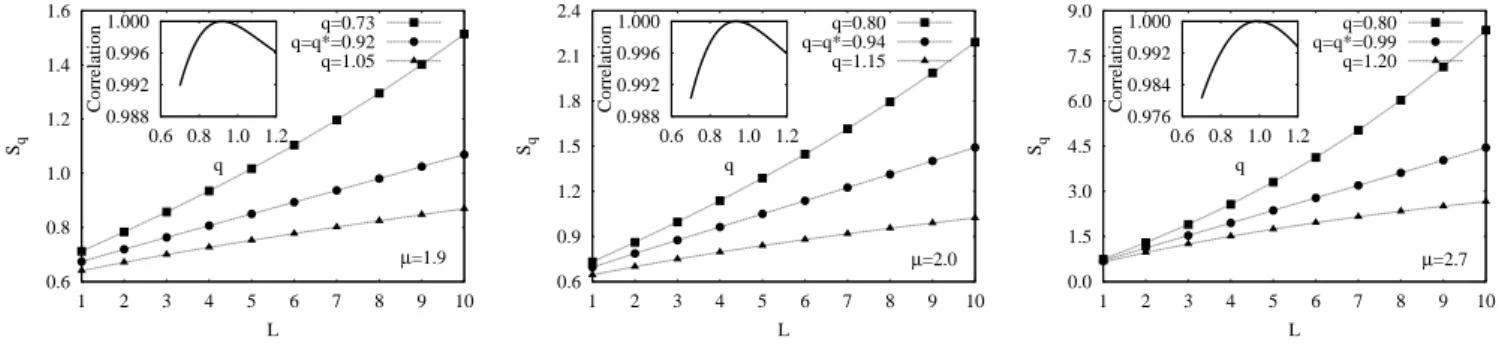
FIG. 1: Sq versusLfor some values ofµ(indicated in the figure) for a two-symbol sequence. We useA=2 andN=108in all the three figures.
2. ENTROPY AND SEQUENCE
The Tsallis entropy is defined, for a system withW mi-crostates and occupation probabilitiespi, as follows:
Sq=
1−∑Wi=1p
q i
q−1 , (3)
whereqis a real parameter. In the limitq→1 we have the standard Boltzmann-Gibbs entropy.Sqis extensive for a
com-posite system consisting of independent subsystems forq=1 and nonextensive forq6=1; for this reason,Sqis sometimes
referred to as nonextensive entropy. However, when we have long-range interactions or long-range correlations, the sub-systems cannot be independent. In this case we will see that Sqcan be extensive for a particular value ofq6=1.
0.80 0.85 0.90 0.95 1.00
1.6 1.8 2.0 2.2 2.4 2.6 2.8 3.0
q*
µ
two symbols three symbols four symbols
FIG. 2: The entropic indexq∗versus µfor two, three and four-symbol sequences, withA=2 andN=108.
In order to evaluate the Tsallis entropy, for the symbolic sequence generated with the previous procedure, we fix win-dows of lengthLwhich are moved along the sequence. Then, we count how many times a given configuration (string) oc-curs, determining the probability pi of a specific
configura-tioni. To illustrate this procedure, suppose that we have the following sequence:
Q={0,0,1,0,0,1,1,1,0,0,0,1,0,0,0,0,1,0,1,1},
104 105 106 107 108 109 1010
100 101 102 103
σ
2
N µ=2.2
FIG. 3: The standard-deviation versusNforµ=2.2 andA=0.1.
then we fix a window of length 2 and move it along the se-quence, i.e., we have
Q=
0,0, |{z}
1 1,0, |{z}
2 0,1, |{z}
3 1,1, |{z}
4 0,0, |{z}
5 0,1, |{z}
6 0,0, |{z}
7 0,0, |{z}
8 1,0, |{z}
9 1,1, |{z} 10 ,
where the index below the keys indicates time steps of the window’s motion. The next step is to count how many times a given configuration occurs, for example, the configuration {0,0}occurred 4 times (in the instants of “time” 1, 5, 7 and 8), leading to the probability 4/10. Similarly, we calculate the probability of other configurations and for other window lengths as well.
Figure (1) showsSqas a function ofLfor some values of
µ. Note that for each value of µ there is only one value of q=q∗that makes the relationSqversusLlinear. This feature
becomes evident when we look at the linear correlations (see the insets in Fig. (1)). We can observe from the above results that whenµdecreasesq∗also decreases.
446 H. V. Ribeiro et al.
terms of the symbolic sequence becomes noncorrelated lead-ing to the usual description based on the Boltzmann-Gibbs entropy. However, when µ decreases, Ny is generally very
large (remember that, whenµ<2, all the moments of p(y)
diverge) and introduces correlation among the terms of the symbolic sequence which are not properly described by the usual formalism. The decreasing values of q∗ reflects this nonusual behavior. We emphasize that in this case the Tsal-lis entropy is extensive and Boltzmann-Gibbs entropy is not, indicating the applicability and robustness of the generalized entropy.
3. DIFFUSION AND SEQUENCE
In order to explore further aspects of a symbolic sequence, let us consider it as an erratic trajectory and establish a
cor-1.00 1.20 1.40 1.60 1.80
2.2 2.4 2.6 2.8 3.0
α
µ
(a)
0.98 0.99 1.00
2.2 2.4 2.6 2.8 3.0
q*
µ
(b)
0.98 0.99 1.00
1.0 1.2 1.4 1.6 1.8
q*
α
(c)
FIG. 4: (a) Theα slope of the curve in Fig (3) versus µ(b) the entropic indexq∗versusµand (c)q∗versusα. In the three figures we useA=0.1.
respondence with a diffusive process. For the case of two-symbol sequences, we associate the two-symbol “0” with a jump of unit length to the right and the symbol “1” with a jump of unit length to the left. That is, a random walk-like process.
Using the previous prescription, we calculate the standard-deviation fori=1 toNover 105events as we can see in Fig. (3). We know that the slopeαof this curve is one for a usual diffusion, but in the case of Fig.(3)αis greater than one. We also observed thatαdepends onµ. This behavior is shown in Fig.(4a). Note that for small values ofµ(µ<3) the dif-fusion is anomalous, i.e., we have a superdifdif-fusion, and for large values (µ≥3) the diffusion regimes tend to a usual dif-fusion. This behavior can be explained if we remember that for small values ofµ,Nycan be very large and consequently
the walker can make large steps without changing the direc-tion. Whenµ is large, this event becomes very rare because Nyis in general small, making the walker change directions,
producing a usual erratic trajectory. We may also connectα withq∗through the values ofµ. In order to do this we evalu-ate the relationq∗versusµas shown in Fig. (4b) and exhibit q∗versusαin Fig. (4c).
4. DISCUSSION AND CONCLUSION
We verified that by varying the value ofµwe can produce long-range correlations in symbolic sequences. This is evi-denced by the nonlinear growing of the Boltzmann-Gibbs en-tropy. This feature led us to use the Tsallis entropy with suit-able values ofqto obtain a satisfactory description of these sequences. Specifically, we observed that the Tsallis entropy preserves the extensivity even when the terms of the symbolic sequence are correlated. We also considered the symbolic se-quence as a random walk-like process and evaluated the stan-dard deviation. The result showed that the diffusive process presents a superdiffusive regime which emerges for small val-ues ofµ(µ<3). The usual diffusion is recovered whenµ≥3.
Acknowledgements
Brazilian Journal of Physics, vol. 39, no. 2A, August, 2009 447
[1] P. Gaspard and X. J. Wang, Proc. Nat. Acad. Sci. USA85, 4591 (1988).
[2] R. S. Mendes, L. R. Envagelista, S. M. Thomaz, A. A. Agostinho, and L. C. Gomes, Ecography31, 450 (2008). [3] A. Drago, A. Lavagno, and P. Quarati, Physica A344, 472
(2004).
[4] S. M. D. Queir´os, L. G. Moyano, J. de Souza, and C. Tsallis, Eur. Phys. J. B55, 161 (2007).
[5] E. P. Borges, Eur. Phys. J. B30, 593 (2002). [6] M. A. Montemurro, Physica A300, 567 (2001).
[7] K. Krishnamachari and A. Krishnamachari, Neural Informa-tion Processing3316, 1354 (2004).
[8] C. K. Peng, S. V. Buldyrev, A. L Goldberger, S. Havlin, F. Sciortino, M. Simons, and H. E. Stanley, Nature 356, 168 (1992).
[9] H. Herzel and I. Grosse, Physica A216, 518 (1995).
[10] W. T. Li, T. G. Marr, and K. Kaneko, Physica D75, 392 (1994). [11] P. Allegrini, P. Grigolini, and B. J. West, Phys. Lett. A211, 217
(1996).
[12] W. Ebeling, R. Feistel, and H. Herzel, Phys. Scripta35, 761 (1987).
[13] W. Li and K. Kaneko, Europhys. Lett.17, 655 (1992). [14] H. Herzel, W. Ebeling, and A. O. Schmitt, Phys. Rev. E50,
5061 (1994).
[15] A. O. Schmitt and H. Herzel, J. Theor. Biol.188, 369 (1997). [16] P. Li`o, A. Politi, M. Buiatti, and S. Ruffo, J. Theor. Biol.180,
151 (1996).
[17] C. Tsallis, J. Stat. Phys.52, 479 (1988).
[18] A. Pluchino, A. Rapisarda, and C. Tsallis, Europhys. Lett.80, 26002 (2007).
[19] E. P. Borges and C. Tsallis, Physica A305, 148 (2002). [20] J. L. Du, Astrophysics and space science305, 247 (2006). [21] P. C. Assis, L. R. da Silva, E. K. Lenzi, L. C. Malacarne, and
R. S. Mendes, J. Math. Phys.46, 123303 (2005).