The Augmenting Effects of Desolvation and
Conformational Energy Terms on the
Predictions of Docking Programs against
mPGES-1
Ashish Gupta1, Neha Chaudhary1, Kumar Reddy Kakularam2, Reddanna Pallu2, Aparoy Polamarasetty1*
1Centre for Computational Biology and Bioinformatics, School of Life Sciences, Central University of Himachal Pradesh, Dharamshala, Himachal Pradesh–176215, India,2Department of Animal Biology, School of Life Sciences, University of Hyderabad, Hyderabad, Telangana–500046, India
Abstract
In this study we introduce a rescoring method to improve the accuracy of docking programs against mPGES-1. The rescoring method developed is a result of extensive computational study in which different scoring functions and molecular descriptors were combined to develop consensus and rescoring methods. 127 mPGES-1 inhibitors were collected from lit-erature and were segregated into training and external test sets. Docking of the 27 training set compounds was carried out using default settings in AutoDock Vina, AutoDock, DOCK6 and GOLD programs. The programs showed low to moderate correlation with the experi-mental activities. In order to introduce the contributions of desolvation penalty and confor-mation energy of the inhibitors various molecular descriptors were calculated. Later, rescoring method was developed as empirical sum of normalised values of docking scores, LogP and Nrotb. The results clearly indicated that LogP and Nrotb recuperate the predic-tions of these docking programs. Further the efficiency of the rescoring method was vali-dated using 100 test set compounds. The accurate prediction of binding affinities for analogues of the same compounds is a major challenge for many of the existing docking programs; in the present study the high correlation obtained for experimental and predicted pIC50values for the test set compounds validates the efficiency of the scoring method.
Introduction
Microsomal prostaglandin E synthase-1 (mPGES-1) belongs to the membrane-associated pro-teins involved in eicosanoid and glutathione metabolism (MAPEG) super family [1]. It is the terminal enzyme in the metabolism of arachidonic acid (AA) via the cyclooxygenase (COX) pathway (particularly COX-2), responsible for the conversion of prostaglandin H2(PGH2) to a more stable product prostaglandin E2(PGE2). As PGE2is a key mediator of pain and
OPEN ACCESS
Citation:Gupta A, Chaudhary N, Kakularam KR, Pallu R, Polamarasetty A (2015) The Augmenting Effects of Desolvation and Conformational Energy Terms on the Predictions of Docking Programs against mPGES-1. PLoS ONE 10(8): e0134472. doi:10.1371/journal.pone.0134472
Editor:Jie Zheng, University of Akron, UNITED STATES
Received:March 14, 2015
Accepted:July 10, 2015
Published:August 25, 2015
Copyright:© 2015 Gupta et al. This is an open access article distributed under the terms of the
Creative Commons Attribution License, which permits unrestricted use, distribution, and reproduction in any medium, provided the original author and source are credited.
Data Availability Statement:All data are available from Harvard's Dataverse database:http://dx.doi.org/ 10.7910/DVN/IYA8Y6.
Funding:The authors have no support or funding to report.
inflammation [2], the enhanced mPGES-1 expression is associated with many pathological conditions in humans; including myositis [3], rheumatoid arthritis [4], osteoarthritis [5], inflammatory bowel disease [6], cancer [7,8], atherosclerosis [9], and Alzheimer’s disease [10]. So, efforts are being made by several pharma companies for the development of anti-inflamma-tory drugs, targeting mPGES-1.
Recently Zhanet al., generated the 3D structure of human mPGES-1 by employing homol-ogy modelling approaches (11). Further, they applied molecular docking and molecular dynam-ics simulations to get detailed insights into the substrate binding domain (SBD) of mPGES-1 protein. Koeberle and collaborators [11] have recently identified pirinxic acid derivatives as potent mPGES-1 inhibitors, with IC50of 1.3μM. Hamzaet al. [12] have also developed a series of novel mPGES-1 inhibitors by employing a combination of large-scale structure-based virtual screening, flexible docking, molecular dynamics simulations and binding free energy calcula-tions. They identified (Z)-5-benzylidene-2-iminothiazolidin-4-one as a novel scaffold for fur-ther rational design and discovery of new mPGES-1 inhibitors. In one of the recent reports, Arhancetet al. [13] described the discovery of PF-4693627 as a potent mPGES-1 inhibitor, by employing SAR and lead optimisation studies, for the potential treatment of inflammation. This compound had improved pharmacokinetic profile with potent inhibition of mPGES, bothin vitroandin vivo. The application of computational studies in drug discovery projects is very challenging. Simple docking algorithms are not accurate enough forin silicoactivity predictions, whereas computationally expensive/efficient simulation methods require great expertise and computational facilities. Hence there is a need to develop accurate and computationally inex-pensive methods for prediction of activity against mPGES-1. Molecular docking is a key tool in structural molecular biology and computer-assisted drug design. During the last three decades molecular docking has emerged as a key tool in structure-based drug discovery. Molecular dock-ing helps us to understand and predict molecular recognition, both structurally (predictdock-ing binding modes), and energetically (predicting binding affinity) between entities of interest. Docking has two main constituents, a scoring function and a search method. Scoring functions segregate the various conformations generated on the basis of the most effective binding interac-tions between the ligand and the protein [14]. It is a known fact that docking forms a good tool for predicting the different poses or conformations in which the ligand binds to the protein. The accurate prediction of the relative binding affinities (RBAs), however, still remains a challenging task [14–16]. This is due to the fact that a single scoring function cannot hold well under all cir-cumstances. In order to get insights into this problem Warrenet al. [15] performed thorough studies with a large and diverse set of receptors and ligands by using different methodologies. When the results were analysed they found very weak correlation between the measured and calculated binding affinities. The scoring functions of most of these docking programs are too general i.e. they are not target specific. Drug discovery researchers started developing tuned/ consensus scoring functions which can increase the accuracy ofin silicopredictions [17–23]. Various studies have shown that the application of scoring functions together with other scoring functions or molecular descriptors can improve the performance significantly. In the present study we developed a scoring methodology specific to mPGES-1 which may be useful for more accurate prediction of binding affinities and thus facilitating the medicinal chemistry projects to identify and discover more potent inhibitors for mPGES-1.
Material and Methods
Preparation of Ligands
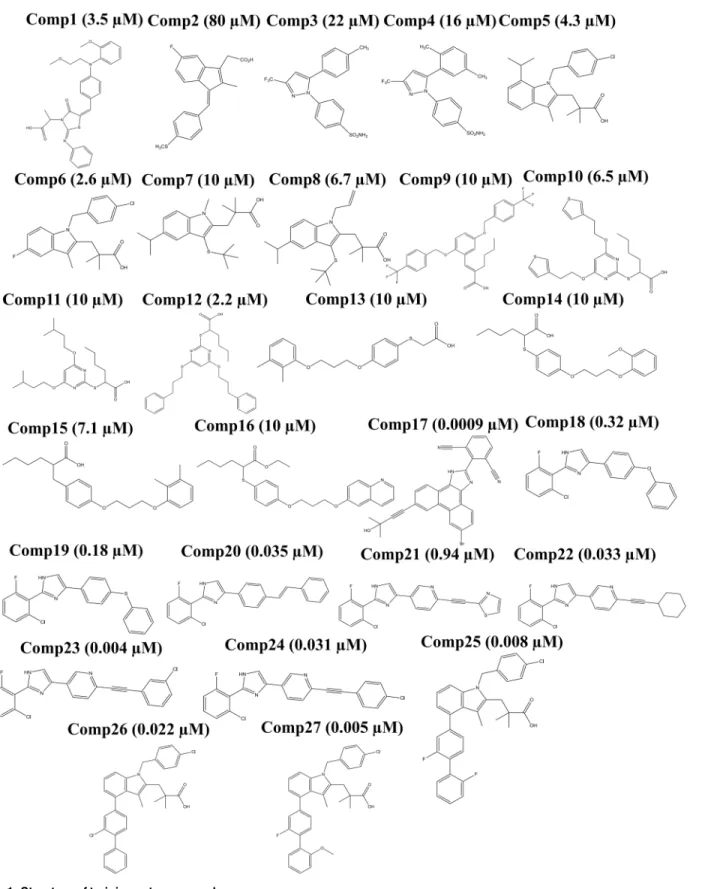
initially using HF method in R.E.D server [25–29] and further optimized using DFT based method i.e. B3LYP/6-31G(d) [30,31] in Gaussian09 [29] to get the lowest energy conforma-tions. The lowest energy conformations from Gaussian were further used for docking. The dataset was further segregated into training set (27 compounds) (Fig 1) and external test set (100 compounds) (Fig A,B,C inS1 File).
Docking
The prepared ligand structures were then docked into the mPGES-1 binding site using default procedure implemented in AutoDock Vina [32], AutoDock [33], DOCK6 [34] and GOLD [35] programs. The binding site of mPGES-1 was defined as was described earlier by Prageet al. [36], and Jakobssonet al. [37]. All the input and output files for the docking programs used can be found in the supplementary material.
Auto Dock Vina
Auto Dock Vina is based on Lamarckian genetic algorithm and empirical binding free energy force field, assuring its enhanced performance and accuracy. After the preparation of ligands and target protein and selecting the binding site residues in mPGES-1 the grid was placed in the centroid of the selected residues. Then docking was performed using the default settings of Auto Dock Vina. AutoDock Vina generates a maximum of 20 conformations for a single ligand and the same were used in the present study. The scoring function of Vina, has advantages of both knowledge-based potentials and empirical scoring functions. It extracts information both from the conformational preferences of the receptor-ligand complexes and the experimental affinity measurements [32].
AutoDock
AutoDock is an automated procedure for calculating the interaction of ligands with biomacro-molecular drug targets. In the present study AutoDock 4.0 was used. AutoDock employs Lamarckian genetic algorithm and empirical free energy scoring function to generate the bind-ing modes of ligand within the protein active site [33]. The target protein and ligands were pre-pared for docking calculation. The coordinates of the active site of the protein was used for generation of grid file. Docking was performed and 200 conformations were generated for every ligand.
Dock
Dock predicts the correct binding mode of small molecule in the binding site of protein, and the corresponding binding energy using anchor and grow algorithm. In the present study DOCK6 was used. For docking the box was generated using the GSH binding site coordinates of mPGES-1; grid was computed using grid parameter file and flexible ligand docking was per-formed using default parameters and for each ligand 200 conformations were generated. Grid score of DOCK6 was used in the present study. The scoring in DOCK is based on the non-bonded terms of molecular mechanic force field [38].
GOLD
Fig 1. Structure of training set compounds.
conformations of a ligand were within 1.5 Å RMSD. Higher Goldscore implies better result. The Goldscore, Chemscore [39] and Astex Statistical Potential (ASP) score [40] are the scoring methods available in GOLD.
Consensus Scoring
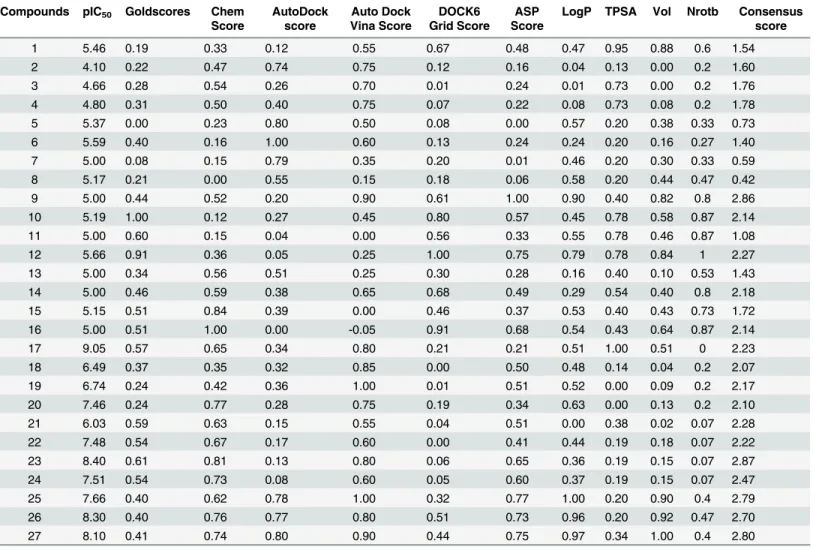
Consensus scoring is a method in which the binding affinities of ligands for a drug target are predicted by using more than one scoring method [41]. In this study, a consensus scoring approach was applied as an average of scores of AutoDock Vina and GOLD (Chem score, Asp score and GOLD fitness score). As the scoring functions of AutoDock Vina and GOLD pro-grams are in different range, prior to mean calculation and other statistical operations on the docking scores, data normalization was performed to bring all the scores in a notionally com-mon scale from 0 to 1 (Table 1). Data normalization was performed using the formula:(For positive scores)
Normalized score¼ ðx minÞ ðmax minÞ
Table 1. Normalized scores of various docking programs and molecular descriptors.
Compounds pIC50 Goldscores Chem
Score
AutoDock score
Auto Dock Vina Score
DOCK6 Grid Score
ASP Score
LogP TPSA Vol Nrotb Consensus
score
1 5.46 0.19 0.33 0.12 0.55 0.67 0.48 0.47 0.95 0.88 0.6 1.54
2 4.10 0.22 0.47 0.74 0.75 0.12 0.16 0.04 0.13 0.00 0.2 1.60
3 4.66 0.28 0.54 0.26 0.70 0.01 0.24 0.01 0.73 0.00 0.2 1.76
4 4.80 0.31 0.50 0.40 0.75 0.07 0.22 0.08 0.73 0.08 0.2 1.78
5 5.37 0.00 0.23 0.80 0.50 0.08 0.00 0.57 0.20 0.38 0.33 0.73
6 5.59 0.40 0.16 1.00 0.60 0.13 0.24 0.24 0.20 0.16 0.27 1.40
7 5.00 0.08 0.15 0.79 0.35 0.20 0.01 0.46 0.20 0.30 0.33 0.59
8 5.17 0.21 0.00 0.55 0.15 0.18 0.06 0.58 0.20 0.44 0.47 0.42
9 5.00 0.44 0.52 0.20 0.90 0.61 1.00 0.90 0.40 0.82 0.8 2.86
10 5.19 1.00 0.12 0.27 0.45 0.80 0.57 0.45 0.78 0.58 0.87 2.14
11 5.00 0.60 0.15 0.04 0.00 0.56 0.33 0.55 0.78 0.46 0.87 1.08
12 5.66 0.91 0.36 0.05 0.25 1.00 0.75 0.79 0.78 0.84 1 2.27
13 5.00 0.34 0.56 0.51 0.25 0.30 0.28 0.16 0.40 0.10 0.53 1.43
14 5.00 0.46 0.59 0.38 0.65 0.68 0.49 0.29 0.54 0.40 0.8 2.18
15 5.15 0.51 0.84 0.39 0.00 0.46 0.37 0.53 0.40 0.43 0.73 1.72
16 5.00 0.51 1.00 0.00 -0.05 0.91 0.68 0.54 0.43 0.64 0.87 2.14
17 9.05 0.57 0.65 0.34 0.80 0.21 0.21 0.51 1.00 0.51 0 2.23
18 6.49 0.37 0.35 0.32 0.85 0.00 0.50 0.48 0.14 0.04 0.2 2.07
19 6.74 0.24 0.42 0.36 1.00 0.01 0.51 0.52 0.00 0.09 0.2 2.17
20 7.46 0.24 0.77 0.28 0.75 0.19 0.34 0.63 0.00 0.13 0.2 2.10
21 6.03 0.59 0.63 0.15 0.55 0.04 0.51 0.00 0.38 0.02 0.07 2.28
22 7.48 0.54 0.67 0.17 0.60 0.00 0.41 0.44 0.19 0.18 0.07 2.22
23 8.40 0.61 0.81 0.13 0.80 0.06 0.65 0.36 0.19 0.15 0.07 2.87
24 7.51 0.54 0.73 0.08 0.60 0.05 0.60 0.37 0.19 0.15 0.07 2.47
25 7.66 0.40 0.62 0.78 1.00 0.32 0.77 1.00 0.20 0.90 0.4 2.79
26 8.30 0.40 0.76 0.77 0.80 0.51 0.73 0.96 0.20 0.92 0.47 2.70
27 8.10 0.41 0.74 0.80 0.90 0.44 0.75 0.97 0.34 1.00 0.4 2.80
After data normalization and calculation of consensus score, correlation coefficient between the activity (pIC50) and the consensus score was calculated. It
was compared with correlation coefficient of all docking programs.
(For negative scores)
Normalized score¼1 ðx minÞ
ðmax minÞ
Where x = corresponding score, max = maximum score and min = minimum score of the dataset
Receptor Specific Tuning/Rescoring Method
For the design of inhibitors, the detailed knowledge of thermodynamics of ligand binding is very important. Upon binding of a ligand to its drug target, the change in Gibbs free energy, known as free energy of binding (ΔGbind), determines the ligand’s binding affinity [42].
AsΔGbindis dependent on the change in enthalpy and entropy, optimizing these factors can improve affinity of ligand [43]. The protein—ligand interactions contribute for the enthalpic component while entropy is primarily attributed to the hydrophobic effect and desolvation penalty, which can be explained in terms of molecular descriptors LogP, topological polar sur-face area (TPSA) and volume of the inhibitor (Vol) [44,45]. It is important to note that pro-tein-ligand binding always takes place in aqueous environment. During the binding of ligand to the protein a series of events will take place, i.e. desolvation of ligand and protein, conforma-tional changes, and formation of intermolecular interactions [46,47].
Hence, in the present study, some molecular descriptors were also incorporated with the docking scores for the accurate prediction of binding affinities of ligands towards mPGES-1. The molecular descriptors considered in the studies were LogP, TPSA, Vol and number of rotatable bonds (Nrotb). The reason for including these molecular descriptors in the study was to introduce the concept of desolvation energy penalty and conformational free energy changes occurring when a ligand binds to a protein. For the prediction of LogP, TPSA, Vol and Nrotb, a web based server named Molinspiration was used.
The total free energy of binding can be expressed as:
DGbind¼DGcomplex ðDGproteinþDGligandÞ ¼DGMMþDGsol TDS
Where,ΔGMM= molecular mechanics free energy;
ΔGsol= solvation free energy TΔS = entropy contribution
The conformational energy penalty is critical for accurate estimation of free energy of bind-ing (ΔGbind) of inhibitors [48]. Siebelet al. [49,50] and Liljeforset al.[51] found that with every 1.4 kcal/mol increase in conformational energy of the bioactive conformation, there is decrease in binding affinity by a factor of 10. The conformational energy that is required for the ligand to adopt its bioactive conformation is crucial in understanding structure-activity studies [51, 52] and is critical in computer-aided ligand design [49]. In the present study, number of rotat-able bonds (Nrotb) in the ligands was considered as descriptor ofΔGconf. The normalised val-ues of LogP and Nrotb were calculated and added empirically to the normalised scores of docking programs to assess the effects of these molecular descriptor terms on their predictions.
Validation
was tested for its ability to predict compounds as active and inactive using the training set. The training set contained 8 active, 9 inactive and 10 moderately active compounds. Efficiency of the rescores was measured in terms of the number of active compounds in the top 8 and the number of inactive compounds in the bottom 9.
Results and Discussion
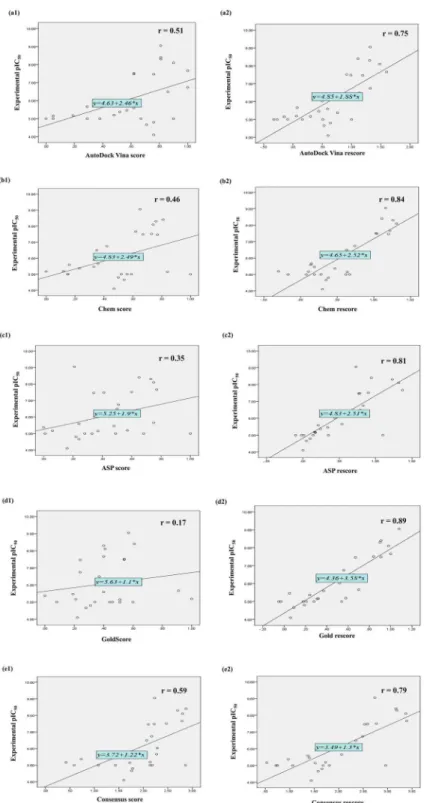
The scores from various docking programs and molecular descriptors were considered as the focus is on the development of a reliable consensus/rescoring method forin silicomPGES-1 activity prediction. The data from various programs was normalized to a common range of 0 to 1. The correlation coefficient (r) of scores of each individual program and mPGES-1 inhibi-tion activity were calculated. Out of the four programs used, AutoDock Vina score exhibited most significant correlation (r = 0.51) with the activity (pIC50) of the training set compounds, followed by Chem score (r = 0.46) and ASP score (r = 0.36) (both obtained from GOLD pro-gram), while the GOLD fitness score showed a correlation of 0.17. The average of the above mentioned scores was considered as the consensus score. Consensus score showed positive cor-relation (r = 0.59) with the activity of the training set compounds, better than the entire indi-vidual scores (Fig 2).
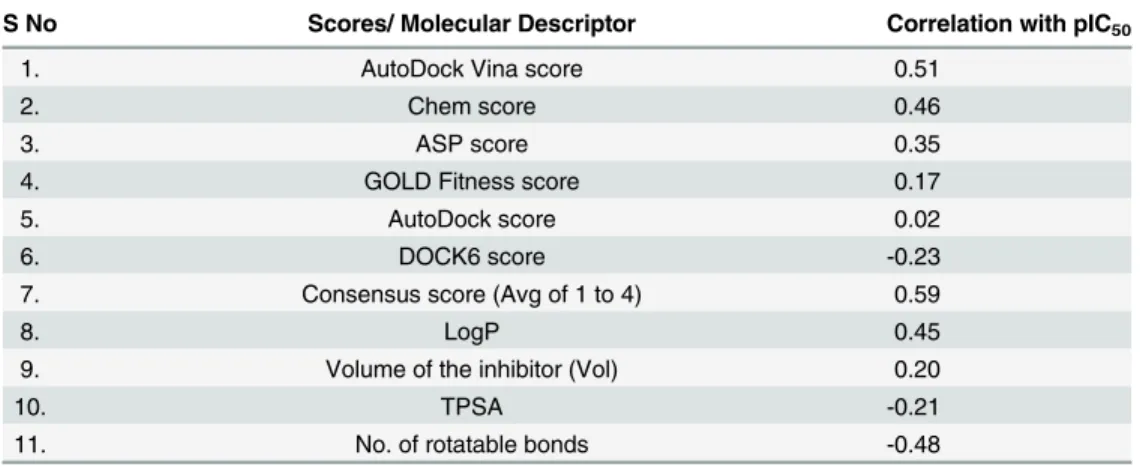
The correlation of LogP TPSA, Vol and Nrotb with the activity were analysed (Table 2), and it was found that out of the descriptors considered forΔGsolv, LogP showed highest positive correlation with the activity of the compounds and rotatable bonds showed negative correla-tion. The negative correlation of Nrotb was in agreement to previous reports which suggest flexibility of ligand contributes in the form of conformational free energy. So in the present study, LogP and Nrotb were considered as molecular descriptors ofΔGsolvandΔGconf respectively.
The major component in free energy of the ligand is the interaction energy between protein and ligand,ΔGinter. The docking scores were considered as a measure ofΔGinter. For the rescor-ing method the effective bindrescor-ing free energy of each ligand was considered as an empirical summation of normalised docking scores, LogP and Nrotb.
The rescoring function was calculated as:
Rescore¼Docking scoreþLogP Nrotb
The correlation of the rescores with activity of the compounds was calculated (Table 3) and the results showed significant improvement in the predictions of various docking programs. The correlation of AutoDock Vina scores increased drastically from 0.51 to 0.75, with the inclusion of molecular descriptors LogP and Nrotb. Most significant improvement was seen in the case of Goldscore which increased to 0.89 from 0.17 with the molecular descriptor terms. The consensus score also improved from 0.59 to 0.79. Overall the scores showed that there was additive effect which caused improvement in the correlation of all the scores considered. These results further confirmed the effectiveness of LogP and Nrotb as molecular descriptors of ΔGsolvandΔGconfrespectively.
Fig 2. Scatter plots showing coefficient of correlation (r) and best line of fit for training set
compounds (a1 and a2 = AutoDock Vina score and AutoDock Vina rescore; b1 and b2 = Chem score and Chem rescore; c1 and c2 = ASP score and ASP rescore; d1 and d2 = Goldscore and Gold rescore; and e1 and e2 = Consensus score and Consensus rescore respectively).
Docking scores and rescores of the training set compounds were analysed to identify the com-pounds occupying the top 8 and bottom 9 places. In the normalised AutoDock Vina score, it was observed that the active compounds were having scores>0.8 whereas the inactive compounds
were showing scores<0.5. On this basis the cut-off values were designated to the active
(scores>0.8) and inactive compounds (scores<0.5) for AutoDock Vina scores and further
anal-ysis was performed on the basis of these cut-off values. Similarly, in the case of Chem score top 8 compounds were having scores>0.67, while the bottom 9 compounds showed Scores<0.36, in
case of ASP scores, active compounds exhibited scores>0.6, whereas inactive compounds had
scores<0.28; in case of Goldscores the top 8 compounds showed scores>0.54 and the bottom
nine (inactives) had scores<0.31, so the same cut-off value were assigned to characterize training
set compounds as active and inactive. Active compounds of the consensus score were the ones having score>1.86 and compounds having scores<1.35 were considered as inactive. For
Auto-Dock Vina rescore compounds having score>1.10 were called active and compounds having
scores<0.42 were called inactive, while in case of Chem rescore, compounds showing
scores>1.03 and scores<0.28 were considered as active and inactive respectively. The active
and inactive compounds, in case of ASP rescore exhibited scores>0.79 and score<0.17
respec-tively, and in case of GOLD rescore active compounds showed scores>0.7 and inactive
com-pounds had scores<0.24. In case of consensus rescore compounds having scores>2.23 were
considered as active and compounds having scores<1.15 were considered inactive (Table 4).
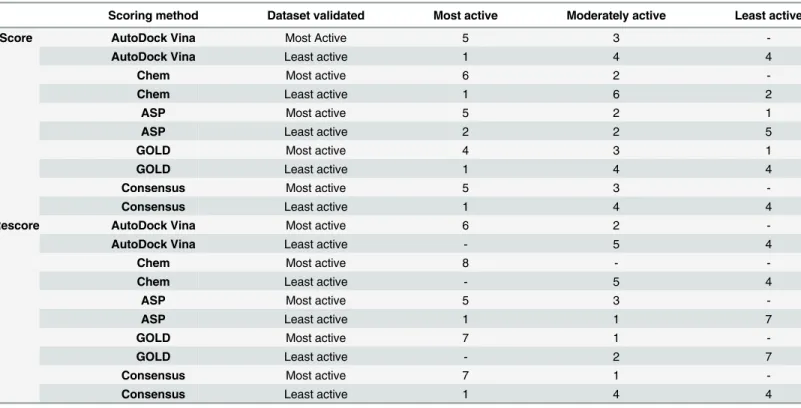
The results have shown that the efficiency of the docking programs clearly increases when molecular descriptor terms LogP and Nrotb are included to explainΔGsolvandΔGconf respec-tively. In the case of GOLD it was observed that only 4 compounds out of the active 8 are in top 8 but in the GOLD rescore the number increased to 7. In Goldscore, one of the active mole-cules was predicted to be least active, but in the case of GOLD rescore none of the active com-pounds were predicted as inactive, further substantiating the better efficiency of the rescores
(Table 4). Similar results were found in the case of AutoDock Vina, Chem scores and
consen-sus scoring. AutoDock score predicted 5 compounds out of 8 as active and 3 as moderately active, while in case of least active compounds, 4 were predicted as inactive, 4 as moderately active and 1 as active. The results were however found much improved in AutoDock rescore where 6 compounds were predicted as active and 2 as moderately active.
However the best results were found in case of Chem and Gold rescores. Chem rescore pre-dicted all the 8 active compounds as active and 4 out of 9 inactive compounds accurately. While the Gold rescore predicted 7 out of 8 compounds as active and 7 out of 9 compounds as inactive. The results indicate that the rescoring method may be effective in eradicating false Table 2. Correlation of normalized docking scores and molecular descriptors with pIC50.
S No Scores/ Molecular Descriptor Correlation with pIC50
1. AutoDock Vina score 0.51
2. Chem score 0.46
3. ASP score 0.35
4. GOLD Fitness score 0.17
5. AutoDock score 0.02
6. DOCK6 score -0.23
7. Consensus score (Avg of 1 to 4) 0.59
8. LogP 0.45
9. Volume of the inhibitor (Vol) 0.20
10. TPSA -0.21
11. No. of rotatable bonds -0.48
positives and false negatives and increasing the accuracy of results. The results indicate clearly that the rescore is predicting the binding affinities of mPGES-1 inhibitors more accurately and the effectiveness of LogP and Nrotb may be further validated on other drug targets and mem-brane proteins.
Further, the rescoring method was validated using external test set of 100 compounds. Regression analysis was performed against scores obtained for training set of compounds. Each of the scores of different docking programs, consensus scores and the molecular descriptors were further used for the prediction of activity of test set compounds.
The formula used for prediction of pIC50for the test set compounds after regression analysis was:
Predicted pIC50¼w1Docking scoreþw2LogPþw3Nrotbþc
Where w1, w2 and w3 = weights obtained after regression analysis on the training set compounds,
Docking score = docking scores of the test set compounds, LogP = LogP values of test set compounds,
Table 3. Pearson and Spearman correlation between scores and rescores of docking programs with experimental values (pIC50) and sigma
2-tailed tests for the training set.
pIC50 AutoDock Vina rescore Chem rescore ASP rescore GOLD rescore Consensus rescore
pIC50 Pearson Correlation 1 .75** .84** .81** .89** .79**
Spearman Correlation 1.00 .67** .69** .81** .88** .71**
**denotes that the correlation is significant at 99% confidence level
doi:10.1371/journal.pone.0134472.t003
Table 4. Efficiency of docking scores and rescores in prediction of training set compounds as active, moderately active and inactive.
Scoring method Dataset validated Most active Moderately active Least active
Score AutoDock Vina Most Active 5 3
-AutoDock Vina Least active 1 4 4
Chem Most active 6 2
-Chem Least active 1 6 2
ASP Most active 5 2 1
ASP Least active 2 2 5
GOLD Most active 4 3 1
GOLD Least active 1 4 4
Consensus Most active 5 3
-Consensus Least active 1 4 4
Rescore AutoDock Vina Most active 6 2
-AutoDock Vina Least active - 5 4
Chem Most active 8 -
-Chem Least active - 5 4
ASP Most active 5 3
-ASP Least active 1 1 7
GOLD Most active 7 1
-GOLD Least active - 2 7
Consensus Most active 7 1
-Consensus Least active 1 4 4
Nrotb = no. of rotatable bonds of test set compounds, c = intercept obtained from regression analysis.
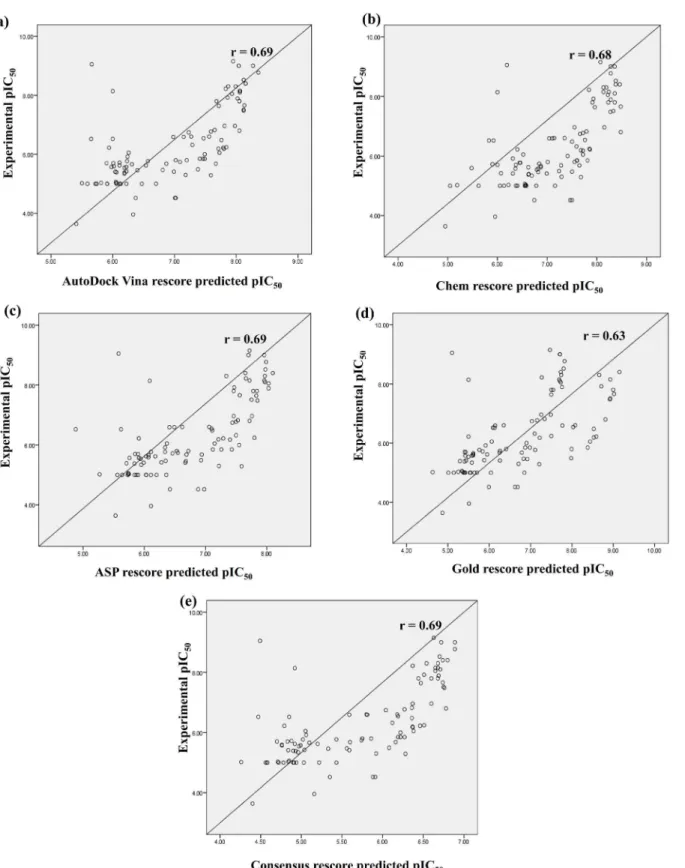
The correlation coefficient between the experimental and predicted pIC50values for the test set compounds was calculated (Table 5). AutoDock Vina showed the best results where the experimental and predicted pIC50of the test set exhibited the highest correlation (r = 0.70), fol-lowed by consensus rescore and ASP rescore (r = 0.69), then Chem rescore (r = 0.68) and Gold rescore (r = 0.63) (Fig 3).
When compared to other prominent drug targets from arachidonic acid metabolism, the number of mPGES-1 inhibitors reported is limited. The test set molecules applied for valida-tion of the scoring method contained analogues from various classes of inhibitors with varied activity. It is a well-known fact that the accurate prediction of binding affinities for analogues of the same compounds is a major challenge for many of the existing docking programs. In the present study the high correlation obtained for experimental and predicted pIC50values for the test set compounds validates the efficiency of the scoring method. The results clearly indicate robustness of the developed rescore as it holds well for the external test set compounds.
Current focus of researchers working in the area of molecular modelling and drug design is towards improving the docking scores for the accurate and rapid prediction of binding affinities of inhibitors towards drug targets. The concept of consensus scoring was introduced by Charif-sonet al. [53], wherein the efficiency of various docking programs was evaluated in combina-tions. They observed that consensus scoring reduced the number of false positives predicted by individual scoring functions, leading to enhancement in number of hits. Even in the present study it was observed that the correlation of docking programs show improvement in consensus as well as rescoring methods. In a number of studies researchers have included some molecular descriptors along with the docking scores to predict the binding affinities accurately. Liet al. [54] have developed a new scoring function called ID-Score to assess protein-ligand binding affinities. Their scoring function is based on a comprehensive set of molecular descriptors playing crucial role in protein-ligand interactions. The present study supports previous reports and also hint that molecular descriptors like LogP and Nrotb can be applied as terms forΔGsolandΔGconfand may increase the correlation of the docking programs against mPGES-1 inhibitor activity predic-tion. The results clearly show that the molecular terms considered have an additive effect in the predictions and contribute to the reduction in number of false positives and improvement in pre-diction of true negatives. The contributions of LogP and Nrotb in the enrichment of binding affinity predictions observed in the present study is in agreement with the reports of Wanget al., [55] and ID score of Menget al., [56]. The validation of the approach using an external test set further supports the potential of the scoring method in virtual screening experiments.
The prominent role of LogP in enhancement may be due to the fact that mPGES-1 is a membrane protein and hydrophobicity of ligands helps in efficient transportation to the bind-ing site embedded in the membrane. This hypothesis may be further validated by investigatbind-ing Table 5. Pearson and Spearman correlation and sigma 2 tailed tests between predicted pIC50and experimental pIC50of the test set.
Experimental pIC50
Predicted pIC50
(Gold rescore)
Predicted pIC50
(AutoDock Vina rescore)
Predicted pIC50(ASP
rescore)
Predicted pIC50
(Chem rescore)
Predicted pIC50
(Consensus rescore) Experimental pIC50 Pearson Correlation
1 .63** .70** .69** .68** .69**
Spearman Correlation
1.00 .69** .72** .71** .70** .72**
**denotes that the correlation is significant at 99% confidence level
Fig 3. Scatter plots showing coefficient of correlation (r) between the experimental pIC50and predicted pIC50by (a) AutoDock Vina rescore, (b)
Chem rescore, (c) ASP rescore, (d) Gold rescore and (e) Consensus rescore; for test set compounds.
the effects of LogP on thein silicopredictions of other membrane proteins. The study may be of significance as there is a need to develop/ improvein silicoprediction methods that can be applied for mPGES-1 inhibitor activity prediction. There are several reports where the researchers performed docking studies on mPGES-1 to understand its SAR with the inhibitors identified, but there are fewer reports of it being successfully applied for virtual screening pro-cedure for the identification of lead compounds, the main challenge being the limitations of the docking programs. Even though there are few reports of virtual screening methods against mPGES-1, the inhibitors identified showed moderate activity inμM range [57]. As accurate and efficient free energy calculations are time consuming and require high expertise, the rescoring method developed in the present study may be helpful for medicinal chemists in bringing down the time and costs involved in inhibitor development.
Conclusion
For the identification of inhibitors against drug targets, docking has become an established tech-nique in drug discovery. There are a number of docking programs available but none of them are suitable for all classes of drug targets. This led to the evolution of tuned scoring functions and other rescoring approaches for improvement in the prediction of binding affinities of small mole-cules towards the drug targets. In this paper, we developed a rescoring method by incorporating the molecular descriptors to explain desolvation penalty and conformational energy of ligands. The rescoring method showed significant improvement in the predictions of training set. The rescore was also effective in differentiating active and inactive mPGES-1 inhibitors in the training set in comparison with the individual docking scores. Further the effectiveness of molecular descriptors LogP and Nrotb was validated using external test set molecules. The results clearly indicate the applicability of LogP and Nrotb inin silicomPGES-1 activity prediction.
Supporting Information
S1 File. Supporting Information.Structure and IC50 of the test set compounds (Comp28--Comp69) (Fig A). Structure and IC50 of the test set compounds (Comp70-Comp111) (Fig B). Structure and IC50 of the test set compounds (Comp112-Comp127) (Fig C). Normalized scores of various docking programs and molecular descriptors for the test set compounds (Table A). Experimental and predicted pIC50 values of the rescores for the test set compounds (Table B). The supplementary material can be accessed using the following doi:http://dx.doi.org/10.7910/
DVN/IYA8Y6.
(DOC)
Acknowledgments
The authors would like to thank Central University of Himachal Pradesh; Centre for Model-ling, Simulation and Design (University of Hyderabad) and Bioinformatics Infrastructure Facility (School of Life Sciences, University of Hyderabad) and School of Mathematics and Sta-tistics (University of Hyderabad) for the facilities. We thank Dr. Indukuri Srividya for copyed-iting the manuscript.
Author Contributions
References
1. Jakobsson PJ, Thoren S, Morgenstern R, Samuelsson B. Identification of human prostaglandin E synthase: a microsomal, glutathione-dependent, inducible enzyme, constituting a potential novel drug target. Proc Natl Acad Sci U S A. 1999; 96(13):7220–5. Epub 1999/06/23. PMID:10377395; PubMed Central PMCID: PMCPmc22058.
2. Friesen RW, Mancini JA. Microsomal prostaglandin E2 synthase-1 (mPGES-1): a novel anti-inflamma-tory therapeutic target. Journal of medicinal chemistry. 2008; 51(14):4059–67. Epub 2008/05/08. doi: 10.1021/jm800197bPMID:18459759.
3. Kudo I, Murakami M. Prostaglandin E synthase, a terminal enzyme for prostaglandin E2 biosynthesis. Journal of biochemistry and molecular biology. 2005; 38(6):633–8. Epub 2005/12/13. PMID:16336776.
4. Kojima F, Matnani RG, Kawai S, Ushikubi F, Crofford LJ. Potential roles of microsomal prostaglandin E synthase-1 in rheumatoid arthritis. Inflammation and regeneration. 2011; 31(2):157–66. Epub 2012/02/ 07. PMID:22308189; PubMed Central PMCID: PMCPmc3269760.
5. Stichtenoth DO, Thoren S, Bian H, Peters-Golden M, Jakobsson PJ, Crofford LJ. Microsomal prosta-glandin E synthase is regulated by proinflammatory cytokines and glucocorticoids in primary rheuma-toid synovial cells. Journal of immunology (Baltimore, Md: 1950). 2001; 167(1):469–74. Epub 2001/06/ 22. PMID:11418684.
6. Subbaramaiah K, Yoshimatsu K, Scherl E, Das KM, Glazier KD, Golijanin D, et al. Microsomal prosta-glandin E synthase-1 is overexpressed in inflammatory bowel disease. Evidence for involvement of the transcription factor Egr-1. The Journal of biological chemistry. 2004; 279(13):12647–58. Epub 2004/01/ 15. doi:10.1074/jbc.M312972200PMID:14722058.
7. Murakami M, Naraba H, Tanioka T, Semmyo N, Nakatani Y, Kojima F, et al. Regulation of prostaglandin E2 biosynthesis by inducible membrane-associated prostaglandin E2 synthase that acts in concert with cyclooxygenase-2. The Journal of biological chemistry. 2000; 275(42):32783–92. Epub 2000/06/28. doi:10.1074/jbc.M003505200PMID:10869354.
8. Ruan D, So SP. Prostaglandin E2 produced by inducible COX-2 and mPGES-1 promoting cancer cell proliferation in vitro and in vivo. Life sciences. 2014; 116(1):43–50. Epub 2014/08/21. doi:10.1016/j.lfs. 2014.07.042PMID:25139833.
9. Cipollone F, Fazia M, Iezzi A, Pini B, Cuccurullo C, Zucchelli M, et al. Blockade of the angiotensin II type 1 receptor stabilizes atherosclerotic plaques in humans by inhibiting prostaglandin E2-dependent matrix metalloproteinase activity. Circulation. 2004; 109(12):1482–8. Epub 2004/03/24. doi:10.1161/ 01.cir.0000121735.52471.acPMID:15037537.
10. Akitake Y, Nakatani Y, Kamei D, Hosokawa M, Akatsu H, Uematsu S, et al. Microsomal prostaglandin E synthase-1 is induced in alzheimer's disease and its deletion mitigates alzheimer's disease-like pathology in a mouse model. Journal of neuroscience research. 2013; 91(7):909–19. Epub 2013/04/05. doi:10.1002/jnr.23217PMID:23553915.
11. Koeberle A, Zettl H, Greiner C, Wurglics M, Schubert-Zsilavecz M, Werz O. Pirinixic acid derivatives as novel dual inhibitors of microsomal prostaglandin E2 synthase-1 and 5-lipoxygenase. Journal of medic-inal chemistry. 2008; 51(24):8068–76. Epub 2008/12/05. doi:10.1021/jm801085sPMID:19053751.
12. Hamza A, Zhao X, Tong M, Tai HH, Zhan CG. Novel human mPGES-1 inhibitors identified through structure-based virtual screening. Bioorganic & medicinal chemistry. 2011; 19(20):6077–86. Epub 2011/09/17. doi:10.1016/j.bmc.2011.08.040PMID:21920764; PubMed Central PMCID: PMCPmc3183289.
13. Arhancet GB, Walker DP, Metz S, Fobian YM, Heasley SE, Carter JS, et al. Discovery and SAR of PF-4693627, a potent, selective and orally bioavailable mPGES-1 inhibitor for the potential treatment of inflammation. Bioorganic & medicinal chemistry letters. 2013; 23(4):1114–9. Epub 2012/12/25. doi:10. 1016/j.bmcl.2012.11.109PMID:23260349.
14. Rajamani R, Good AC. Ranking poses in structure-based lead discovery and optimization: current trends in scoring function development. Current opinion in drug discovery & development. 2007; 10 (3):308–15. Epub 2007/06/09. PMID:17554857.
15. Warren GL, Andrews CW, Capelli AM, Clarke B, LaLonde J, Lambert MH, et al. A critical assessment of docking programs and scoring functions. Journal of medicinal chemistry. 2006; 49(20):5912–31. Epub 2006/09/29. doi:10.1021/jm050362nPMID:17004707.
16. Mikulskis P, Genheden S, Ryde U. A large-scale test of free-energy simulation estimates of protein-ligand binding affinities. Journal of chemical information and modeling. 2014; 54(10):2794–806. Epub 2014/09/30. doi:10.1021/ci5004027PMID:25264937.
18. Du J, Bleylevens IW, Bitorina AV, Wichapong K, Nicolaes GA. Optimization of compound ranking for structure-based virtual ligand screening using an established FRED-Surflex consensus approach. Chemical biology & drug design. 2014; 83(1):37–51. Epub 2013/08/15. doi:10.1111/cbdd.12202 PMID:23941463.
19. Park H, Eom JW, Kim YH. Consensus scoring approach to identify the inhibitors of AMP-activated pro-tein kinase alpha2 with virtual screening. Journal of chemical information and modeling. 2014; 54 (7):2139–46. Epub 2014/06/11. doi:10.1021/ci500214ePMID:24915156.
20. O'Boyle NM, Liebeschuetz JW, Cole JC. Testing assumptions and hypotheses for rescoring success in protein-ligand docking. Journal of chemical information and modeling. 2009; 49(8):1871–8. Epub 2009/ 08/04. doi:10.1021/ci900164fPMID:19645429.
21. Zhang Z, Lange OF. Replica Exchange Improves Sampling in Low-Resolution Docking Stage of Roset-taDock. PLoS One. 2013; 8(8):e72096. doi:10.1371/journal.pone.0072096PMID:24009670
22. Coleman RG, Carchia M, Sterling T, Irwin JJ, Shoichet BK. Ligand Pose and Orientational Sampling in Molecular Docking. PLoS One. 2013; 8(10):e75992. doi:10.1371/journal.pone.0075992PMID: 24098414
23. Barelier S, Boyce SE, Fish I, Fischer M, Goodin DB, Shoichet BK. Roles for Ordered and Bulk Solvent in Ligand Recognition and Docking in Two Related Cavities. PLoS One. 2013; 8(7):e69153. doi:10. 1371/journal.pone.0069153PMID:23874896
24. Schomburg I, Chang A, Ebeling C, Gremse M, Heldt C, Huhn G, et al. BRENDA, the enzyme database: updates and major new developments. Nucleic acids research. 2004; 32(Database issue):D431–3. Epub 2003/12/19. doi:10.1093/nar/gkh081PMID:14681450; PubMed Central PMCID:
PMCPmc308815.
25. Wang F, Becker JP, Cieplak P, F-Y Dupradeau FY. R.E.D. Python: Object oriented programming for Amber force fields. Nov. 2013.
26. Vanquelef E, Simon S, Marquant G, Garcia E, Klimerak G, Delepine JC, et al. R.E.D. Server: a web ser-vice for deriving RESP and ESP charges and building force field libraries for new molecules and molec-ular fragments. Nucleic acids research. 2011; 39(Web Server issue):W511–7. Epub 2011/05/26. doi: 10.1093/nar/gkr288PMID:21609950; PubMed Central PMCID: PMCPmc3125739.
27. Dupradeau FY, Pigache A, Zaffran T, Savineau C, Lelong R, Grivel N, et al. The R.E.D. tools: advances in RESP and ESP charge derivation and force field library building. Physical chemistry chemical phys-ics: PCCP. 2010; 12(28):7821–39. Epub 2010/06/25. doi:10.1039/c0cp00111bPMID:20574571; PubMed Central PMCID: PMCPmc2918240.
28. Bayly CI, Cieplak P, Cornell WD, Kollman PA. A Well-Behaved Electrostatic Potential Based Method Using Charge Restraints for Deriving Atomic Charges—The Resp Model. Journal Of Physical Chemis-try. 1993; 97(40):10269–80. citeulike-article-id:919072.
29. Frisch MJ, Trucks GW, Schlegel HB, Scuseria GE, Robb MA, Cheeseman JR et. al. Gaussian 09, Revi-sion C.01, Gaussian, Inc., Wallingford CT,. 2010.
30. Becke AD. Density-functional exchange-energy approximation with correct asymptotic behavior. Physi-cal review A. 1988; 38(6):3098–100. Epub 1988/09/15. PMID:9900728.
31. Lee C, Yang W, Parr RG. Development of the Colle-Salvetti correlation-energy formula into a functional of the electron density. Physical review B, Condensed matter. 1988; 37(2):785–9. Epub 1988/01/15. PMID:9944570.
32. Trott O, Olson AJ. AutoDock Vina: improving the speed and accuracy of docking with a new scoring function, efficient optimization, and multithreading. Journal of computational chemistry. 2010; 31 (2):455–61. Epub 2009/06/06. doi:10.1002/jcc.21334PMID:19499576; PubMed Central PMCID: PMCPmc3041641.
33. Morris GM, Huey R, Lindstrom W, Sanner MF, Belew RK, Goodsell DS, et al. AutoDock4 and Auto-DockTools4: Automated Docking with Selective Receptor Flexibility. Journal of computational chemis-try. 2009; 30(16):2785–91. doi:10.1002/jcc.21256PMID:19399780; PubMed Central PMCID: PMCPmc2760638.
34. Lang PT, Brozell SR, Mukherjee S, Pettersen EF, Meng EC, Thomas V, et al. DOCK 6: combining tech-niques to model RNA-small molecule complexes. RNA (New York, NY). 2009; 15(6):1219–30. Epub 2009/04/17. doi:10.1261/rna.1563609PMID:19369428; PubMed Central PMCID: PMCPmc2685511.
35. Jones G, Willett P, Glen RC, Leach AR, Taylor R. Development and validation of a genetic algorithm for flexible docking. Journal of molecular biology. 1997; 267(3):727–48. Epub 1997/04/04. doi:10.1006/ jmbi.1996.0897PMID:9126849.
37. Pawelzik SC, Uda NR, Spahiu L, Jegerschold C, Stenberg P, Hebert H, et al. Identification of key resi-dues determining species differences in inhibitor binding of microsomal prostaglandin E synthase-1. The Journal of biological chemistry. 2010; 285(38):29254–61. Epub 2010/07/08. doi:10.1074/jbc. M110.114454PMID:20605783; PubMed Central PMCID: PMCPmc2937957.
38. Meng EC, Shoichet BK, Kuntz ID. Automated docking with grid-based energy evaluation. Journal of computational chemistry. 1992; 13(4):505–24. doi:10.1002/jcc.540130412
39. Eldridge MD, Murray CW, Auton TR, Paolini GV, Mee RP. Empirical scoring functions: I. The develop-ment of a fast empirical scoring function to estimate the binding affinity of ligands in receptor com-plexes. J Comput Aided Mol Des. 1997; 11(5):425–45. Epub 1997/12/31. PMID:9385547.
40. Mooij WT, Verdonk ML. General and targeted statistical potentials for protein-ligand interactions. Pro-teins. 2005; 61(2):272–87. Epub 2005/08/18. doi:10.1002/prot.20588PMID:16106379.
41. Houston DR, Walkinshaw MD. Consensus docking: improving the reliability of docking in a virtual screening context. Journal of chemical information and modeling. 2013; 53(2):384–90. Epub 2013/01/ 29. doi:10.1021/ci300399wPMID:23351099.
42. Polyansky AA, Zubac R, Zagrovic B. Estimation of conformational entropy in protein-ligand interactions: a computational perspective. Methods in molecular biology (Clifton, NJ). 2012; 819:327–53. Epub 2011/12/21. doi:10.1007/978-1-61779-465-0_21PMID:22183546.
43. Freire E. Do enthalpy and entropy distinguish first in class from best in class? Drug discovery today. 2008; 13(19–20):869–74. Epub 2008/08/16. doi:10.1016/j.drudis.2008.07.005PMID:18703160; PubMed Central PMCID: PMCPmc2581116.
44. Lipinski CA, Lombardo F, Dominy BW, Feeney PJ. Experimental and computational approaches to esti-mate solubility and permeability in drug discovery and development settings. Advanced drug delivery reviews. 2001; 46(1–3):3–26. Epub 2001/03/22. PMID:11259830.
45. Veber DF, Johnson SR, Cheng HY, Smith BR, Ward KW, Kopple KD. Molecular properties that influ-ence the oral bioavailability of drug candidates. Journal of medicinal chemistry. 2002; 45(12):2615–23. Epub 2002/05/31. PMID:12036371.
46. Chaires JB. Calorimetry and thermodynamics in drug design. Annual review of biophysics. 2008; 37:135–51. Epub 2008/06/25. doi:10.1146/annurev.biophys.36.040306.132812PMID:18573076.
47. Perozzo R, Folkers G, Scapozza L. Thermodynamics of protein-ligand interactions: history, presence, and future aspects. Journal of receptor and signal transduction research. 2004; 24(1–2):1–52. Epub 2004/09/04. PMID:15344878.
48. Bostrom J, Norrby PO, Liljefors T. Conformational energy penalties of protein-bound ligands. J Comput Aided Mol Des. 1998; 12(4):383–96. Epub 1998/10/20. PMID:9777496.
49. Siebel GLaK, P. A., In Hansch C, Sammes PG, Taylor B, Ramsden CA (Eds.) Comprehensive Medici-nal Chemistry. 1990,; Vol. 4: pp.125–38.
50. Liljefors TaP, I., In Krogsgaard-Larsen P., Liljefors T. and Madsen U. (Eds.) A Textbook of Drug Design and Development, 2nd ed. 1996:pp. 60–93.
51. Pettersson I, Liljefors T. Structure-activity relationships for apomorphine congeners. Conformational energies vs. biological activities. J Comput Aided Mol Des. 1987; 1(2):143–52. Epub 1987/07/01. PMID:3504213.
52. Bengtsson M, Liljefors T, Hansson BS. Dienic analogs of (Z)-5-decenyl acetate, a pheromone compo-nent of the turnip moth, Agrotis segetum: Synthesis, conformational analysis and structure-activity rela-tionships. Bioorganic Chemistry. 1987; 15(4):409–22.http://dx.doi.org/10.1016/0045-2068(87)90036-8.
53. Charifson PS, Corkery JJ, Murcko MA, Walters WP. Consensus scoring: A method for obtaining improved hit rates from docking databases of three-dimensional structures into proteins. Journal of medicinal chemistry. 1999; 42(25):5100–9. Epub 1999/12/22. PMID:10602695.
54. Li GB, Yang LL, Wang WJ, Li LL, Yang SY. ID-Score: a new empirical scoring function based on a com-prehensive set of descriptors related to protein-ligand interactions. Journal of chemical information and modeling. 2013; 53(3):592–600. Epub 2013/02/12. doi:10.1021/ci300493wPMID:23394072.
55. Wang R, Liu L, Lai L, Tang Y. SCORE: A New Empirical Method for Estimating the Binding Affinity of a Protein-Ligand Complex. J Mol Med. 1998; 4(12):379–94. doi:10.1007/s008940050096
56. Meng E, Kuntz I, Abraham D, Kellogg G. Evaluating docked complexes with the HINT exponential func-tion and empirical atomic hydrophobicities. J Computer-Aided Mol Des. 1994; 8(3):299–306. doi:10. 1007/BF00126747