JOURNAL OF NANO- AND ELECTRONIC PHYSICS Р А А - А Р
Vol. 6 No 2, 02006(2pp) (2014) Том 6 № 2, 02006(2cc) (2014)
2077-6772/2014/6(2)02006(2) 02006-1 2014 Sumy State University
Interaction of Glucose with ZnO Nanoparticles
P.K. Samanta1,*, A.K. Bhunia2, T. Kamilya3
1 Department of Physics, Ghatal R.S. Mahavidyalaya, Paschim Medinipur-721212, India
2 Department of Physics & Techno-Physics, Vidyasagar University, Paschim Medinipur-721306, India
3Department of Physics, Narajole Raj College, Paschim Medinipur-721211, India
(Received 16 March 2014; published online 20 June 2014)
We report the results of the extent of interaction as well as the formation of a bioconjugate of glucose with Zinc Oxide nano particles (ZnO NPs) to understand the non-invasive monitoring of glucose by semiconductor NPs. We performed an array of photophysical as well as microscopic measurements to quantify the interaction between ZnO NPs and glucose. We have found that time constant of interaction (t1) 18.47 min for the binding
glucose with surface of ZnO NPs and follows a single exponential association process.
Keywords: ZnO, Glucose, Interaction, Absorption, Exponential-association.
PACS numbers: 78.67.Bf, 78.67.Rb, 87.64. – t
1. INTRODUCTION
Diabetes describes a group of metabolic diseases in which the person has high blood glucose (blood sugar). The long term health disorders including cardiovascu-lar disease and blindness are the outcomes of diabetes. The monitoring of glucose concentration in our blood is one of the major challenges in detection of diabetes. In spite of intensive efforts, a few methodologies are available for the non-invasive monitoring of blood glu-cose [1-2]. The commercial exploration of nanotechnol-ogy has accelerated the evolution of nanomaterials with many exceptional size-dependent properties for use in several areas of applied biomedical research in developing novel and improved diagnostics and thera-peutics like fluorescent biological labeling to biosensors preparation.
The metallic nanostructures of gold, silver nanostructure has application in glucose testing and sensing platforms. In this communication, we report the preparation of zinc oxide (ZnO) nanoparticles (NPs) and its interaction with glucose as glucose sensing plat-forms. The physical basis of the interaction of ZnO NPs with glucose under conditions of environmental expo-sure in a better way is studied by major spectroscopic along with microscopic (HRTEM) techniques.
2. EXPERIMRNTAL
ZnO NPs were synthesized using a simple wet chem-ical method as reported elsewhere in [3] with minor modification. The reagents used for fabricating ZnO NPs were of analytical grade (MERCK, 99.99 % pure) and used as supplied. Under constant stirring 0.5 M Zinc Nitrate solution NaOH solution (1M) was added drop-wise for 5 min and the stirring was continued further for 15 min. A white precipitate was deposited at the bottom of the flask. The precipitate was then filtered and washed 2-3 times with Millipore water for removal of any residual salts and dried in a furnace.
Glucose anhydrous (99.5 %) was purchased from HIMEDIA Chemical Co. (Mumbai).The sample was used as received without any further purification. The
Glucose solution (CGLU 1 mg/mL) was prepared by using triple distilled water, deionized with a Milli-Q water purification system from Millipore, U.S.A. The pH and the resistivity of freshly prepared water were 6.8 and 18.2 Mcm, respectively. The ZnO NPs are dispersed in deionized water with concentration of Zno (CZnO) 1 mg/mL. Finally, the colloidal solution of ZnO
is mixed with glucose solution by 1 : 1 ratio. The as prepared samples are taken for optical absorption study by using Shimadzu-Pharmaspec-1700 UV-VIS. A small drop of this was dispersed sample was placed on a thin carbon film supported on the copper grid and kept for some time for drying and used for microstruc-tural study. The Transmission Electron Micrograph of the prepared ZnO NPs was acquired using JEOL-JEM-200 operating at JEOL-JEM-200 kV. The SEAD pattern of the said NPs was also carried out.
3. RESULTS AND DISCUSSIONS
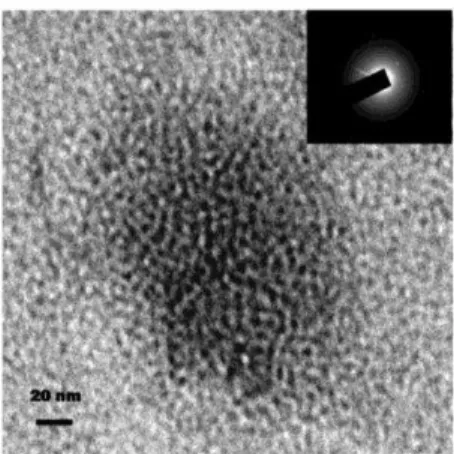
Typical TEM image of ZnO nanoparticle is shown in Fig. 1. ZnO nanoparticles of diameter ~ 10-20 nm were observed.
Fig. 1– TEM image of ZnO nanoparticles. Inset shows the SAED pattern
P.K. SAMANTA,A.K. BHUNIA,T. KAMILYA J.NANO-ELECTRON.PHYS. 6, 02006 (2014)
02006-2
200 400 600 800
0.2 0.4 0.6 0.8 1.0
Ab
s
o
r
p
t
ion
(
AU
)
Wavelength (nm)
ZnO+Glucose =0 min =7 min =14min =21min =28min =35min =42min
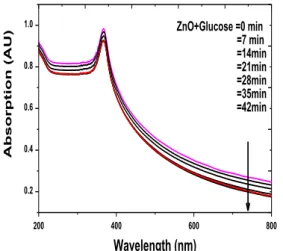
Fig. 2– Absorption spectra of ZnO nanoparticles in glucose under different time
0 10 20 30 40 50
0.00 0.01 0.02 0.03 0.04 0.05 0.06
A (AU
)
Time (Min)
Fig. 3– Change in absorption with time
Typical absorption spectra of ZnO NPs in presence of glucose are shown in Fig 2. ZnO NPs exhibit an ab-sorption peak at ~ 368 nm due to excitonic transition at room temperature 28 °C. No shift of the absorption peak of ZnO is observed in presence of glucose. The
intensity of the absorption of ZnO decreases in interac-tion with glucose.
The change in absorption intensity vs. time plot is fitted by non-linear least square fitting based on Le-venberg-Marquardt algorithm of Microcal Origin 7.5 with the following exponential association equation (1) (Fig. 2) [4].
1
1
[1 exp( )]
t o
t
I I A
t
(1)
Where, IO and It are the absorption intensities at
time zero and t respectively. The constants A1, is the
relative contribution and t1 is corresponding time
con-stant of mechanism involving in interaction between ZnO and Glucose. We have found that time constant of interaction (t1) 18.47 min for the binding glucose with
surface of ZnO NPs and follows a single exponential association process.
4. CONCLUSIONS
In conclusion, we have synthesized ZnO nanoparti-cles using a simple wet chemical method. The results of the extent of interaction of glucose with ZnO NPs have been studied to understand the non-invasive monitor-ing of glucose by semiconductor NPs. The photophysi-cal as well as microscopic measurements revealed the interaction the interaction between ZnO NPs and glu-cose. We have found that time constant of interaction (t1) 18.47 min for the binding glucose with surface of
ZnO NPs and follows a single exponential association process.
ACKNOWLEDGEMENT
The author (PKS) sincerely acknowledge UGC-DAE-CSR Kolkata center for financial support with Grant No. UGC-DAE-CSR-KC/CRS/13/RC12/0983 dat-ed 16.12.2013 for carryout this research work.
REFERENCES
1. G.S. Vorobjov, V.O. Zhurba, A.S. Krivets, J. Nano- Elec-tron. Phys.2 No4, 131 (2010).
2. D.K. Chatterjee, M.K. Gnanasammandhan, Y. Zhang,
Small 6, 2781 (2010).
3. R.A. Kudgus, R. Bhattacharya, P. Mukherjee Cancer
Nan-otechnology11, 965 (2011).
4. P.K. Samanta, S.K. Patra, P.R. Chaudhuri, Int. J. Mat. Sci.4, 803 (2009).