Sharma Rohit et al: Quantitative Estimation of Satva extracted from Guduchi
JPSI 1 (1), JAN – FEB 2012, 38-40
Journal of Pharmaceutical and Scientific Innovation
www.jpsionline.com
Research Article
QUANTITATIVE ESTIMATION OF SATVA EXTRACTED FROM DIFFERENT STEM SIZES
OF GUDUCHI
(
TINOSPORA CORDIFOLIA
(WILLD.) MIERS)
Sharma Rohit
1*, C.R Harisha
2, Galib
3, Patgiri BJ
4, Prajapati P.K
5 1*M.D Scholar, Dept. of R.S & B.K, I.P.G.T & R.A, Gujarat Ayurved University, Jamnagar, Gujarat, India
2
Head of Pharmacognosy Laboratory, I.P.G.T & R.A, Gujarat Ayurved University, Jamnagar, Gujarat, India
3
Lecturer, Dept. of R.S & B.K, I.P.G.T & R.A, Gujarat Ayurved University, Jamnagar, Gujarat, India
4
Reader, Dept. R.S & B.K, I.P.G.T & R.A, Gujarat Ayurved University, Jamnagar, Gujarat, India
5
Head of Dept. R.S & B.K, I.P.G.T & R.A, Gujarat Ayurved University, Jamnagar, Gujarat, India
Received on: 14/12/11 Revised on: 19/01/12 Accepted on: 22/01/12
ABSTRACT
Tinospora cordifolia (Willd.) Miers known as Guduchi in Sanskrit is an important drug of Ayurvedic system of medicine since ancient times. The plant is useful in wide range of diseases like Jwara (fever), Kamala (jaundice), Prameha (diabetes) etc. Guduchi Satva, the starchy material of the stem is well-known single drug formulation of Guduchi and is the potent one. Species of the plant, size of the stem, collection time, maturity or immaturity of plant may affect the percentage of Guduchi Satva. Keeping these points in view, an attempt has been made to estimate quantitative variation in Guduchi Satva by using three different sizes of the stem. The results of this study revealed the yield of Guduchi Satva was more in medium size of the stem (1.6-2.0cm) than thin size (1.0-1.5cm) and thick size (2.1-2.5cm). These findings can be considered in further Pharmaceutical validation of Guduchi Satva
Key Words: Guduchi, Satva, Stem, Tinospora.
INTRODUCTION
Tinospora is one of the important genera of the family, consisting of about 15 species. Some medicinally important species includes T. cordifolia, T. malabarica, T. tementosa,
T. crispa, T. uliginosa, etc.1 Tinospora cordifolia is a large,
glabrous, deciduous, climbing shrub. The stem structure is fibrous and the transverse section exhibits a yellowish wood with radially arranged wedge shaped wood bundles, containing large vessels, separated by narrow medullary rays2. The stem is bitter, stomachic, stimulates bile secretion, enriches the blood and useful in jaundice, urinary disease and upper respiratory tract infections3.The description of the plant with its therapeutic attributes is extensively available in most of the classical texts like Charaka, Sushruta and Ashtanga
Hridaya, Bhava Prakasha, Dhanavantari Nighantu etc. In
Hindi, the plant is commonly known as Giloe4 which is a Hindu mythological term that refers to the heavenly elixir that has saved celestial beings from old age and kept them eternally young. Other common names and synonyms are Guduchi, Amrita, Amritavalli, Madhuparni, Guduchika,
Chinnobhava, Vatsadani, Tantrika, Kundalini,
Chakralakshanika (Sanskrit), Gulancha (Bengali), Gurcha
(Hindi), Garo, Galac (Gujarati), Thippateega (Telugu),
Amrutavalli (Kannada), Amrita, Gilo (Kashmiri),
Chittamrutu (Malayalam), Gulvel (Marathi), Guluchi (Oriya),
Gilo (Punjabi), Seendal, Seendil Kodi (Tamil), Siddhilata,
Amarlata (Assamese) Heartleaf Moonseed, Tinospora
(English)5.
Satva is aqueous extractable solid substance collected from
herbal drug6. The commonest example is Guduchi Satva, which is the starch of Tinospora cordifolia. In the Ayurvedic medicines the solid white extract of Tinospora cordifolia (Willd.) Miers Known as “Guduchi Satva” is very commonly prescribed7.
Guduchi Satva is found mentioned in Rasendra Mangalam8
for the first time. Due to its usefulness in the disease Fevers, it is known as ‘Indian Quinine’9. In Unani System of Medicine, mostly “Sat Giloe” is incorporated in the preparations. “Arq Giloe” prepared from the fresh plant is
considered as febrifuge, while “Arq Maul Laham Mako-kashiwala” is a general tonic10.
Earlier scholars worked in the pharmaceutical aspects of
Guduchi Satva reported quantitative variation in the final
product. Mehra P N (1969) et al.1 1 reported yield of 0.48 %
Satva with fresh stem and 1.20% with dried stem. Preeti
Salunke (1997) et al.1 2 reported extraction of 0.1 % of Satva from fresh stem. These variations may be due to differences in the species, size of the stem, collection time and levels of maturity of plant. The current study is performed with different sizes of stem to find out the ideal size of stem to be collected for Guduchi Satva preparation.
MATERIALS AND METHODS
Procurement and identification of Guduchi stem:
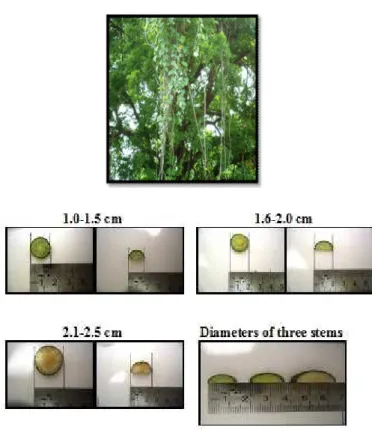
Fresh Guduchi stem spreading over Neem (Azadirachta
indica) tree (Fig. 1) was procured from the campus of
I.P.G.T. & R.A., G.Ay.U, Jamnagar and identified at Pharmacognosy laboratory.
Batches:
The stem was categorized into three groups as follows (Fig. 2).
Total 15 batches of Satva (5 each from 1 group) were prepared to get an average data. All the thin, medium and thick sizes used were of same plant.
(1) Three batches of 1.0-1.5 cm diameter of stem- Thin stem
(2) Three batches of 1.6-2.0 cm diameter of stem- Medium stem
(3) Three batches of 2.1-2.5cm diameter of stem- Thick stem
Method of preparation (Fig. 3):
Sharma Rohit et al: Quantitative Estimation of Satva extracted from Guduchi
JPSI 1 (1), JAN – FEB 2012, 38-40 for settlement. The supernatant liquid was decanted carefully
Heavy starchy sediment, which was settled at the bottom, was shifted into a tray, air dried under running fan, collected and stored as Guduchi Satva in airtight jars.
Observations:
1. As the maceration was completed after 1 hr, the sliminess of pulp was almost reduced.
2. The colour of liquid after straining with four folded cloth was greenish brown.
3. The colour of final Product was Shankhabha (clear white).
DISCUSSION:
First time Guduchi Satva preparation has been mentioned in
Yoga Ratnakar and then Rasa Yoga Sagar, Siddha Yoga
Sangraha, Dravyaguna vigyana etc. have described
elaborately. All these texts have different method of preparation.
According to Yoga Ratnakar1 3, Guduchi stem is cut into small pieces and triturated well it was filtered through cloth and supernatant liquid is decanted and “Shankhanibha”
sediment is collected. The quantity of liquid and overnight soaking is not stated in this reference. “Shankhanibha” reveals the colour of Satva.
According to Siddha Yoga Sangraha1 4, Guduchi stem is cut into small pieces and pounded well then it was kept for overnight soaking in water. Next day it was filtered through cloth, allowed for sedimentation, supernatant liquid is decanted and sediment is collected. In this reference soaking is mentioned, but the volume of liquid is not mentioned.
Rasa Yoga Sagar1 5 has also not mentioned the quantity of
liquid, but it states that the Kalka should be done so fine by triturating. The colour of Satva is “Shubhrakhandnibha”. In commentary of Bhavprakasha1 6, four time of water for soaking has been mentioned.
So, Quantitative evaluation of Satva is not mentioned clearly in classical texts. Only sedimentation and filtration is described. There is also variation in the soaking time i.e. 12 to 24 hours.
In present study, Guduchi grown on Neem trees was collected from the natural habitat. Neem Guduchi is said to be the best as the synergy between these plants enhance its efficacy17.
Different sizes of Guduchi stem were collected to evaluate the quantitative variation of those sizes of stem, because no any classical texts have mentioned that which size of
Guduchi stem is to be used for Satva preparation. So,
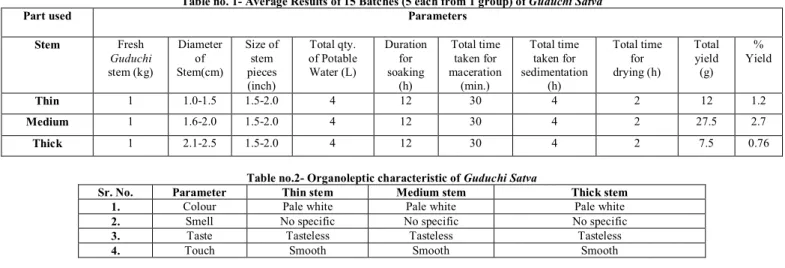
pharmaceutically Guduchi Satva was prepared to find out which size of stem is the best for achieving more Satva. The details of Guduchi Satva preparation are placed in Table no.1.
Organoleptic characteristic of Guduchi Satva are given in Table no.2. Guduchi Satva is described as slight bitter by some recent experts18, but in present study it was found tasteless. Freshly prepared Satva is good in taste, but carelessly prepared one is bitter in taste due to coming of bitter principle of stem in it.
The yield of Satva from thin, medium and thick stem was 1.2 %, 2.7 % and 0.76 % respectively. So, it was cleared from above figures that medium size of stem yielded more Satva i.e. 2.7 % (Avg. of 5 batches) than thin and thick size of stem.
Acharya Yadavji Trikamji has mentioned ‘Angustha’ size of
stem for the preparation of Ghana1 9. It may be inferred that ‘Angustha’ size of stem contains more starch. A survey of
Angustha (Thumb) size of 20 Healthy volunteers having age
between 21-25 yrs, average Weight - 55 to 65 kg and Height- 162 to 172 cm was done and recorded, which was ranging from 1.8-2.1cm and was corroborating with the medium size
Guduchi taken in the present study.
CONCLUSION:
Yield of the Guduchi satva greatly depends on the size, environment, association and cellular activities; maximum metabolic activity of the starch grains in cellular constituents matures at after preliminary development, during this stage percentage of the starch also increases. The study reveals that the thin stem yields very less compared to the medium size, more than that thick stem. Medium size stem yields more than both thin and thick samples, whereas thick samples yield very less as compared to the both small and medium samples. The Organoleptic characters show almost similar in nature. Thus the present study concludes that Maximum Yield of
Satva (2.7 %) was obtained in medium size (1.6-2.0 cm) stem
of Guduchi and it may adopt for the future utilization in
pharmaceutical companies .
Table no. 1- Average Results of 15 Batches (5 each from 1 group) of Guduchi Satva
Part used Parameters
Stem Fresh
Guduchi
stem (kg)
Diameter of Stem(cm)
Size of stem pieces (inch)
Total qty. of Potable Water (L)
Duration for soaking
(h)
Total time taken for maceration
(min.)
Total time taken for sedimentation
(h)
Total time for drying (h)
Total yield (g)
% Yield
Thin 1 1.0-1.5 1.5-2.0 4 12 30 4 2 12 1.2 Medium 1 1.6-2.0 1.5-2.0 4 12 30 4 2 27.5 2.7 Thick 1 2.1-2.5 1.5-2.0 4 12 30 4 2 7.5 0.76
Table no.2- Organoleptic characteristic of Guduchi Satva
Sharma Rohit et al: Quantitative Estimation of Satva extracted from Guduchi
JPSI 1 (1), JAN – FEB 2012, 38-40
REFERENCES:
1
Sharma Abhimanyu et.al. Tinospora cordifolia (Willd.) Hook. F. & Thomson- A plant with immence economic potential, Journal of Chemical and Pharmaceutical research, 2010; 2(5): 327-333.
2 BV Shetty, V Singh. Flora of Rajasthan. 1st ed. Merut: Merut publishers
and Distributors; Vol 1: 756-100.
3 Vedavathy S, Rao KN. Antipyretic activity of six indigenous medicinal
plants of Tirumala Hills. Andhra Pradesh, India, Journal of Ethnopharmacology, 1991; 33:193-6.
4 Bhandari C. Vanaushadhi Chandrodaya. 1st ed. Vol. 3. Varanasi:
Chaukhamba Sanskrit Sansthan; 2006. p. 86.
5
Anonymous. The Ayurvedic Pharmacopoeia of India. Part I. 1st ed. Vol. 1. New Delhi: Department of AYUSH, Ministry of Health and FW; 2001. pp. 53–5.
6 Anonymous. The Ayurvedic Formulary of India, Ministry of Health and
Family Welfare, Govt. of India, New Delhi, Second edition: 2003; Part-1, p560.
7 A.N. Namjoshi. Studies in the pharmacognosy of Ayurvedic drugs.
Gomantak press; 1960, p 6.
8Nagarjuna. Rasendra Mangalam of Nagarjuna. Edited by Sharma H S. verse
3/112;, Varanasi: Chaukhamba orientalia; 2008. p 84.
9
Bhavamishra. Bhavprakash Nighantu. Edited with Vidyotini Hindi commentary by Sri Brahamashankara Mishra and Rupalala Vaishya. Chaukhambha Sanskrit Sansthan; 10th edition: 2002; Part-1, p 271.
10 Thakur RS, Ouri H S & Akhtar hussain. Major Medicinal plants of India,
Central institute of medicinal and aromatic plants, Lucknow; 1989; p 499.
11 Mehra P. N., Puri H.S. Indian journal of pharmacology. 1969; 31(6), p
180.
12
Salunke Preeti. Pimpalgaonkar P.B., A comparative study of Guduchi Satva and Guduchi Ghana, MD dissertation, R.A.Podar Ayurvedic Medical College, Mumbai, 1997.
13
Yogaratnakar. Vidhyotani Hindi commentary by Shri Laksmipati Shastry. Varanasi: Chaukhamba Sanskrit Sansthan; 7th edition: 2002; p118.
14 Acharya Yadavji Trikamaji. Siddha Yoga Sangraha. Shri Baidhnath
Ayurved Bhavan Ltd; Ist edition:1954, ch 14, p 84.
15
Sharma Hariprapanna. Rasa Yoga Sagar. 2004, vol. I, p 378.
16 Bhavamishra. Bhavprakash Nighantu. edited with Vidyotini Hindi
commentary by Sri Brahamashankara Mishra and Rupalala Vaishya. Chaukhambha Sanskrit Sansthan; 10th edition: 2002, Part-1, p 270.
17 Anonymous. Quality standards of Indian Medicinal Plants. Indian Council
of Medical Research; New Delhi: 2003, Vol. 1, p 212.
18
Hiremath Shobha G. A Text Book of Bhaishajya Kalpana. by IBH Prakashana. Bangalore; Part-1, ch 19, p 220.
19Acharya Yadavji Trikamaji. Siddha Yoga Sangraha. Nagpur: Shri
Baidhnath Ayurved Bhavan Ltd.; 11 th Edition, p 4.
Source of support: Nil, Conflict of interest: None Declared
Fig. 1- Guduchi collected from natural habitat with Neem tree.
Fig. 2- Variations in Stem Diameters
A B C
F E D
G H I
A- Guduchi stem, B- pounding, C- overnight soaking, D- maceration, E-allowed for sedimentation, F- removal of supernatant liquid, G- scrapping of white sediment, H- collection