CPD
9, 3489–3518, 2013Simulating warmth of the mid-Miocene Climate Optimum in
CESM1
A. Goldner et al.
Title Page
Abstract Introduction
Conclusions References
Tables Figures
◭ ◮
◭ ◮
Back Close
Full Screen / Esc
Printer-friendly Version Interactive Discussion
Discussion
P
a
per
|
D
iscussion
P
a
per
|
Discussion
P
a
per
|
Discuss
ion
P
a
per
Clim. Past Discuss., 9, 3489–3518, 2013 www.clim-past-discuss.net/9/3489/2013/ doi:10.5194/cpd-9-3489-2013
© Author(s) 2013. CC Attribution 3.0 License.
Open Access
Climate of the Past
Discussions
Geoscientiic Geoscientiic
Geoscientiic Geoscientiic
This discussion paper is/has been under review for the journal Climate of the Past (CP). Please refer to the corresponding final paper in CP if available.
The challenge of simulating warmth of the
mid-Miocene Climate Optimum in CESM1
A. Goldner1, N. Herold1, and M. Huber1,2
1
Earth, Atmospheric, and Planetary Sciences, Purdue University, 550 Stadium Mall Drive, West Lafayette, IN 47907, USA
2
Purdue Climate Change Research Center, Purdue University, Mann Hall 203 S. Martin Jischke Drive, West Lafayette, IN 47907, USA
Received: 10 June 2013 – Accepted: 18 June 2013 – Published: 26 June 2013
Correspondence to: A. Goldner ([email protected])
CPD
9, 3489–3518, 2013Simulating warmth of the mid-Miocene Climate Optimum in
CESM1
A. Goldner et al.
Title Page
Abstract Introduction
Conclusions References
Tables Figures
◭ ◮
◭ ◮
Back Close
Full Screen / Esc
Printer-friendly Version Interactive Discussion
Discussion
P
a
per
|
D
iscussion
P
a
per
|
Discussion
P
a
per
|
Discuss
ion
P
a
per
|
Abstract
The mid-Miocene Climatic Optimum (MMCO) is an intriguing climatic period due to its above-modern temperatures in mid-to-high latitudes in the presence of
close-to-modern CO2 concentrations. We use the recently released Community Earth System
Model (CESM1.0) with a slab ocean to simulate this warm period, incorporating recent 5
Miocene CO2 reconstructions of 400 ppm. We simulate a global mean annual
tem-perature (MAT) of 18◦C,
∼4◦C above the pre-industrial value, but 4◦C colder than the
global Miocene MAT we calculate from climate proxies. Sensitivity tests reveal that the inclusion of a reduced Antarctic ice sheet, eastern equatorial Pacific Ocean
tempera-ture anomalies, increased CO2to 560 ppm, and variations in obliquity only marginally
10
improve model-data agreement. All MMCO simulations have an equator to pole
tem-perature gradient which is at least∼10◦C larger than the reconstruction from proxies.
The MMCO simulation most comparable to the proxy records requires a CO2
concen-tration of 800 ppm. Our results illustrate that MMCO warmth is not reproducible using
the CESM1.0 forced with CO2concentrations reconstructed for the Miocene or
includ-15
ing various proposed Earth system feedbacks; the remaining discrepancy in the MAT
is comparable to that introduced by a CO2 doubling. The models tendency to
under-estimate proxy derived global MAT and overunder-estimate the equator to pole temperature gradient suggests a major climate problem in the MMCO akin to those in the Eocene. Our results imply that this latest model, as with previous generations of climate models, 20
is either not sensitive enough or additional forcings remain missing that explain half of the anomalous warmth and pronounced polar amplification of the MMCO.
1 Introduction
The Middle Miocene Climatic Optimum (MMCO 17–14.50 Ma) (Zachos et al., 2008) is a period in Earth’s history in which temperatures were significantly warmer in the deep 25
CPD
9, 3489–3518, 2013Simulating warmth of the mid-Miocene Climate Optimum in
CESM1
A. Goldner et al.
Title Page
Abstract Introduction
Conclusions References
Tables Figures
◭ ◮
◭ ◮
Back Close
Full Screen / Esc
Printer-friendly Version Interactive Discussion
Discussion
P
a
per
|
D
iscussion
P
a
per
|
Discussion
P
a
per
|
Discuss
ion
P
a
per
al., 2008; Shevenell et al., 2008). These warm extra-tropical temperatures have been hard to reconcile with reconstructed below-modern tropical sea surface temperature
(SST) records and boron and alkenone CO2 reconstructions of 200–280 ppm levels
(Pagani et al., 2005; Pearson and Palmer, 2000).
Recent re-evaluation of the proxy records has led to advancement in our understand-5
ing of MMCO warmth. First, the MMCO tropical SST records showing below-modern levels (Savin, 1977; Nikolaev et al., 1998; Bojar et al., 2005) are now understood to have a cool diagenetic bias (Stewart et al., 2004). Excluding these records indicates that tropical SSTs in the Miocene were above modern (Shevenell et al., 2004; You et
al., 2009; LaRiviere et al., 2012). Second, recent leaf stomatal studies reconstruct CO2
10
concentrations at the MMCO to be 400–500 ppm (Kürschner et al., 2008) and these re-sults have been confirmed in boron isotope-based reconstructions (Foster et al., 2012) and updated alkenone reconstructions (Zhang et al., 2013).
Nevertheless, even with higher CO2 concentrations MMCO warming has been
dif-ficult to reproduce in an intermediate complexity Earth system model (Henrot et al., 15
2010), atmosphere and slab ocean models (Tong et al., 2009; You et al., 2009), and fully coupled atmosphere ocean models (Herold et al., 2011; Krapp and Jungclaus, 2011). For example, Herold et al. (2011) found that the Community Climate System
Model (CCSM3.0) was ∼10◦C too cold compared to proxy records in high latitude
regions like Alaska and Antarctica. In this study, we implement boundary conditions 20
from Herold et al. (2011) within the National Center for Atmospheric Research (NCAR) Community Earth System Model (CESM1.0) using the Community Atmosphere Model (CAM4) framework to simulate the MMCO. This allows for a clean comparison with previous simulations done with CCSM3.0, using a latest generation model included in the Coupled Model Intercomparison Project (CMIP5).
25
CPD
9, 3489–3518, 2013Simulating warmth of the mid-Miocene Climate Optimum in
CESM1
A. Goldner et al.
Title Page
Abstract Introduction
Conclusions References
Tables Figures
◭ ◮
◭ ◮
Back Close
Full Screen / Esc
Printer-friendly Version Interactive Discussion
Discussion
P
a
per
|
D
iscussion
P
a
per
|
Discussion
P
a
per
|
Discuss
ion
P
a
per
|
differences exist (Potter and Szatmari, 2009). Additionally, the CO2 levels during the
MMCO are in the range of values for the next century, and paleoclimate records are
bet-ter constrained compared to earlier warm periods such as the Eocene (∼56–33.9 Ma)
where there is large uncertainty in the CO2(Pagani, 2002; Pearson and Palmer, 2000;
Royer et al., 2012) and temperature records. 5
2 Methods
2.1 Modelling framework
A series of MMCO global climate simulations are conducted using components of the NCAR CESM1.0 (Gent et al., 2011). The Community Atmospheric Model (CAM4) is run at 1.9◦
×2.5◦horizontal resolution with 26 vertical levels and coupled to the Community
10
Land Model (CLM4) (Lawrence et al., 2012), the Community Sea-Ice Model (CICE4) (Hunke and Lipscomb, 2008) and the slab ocean model, described below (Bitz et al., 2012). This model simulates modern surface temperature distributions and equator to pole temperature gradients well (Gent et al., 2011), although biases exist (Kay et al., 2012; Neale et al., 2013).
15
2.2 Experimental design
The control Pre-industrial (PI) simulation employs the modelling components described
above in standard configuration and with CO2concentrations set at 287 ppm. The slab
ocean forcing file for the PI case has heat fluxes, salinity, and density inputs from a fully coupled atmosphere, ocean, ice, and land simulation (Bitz et al., 2012). Addi-20
tionally we run a PI simulation at 400 ppm CO2 (PI400) to compare with our MMCO
simulation (also at 400 ppm CO2). This high CO2 PI configuration allows us to isolate
the temperature effect of including MMCO boundary conditions at constant CO2.
CPD
9, 3489–3518, 2013Simulating warmth of the mid-Miocene Climate Optimum in
CESM1
A. Goldner et al.
Title Page
Abstract Introduction
Conclusions References
Tables Figures
◭ ◮
◭ ◮
Back Close
Full Screen / Esc
Printer-friendly Version Interactive Discussion
Discussion
P
a
per
|
D
iscussion
P
a
per
|
Discussion
P
a
per
|
Discuss
ion
P
a
per
ducted within the CCSM3 framework (Tong et al., 2009; You et al., 2009), but here we improve upon their methodology by using ocean heat fluxes derived from a cou-pled ocean-atmosphere simulation of the Miocene. To create the Miocene slab ocean forcing file we use a previous CCSM3.0 Miocene simulation (Herold et al., 2012). This includes mix-layer depth and ocean heat transport from a fully coupled model. Using 5
slab fluxes from CCSM3.0 is not an issue because we find no substantial differences in
SST (Fig. S1) or climate between CCSM3.0 and CESM1.0 for deep paleoclimate sim-ulations such as the Eocene as the ocean component biases are very similar between the two modeling frameworks (Danabasoglu et al., 2012).
Our use of the slab ocean model in this study, as opposed to a fully dynamic ocean 10
model, is justified given that (1) we are interested in simulating a large number of sensi-tivity experiments which demand already intensive computational resources. (2) Expe-rience from modern and Eocene studies show that this slab ocean approach produces very similar answers to those from coupled models (Gettelman et al., 2012; Bitz et al., 2012). (3) We can run the slab ocean simulations with higher resolution in the at-15
mosphere (1.9◦×2.5◦) than is standard for most paleoclimate studies because of the
reduced computational requirement.
The simulations conducted are run for over 60 yr with the last 20 used for analy-sis. The simulations here are well equilibrated as evidenced by the radiative balance
statistics found in Table S3. Additional MMCO CO2sensitivity experiments were run at
20
560 ppm CO2(MMCO560) to account for the uncertainty in Miocene CO2
reconstruc-tions and the model data comparisons for this experiment is described in Fig. 3b. We
also run a simulation at 800 ppm (MMCO800) CO2 (Fig. 3c) to explore a wide range
of CO2values although we note that this is well outside the range of the reconstructed
CO2levels for the MMCO.
25
2.3 MMCO terrestrial and sea surface temperature compilation
CPD
9, 3489–3518, 2013Simulating warmth of the mid-Miocene Climate Optimum in
CESM1
A. Goldner et al.
Title Page
Abstract Introduction
Conclusions References
Tables Figures
◭ ◮
◭ ◮
Back Close
Full Screen / Esc
Printer-friendly Version Interactive Discussion
Discussion
P
a
per
|
D
iscussion
P
a
per
|
Discussion
P
a
per
|
Discuss
ion
P
a
per
|
and S2). We present the longitudinal and spatial distribution of the proxy records in Fig. 1. The proxy reconstruction spans over the MMCO (17–14.50 Ma), however, be-cause of the sparseness of data over this period we include records that have an av-erage age between 20 and 13.65 Ma, where they fill spatial gaps (i.e. Southern Hemi-sphere). This data compilation can be used as a reference data set for future MMCO 5
model data comparisons.
We update the minimum error in our compiled terrestrial proxy records for a num-ber of reasons. Firstly, recent work suggests that for physiognomic leaf-climate
meth-ods there should be a minimum error of±5◦C (Royer, 2012). Secondly, studies have
suggested that there is large uncertainty in estimating MAT (Grimm and Denk, 2012) 10
using the coexistence approach (Mosbrugger and Utescher, 2007). For our intended purposes increasing the minimum proxy record uncertainty should make matching the simulations more obtainable. If our model still fails to match proxy data even with gen-erous error bars this merely proves our main results further.
The SST records are compiled from available published data in the literature and we 15
describe these records in detail in Table S2. We leave out some tropical SST records which may have a diagenetic bias as described in (Sexton et al., 2006; Huber, 2008). Tropical SSTs are few and far between for the MMCO, but more common in the mid-to-late Miocene, thus we may omit proxy records from over almost half the surface
area of the planet (30◦N and 30◦S) or utilize data from intervals slightly outside the
20
MMCO. Because there is a lack of tropical SST data points for the MMCO we compile
SSTs from the late Miocene and justify this based off the minimal change between
middle and late Miocene SSTs at other locations (LaRiviere et al., 2012). Given that
the Pliocene tropical SSTs were∼4–6◦C (Brierley et al., 2009; Dekens et al., 2007;
Ravelo et al., 2006; Fedorov et al., 2013) above modern and the late Miocene were 25
∼7–9◦C above modern (LaRiviere et al., 2012) it is reasonable to conjecture MMCO
CPD
9, 3489–3518, 2013Simulating warmth of the mid-Miocene Climate Optimum in
CESM1
A. Goldner et al.
Title Page
Abstract Introduction
Conclusions References
Tables Figures
◭ ◮
◭ ◮
Back Close
Full Screen / Esc
Printer-friendly Version Interactive Discussion
Discussion
P
a
per
|
D
iscussion
P
a
per
|
Discussion
P
a
per
|
Discuss
ion
P
a
per
updated minimum error bars are large enough to encompass the temporal variation in these records.
Previous work has discussed the importance of including orbital variations when quantifying uncertainty in model data comparisons (Haywood et al., 2013). To quan-tify the possible error introduced by aliasing of orbital variability in our interpretation of 5
model data mismatch, we conduct two sensitivity experiments varying obliquity to
min-imum and maxmin-imum Miocene values (22◦ and 25◦respectively). We then calculate the
maximum and minimum model-derived temperatures at each proxy location from both extreme orbit simulations and use this absolute anomaly as an estimate of orbitally induced variance. These maximum and minimum values are plotted as vertical error 10
bars on the modelled MAT in our pointwise model data comparisons (Figs. 2, 3, 4, 5, 6).
3 Results
3.1 Proxy derived MAT value
To determine the difference in global MAT between Miocene and pre-industrial climate
15
we take the proxy records and perform a pointwise anomaly of proxy-derived MAT com-pared to modern observed MAT at paleo-latitudes and paleo-longitudes. We split the
resulting anomalies into tropical (30◦N to 30◦S) mid-latitude (30◦N/S to 60◦N/S) and
polar (60◦N/S to 90◦N/S) regions and conduct a weighted average anomaly over each
latitudinal region. This latitudinal binning and area weighting addresses issues of hav-20
ing more proxy records in certain regions (i.e. the mid-latitudes). Using proxy records
for the MMCO (Table S1 and S2) we calculate a global MAT change of∼7.6◦C±2.30
(We report two standard errors from the mean) compared to PI. The proxy-derived temperatures compared against modern observations (ECMWF 40 Year Reanalysis
Project) is 6.8◦C±2.20 as there is∼1.0◦C of warming between modern observations
25
CPD
9, 3489–3518, 2013Simulating warmth of the mid-Miocene Climate Optimum in
CESM1
A. Goldner et al.
Title Page
Abstract Introduction
Conclusions References
Tables Figures
◭ ◮
◭ ◮
Back Close
Full Screen / Esc
Printer-friendly Version Interactive Discussion
Discussion
P
a
per
|
D
iscussion
P
a
per
|
Discussion
P
a
per
|
Discuss
ion
P
a
per
|
To validate our approach for estimating proxy derived MAT we calculate a resampled MAT using our methodology and compare against a globally weighted MAT (we will call this true MAT) from both model runs and modern observational datasets. The globally
weighted true MAT value of the MMCO simulation is 18.00◦C (Table 1) whereas our
calculation for MAT resampled over the proxy record regions using the methodology 5
from above is 17.12◦C. The calculated standard error from the mean including proxy
record uncertainty is 1.33◦C, which illustrates that our resampled MAT value is well
within the calculated standard error. We also calculate the resampled MAT using mod-ern observations and with other Miocene simulations and find that all the resampled MAT estimates fall within two standard errors of the true MAT. For all intended purposes 10
we are confident that our approach for reconstructing global MAT from our proxy record compilation is a valid estimate.
3.2 MMCO simulation compared against the proxy records
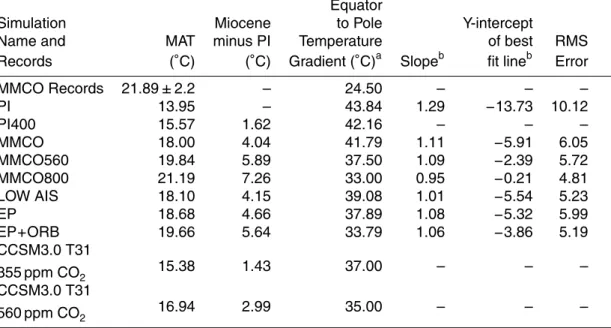
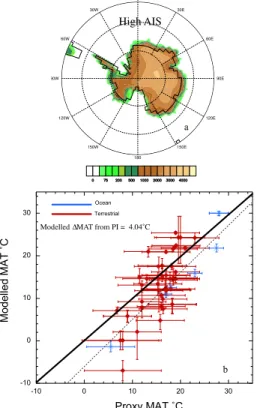
The MMCO simulation is 4.04◦C warmer than the control PI simulation, but the
simula-tion is about 4◦C cooler than globally averaged MMCO proxy temperature
reconstruc-15
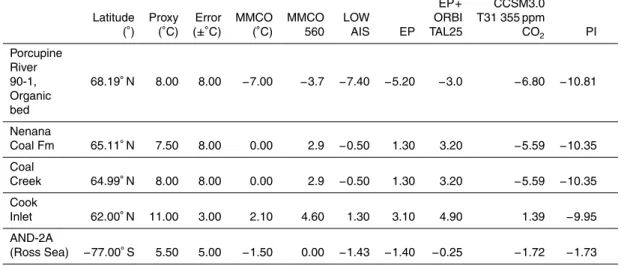
tions (Table 1). The MMCO simulation generally captures the tropical and mid-latitude temperature distribution of the proxy records, but fails to achieve above-freezing tem-peratures in the high latitudes (Fig. 2b, Table 2). The nature of this discrepancy can
be clarified by examining the equator to pole surface temperature gradient. It is 17◦C
larger in the MMCO simulation than in the proxy records (Table 1). Using the methods 20
described in Lunt et al. (2012), the equator to pole temperature gradient is calculated
by averaging the mean annual temperatures over the absolute latitudes of (60–80◦)
minus (0–30◦); except here we use 80◦ because this the maximum latitudinal extent of
proxy records. Additionally, an error weighted best fit line for the pointwise comparison
reveals a root mean square (RMS) error of∼6◦C and y-intercept of −6◦C, although
25
the slope of the regression line is close to 1 (Table 1). In summary, the MMCO
simula-tion (at 400 ppm CO2) is unable to produce high latitude warmth or a sufficiently warm
CPD
9, 3489–3518, 2013Simulating warmth of the mid-Miocene Climate Optimum in
CESM1
A. Goldner et al.
Title Page
Abstract Introduction
Conclusions References
Tables Figures
◭ ◮
◭ ◮
Back Close
Full Screen / Esc
Printer-friendly Version Interactive Discussion
Discussion
P
a
per
|
D
iscussion
P
a
per
|
Discussion
P
a
per
|
Discuss
ion
P
a
per
3.3 Effect of MMCO boundary conditions and CO2sensitivity experiments
We find that our MMCO simulation is 2.43◦C warmer compared to the PI simulation
run at 400 ppm CO2 (PI400). Thus 2.43◦C of the temperature difference between our
MMCO and PI simulations are a result of changes in continental positions, topography, and vegetation. This change is consistent with late Miocene modelling which finds 5
3.0◦C of warming due to changes in vegetation and topography (Knorr et al., 2011).
A CO2 sensitivity experiment run at 560 ppm CO2 (above most reconstructed CO2
records) is also too cold at high latitudes compared to proxy records (Fig. 3b) and the equator to pole temperature difference is still too large by∼13◦C (Table 1). This
simula-tion has a global MAT 5.89◦C higher than the control PI simulation, and is
∼2◦C colder
10
than the proxy-derived global MAT. The error weighted best fit line for the MMCO560
pointwise comparison gives a y-intercept of∼ −2.5◦C, but the calculated RMS error is
still 5.7◦C (Table 1). The MMCO800 simulation has a MAT 7.26◦C above PI (Table 1),
which is our best comparison with the proxy derived MAT value. The error weighted best fit line is also very close to the one to one line and has a y-intercept close to zero 15
(Fig. 3d). Overall MMCO800 matches the proxy compilation the best and we use this comparison to prove that matching global MMCO warmth can be accomplished, but at
CO2concentrations approximately twice that reconstructed from proxies. These results
are very similar to those found in the Eocene (Huber and Caballero, 2011; Lunt et al., 2012)
20
Below, we test hypotheses that have been proposed to explain Miocene warmth,
with the goal of improving the model data comparison without having to increase CO2
CPD
9, 3489–3518, 2013Simulating warmth of the mid-Miocene Climate Optimum in
CESM1
A. Goldner et al.
Title Page
Abstract Introduction
Conclusions References
Tables Figures
◭ ◮
◭ ◮
Back Close
Full Screen / Esc
Printer-friendly Version Interactive Discussion
Discussion
P
a
per
|
D
iscussion
P
a
per
|
Discussion
P
a
per
|
Discuss
ion
P
a
per
|
4 Further sensitivity studies
4.1 Reducing Antarctic ice-sheet volume
Recent work estimates the volume of the middle Miocene Antarctic Ice Sheet (AIS) to
be∼30–50 % less than modern (Shevenell et al., 2008). Consequently the Herold et
al. (2008) reconstruction for AIS elevation and extent is likely too large (Fig. 2a). To cor-5
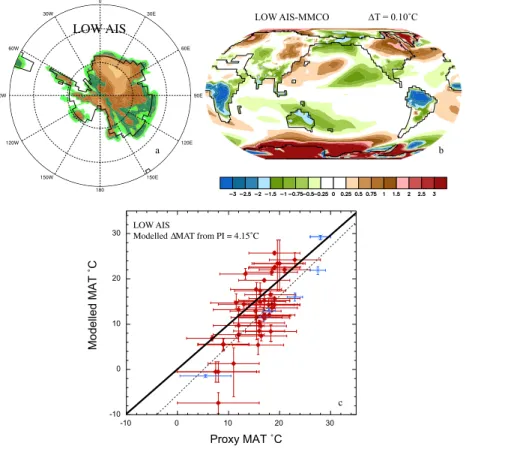
rect this, we utilize a new AIS reconstruction derived from a fully interactive terrestrial ice and atmosphere model (Pollard personal communication) (Fig. 4a). We introduce an AIS that is half the volume of that used in Herold et al. (2011) (Fig. 2a) from the
offline interactive ice sheet simulation. This new AIS volume is within the range of
esti-mates from proxy records (Pekar and DeConto, 2006; Billups and Schrag, 2003). We 10
also reduce the area of glacier albedo over Antarctica by half and replace it with a combination of unvegetated and tundra-like land cover. We introduce this new AIS to-pography and vegetation cover (Fig. 4a) into the MMCO boundary conditions described
in Herold et al. (2008) and denote this simulation LOW AIS. The difference in surface
albedo over the AIS between these two simulations ends up being similar as snow 15
(also with a high albedo) ends up covering the areas that were once glacier because Antarctica stays below freezing year round.
The LOW AIS simulation is 4.15◦C warmer than PI and 0.10◦C warmer than the
previously described MMCO simulation with a high AIS (Fig. 4c). Thus, there is no sig-nificant global mean temperature impact from decreasing the size of the AIS, consistent 20
with previous work (Goldner et al., 2013). Although recent coupled MMCO simulations have found warmer and wetter conditions regionally over Europe due to reducing ice extent in Antarctica highlighting the importance of including ocean feedbacks for
resolv-ing regional temperature distributions (Hamon et al., 2012). The temperature difference
between LOW AIS and the MMCO simulation is largest over Antarctica (Fig. 4b) be-25
CPD
9, 3489–3518, 2013Simulating warmth of the mid-Miocene Climate Optimum in
CESM1
A. Goldner et al.
Title Page
Abstract Introduction
Conclusions References
Tables Figures
◭ ◮
◭ ◮
Back Close
Full Screen / Esc
Printer-friendly Version Interactive Discussion
Discussion
P
a
per
|
D
iscussion
P
a
per
|
Discussion
P
a
per
|
Discuss
ion
P
a
per
A slight warming occurs in the Ross Sea between the LOW AIS simulation and the MMCO simulation, but overall there is minor improvement in the model data compari-son (Fig. 4c) by lowering the height and reducing glacier extent of the AIS (Fig. 4a)
4.2 El Padre
It has been hypothesized that pre-Quaternary climates were characterized by a reor-5
ganization of tropical ocean-atmosphere circulation inducing a permanent El Niño-like SST distribution (Philander and Fedorov, 2003; Lyle et al., 2008; Ravelo et al., 2006) which has been called El Padre. A reduced temperature gradient in the eastern equato-rial Pacific (EEP) should induce high latitude warming in Alaska and other high latitude regions, because this is a standard teleconnected response during modern El Niño’s 10
(Molnar and Cane, 2007). Prior modelling studies have demonstrated the effectiveness
of this mechanism (Barreiro et al., 2006; Vizcaíno et al., 2010; Bonham et al., 2009; Haywood et al., 2007; Goldner et al., 2011), although no modeling study has explicitly studied its impacts with realistic MMCO boundary conditions.
To explore the impacts of an El Padre SST anomaly in our simulations, we take the 15
heat convergence and mixed layer depths derived from a fully coupled Miocene simu-lation (Herold et al., 2012) and zonally average these quantities across the Equatorial
Pacific (10◦N and 10◦S of the equator). We introduce the zonally averaged ocean heat
convergence and mixed layer depths into a new slab ocean forcing file and simulate
the MMCO with a low AIS at 400 ppm CO2. The resulting surface temperature anomaly
20
is El Padre like (Fig. 5a) and the simulation is called EP. We are confident the CAM4 CESM1.0 framework reproduces modern day observational teleconnections patterns induced by El Niño forcing as described in detail in other studies (Wang et al., 2013; Shields et al., 2012). Although an interesting question for past warm periods like the MMCO is how these global and regional responses to ENSO have varied throughout 25
CPD
9, 3489–3518, 2013Simulating warmth of the mid-Miocene Climate Optimum in
CESM1
A. Goldner et al.
Title Page
Abstract Introduction
Conclusions References
Tables Figures
◭ ◮
◭ ◮
Back Close
Full Screen / Esc
Printer-friendly Version Interactive Discussion
Discussion
P
a
per
|
D
iscussion
P
a
per
|
Discussion
P
a
per
|
Discuss
ion
P
a
per
|
In the EP simulation, high latitude regions warm, especially Alaska and Antarctica (Fig. 5a). The pointwise model data comparison for the EP simulation is plotted in
Fig. 5b. This simulation is∼4.6◦C warmer in global mean than the PI simulation and
∼0.5◦C warmer than the MMCO and LOW AIS simulations. Warming due to adding El
Padre is largest in regions where the model previously performed the worst (Fig. 5a). 5
Roughly 2◦C of warming occurs in Alaska, but the simulation is still∼8.5◦C too cold in
this region (Table 2) and still has a∼13◦C larger equator to pole surface temperature
gradient compared to the proxy records (Table 1). Imposing an El Padre illustrates a
mechanism capable of warming the high latitudes without elevating CO2consistent with
the results of (LaRiviere et al., 2012; Sriver and Huber, 2010; Brierley et al., 2009). Nev-10
ertheless this change does not reconcile the warmth of the MMCO, as temperatures are still∼2◦C too cool globally and∼8.5◦C too cool in the high latitudes.
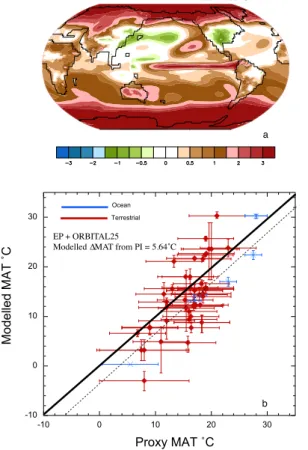
Adding EP and increasing obliquity to 25◦ results in a simulation that is 5.64◦C
warmer than PI (Fig. 6). This MAT anomaly compared to PI is similar to the warm-ing found in the MMCO560 simulation. The MMCO560 simulation does not include any 15
of the boundary condition changes aimed at increasing high latitude warmth.
Interest-ingly the EP, AIS, and obliquity forcing results in a 4◦C improvement in simulating the
equator to pole temperature gradient compared to MMCO560 (Table 1). Both compar-isons are too cold compared to the proxy derived global MAT value as matching the
proxy records in high latitudes requires a CO2concentration double what is predicted
20
in the reconstructions.
5 Discussion
5.1 Comparison with previous MMCO CCSM3.0 simulations
The most comparative study to the experiments presented here are the CCSM3.0 MMCO simulations described in Herold et al. (2011) (Table 1). The CESM1.0 Miocene 25
CPD
9, 3489–3518, 2013Simulating warmth of the mid-Miocene Climate Optimum in
CESM1
A. Goldner et al.
Title Page
Abstract Introduction
Conclusions References
Tables Figures
◭ ◮
◭ ◮
Back Close
Full Screen / Esc
Printer-friendly Version Interactive Discussion
Discussion
P
a
per
|
D
iscussion
P
a
per
|
Discussion
P
a
per
|
Discuss
ion
P
a
per
al., 2011) at the same CO2 levels. CAM4 is warmer than CAM3 at the same CO2
concentrations, in large part because it is a more sensitive model to background CO2
concentrations. CCSM3.0 had a 2.5◦C change in global mean surface temperature to
a doubling of CO2(Kiehl et al., 2006), while CSEM1.0 has a 3.5◦C temperature change
to a doubling of CO2 (Gettelman et al., 2012), roughly a 1◦C higher climate
sensitiv-5
ity. Imposing large forcings such as an El Padre anomaly, reducing AIS topography and albedo, or including uncertainty of orbital forcing failed to produce suitably warm temperatures in the global mean (Table 1) and at high latitudes (Table 2).
Additional simulations in past warm climates exploring precession (Sloan and Huber, 2001; Lawrence et al., 2003), eccentricity (Westerhold et al., 2005), vegetation (Knorr 10
et al., 2011), and using a dynamic ocean could be important in our understanding of MMCO warmth. We point out that previous fully coupled ocean atmosphere simulations
at 560 ppm CO2were unable to reproduce MMCO warmth (Herold et al., 2011). In fact,
the CCSM3.0 MMCO simulation at 560 ppm CO2 performs worse against the proxy
records than our MMCO CAM4 simulation at 400 ppm CO2(Table 1). We also reiterate
15
that the temperature effect of including MMCO boundary conditions induces 2.43◦C
of warming compared to the PI400 simulation. This is roughly a third of the warming
needed to explain the MMCO warmth of∼7.6◦C±2.30.
5.2 Comparison with other fully coupled MMCO simulations
Krapp and Jungclaus (2011) simulated the MMCO and found a MAT of 17.1◦C at
20
480 ppm CO2 and 19.2◦C at 720 ppm CO
2. These simulations are roughly 4◦C and
2◦C colder compared to the MAT calculated from the proxy records presented here.
This study also comes to similar conclusions about their model’s inability to reproduce reconstructed warmth in the high latitude regions especially in the Southern Hemi-sphere. Hamon et al. (2012) also conducted fully coupled MMCO simulations under a 25
variety of different changes in boundary conditions. Comparison to this study is diffi
complex-CPD
9, 3489–3518, 2013Simulating warmth of the mid-Miocene Climate Optimum in
CESM1
A. Goldner et al.
Title Page
Abstract Introduction
Conclusions References
Tables Figures
◭ ◮
◭ ◮
Back Close
Full Screen / Esc
Printer-friendly Version Interactive Discussion
Discussion
P
a
per
|
D
iscussion
P
a
per
|
Discussion
P
a
per
|
Discuss
ion
P
a
per
|
ity Planet Simulator explored changes in topography, sea-ways, CO2, and vegetation
across the MMCO and these simulations are too cold in the mid-latitudes compared
to the records. They simulate warming of 2.9◦C and 3.4◦C above PI when CO2
con-centrations are increased to 500 ppm and vegetation is altered, which is half of the temperature change needed to explain the proxy derived MAT.
5
6 Conclusions
Paleoclimate modeling studies need to conduct a pointwise model data comparison to be confident that their modelling results match proxy records and consequently we will make the presented MMCO temperature data set available for these types of
compar-isons. Simulating the MMCO at 400 ppm CO2 using the CAM4 CESM1.0 framework
10
produces a significant model data mismatch in global MAT and in high latitudes. The
discrepancy in the MAT comparison is equal to that introduced by a full doubling of CO2,
as the model matches the data best at 800 ppm CO2. A similar conclusion about climate
model sensitivity to background CO2forcing was reached based on fully coupled ocean
atmosphere Eocene simulations where a CO2level nearly double the reconstructions
15
was required to match the proxy records (Huber and Caballero, 2011). It is interesting
to note that the reconstructed CO2 used in this study of 400 ppm is equivalent to the
concentration used in simulations of the Pliocene, where global temperatures were not as warm as the Miocene.
Including two of the most discussed Earth system feedbacks (El Padre and reduced 20
ice volume) had small impacts on improving the model predictions even when we in-cluded uncertainty associated with time varying and possible aliasing of orbital forcing.
Like previous fully coupled atmosphere ocean efforts (Herold et al., 2011; Krapp and
Jungclaus, 2011) matching proxy records at the MMCO is challenging even in the latest generation of models and using a model with a climate sensitivity near the median of 25
(Ta-CPD
9, 3489–3518, 2013Simulating warmth of the mid-Miocene Climate Optimum in
CESM1
A. Goldner et al.
Title Page
Abstract Introduction
Conclusions References
Tables Figures
◭ ◮
◭ ◮
Back Close
Full Screen / Esc
Printer-friendly Version Interactive Discussion
Discussion
P
a
per
|
D
iscussion
P
a
per
|
Discussion
P
a
per
|
Discuss
ion
P
a
per
bles S1 and S2) we are confident in the broad trends reflected in the proxy record. Thus, explaining the warming will require additional incremental changes in boundary
conditions (such as an even higher CO2), a more sensitive model to background CO2
concentrations, and/or identification of some – as yet unknown – process or forcing
that accounts for almost half of the difference in temperature between today and the
5
MMCO.
Although some terrestrial CO2 proxies suggest CO2was higher than 500 ppm, this
would not solve the data model mismatch, as increasing CO2 past 560 would likely
make the tropics too warm (e.g. Fig. 3b, d). Ultimately, our inability either to identify a
missing paleoclimate forcing or formulate models with sufficient positive feedbacks to
10
recreate substantial increases in global mean temperature with strong polar amplifica-tion represents a persistent weakness of climate models.
Supplementary material related to this article is available online at:
http://www.clim-past-discuss.net/9/3489/2013/cpd-9-3489-2013-supplement. pdf.
15
Acknowledgements. We acknowledge support of the Computational Sciences and Engineer-ing (CS&E) program which supports the first author through a GAANN fellowship. The authors would like to thank Christine Shields and David Pollard who helped with some of the imple-mentation and development of the Miocene simulations. We also thank Matthew Pound who supplied us with his middle Miocene terrestrial data compilation. In addition, parts of this
re-20
CPD
9, 3489–3518, 2013Simulating warmth of the mid-Miocene Climate Optimum in
CESM1
A. Goldner et al.
Title Page
Abstract Introduction
Conclusions References
Tables Figures
◭ ◮
◭ ◮
Back Close
Full Screen / Esc
Printer-friendly Version Interactive Discussion
Discussion
P
a
per
|
D
iscussion
P
a
per
|
Discussion
P
a
per
|
Discuss
ion
P
a
per
|
References
Barreiro, M., Philander, G., Pacanowski, R., and Fedorov, A.: Simulations of warm tropical conditions with application to middle Pliocene atmospheres, Clim. Dynam., 26, 349–365, doi:10.1007/s00382-005-0086-4, 2006. 3499
Billups, K. and Schrag, D. P.: Application of benthic foraminiferal Mg/Ca ratios to questions
5
of Cenozoic climate change, Earth Planet. Sci. Lett., 209, 181–195, doi:10.1016/S0012-821X(03)00067-0, 2003. 3498
Bitz, C. M., Shell, K. M., Gent, P. R., Bailey, D., Danabasoglu, G., Armour, K. C., Holland, M. M., and Kiehl, J. T.: Climate sensitivity of the community climate system model version 4, J. Climate, 25, 3053–3070, doi:10.1175/JCLI-D-11-00290.1, 2012. 3492, 3493
10
Böhme, M., Bruch, A. A., and Selmeier, A.: The reconstruction of Early and Middle Miocene cli-mate and vegetation in Southern Germany as determined from the fossil wood flora, Palaeo-geogr. Palaeocli., 253, 91–114, doi:10.1016/j.palaeo.2007.03.035, 2007. 3490
Bonham, S., Haywood, A., Lunt, D., Collins, M., and Salzmann, U.: El Niño-Southern Oscillation, Pliocene climate and equifinality, Philos. T. Royal Soc. A., 367, 127–156,
15
doi:10.1098/rsta.2008.0212, 2009. 3499
Bojar, A. V., Hiden, H., Fenninger, A., and Neubauer, F.: Middle Miocene temperature changes in the central paratethys: Relations with the East Antarctica ice sheet development, paper presented at South American Symposium on Isotope Geology, Dep. of Geol., Fed. Univ. of Pernambuco, Salvador, Brazil, 2005. 3491
20
Brierley, C. M., Fedorov, A. V., Lui, Z., Herbert, T., Lawrence, K., and LaRiviere, J. P.: Greatly ex-panded tropical warm pool and weakened Hadley circulation in the early Pliocene, Science, 323, 1714–1718, doi:10.1126/science.1167625, 2009. 3494, 3500
Danabasoglu, G., Bates, S. C., Briegleb, B. P., Jayne, S. R., Jochum, M., Large, W. G., and Yeager, S. G.: The CCSM4 ocean component, J. Climate, 25, 1361–1389, 2012. 3493
25
Dekens, P. S., Ravelo, A. C., and McCarthy, M. D.: Warm upwelling regions in the Pliocene warm period, Paleoceanography, 22, PA3211, doi:10.1029/2006PA001394, 2007. 3494 Fedorov, A. V., Brierley, C. M., Lawrence, K. T., Liu, Z., Dekens, P. S., and Ravelo, A. C.: Patterns
and mechanisms of early Pliocene warmth, Nature, 496, 43–49, doi:10.1038/nature12003, 2013. 3494
CPD
9, 3489–3518, 2013Simulating warmth of the mid-Miocene Climate Optimum in
CESM1
A. Goldner et al.
Title Page
Abstract Introduction
Conclusions References
Tables Figures
◭ ◮
◭ ◮
Back Close
Full Screen / Esc
Printer-friendly Version Interactive Discussion
Discussion
P
a
per
|
D
iscussion
P
a
per
|
Discussion
P
a
per
|
Discuss
ion
P
a
per
Foster, G. L., Lear, C. H., and Rae, J. W. B.: The evolution of pCO2, ice volume and climate during the Middle Miocene, Earth Planet Sci. Lett., 341–344, 243–254, doi.org/10.1016/j.epsl.2012.06.007, 2012. 3491
Galeotti, S., von der Heydt, A., Huber, M., Bice, D., Dijkstra, H., Jilbert, T., and Reichart, G. J.: Evidence for active El Niño Southern Oscillation variability in the Late Miocene greenhouse
5
climate, Geology, 38, 419–422, doi: 10.1130/G30629.1, 2010. 3499
Gent, P. R., Danabasoglu, G., Donner, L. J., Holland, M. M., Hunke, E. C., Jayne, S. R., Lawrence, D. M., Neale, R. B., Rasch, P. J., Vertenstein, M., Worley, P. H., Yang, Z.-L., and Zhang, M:. The Community Climate System Model version 4, J. Climate, 24, 4973–4991, doi:10.1175/2011JCLI4083.1, 2012. 3492
10
Gettelman, A., Kay, J. E., and Shell, K. M.: The evolution of climate sensitivity and climate feed-backs in the Community Atmosphere Model, J. Climate, 25, 1453–1469, doi:10.1175/JCLI-D-11-00197.1, 2012. 3493, 3501
Goldner, A., Huber, M., Diffenbaugh, N., and Caballero, R.: Permanent El Niño teleconnection “blueprint” for past global and North American hydroclimatology, Clim. Past, 7, 723–743,
15
doi:10.5194/cp-7-723-2011, 2011. 3499
Goldner, A., Huber, M., and Caballero, R.: Does Antarctic glaciation cool the world?, Clim. Past, 9, 173–189, doi:10.5194/cp-9-173-2013, 2013 3498
Grimm, G. W. and Denk, T.: Reliability and Resolution – a revalidation of the co-existence approach using modern-day data, Rev. Palaeobot. Palynol., 172, 33–47,
20
doi:10.1016/j.revpalbo.2012.01.006, 2012. 3494
Hamon, N., Sepulchre, P., Donnadieu, Y., Henrot, A. J., François, L., Jaeger, J. J., and Ram-stein, G.: Growth of subtropical forests in Miocene Europe: The roles of carbon dioxide and Antarctic ice volume, Geology, 40, 567–570, doi:10.1130/G32990.1, 2012. 3498
Haywood, A. M., Valdes, P. J., and Peck, V. L.: A permanent El Niño-like state during the
25
Pliocene?, Paleoceanography, 22, PA1213, doi:10.1029/2006PA001323, 2007. 3499 Haywood, A. M., Hill, D. J., Dolan, A. M., Otto-Bliesner, B. L., Bragg, F., Chan, W.-L.,
Chan-dler, M. A., Contoux, C., Dowsett, H. J., Jost, A., Kamae, Y., Lohmann, G., Lunt, D. J., Abe-Ouchi, A., Pickering, S. J., Ramstein, G., Rosenbloom, N. A., Salzmann, U., Sohl, L., Stepanek, C., Ueda, H., Yan, Q., and Zhang, Z.: Large-scale features of Pliocene
cli-30
CPD
9, 3489–3518, 2013Simulating warmth of the mid-Miocene Climate Optimum in
CESM1
A. Goldner et al.
Title Page
Abstract Introduction
Conclusions References
Tables Figures
◭ ◮
◭ ◮
Back Close
Full Screen / Esc
Printer-friendly Version Interactive Discussion
Discussion
P
a
per
|
D
iscussion
P
a
per
|
Discussion
P
a
per
|
Discuss
ion
P
a
per
|
Henrot, A., Francois, L., Favre, E., Butzin, M., Ouberdous, M., and Munhoven, G.: Effects of CO2, continental distribution, topography and vegetation changes on the climate at the mid-dle Miocene: A model study, Clim. Past, 6, 675–694, doi:10.5194/cp-6-675-2010, 2010. 3491 Herold, N., Seton, M., Müeller, R. D., You, Y., and Huber, M.: Middle Miocene tectonic boundary conditions for use in climate models, Geochem. Geophy. Geosy., 9, Q10009,
5
doi:10.1029/2008GC002046, 2008. 3491
Herold, N., Huber, M., and Müller, R. D.: Modeling the Miocene Climatic Optimum.Part I: Land and Atmosphere, J. Climate, 24, 6353–6372, doi:10.1029/2010PA002041, 2011. 3491, 3500, 3501, 3502
Herold, N., Huber, M., Müller, R. D., and Seton, M.: Modeling the Miocene climatic optimum:
10
Ocean circulation, Paleoceanography, 27, PA1209, doi:10.1029/2010PA002041, 2012. 3493, 3499
Huber, M.: A hotter greenhouse?, Science, 321, 353–354, doi:10.1126/science.1161170, 2008. 3494
Huber, M. and Caballero, R.: The early Eocene equable climate problem revisited, Clim. Past,
15
7, 603–633, doi:10.5194/cp-7-603-2011, 2011. 3497, 3502
Hunke, E. C. and Lipscomb, W. H.: CICE: the Los Alamos sea ice model users manual, Version 4, Tech. Report LA-CC-06-012j, Los Alamos National Laboratory, 2008. 3492
Kay, J. E., Hillman, B., Klein, S., Zhang, Y., Medeiros, B., Gettelman, G., Pincus, R., Eaton, B., Boyle, J., Marchand, R., and Ackerman, T.: Exposing global cloud biases in the Community
20
Atmosphere Model (CAM) using satellite observations and their corresponding instrument simulators, J. Climate, 25, 5190–5207, doi:10.1175/JCLI-D-11-00469.1, 2012. 3492
Kiehl, J. T., Shields, C. A., Hack, J. J., and Collins, W. D.: The climate sensitivity of the Community Climate System Model version 3 (CCSM3), J. Climate, 19, 2584–2596, doi:10.1175/JCLI3747.1, 2006. 3501
25
Knorr, G., Butzin, M., Micheels, A., and Lohmann, G.: A warm Miocene climate at low atmo-spheric CO2 levels, Geophys. Res. Lett., 38, L20701, doi:10.1029/2011GL048873, 2011. 3497, 3501
Krapp, M. and Jungclaus, J. H.: The Middle Miocene climate as modelled in an atmosphere-ocean-biosphere model, Clim. Past, 7, 1169–1188, doi:10.5194/cp-7-1169-2011, 2011.
30
CPD
9, 3489–3518, 2013Simulating warmth of the mid-Miocene Climate Optimum in
CESM1
A. Goldner et al.
Title Page
Abstract Introduction
Conclusions References
Tables Figures
◭ ◮
◭ ◮
Back Close
Full Screen / Esc
Printer-friendly Version Interactive Discussion
Discussion
P
a
per
|
D
iscussion
P
a
per
|
Discussion
P
a
per
|
Discuss
ion
P
a
per
Kürschner, W. M., Kvacek, Z., and Dilcher, D. L.: The impact of Miocene atmospheric carbon dioxide fluctuations on climate and the evolution of terrestrial ecosystems, Proc. Natl. Acad. Sci., 105, 44–453, doi:10.1073/pnas.0708588105, 2008. 3491
LaRiviere, J. P. Ravelo, A. C., Crimmins, A., Dekens, P. S., Ford, H. L., Lyle, M., and Wara, M. W.: Late Miocene decoupling of oceanic warmth and atmospheric carbon dioxide forcing,
5
Nature, 486, 97–100, doi:10.1038/nature11200, 2012. 3491, 3494, 3500
Lawrence, K. T., Sloan, L. C., and Sewall, J. O.: Terrestrial climatic response to precessional orbital forcing in the Eocene, Special Papers-Geological Society of America, 65–78, 2003. 3501
Lawrence, D. M., Oleson, K. W., Flanner, M. G., Fletcher, C. G., Lawrence, P. J., Levis, S.,
10
Swenson, S. C., and Bonan, G. B.: The CCSM4 land simulation, 1850–2005: assessment of surface climate and new capabilities, J. Climate, 25, 2240–2260, doi:10.1175/JCLI-D-11-00103.1, 2012. 3492
Lunt, D. J., Dunkley Jones, T., Heinemann, M., Huber, M., LeGrande, A., Winguth, A., Loptson, C., Marotzke, J., Roberts, C. D., Tindall, J., Valdes, P., and Winguth, C.: A model – data
15
comparison for a multi-model ensemble of early Eocene atmosphere – ocean simulations: EoMIP, Clim. Past, 8, 1717–1736, doi:10.5194/cp-8-1717-2012, 2012. 3497
Lyle, M., Barron, J., Bralower J., Huber, M, Lyle, A. O., Ravelo, A. C., Rea, R. K., and Wil-son, P.: Pacific Ocean and cenozoic evolution of climate, Rev. Geophys., 46, RG2002, doi:10.1029/2005RG000190, 2008. 3499
20
Molnar, P. and Cane, M. A.: Early Pliocene (pre–Ice Age) El Niño like global climate: which El Niño?, Geosphere, 3, 337–365, doi:10.1130/?GES00103.1, 2007. 3499
Mosbrugger, V. and Utescher, T.: The coexistence approach a method for quantitative recon-structions of Tertiary terrestrial palaeoclimate data using plant fossils, Palaeogeogr. Palaeo-cli., 134, 61–86, doi.org/10.1016/S0031-0182(96)00154-X, 1997. 3494
25
Müller, R. D., Sdrolias, M., Gaina, C., Steinberger, B., and Heine, C.: Long-term sea-level fluctuations driven by ocean basin dynamics, Science, 319, 1357–1362, doi:10.1126/science.1151540, 2008.
Neale, R. B., Richter, J., Park, S., Lauritzen, P. H., Vavrus, S. J., Rasch, P. J., and Zhang, M.: The mean climate of the community atmosphere model (CAM4) in forced SST and fully
30
CPD
9, 3489–3518, 2013Simulating warmth of the mid-Miocene Climate Optimum in
CESM1
A. Goldner et al.
Title Page
Abstract Introduction
Conclusions References
Tables Figures
◭ ◮
◭ ◮
Back Close
Full Screen / Esc
Printer-friendly Version Interactive Discussion
Discussion
P
a
per
|
D
iscussion
P
a
per
|
Discussion
P
a
per
|
Discuss
ion
P
a
per
|
Nikolaev, S. D., Oskina, N. S., Blyum, N. S., and Bubenshchikova, N. V.: Neogene-Quaternary variations of the “pole-equator” temperature gradient of the surface oceanic waters in the North Atlantic and North Pacific, Global Planet. Change, 18, 85–111, 1998. 3491
Pagani, M.: The alkenone-CO2 proxy and ancient atmospheric carbon dioxide, Philos. T. Roy. Soc. A, 360, 609–632, doi:10.1098/rsta.2001.0959, 2002. 3492
5
Pagani, M., Zachos, J. C., Freeman, K. H., Tipple, B., and Bohaty, S.: Marked decline in at-mospheric carbon dioxide concentrations during the Paleogene, Science, 309, 600–603, doi:10.1126/science.1110063, 2005. 3491
Pearson, P. N. and Palmer, M. R.: Atmospheric carbon dioxide concentrations over the past 60 million years, Nature 406, 695–699, doi:10.1038/35021000, 2000. 3491, 3492
10
Pekar, S. F. and DeConto, R. M.: High-resolution ice-volume estimates for the early Miocene: evidence for a dynamic ice sheet in Antarctica, Palaeogeogr. Palaeocli., 231, 101–109, doi:10.1016/j.palaeo.2005.07.027, 2006. 3498
Philander, S. G. and Fedorov, A. V.: Role of tropics in changing the response to Milankovitch forcing some three million years ago, Paleoceanography, 18, 1045,
15
doi:10.1029/2002PA000837, 2003. 3499
Potter, P. E. and Szatmari, P.: Global Miocene tectonics and the modern world, Earth-Sci. Rev., 96, 279–295, doi:10.1016/j.earscirev.2009.07.003, 2009. 3492
Pound, M., Haywood, A. M., Salzman, U., and Riding J. B.: Global vegetation dynamics and latitudinal temperature gradients during the Mid to LateMiocene (15.97–5.33Ma), Earth-Sci.
20
Rev., 112, 1–22, doi:10.1016/j.earscirev.2012.02.005, 2012. 3490
Ravelo, A. C., Dekens, P. S., and McCarthy, M.: Evidence for El Niño like conditions during the Pliocene, GSA Today, 16, 4–11, 2006. 3494, 3499
Royer, D. L.: Climate reconstruction from leaf size and shape: new developments and chal-lenges, in: Reconstructing Earth’s Deep-Time Climate – The State of the Art in 2012, edited
25
by: Ivany, L. C. and Huber, B. T., Paleontological Society Papers, 18, 195–212 (invited con-tribution), 2012. 3494
Royer, D. L., Osborne, C. P., and Beerling, D. J.: High CO2 increases the freezing sensitivity of plants: Implications for paleoclimatic reconstructions from fossil floras, Geology, 30, 963– 966, doi:10.1130/0091-7618(2002)030<0963:HCITFS>2.0.CO;2, 2002. 3492
30
CPD
9, 3489–3518, 2013Simulating warmth of the mid-Miocene Climate Optimum in
CESM1
A. Goldner et al.
Title Page
Abstract Introduction
Conclusions References
Tables Figures
◭ ◮
◭ ◮
Back Close
Full Screen / Esc
Printer-friendly Version Interactive Discussion
Discussion
P
a
per
|
D
iscussion
P
a
per
|
Discussion
P
a
per
|
Discuss
ion
P
a
per
Sexton, P., Wilson, P., Pearson, P.: Microstructural and geochemical perspectives on plank-tic foraminiferal preservation: “glassy” versus “frosty”, Geochem. Geophys. Geosyst., 7, Q12P19, doi:10.1029/2006GC001291, 2006. 3494
Shevenell, A. E., Kennett, J. P., and Lea, D. W.: Middle Miocene southern ocean cooling and Antarctic cryosphere expansion, Science, 305, 1766–1770, doi:10.1126/science.1100061,
5
2004. 3491
Shevenell, A. E., Kennett, J. P., and Lea, D. W.: Middle Miocene ice sheet dynamics, deep-sea temperatures, and carbon cycling: A Southern Ocean perspective, Geochem. Geophys. Geosyst., 9, Q02006, doi:10.1029/2007GC001736, 2008. 3491, 3498
Shields, C. A., Bailey, D. A., Danabasoglu, G., Jochum, M., Kiehl, J. T., Levis, S., and Park, S.:
10
The Low-Resolution CCSM4, J. Climate, 25, 3993–4014, doi:10.1175/JCLI-D-11-00260.1, 2012. 3499
Sloan, L. C. and Huber, M.: Eocene oceanic responses to orbital forcing on precessional time scales, Paleoceanography, 16, 101–111, doi:10.1029/1999PA000491, 2001. 3501
Sriver, L. and Huber, M.: Modeled sensitivity of upper thermocline properties to tropical cyclone
15
winds and possible feedbacks on the Hadley circulation, Geophys. Res. Lett., 37, L08704, doi:doi:10.1029/2010GL042836, 2010. 3500
Stewart, D. R. M., Pearson, P. N., Ditchfield, P. W., and Singano, J. M.: Miocene tropical In-dian Ocean temperatures: Evidence from three exceptionally preserved foraminiferal assem-blages from Tanzania, J. Afr. Earth Sci., 40, 173–189, doi:10.1016/j.jafrearsci.2004.09.001,
20
2004. 3491
Tang, H., Eronen, J. T., Micheels, A., and Ahrens, B. Strong interannual variation of the Indian summer monsoon in the Late Miocene, Clim. Dynam., doi:10.1007/s00382-012-1655-y, in press, 2013. 3499
Tong, J. A., You, Y., Müller, R. D., and Seton, M.: Climate model sensitivity to
atmo-25
spheric CO2 concentrations for the middle Miocene, Global Planet. Change, 67, 129–140, doi:10.1016/j.gloplacha.2009.02.001, 2009. 3491, 3493
Vizcaíno, M., Rupper, S., and Chiang, J. C. H.: Permanent El Niño and the onset of Northern Hemisphere glaciations: mechanism and comparison with other hypotheses, Paleoceanog-raphy, 25, PA2205, doi:10.1029/2009PA001733, 2010. 3499
30
CPD
9, 3489–3518, 2013Simulating warmth of the mid-Miocene Climate Optimum in
CESM1
A. Goldner et al.
Title Page
Abstract Introduction
Conclusions References
Tables Figures
◭ ◮
◭ ◮
Back Close
Full Screen / Esc
Printer-friendly Version Interactive Discussion
Discussion
P
a
per
|
D
iscussion
P
a
per
|
Discussion
P
a
per
|
Discuss
ion
P
a
per
|
Westerhold, T., Bickert, T., and Röhl, U.: Middle to late Miocene oxygen isotope stratigraphy of ODP site 1085 (SE Atlantic): new constrains on Miocene climate variability and sea-level fluctuations, Palaeogeogr. Palaeocli., 217, 205–222, 2005. 3501
You, Y., Huber, M., Mueller, D., Poulsen, C. J., and Ribbe, J.: Simulation of the Middle Miocene climate optimum, Geophys. Res. Lett., 36, L04702, doi:10.1029/2008GL036571, 2009. 3491,
5
3493
Zachos, J. C., Dickens, G. R., and Zeebe, R. E.: An early Cenozoic perspective on greenhouse warming and carbon-cycle dynamics, Nature, 451, 279–283, doi:10.1038/nature06588, 2008. 3490
Zhang, Y. G., Pagani, M., Liu, Z., Bohaty, M., and DeConto, R.: A 40-million-year history of
10
CPD
9, 3489–3518, 2013Simulating warmth of the mid-Miocene Climate Optimum in
CESM1
A. Goldner et al.
Title Page
Abstract Introduction
Conclusions References
Tables Figures
◭ ◮
◭ ◮
Back Close
Full Screen / Esc
Printer-friendly Version Interactive Discussion
Discussion
P
a
per
|
D
iscussion
P
a
per
|
Discussion
P
a
per
|
Discuss
ion
P
a
per
Table 1.Compilation of model and proxy MAT values, equator to pole temperature gradient values, and model data point wise comparison statistics.
Equator
Simulation Miocene to Pole Y-intercept
Name and MAT minus PI Temperature of best RMS
Records (◦C) (◦C) Gradient (◦C)a
Slopeb fit lineb Error
MMCO Records 21.89±2.2 – 24.50 – – –
PI 13.95 – 43.84 1.29 −13.73 10.12
PI400 15.57 1.62 42.16 – – –
MMCO 18.00 4.04 41.79 1.11 −5.91 6.05
MMCO560 19.84 5.89 37.50 1.09 −2.39 5.72
MMCO800 21.19 7.26 33.00 0.95 −0.21 4.81
LOW AIS 18.10 4.15 39.08 1.01 −5.54 5.23
EP 18.68 4.66 37.89 1.08 −5.32 5.99
EP+ORB 19.66 5.64 33.79 1.06 −3.86 5.19
CCSM3.0 T31
355 ppm CO2 15.38 1.43 37.00 – – –
CCSM3.0 T31
560 ppm CO2 16.94 2.99 35.00 – – –
aThe equator to pole surface temperature gradient is calculated by averaging the mean annual temperatures over the
absolute latitudes of (60–80◦) minus (0–30◦); 80◦is the maximum latitudinal extent of proxy records.bThe slope and
CPD
9, 3489–3518, 2013Simulating warmth of the mid-Miocene Climate Optimum in
CESM1
A. Goldner et al.
Title Page
Abstract Introduction
Conclusions References
Tables Figures
◭ ◮
◭ ◮
Back Close
Full Screen / Esc
Printer-friendly Version Interactive Discussion
Discussion
P
a
per
|
D
iscussion
P
a
per
|
Discussion
P
a
per
|
Discuss
ion
P
a
per
|
Table 2. High latitude model proxy data comparison for the Alaskan and Antarctic records. The simulations in the comparison include CESM1.0 and CCSM3.0 (Herold et al., 2011) model runs.
EP+ CCSM3.0 Latitude Proxy Error MMCO MMCO LOW ORBI T31 355 ppm
(◦) (◦C) (
±◦C) (◦C) 560 AIS EP TAL25 CO2 PI
Porcupine River
90-1, 68.19◦N 8.00 8.00
−7.00 −3.7 −7.40 −5.20 −3.0 −6.80 −10.81 Organic
bed Nenana
Coal Fm 65.11◦N 7.50 8.00 0.00 2.9
−0.50 1.30 3.20 −5.59 −10.35 Coal
Creek 64.99◦N 8.00 8.00 0.00 2.9
−0.50 1.30 3.20 −5.59 −10.35
Cook
Inlet 62.00◦N 11.00 3.00 2.10 4.60 1.30 3.10 4.90 1.39
−9.95 AND-2A
(Ross Sea) −77.00◦S 5.50 5.00
CPD
9, 3489–3518, 2013Simulating warmth of the mid-Miocene Climate Optimum in
CESM1
A. Goldner et al.
Title Page
Abstract Introduction
Conclusions References
Tables Figures
◭ ◮
◭ ◮
Back Close
Full Screen / Esc
Printer-friendly Version Interactive Discussion
Discussion
P
a
per
|
D
iscussion
P
a
per
|
Discussion
P
a
per
|
Discuss
ion
P
a
per
-10 0 10 20 30
-80 -40 0 40 80
Latitude
MAT
˚C
a
b
CPD
9, 3489–3518, 2013Simulating warmth of the mid-Miocene Climate Optimum in
CESM1
A. Goldner et al.
Title Page
Abstract Introduction
Conclusions References
Tables Figures
◭ ◮
◭ ◮
Back Close
Full Screen / Esc
Printer-friendly Version Interactive Discussion
Discussion
P
a
per
|
D
iscussion
P
a
per
|
Discussion
P
a
per
|
Discuss
ion
P
a
per
|
High AIS
a
b
-10 0 10 20 30
-10 0 10 20 30
Mo
d
e
lle
d
MAT
˚C
Proxy MAT ˚C Ocean
Terrestrial
Modelled ∆MAT from PI = 4.04˚C
CPD
9, 3489–3518, 2013Simulating warmth of the mid-Miocene Climate Optimum in
CESM1
A. Goldner et al.
Title Page
Abstract Introduction
Conclusions References
Tables Figures
◭ ◮
◭ ◮
Back Close
Full Screen / Esc
Printer-friendly Version Interactive Discussion
Discussion
P
a
per
|
D
iscussion
P
a
per
|
Discussion
P
a
per
|
Discuss
ion
P
a
per
MMCO560 - MMCO ∆T = 1.84˚C
a
MMCO560
Modelled ∆MAT from PI = 5.89˚C
-10 0 10 20 30
-10 0 10 20 30
Proxy MAT ˚C
Mo
d
e
lle
d
MAT
˚C
b
-10 0 10 20 30
-10 0 10 20 30
Mo
d
e
lle
d
MAT
˚C
Proxy MAT ˚C MMCO800
Modelled ∆MAT from PI = 7.26˚C
d c
MMCO800 - MMCO ∆T = 3.19˚C
Fig. 3. (a)Modelled temperature anomaly for the MMCO560 (560 ppm CO2) simulation minus the MMCO simulation (◦C).(b)Pointwise MMCO560 simulated global MAT compared against
the proxy record MAT (◦C). (c) Modelled temperature anomaly for the MMCO800 (800 ppm
CO2) simulation minus the MMCO simulation (◦C). (d)Pointwise MMCO800 simulated global
MAT compared against the proxy record MAT (◦C). These are the same terrestrial and SST
CPD
9, 3489–3518, 2013Simulating warmth of the mid-Miocene Climate Optimum in
CESM1
A. Goldner et al.
Title Page
Abstract Introduction
Conclusions References
Tables Figures
◭ ◮
◭ ◮
Back Close
Full Screen / Esc
Printer-friendly Version Interactive Discussion
Discussion
P
a
per
|
D
iscussion
P
a
per
|
Discussion
P
a
per
|
Discuss
ion
P
a
per
|
LOW AIS
a
LOW AIS-MMCO ∆T = 0.10˚C
b
LOW AIS
Modelled ∆MAT from PI = 4.15˚C
c
-10 0 10 20 30
-10 0 10 20 30
Mo
d
e
lle
d
MAT
˚C
Proxy MAT ˚C
Fig. 4. (a)LOW AIS topography based on offline ice-sheet modeling (David Pollard, personal comms), (b) modelled temperature anomaly (◦C) between the LOW AIS simulation and the
CPD
9, 3489–3518, 2013Simulating warmth of the mid-Miocene Climate Optimum in
CESM1
A. Goldner et al.
Title Page
Abstract Introduction
Conclusions References
Tables Figures
◭ ◮
◭ ◮
Back Close
Full Screen / Esc
Printer-friendly Version Interactive Discussion
Discussion
P
a
per
|
D
iscussion
P
a
per
|
Discussion
P
a
per
|
Discuss
ion
P
a
per
∆T = 0.58˚C EP- LOW AIS
a
-10 0 10 20 30
-10 0 10 20 30
Ocean Terrestrial
Mo
d
e
lle
d
MAT
˚C
Proxy MAT ˚C
b EP
Modelled ∆MAT from PI = 4.66˚C
Fig. 5. (a)Modelled temperature anomaly for the EP simulation minus the LOW AIS simulation (◦C),(b)Pointwise EP case global mean MAT compared against the proxy record MAT (◦C).
CPD
9, 3489–3518, 2013Simulating warmth of the mid-Miocene Climate Optimum in
CESM1
A. Goldner et al.
Title Page
Abstract Introduction
Conclusions References
Tables Figures
◭ ◮
◭ ◮
Back Close
Full Screen / Esc
Printer-friendly Version Interactive Discussion
Discussion
P
a
per
|
D
iscussion
P
a
per
|
Discussion
P
a
per
|
Discuss
ion
P
a
per
|
EP + ORBITAL - LOW AIS ∆T = 1.53˚C
a
-10 0 10 20 30
-10 0 10 20 30
Mo
d
e
lle
d
MAT
˚C
Proxy MAT ˚C Ocean
Terrestrial
EP + ORBITAL25
Modelled ∆MAT from PI = 5.64˚C
b
Fig. 6. (a)Modelled temperature anomaly for the EP+ORBITAL25 simulation minus the LOW AIS simulation (◦C),(b)Pointwise EP
+ORBITAL25 case global mean MAT compared against the proxy record MAT (◦C). These are the same terrestrial and SST records described in Fig. 1.