Sizes of flaring kernels in various parts of the H
α
line profile
K. Radziszewski and P. Rudawy
Astronomical Institute of University of Wrocław, 51-622 Wrocław, ul. Kopernika 11, Poland
Received: 1 October 2007 – Revised: 7 May 2008 – Accepted: 7 May 2008 – Published: 15 October 2008
Abstract. In this paper we present new results of spectra-photometrical investigations of the flaring kernels’ sizes and their intensities measured simultaneously in various parts of the Hα line profile. Our investigations were based on the very high temporal resolution spectral-imaging observa-tions of the solar flares collected with Large Coronagraph (LC), Multi-channel Subtractive Double Pass Spectrograph and Solar Eclipse Coronal Imaging System (MSDP-SECIS) at Białkow Observatory (University of Wrocław, Poland).
We have found that the areas of the investigated individual flaring kernels vary in time and in wavelengths, as well as the intensities and areas of the Hαflaring kernels decreased systematically when observed in consecutive wavelengths to-ward the wings of the Hαline. Our result could be explained as an effect of the cone-shaped lower parts of the magnetic loops channeling high energy particle beams exciting chro-mospheric plasma.
Keywords. Solar physics, astrophysics, and astronomy (En-ergetic particles; Magnetic fields; Photosphere and chromo-sphere)
1 Introduction
Solar flares have been investigated for more than a cen-tury, nevertheless some very important questions still remain unanswered. One of them is a problem of very fast heat-ing of a relatively dense and cold chromospheric plasma by charged particles streaming down along flaring loops from primary energy sources located somewhere close to the tops of the loops and – to some extent – by conduction and by electromagnetic radiation. The accelerated particles travel with nearly relativistic speeds and collide with the chromo-sphere in fractions of seconds after their release.
Correspondence to:K. Radziszewski ([email protected])
Satellite-born observations made in the hard X-ray do-main of the spectrum clearly reveal that primary regions of the magnetic energy conversion are located high in the corona. There are also secondary hard X-ray sources, lo-cated near the feet of the flaring loops (so-called “foot-point HXR sources”). The co-temporal observations made in vis-ible wavelengths (like in hydrogen Hαline, 656.3 nm) usu-ally reveal numerous bright compact and/or extended emis-sion sources localized in the closest vicinity of the foot-point HXR sources. The high time resolution observations of the visible flaring kernels show that their intensities undoubtedly vary in time.
0 10 20 30 40 px 0 10 20 30 40 px
Hα Centre
0 10 20 30 40
px 0 10 20 30 40 px
Hα − 0.2Å
0 10 20 30 40
px 0 10 20 30 40 px
Hα − 0.4Å
0 10 20 30 40
px 0 10 20 30 40 px
Hα − 0.6Å
0 10 20 30 40
px 0 10 20 30 40 px
Hα − 0.8Å
0 10 20 30 40
px 0 10 20 30 40 px
Hα − 1.0Å
0 10 20 30 40
px 0 10 20 30 40 px
Hα Centre
0 10 20 30 40
px 0 10 20 30 40 px
Hα + 0.2Å
0 10 20 30 40
px 0 10 20 30 40 px
Hα + 0.4Å
0 10 20 30 40
px 0 10 20 30 40 px
Hα + 0.6Å
0 10 20 30 40
px 0 10 20 30 40 px
Hα + 0.8Å
0 10 20 30 40
px 0 10 20 30 40 px
Hα + 1.0Å
K1 K2
K3
Hα Centre
Hα Centre
Hα − 0.2Å
Hα + 0.2Å
Hα − 0.4Å
Hα + 0.4Å
Hα − 0.6Å
Hα + 0.6Å
Hα − 0.8Å
Hα + 0.8Å
Hα − 1.0Å
Hα + 1.0Å
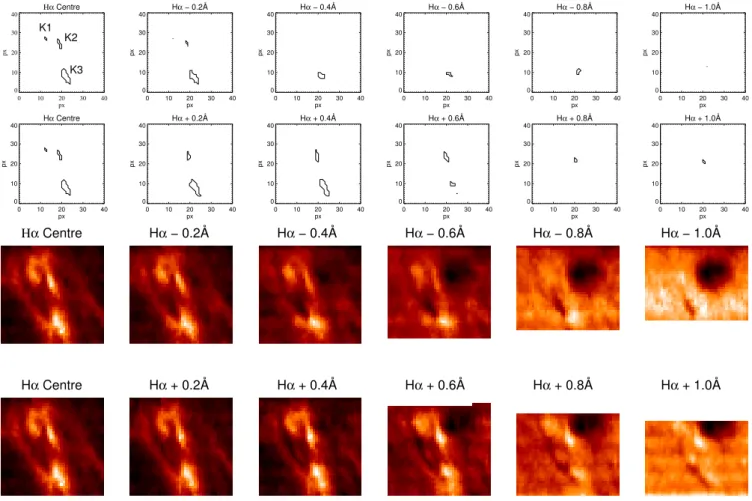
Fig. 1.C1.2 class solar flare observed in NOAA 10410 active region at 16:03:45 UT on 16 July 2003. Upper panel: sizes and shapes of the flaring kernels K1, K2 and K3 delimited with isophote on the level of 75% of the net maximum brightness of the kernel. Lower panels: 2-D quasi-monochromatic images of the observed flaring kernels, obtained simultaneously in various wavelenghts. See main text for details.
The observational data and data reduction are described in Sect. 2 while the results are presented in Sect. 3 and discus-sion of the results in Sect. 4.
2 Observations and data reduction
The Hαspectra-imaging observations of the flaring kernels were collected with the Large Coronagraph (LC) equipped with MSDP and Solar Eclipse Coronal Imaging System (SECIS) at the Białkow Observatory of the University of Wrocław. The LC has a 53-cm diameter main objective, its effective focal length is equal to 1450 cm. Spatial resolu-tion of the instrument, usually limited by visual condiresolu-tions, is about 1 s of the arc. During windy days theLC, which is very susceptible to gusts was replaced by our Horizontal Tele-scope with a compact Jensch-type coelostat, with the main objective of the aperture of 15 cm and the focal length of 5 m. The MSDP spectrograph has a rectangular (2-D) entrance window, which covers an equivalent area of 325×41 arcsec2
on the Sun (Mein, 1991; Rompolt et al., 1994) and creates
Hαspectra for all pixels inside the field of view simultane-ously.
16:00 16:05 16:10 16:15 16:20 16:25 Time [UT]
10−8
10−7
10−6
F [W m
−2] GOES 1 − 8 Å
GOES 0.5 − 4 Å
6562.0 6562.5 6563.0 6563.5
Wavelength [Å] 0
5 10 15 20 25
Area [px]
K2 K3
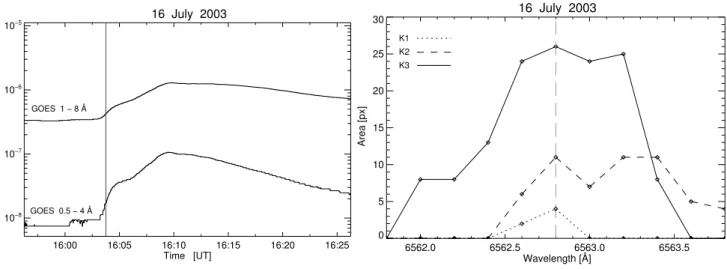
Fig. 2.Areas of the K1, K2 and K3 flaring kernels of the C1.2 class solar flare at 16:03:45 UT on 16 July 2003. Left panel: X-ray GOES fluxes in 0.05–0.4 nm and 0.1–0.8 nm bands recorded during the flare. The vertical line marks 16:03:45 UT. Right panel: areas of the K1, K2 and K3 flaring kernels (in pixels) measured simultaneously in various wavelengths in a frame of the Hαline profile (up to±1.0 ˚A from the Hαline center). The vertical dashed line points the Hαline center.
very suitable for studies of the fast variations of the spectral line profiles emitted by individual Hαflaring kernels or in-vestigations of the solar structures observed simultaneously in various wavelengths and can be a very valuable source of the observational data for modeling of the sub-second flaring processes (Heinzel, 2003).
In a course of three observational seasons 2003–2005 we recorded data for almost forty solar flares. For each event we recorded 10 or 20 thousand spectra-images with time reso-lution freely selected between 0.04 s (25 images per second) and 0.075 s (slightly more than 13 images per second) – de-pending on the intensity of the light beam. More detailed in-formation concerning the MSDP-SECIS system and data re-duction are available in papers by Radziszewski et al. (2006) and (2007).
As a result of the numerical reduction of the collected spectra-images of each particular flare we obtained a series of 10 or 20 thousand of “data-cubes”, consisting of thirteen two-dimensional, quasi-monochromatic images (band-width equal to 0.06 ˚A), separated in wavelengths by 0.2 ˚A. Due to the actual localizations of the investigated flaring kernels in the frames of the fields of views, we decided to present the restored profiles consistently for all flares up to±1.0 ˚A from the Hαline center only.
The collected data allow us to investigate local temporal variations of the Hαemission and Doppler-shifts of the emit-ting material. The temporal variations of the obtained Hα
data (profiles, intensities, areas of the emitting kernels, etc.) were compared with temporal variations of the X-ray fluxes recorded with Reuven Ramaty High Energy Solar Spectro-scopic Imager (RHESSI) and also with X-ray photometers on board the GOES satellites. Our observations, based on high
cadence spectra-imaging spectrograph MSDP and RHESSI satellite data, have confirmed the high temporal correlation between HXR and Hαemissions for several solar flares (see Radziszewski et al., 2006, 2007, and references therein).
From among almost forty events observed with LC-MSDP-SECIS or HT-LC-MSDP-SECIS systems we have chosen for this work three small and medium GOES class events, observed from the beginning of the soft X-ray flux increase and having well separated, individual flaring kernels. The quality of the selected data was among the best from all col-lected (stable pointing of the telescope as well as good see-ing and weather conditions). The selected data include: C1.2 class solar flare observed in NOAA 10410 active region at 16:10 UT on 16 July 2003 (Figs. 1 and 2); B2.5 class so-lar fso-lare in NOAA 10603 active region observed at 07:26 UT on 3 May 2004 (Figs. 3 and 4) and C8.3 class solar flare in NOAA 10786 active region observed at 08:03 UT on 12 July 2005 (Figs. 5 and 6).
3 Results of the observations
0 10 20 30 40 px 0 10 20 30 40
px
Hα Centre
0 10 20 30 40
px 0 10 20 30 40
px
Hα − 0.2Å
0 10 20 30 40
px 0 10 20 30 40
px
Hα − 0.4Å
0 10 20 30 40
px 0 10 20 30 40
px
Hα − 0.6Å
0 10 20 30 40
px 0 10 20 30 40
px
Hα − 0.8Å
0 10 20 30 40
px 0 10 20 30 40
px
Hα − 1.0Å
0 10 20 30 40
px 0 10 20 30 40
px
Hα Centre
0 10 20 30 40
px 0 10 20 30 40
px
Hα + 0.2Å
0 10 20 30 40
px 0 10 20 30 40
px
Hα + 0.4Å
0 10 20 30 40
px 0 10 20 30 40
px
Hα + 0.6Å
0 10 20 30 40
px 0 10 20 30 40
px
Hα + 0.8Å
0 10 20 30 40
px 0 10 20 30 40
px
Hα + 1.0Å
K4 K5
Hα Centre
Hα Centre
Hα − 0.2Å
Hα + 0.2Å
Hα − 0.4Å
Hα + 0.4Å
Hα − 0.6Å
Hα + 0.6Å
Hα − 0.8Å
Hα + 0.8Å
Hα − 1.0Å
Hα + 1.0Å
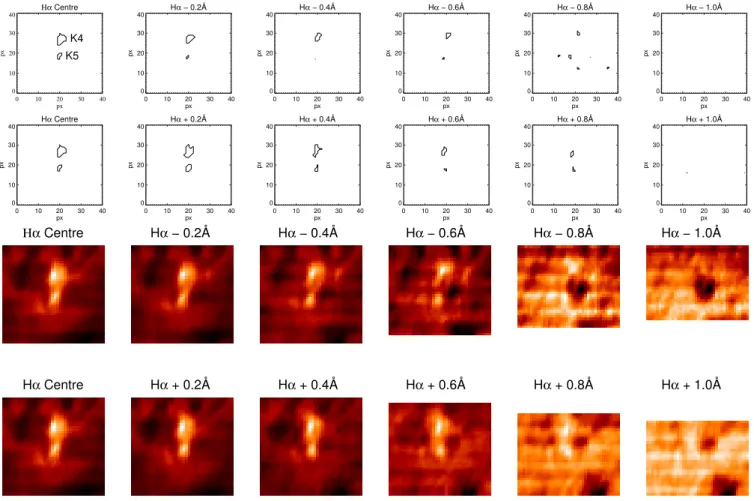
Fig. 3.B2.5 class solar flare (kernels K4 and K5) in NOAA 10603 active region observed at 07:24:33 UT on 3 May 2004. The upper and lower panels are the same as on Fig. 1.
3 May 2004
07:15 07:20 07:25 07:30 07:35 07:40
Time [UT]
10−8
10−7
10−6
F [W m
−2]
GOES 1 − 8 Å
GOES 0.5 − 4 Å
3 May 2004
6562.0 6562.5 6563.0 6563.5
Wavelength [Å] 0
5 10 15 20 25
Area [px]
K4 K5
0 10 20 30 40 px 0 10 20
px
0 10 20 30 40
px 0 10 20
px
0 10 20 30 40
px 0 10 20
px
0 10 20 30 40
px 0 10 20
px
0 10 20 30 40
px 0 10 20
px
0 10 20 30 40
px 0 10 20
px
0 10 20 30 40
px 0 10 20 30 40
px
Hα Centre
0 10 20 30 40
px 0 10 20 30 40
px
Hα + 0.2Å
0 10 20 30 40
px 0 10 20 30 40
px
Hα + 0.4Å
0 10 20 30 40
px 0 10 20 30 40
px
Hα + 0.6Å
0 10 20 30 40
px 0 10 20 30 40
px
Hα + 0.8Å
0 10 20 30 40
px 0 10 20 30 40
px
Hα + 1.0Å
K7
Hα Centre
Hα Centre
Hα − 0.2Å
Hα + 0.2Å
Hα − 0.4Å
Hα + 0.4Å
Hα − 0.6Å
Hα + 0.6Å
Hα − 0.8Å
Hα + 0.8Å
Hα − 1.0Å
Hα + 1.0Å
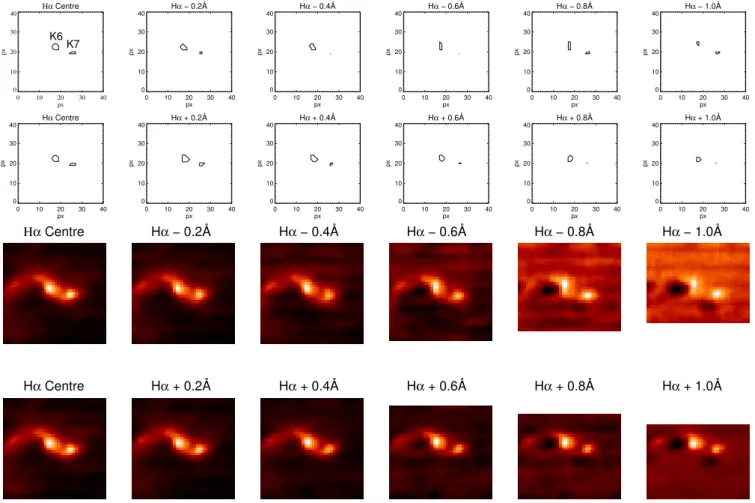
Fig. 5.C8.3 class solar flare (kernels K6 and K7) in NOAA 10786 active region observed at 08:01:22 UT on 12 July 2005. The upper and lower panels are the same as on Fig. 1.
12 July 2005
07:55 08:00 08:05 08:10 08:15 08:20
Time [UT]
10−8
10−7
10−6
10−5
F [W m
−2] GOES 1 − 8 Å
GOES 0.5 − 4 Å
12 July 2005
6562.0 6562.5 6563.0 6563.5
Wavelength [Å] 0
5 10 15
Area [px]
K6 K7
Fig. 7. Plasma located on various depths in the lower part of the magnetic loops is excited and heated by non-thermal electrons of various energies. Due to the cone-shaped lower part of the loop, the actual size of the flaring kernel will depend on the wavelength in a frame of the Hαline profile.
there are 2-D quasi-monochromatic images presented of the selected flaring kernels, obtained simultaneously in various wavelengths and (as a contour maps) sizes and shapes of the flaring regions, delimited with an arbitrary selected isophote on the level of 75% of the net maximum brightness of the kernel (the intensity of the brightest pixel of the evaluated kernel minus the mean emission of the adjacent quiet chro-mosphere). We checked various methods of determination of the kernels’ sizes in various wavelengths. According to us, the applied method is the most stable and reliable, especially for long series of data, taken under circumstances of variable atmospheric transmittance and observing. We also checked brightness distributions of the investigated kernels and we did not reveal any local strong increases of brightness, which could cause false estimations of the kernel sizes.
After evaluation of whole series of data (usually covering a period of 8–10 min of the flare) we have found that:
– the most significant changes in emission were detected during the early phases of the flare, when high-energy particles beams hit the chromosphere;
– the sizes of the flaring kernels (area or equivalent ra-dius defined as a rara-dius of the circle having the same area as irregular surface) of the investigated flares are the greatest when measured on images taken in the Hα
line center or in wavelengths close to the line center; – the effect of the decrease of the kernels’ areas in Hα
line wings was also detected for a series of consecutive images taken during the increase phases of the flares; – the sizes of the flaring kernels decreased significantly
and systematically when measured on images taken (at
exactly the same moment) in increased distances from the line center toward the line wings (see Figs. 2, 4 and 6), i.e. to some extent, toward the deeper layers of the chromosphere (see Fig. 7). Most of the kernels show roughly a symmetrical decrease in the visible areas in increased distances from the line center (kernels K1, K3–K7); one kernel only (K2) shows a very asymmet-rical decrease in the visible areas (it shrank and disap-peared much faster when observed in the blue wing of the Hαline than in the red one). One can also notice a slight increase in the area of the K7 kernel observed in the far blue wing of the Hαline.
The effect of the decrease in the flaring kernels sizes was investigated by us only for faint and mid-class solar flares, while in such flares the individual flaring kernels could be easily identified and measured.
4 Discussion
Taking advantage of the unique parameters and abilities of the MSDP spectrograph we recorded on each spectra-image directly the sizes of the Hαflaring kernels in numerous wave-lengths of the Hαline profile simultaneously, with very short exposure time (0.04–0.075 s) and under exactly the same in-fluence of the atmospheric observation. We have found that the sizes of the flaring kernels are greatest when measured on images taken in the Hαline center and decreased signifi-cantly when measured on images taken in increased distances from the line center toward both line wings (see Figs. 2, 4 and 6, right panels).
Due to the very heterogenous vertical structure and ob-vious strong turbulence of the plasma located in the feet of the flaring loop, fast bulk motions of the plasma caused by chromospheric evaporation processes it is not a straight, time independent and linear dependent between wavelengths and depth. Nevertheless, our observational results, obtained for numerous flaring kernels of the faint and mid-class solar flares could be caused by a cone-shape of the lower parts of the magnetic loops channeling particle beams exciting chro-mospheric plasma (see diagram on Fig. 7).
In this work we presented in detail the results obtained for seven flaring kernels observed in three solar flares only. A brief inspection of the observations taken during the other ten flares of various GOES classes (B and C), recorded during less favorable observing conditions and having lower over-all quality, revealed qualitatively the same effect. However, the effect was not detected by us in the strong X3.8 flare ob-served on 17 January 2005, having bright and extended flar-ing structures. Such strong flares (especially X class events) seem to be not sufficient for our investigations, due to the lack of well separated, individual kernels.
already reported by Ji et al. (2004).
Acknowledgements. This work was supported by the Polish Min-istry of Science and Higher Education, grant number N203 022 31/2991.
Topical Editor R. Forsyth thanks N. Labrosse and another anonymous referee for their help in evaluating this paper.
References
Aschwanden, M. J.: Physics of the Solar Corona, Springer Verlag, p.127, 2006.
Foukal, P.: Solar Astrophysics, John Wiley and Sons Inc., p.364, 1990.
Gabriel, A. H.: A magnetic model of the solar transition region, Roy. Soc. Phil. Trans. Ser.A, 281, 339–352, 1976.
Heinzel, P.: Understanding solar flares from optical observations: How do particle beams affect the lower atmosphere?, Adv. Space Res., 32, 2393–2402, 2003.
Ji, H., Wang, H., Goode, P. R., Jiang, Y., and Yurchyshyn, V.: Traces of the dynamic current sheet during a solar flare, Astrophys. J., 607, L55–L58, 2004.
Mein, P.: Solar 2D spectroscopy – A new MSDP instrument, As-tron. Astrophys., 248, 669–676, 1991.
259–271, 2000.
Radziszewski, K., Rudawy, P., and Phillips, K. J. H.: High time resolution observations of solar Hαflares. I., Astron. Astrophys., 461, 303–313, 2007.
Radziszewski, K., Rudawy, P., Phillips, K. J. H., and Dennis, B. R.: High time resolution observations of the solar flare Hαemission, Adv. Space Res., 37, 1317–1322, 2006.
Rompolt, B., Mein, P., Mein, N., Rudawy, P., and Berlicki, A.: The MSDP Recently Installed at the Spectrograph of the Large Coro-nagraph of the Wroclaw Astronomical Institute, JOSO Annual Report 1993, edited by: v. Alvensleben, A., 87–91, 1994. Rudawy, P., Phillips, K. J. H., Gallagher, P. T., Williams, D.,
Rompolt, B., and Keenan, F. P.: Search for 1–10 Hz modula-tions in coronal emission with SECIS during the August 11, 1999 eclipse, Astron. Astrophys., 416, 1179–1186, 2004.
Stix, M.: The Sun, An Introduction, Springer Verlag, p.274, 1989. Vernazza, J. E., Avrett, E. H., and Loeser, R.: Structure of the
So-lar Chromosphere. Basic Computations and Summary of the Re-sults, Astrophys. J., 184, 605–631, 1973.