Influence of Various Acidic Beverages on
Tooth Erosion. Evaluation by a New Method
Stefan Zimmer*, Georg Kirchner, Mozhgan Bizhang, Mathias Benedix
Dept. of Operative and Preventive Dentistry, School of Dentistry, Witten/Herdecke University, Alfred-Herrhausen-Str. 50, Witten, Germany
Abstract
Material & Methods
We have analyzed the loss of enamel and dentine after exposure to different non-alcoholic drinks with a simple new method using bovine teeth. 100 enamel and 100 dentine speci-mens from freshly extracted bovine incisors were randomly attributed to 10 groups (n=10 for enamel and dentine each). Prior to the start of the experiment all specimens were weighed using a precision balance. The mean initial masses (SD) were 35.8 mg (7.2) for enamel and 24.7 mg (7.0) for dentine. No statistically significant differences were found be-tween groups for initial masses (p>0.05, ANOVA with Bonferroni post hoc test). Thereafter, all specimens of one group were simultaneously placed in 200 ml of the following fluids: Coca-Cola, Coca-Cola light, Sprite, apple juice, Red Bull, orange juice, Bonaqua Fruits (Mango-Acai), tap water, chlorinated swimming pool water, and lemon juice. Fluids were continuously ventilated at 37° C for 7 days. Thereafter the specimens were weighed again and the mean mass loss was calculated.
Results
The values were (enamel/dentine): Coca-Cola 7.5 mg/6.6 mg; Coca-Cola light 5.2 mg/3.5 mg, Sprite 26.1 mg/17.7 mg, apple juice 27.1 mg/15.2 mg, Red Bull 16.6 mg/17.0 mg, or-ange juice 24.3 mg/20.2 mg, Bonaqua Fruits (Mango-Acai) 17.8 mg/16.2 mg, tap water -0.2 mg/-0.3 mg, swimming pool water -0.3 mg/-0.2 mg, and lemon juice 32.0 mg/28.3 mg. From all drinks, Cola and Cola light showed the least erosivity (p<0.001, ANOVA with Bonferroni post hoc test) whereas lemon juice showed statistically significant higher erosivity than all other drinks except Sprite and apple juice (p<0.01, ANOVA with Bonferroni post hoc test).
Conclusions
In conclusion, erosivity of common non-alcoholic drinks varies widely. For example, Sprite, apple juice, and orange juice are about five times more erosive than Coca-Cola light. The findings from the present study should be taken into account in choosing a diet that provides satisfactory nutrition while minimizing tooth erosion.
a11111
OPEN ACCESS
Citation:Zimmer S, Kirchner G, Bizhang M, Benedix M (2015) Influence of Various Acidic Beverages on Tooth Erosion. Evaluation by a New Method. PLoS ONE 10(6): e0129462. doi:10.1371/journal. pone.0129462
Academic Editor:Jonathan A Coles, Glasgow University, UNITED KINGDOM
Received:February 8, 2015
Accepted:May 9, 2015
Published:June 2, 2015
Copyright:© 2015 Zimmer et al. This is an open access article distributed under the terms of the Creative Commons Attribution License, which permits unrestricted use, distribution, and reproduction in any medium, provided the original author and source are credited.
Data Availability Statement:All relevant data are within the paper.
Funding:The authors received no specific funding for this work.
Introduction
Tooth erosion is a chronic loss of dental hard tissues (enamel and dentine) caused by acids of intrinsic (gastric) or extrinsic (dietary) origin. To some extent, it is a physiological and age
de-pendent process related to acid containing food intake [1]. A pathological status is reached at
the latest when the teeth are so worn that their functionality is impaired [2], but it may also be
already perceived by patients and dentists when the appearance of the teeth is affected [1]. In
contrast to the physiological status of erosion, no age dependence is found in the pathological
form [1]. It is classified as a disease in the WHO ICD10-classification [3].
The prevalence of tooth erosions is high and continuously growing within populations [4].
A recent study from Israel [5] showed a prevalence of between 36.6% in 15-18-year-olds and
61.9% in 55-60-year-olds. In their systematic review, Salas et al. showed a prevalence of 30.4%
in 8-19-year-old children and adolescents [6]. Although the prevalence of tooth erosion is high
and increasing in many countries, its relevance for oral health is not comparable to caries and periodontitis. For example, no tooth loss is reported due to tooth ersosion in Germany, but
14.1 teeth are lost on average due to caries and periodontitis at the age of 65–74 years [7].
Since no age dependence is found [1], an independent variable may be responsible for severe
levels of erosive destruction. Mulic et al. found that gastric acids (reflux or vomiting), fruit
juices and soft drinks are risk indicators for erosive wear [8]. This was confirmed in a
meta-analysis by Hi et al. where soft drinks showed the highest and statistically significant odds ratio
(2.41) for the development of dental erosions [9]. In accordance, Habib et al. found a
statistical-ly significant odds ratio of 2.38 for acidic fruit juice consumption [10]. Since the consumption
of soft drinks is continuously increasing in developed countries [11], the knowledge about their
erosivity is important in dietary and dental counseling. However, Barbour and Lussi stated that
“a ranking for the in vivo erosivity of different acidic drinks. . .is rather complicated if not
im-possible”[12]. The need for valid data on the erosivity of soft drinks having been recognized,
the question arises which methodology could be used to address this problem. To date, several
qualitative and quantitativein-vivo,in-situandin-vitromethods have been used to determine
tooth erosivity in enamel and dentine [13,14]. For diet counseling, only quantitative data are
relevant. According to Schlueter et al., profilometry is the most commonly applied quantitative method, followed by measurement of surface hardness and microradiography. Measurement of calcium and phosphate release from dental hard tissues in solutions is another common
method [13].
Non-contact, 3-D-profilometry is a valid tool in determining surface tissue loss, but it does
not allow to measure the mineral loss occurring beneath a pseudo-intact surface [13]. This is
possible by microradiography but, like 3-D-profilometry, specimen preparation and analysis are time consuming and require expensive technical equipment. Measuring surface hardness is at least a simple and quick method, but can only show the status of the remaining surface with-out giving information abwith-out lost hard tissue at the surface of the specimen.
A possible simple and meaningful method may be gravimetric analysis. This method evalu-ates the erosivity by weighing enamel or dentine specimens before and after erosive exposition. To our knowledge, the first and only studies using a gravimetric method were performed by
von Fraunhofer and Rogers using a small number of human tooth samples [15,16]. In
consid-eration of the described needs and methodologies, it was the aim of the present study to gener-ate some data for commonly consumed non-alcoholic beverages with a newly developed gravimetric method using bovine tooth specimens. Additionally, the erosivity of chlorinated swimming pool water should be analyzed since pathologic erosion was observed in competitive
Materials and Methods
This was anin-vitrostudy on bovine enamel and dentine specimens. All animal material
(teeth) used in this study originated from the slaughterhouse Schlachthof Bochum GmbH,
Freudenbergstr. 45K, 44809 Bochum—Hamme / Germany. All cattle were slaughtered for
meat production and not for research purposes.
Before the main experiment was started, a preliminary test was performed with ten enamel and dentine specimens each to validate the study design and to determine an adequate expo-sure time. In the main experiment, similar enamel and dentine specimens (n = 200, 5 mm Ø) were gathered from freshly extracted bovine incisors and ground down to a thickness of 1 mm. Specimens were randomly attributed to 10 groups (n = 10 enamel and dentine specimens each). Prior to the start of the experiment all specimens were dried on blotting-paper at room temperature for one hour and weighed using a precision balance (Sartorius BP61S, Göttingen, Germany, metering accuracy 0.1 mg). The mean initial masses (SD) were 35.8 mg (7.2) for enamel and 24.7 mg (7.0) for dentine. No statistically significant differences were found
be-tween groups for initial masses (p>0.05, ANOVA with Bonferroni post hoc test). Thereafter,
all specimens of one group were simultaneously placed in a pvc pannier which was suspended in a plastic container containing 200 ml of the following fluids: Coca-Cola, Coca-Cola light, Sprite (all Coca-Cola Erfrischungsgetränke AG, Germany), apple juice (Amecke Fruchtsaft GmbH, not-from-concentrate juice, clear), Red Bull (Red Bull GmbH, Germany), orange juice Direktsaft (real, -Handels GmbH), Bonaqua Fruits (Mango-Acai) (Coca-Cola Erfrischungsge-tränke AG, Germany), tap water (Chlorine free, disinfected with UV-irradiation, public water
supply, Witten/Germany, fluoride concentration<0.25 ppm), swimming pool water from a
local public swimming pool (Witten-Annen/Germany), and lemon juice (Sportfit Fruchtsaft GmbH & Co KG). According to the product declarations, none of the commercial products contained any preservatives. Tap water served as a negative, lemon juice as a positive reference. Fluids with specimens were continuously ventilated by an aquarium pump at 37°C for 7 days. The air outlet was placed at the bottom of the containers to ensure a good aeration from the ground to the surface of the fluids. The fluids were replaced daily. Thereafter the specimens were removed from the fluids, rinsed with saline solution for 30 seconds and dried on blotting-paper at room temperature for one hour. Subsequently they were weighed again and the mass loss was calculated in mg. The pH values of all liquids were determined (Beckmann Coulter
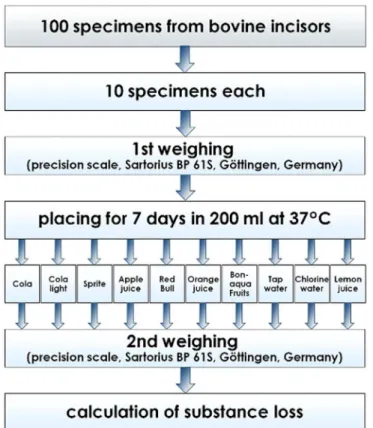
GmbH Krefeld, Germany, Serial# 0217107).Fig 1shows the flow diagram of the study design
which was carried out twice, separately for enamel and dentine.
Since a Kolmogorov Smirnov test showed normal distribution, means and standard devia-tions were calculated. One way ANOVA with Bonferroni post hoc test was used to compare the results between groups.
Results
Table 1shows the mean (SD) mass losses of enamel and dentine after seven days as well as the
results of the pH measurement. Coca-Cola and Coca-Cola light showed the least erosivity
(p<0.001) with respect to enamel and dentine. For dentine, lemon juice showed statistically
significant higher erosivity than all other liquids (p<0.001). This was also true for enamel
ex-cept for Sprite and apple juice (p<0.01). No statistically significant differences were found
be-tween the other liquids
Discussion
Fig 1. Flow diagram of the study design.The study protocol was conducted twice, separately for enamel and dentine.
doi:10.1371/journal.pone.0129462.g001
Table 1. Mean weight loss of enamel and dentine after seven days and initial pH of liquids.
Hard tissue loss in mg (mean, SD)
Enamel1 Dentine2 Initial pH
Coca-Cola 7.5 (0.6)a 6.6 (0.7)a 2.47
Coca-Cola light 5.2 (0.8)a, d 3.5 (0.8)a, c 2.59
Sprite 26.1 (7.1)b, c 17.7 (3.4)b 2.68
Apple juice (Amecke) 27.1 (6.1)b, c 15.2 (4.6)b 3.38
Red Bull 16.6 (2.9)b 17.0 (1.8)b 3.38
Orange juice (real) 24.3 (4.9)b 20.2 (4.8)b 3.87
Bonaqua Fruits(Mango Acai) 17.8 (1.7)b 16.2 (3.9)b 3.63
Tap water -0.2 (0.3)d -0.3 (0.3)c 7.40
Chlorinated swimming pool water -0.3 (0.3)d -0.2 (0.4)c 7.31
Lemon juice (Sportfit) 32.0 (5.7)c 28.3 (6.7) 2.50
1
Enamel: Values with the same letters are not significantly different. Cola and Cola light showed
significantly lowest values (p<0.001) of all drinks,lemon juice showed significantly higher erosivity than all other drinks except Sprite and apple juice (p<0.01).
2
Dentine: Values with the same letters are not significantly different. All other values are significantly different at p<0.001
to gain and they have a known and homogenous history. All teeth originated from the same cattle herd, all cattle received the same feed and were at the same age when they were slaugh-tered. There was no noteworthy fluoride exposure from food or water. In addition, bovine teeth are much bigger than human teeth and therefore it is easier to prepare suitable specimens. There are no ethical concerns in contrast to the use of extracted human teeth. Nor is it possible to get a homogenous sample of extracted human teeth. They are largely varying in age, fluoride exposure and were subjected to different diets. Furthermore, it has been shown that bovine
teeth are an equivalent substitute to human teeth for erosion studies [18]. All specimens used
in the present study had approximately the same diameter (5 mm), thickness (1 mm) and
therefore the same surface (55.0 mm2) allowing the same exposure to the tested liquids.
This study provides no absolute data on the hard tissue loss caused by tooth erosion in the oral cavity because individual host factors such as saliva composition and flow rate as well as
individual drinking habits have a strong influence on this outcome [19,20]. Therefore, it was
not intended to simulate natural conditions of the oral cavity. The aim of this study was to pro-vide a relative value of erosivity for the tested soft drinks in the sense of a material property. For diet counseling the data will allow a ranking for the most erosive beverages compared to the erosivity of tap water. However, it has to be considered, that the results of the present study are only valid for the tested brands of soft drinks and juices. Other brands may have a different erosivity.
Daily counseling of erosive drinks is often misleadingly based on the pH-value of the respec-tive products. However, the pH alone gives no valid information about the erosivity of drinks.
Although enamel may be dissolved at a pH of 5.2–5.9 [21] and dentine already at pH 6.0–6.8
[22] there is no fixed critical pH for dental erosion [19]. Besides pH, factors such as acid type
(e.g. phosphoric acid or citric acid), buffer capacity, adhesion, chelating effect, phosphate-,
fluoride- and calcium content of the drink play a role for the erosive properties of a drink. [19]
Neither is it enough to know the titratable acid of a drink to judge its erosive capacity. In con-trast, the gravimetric method used in the present study is suitable to include all these proper-ties. However, it is not suitable to include patient related factors such as drinking habits, saliva composition and flow rate, and oral hygiene measures (e.g. fluoride administration). These fac-tors can only be determined in the framework of a meticulous dental examination and risk as-sessment and are not a part of diet counseling.
In their gravimetric study on dental enamel, von Fraunhofer and Rogers used two human specimens per beverage in a 14-day study. Their results were in good accordance with the
pres-ent study. From all soft drinks, Coca-Cola showed the lowest (2.78 mg / cm2), Sprite an average
(8.60 mg / cm2) and Diet Mountain Dew (14.82 mg / cm2) the highest substance loss. The same
as in our study, tap water showed no erosivity (-0.05 mg / cm2) [15]. Jensdottir et al. used a
dif-ferent method in their study on five cola drinks and five orange juices [23]. At the beginning of
the experiment, the drinks were titrated with 1 M NaOH until a pH of 5.5 was reached. The ti-tratable acid for the orange juices was nearly six times higher than for the cola drinks. Thereaf-ter, 50 mg hydroxyapatite (HAP) powder was added to 50 mL of the original solutions. The
dissolved HAP was determined and an“erosive potential”was calculated as mg HAP dissolved
three minutes. This was done on the basis of the preliminary study in order to allow a good dis-crimination between the tested liquids. It is clear that such a long exposure time does not corre-late with a single drink consumption. However, if the exposure time of the teeth to acidic drinks is five minutes per day only, the seven days from the present study reflect a life time of 5.5 years. Jager et al. determined the erosive potential of soft drinks as loss of calcium to the beverage after different exposure times. From the calcium concentrations found in the beverages by
atomic absorption spectrometry, they calculated the enamel loss of the specimens inμm. After
three minutes Coca-Cola showed a loss of 0.34μm, apple juice 1.06μm, and Sprite the highest
value (3.74μm) [20]. With respect to the ranking of the three drinks, the results remained
sta-ble during the entire study period of 30 minutes. However, as already shown in the short-term
study of Jensdottir et al. [23], the erosivity of the drinks on enamel developed differently over
time. After 30 minutes of exposure, Coca-Cola showed a loss of 1.18μm, apple juice 3.81μm,
and Sprite 5.34μm. In contrast to the present study, the erosivity of Sprite was still higher than
those of apple juice at the end of the study. The reason may be the different variety of apple juices, but also the different exposure times of both studies. Having in mind the results of Jens-dottir et al. and the development of erosive potential between three and 30 minutes exposure time in the study of Jager et al., it might be speculated that the erosive potential of Sprite and apple juice might be equivalent after seven days as found in the present study.
Although pathologic erosion was observed in competitive swimmers [17], the erosive
poten-tial of swimming pool water did not differ from tap water. However, it must be considered that the teeth of competitive swimmers are exposed to water for hours every day. Since water is also undersaturated with respect to the minerals of dental hard tissues, there is also dissolution of
enamel in water as a function of time [24]. Enamel and dentine specimens from tap water and
pool water showed a small mass increase during the study (0.2 and 0.3 mg). This might be at-tributed to some water absorption of the specimens.
Although dentine dissolves already at a higher pH than enamel, the present study showed more substance loss for enamel. This can be explained by the fact that dentine has a much higher content of organic material (24.69 weight %) than enamel (0.98 weight %), primarily in
the form of collagen [25]. This collagen network is not dissolved by acid and may have a sealing
effect on the exposed dentine surface preventing further dissolution of mineral after a certain time. This is supported by the fact that a soft covering was found at the dentine surface after seven days exposure time. Therefore, a shorter exposure time for dentine might be discussed for future studies. However this does not mean that the smear layer might prevent further
den-tine loss in thein-vivo-situation since it will be brushed away by daily oral hygiene.
Conclusions
Erosivity of common non-alcoholic drinks as measured in vitro by substance loss of bovine enamel and dentine varies widely. For example, Sprite, apple juice, and orange juice are about five times more erosive than Coca Cola light. The findings from the present study may be help-ful in daily dietary and dental counseling since they allow identifying the most erosive non-al-coholic beverages. However, it has to be considered by dental professionals, that not only dental aspects are important in nutrition counseling. Despite its high erosivity, orange juice may be a valuable contribution to a healthy nutrition whereas other non alcoholic drinks with low erosivity are not.
Acknowledgments
Author Contributions
Conceived and designed the experiments: SZ GK MBi MBe. Performed the experiments: GK MBe. Analyzed the data: SZ. Contributed reagents/materials/analysis tools: SZ GK MBe. Wrote the paper: SZ MBi.
References
1. Bartlett D, Dugmore C (2008) Pathological or physiological erosion—is there a relationship to age? Clin
Oral Investig 12 Suppl 1: S27–31. doi:10.1007/s00784-007-0177-1PMID:18228061
2. Smith BG, Bartlett DW, Robb ND (1997) The prevalence, etiology and management of tooth wear in the United Kingdom. J Prosthet Dent 78: 367–372. PMID:9338867
3. WHO (2015) International Statistical Classification of Diseases and Related Health Problems 10th Revision.
4. Jaeggi T, Lussi A (2014) Prevalence, incidence and distribution of erosion. Monogr Oral Sci 25: 55–73.
doi:10.1159/000360973PMID:24993258
5. Vered Y, Lussi A, Zini A, Gleitman J, Sgan-Cohen HD (2014) Dental erosive wear assessment among adolescents and adults utilizing the basic erosive wear examination (BEWE) scoring system. Clin Oral Investig 18: 1985–1990. doi:10.1007/s00784-013-1175-0PMID:24420504
6. Salas MM, Nascimento GG, Huysmans MC, Demarco FF (2015) Estimated prevalence of erosive tooth wear in permanent teeth of children and adolescents: An epidemiological systematic review and meta-regression analysis. J Dent 43: 42–50. doi:10.1016/j.jdent.2014.10.012PMID:25446243
7. Micheelis W, Schiffner U (2006) Vierte Deutsche Mundgesundheitsstudie (DMS IV); (IDZ) IdDZ, editor. Köln: Deutscher Zahnärzte Verlag. 1–502 p.
8. Mulic A, Skudutyte-Rysstad R, Tveit AB, Skaare AB (2012) Risk indicators for dental erosive wear among 18-yr-old subjects in Oslo, Norway. Eur J Oral Sci 120: 531–538. doi:10.1111/j.1600-0722. 2012.00997.xPMID:23167470
9. Li H, Zou Y, Ding G (2012) Dietary factors associated with dental erosion: a meta-analysis. PLoS One 7: e42626. doi:10.1371/journal.pone.0042626PMID:22952601
10. Habib M, Hottel TL, Hong L (2013) Prevalence and risk factors of dental erosion in American children. J Clin Pediatr Dent 38: 143–148. PMID:24683778
11. Gambon DL, Brand HS, Veerman EC (2012) Dental erosion in the 21st century: what is happening to nutritional habits and lifestyle in our society? Br Dent J 213: 55–57. doi:10.1038/sj.bdj.2012.613PMID: 22836413
12. Barbour ME, Lussi A (2014) Erosion in relation to nutrition and the environment. Monogr Oral Sci 25: 143–154. doi:10.1159/000359941PMID:24993263
13. Schlueter N, Hara A, Shellis RP, Ganss C (2011) Methods for the measurement and characterization of erosion in enamel and dentine. Caries Res 45 Suppl 1: 13–23. doi:10.1159/000326819PMID: 21625129
14. Shellis RP, Ganss C, Ren Y, Zero DT, Lussi A (2011) Methodology and models in erosion research: discussion and conclusions. Caries Res 45 Suppl 1: 69–77. doi:10.1159/000325971PMID:21625135
15. Fraunhofer von JA, Rogers MM (2004) Dissolution of dental enamel in soft drinks. General Dentistry 52: 308–312. PMID:15366295
16. Fraunhofer von JA, Rogers MM (2005) Effects of sports drinks and other beverages on dental enamel. General Dentistry 53: 28–31. PMID:15779219
17. Geurtsen W (2000) Rapid general dental erosion by gas-chlorinated swimming pool water. Review of the literature and case report. Am J Dent 13: 291–293. PMID:11764119
18. Wegehaupt F, Gries D, Wiegand A, Attin T (2008) Is bovine dentine an appropriate substitute for human dentine in erosion/abrasion tests? J Oral Rehabil 35: 390–394. doi:10.1111/j.1365-2842.2007. 01843.xPMID:18405276
19. Lussi A, Carvalho TS (2014) Erosive tooth wear: a multifactorial condition of growing concern and in-creasing knowledge. Monogr Oral Sci 25: 1–15. doi:10.1159/000360380PMID:24993253
20. Jager DH, Vieira AM, Ruben JL, Huysmans MC (2012) Estimated erosive potential depends on expo-sure time. J Dent 40: 1103–1108. doi:10.1016/j.jdent.2012.09.004PMID:23000470
21. Schmidt-Nielsen B (1946) The Solubility of Tooth Substance in Relation to the Composition of Saliva. Acta Odontol Scand 7. PMID:20989514
23. Jensdottir T, Holbrook P, Nauntofte B, Buchwald C, Bardow A (2006) Immediate erosive potential of cola drinks and orange juices. J Dent Res 85: 226–230. PMID:16498068
24. Dawes C (2003) What is the critical pH and why does a tooth dissolve in acid? J Can Dent Assoc 69: 722–724. PMID:14653937