ACPD
6, 1413–1453, 2006New cloud microphysical model and parameterization
N. Kuba and Y. Fujiyoshi
Title Page Abstract Introduction Conclusions References Tables Figures
◭ ◮
◭ ◮
Back Close Full Screen / Esc
Print Version
Interactive Discussion
EGU
Atmos. Chem. Phys. Discuss., 6, 1413–1453, 2006 www.atmos-chem-phys.org/acpd/6/1413/
SRef-ID: 1680-7375/acpd/2006-6-1413 European Geosciences Union
Atmospheric Chemistry and Physics Discussions
Development of a cloud microphysical
model and parameterizations to describe
the e
ff
ect of CCN on warm cloud
N. Kuba1and Y. Fujiyoshi2 1
Frontier Research Center for Global Change (FRCGC), Japan Agency for Marin-Earth Science and Technology (JAMSTEC), Yokohama, Japan
2
Frontier Research Center for Global Change (FRCGC), Japan Agency for Marin-Earth Science and Technology (JAMSTEC)/Inst. Low. Temp. Sci., Hokkaido Univ., Sapporo, Japan Received: 30 November 2005 – Accepted: 1 January 2006 – Published: 21 February 2006 Correspondence to: N. Kuba ([email protected])
ACPD
6, 1413–1453, 2006New cloud microphysical model and parameterization
N. Kuba and Y. Fujiyoshi
Title Page Abstract Introduction Conclusions References Tables Figures
◭ ◮
◭ ◮
Back Close Full Screen / Esc
Print Version
Interactive Discussion
EGU
Abstract
First, a hybrid cloud microphysical model was developed that incorporates both
La-grangian and Eulerian frameworks to study quantitatively the effect of cloud
condensa-tion nuclei (CCN) on the precipitacondensa-tion of warm clouds. A parcel model and a grid model comprise the cloud model. The condensation growth of CCN in each parcel is
esti-5
mated in a Lagrangian framework. Changes in cloud droplet size distribution arising from condensation and coalescence are calculated on grid points using a two-moment bin method in a semi-Lagrangian framework. Sedimentation and advection are esti-mated in the Eulerian framework between grid points. Results from the cloud model
show that an increase in the number of CCN affects both the amount and the location
10
of precipitation. Additionally, results from the hybrid microphysical model and Kessler’s parameterization were compared.
Second, new parameterizations were developed that estimate the number and size distribution of cloud droplets given the updraft velocity and the number of CCN. The parameterizations were derived from the results of numerous numerical experiments
15
that used the cloud microphysical parcel model. The input information of CCN for these parameterizations is only several values of CCN spectrum (they are given by CCN counter for example). It is more convenient than conventional parameterizations
those need values concerned with CCN spectrum,Candk in the equation ofN=CSk,
or, breadth, total number and median radius, for example. The new parameterizations’
20
predictions of initial cloud droplet size distribution for the bin method were verified by using the aforesaid hybrid microphysical model. The newly developed
parameteriza-tions will save computing time, and can effectively approximate components of cloud
microphysics in a non-hydrostatic cloud model. The parameterizations are useful not only in the bin method in the regional cloud-resolving model but also both for a
two-25
moment bulk microphysical model and for a global model. The effects of sea salt,
ACPD
6, 1413–1453, 2006New cloud microphysical model and parameterization
N. Kuba and Y. Fujiyoshi
Title Page Abstract Introduction Conclusions References Tables Figures
◭ ◮
◭ ◮
Back Close Full Screen / Esc
Print Version
Interactive Discussion
EGU
1. Introduction
Accurate representation of the effect of aerosols on precipitation and on the optical
properties of clouds is a key to improving climate models. Previous studies have shown that variations in cloud nuclei are primarily responsible for variations in cloud droplet concentrations and colloidal stability (Twomey and Squires, 1959; Twomey and Warner,
5
1967; Harshvardhan, 2002). Differences in cloud microstructure cause differences in
optical properties, precipitation efficiency, and cloud lifetime (Twomey, 1974; Albrecht,
1989). For example, an increase in the number of aerosol particles suppresses precip-itation (Rosenfeld, 1999, 2000; Andreae et al., 2004; Givanti and Rosenfeld, 2004). It
is therefore desirable to use cloud microphysical models that can simulate the effects
10
of cloud condensation nuclei (CCN) on the cloud microstructure in climate or cloud models.
Many studies have used detailed microphysical models (Clark, 1973; Takahashi, 1976; Hall, 1980; Reisin et al., 1996; Khain et al., 1999). Vertical intervals between grid points in those studies exceeded 100 m, but grid point supersaturation values were
15
used to estimate CCN nucleation. The number concentration of cloud droplets
signif-icantly influences the radiative properties and precipitation efficiency of clouds and
depends on the CCN spectrum and maximum value of supersaturation near the cloud base. Supersaturation changes very rapidly near the cloud base, so its maximum value cannot be estimated from values on grid points with intervals exceeding tens of meters.
20
Furthermore, supersaturation is affected by updraft velocity and by the number of
acti-vated nuclei. It is therefore advantageous to calculate CCN growth by condensation in a Lagrangian framework to determine if and when each nucleus is activated.
Chen and Lamb (1999) used a detailed microphysical and chemical cloud model (Chen and Lamb, 1994) to simulate orographic cloud formation. A Lagrangian
ap-25
proach using 15 parcels to represent 15 vertical layers was used to examine
micro-physical processes. The results agreed with observations, but it is difficult to apply the
ACPD
6, 1413–1453, 2006New cloud microphysical model and parameterization
N. Kuba and Y. Fujiyoshi
Title Page Abstract Introduction Conclusions References Tables Figures
◭ ◮
◭ ◮
Back Close Full Screen / Esc
Print Version
Interactive Discussion
EGU
eddy simulation model that includes an explicit microphysics scheme. Their grid point vertical interval (25 m) is smaller than previous studies but not small enough to allow an accurate estimate of maximum supersaturation near the cloud base. Furthermore, their CCN classification cannot accurately estimate the number of activated CCN (number of cloud droplets).
5
Rainfall amounts and precipitation area are affected by raindrop fall velocity, which
has a wide distribution (from 10 cm s−1 to 10 m s−1). Differences in fall velocity cannot
be neglected if precipitation is to be simulated precisely, yet conventional bulk models put all rainwater in only one category. Cotton et al. (2003) showed that the Colorado State University Regional Atmospheric Modeling System (RAMS), which has a bulk
10
microphysical model but simulates sedimentation by emulating a full-bin model, can get the results agreeing with the results from a full bin resolving microphysics model
in a large eddy simulation (LES). It shows that the difference in fall velocity caused by
the difference in the size of droplets is important. A bin model can resolve differences
not only in fall velocity but also in collection efficiency more accurately according to the
15
resolution of the bin framework.
The microphysical model in this study is based on the two-moment bin method de-veloped by Chen and Lamb (1994). In addition, a Lagrangian framework is used to estimate the CCN activation and to give the initial cloud droplet size distribution for the bin model. The model estimates both the condensational growth of each cloud
con-20
densation nucleus and the time change of supersaturation in a Lagrangian framework. Therefore, the number concentration of activated CCN and the size distribution of cloud droplets can be estimated accurately. As a result, the relationship between CCN and
precipitation efficiency in warm clouds can be studied precisely.
The model developed in this study can also be used to verify and improve the
mi-25
crophysical bulk model. It is difficult, however, to install this hybrid cloud microphysical
model with both Lagrangian and Eulerian frameworks into a non-hydrostatic 3-D cloud
model. It is also difficult to input a full CCN spectrum into a simulation. Therefore,
ACPD
6, 1413–1453, 2006New cloud microphysical model and parameterization
N. Kuba and Y. Fujiyoshi
Title Page Abstract Introduction Conclusions References Tables Figures
◭ ◮
◭ ◮
Back Close Full Screen / Esc
Print Version
Interactive Discussion
EGU
a cloud microphysical model that uses the bin method. Input CCN data for the param-eterizations can be simplified if the most influential factor can be found. The impacts on precipitation of small particle CCN, large particle CCN, and giant particle CCN were estimated systematically using the hybrid cloud microphysical model. The parameteri-zations developed were then verified using the hybrid cloud microphysical model. The
5
parameterizations thus developed are useful not only for the bin method in regional cloud-resolving models but also for bulk microphysical models in global models.
2. Model description
The hybrid microphysical cloud model was developed to produce accurate estimates of
the number concentration of cloud droplets and the effect of CCN on the microstructure
10
of clouds. This hybrid cloud microphysical model estimates the maximum values of su-persaturation and the number concentration of cloud droplets using a parcel model with a Lagrangian framework. This hybrid cloud microphysical model also uses a bin model in the grid point model with semi-Lagrangian or Eulerian frameworks to estimate con-densation, coalescence, sedimentation, and advection of cloud droplets and raindrops.
15
Table 1 shows the two schemes.
2.1. Cloud microphysical model (Lagrangian framework)
CCN activation for each grid point is estimated by a parcel model. When the relative humidity at a grid point reaches 100% for the first time, or when relative humidity at a grid point exceeds 100% but no cloud water exists on the windward side of the grid
20
point, an air parcel that includes CCN and vapor starts to rise from the windward side of the grid point.
CCN activation and the initial growth of cloud droplets by condensation are computed
in a Lagrangian framework that incorporates the solute effect on CCN. This method
precludes numerical diffusion of droplet size distribution. CCN size distributions are
ACPD
6, 1413–1453, 2006New cloud microphysical model and parameterization
N. Kuba and Y. Fujiyoshi
Title Page Abstract Introduction Conclusions References Tables Figures
◭ ◮
◭ ◮
Back Close Full Screen / Esc
Print Version
Interactive Discussion
EGU
approximated using discrete radii classes with prudent choices of initial values. The number of CCN included in one class should be small compared to the number of
activated cloud droplets. In this study, CCN (up to 12µm in radius) are partitioned into
185 separate classes, of which more than 100 classes can be activated and evolve into cloud droplets. The minimum input CCN radius must be smaller than the radius of the
5
smallest CCN that can be activated, because the simulated results would be invalid if all CCN were activated.
Considering the time constants at which CCN reach their equilibrium radii in the
ambient humidity (100% at cloud base), CCN smaller than 0.1µm in radius, and CCN
larger than 1µm in radius, are initially assumed to be in equilibrium at 99% and 90%
10
RH, respectively. Intermediate CCN are initially assumed to be in equilibrium between
99 and 90%RH as a function of radius.
The time evolution of the representative droplet radius in each class is calculated as detailed in Takeda and Kuba (1982) and Kuba et al. (2003). The time step in this model is 0.05 s. The growth by condensation of each droplet during each step is limited so
15
that the radius of each droplet does not exceed its equilibrium radius.
When droplets condensed on CCN grow large enough to be distinguished from non-activated nuclei, the cloud droplets’ size distribution calculated by the parcel model is assigned to the grid point as the initial cloud droplet size distribution for the bin model. The mixing ratio of vapor and potential temperature in the parcel are also assigned to
20
the grid point.
When relative humidity at a grid point exceeds 100% (cloud droplets exist already) but no cloud water exists on the windward side of the grid point, the inflow of cloud droplets from the windward side of the grid point is estimated by using the cloud droplet size distribution in the parcel model.
25
2.2. Cloud microphysical model (Semi-Lagrangian framework)
The cloud droplet size distribution at a grid point is formulated using bins of fixed
masses. Representative masses for each bin are given by xi=x12
(i−1)/k
ACPD
6, 1413–1453, 2006New cloud microphysical model and parameterization
N. Kuba and Y. Fujiyoshi
Title Page Abstract Introduction Conclusions References Tables Figures
◭ ◮
◭ ◮
Back Close Full Screen / Esc
Print Version
Interactive Discussion
EGU
represents the fineness of classification. The time evolutions of the number and total
mass (ni andmi, respectively) of droplets with masses between the two boundaries of
the i-th bin, that is, betweenbi=xi2−1/2k andbi+1=xi+12
−1/2k
, are computed.
Time changes due to growth by condensation and coalescence are calculated in the semi-Lagrangian framework by using the two-moment bin method developed by Chen
5
and Lamb (1994) as shown in the appendix to minimize numerical diffusion of cloud
droplet size distribution. Additionally fine resolution (k=2 in this study) is used. There
are 71 bins for radii between 1µm and 3.25 mm.
The time steps for growth by condensation and coalescence are 0.5 s, but the time step for coalescence can be shortened to prevent multiple collisions in one time step
10
(the shortest time step for coalescence is 0.005 s). Sedimentation and advection of droplets are estimated in the Eulerian framework among grid points.
The solute effect on cloud droplet growth by condensation is not considered here.
This simplification introduces little error because almost all cloud droplets are suffi
-ciently dilute at this stage, with the exception of those unusual droplets that form on
15
rare, large CCN. However, these large drops grow mostly by coalescence and the
condensational growth rate (dr/d t)cond is much smaller than r. Underestimating the
growth rate due to condensation alone does not significantly affect estimates of their
overall growth rate. Details on such underestimates of growth rate are in the appendix of Kuba et al. (2003).
20
3. Numerical experiments
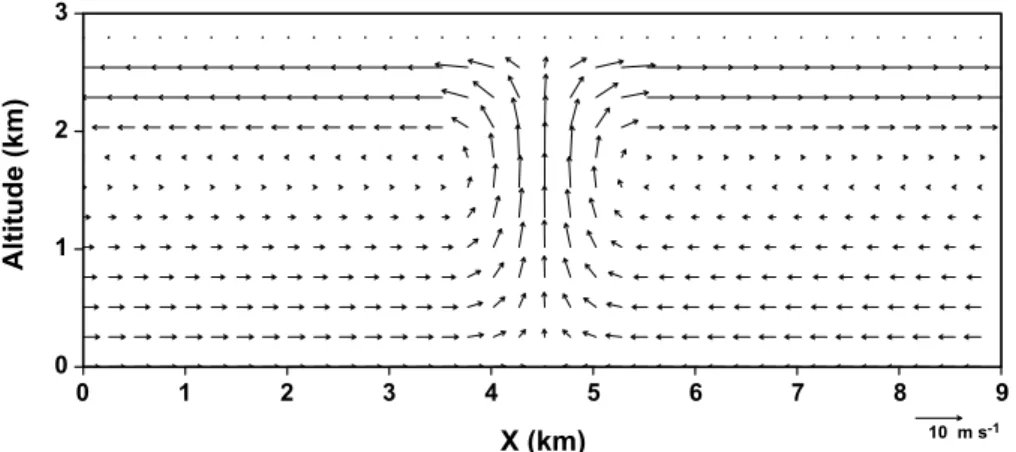
The dynamical framework of this study was designed to test the warm rain microphysi-cal model Case 1 of the fifth WMO Cloud Modeling Workshop (Szumowski et al., 1998). The dynamical cloud model predicts an evolving flow for 50 min and performs a
two-dimensional advection of the temperature and water variables (domain: 9 km×3 km,
25
dxandd z: 50 m,d t: 3 s). The advection scheme is a modified version of that by
ACPD
6, 1413–1453, 2006New cloud microphysical model and parameterization
N. Kuba and Y. Fujiyoshi
Title Page Abstract Introduction Conclusions References Tables Figures
◭ ◮
◭ ◮
Back Close Full Screen / Esc
Print Version
Interactive Discussion
EGU
to the peak updraft.
This simple model cannot estimate the effect of rainfall-induced drag on the
dynam-ics. The effect of the change in drag caused by CCN differences will be studied in
subsequent work. However, the model can estimate the effects of CCN on cloud
mi-crostructure and rainwater generation.
5
3.1. Effect of small-particle CCN
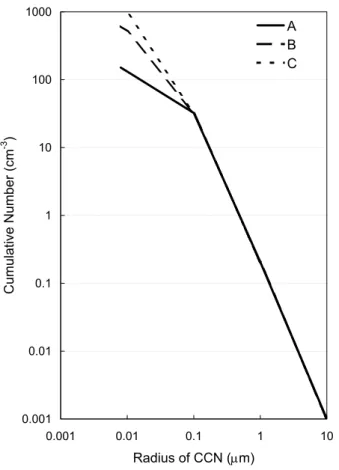
We used the three CCN size distributions (A, B, and C) (Fig. 2) to study the effect of
the number of small-particle CCN. A, B, and C are typical size distributions for clean maritime, lightly polluted maritime, and heavily polluted maritime CCN respectively.
The difference between the three cases is the number of small CCN (radius<0.1µm).
10
Their ratios are 1, 5, and 10, respectively. Table 2 lists the ratio of the number of CCN in each case to that in case A for the three size regimes (small, large, and giant particles). For simplicity, all CCN are assumed to be NaCl and all grid points have same CCN size distribution in this study.
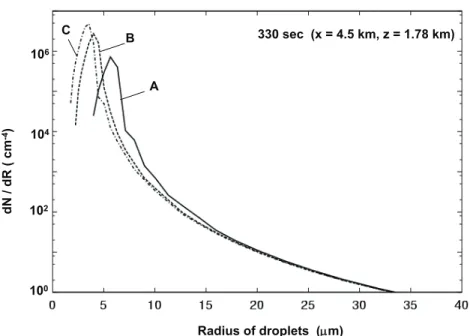
Figure 3 shows cloud droplet size distributions at the cloud base, at the center of
15
the cloud, at 5.5 min for the three cases. The concentrations of cloud droplets for
cases A, B, and C are 103, 325, and 550 cm−3, respectively. Larger numbers of
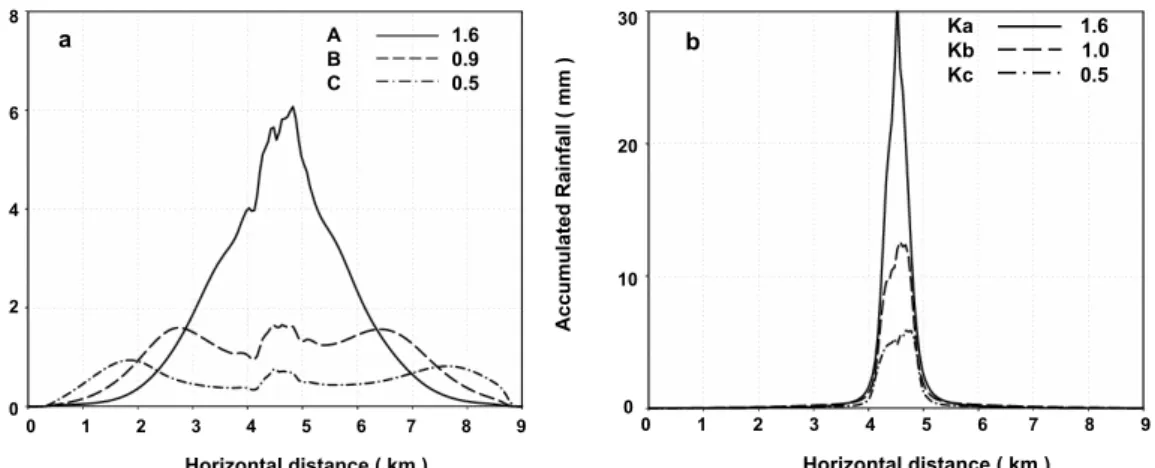
small-particle CCN lead to a smaller mode radius for cloud droplets. Figure 4a shows the accumulated rainfall at 50 min for three cases. The figure also lists values averaged in the domain. Smaller rainfall amounts result from the case with larger numbers of CCN,
20
in agreement with many studies (Twomey, 1974; Albrecht, 1989; Saleeby and Cotton, 2004). It is also shown in Fig. 4a that the more CCN lead to the more widespread
rainfall area. This study shows that rainfall area is also affected by the number of CCN
because increased numbers of small CCN significantly reduce not only the rainwater production rate but also the fall velocity of the raindrops as a result of their smaller size.
25
ACPD
6, 1413–1453, 2006New cloud microphysical model and parameterization
N. Kuba and Y. Fujiyoshi
Title Page Abstract Introduction Conclusions References Tables Figures
◭ ◮
◭ ◮
Back Close Full Screen / Esc
Print Version
Interactive Discussion
EGU
Kessler’s parameterization was installed on the same kinematic framework for com-parison. The parameterization is expressed as follows (Cotton and Anthes, 1989):
R=α(Qc−Qc0)H(Qc−Qc0)+β QcQ0r.875 (1)
whereR is the production rate of rainwater, Qc andQr are the mixing ratios of cloud
water and rain water, and α, β and Qc0 are constants. H(Qc−Qc0) is the Heaviside
5
function that is introduced to represent the threshold process. The following typical combination of values is used here, following the code distributed by Szumowski et al. (1989):
(α, β, Qc0)=(0.001,2.2,0.0005)
The terminal fall velocityVt(cm s−1) of rain water is assumed to be
10
Vt =V0(1000ρ)−0.5(ρ Q
r)γ (2)
whereρis air density (g cm−3). As in the code distributed by Szumowski et al. (1989),
the following values are used:
(V0, γ)=(36.34,0.136).
Mean rainfall amount in the domain at 50 min calculated from simulations using these
15
values is 1.37 mm. A situation similar to cases A, B, and C was simulated with different
values of (α, β, Qc0) as follows:
(α, β, Qc0)=(0.003,2.2,0.0005) for caseK a
(α, β, Qc0)=(0.001,1.1,0.0005) for caseK b
(α, β, Qc0)=(0.0005,1.1,0.001) for caseK c.
20
Figure 4b shows the accumulated 50-min rainfall for these cases. The combination
ACPD
6, 1413–1453, 2006New cloud microphysical model and parameterization
N. Kuba and Y. Fujiyoshi
Title Page Abstract Introduction Conclusions References Tables Figures
◭ ◮
◭ ◮
Back Close Full Screen / Esc
Print Version
Interactive Discussion
EGU
0.5 mm, respectively. Adjusting the coefficients (α, β, Qc0) controls the averaged
accu-mulated rainfall. However the horizontal distributions of rainfall amounts in Fig. 4b are
very different from those in Fig. 4a, because the bulk model cannot accurately express
differences in fall velocity for raindrops with a wide range of radii (40µm∼2 mm). On
the other hand, the bin model can estimate the fall velocity of raindrops for each bin.
5
3.2. Effect of large-particle CCN
Cases D and E, described next, investigate the role of the large-particle CCN
(0.1µm<radius<1µm) in warm cloud. Case D adds large-particle CCN to case A
(clean maritime case). Case E adds large-particle CCN to case C (small-particle rich case). In both cases large particle CCN are added mainly in the size range between
10
0.1 and 0.8µm, moderately in the size ranges between 0.08 and 0.1µm and between
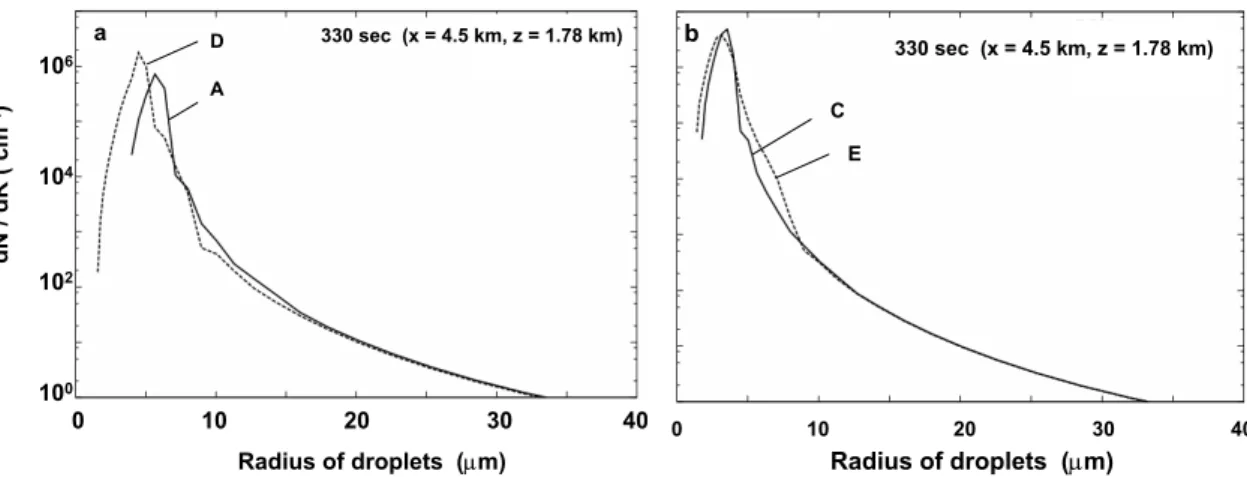
0.8 and 1.0µm. Figure 5a shows the cloud droplet size distributions at the cloud base,
at the center of the cloud, at 5.5 min for cases A and D. The cloud droplet
concentra-tions for cases A and D are 103 and 209 cm−3, respectively. Similarly, Fig. 5b shows
cloud droplet size distributions for cases C and E; the cloud droplet concentrations
15
are 550 and 583 cm−3, respectively. Figure 5 shows that adding large-particle CCN
reduces the mode radius of cloud droplets and that this effect is larger for cases with
fewer CCN. If there are many CCN, adding large-particle CCN increases the number of large cloud droplets.
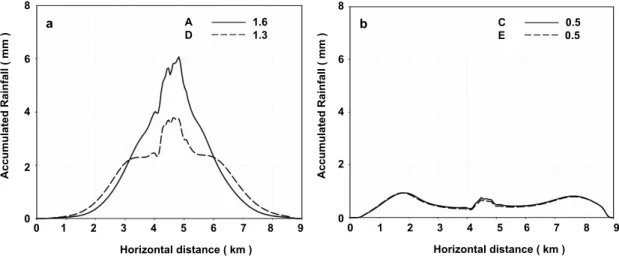
Figure 6a shows accumulated rainfall at 50 min for cases A and D. Adding
large-20
particle CCN decreases the amount of rainfall for cases with small numbers of small-particle CCN. Figure 6b shows accumulated rainfall at 50 min for cases C and E. Adding
large-particle CCN does not affect rainfall amounts when there are large numbers of
particle CCN. Rainwater is produced mainly from water condensed on small-particle CCN for the cases with small numbers of CCN (cases A and D). In this case,
25
ACPD
6, 1413–1453, 2006New cloud microphysical model and parameterization
N. Kuba and Y. Fujiyoshi
Title Page Abstract Introduction Conclusions References Tables Figures
◭ ◮
◭ ◮
Back Close Full Screen / Esc
Print Version
Interactive Discussion
EGU
3.3. Effect of giant-particle CCN
Cases F–I, described below, help define the role of giant-particle CCN (radius>1µm)
in warm cloud. Case F adds giant CCN to case A (clean maritime case), and case G removes giant CCN from case A. Case H adds giant CCN to case C (small-particle rich case) and case I (continental case) removes giant CCN from case C.
5
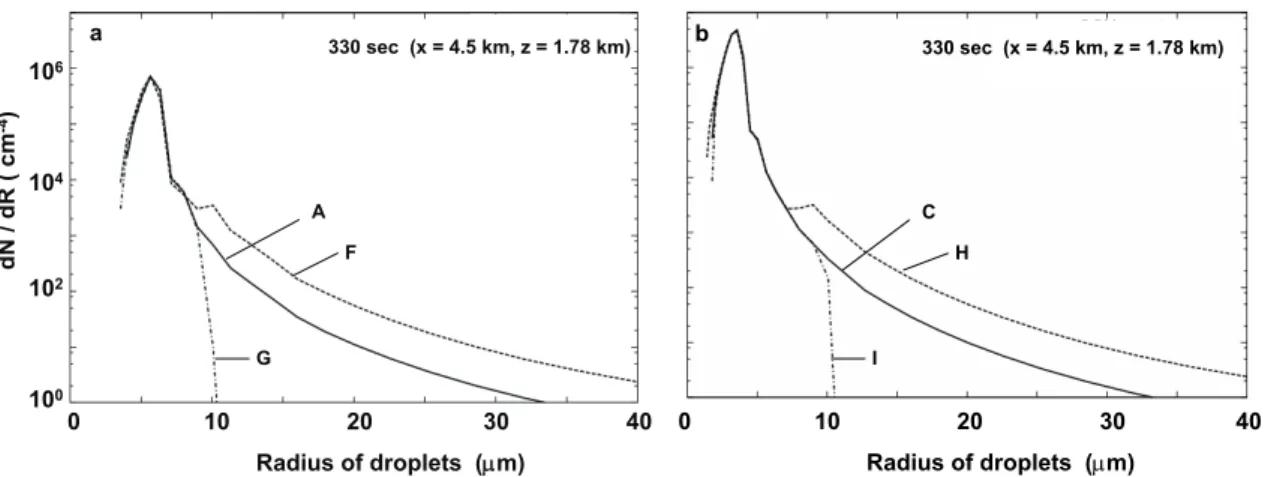
Figures 7a and b show the cloud droplet size distribution at the cloud base, at the center of the cloud, at 5.5 min for cases A, F, G, C, H, and I; cloud droplet
concen-trations are 103, 102, 103 cm−3, 550, 541, and 550 cm−3, respectively. The addition
of giant CCN does not affect the mode radius of cloud droplets, but it does affect the
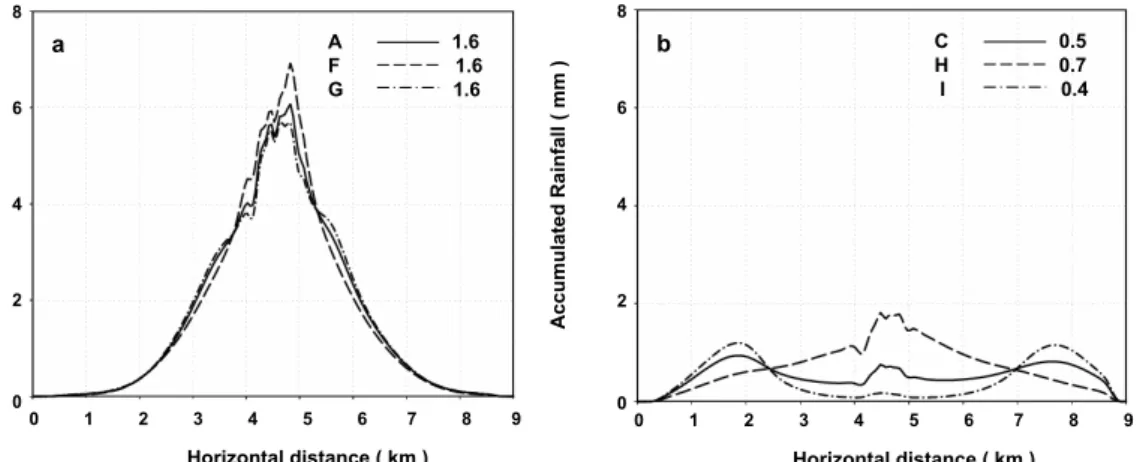
number of large cloud droplets. Figures 8a and b show accumulated rainfall at 50 min
10
for cases A, F, G, C, H, and I. Figure 8a shows that the addition of giant-particle CCN increases the rainfall at the center of cloud. It is because that drops condensed on giant-particle CCN become large enough to fall against the strong updraft at the
cen-ter of cloud. However many droplets condensed on CCN smaller than 1.0µm, also
grow enough to start coalescence growth, and become rain drops. Therefore
addi-15
tion of giant CCN does not dramatically affect rainfall for cases with small numbers of
CCN (Fig. 8a). For cases with small numbers of small-particle CCN, rainwater mainly originates from water condensed on small-particle CCN. In contrast, if there are many small-particle CCN, the more giant-particle CCN leads to the higher amounts of rainfall (Fig. 8b). When there are many particle CCN, droplets condensed on
small-20
particle CCN can not grow enough to start coalescence growth, and then rainwater originates mostly from water condensed on giant-particle CCN and droplets caught by droplet condensed on giant-particle CCN. These results agree with the results in Kuba and Takeda (1983), Cooper et al. (1997), Feingold et al. (1999), and Saleeby and
Cotton (2004), in which they showed that the effect of giant-particle CCN on rainfall
25
efficiency of clouds is most remarkable in cases with numerous small-particle CCN.
Additionally this study shows clearer differences in rainfall amounts and in the area of
ACPD
6, 1413–1453, 2006New cloud microphysical model and parameterization
N. Kuba and Y. Fujiyoshi
Title Page Abstract Introduction Conclusions References Tables Figures
◭ ◮
◭ ◮
Back Close Full Screen / Esc
Print Version
Interactive Discussion
EGU
4. Parameterizations
4.1. Parameterizations to predict the number of cloud droplets
Section 3 showed that the most influential CCN factor is the number of small-particle
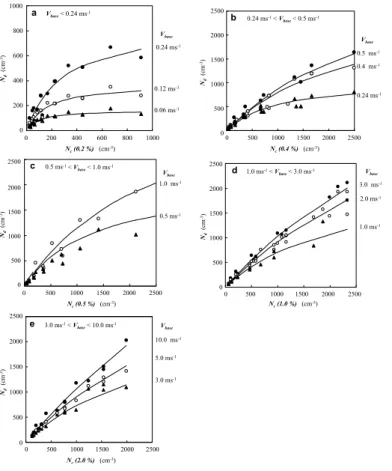
CCN. A parameterization is developed to relate cloud droplet number (Nd cm−3) to the
updraft velocity at the cloud base (Vbasem s−1) and the cumulative number of CCN that
5
can be activated at S% supersaturation (Nc(S) cm
−3
) (Kuba et al., 2003; Kuba and Iwabuchi, 2003). In this study, those factors are extended for a wider range of updraft velocities, as in Kuba and Iwabuchi (2003). Figure 9 shows relationship between the number of cloud droplets and the number of CCN that can be activated at fixed
super-saturationS%. The results of the numerical simulations with many kinds of CCN size
10
distributions using the cloud microphysical parcel model are shown by marks. Based on these fitting curves approximations are developed as follows;
Nd =ANc(S)/(Nc(S)+B) (3)
ForVbase≤0.24 ms
−1
: S =0.2%
A=4710Vbase1.19
B=1090Vbase+33.2
For 0.24≤Vbase≤0.5 ms−1:S =0.4%
A=11700Vbase−1690
B=10600Vbase−1480
For 0.5≤Vbase≤1.0 ms−1: S =0.5%
A=4300Vbase1.05 B=2760Vbase0.755
ACPD
6, 1413–1453, 2006New cloud microphysical model and parameterization
N. Kuba and Y. Fujiyoshi
Title Page Abstract Introduction Conclusions References Tables Figures
◭ ◮
◭ ◮
Back Close Full Screen / Esc
Print Version
Interactive Discussion
EGU
For 1.0≤Vbase≤3.0 ms−1: S =1.0%
A=7730−15 800 exp(−1.08Vbase)
B=6030−24 100 exp(−1.87Vbase)
For 3.0≤Vbase≤10.0 ms−1:S =2.0%
A=1140Vbase−741
B=909Vbase−56.2
In case of the larger updraft, we need to count CCN number under the higher su-persaturation to get the good correlation between CCN number and droplet num-ber. Critical supersaturations of 0.2%, 0.4% , 0.5%, 1.0%, and 2.0% correspond to
5
radii of 0.036µm (0.048µm), 0.023µm (0.031µm), 0.019µm (0.027µm), 0.012µm
(0.017µm) and 0.0077µm (0.011µm) for dry nuclei of NaCl ((NH4)2SO4), for example.
Nc(S) forS=0.2%, 0.4%, 0.5%, 1.0%, or 2.0% reflects the number of small CCN and
large CCN. The input information of CCN for these parameterizations is only several values of CCN spectrum (they are given by CCN counter for example). It is more
con-10
venient than conventional parameterizations those need values concerned with CCN
spectrum,C andk in the equation ofN=CSk (as in Twomey, 1959) or, breadth, total
number and median radius, for example.
Typically, global models do not include cloud microphysical models; thus
parameter-izations will be useful in global models to approximate the effects of aerosol particles.
15
This parameterizations was incorporated into the global model CCSR/NIES/FRCGC-AGCM, which also includes the aerosol transportation model SPRINTARS (Takemura et al., 2000, 2002), to test application of the parameterization. CCSR/NIES/FRCGC-AGCM is an atmospheric general circulation model that has been developed based on CCSR/NIES-AGCM (Numaguti, 1993; Numaguti et al., 1995). Particle radii that
cor-20
respond to the critical supersaturations 0.2%, 0.4%, 0.5%, 1.0%, and 2.0%, and an assumed size distribution of CCN for each constituent are used to estimate the
num-ber of CCNNc(S), because SPRINTARS output is the global distribution of the masses
ACPD
6, 1413–1453, 2006New cloud microphysical model and parameterization
N. Kuba and Y. Fujiyoshi
Title Page Abstract Introduction Conclusions References Tables Figures
◭ ◮
◭ ◮
Back Close Full Screen / Esc
Print Version
Interactive Discussion
EGU
and dust particles.
To calculate the particle radius that corresponds to each critical supersaturation, sea salt particles are assumed to be NaCl and sulfate particles are assumed to be
(NH4)2SO4. Many different chemical constituents comprise organic carbon particles. It
is difficult to treat each chemical constituent separately, so an approximation is needed
5
for the average nature of organic carbon particles in the real atmosphere. The first step is to adopt the approximation derived by Ghan et al. (2001): the material density and hygroscopicity of organic carbon particles are approximately 1 and 0.14, respectively (see their Table 1). These values allow a calculation of the dry radius for each super-saturation. Critical supersaturations of 0.2%, 0.4%, 0.5%, 1.0%, and 2.0% correspond
10
to radii of 0.074µm, 0.047µm, 0.040µm, 0.025µm, and 0.016µm for a dry nucleus
of organic carbon particles. Black carbon and dust particles are assumed insoluble; they become CCN only when coated by water-soluble constituents. Black carbon and dust particles can therefore be excluded from the CCN if sea salt, sulfate, and organic
carbon aerosol particles are estimated sufficiently without regard to whether they are
15
mixed with insoluble matter.
Because CCSR/NIES/FRCGC-AGCM does not resolve the cloud updraft, turbulent kinetic energy is used to estimate updraft velocity as in Lohmann et al. (1999).
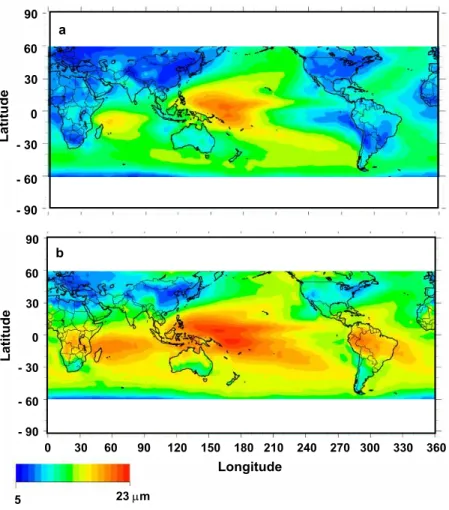
Fig-ure 10a shows the annual mean value (for 2000) of effective cloud droplet radii at cloud
tops warmer than 273 K. These annual mean values were calculated by T. Takemura
20
(personal communication) following the methods in Takemura et al. (2005). Figure 10a
shows a land-ocean contrast of the effective radius of cloud droplets that is often
re-trieved from NOAA/AVHRR (Advanced Very High Resolution Radiometer) data
(Naka-jima and Naka(Naka-jima, 1995; Kawamoto, 2001). To estimate the effect of organic carbon
aerosol particles on the effective radius of cloud droplets, Fig. 10b shows the same
25
calculations as in Fig. 10a, but organic carbon particles are neglected. Comparisons of Fig. 10a and b show that considering organic carbon particles leads to decrease in
annual mean value of cloud droplet effective radius over South Africa, Australia, and
ACPD
6, 1413–1453, 2006New cloud microphysical model and parameterization
N. Kuba and Y. Fujiyoshi
Title Page Abstract Introduction Conclusions References Tables Figures
◭ ◮
◭ ◮
Back Close Full Screen / Esc
Print Version
Interactive Discussion
EGU
compared with whole CCN concentration. Therefore, the effect of organic carbon
par-ticles on the cloud microstructure is not negligible over South Africa, Australia, and South America.
4.2. Parameterizations to predict the droplet size distribution
Both the number of cloud droplets and the shape of the distribution are needed to
5
derive the initial cloud droplet size distribution in the bin model. Gamma distributions have been used in many studies to express the cloud droplet size distribution, and they are written as follows:
n(r)=C rβexp(−Dr)dr (4)
C= Nd
β!
4π
3Q(β+3)(β+2)(β+1)Nd
β+31
10
D=
4π
3Q(β+3)(β+2)(β+1)Nd
13 .
Here,n(r) is the number density of cloud droplets (cm−4), Nd is the number
concen-tration of cloud droplets (cm−3), andQ is the cloud water (g cm−3). βis an integer (2
or 4 in this study). When we can clearly distinguish cloud droplets from non-activated wet CCN and adjusted cloud water reaches the critical value, the gamma distribution
15
is assigned to the bin as the initial cloud droplet size distribution.
5. Verification of parameterizations
The hybrid cloud microphysical model described in Sect. 2 is used as truth to verify the parameterizations in Sect. 4. The new model uses the parameterizations instead of the parcel model. Parameterization verification is achieved by comparing the results from
ACPD
6, 1413–1453, 2006New cloud microphysical model and parameterization
N. Kuba and Y. Fujiyoshi
Title Page Abstract Introduction Conclusions References Tables Figures
◭ ◮
◭ ◮
Back Close Full Screen / Esc
Print Version
Interactive Discussion
EGU
the new model using both the parameterizations and bin method, with the results from the model using the hybrid cloud microphysical model that uses both a parcel model and bin method.
The procedure for using parameterizations to predict initial cloud droplet size distri-bution for the bin model instead of the parcel model is as follows:
5
1. When the condensed cloud water determined by adjusting the supersaturation
at a grid point reaches 1.5 e-5 (g g−1), Nd is derived by Eq. (3). This threshold
was derived from many trials that tested whether cloud droplets could be clearly distinguished from non-activated CCN.
2. UsingNd and the adjusted condensed cloud waterQ, the cloud droplet size
dis-10
tributionn(r) (Eq. 4) is derived.
3. The number and total mass of droplets included in each bin are calculated by integrating Eq. (4).
Figure 11a shows the cloud droplet size distributions derived explicitly by the parcel model and approximated by Eqs. (3) and (4) for case A. Cloud droplet size distributions
15
derived from the parameterization with a Gamma distribution are wider than those derived using the parcel model, and the large cloud droplets that condense on
giant-particle CCN cannot be described. Differences in the cloud droplet size distribution
between the parcel model and the parameterization are smaller at later stages and at higher levels in the cloud (Fig. 11b), except for large droplets condensed on
giant-20
particle CCN. Because the numbers of cloud droplets in both the parcel model and
the parameterization are same and the smaller droplets grow faster, the differences
become smaller. However the lack of large cloud droplets condensed on giant-particle CCN in the cloud droplet size distribution derived from parameterization is not solved even in this stage. It is the restriction of this parameterization.
25
Figure 12a–c shows the accumulated surface rainfall at 50 min for cases A, B, and C,
ACPD
6, 1413–1453, 2006New cloud microphysical model and parameterization
N. Kuba and Y. Fujiyoshi
Title Page Abstract Introduction Conclusions References Tables Figures
◭ ◮
◭ ◮
Back Close Full Screen / Esc
Print Version
Interactive Discussion
EGU
parameterizations are not large (mean values in the domain are also shown in Fig. 12).
Parameterizations can express differences in rainfall amounts caused by differences in
the number of small CCN. Using 4 asβoffers little improvement over 2, so 2 is used
from now on.
The effect of adding large or giant CCN was tested in cases for which large CCN
5
or giant CCN were increased five-fold over case A (clean maritime case) or C (small-particle rich case). Figure 13a shows accumulated surface rainfall at 50 min for case A and the case with high concentrations of large CCN (case D) or giant CCN (case F) from the hybrid cloud model that uses the parcel method and two-moment bin method. Figure 13b is the same as Fig. 13a but shows the results from the cloud model that
10
uses parameterization and the two-moment bin method. Adding large CCN reduces
the rainfall amounts; adding giant CCN has little effect on the rainfall amounts.
Compar-isons of Figs. 13a and b show that the parameterization predicts the effects of adding
large or giant CCN.
Figures 13c and d are similar to Figs. 13a and b, but large CCN (case E) or giant
15
CCN (case H) are added to case C (small-particle rich case). As noted in Sect. 3.2,
adding large CCN does not affect the rainfall amounts for this case. Adding giant
CCN causes an increase in rainfall over the small-particle rich case (Fig. 13c for the hybrid cloud microphysical model) as shown in Sect. 3.3. In contrast, the method using
parameterizations and the two-moment bin cannot model the effect of adding giant
20
CCN (Fig. 13d). The parameterizations use the number of CCN, so differences in the
number of giant CCN cannot be reflected in the initial cloud droplet size distribution
of the bin model. However, the effect of giant CCN on warm rain is not so large for
usual cases (cases A, B, and C, for example), as discussed in Sect. 3.3. Therefore
these parameterizations may be useful for estimating the effect of CCN on warm rain
25
in non-hydrostatic 3-D cloud models except for cases in which giant-particle CCN has
large effect on precipitation. In these cases the hybrid cloud microphysical model that
ACPD
6, 1413–1453, 2006New cloud microphysical model and parameterization
N. Kuba and Y. Fujiyoshi
Title Page Abstract Introduction Conclusions References Tables Figures
◭ ◮
◭ ◮
Back Close Full Screen / Esc
Print Version
Interactive Discussion
EGU
6. Conclusions
A hybrid cloud microphysical model was developed that combines Lagrangian and
Eu-lerian frameworks. The model can estimate the effect of CCN on cloud
microstruc-ture. The effect of CCN on warm cloud rainfall was studied using this microphysical
model and a simple two-dimensional cloud model, and the following conclusions were
5
reached:
1. The number of small-particle CCN has a large impact on the amount of rain-fall. Larger numbers of small-particle CCN cause a smaller mode radius of cloud droplets at the cloud base and lead to lighter rainfall. Adding small-particle CCN
reduces both the amount of rainfall and the fall velocity of raindrops, which affects
10
the rainfall area.
2. Adding large-particle CCN leads to a decrease in the mode radius of cloud droplets at the cloud base when there are small numbers of small CCN. On the other hand, when there are large numbers of small-particle CCN, adding large-particle CCN leads to an increase in large cloud droplets at the cloud base.
15
Adding large-particle CCN leads to a decrease in the amount of rainfall when
there are small numbers of small-particle CCN; it does not affect the amount of
rainfall when there are large numbers of small CCN. When there are few CCN, rainwater is produced from condensation onto small-particle CCN but not from condensation onto large-particle CCN.
20
3. When there are small numbers of small-particle CCN, adding giant-particle CCN leads to a slight decrease in rainfall, which suggests that almost all rain water is produced by condensation onto small-particle CCN. On the other hand, when there are large numbers of small-particle CCN, adding giant-particle CCN leads to a modest increase in the amount of rainfall, which suggests that rain water
25
ACPD
6, 1413–1453, 2006New cloud microphysical model and parameterization
N. Kuba and Y. Fujiyoshi
Title Page Abstract Introduction Conclusions References Tables Figures
◭ ◮
◭ ◮
Back Close Full Screen / Esc
Print Version
Interactive Discussion
EGU
4. Rainfall calculated by a bulk microphysical model using Kessler’s
parameteriza-tion can be tuned by changing the coefficients. However, the relationship between
the coefficients and CCN properties is unclear. Furthermore, the bulk model does
not express the proper fall velocities of raindrops that are distributed over a wide velocity range. A high-resolution cloud model therefore needs a cloud
microphys-5
ical model that uses a bin method.
The kinematic framework in this study is so simple that a change in cloud
microstruc-ture cannot affect cloud dynamics. Therefore, a quantitatively accurate estimate of the
effect of CCN on warm rain cannot be studied here. However, the basic role of CCN
in warm rain production can be estimated using the hybrid cloud microphysical model.
10
The effect of CCN on warm rain can be estimated quantitatively when the hybrid cloud
microphysical model is incorporated into a three-dimensional cloud dynamical model. In addition, the model can be used to verify and improve the microphysical bulk model. Parameterizations to predict the initial cloud droplet size distribution for the bin model were developed. The results from a cloud model using these parameterizations and
15
a two-moment bin model were compared to results from a hybrid cloud microphysi-cal model that combines Lagrangian and Eulerian frameworks. Replacing the parcel model with the parameterizations developed in this study saves computing time at the cost of a small degree of error. A cloud model that includes the parameterizations and
a two-moment bin model estimates the effects of CCN on cloud microstructure with
20
sufficient accuracy. These parameterizations use only the number of CCN that can be
activated under a certain supersaturation (0.2–2.0%). Thus, the effect of giant-particle
CCN on warm rain precipitation cannot be estimated. However, the effect of
giant-particle CCN is not large compared to the effects of small and large-particle CCN.
If the effect of seeding giant-particle CCN must be estimated, a combination of two
25
ACPD
6, 1413–1453, 2006New cloud microphysical model and parameterization
N. Kuba and Y. Fujiyoshi
Title Page Abstract Introduction Conclusions References Tables Figures
◭ ◮
◭ ◮
Back Close Full Screen / Esc
Print Version
Interactive Discussion
EGU
a three-dimensional non-hydrostatic cloud model, CReSS (Tsuboki and Sakakibara, 2002). The parameterizations to predict the number of cloud droplets can be also applied to a GCM. GCM simulations that include an aerosol transport model and the
developed parameterizations show that the effect of organic carbon particles on the
cloud microstructure is not negligible over South Africa, Australia, and South America.
5
Appendix A
Two-moment bin method
The two-moment bin method was developed by Chen and Lamb (1994) and described in detail in their paper. Only highlights are described here.
A.1. Growth by condensation
10
1) The growth of the boundary of a bin is calculated by
b′
i =bi + ∆t
dx
d t
cond
x=bi
(A1)
where bi (i=1, 2, . . . , i m) is the fixed boundary of the i-th bin and dxd tcond
is the condensational growth rate of mass.
2) The number and total mass of droplets with masses betweenb′i and b′i+1at time
15
t+∆tare expressed asNi andMi, as follows:
Ni =ni (A2)
Mi =mi+ni∆t
dx
d t
cond
x=mi/ni
ACPD
6, 1413–1453, 2006New cloud microphysical model and parameterization
N. Kuba and Y. Fujiyoshi
Title Page Abstract Introduction Conclusions References Tables Figures
◭ ◮
◭ ◮
Back Close Full Screen / Esc
Print Version
Interactive Discussion
EGU
whereni andmi are the number and the total mass of cloud droplets included in the
i-th bin at timet.
3) The number and total mass of droplets with masses betweenb′
i and b
′
i+1at time
t+∆tcan be expressed as the integral of the density functionf(x) andf(x)x between
b′i andb′i+1.f(x) is approximated as
5
f(x)=A+B(x−x0)
x0=(b
′
i +b
′
i+1)/2 (A4)
Zb′i+1 b′
i
f(x)dx = Ni (A5)
Zb′i+1 b′
i
f(x)x dx = Mi (A6)
ThenAandBare
10
A=Ni/(b ′ i+1−b
′
i) (A7)
B=12(Mi −x0Ni)/(b′i+1−b
′ i)
3
(A8)
4) New valuesn′i orm′i for the fixed bin are calculated by integrating the functionf(x)
orf(x)x for each suitable region.
A.2. Growth by coalescence
15
5) New particles produced by collision of particles in the i-th and j-th bins are included
in the range betweenx1andx2.
ACPD
6, 1413–1453, 2006New cloud microphysical model and parameterization
N. Kuba and Y. Fujiyoshi
Title Page Abstract Introduction Conclusions References Tables Figures
◭ ◮
◭ ◮
Back Close Full Screen / Esc
Print Version
Interactive Discussion
EGU
x2=bi+1+bj+1 (A10)
6) The number and total mass of new droplets with masses betweenx1and x2 are
expressed asN andM:
N=ninjK( mi
ni ,mj
nj
)∆t (A11)
M=(mi
ni +
mj
nj
)N (A12)
5
whereK is the particle interaction kernel.
7) The density function of the new droplets is approximated as
f(x)=A+B(x−x0)
x0=(x1+x2)/2 (A13)
Zx2
x1
f(x)dx = N (A14)
10
Zx2
x1
f(x)x dx = M (A15)
ThenAandBare
A=N/(x2−x1) (A16)
B=12(M−x0N)/(x2−x1)3 (A17)
8) The valuesni and mi that should be added to the original value of the fixed bin
15
are calculated by integrating the functionf(x) or f(x)x for each suitable region. The
concentration N is subtracted from the original values of the i-th and j-th bins. The
mass ofNmi/ni orNmj/nj is also subtracted from the original total mass of the i-th or
ACPD
6, 1413–1453, 2006New cloud microphysical model and parameterization
N. Kuba and Y. Fujiyoshi
Title Page Abstract Introduction Conclusions References Tables Figures ◭ ◮ ◭ ◮ Back Close Full Screen / Esc
Print Version
Interactive Discussion
EGU
A.3. Incomplete distribution (for both condensation or coalescence processes)
When the functionf(x) is a negative value at the boundary of the region (b′
i<x<b ′ i+1)
or (x1<x<x2), it is modified as follows:
if f(b′
i+1)<0 or f(x2)<0;
f(x)=B′
(x−x∗) for b′
i < x < x ∗
or x1< x < x
∗
5
f(x∗
)=0
f(x)=0 for x∗
< x < b′
i+1 or x
∗
< x < x2 (A18)
where B′
=−2Ni(b′i −x∗) or B′=−2N(x1−x∗) x∗
=3Mi/Ni −2bi or x∗
=3M/N−2x1.
10
if f(b′
i)<0 or f(x1)<0; (A19)
f(x)=B′
(x−x∗) for x∗< x < b′i
+1 or x
∗
< x < x2
f(x∗
)=0
f(x)=0 for b′
i < x < x ∗
or x1< x < x
∗
(A20)
15
where B′
=2Ni(b′ i+1−x
∗
) or B′
=2N(x2−x
∗
) (A21)
x∗
=3Mi/Ni −2bi+1 or x
∗
=3M/N−2x2. (A22)
Acknowledgements. The authors sincerely thank T. Takemura of Kyushu University, who incorporated the parameterizations developed in this study into the global model CCSR/NIES/FRCGC-AGCM equipped with the aerosol transport model SPRINTARS
(Take-20
ACPD
6, 1413–1453, 2006New cloud microphysical model and parameterization
N. Kuba and Y. Fujiyoshi
Title Page Abstract Introduction Conclusions References Tables Figures
◭ ◮
◭ ◮
Back Close Full Screen / Esc
Print Version
Interactive Discussion
EGU
References
Chen, J.-P. and Lamb, D.: Simulation of cloud microphysics and chemical processes using a multicomponent framework. Part I Description of the microphysical model, J. Atmos. Sci., 51, 2613–2630, 1994.
Chen, J.-P. and Lamb, D.: Simulation of cloud microphysics and chemical processes using a
5
multicomponent framework. Part II Microphysical evolution of a wintertime orographic cloud, J. Atmos. Sci., 56, 2293–2312, 1999.
Clark, T. L.: Numerical modeling of the dynamics and microphysics of warm cumulus convec-tion, J. Atmos. Sci., 30, 857–878, 1973.
Cooper, W. A., Bruintjes, R. T., and Mather, G. K.: Calculating pertaining to hygrospic seeding
10
with flares, J. Appl. Meteor., 36, 1449–1469, 1997.
Cotton, W. R. and Anthes, R. A.: Storm and Cloud Dynamics (Chapter 4), Academic Press, 880pp, 1989.
Cotton, W. R., Pielke Sr., R. A., Walco, R. L., Liston G. E., Tremback, C. J., Jiang, H., McAnelly, R. L., Harringto, J. Y., Nicholls, M. E., Carrio, G. G., and McFadde, J. P.: RAMS 2001: Current
15
status and future directions, Meteorol. Atmos. Phys., 82, 5–29, 2003.
Feingold, G., Cotton, W. R., Kreidenwei, S. M., and Davis, J. T.: The impact of giant cloud condensation nuclei on drizzle formation in stratocumulus: Implications for cloud radiative properties, J. Atmos. Sci., 56, 15, 4100–4117, 1999.
Ghan, S., Easter, R., Hudson, J., and Breon, F. M.: Evaluation of aerosol indirect radiative
20
forcing in MIRAGE, J. Geophys. Res., 106, D6, 5317–5334, 2001.
Givati, A. and Rosenfeld, D.: Quantifying precipitation suppression due to air pollution, J. Appl. Meteor., 43, 1038–1056, 2004.
Hall, W. D.: A detailed microphysical model within a two-dimensional dynamic framework: Model description and preliminary results, J. Atmos. Sci., 37, 2486–2507, 1980.
25
Harshvardhan, S., Schwartz, E., Benkovitz, C. M., and Guo, G.: Aerosol influence on cloud mi-crophysics examined by satellite measurements and chemical transport modeling, J. Atmos. Sci., 59, 714–725, 2002.
Kawamoto, K., Nakajima, T., and Nakajima, T. Y.: A global determination of cloud microphysics with AVHRR remote sensing, J. Climate, 14, 2054–2068, 2001.
30
ACPD
6, 1413–1453, 2006New cloud microphysical model and parameterization
N. Kuba and Y. Fujiyoshi
Title Page Abstract Introduction Conclusions References Tables Figures
◭ ◮
◭ ◮
Back Close Full Screen / Esc
Print Version
Interactive Discussion
EGU microphysics cloud ensemble model, Atmos. Res., 52, 195–220, 1999.
Kuba, N. and Takeda, T.: Numerical study of the effect of CCN on the size distribution of cloud droplets. Part II. Formation of large droplets, J. Meteorol. Soc. Japan, 61, 3, 375–387, 1983. Kuba, N. and Iwabuchi, H.: Revised parameterization to predict cloud droplet concentration
and a retrieval method to predict CCN concentration – Supplement, J. Meteorol. Soc. Japan,
5
81, 1485–1487, 2003.
Kuba, N., Iwabuchi, H., Maruyama, K., Hayasaka, T., Takeda, T., and Fujiyoshi, Y.: Param-eterization of the effect of cloud condensation nuclei on the optical properties of a non-precipitating water layer cloud, J. Meteorol. Soc. Japan, 81, 393–414, 2003.
Lohmann, U., Feichter, J., Chuang, C. C., and Penner, J. E.: Prediction of the number of cloud
10
droplets in the ECHAM GCM, J. Geophys. Res., 104, 9169–9198, 1999.
Nakajima, T. Y. and Nakajima, T.: Wide-area determination of cloud microphysical properties from NOAA AVHRR measurements for FIRE and ASTEX regions, J. Atmos. Sci., 52, 4043– 4095, 1995.
Numaguti, A.: Dynamics and energy balance of the Hadley circulation and the tropical
precip-15
itation zones: Significance of the distribution of evaporation, J. Atmos. Sci., 50, 1874–1887, 1993.
Numaguti, A., Takahashi, M., Nakajima, T., and Sumi, A.: Development of an atmospheric gen-eral circulation model, in: Reports of a New Program for Creative Basic Research Studies, Studies of Global Environment Change with Special Reference to Asia and Pacific Regions,
20
Rep., I-3, pp. 1–27, CCSR, Tokyo, 1995.
Reisin, T. G., Levin, Z., and Tzivion, S.: Rain production in convective clouds as simulated in an axisymmetric model with detailed microphysics. Part I: Description of model, J. Atmos. Sci., 53, 3, 497–519, 1996.
Rosenfeld, D.: TRMM observed first direct evidence of smoke from forest fires inhibiting rainfall,
25
Geophys. Res. Lett., 26, 3105–3108, 1999.
Rosenfeld, D.: Suppression of rain and snow by urban and industrial air pollution, Science, 287, 1973–1976, 2000.
Saleeby, S. M. and Cotton, W.: A large-droplet mode and prognostic number concentration of cloud droplets in the Colorado State University Regional Atmospheric Modeling System
30
(RAMS). Part I: Module descriptions and supercell test simulations, J. Appl. Meteor., 43, 182–195, 2004.
ACPD
6, 1413–1453, 2006New cloud microphysical model and parameterization
N. Kuba and Y. Fujiyoshi
Title Page Abstract Introduction Conclusions References Tables Figures
◭ ◮
◭ ◮
Back Close Full Screen / Esc
Print Version
Interactive Discussion
EGU with small implicit diffusion, J. Comput. Phys., 54, 325–362, 1984.
Szumowski, M. J., Grabowski, W. W., and Ochs III, H. T.: Simple two-dimensional kinematic framework designed to test warm rain microphysical models, Atmos. Res., 45, 299–326, 1998.
Takahashi, T.: Hail in an axisymmetric cloud model, J. Atmos. Sci., 33, 1579–1601, 1976.
5
Takeda, T. and Kuba, N.: Numerical study of the effect of CCN on the size distribution of cloud droplets. Part I. Cloud droplets in the stage of condensation growth, J. Meteor. Soc. Japan, 60, 4, 978–993, 1982.
Takemura, T., Okamoto, H., Maruyama, Y., Numaguti, A., Higurashi, A., and Nakajima, T.: Global three-dimensional simulation of aerosol optical thickness distribution of various
ori-10
gins, J. Geophys. Res., 105, 17 853–17 873, 2000.
Takemura, T., Nakajima, T., Dubovik, O., Holben, B. N., and Kinne, S.: Single-scattering albedo and radiative forcing of various aerosol species with a global three-dimensional model, J. Climate, 15, 333–352, 2002.
Takemura, T., Nozawa, T., Emori, S., Nakajima, T. Y., and Nakajima, T.: Simulation of climate
15
response to aerosol direct and indirect effects with aerosol transport-radiation model. J. Geo-phys. Res., 110, D02202, doi:10.1029/2004JD005029, 2005.
Tsuboki, K. and Sakakibara, A.: Large-scale parallel computing of Cloud Resolving Storm Simulator, High Performance Computing, Springer, edited by: Zima, H. P., Joe, K., Sato, M., Seo, Y., and Shimasaki, M., 243–259, 2002.
20
ACPD
6, 1413–1453, 2006New cloud microphysical model and parameterization
N. Kuba and Y. Fujiyoshi
Title Page Abstract Introduction Conclusions References Tables Figures
◭ ◮
◭ ◮
Back Close Full Screen / Esc
Print Version
Interactive Discussion
EGU
Table 1.The two computational schemes for cloud microphysical model.
Parcel model Bin model
Framework Lagrangian semi-Lagrangian
Fixed values nj xi=x12
(i−1)/k
Concentration of CCN Representative mass of droplets included in each class. included in each bin.
(j=1,. . . , 185) (k=2,i=1,. . . , 71)
Variable values xj(t) ni(t)
Mass of droplets forming Concentration of droplets on CCN included in each class. included in each bin. Activation Takeda and Kuba (1982) not considered Condensation Takeda and Kuba (1982) Chen and Lamb (1994)
Coalescence not considered Chen and Lamb (1994)
∆t 0.05 s 0.5 s (condensation),
ACPD
6, 1413–1453, 2006New cloud microphysical model and parameterization
N. Kuba and Y. Fujiyoshi
Title Page Abstract Introduction Conclusions References Tables Figures
◭ ◮
◭ ◮
Back Close Full Screen / Esc
Print Version
Interactive Discussion
EGU
Table 2.The ratio of the number of CCN in each case to that in case A.
small particle CCN large particle CCN giant particle CCN Case (0.1µm<radius) (0.1<radius<1µm) (1µm<radius)
A 1 1 1
B 5 1 1
C 10 1 1
D 1 5 1
E 10 5 1
F 1 1 5
G 1 1 0
H 10 1 5
ACPD
6, 1413–1453, 2006New cloud microphysical model and parameterization
N. Kuba and Y. Fujiyoshi
Title Page Abstract Introduction Conclusions References Tables Figures
◭ ◮
◭ ◮
Back Close Full Screen / Esc
Print Version
Interactive Discussion
EGU
Altitude (km)
3
2
1
0
0 1 2 3 4 5 6 7 8 9
X (km) 10 m s-1
ACPD
6, 1413–1453, 2006New cloud microphysical model and parameterization
N. Kuba and Y. Fujiyoshi
Title Page Abstract Introduction Conclusions References Tables Figures
◭ ◮
◭ ◮
Back Close Full Screen / Esc
Print Version
Interactive Discussion
EGU
0.001 0.01 0.1 1 10 100 1000
0.001 0.01 0.1 1 10
Radius of CCN (µm)
Cumulative Number (cm
-3 )
A B C
Fig. 2.Three CCN size distributions (A, B, and C) used in this study. The ratios of the number
ACPD
6, 1413–1453, 2006New cloud microphysical model and parameterization
N. Kuba and Y. Fujiyoshi
Title Page Abstract Introduction Conclusions References Tables Figures
◭ ◮
◭ ◮
Back Close Full Screen / Esc
Print Version
Interactive Discussion
EGU
Radius of droplets (μm)
dN
/ dR
( cm
-4)
100
102
104
106
330 sec (x = 4.5 km, z = 1.78 km) B
C
A
Fig. 3.Cloud droplet size distributions at the cloud base, at the center of the cloud, at 5.5 min
ACPD
6, 1413–1453, 2006New cloud microphysical model and parameterization
N. Kuba and Y. Fujiyoshi
Title Page Abstract Introduction Conclusions References Tables Figures
◭ ◮
◭ ◮
Back Close Full Screen / Esc
Print Version
Interactive Discussion
EGU
0 1 2 3 4 5 6 7 8 9
Accumulated Rainfall ( mm )
8
4
2
0
Horizontal distance ( km ) A 1.6 B 0.9 C 0.5 6
a
0 1 2 3 4 5 6 7 8 9
Accumulated Rainfall ( mm )
30
20
10
0
Horizontal distance ( km ) Ka 1.6 Kb 1.0
Kc 0.5
b
Fig. 4. Accumulated rainfall at 50 min. (a) Cases A, B, and C. Values averaged in the
ACPD
6, 1413–1453, 2006New cloud microphysical model and parameterization
N. Kuba and Y. Fujiyoshi
Title Page Abstract Introduction Conclusions References Tables Figures
◭ ◮
◭ ◮
Back Close Full Screen / Esc
Print Version
Interactive Discussion
EGU
330 sec (x = 4.5 km, z = 1.78 km)
A D a
dN
/ dR
( cm
-4)
102 104 106
100
Radius of droplets (µm)
0 10 20 30 40
Radius of droplets (µm)
330 sec (x = 4.5 km, z = 1.78 km)
C
E b
0 10 20 30 40
Fig. 5.Cloud droplet size distributions at the cloud base, at the center of the cloud, at 5.5 min.
ACPD
6, 1413–1453, 2006New cloud microphysical model and parameterization
N. Kuba and Y. Fujiyoshi
Title Page Abstract Introduction Conclusions References Tables Figures
◭ ◮
◭ ◮
Back Close Full Screen / Esc
Print Version
Interactive Discussion
EGU
0 1 2 3 4 5 6 7 8 9
Accumulated Rainfall ( mm )
8
4
2
0
Horizontal distance ( km )
a A 1.6
D 1.3
6
0 1 2 3 4 5 6 7 8 9
Accumulated Rainfall ( mm )
8
4
2
0
Horizontal distance ( km )
b C 0.5
E 0.5
6
Fig. 6. Accumulated rainfall at 50 min. (a)Cases A and D. Values averaged in the domain for
ACPD
6, 1413–1453, 2006New cloud microphysical model and parameterization
N. Kuba and Y. Fujiyoshi
Title Page Abstract Introduction Conclusions References Tables Figures
◭ ◮
◭ ◮
Back Close Full Screen / Esc
Print Version
Interactive Discussion
EGU
330 sec (x = 4.5 km, z = 1.78 km)
A
F a
G
dN
/ dR
( cm
-4)
100
102
104
106
Radius of droplets (μm)
0 10 20 30 40
330 sec (x = 4.5 km, z = 1.78 km)
C
H b
I
Radius of droplets (µm)
0 10 20 30 40
Fig. 7.Cloud droplet size distributions at the cloud base, at the center of the cloud, at 5.5 min.
ACPD
6, 1413–1453, 2006New cloud microphysical model and parameterization
N. Kuba and Y. Fujiyoshi
Title Page Abstract Introduction Conclusions References Tables Figures
◭ ◮
◭ ◮
Back Close Full Screen / Esc
Print Version
Interactive Discussion
EGU
0 1 2 3 4 5 6 7 8 9
Accumulated Rainfall ( mm )
8
4
2
0
Horizontal distance ( km ) a A 1.6
F 1.6 G 1.6
6
C 0.5 H 0.7 I 0.4
0 1 2 3 4 5 6 7 8 9
Accumulated Rainfall ( mm )
Horizontal distance ( km )
b
8
4
2
0 6
Fig. 8.Accumulated rainfall at 50 min.(a)Cases A, F, and G. Values averaged in the domain for