Arq Bras Oftalmol. 2004;67(6):917-20
Alterações oculares por uso sistêmico de alfa-interferon em pacientes com hepatite C
Trabalho realizado no Departamento de Oftalmologia e Disciplina de Gastroenterologia Clínica da Universi-dade Federal de São Paulo.
1Médico Oftalmologista do Departamento de
Oftalmo-logia da Universidade Federal de São Paulo - UNIFESP.
2Pós-graduanda em nível de Doutorado da Disciplina
de Gastroenterologia da Universidade Federal de São Paulo - UNIFESP.
3Professor Adjunto Doutor da Disciplina de
Gastroente-rologia da Universidade Federal de São Paulo - UNIFESP.
4Mestre em Oftalmologia pela Universidade Federal de
São Paulo - UNIFESP.
Endereço para correspondência: Dr. Liang Shih Jung Rua Borges Lagoa Nº 933/74 - São Paulo (SP) CEP 04038-032
E-mails: [email protected] [email protected] Recebido para publicação 24.10.2003 Versão revisada recebida em 23.05.2004 Aprovação em 31.05.2004
Liang Shih Jung1
Fabiano Bojikian Ciola1
Raquel Dilguerian de Oliveira Conceição2
Antonio Eduardo Benedito Silva3
Nilva Simerem Bueno Moraes4
Ocular changes due to systemic alpha-interferon therapy
for hepatitis C
Purpose: To describe ocular (specially fundoscopic) changes due to systemic alpha-interferon (IFN) therapy in patients with hepatitis C. This is a prospective, descriptive and observational (non-interventional) study, and its results are preliminary. Methods: Patients were selected with indication of alpha-interferon therapy for hepatitis C. They underwent ocular examinations before therapy and 1, 3, 6 and 12 months after starting the therapy. HIV patients and those who had a history of previous treatment with alpha-interferon were excluded from the study, but examined.
Results: Fifty-one patients were selected from November 1999 to June 2000. The male-to-female ratio was 1.55. The age average was 47 years. The best corrected visual acuity ranged from 20/15 to 20/40. Most of the symptomatic patients complained of foreign body sensation in the eyes, which became more tolerable with time. Complaints comprised flu-like symptoms, joint pain, depression, headache, and general weakness. Ocu-lar findings related to alpha-interferon were: cotton wool spots (3 eyes) and intraretinal hemorrhage (1 eye). One patient died during the study, due to another disease not related to hepatitis, and one patient refused to be examined. Conclusions: There are retinal vascular changes due to systemic alpha-interferon for hepatitis C. There are no studies in our country describing ocular changes in patients with hepatitis C on therapy with alpha-interferon. General physicians and specially gastroenterologists should pay special attention to this problem, and refer these patients to the ophthalmologist in order to determine and follow any lesion that may be related to the use of this drug.
ABSTRACT
Keywords: Hepatitis C/drug therapy; Interferon-alpha/therapeutic use; Retina diseases/ etiology
INTRODUCTION
Interferons are a group of glycoproteins that modulate the activity of the immunological system. They can be divided into 3 groups, α, β, γ. Interferon α acts through monocytes and lymphocytes modulating the synthesis of immunoglobulin. Recombinant alpha-interferon (IFN) has re-cently been approved as a therapy for chronic hepatitis C, for its antiviral effects and to inhibit cell proliferation.
Therapy with IFNα has been associated with the presence of systemic side effects, such as flu-like syndrome, arthralgia, platelet reduction, leukope-nia(1), depression, delirium, thyroid disorders(2) and ocular side effects(3-5,8-11).
There are descriptions in the literature(1,4,12-24) of retinal vascular abnormalities
(retinal microvascular changes, presence of cotton-wool spots, intraretinal
Arq Bras Oftalmol. 2004;67(6):917-20
918Ocular changes due to systemic alpha-interferon therapy for hepatitis C
hemorrhages, retinal detachment) due to this drug. Mostly, the ocular changes are transient and asymptomatic(12-13,16). Howe-ver, in some special cases an aggressive intervention should be carried out, such as retinal photocoagulation or surgery(10-11,23-26).
PURPOSE
There are no studies in our country regarding this issue. Our purpose is to describe ocular (with special attention to fundoscopy) changes due to IFN. This is a prospective, des-criptive and observational (non-interventional) study, and its results are preliminary.
METHODS
From November 1999 to June 2000, all patients with a diagnosis of chronic hepatitis C that fulfilled the criteria for treatment were selected. The standard therapy consisted of: IFN 3MU three times per week plus ribavirin 1 g daily, during 12 months. Exclusion criteria were: a) HIV co-infection, b) diabetes mellitus, hypertension or renal failure and c) previous exposure to IFN.
Ocular examination consisted of best corrected visual acuity measurement, refraction, anterior segment biomicros-copy, IOP, dilated fundoscopy and fundus biomicroscopy before and 1, 3, 6 and 12 months after starting therapy.
RESULTS
Initially, 51 patients fulfilled the criteria for IFN therapy, but 20 of them were excluded, due to the following reasons: HIV-positive (n=3); previous exposure to IFN (n=6); no com-pliance with the follow-up visits (n=9); renal failure (n=1) and one patient died during the study time, due to a disease not related to hepatitis (cardiac arrest). These patients, although not included in the study, have been observed until the end of the therapy.
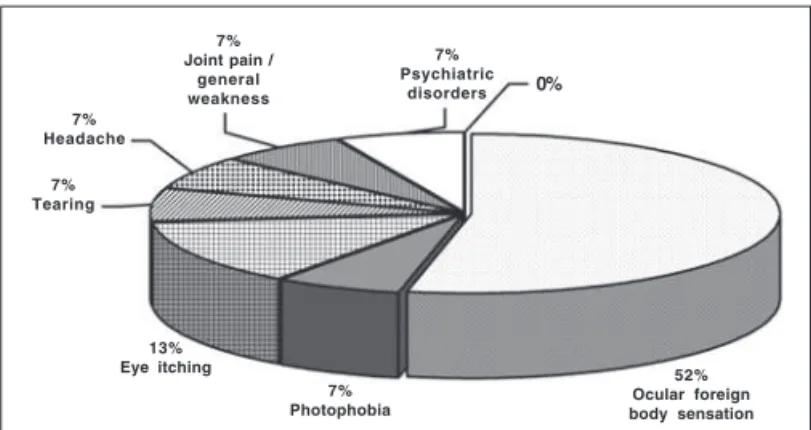
Follow-up was carried out for the remaining 31 patients. The male-to-female ratio was 1.58 (61% male) and the median age was 44.1 years (range 25-66 years). General complaints were joint pain, psychiatric disturbances, headache, and ge-neral weakness (Figure 1). Best corrected visual acuity ranged from 20/15 to 20/40 and IOP levels ranged between 9 and 20 mmHg. Symptomatic patients complained of foreign body sen-sation in the eyes mainly in the first 2 months of therapy, becoming more tolerable with time.
Ocular findings related to IFN were development of cotton wool spots (3 eyes) and retinal hemorrhage (1 eye). In one patient with previous exposure to IFN, vitreous hemorrhage, cotton wool spots, hard exudates and vascular tortuosity although asymptomatic were observed. Other ocular findings included hordeolum (n=1) and toxoplasmosis scarred chorio-retinitis (n=2). Two HIV patients presented unilateral scarred
retino-choroiditis due to toxoplasmosis, one of which was characterized as Jensen’s papillitis.
DISCUSSION
In our study, there were no cases of severe ocular complica-tions due to the administration of systemic IFN. The only case of retinopathy started less than 2 months after the beginning of the therapy, and did not lead to any ocular symptom. Still, the retinopathy did not resolve spontaneously by the time this patient died of cardiac infarction. The other case of retinopathy was excluded from the study, due to past personal history of hypertension, diabetes mellitus and chronic renal insufficiency, but was followed up. Therefore, the retinal findings in this patient could not be associated only with IFN itself.
In the international literature, the incidence of retinopathy associated with IFN ranges from 18 to 86%(27). This variation can be explained by the amount of analyzed patients, the associated risk factors, and indication of IFN administration. Some studies report disappearance of the retinopathy even with maintenance of the therapy(2,4,12,16), while others describe its persistence(13,15). There are several clinical evolutions, and most of them are benign. One single case is about a patient that presented a disarrangement of the basic structures of the eye and infiltration of inflammatory cells, leading to eyeball rupture(25). This is probably the most severe case of ocular complication by IFN.
The pathogenesis of retinopathy is not totally clear. Seve-ral theories have been formulated to explain the mechanisms of retinal dysfunction:
• Obstruction of axoplasmatic flow secondary to ischemia of the retinal vasculature, causing cotton wool spots(22,28). • The presence of cotton-wool spots and retinal
hemorrha-ges indicates that probably there is an impairment of reti-nal blood circulation and somehow there might be retireti-nal ischemia(1,14,21). According to the authors, the dysfunc-tions are similar to those found in diabetic retinopathy. • Decreased platelet counts, increased triglyceride levels
and diabetes mellitus. Hypoalbuminemia decreases the
7% Psychiatric
disorders 7%
Joint pain / general weakness 7%
Headache
7% Tearing
0%
13% Eye itching
7% Photophobia
52% Ocular foreign body sensation
Figure 1 - Ocular and general complaints of patients undergoing IFN therapy
Arq Bras Oftalmol. 2004;67(6):917-20
Ocular changes due to systemic alpha-interferon therapy for hepatitis C 919
plasma oncotic pressure difference between interstitial fluids(1,15).
• Intra-arterial obstruction by leukoaggregated embolization results from complement activation with IFN alpha causing synergistic elevation of C5a levels, the complement com-ponent responsible for granulocyte shape alteration and aggregation(1,20,28). According to those studies, C5a levels increased 5 to 10 times in patients with retinal complica-tions on IFN therapy as compared with those without retinal complications. IFN alpha has been shown to increa-se leukocyte adhesion to vascular endothelium in rats(15). The three typical fundus changes are: retinal hemorrhage, cotton-wool spots, and nerve fiber layer defect21. Patients with previous history of diabetes mellitus are more suscepti-ble to the development of retinopathy(1,4,14-15). Ocular pain is not likely to be related to retinopathy(16-17,21). Because this retinopathy is usually mild and seldom induces visual symp-toms, the therapy can be continued in most patients. Howe-ver, severe retinal damage carries the risk of complete loss of vision. Therefore, careful monitoring of retinal lesions is re-quired in patients receiving IFN therapy, especially in those with underlying diabetes mellitus or hypertension.
There is no classification for IFN-induced retinopathy, like diabetic retinopathy. Therefore there is no rule for sus-pending the use of interferon in patients who develop retino-pathy or any other ocular side effects. The common sense for most authors is that careful monitoring should be performed in the presence of any ocular sign, even without symp-toms(3,12-14,16,19-20,27,29). The ophthalmic intervention is of cru-cial importance in order to keep satisfactory ocular function, even if invasive procedures are necessary, such as laser retinal photocoagulation or eye surgery(8,25).
CONCLUSION
In the present study, retinal abnormalities, although asymptomatic were found in the eyes of patients undergoing IFN therapy for hepatitis C. In our country, there are no stu-dies describing the features of these microvascular abnormali-ties or their epidemiology. Since this is a preliminary study, further research on this issue must be carried out, probably with a more significant amount of cases. Patients undergoing the therapy should always be referred to the ophthalmologist in order to determine and follow any lesion that may be related to the use of this drug.
RESUMO
Objetivo: Avaliar alterações oculares (em especial lesões
fun-doscópicas) em pacientes com hepatite C tratados com alfa-interferon (IFN). Métodos: Estudo prospectivo, descritivo e observacional de pacientes com hepatite C do serviço de Gastroenterologia da UNIFESP com indicações de uso de
alfa-interferon entre novembro de 1999 e junho de 2000. Esses pacientes foram submetidos a exame oftalmológico completo antes e 1, 3, 6 e 12 meses após o início do tratamento. Pacien-tes HIV positivos, ou com exposição prévia à droga foram excluídos. Resultados: De um total de 51 pacientes seleciona-dos, 31 foram acompanhados. A relação masculino-feminino foi de 1,55, e a média de idade de 47 anos. A acuidade visual corrigida variou de 20/15 a 20/40. Vinte e dois por cento dos pacientes queixaram-se de sensação de corpo estranho, prin-cipalmente nos dois primeiros meses de terapia. Queixas ge-rais foram: artralgia, cefaléia, depressão, fraqueza muscular. Achados oculares foram: hemorragia retiniana (um olho) e exsudatos moles (três olhos), todos assintomáticos. Em um paciente com história pregressa de tratamento com interferon, observou-se presença de hemorragia vítrea, exsudatos duros e moles e tortuosidade vascular. Um paciente faleceu durante o tratamento por infarto cardíaco. Conclusões: Existem altera-ções oculares por uso sistêmico de alfa-interferon. Não exis-tem estudos no nosso país descrevendo essas alterações. Médicos clínicos gerais e gastroenterologistas devem prestar atenção a esse tipo de problema, e encaminhar os pacientes a um serviço de oftalmologia para acompanhamento paralelo.
Descritores: Hepatite C/quimioterapia; Alfa-interferon/uso
terapêutico; Retinopatia/etiologia.
REFERENCES
1. Tokai R, Ikeda T, Miyaura T, Sato K. Interferon-associated retinopathy and cystoid macular edema. Arch Ophthalmol. 2001;119(7):1077-9.
2. Okanoue T, Sakamoto S, Itoh Y, Minami M, Yasui K, Sakamoto M, et al. Side effects of high-dose interferon therapy for chronic hepatitis C. J Hepatol. 1996;25(3):283-91.
3. Purvin VA. Anterior ischemic optic neuropathy secondary to interferon alfa. Arch Ophthalmol. 1995;113(8):1041-4.
4. Hayasaka S, Fujii M, Yamamoto Y, Noda S, Kurome H, Sasaki M. Retino-pathy and subconjunctival haemorrhage in patients with chronic viral hepatitis receiving inteferon alfa. Br J Ophthalmol. 1995;79(2):150-2.
5. O’Neill DP. The eye and liver disorders. Eye. 1992;6(Pt 4):366-70. 6. Zegans ME, Anninger W, Chapman C, Gordon SR. Ocular manifestations of
hepatitis C virus infection. Curr Opin Ophthalmol. 2002;13(6):423-7. 7. Moazami G, Auran JD, Florakis GJ, Wilson SE, Srinivasan DB. Interferon
treatment of Mooren’s ulcers associated with hepatitis C. Am J Ophthalmol. 1995;119(3):365-6.
8. Baratz KH, Fulcher SF, Bourne WM. Hepatitis C-associated keratitis. Arch Ophthalmol. 1998;116(4):529-30.
9. Fukumoto Y, Shigemitsu T, Kajii N, Omura R, Harada T, Okita K. Abducent nerve paralysis during interferon alpha-2a therapy in a case of chronic active hepatitis C. Intern Med. 1994;33(10):637-40.
10. Gillies MC, Garrett SK, Shina SM, Morlet N, Taylor HR. Topical interferon alpha 2b for corneal haze after excimer laser photorefractive keratectomy. J Cataract Refract Surg. 1996;22(7):891-900.
11. Leyland M, Torok ME, Acheson J, Foster GR. Hepatitis C virus infection is not associated with a marked increase in the prevalence of ophthalmic morbi-dity. Eye. 2000;14(Pt 6):889-91.
12. Peres-AlvareZ AF, Jimenez-Alonso J, Reche-MOLINA I, Leon-Ruiz lL, Hi-dalgo-Tenorio C, Sabio JM. Retinal vasculitis and vitreitis in a patient with chronic hepatitis C virus. Arch Intern Med. 2001;161(18):2262.
13. Jain K, Lam WC, Waheeb S, Thai Q, Heathcote J. Retinopathy in chronic hepatitis C patients during interferon treatment with ribavirin. Br J Ophthal-mol. 2001;85(10):1171-3.
14. Esmaeli B, Koller C, Papadopoulos N, Romaguera J. Interferon-induced retino-pathy in asymptomatic cancer patients. Ophthalmology. 2001;108(5):858-60.
Arq Bras Oftalmol. 2004;67(6):917-20
920Ocular changes due to systemic alpha-interferon therapy for hepatitis C
15. Willson RL, Ross RD, Willson LM, Cohen G, Redfield TL, Gitter KA. Interferon-associated retinopathy in a young, insulin-dependent diabetic patient. Retina. 2000;20(4):413-5.
16. Norcia F, Di Maria A, Prandini F, Redaelli C. Natural interferon therapy: optic nerve ischemic damage? Ophthalmologica. 1999;213(5):339-40. 17. Kadayifcilar S, Boyacioglu S, Kart H, Gursoy M, Aydin P. Ocular
complica-tions with high-dose interferon alpha in chronic active hepatitis. Eye. 1999;13 (Pt 2):241-6.
18. Abe T, Nakajima A, Matsunaga M, Sakuragi S, Komatsu M. Decreased tear lactoferrin concentration in patients with chronic hepatitis C. Br J Ophthalmol. 1999;83(6):684-7.
19. Manesis EK, Moschos M, Brouzas D, Kotsiras J, Petrou C, Theodosiadis G, et al. Neurovisual impairment: a frequent complication of alpha-interferon treatment in chronic viral hepatitis. Hepatology 1998;27(5):1421-7. Comment in: Hepatology. 1998;27(5):1441-2.
20. Sugano S, Suzuki T, Watanabe M, Ohe K, Ishii K, Okajima T. Retinal complications and plasma C5a levels during interferon alpha therapy for chronic hepatitis C. Am J Gastroenterol. 1998;93(12):2441-4.
21. Kawano T, Shigehira M, Uto H, Nakama T, Kato J, Hayashi K, et al. Retinal complications during interferon therapy for chronic hepatitis C. Am J Gas-troenterol. 1996;91(2):309-13.
22. Guyer DR, Tiedeman J, Yannuzzi LA, Slakter JS, Parke D, Kelley J, et al. Interferon-associated retinopathy. Arch Ophthalmol. 1993;111(3):350-6. 23. Schulman JA, Liang C, Kooragayala LM, King J.Posterior segment
compli-cations in patients with hepatitis C treated with interferon and ribavirin. Ophthalmology. 2003;110(2):437-42.
24. Hejny C, Sternberg P, Lawson DH, Greiner K, Aaberg TM Jr. Retinopathy associated with high-dose interferon alfa-2b therapy. Am J Ophthalmol. 2001; 131(6):782-7.
25. Yamada H, Mizobuchi K, Isogai Y. Acute onset of ocular complications with interferon. Lancet 1994;343(8902):914.
26. Kuga K, Hasumura S, Nagamori S, Toda G, Kitahara K.Intraocular hemorrhage developing during interferon therapy. Intern Med. 1996;35(1):15-8.
27. Hayasaka S, Nagaki Y, Matsumoto M, Sato S. interferon-associated retinopathy. Br J Ophthalmol. 1998;82(3):323-5.
28. Sugano S, Yanagimoto M, Suzuki T, Sato M, Onmura H, Aizawa H, et al. Retinal complications with elevated circulating plasma C5a associated with interferon-alpha therapy for chronic active hepatitis C. Am J Gastroenterol. 1994;89(11):2054-6.
29. Pivetti-Pezzi P, Accorinti M, Pirraglia MP, Priori R, Valesini G. Interferon alpha for ocular Behcet’s disease. Acta Ophthalmol Scand. 1997;75(6):720-2.