Vol.47, No.2, Dec 2014, pp.89-96
89
Oxidation resistance of the nanostructured YSZ coating on the IN-738
superalloy
Ahmad Keyvani
1*, Mohsen Saremi
2,
eydarzadeh Sohi
1
. School of Metallurgy and Materials, College of Engineering, University of Tehran, Iran 2
. Department of Metallurgy and Materials Engineering, Faculty of Technology and Engineering, Shahrekord University, Iran
Received 2 December 2013; Accepted 30 December 2014
* Corresponding author: [email protected] ; Tel: +98 9132322583
Abstract
Conventional and nanostructured YSZ coatings were deposited on the IN-738 Ni super alloy by the atmospheric plasma spray technique. The oxidation was measured at 1100°C in an atmospheric electrical furnace. According to the experimental results the nanostructured coatings showed a better oxidation resistance than the conventional ones. The improved oxidation resistance of the nanocoating could be explained by the change in structure to a dense and more packed structure in this coating. The mechanical properties of the coatings were tested using the thermal cyclic, nanoindentation and bond strength tests, during which the nanostructured YSZ coating showed a better performance by structural stability.
Keywords: Plasma spray; Nanostructure; Oxidation; Nanoindentation.
1. Introduction
Plasma sprayed thermal barrier coatings based on yttria stabilized zirconia YSZ, have been applied to the hot section components of the gas turbine engine to increase the inlet temperature of the combustion chamber [1-3]. Due to low density, high hardness, good stiffness, strength and refractoriness, zirconia based ceramics are considered a good choice for use in thermal and wear applications [4]. The coatings sprayed onto the cylinder liners and turbine work pieces can act as a barrier to
reduce the thermal effect and enhance the thermal efficiency of the aerial and gas turbines engines [5].
The TBC coatings are subject to the harsh atmosphere of the combating chamber facing thermal shock, oxidation and hot corrosion phenomena. Many reports revealed that resistance against the above mentioned phenomena depended mainly upon the coating microstructure, as well as the heating conditions [6-9]. Therefore, by controlling the
2
Keyvaniet al./ Vol.47, No.2, Dec 2014
90 microstructure it would be possible to control the durability of the TBC coatings. This can be done by using controlled porosity, segmentation, micro-cracking, residual stress control and post-spray thermal treatment [6-12]. In recent years, nanostructured zirconia coatings deposited by atmospheric plasma spraying have attracted research interest because of some of the properties superior to those of the traditional zirconia coatings [13, 14]. Some investigators have reported that nanostructured coatings improve mechanical properties, show better thermal resistance, and reduce thermal conductivity compared with their coarse-grained coatings [15-20]. A few articles were reported on the thermal shock resistance of the nanostructured zirconia coatings but rarely had their oxidation and hot corrosion resistances been investigated [8, 14]. A few researchers have applied nanostructured TBC and studied the nanostructure zirconia coating resistance to thermal shocks [21-27], but there is a dearth of
knowledge regarding their oxidation and hot corrosion resistances. Therefore, this work aims at investigating and comparing the oxidation and hot corrosion resistances of the nanostructured zirconia coating applied by the plasma sprayed with the conventional ones.
2. Experimental
In the present study the nickel based superalloy (Inconel 738) in the shape of a disk (Ø 25×10 mm) was used as the substrate.
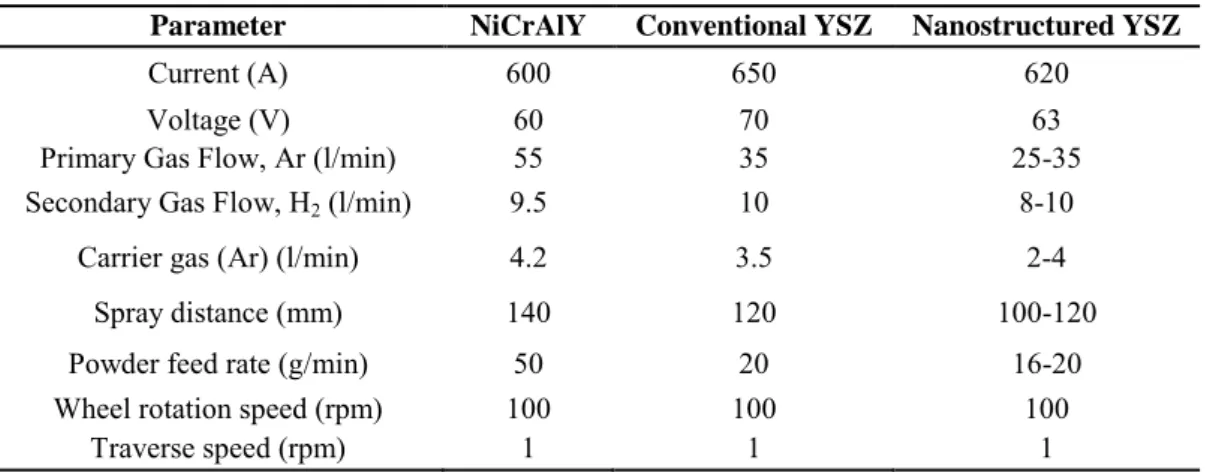
The specimen surfaces were shot-blasted with 50-80 mesh alumina grit and under a pressure of 0.28-0.34 MPa before applying the coatings. The surfaces were cleaned using the methyl ethyl ketone cleaner, and degreased in tri-chloroethylene vapor. After washing they were preheated to 65-95C and finally the coatings were applied over the specimens. Argon and hydrogen were the primary and the secondary plasma gases, respectively. Plasma spray parameters are summarized in Table 1.
Table 1. Parameters of plasma spraying
Parameter NiCrAlY Conventional YSZ Nanostructured YSZ
Current (A) 600 650 620
Voltage (V) 60 70 63
Primary Gas Flow, Ar (l/min) 55 35 25-35
Secondary Gas Flow, H2 (l/min) 9.5 10 8-10
Carrier gas (Ar) (l/min) 4.2 3.5 2-4
Spray distance (mm) 140 120 100-120
Powder feed rate (g/min) 50 20 16-20
Wheel rotation speed (rpm) 100 100 100
Traverse speed (rpm) 1 1 1
Amdry 962 (Sulzer Metco, USA) trade mark NiCrAlY micro-powders, micro-sized Sulzer Metco 204NS-G (Sulzer Metco, USA) trade mark YSZ conventional zirconia powders were used. The nanosize yttria stabilized zirconia powders were prepared via the chemical co-precipitation process, with particle sizes of < 200 nm, Nanox Powder S4007 (Inframat, USA), from plasma sprayable agglomerated spherical micrometer sized granules (typical size range in 15-150 µm) and the coating was applied through plasma spraying.
91
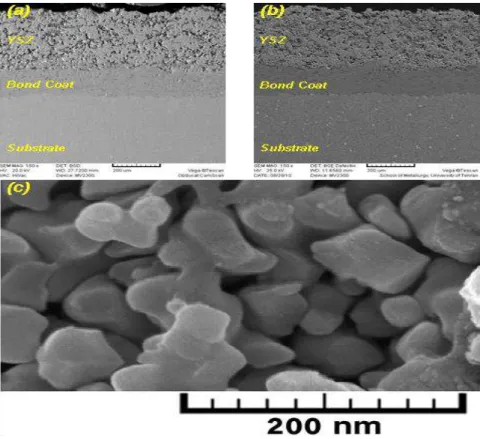
Fig. 1. SEM micrographs of cross sections (as-sprayed) of the: a) conventional coating; b) nanostructured coating; c) FESEM image of outer surface morphology of the nanostructured YSZ
2.1. Oxidation test
The specimens were then placed in an air atmosphere electrical furnace for oxidation tests at 1100°C. The specimens were set for 4 hours at the temperatures mentioned in the furnace and then were furnace cooled. Specimen removal before complete cooling of the furnace was avoided to prevent thermal shocks. The coating stability was checked by the appearance of the first crack or spallation at the coating edge. The TGO thickness and microstructure were also examined. The results were the average of five samples. Reproducibility of the data was checked by performing the test with four samples, i.e. for the conventional and nanostructured coatings 10 specimens were tested.
2.2. Nanoindentation test to study
mechanical properties
Nanoindentation test is a new technique to study Young’s modulus (E) and hardness (H) of the materials. The test is applied dynamically and the changes in the load and indentation depth are monitored. In nanoindentation tests, the degree of hardness and elastic modulus
were measured at the specimen cross-section composed of the IN-738 substrate, NiCrAlY bond coat and micro and nanostructured YSZ coatings before and after oxidation, also after the 200 h cyclic oxidation .
In this experiment, the mechanical properties were determined by using a nano indenter (Micro Materials LTD, wrexham, UK) with Berkovich tip.
The average values for ten points were considered as H and E. The parameters used in the nanoindentation test are: maximum load = l00 mN, loading rate = 5 mN/s, unloading rate = 5 mN/s and dwell period at maximum load = 10 s.
2.3. Bond strength test
Keyvaniet al./ Vol.47, No.2, Dec 2014
92 Field Emission Scanning Electron Microscopy (FESEM, Hitachi S4160), Scanning Electron Microscopy (SEM, Oxford CAMSCAN-MV2300) equipped with Energy Dispersive Spectrometer (EDS) and Philips X'pert X-ray diffraction were used to study different phases in the coats.
3. Results and Discussion
The YSZ coating applied by the thermal spray method may have microcracks and voids [27,29], but it seems that the nanostructured YSZ should have less pores and voids due to the packness of the nanostructure. Figure 1 shows the SEM images of TBC microstructure that indicates the YSZ with a lamellar and porous structure coated over the NiCrAlY bond coat, which is a feature of the plasma spray coating. Pores and microcracks can be observed in the cross-section of the YSZ coating in both layers and also in the outer surface of the coating. While in the nanostructured TBC that is made from ultrafine particles the inhomogeneities and pores are reduced considerably. This will result in lower O2 diffusion and infiltration of
the corrosive materials. Moreover, the absence of voids or microcracks in the zirconia layer indicates proper cohesion of the two layers.
3.1. Oxidation
The results of the oxidation tests showed that nanostructured YSZ was more resistant to oxidation than the conventional YSZ. The low resistance of the conventional YSZ may be attributed to the inhomogenously distributed microcracks, open pores and finally to less adhesion of the top layer to the NiCrAlY metallic bond coat. The conventional YSZ coating cracked after ≈ 200 h of oxidation, while the nanostructured YSZ coating tolerated ≈ 260 h of oxidation and finally cracked and lled from the specimen. The thermally grown oxide, TGO layer is the origin of the stresses which can cause crack formation and degradation of the ceramic barrier coating. Various mechanisms have been proposed for such proneness to degradation. As there are usually asperities in the interface of the TGO/YSZ interface and the peak in these asperities is the stress
concentration site; therefore, crack initiation and spalling of ceramic layer originates from the TGO, which forms in the interface [30]. It has also been proposed that due to the difference in the thermal expansion between the TGO layer and its substrate (NiCrAlY bond coat) residual compression stresses are developed [31] and during the next thermal cycles the aforementioned stresses are freed as tensile stresses parallel to the TGO/YSZ interface, which is simultaneous with interface spallation [32]. The increase in the TGO thickness certainly results in the development of larger stresses.
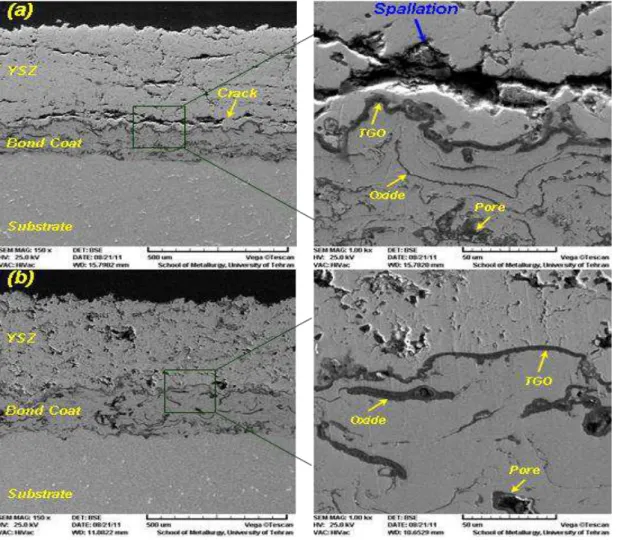
The SEM images of the TBC layers of microstructures after oxidation are shown in Figure 2. The TGO formed is much more and thicker in the conventional TBC, while less TGO is formed in the interface and adjacent area in the nanostructured YSZ. This can clearly be attributed to less O2 diffusion
through the pores [33, 34].
Figure 3 shows the increase in the thickness of the TGO after 48, 100, 148 and 200 h of oxidation at 1100°C. The growth of the TGO in the nanostructured TBC is much less than that of the conventional one. As it is seen in the first 48 h of oxidation the increase in the TGO thickness is fast but in the time interval of 100 to 148 h this trend decreased and reached a constant rate after 148 h.
The presence of a fine grained and dense nanostructured YSZ layer played an effective role in reducing the oxygen permeation towards the ceramic zirconia layer [33]. The rate of the oxygen ion permeation via the more compacted particles is much less than the conventional microzirconia particles. Due to more even microcracks and linked porosities made by the nanostructured YSZ, it is more resistant to oxygen permeation than the ordinary YSZ [34].
The results of the oxidation test indicated that: the nanostructured YSZ coating decreases oxygen diffusion towards the NiCrAlY bond coat and acts as a strong barrier for the infiltration of corrosive materials into the ceramic YSZ. As a result, the existence of the finer particles in the YSZ coating can increase the TBC durability in the service conditions of gas turbines.
93
Fig. 2. Cross-sectional SEM images of TBC coatings after 200 h oxidation test: a) conventional YSZ; b) nanostructured YSZ
Keyvaniet al./ Vol.47, No.2, Dec 2014
94 3.2. Mechanical properties
Figure 4 compares the hardness (H) and elastic modulus (E) of the IN-738 substrate, NiCrAlY bond coat and micro and nanostructured YSZ tested by nanoindentation before and after oxidation (as-sprayed), after 200 h oxidation at 1100°C. Although the substrate hardness has increased after oxidation its elastic modulus has not altered considerably. After oxidation the elastic modulus of the micro and nanostructured YSZ coating has decreased.
The comparison of the mechanical properties, i.e. the elastic modulus and hardness of the coatings by the nanoindentation method shows that the elastic modulus of the NiCrAlY bond coat of the micro YSZ has increased from 73 GPa to 175.84 GPa during oxidation, while this in the nanostructured YSZ has increased from 73 GPa to 167.28 GPa. This can be attributed to the formation of the (Ni/Cr)-O oxides, which results in volume swell. Consequently, compressive stresses are made and the elastic modulus is increased. Additionally, the oxide phases have higher elastic modulus.
For the nanostructured YSZ coating the elastic modulus increase is less than that of the micro, which is due to less formation of the Ni-Cr oxide spinels (spinel Ni/Cr oxides).
The above results are in good agreement with those achieved by H. J. Jang [35] about the mechanical properties of the micro TBCs. He has also suggested that the increase in the elastic modulus of the NiCrAlY bond coat at 900-1100°C is due to the formation of the oxide phases.
After oxidation at 1100°C for 200 h, the elastic modulus of the micro YSZ has decreased from 99.50 GPa to 69.39 GPa (Fig. 4) while for nanostructured YSZ this has dropped from 125.00 GPa to 103.54 GPa. The decrease in the YSZ elastic modulus after oxidation can be attributed to the growth of the microcracks and tensile stresses [36, 37]. As the TGO growth and the amount of spinel oxides in the NiCrAlY layer of the nanostructured YSZ is less than that of the micro YSZ, the stresses exerted upon the nanostructured YSZ layer is decreased. Accordingly, the variation of the elastic modulus in the nanostructured YSZ layer is less than that of the micro YSZ.
Fig. 4. The comparison of conventional and nanostructured YSZ coating layers: (a, b) hardness;
(c, d) elastic modulus before and after oxidation
95 Thus, after oxidation the variation in the mechanical properties of the nanostructured YSZ coating is less than that of the micro YSZ coating. It seems that the mechanical interlockings in the nanostructured YSZ coating are stronger. As a result the widening of the microcracks is less despite the stresses induced due to the TGO layer growth and oxide phases.
The bond strength results indicate that the nanostructured YSZ coating is stronger than the micro YSZ. As the spallation of both the micro and nanostructured coatings takes place in the interface of the NiCrAlY, one can say that the YSZ particles cohesion is stronger than adhesion with the NiCrAlY layer [39].
Due to the higher oxidation resistance, less variation in the elastic modulus during the thermal cycles and higher bond strength of the nanostructured YSZ coating (42±4 MPa), it can be concluded that the nanostructured YSZ coating possesses better mechanical properties than the micro YSZ coating (37±3 MPa).
Accordingly, as a result of microstructural observation, thermal cycle tests, nanoindentation and bond strength, the nanostructured YSZ possess better mechanical resistance during the thermal cycles.
4. Conclusions
Based on the experimental results it can be concluded that the packing density and homogeneity of the nanostructured YSZ increases its resistance against oxidation. This is mainly due to the of O2 through
the pores and structure of the crystal YSZ. As a result of stronger mechanical bonding and adhesion in the nanostructured YSZ and decrease in its microcracks, there was less variation in its elastic modulus than the micro YSZ during thermal cycling.
References
[1].W. Beele, G. Marijnissen, A. Lieshout, The evolution of thermal barrier coatings: status and upcoming solutions for today’s key issues, Surf. Coat. Technol. 120-121 (1999) 61-67. [2].A. Uzun, I. Cevik, M. Akcil, Effects of thermal
barrier coating on a turbocharged diesel engine performance, Surf. Coat. Technol. 116-119 (1999) 505-507.
[3].G.W. Goward, Progress in coating for gas turbine airfoils, Surf. Coat. Technol. 108-109 (1998) 73-79.
[4].H. Liu, Q. Xue, The tribological properties of TZP-graphite self lubricating ceramics, Wear 198 (1996) 143-149.
[5].H. Ahn, J. Kim, D. Lim, Tribologicalbehaviour of plasma zirconia coatings, Wear 203-204 (1997) 77-87.
[6].P. Bengtsson, T. Johannesson, Characterization of microstructural defects in plasma-sprayed thermal barrier coatings, J. Therm. Spray Technol. 4(3) (1995) 245-251.
[7].B.D. Choules, K. Kokini, T.A. Taylor, Thermal fracture of thermal barrier coatings in a high heat flux environment, Surf. Coat. Technol. 106 (1998) 23-29.
[8].G. Fargas, D. Casellas, L. Llanes, M. Anglada, Thermal shock resistance of yttria-stabilized zirconia with Palmqvist indentation cracks, J. Euro. Ceram. Soc. 23 (2003) 107-114.
[9].G. Sreedhar, V.S. Raja, Hot corrosion of YSZ/Al2O3 dispersed NiCrAlY plasma-sprayed
coatings in Na2SO4-10 wt.%NaCl melt, Corros.
Sci. 52 (2010) 2592-2602.
[10]. W.D. Kingery, H.K. Bowen, D.R. Uhlmann, Introduction to Ceramics, second ed., Wiley Interscience, New York, (1976).
[11]. T.A. Taylor, Thermal barrier coating for substrates and process for producing it, US Patent 5,073,433 (1991).
[12]. G. Marijnissen, A. Lieshout, G. Ticheler, H. Bons, M. Ridder, Thermal barrier coating system ceramic structure, US Patent 5,876,860 (1999).
[13]. H. Chen, C.X. Ding, Nanostructured zirconia coating prepared by atmospheric plasma spraying, Surf. Coat. Technol. 150 (2002) 31-36.
[14]. H. Chen, C. Ding, P. Zhang, P. La, S.W. Lee, Wear of plasma-sprayed nanostructured zirconia coatings against stainless steel under distilled-water conditions, Surf. Coat. Technol. 173 (2003) 144-149.
[15]. C.C. Berndt, E.J. Larernia, Thermal spray processing of nanoscale materials, J. Therm. Spray Technol. 7(3) (1998) 411- 440.
[16]. B.H. Kear, G. Skandan, Thermal spray processing of nanoscale materials, Nanostructured Mater. 8 (6) (1997) 765-769.
Keyvaniet al./ Vol.47, No.2, Dec 2014
96 [17]. P.G. Klemens, M. Gell, Thermal conductivity
of thermal barrier coatings, Mater. Sci. Eng. A 245 (1998) 143-149.
[18]. J. Karthikeyan, C.C. Berndt, J. Tikkanen, S. Reddy, H. Herman, Plasma spray synthesis of nanomaterial powders and deposits, Mater. Sci. Eng. A 238 (1997) 275-286.
[19]. M. Gell, Application opportunities for nanostructured materials and coatings, Mater. Sci. Eng. A 204 (1-2) (1995) 246-251.
[20]. C. Amaya, W. Aperador, J.C. Caicedo, F.J. Espinoza-Beltran, J. Munoz-Saldana, G. Zambrano, P. Prieto, Corrosion study of alumina/yttria-stabilized zirconia (Al2O3/YSZ) nanostructured thermal barrier coatings (TBC) exposed to high temperature treatment, Corros. Sci. 51 (2009) 2994-2999.
[21]. L. Chun-bo, Z. Zhi-min, J. Xian-liang, L. Min, Z. Zhao-hui, Comparison of thermal shock behaviors between plasma-sprayed nanostructured and conventional zirconia thermal barrier coatings, Trans. Nanoferrous Met. Soc. China 19 (2009) 99-107.
[22]. G. Skandan, Processing of nanostructured zirconia ceramics, Nanostructured Mater. 5 (2) (1995) 111-126.
[23]. Y. Zhu, M. Huang, J. Huang, C. Ding, Vacuum-plasma sprayed nanostructured titanium oxide films, J. Therm. Spray Technol. 8(2) (1999) 219-222.
[24]. B.H. Kear, Z. Kalman, R.K. Sadangi, G. Skandan, J. Colaizzi, W.E. Mayo, Plasma-sprayed nanostructured Al2O3/TiO2 powders
and coatings, J. Therm. Spray Technol. 9(4) (2000) 483-487.
[25]. L.L. Shaw, D. Goberman, R. Ren, M. Gell, S. Jiang, Y. Wang, T.D. Xiao, P.R. Strutt, The dependency of microstructure and properties of nanostructured coatings on plasma spray conditions, Surf. Coat. Technol. 130 (2000) 1-8. [26]. H. Chen, Y. Zeng, C. Ding, Microstructural
characterization of plasma-sprayed nanostructured zirconia powders and coatings, J. Eur. Ceram. Soc. 23 (2003) 491-497.
[27]. B. Liang, C. Ding, Thermal shock resistances of nanostructured and conventional zirconia coatings deposited by atmospheric plasma spraying, Surf. Coat. Technol. 197 (2005) 185-192.
[28]. ASTM C633-79, Standard test method for adhesion or cohesion strength of thermal spray
coating, 19th Annual Book of ASTM Standards, ASTM, Philadelphia, (1979). [29]. A.M. Limarga, S. Widjaja, T.H. Yip,
Mechanical properties and oxidation resistance of plasma-sprayed multilayered Al2O3/ZrO2
thermal barrier coatings, Surf. Coat. Technol. 197 (2005) 93-102.
[30]. K.W. Schlichting, N.P. Padture, E.H. Jordan, M. Gell, Failure modes in plasma-sprayed thermal barrier coatings, Mater. Sci. Eng. A 342 (2003) 120-130.
[31]. A.G. Evans, D.R. Mumm, J.W. Hutchinson, G.H. Meier, F.S. Pettit, Mechanisms controlling the durability of thermal barrier coatings, Prog. Mater. Sci. 46 (2001) 505-553.
[32]. A.N. Khan, J. Lu, Behavior of air plasma sprayed thermal barrier coatings subject to intense thermal cycling, Surf. Coat. Technol. 166 (2003) 37-43.
[33]. P.S. Manning, J.D. Sirman, R.A.D. Souza, J.A. Kilner, The kinetics of oxygen transport in 9.5 mol% single crystal yttria stabilized zirconia, Solid State Ionics 100 (1997) 1-10. [34]. A.C. Fox, T.W. Clyne, Oxygen transport by
gas permeation through the zirconia layer in plasma sprayed thermal barrier coatings, Surf. Coat. Technol. 184 (2004) 311-321.
[35]. H.J. Jang, D.H. Park, Y.G. Jung, S.C. Choi, U. Paik, Mechanical characterization and thermal behavior of HVOF-sprayed bond coat in thermal barrier coatings (TBCs), Surf. Coat. Technol. 200 (2006) 4355-4362.
[36]. J.S. Wallace, J. Ilavsky, Elastic modulus measurements in plasma sprayed deposits, J. Therm. Spray Technol. 7 (1998) 521-526. [37]. Y.S. Song, I.G. Lee, D.J. Kim, K. Lee, High
temperature properties of plasma sprayed coatings of YSZ/NiCrAlY on inconel substrate, Mater. Sci. Eng. A 332 (2002) 129-133. [38]. F. Tang, J.M. Schoenung, Cycled evolution
of Young’s modulus of air plasma sprayed yttria stabilized zirconia in thermally thermal barrier coatings, Scripta Mater. 54 (2006) 1587-1592.