The origin of summer monsoon rainfall at New Delhi by deuterium excess
115 Hydrology and Earth System Sciences, 8(1), 115118 (2004) © EGU
The origin of summer monsoon rainfall at New Delhi by
deuterium excess
Hongxi Pang
1, Yuanqing He
1, 2, Zhonglin Zhang
1, Aigang Lu
1and Juan Gu
11Cold and Arid Regions Environmental and Engineering Research Institute, Chinese Academy of Science, Lanzhou 730000, China 2Institute of Tibetan Plateau, Chinese Academy of Science, Beijing 100029, China
Email for corresponding author: [email protected]
Abstract
The deuterium excess in summer monsoon precipitation, determined from isotopic measurements (d18O and dD) at New Delhi, has been
shown to be correlated, negatively, with relative humidity at the 1000 hPa level over the western Arabian Sea. Furthermore, summer rainfall in north-western India is correlated, positively, with the zonal wind speed at the 1000 hPa level over the western Arabian Sea, while relative humidity is correlated, negatively, with zonal wind speed at the same level. It is concluded that evaporation from the western Arabian Sea is a major source of the summer rainfall at New Delhi.
Keywords: deuterium excess, relative humidity, origin of precipitation
Introduction
The south-west Indian monsoon, a large-scale atmospheric circulation system in southern Asia, prevailing from June to September, contributes some 6090% of the annual rainfall in monsoon-controlled regions of India. Accordingly, it is important to study the origin of the moisture and its transportation processes over this region. According to measurements during the International Indian Ocean Expedition (IIOE), Pisharoty (1965) indicated that evaporation from the Arabian Sea is a major contributor to Indian summer monsoon rain. Rao et al. (1981) suggested that nearly 40% of Arabian Sea evaporation is precipitated locally and the rest is transported to the Indian subcontinent. Furthermore, Murakami et al. (1984) considered that the cross equatorial air-flow from the southern Indian Ocean cannot reach South Asia to form rainfall, so evaporation from the Arabian Sea should be an important source of Indian precipitation. Yet, based on vapour flux studies in the troposphere, Pearce and Mohanty (1984) suggested that Indian summer rain originates mainly in the southern Indian Ocean. Kumar and Schluessel (1988) also considered that 70% of the moisture for the monsoon rains in India comes from the Southern Hemisphere.
In the present study, d18O and dD precipitation data from the IAEA/WMO station at New Delhi have been analysed and the deuterium excess (d-excess) series from 19611996 determined. Also, summer rainfall data in north-western India (Fig. 1) and relative humidity and wind speed at the
! "
116
1000 hPa level over the Western Arabian Sea, derived from NCEP/NCAR data, have been included in the analysis, to trace the source of summer monsoon precipitation at New Delhi.
Data and methodology
The d18O and dD data applied in the paper, were retrieved from GNIP (Global Network for Isotopes in Precipitation), accessible at: http://isohis.iaea.org; the re-analysis data of NCEP/NCAR zonal wind speed and relative humidity are available at http://www.cdc.noaa.gov/cdc/reanalysis/ reanalysis.shtml; and the summer monsoon rainfall of the northwestern India refers to Sontakke and Nityanand Singh (1996).
Craig (1961) defined the correlation between d´D and d18O in atmospheric precipitation as the meteoric water line (MWL), which can be expressed as
dD = 8d18O + 10.
Because of rapid evaporation in precipitation source areas, the fractionation of oxygen and hydrogen does not normally occur under equilibrium conditions so there is a difference between dD and d18O. Dansgaard (1964) defined this parameter as d-excess, which is both an indicator of non-equilibrium conditions and an index of evaporation rate, formulated as
d-excess =dD 8d18O. (1)
The d-excess in precipitation depends on the relative humidity in the precipitation source area (Merlivat and Jouzel, 1979; Jouzel and Merlivat, 1984). Lower relative humidities cause higher d-excess values in precipitation and vice versa. Therefore, the moisture source for the monsoon rain of New Delhi can be traced by d-excess based on the correlation between the d-excess and the relative humidity over the potential source of the water vapour.
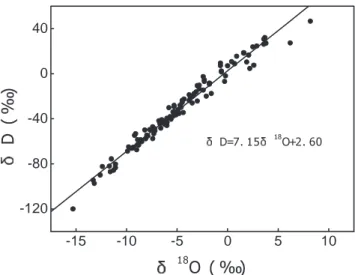
To smooth other factors controlling d-excess variation, (wind speed, sea surface temperature over the source area and the re-evaporation of raindrops), the mean d-excess value from June to September was used in the analysis. Compared with other IAEA/WMO stations in the monsoon regions, at New Delhi the stable isotopic data record (d18O and dD) is more continuous and longer. However, the deuterium values (dD) were missing for the years 1970, 1971, 1972 and 1977. Accordingly, the monsoon meteoric water line (Fig. 2) was constructed using monthly values of d18O and dD in summer (June to September) over the years
1961 to 1996 and the resulting linear relation is
dD = 7.15d18O + 2.60. (2)
Calculating the missing dD values from measured d18O values for the four years using Eqn. (2), the deuterium excess series can be obtained according to Eqn. (1).
Results
To simplify the analysis, the Arabian Sea was divided into the western Arabian Sea (1020ºN, 5060ºE), the eastern Arabian Sea (1020ºN, 7080ºE) and the coastal sea off Somali (010ºN, 5060ºE); likewise, the South Indian Ocean was divided into the western South Indian Ocean (30ºS0, 40ºE60ºE), the central South Indian Ocean (30ºS0, 60ºE 80ºE) and the eastern South Indian Ocean (30ºS0, 80ºE 100ºE). By re-analysing NCEP/NCAR data, the average values of summer relative humidity at the 1000 hPa level were calculated for the six regions of the Indian Ocean. The only statistically-significant correlation with deuterium excess in monsoon rainfall at New Delhi was with the relative humidity of the Western Arabian Sea (Fig. 1). The curves in Fig. 3 are the cumulative anomalies of relative humidity and d-excess. The relative humidities may be divided into three stages: rising from 19611965 (Stage 1), falling from 19661984 (Stage 2) and rising 1985 to 1996 (Stage 3). Similarly, d-excess values decrease from 1961 1966 (Phase 1), increase from 19671984 (Phase 2) and decrease from 19851996. The manifestly negative correlation between the relative humidity and d-excess implies that the major vapour source of monsoon rain at New Delhi is in the western Arabian Sea.
From Fig. 3, it is obvious that two climatic discontinuities occurred in the mid-1960s and in the 1980s respectively;
-15 -10 -5 0 5 10
-120 -80 -40 0 40
'
Å
2 Å
' 2
The origin of summer monsoon rainfall at New Delhi by deuterium excess
117 the former coincided with a change in the Asian Monsoon
(Fu and Fletcher, 1988) while the latter reflected a strengthening of the South Asian Monsoon in 1984 (Tang et al., 1998)
Figure 4 shows variations in the summer rainfall in north-western India (the polygon in Fig. 1) as well as the average values of summer zonal wind speed and relative humidity above the western Arabian Sea at the 1000hPa level during 19611995. Statistical analyses indicate that the summer rainfall amount is positively correlated with the zonal wind speed, (correlation coefficient 0.71 significant at the 99% confidence level (Fig.4a, b)), suggesting that the zonal wind of the western Arabian Sea plays an important role in the summer rainfall in north-western India. Furthermore, the wind speed is negatively correlated with the relative humidity (correlation coefficient 0.45 at 99% confidence level) (Fig.4b, c), indicating that evaporation from the western Arabian Sea is transported eastward by the zonal wind. The stronger the wind, the more water vapour is transported, resulting in lower values of relative humidity and vice versa.
Discussion and Summary
Changes of the d-excess in precipitation at New Delhi recorded discontinuities in the South Asian Monsoon in the mid-1960s and mid-1980s, so variations in d-excess at New
Delhi may be a typical proxy in monsoon behaviour. The correlation between the d-excess and the relative humidity above the western Arabian Sea suggests that monsoon precipitation at New Delhi is derived mainly from the western Arabian Sea. However, this conclusion cannot be extrapolated to the whole south-west monsoon region on the basis of d-excess data at a single station. Furthermore, this result is in conflict with the opinion that cross-Equatorial air flow is the main source of south-west monsoon precipitation.
The south-west monsoon is a large-complex climatic system which, during monsoonal seasons, behaves in different ways in different years, with active and more passive phases (Krishnamurthy and Shukla, 2000). Further work will clarify whether the vapour sources differ in the active and break phases or in the stronger and weaker monsoonal years, and whether the water vapour for precipitation in different parts of India is derived from the same sources.
Acknowledgments
The reported here was supported by the Hundred Talents Program(CAS2004-43) from Chinese Academy of Sciences, the funds of Great Project for Western China Development(90302006) and Outstanding Young Scientists(40121101) from the Chinese Natural Science
1960 1970 1980 1990
-20 -10 0 10 20 GH XW HU LX P H [F HV V Å Year
1960 1970 1980 1990
-6 -3 0 3 6
b
UH OD WL YH K XP LG LW \a
1960 1970 1980 1990 62 64 66 Year re la ti v e hu mi di ty ( % ) c 4 5 6 wi nd s p eed ( m/ s ) b 400 600 800 1000 pr ec ip it a tio n ( m m ) a
Fig 3. Cumulative anomalies from deuterium excess of monsoon precipitation at New Delhi and relative humidity at the 1000 hPa level of the western Arabian Sea during 19611996
! "
118
Foundation, the Knowledge-Innovation Programme (210506) from LICCRE, Cold and Arid Regions Environmental and Engineering Institute, Chineses Academy of Sciences.
References
Craig, H., 1961. Isotopic variations in meteoric waters. Science,
133, 17021703.
Dansgaard, W., 1964. Stable isotopes in precipitation. Tellus, 16,
436468.
Fu, C.B. and Fletcher, J., 1988. Large signals of climatic variation
over the ocean in the Asian monsoon region. Adv. Atmos. Sci.,
5, 389404.
Jouzel, J. and Merlivat, L., 1984. Deuterium and oxygen-18 in precipitation: modeling of the isotope effects during snow
formation. J. Geophys. Res., 89, 1174911757.
Krishnamurthy, V. and Shukla, J., 2000. Intraseasonal and
Interannual variability of rainfall over India. J. Climate, 13,
43664377.
Kumar, M.R. and Schluessel, P., 1988. Air-sea interaction over the Indian Ocean during the two contrasting monsoon years
1987 and 1988 studied with satellite data. Theor. Appl. Climatol.,
60, 219231.
Merlivat, L. and Jouzel, J., 1979. Global climate interpretation of
the deuterium-oxygen 18 relationship for precipitation. J.
Geophys. Res., 84, 50295033.
Murakami, T., Nakazowa, T. and He, T., 1984. On the 40-50 day oscillations during the monsoon during the northern hemispheric
summer Part II:Heat and moisture budget. J. Meteorol. Soc.
Japan, 62, 469484.
Pearce, R.P. and Mohanty, U.C., 1984. Onsets of Asian summer
monsoon, 1979-1982. J. Atmos. Sci., 41, 16201639.
Pisharoty, P.R., 1965. Evaporation from the Arabian Sea and the
Indian southwest monsoon. Proc. Symp. Meteorological Results,
IIOE, Bombay, India. 4354.
Rao, G.V., Schaub Jr., W.R. and Puetz, J., 1981. Evaporation and precipitation over the Arabian Sea during several monsoon
seasons. Mon. Weather Rev., 109, 364370.
Sontakke, N.A. and Singh, N., 1996. Longest instrumental regional and all-India summer monsoon rainfall series using optimum
observations: reconstruction and update. Holocene, 6, 315331.
Tang Maocang, Cheng Guodong and Lin Zhenyao, 1998.