This content has been downloaded from IOPscience. Please scroll down to see the full text.
Download details:
IP Address: 186.217.234.72
This content was downloaded on 06/02/2014 at 16:26
Please note that terms and conditions apply.
Time reconstruction and performance of the CMS electromagnetic calorimeter
2010 JINST 5 T03011
PUBLISHED BYIOP PUBLISHING FORSISSARECEIVED:November 23, 2009
ACCEPTED:January 5, 2010
PUBLISHED:March 19, 2010
COMMISSIONING OF THECMS EXPERIMENT WITHCOSMIC RAYS
Time reconstruction and performance of the CMS
electromagnetic calorimeter
CMS Collaboration
ABSTRACT: The resolution and the linearity of time measurements made with the CMS
electro-magnetic calorimeter are studied with samples of data from test beam electrons, cosmic rays, and beam-produced muons. The resulting time resolution measured by lead tungstate crystals is bet-ter than 100 ps for energy deposits larger than 10 GeV. Crystal-to-crystal synchronization with a precision of 500 ps is performed using muons produced with the first LHC beams in 2008.
KEYWORDS: Calorimeters; Large detector systems for particle and astroparticle physics
2010 JINST 5 T03011
Contents
1 Introduction 1
2 Time extraction with ECAL crystals 2
3 Time measurement resolution 4
4 Synchronization between crystals 5
5 Resolution and linearity checks using cosmic ray muons 8
6 Conclusions 9
The CMS collaboration 11
1 Introduction
The primary goal of the Compact Muon Solenoid (CMS) experiment [1] is to explore particle physics at the TeV energy scale, exploiting the proton-proton collisions delivered by the Large Hadron Collider (LHC) at CERN [2]. The electromagnetic calorimeter (ECAL), which measures the energy of electrons and photons produced in LHC collisions, is located inside the bore of the solenoid magnet. It is a hermetic homogeneous calorimeter made of 75 848 lead tungstate (PbWO4) scintillating crystals: 61 200 in the barrel (EB) and 7324 in each endcap (EE). The barrel has an inner radius of 129 cm, while the distance between the center of the interaction region and the endcap envelope is about 315 cm. Lead tungstate has a fast scintillation response and is resistant to radiation; it has a high density (8.3 g cm−3), a short radiation length (X
0= 0.89 cm), and a small Moli`ere radius (RM = 2.0 cm), features that allow a highly granular, compact detector to be built.
Each individual crystal is a truncated pyramid, with a lateral size comparable toRMand a length of
25.8X0(24.7X0) for the barrel (endcaps). The scintillation decay time of the crystals is comparable to the LHC bunch crossing interval of 25 ns, and about 80% of the light is emitted in 25 ns. For the light detection, the crystals are equipped with avalanche photodiodes in the barrel and vacuum phototriodes in the endcaps.
2010 JINST 5 T03011
In addition to the energy measurement, the combination of the scintillation timescale of PbWO4, the electronic pulse shaping, and the sampling rate allow excellent time resolution to be obtained with the ECAL. This is important in CMS in many respects. The better the precision of time measurement and synchronization, the larger the rejection of backgrounds with a broad time distribution. Such backgrounds are cosmic rays, beam halo muons, electronic noise, and out-of-time proton-proton interactions. Precise out-of-time measurement also makes it possible to identify parti-cles predicted by different models beyond the Standard Model. Slow heavy charged R-hadrons [6], which travel through the calorimeter and interact before decaying, and photons from the decay of long-lived new particles reach the calorimeter out-of-time with respect to particles travelling at the speed of light from the interaction point. As an example, to identify neutralinos decaying into photons with decay lengths comparable to the ECAL radial size, a time measurement resolution better than 1 ns is necessary. To achieve these goals the time measurement performance both at low energy (1 GeV or less) and high energy (several tens of GeV for showering photons) becomes rel-evant. In addition, amplitude reconstruction of ECAL energy deposits benefits greatly if all ECAL channels are synchronized within 1 ns [7]. Previous experiments have shown that it is possible to measure time with electromagnetic calorimeters with a resolution better than 1 ns [8].
In section2, the algorithm used to extract the time from the digitized ECAL signal is presented. In section 3, the uncertainties in the time measurement and the time resolution extracted using electrons from a test beam are detailed. In section 4, the synchronization of ECAL crystals in preparation for the first LHC collisions is discussed, and the time inter-calibration obtained using muons from the first LHC beam events is presented. Finally, section5shows results on the ECAL time resolution and linearity, obtained using cosmic ray muons after the insertion of the ECAL into its final position in CMS.
The scope of this paper is limited to the timing extracted for single crystals. For electro-magnetic showers that spread over several crystals, the time measurement can be averaged, thus improving the resolution.
2 Time extraction with ECAL crystals
2010 JINST 5 T03011
[ns]
max
T - T
-150 -100 -50 0 50 100
[ns]
max
T - T
-150 -100 -50 0 50 100
max
A / A
0 0.2 0.4 0.6 0.8 1
1 2 3
4 5 6 7 8 9 10 a)
R = A(T) / A(T+25 ns)
0 0.25 0.5 0.75 1 1.25 1.5
R = A(T) / A(T+25 ns)
0 0.25 0.5 0.75 1 1.25 1.5
[ns]
max
T - T
-75 -50 -25 0 25 50 75 4 5 6 7 8 9 b)
Figure 1. (a) Typical pulse shape measured in the ECAL, as a function of the difference between the time (T) of the ADC sample and the time (Tmax) of the maximum of the pulse. The dots indicate ten discrete samples
of the pulse, from a single event, with pedestal subtracted and normalized to the maximum amplitude. The solid line is the average pulse shape, as measured with a beam of electrons triggered asynchronously with respect to the digitizer clock phase. (b) Pulse shape representation using the time differenceT−Tmaxas a
function of the ratio of the amplitudes in two consecutive samples (R).
An alternative representation of the pulse shape is provided by a ratio variable, defined as R(T) =A(T)/A(T+25 ns). Figure1(b) shows the measured pulse shape using the variableT− Tmax, as a function ofR(T). In view of the universal character of the pulse shape, this representation is independent ofAmax. It can be described well with a simple polynomial parameterization. The corresponding parameters have been determined in an electron test beam (see section 3) for a representative set of EB and EE crystals, and are subsequently used for the full ECAL.
Each pair of consecutive samples gives a measurement of the ratioRi=Ai/Ai+1, from which an estimate of Tmax,i can be extracted, with Tmax,i =Ti−T(Ri). Here Ti is the time when the
sampleiwas taken andT(Ri)is the time corresponding to the amplitude ratioRi, as given by the
parameterization corresponding to figure 1(b). The uncertainty on each Tmax,i measurement, σi,
is the product of the derivative of the T(R) function and the uncertainty on the value ofRi. The
latter has three independent contributions, which are added in quadrature. The first contribution is due to noise fluctuations in each sample. The second contribution is due to the uncertainty on the estimation of the pedestal value subtracted from the measured amplitudes [7]. The last contribution is due to truncation during 12-bit digitization.
The number of available ratios depends on the absolute timing of a pulse with respect to the trigger. Ratios corresponding to large derivatives of theT(R)function and to very small amplitudes are not used. Pulses from particles arriving in-time with the LHC bunch crossing typically have 4 or 5 available ratios. The time of the pulse maximum,Tmax, and its error are then evaluated from the weighted average of the estimatedTmax,i:
Tmax=
∑iTmax,i σ2
i
∑i 1
2010 JINST 5 T03011
The values ofTmax,i and their errorsσi are combined as if they were uncorrelated. Adjacent Ri
ratios, however, share a common amplitude measurement value, and are thus anti-correlated. Monte Carlo studies show that the uncertainty estimated using eq. (2.1) is, on average, about 20% too large because of the anti-correlation, and that the averaging of individual time measurements results in a bias of about 10% of the statistical uncertainty ofTmax, which is negligible. The differentRi
ratios are also correlated because there are correlations in the noise contributions to the samples (see figure 3 of ref. [7]). This has no impact on the average and a very small effect on the estimated uncertainty ofTmax, corresponding to<10% of the statistical uncertainty.
3 Time measurement resolution
The time resolution can be expressed as the sum in quadrature of three terms accounting for differ-ent sources of uncertainty, and may be parameterized as follows:
σ2(t) =
Nσn
A
2
+
S
√
A
2
+C2 . (3.1)
HereAis the measured amplitude,σn is related to the noise level in individual samples, andN,S,
andCrepresent the noise, stochastic, and constant term coefficients, respectively. The noise term contains the three uncertainties mentioned above, in the discussion of the uncertainty on Tmax,i. Monte Carlo simulation studies giveN=33 ns, when the electronic noise in the barrel and endcaps isσn∼42 MeV andσn∼140 MeV, respectively. The stochastic term comes from fluctuations in
photon collection times, associated with the finite time of scintillation emission. It is estimated to be negligible and it is not considered in this study. The constant term has several contributions: effects correlated with the point of shower initiation within the crystal and systematic effects in the time extraction, such as those due to small differences in pulse shapes for different channels.
To study the pulse shape and determine the intrinsic time resolution of the ECAL detector, electrons from a test beam are used. Several fully equipped barrel and endcap sectors were exposed to electrons at the H2 and H4 test beam facilities at CERN, prior to their installation into the CMS detector [3]. The beam lines delivered electrons with energies between 15 GeV and 250 GeV. In the test beam, sectors were mounted on a rotating table that allowed the beam to be directed onto each crystal of the supermodule. The 2-D profile of the electron beam was almost Gaussian, with a spread comparable to the crystal size. As a consequence, in a single run, electrons hit the crystal in different positions and the fraction of energy deposited by an electron in a given crystal varied from event to event.
2010 JINST 5 T03011
n σ / eff A10 102 103
n
σ
/ eff A
10 102 103
) [ns]2
- t1
( t
σ
-1 10
1
10 E in EB [GeV]
1 10
E in EE [GeV]
1 10 102
C 2 ⊕ n σ / eff A N ) = 2 -t 1 (t σ 0.2 ns ± N = 35.1
0.004 ns ± = 0.020 C
/ ndf = 173 / 169
2
χ
CMS 2008
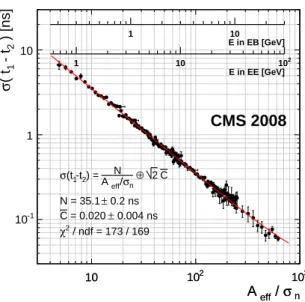
Figure 2. Gaussian width of the time difference between two neighboring crystals as a function of the variableAeff/σn, for test beam electrons with energies between 15 and 300 GeV. The equivalent single-crystal energy scales for barrel and endcaps are overlaid on the plot.
Gaussian function with negligible tails for all amplitudes. The spread is defined as the sigma of the Gaussian fit to the distribution and is parameterized, following eq. (3.1), as
σ2(t1−t2) =
Nσn
Aeff
2
+2C2 (3.2)
whereAeff=A1A2/ q
A2
1+A22, witht1,2andA1,2 corresponding to the times and amplitudes mea-sured in the two crystals, andC being the residual contribution from the constant terms. The extracted width is presented in figure2as a function of the variableAeff/σn. The fitted noise term
corresponds toN= (35.1±0.2)ns.Cis very small,C= (20±4)ps. For values ofAeff/σngreater
than 400, σ(t) is less than 100 ps, demonstrating that, with a carefully calibrated and synchro-nized detector, it is possible to reach a time resolution better than 100 ps for large energy deposits (E >10–20 GeV in the barrel). As a crosscheck, the stochastic component was left free in the fit and found to beS<7.9 ns MeV12 (90% C.L.), confirming that this term is negligible.
4 Synchronization between crystals
For each individual ECAL channel, the signals generated by particles originating from the interac-tion point (IP) are registered with approximately the same value ofTmax, because their flight times to the crystal do not change (up to small differences related to the precise position of the IP). Because the time of flight varies across the ECAL by a few nanoseconds and there are different intrinsic delays among channels, a crystal-to-crystal synchronization of the ECAL must be performed.
2010 JINST 5 T03011
ix10 20 30 40 50 60 70 80 90100
iy 10 20 30 40 50 60 70 80 90 100 a) η i
-86 0 86
φ i 1 41 81 121 161 201 241 281 321 361 energy [GeV] 0 1 2 3 4 5 6 7 8 9 10 CMS 2008 b) ix 10 20 30 40 50 60 70 80 90100
iy 10 20 30 40 50 60 70 80 90 100 c)
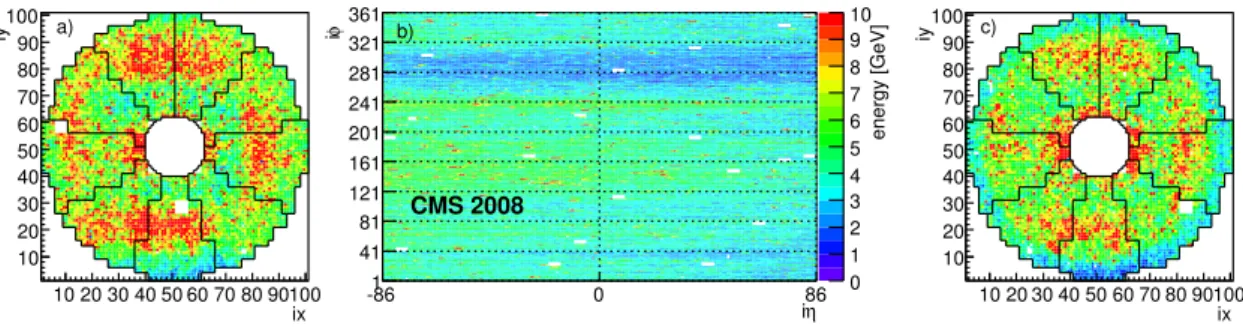
Figure 3. ECAL average energy deposit per crystal for a typical “beam splash” event with muons coming from the “minus” side. (a) Occupancy of the “minus” endcap, whereixandiyindicate the indices of the crystals in the horizontal (x) and vertical (y) coordinates, respectively. (b) Occupancy of the barrel, whereiη andiφ indicate the indices of the crystals in theη andφ coordinates. (c) Occupancy of the “plus” endcap. The white regions correspond to channels masked in the readout. They represent a small fraction of the total number of channels, smaller than 1% in that specific run. Many of these channels have been recovered subsequently.
corresponding to particles coming from the IP must be determined for each ECAL channel with an accuracy exceeding the typical time resolution. These additional corrections, called software synchronizations, can be extracted offline with physics collision events. Minimum bias events, which have a typical energy scale of 500 MeV/channel, can be used for this purpose. With the trigger menus planned for early data taking, they will yield about 1000 events/channel/day. A synchronization precision on the order of 100 ps is estimated to be achievable using data from a single day of running at the start of the LHC.
Beam-produced muons, collected by CMS with the first beams circulating in the LHC in September 2008, are used to synchronize the detector. The beams were dumped on collimators located approximately 150 m upstream of CMS, producing so-called “beam splash” events. The proton bunch length along the direction of propagation was about 6 cm, corresponding to about 200 ps spread in time. The resulting pions and kaons decayed into a very large number of muons, moving horizontally along the beam direction, corresponding to thez axis, at close to the speed of light. The arrival time of these muons at each crystal depends on the crystal position, and can be precisely predicted. In figure3the ECAL energy deposits in each crystal for a typical “beam splash” event are shown. Several muons cross each crystal, resulting in energy deposits between 2 and 10 GeV. It may be noted that almost every crystal registered a significant energy.
As stated above, it is important to synchronize the calorimeter such that particles travelling from the interaction region appear in-time. Since muons from “beam splash” events travel as a plane wave and do not come from the interaction region, a correction using the predicted time of flight is applied. In order to compare times obtained from different events, the average times in the barrel and each endcap are used as references. It should be noted that, because of the time of flight of muons, the “Tmaxphase” depends on the position of the crystal and muon direction. Crystals with the same pseudorapidityη, forming a ring inφ, have a common “Tmaxphase”.
2010 JINST 5 T03011
) [ns]
calib
(C
∆
-2 0 2
arbitrary units 0 0.05 0.1 0.15 0.2 12) ps ± RMS=(228 CMS 2008 a) ) [ns] calib (C ∆
-2 0 2
arbitrary units 0 0.02 0.04 0.06 0.08 0.1
0.12 |∆(Tmaxph.)|<3 ns
3) ps ± RMS=(329 ph.)|<10 ns max (T ∆ | 3) ps ± RMS=(595 CMS 2008 b)
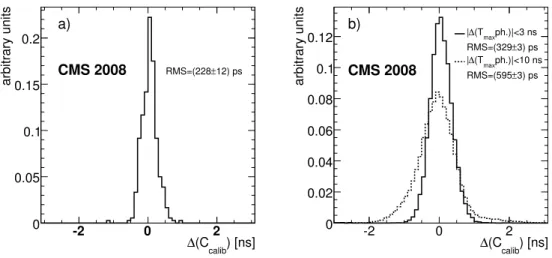
Figure 4. Distributions of the differences between the calibration coefficients obtained using muons from the “plus” beam and muons from the “minus” beam for (a) 360 barrel channels in which muons arrived at the same time delay with respect to the trigger, and (b) two different samples of barrel crystals, for which the difference between the mean measured absolute times (t) is in the range 3 to 10 ns (see text). The histograms are normalized to have unit area in each case.
opposite direction (“plus” beam). For every individual channel, an average of time measurements weighted by their uncertainties is calculated, resulting in the time intercalibration coefficient. This procedure is applied separately for “plus” and “minus” beam events. Comparison of the “plus” and “minus” calibrations yields an estimate of the statistical and systematic uncertainties of the calibration and time reconstruction algorithms, while the sum of the two samples is used to extract the intercalibration coefficients.
Figure 4(a) shows the difference between “plus” and “minus” calibrations for the 360 barrel channels in which muons arrived at the same time delay with respect to the trigger in both “plus” and “minus” runs. These channels, forming a ring inφ, have the unique property of sharing the same “Tmax phase” for both “plus” and “minus” muons. Thus channels in this ring experience conditions similar to those in normal LHC operation i.e. the energy deposits are synchronous. The Gaussian spread of the distribution is about 230 ps, which is in good agreement with the expected statistical uncertainty. Summing the event samples from both “plus” and “minus” beams results in a synchronization of ECAL channels with a statistical uncertainty of about 85 ps in the barrel and 105 ps in the endcaps.
system-2010 JINST 5 T03011
atic effects correlated with the uncertainties in the pulse shape. The time reconstruction method assumes the same pulse shape for all ECAL channels, but the real pulse shapes slightly differ from channel to channel (see figure 10 of ref. [7]). Detailed Monte Carlo simulation studies and mea-surements with electrons from a test beam show that these differences in shape pose no problem for in-time signals, while out-of-time signals are reconstructed with a systematic uncertainty ranging from tens to hundreds of picoseconds. The effect is proportional to the size of the range in “Tmax phase”. The results shown in figure4(b) confirm these studies. In LHC collisions, the time range will not have a wide spread since events will be synchronous and the accumulated bias in the time reconstruction will be minimal. Thus the systematic error on the synchronization is expected to be negligible when using collision events.
It can be concluded that the overall uncertainty in the determination of the synchronization coefficients, which is the quadratic sum of the statistical and systematic uncertainties, is about 300– 600 ps. This is the time resolution expected at the start-up of the LHC, when these synchronization coefficients will be used.
5 Resolution and linearity checks using cosmic ray muons
The resolution and the linearity of time measurements are determined with a sample of cosmic ray muons collected during summer 2008, when the ECAL was already inserted into its final position in CMS. Samples used for this analysis were taken from runs without magnetic field. Muon tracks are reconstructed in the muon system and, where possible, in the inner tracker. Muons typically deposit energy in several ECAL crystals, which are then grouped to form clusters. The purity of the sample is increased by requiring the extrapolated muon track to point towards the barycenter of the ECAL cluster. This is done by requiring that the distance between the calorimeter deposit and the position of entrance of the muon track in the η-φ plane is consistent with zero within the experimental resolution [10]. The selection is restricted to the barrel region, resulting in a sample of about 2×10⁵ muons. The associated clusters correspond to muons that lose energy in the calorimeter by ionization, with very little background contamination. The synchronization constants obtained from “beam splash” events are then applied.
The approach to extract the resolution is similar to that described in section3, but in this case the crystal with the maximum amplitude is compared with the other crystals in the cluster. Since different pairs of crystals are used, covering the entire barrel, a constant term comparable to the systematic uncertainty of the synchronization is expected.
The results on the resolution are presented in figure 5(a). The noise term is found to beN= (31.5±0.7) ns and is very similar to that obtained from test beam data. The constant term is measured to beC= (380±10) ps, which is consistent with the expected systematic uncertainty from “beam splash” synchronization.
2010 JINST 5 T03011
n σ / eff A0 200 400 600 800
) [ns]2
-t 1 (t σ 0 1 2 3 C 2 ⊕ n σ / eff A N ) = 2 -t 1 (t σ 0.7 ns ± N = 31.5
0.01 ns ± = 0.38 C CMS 2008 a) ) [ns] ex (t ∆
0 5 10
) [ns] m (t ∆ 0 5 10 15 ) ex (t ∆ ) = q + m
m
(t ∆
0.20 ns ± q = -0.56
0.02 ± m = 0.98
CMS 2008 b)
Figure 5. (a) Spread of the time difference between crystals of the same cluster, as a function of the variable
Aeff=A1A2/
q
A2
1+A22, for cosmic ray muons. (b) Measured time difference between top and bottom muon
clusters,∆(tm), as a function of the expected difference corresponding to the time of flight of a relativistic muon,∆(tex).
is calculated taking into account the fact that, on average, cosmic ray muons enter crystals at the center of the lateral edge. The time of flight ranges from about 0 ns, which corresponds to muons almost tangential to the ECAL surface, to about 14 ns. In figure 5(b) the correlation between expected and measured times is shown. The distribution is fitted with a straight line, resulting in a slope (m) compatible with unity. The offset (q) is compatible with zero within the systematic uncertainty on the synchronization, which is of the order of 300–600 ps, as discussed in section4.
6 Conclusions
The resolution and the linearity of the time measurement of the CMS electromagnetic calorimeter have been investigated with samples of data from test beam electrons, cosmic rays, and “beam splash” events. Results obtained with test beam electrons show that the resolution for electromag-netic showers, which can be reached with a perfect time alignment, is better than 100 ps for large energies (more than 10–20 GeV in the barrel). At lower energies, the noise term limits the resolu-tion. As an example, 1 GeV energy deposits in the ECAL barrel have a time resolution of 1.5 ns. The noise term measurement has been confirmed using cosmic ray muon events with the ECAL de-tector fully equipped and inserted in CMS. The linearity of the time measurement has been verified using cosmic ray muons that travel across the ECAL barrel, by comparing the measured time dif-ference between the top and the bottom parts of the detector with the expected muon time of flight. “Beam splash” events have been used to synchronize all ECAL crystals with a precision of
∼500 ps. The corresponding set of synchronization coefficients will be used at LHC start-up. The synchronization will be much improved once collision data are available.
2010 JINST 5 T03011
Acknowledgments
We thank the technical and administrative staff at CERN and other CMS Institutes, and ac-knowledge support from: FMSR (Austria); FNRS and FWO (Belgium); CNPq, CAPES, FAPERJ, and FAPESP (Brazil); MES (Bulgaria); CERN; CAS, MoST, and NSFC (China); COLCIEN-CIAS (Colombia); MSES (Croatia); RPF (Cyprus); Academy of Sciences and NICPB (Estonia); Academy of Finland, ME, and HIP (Finland); CEA and CNRS/IN2P3 (France); BMBF, DFG, and HGF (Germany); GSRT (Greece); OTKA and NKTH (Hungary); DAE and DST (India); IPM (Iran); SFI (Ireland); INFN (Italy); NRF (Korea); LAS (Lithuania); CINVESTAV, CONACYT, SEP, and UASLP-FAI (Mexico); PAEC (Pakistan); SCSR (Poland); FCT (Portugal); JINR (Arme-nia, Belarus, Georgia, Ukraine, Uzbekistan); MST and MAE (Russia); MSTDS (Serbia); MICINN and CPAN (Spain); Swiss Funding Agencies (Switzerland); NSC (Taipei); TUBITAK and TAEK (Turkey); STFC (United Kingdom); DOE and NSF (USA). Individuals have received support from the Marie-Curie IEF program (European Union); the Leventis Foundation; the A. P. Sloan Founda-tion; and the Alexander von Humboldt Foundation.
References
[1] CMS collaboration,The CMS experiment at the CERN LHC,2008JINST 3S08004.
[2] L. Evans and P. Bryant eds.,LHC Machine,2008JINST3S08001.
[3] P. Adzic et al.,Energy resolution of the barrel of the CMS electromagnetic calorimeter,2007JINST2
P04004.
[4] CMS collaboration,CMS Technical Design Report, Volume I: Detector Performance and Software, CERN-LHCC-2006-001 (2006).
[5] CMS collaboration,CMS technical design report, volume II: physics performance,J. Phys.G 34
(2007) 995.
[6] R. Mackeprang and A. Rizzi,Interactions of coloured heavy stable particles in matter,Eur. Phys. J.
C 50(2007) 353.
[7] P. Adzic et al.,Reconstruction of the signal amplitude of the CMS electromagnetic calorimeter,Eur.
Phys. J.C46S1(2006) 23.
[8] M. Goncharov et al.,The Timing system for the CDF electromagnetic calorimeters,Nucl. Instrum.
Meth.A 565(2006) 543.
[9] CMS collaboration,The Electromagnetic Calorimeter Project: Technical Design Report, CERN-LHCC-97-33 (1997).
[10] CMS collaboration,Measurement of the muon stopping power in lead tungstate,2010JINST5
2010 JINST 5 T03011
The CMS collaboration
Yerevan Physics Institute, Yerevan, Armenia
S. Chatrchyan, V. Khachatryan, A.M. Sirunyan
Institut f ¨ur Hochenergiephysik der OeAW, Wien, Austria
W. Adam, B. Arnold, H. Bergauer, T. Bergauer, M. Dragicevic, M. Eichberger, J. Er¨o, M. Friedl, R. Fr¨uhwirth, V.M. Ghete, J. Hammer1, S. H¨ansel, M. Hoch, N. H¨ormann, J. Hrubec, M. Jeitler, G. Kasieczka, K. Kastner, M. Krammer, D. Liko, I. Magrans de Abril, I. Mikulec, F. Mittermayr, B. Neuherz, M. Oberegger, M. Padrta, M. Pernicka, H. Rohringer, S. Schmid, R. Sch¨ofbeck, T. Schreiner, R. Stark, H. Steininger, J. Strauss, A. Taurok, F. Teischinger, T. Themel, D. Uhl, P. Wagner, W. Waltenberger, G. Walzel, E. Widl, C.-E. Wulz
National Centre for Particle and High Energy Physics, Minsk, Belarus
V. Chekhovsky, O. Dvornikov, I. Emeliantchik, A. Litomin, V. Makarenko, I. Marfin, V. Mossolov, N. Shumeiko, A. Solin, R. Stefanovitch, J. Suarez Gonzalez, A. Tikhonov
Research Institute for Nuclear Problems, Minsk, Belarus
A. Fedorov, A. Karneyeu, M. Korzhik, V. Panov, R. Zuyeuski
Research Institute of Applied Physical Problems, Minsk, Belarus
P. Kuchinsky
Universiteit Antwerpen, Antwerpen, Belgium
W. Beaumont, L. Benucci, M. Cardaci, E.A. De Wolf, E. Delmeire, D. Druzhkin, M. Hashemi, X. Janssen, T. Maes, L. Mucibello, S. Ochesanu, R. Rougny, M. Selvaggi, H. Van Haevermaet, P. Van Mechelen, N. Van Remortel
Vrije Universiteit Brussel, Brussel, Belgium
V. Adler, S. Beauceron, S. Blyweert, J. D’Hondt, S. De Weirdt, O. Devroede, J. Heyninck, A. Kalogeropoulos, J. Maes, M. Maes, M.U. Mozer, S. Tavernier, W. Van Doninck1, P. Van Mulders, I. Villella
Universit´e Libre de Bruxelles, Bruxelles, Belgium
O. Bouhali, E.C. Chabert, O. Charaf, B. Clerbaux, G. De Lentdecker, V. Dero, S. Elgammal, A.P.R. Gay, G.H. Hammad, P.E. Marage, S. Rugovac, C. Vander Velde, P. Vanlaer, J. Wickens
Ghent University, Ghent, Belgium
M. Grunewald, B. Klein, A. Marinov, D. Ryckbosch, F. Thyssen, M. Tytgat, L. Vanelderen, P. Verwilligen
Universit´e Catholique de Louvain, Louvain-la-Neuve, Belgium
S. Basegmez, G. Bruno, J. Caudron, C. Delaere, P. Demin, D. Favart, A. Giammanco, G. Gr´egoire, V. Lemaitre, O. Militaru, S. Ovyn, K. Piotrzkowski1, L. Quertenmont, N. Schul
Universit´e de Mons, Mons, Belgium
N. Beliy, E. Daubie
Centro Brasileiro de Pesquisas Fisicas, Rio de Janeiro, Brazil
2010 JINST 5 T03011
Universidade do Estado do Rio de Janeiro, Rio de Janeiro, BrazilW. Carvalho, D. De Jesus Damiao, C. De Oliveira Martins, S. Fonseca De Souza, L. Mundim, V. Oguri, A. Santoro, S.M. Silva Do Amaral, A. Sznajder
Instituto de Fisica Teorica, Universidade Estadual Paulista, Sao Paulo, Brazil
T.R. Fernandez Perez Tomei, M.A. Ferreira Dias, E. M. Gregores2, S.F. Novaes
Institute for Nuclear Research and Nuclear Energy, Sofia, Bulgaria
K. Abadjiev1, T. Anguelov, J. Damgov, N. Darmenov1, L. Dimitrov, V. Genchev1, P. Iaydjiev, S. Piperov, S. Stoykova, G. Sultanov, R. Trayanov, I. Vankov
University of Sofia, Sofia, Bulgaria
A. Dimitrov, M. Dyulendarova, V. Kozhuharov, L. Litov, E. Marinova, M. Mateev, B. Pavlov, P. Petkov, Z. Toteva1
Institute of High Energy Physics, Beijing, China
G.M. Chen, H.S. Chen, W. Guan, C.H. Jiang, D. Liang, B. Liu, X. Meng, J. Tao, J. Wang, Z. Wang, Z. Xue, Z. Zhang
State Key Lab. of Nucl. Phys. and Tech., Peking University, Beijing, China
Y. Ban, J. Cai, Y. Ge, S. Guo, Z. Hu, Y. Mao, S.J. Qian, H. Teng, B. Zhu
Universidad de Los Andes, Bogota, Colombia
C. Avila, M. Baquero Ruiz, C.A. Carrillo Montoya, A. Gomez, B. Gomez Moreno, A.A. Ocampo Rios, A.F. Osorio Oliveros, D. Reyes Romero, J.C. Sanabria
Technical University of Split, Split, Croatia
N. Godinovic, K. Lelas, R. Plestina, D. Polic, I. Puljak
University of Split, Split, Croatia
Z. Antunovic, M. Dzelalija
Institute Rudjer Boskovic, Zagreb, Croatia
V. Brigljevic, S. Duric, K. Kadija, S. Morovic
University of Cyprus, Nicosia, Cyprus
R. Fereos, M. Galanti, J. Mousa, A. Papadakis, F. Ptochos, P.A. Razis, D. Tsiakkouri, Z. Zinonos
National Institute of Chemical Physics and Biophysics, Tallinn, Estonia
A. Hektor, M. Kadastik, K. Kannike, M. M¨untel, M. Raidal, L. Rebane
Helsinki Institute of Physics, Helsinki, Finland
E. Anttila, S. Czellar, J. H¨ark¨onen, A. Heikkinen, V. Karim¨aki, R. Kinnunen, J. Klem, M.J. Kortelainen, T. Lamp´en, K. Lassila-Perini, S. Lehti, T. Lind´en, P. Luukka, T. M¨aenp¨a¨a, J. Nysten, E. Tuominen, J. Tuominiemi, D. Ungaro, L. Wendland
Lappeenranta University of Technology, Lappeenranta, Finland
K. Banzuzi, A. Korpela, T. Tuuva
Laboratoire d’Annecy-le-Vieux de Physique des Particules, IN2P3-CNRS, Annecy-le-Vieux, France
2010 JINST 5 T03011
DSM/IRFU, CEA/Saclay, Gif-sur-Yvette, FranceM. Besancon, R. Chipaux, M. Dejardin, D. Denegri, J. Descamps, B. Fabbro, J.L. Faure, F. Ferri, S. Ganjour, F.X. Gentit, A. Givernaud, P. Gras, G. Hamel de Monchenault, P. Jarry, M.C. Lemaire, E. Locci, J. Malcles, M. Marionneau, L. Millischer, J. Rander, A. Rosowsky, D. Rousseau, M. Titov, P. Verrecchia
Laboratoire Leprince-Ringuet, Ecole Polytechnique, IN2P3-CNRS, Palaiseau, France
S. Baffioni, L. Bianchini, M. Bluj3, P. Busson, C. Charlot, L. Dobrzynski, R. Granier de Cassagnac, M. Haguenauer, P. Min´e, P. Paganini, Y. Sirois, C. Thiebaux, A. Zabi
Institut Pluridisciplinaire Hubert Curien, Universit´e de Strasbourg, Universit´e de Haute Alsace Mulhouse, CNRS/IN2P3, Strasbourg, France
J.-L. Agram4, A. Besson, D. Bloch, D. Bodin, J.-M. Brom, E. Conte4, F. Drouhin4, J.-C. Fontaine4, D. Gel´e, U. Goerlach, L. Gross, P. Juillot, A.-C. Le Bihan, Y. Patois, J. Speck, P. Van Hove
Universit´e de Lyon, Universit´e Claude Bernard Lyon 1, CNRS-IN2P3, Institut de Physique Nucl´eaire de Lyon, Villeurbanne, France
C. Baty, M. Bedjidian, J. Blaha, G. Boudoul, H. Brun, N. Chanon, R. Chierici, D. Contardo, P. Depasse, T. Dupasquier, H. El Mamouni, F. Fassi5, J. Fay, S. Gascon, B. Ille, T. Kurca, T. Le Grand, M. Lethuillier, N. Lumb, L. Mirabito, S. Perries, M. Vander Donckt, P. Verdier
E. Andronikashvili Institute of Physics, Academy of Science, Tbilisi,Georgia
N. Djaoshvili, N. Roinishvili, V. Roinishvili
Institute of High Energy Physics and Informatization, Tbilisi State University, Tbilisi,
Georgia
N. Amaglobeli
RWTH Aachen University, I. Physikalisches Institut, Aachen, Germany
R. Adolphi, G. Anagnostou, R. Brauer, W. Braunschweig, M. Edelhoff, H. Esser, L. Feld, W. Karpinski, A. Khomich, K. Klein, N. Mohr, A. Ostaptchouk, D. Pandoulas, G. Pierschel, F. Raupach, S. Schael, A. Schultz von Dratzig, G. Schwering, D. Sprenger, M. Thomas, M. Weber, B. Wittmer, M. Wlochal
RWTH Aachen University, III. Physikalisches Institut A, Aachen, Germany
O. Actis, G. Altenh¨ofer, W. Bender, P. Biallass, M. Erdmann, G. Fetchenhauer1, J. Frangenheim, T. Hebbeker, G. Hilgers, A. Hinzmann, K. Hoepfner, C. Hof, M. Kirsch, T. Klimkovich, P. Kreuzer1, D. Lanske†, M. Merschmeyer, A. Meyer, B. Philipps, H. Pieta, H. Reithler, S.A. Schmitz, L. Sonnenschein, M. Sowa, J. Steggemann, H. Szczesny, D. Teyssier, C. Zeidler
RWTH Aachen University, III. Physikalisches Institut B, Aachen, Germany
M. Bontenackels, M. Davids, M. Duda, G. Fl¨ugge, H. Geenen, M. Giffels, W. Haj Ahmad, T. Hermanns, D. Heydhausen, S. Kalinin, T. Kress, A. Linn, A. Nowack, L. Perchalla, M. Poettgens, O. Pooth, P. Sauerland, A. Stahl, D. Tornier, M.H. Zoeller
Deutsches Elektronen-Synchrotron, Hamburg, Germany
2010 JINST 5 T03011
M. Marienfeld, A.B. Meyer, S. Miglioranzi, J. Mnich, M. Ohlerich, J. Olzem, A. Parenti, C. Rosemann, R. Schmidt, T. Schoerner-Sadenius, D. Volyanskyy, C. Wissing, W.D. Zeuner1
University of Hamburg, Hamburg, Germany
C. Autermann, F. Bechtel, J. Draeger, D. Eckstein, U. Gebbert, K. Kaschube, G. Kaussen, R. Klanner, B. Mura, S. Naumann-Emme, F. Nowak, U. Pein, C. Sander, P. Schleper, T. Schum, H. Stadie, G. Steinbr¨uck, J. Thomsen, R. Wolf
Institut f ¨ur Experimentelle Kernphysik, Karlsruhe, Germany
J. Bauer, P. Bl¨um, V. Buege, A. Cakir, T. Chwalek, W. De Boer, A. Dierlamm, G. Dirkes, M. Feindt, U. Felzmann, M. Frey, A. Furgeri, J. Gruschke, C. Hackstein, F. Hartmann1, S. Heier, M. Heinrich, H. Held, D. Hirschbuehl, K.H. Hoffmann, S. Honc, C. Jung, T. Kuhr, T. Liamsuwan, D. Martschei, S. Mueller, Th. M¨uller, M.B. Neuland, M. Niegel, O. Oberst, A. Oehler, J. Ott, T. Peiffer, D. Piparo, G. Quast, K. Rabbertz, F. Ratnikov, N. Ratnikova, M. Renz, C. Saout1, G. Sartisohn, A. Scheurer, P. Schieferdecker, F.-P. Schilling, G. Schott, H.J. Simonis, F.M. Stober, P. Sturm, D. Troendle, A. Trunov, W. Wagner, J. Wagner-Kuhr, M. Zeise, V. Zhukov6, E.B. Ziebarth
Institute of Nuclear Physics ”Demokritos”, Aghia Paraskevi, Greece
G. Daskalakis, T. Geralis, K. Karafasoulis, A. Kyriakis, D. Loukas, A. Markou, C. Markou, C. Mavrommatis, E. Petrakou, A. Zachariadou
University of Athens, Athens, Greece
L. Gouskos, P. Katsas, A. Panagiotou1
University of Io´annina, Io´annina, Greece
I. Evangelou, P. Kokkas, N. Manthos, I. Papadopoulos, V. Patras, F.A. Triantis
KFKI Research Institute for Particle and Nuclear Physics, Budapest, Hungary
G. Bencze1, L. Boldizsar, G. Debreczeni, C. Hajdu1, S. Hernath, P. Hidas, D. Horvath7, K. Krajczar, A. Laszlo, G. Patay, F. Sikler, N. Toth, G. Vesztergombi
Institute of Nuclear Research ATOMKI, Debrecen, Hungary
N. Beni, G. Christian, J. Imrek, J. Molnar, D. Novak, J. Palinkas, G. Szekely, Z. Szillasi1, K. Tokesi, V. Veszpremi
University of Debrecen, Debrecen, Hungary
A. Kapusi, G. Marian, P. Raics, Z. Szabo, Z.L. Trocsanyi, B. Ujvari, G. Zilizi
Panjab University, Chandigarh, India
S. Bansal, H.S. Bawa, S.B. Beri, V. Bhatnagar, M. Jindal, M. Kaur, R. Kaur, J.M. Kohli, M.Z. Mehta, N. Nishu, L.K. Saini, A. Sharma, A. Singh, J.B. Singh, S.P. Singh
University of Delhi, Delhi, India
S. Ahuja, S. Arora, S. Bhattacharya8, S. Chauhan, B.C. Choudhary, P. Gupta, S. Jain, S. Jain, M. Jha, A. Kumar, K. Ranjan, R.K. Shivpuri, A.K. Srivastava
Bhabha Atomic Research Centre, Mumbai, India
R.K. Choudhury, D. Dutta, S. Kailas, S.K. Kataria, A.K. Mohanty, L.M. Pant, P. Shukla, A. Topkar
Tata Institute of Fundamental Research - EHEP, Mumbai, India
2010 JINST 5 T03011
Tata Institute of Fundamental Research - HECR, Mumbai, IndiaS. Banerjee, S. Dugad, N.K. Mondal
Institute for Studies in Theoretical Physics & Mathematics (IPM), Tehran, Iran
H. Arfaei, H. Bakhshiansohi, A. Fahim, A. Jafari, M. Mohammadi Najafabadi, A. Moshaii, S. Paktinat Mehdiabadi, S. Rouhani, B. Safarzadeh, M. Zeinali
University College Dublin, Dublin, Ireland
M. Felcini
INFN Sezione di Baria, Universit`a di Barib, Politecnico di Baric, Bari, Italy
M. Abbresciaa,b, L. Barbonea, F. Chiumaruloa, A. Clementea, A. Colaleoa, D. Creanzaa,c,
G. Cuscelaa, N. De Filippisa, M. De Palmaa,b, G. De Robertisa, G. Donvitoa, F. Fedelea, L. Fiorea, M. Francoa, G. Iasellia,c, N. Lacalamitaa, F. Loddoa, L. Lusitoa,b, G. Maggia,c, M. Maggia, N. Mannaa,b, B. Marangellia,b, S. Mya,c, S. Natalia,b, S. Nuzzoa,b, G. Papagnia, S. Piccolomoa, G.A. Pierroa, C. Pintoa, A. Pompilia,b, G. Pugliesea,c, R. Rajana, A. Ranieria, F. Romanoa,c, G. Rosellia,b, G. Selvaggia,b, Y. Shindea, L. Silvestrisa, S. Tupputia,b, G. Zitoa
INFN Sezione di Bolognaa, Universita di Bolognab, Bologna, Italy
G. Abbiendia, W. Bacchia,b, A.C. Benvenutia, M. Boldinia, D. Bonacorsia, S. Braibant-Giacomellia,b, V.D. Cafaroa, S.S. Caiazzaa, P. Capiluppia,b, A. Castroa,b, F.R. Cavalloa, G. Codispotia,b, M. Cuffiania,b, I. D’Antonea, G.M. Dallavallea,1, F. Fabbria, A. Fanfania,b,
D. Fasanellaa, P. Giacomellia, V. Giordanoa, M. Giuntaa,1, C. Grandia, M. Guerzonia, S. Marcellinia, G. Masettia,b, A. Montanaria, F.L. Navarriaa,b, F. Odoricia, G. Pellegrinia, A. Perrottaa, A.M. Rossia,b, T. Rovellia,b, G. Sirolia,b, G. Torromeoa, R. Travaglinia,b
INFN Sezione di Cataniaa, Universita di Cataniab, Catania, Italy
S. Albergoa,b, S. Costaa,b, R. Potenzaa,b, A. Tricomia,b, C. Tuvea
INFN Sezione di Firenzea, Universita di Firenzeb, Firenze, Italy
G. Barbaglia, G. Broccoloa,b, V. Ciullia,b, C. Civininia, R. D’Alessandroa,b, E. Focardia,b, S. Frosalia,b, E. Galloa, C. Gentaa,b, G. Landia,b, P. Lenzia,b,1, M. Meschinia, S. Paolettia, G. Sguazzonia, A. Tropianoa
INFN Laboratori Nazionali di Frascati, Frascati, Italy
L. Benussi, M. Bertani, S. Bianco, S. Colafranceschi11, D. Colonna11, F. Fabbri, M. Giardoni, L. Passamonti, D. Piccolo, D. Pierluigi, B. Ponzio, A. Russo
INFN Sezione di Genova, Genova, Italy
P. Fabbricatore, R. Musenich
INFN Sezione di Milano-Biccocaa, Universita di Milano-Bicoccab, Milano, Italy
A. Benagliaa, M. Callonia, G.B. Ceratia,b,1, P. D’Angeloa, F. De Guioa, F.M. Farinaa, A. Ghezzia, P. Govonia,b, M. Malbertia,b,1, S. Malvezzia, A. Martellia, D. Menascea, V. Miccioa,b, L. Moronia, P. Negria,b, M. Paganonia,b, D. Pedrinia, A. Pulliaa,b, S. Ragazzia,b, N. Redaellia, S. Salaa, R. Salernoa,b, T. Tabarelli de Fatisa,b, V. Tancinia,b, S. Taronia,b
INFN Sezione di Napolia, Universita di Napoli ”Federico II”b, Napoli, Italy
2010 JINST 5 T03011
INFN Sezione di Padovaa, Universit`a di Padovab, Padova, ItalyP. Azzia,1, N. Bacchettaa, L. Barcellana, P. Bellana,b,1, M. Bellatoa, M. Benettonia, M. Biasottoa,13, D. Biselloa,b, E. Borsatoa,b, A. Brancaa, R. Carlina,b, L. Castellania, P. Checchiaa, E. Contia, F. Dal Corsoa, M. De Mattiaa,b, T. Dorigoa, U. Dossellia, F. Fanzagoa, F. Gasparinia,b, U. Gasparinia,b, P. Giubilatoa,b, F. Gonellaa, A. Greselea,14, M. Gulminia,13, A. Kaminskiya,b, S. Lacapraraa,13, I. Lazzizzeraa,14, M. Margonia,b, G. Marona,13, S. Mattiazzoa,b, M. Mazzucatoa, M. Meneghellia, A.T. Meneguzzoa,b, M. Michelottoa, F. Montecassianoa, M. Nespoloa, M. Passaseoa, M. Pegoraroa, L. Perrozzia, N. Pozzobona,b, P. Ronchesea,b, F. Simonettoa,b, N. Tonioloa, E. Torassaa, M. Tosia,b, A. Triossia, S. Vaninia,b, S. Venturaa, P. Zottoa,b, G. Zumerlea,b
INFN Sezione di Paviaa, Universita di Paviab, Pavia, Italy
P. Baessoa,b, U. Berzanoa, S. Bricolaa, M.M. Necchia,b, D. Paganoa,b, S.P. Rattia,b, C. Riccardia,b, P. Torrea,b, A. Vicinia, P. Vituloa,b, C. Viviania,b
INFN Sezione di Perugiaa, Universita di Perugiab, Perugia, Italy
D. Aisaa, S. Aisaa, E. Babuccia, M. Biasinia,b, G.M. Bileia, B. Caponeria,b, B. Checcuccia, N. Dinua, L. Fan`oa, L. Farnesinia, P. Laricciaa,b, A. Lucaronia,b, G. Mantovania,b, A. Nappia,b, A. Pilusoa, V. Postolachea, A. Santocchiaa,b, L. Servolia, D. Tonoiua, A. Vedaeea, R. Volpea,b
INFN Sezione di Pisaa, Universita di Pisab, Scuola Normale Superiore di Pisac, Pisa, Italy
P. Azzurria,c, G. Bagliesia, J. Bernardinia,b, L. Berrettaa, T. Boccalia, A. Boccia,c, L. Borrelloa,c, F. Bosia, F. Calzolaria, R. Castaldia, R. Dell’Orsoa, F. Fioria,b, L. Fo`aa,c, S. Gennaia,c, A. Giassia,
A. Kraana, F. Ligabuea,c, T. Lomtadzea, F. Mariania, L. Martinia, M. Massaa, A. Messineoa,b, A. Moggia, F. Pallaa, F. Palmonaria, G. Petragnania, G. Petrucciania,c, F. Raffaellia, S. Sarkara, G. Segneria, A.T. Serbana, P. Spagnoloa,1, R. Tenchinia,1, S. Tolainia, G. Tonellia,b,1, A. Venturia,
P.G. Verdinia
INFN Sezione di Romaa, Universita di Roma “La Sapienza”b, Roma, Italy
S. Baccaroa,15, L. Baronea,b, A. Bartolonia, F. Cavallaria,1, I. Dafineia, D. Del Rea,b, E. Di Marcoa,b, M. Diemoza, D. Francia,b, E. Longoa,b, G. Organtinia,b, A. Palmaa,b, F. Pandolfia,b, R. Paramattia,1, F. Pellegrinoa, S. Rahatloua,b, C. Rovellia
INFN Sezione di Torino a, Universit`a di Torino b, Universit`a del Piemonte Orientale (No-vara)c, Torino, Italy
G. Alampia, N. Amapanea,b, R. Arcidiaconoa,b, S. Argiroa,b, M. Arneodoa,c, C. Biinoa, M.A. Borgiaa,b, C. Bottaa,b, N. Cartigliaa, R. Castelloa,b, G. Cerminaraa,b, M. Costaa,b,
D. Dattolaa, G. Dellacasaa, N. Demariaa, G. Dugheraa, F. Dumitrachea, A. Grazianoa,b, C. Mariottia, M. Maronea,b, S. Masellia, E. Migliorea,b, G. Milaa,b, V. Monacoa,b, M. Musicha,b, M. Nervoa,b, M.M. Obertinoa,c, S. Oggeroa,b, R. Paneroa, N. Pastronea, M. Pelliccionia,b, A. Romeroa,b, M. Ruspaa,c, R. Sacchia,b, A. Solanoa,b, A. Staianoa, P.P. Trapania,b,1, D. Trocinoa,b, A. Vilela Pereiraa,b, L. Viscaa,b, A. Zampieria
INFN Sezione di Triestea, Universita di Triesteb, Trieste, Italy
F. Ambroglinia,b, S. Belfortea, F. Cossuttia, G. Della Riccaa,b, B. Gobboa, A. Penzoa
Kyungpook National University, Daegu, Korea
2010 JINST 5 T03011
Wonkwang University, Iksan, KoreaS.Y. Bahk
Chonnam National University, Kwangju, Korea
S. Song
Konkuk University, Seoul, Korea
S.Y. Jung
Korea University, Seoul, Korea
B. Hong, H. Kim, J.H. Kim, K.S. Lee, D.H. Moon, S.K. Park, H.B. Rhee, K.S. Sim
Seoul National University, Seoul, Korea
J. Kim
University of Seoul, Seoul, Korea
M. Choi, G. Hahn, I.C. Park
Sungkyunkwan University, Suwon, Korea
S. Choi, Y. Choi, J. Goh, H. Jeong, T.J. Kim, J. Lee, S. Lee
Vilnius University, Vilnius, Lithuania
M. Janulis, D. Martisiute, P. Petrov, T. Sabonis
Centro de Investigacion y de Estudios Avanzados del IPN, Mexico City, Mexico
H. Castilla Valdez1, A. S´anchez Hern´andez
Universidad Iberoamericana, Mexico City, Mexico
S. Carrillo Moreno
Universidad Aut´onoma de San Luis Potos´ı, San Luis Potos´ı, Mexico
A. Morelos Pineda
University of Auckland, Auckland, New Zealand
P. Allfrey, R.N.C. Gray, D. Krofcheck
University of Canterbury, Christchurch, New Zealand
N. Bernardino Rodrigues, P.H. Butler, T. Signal, J.C. Williams
National Centre for Physics, Quaid-I-Azam University, Islamabad, Pakistan
M. Ahmad, I. Ahmed, W. Ahmed, M.I. Asghar, M.I.M. Awan, H.R. Hoorani, I. Hussain, W.A. Khan, T. Khurshid, S. Muhammad, S. Qazi, H. Shahzad
Institute of Experimental Physics, Warsaw, Poland
M. Cwiok, R. Dabrowski, W. Dominik, K. Doroba, M. Konecki, J. Krolikowski, K. Pozniak16, R. Romaniuk, W. Zabolotny16, P. Zych
Soltan Institute for Nuclear Studies, Warsaw, Poland
T. Frueboes, R. Gokieli, L. Goscilo, M. G´orski, M. Kazana, K. Nawrocki, M. Szleper, G. Wrochna, P. Zalewski
Laborat´orio de Instrumentac¸˜ao e F´ısica Experimental de Part´ıculas, Lisboa, Portugal
2010 JINST 5 T03011
Joint Institute for Nuclear Research, Dubna, RussiaI. Altsybeev, I. Belotelov, P. Bunin, Y. Ershov, I. Filozova, M. Finger, M. Finger Jr., A. Golunov, I. Golutvin, N. Gorbounov, V. Kalagin, A. Kamenev, V. Karjavin, V. Konoplyanikov, V. Korenkov, G. Kozlov, A. Kurenkov, A. Lanev, A. Makankin, V.V. Mitsyn, P. Moisenz, E. Nikonov, D. Oleynik, V. Palichik, V. Perelygin, A. Petrosyan, R. Semenov, S. Shmatov, V. Smirnov, D. Smolin, E. Tikhonenko, S. Vasil’ev, A. Vishnevskiy, A. Volodko, A. Zarubin, V. Zhiltsov
Petersburg Nuclear Physics Institute, Gatchina (St Petersburg), Russia
N. Bondar, L. Chtchipounov, A. Denisov, Y. Gavrikov, G. Gavrilov, V. Golovtsov, Y. Ivanov, V. Kim, V. Kozlov, P. Levchenko, G. Obrant, E. Orishchin, A. Petrunin, Y. Shcheglov, A. Shchetkovskiy, V. Sknar, I. Smirnov, V. Sulimov, V. Tarakanov, L. Uvarov, S. Vavilov, G. Velichko, S. Volkov, A. Vorobyev
Institute for Nuclear Research, Moscow, Russia
Yu. Andreev, A. Anisimov, P. Antipov, A. Dermenev, S. Gninenko, N. Golubev, M. Kirsanov, N. Krasnikov, V. Matveev, A. Pashenkov, V.E. Postoev, A. Solovey, A. Solovey, A. Toropin, S. Troitsky
Institute for Theoretical and Experimental Physics, Moscow, Russia
A. Baud, V. Epshteyn, V. Gavrilov, N. Ilina, V. Kaftanov†, V. Kolosov, M. Kossov1, A. Krokhotin, S. Kuleshov, A. Oulianov, G. Safronov, S. Semenov, I. Shreyber, V. Stolin, E. Vlasov, A. Zhokin
Moscow State University, Moscow, Russia
E. Boos, M. Dubinin17, L. Dudko, A. Ershov, A. Gribushin, V. Klyukhin, O. Kodolova, I. Lokhtin, S. Petrushanko, L. Sarycheva, V. Savrin, A. Snigirev, I. Vardanyan
P.N. Lebedev Physical Institute, Moscow, Russia
I. Dremin, M. Kirakosyan, N. Konovalova, S.V. Rusakov, A. Vinogradov
State Research Center of Russian Federation, Institute for High Energy Physics, Protvino, Russia
S. Akimenko, A. Artamonov, I. Azhgirey, S. Bitioukov, V. Burtovoy, V. Grishin1, V. Kachanov, D. Konstantinov, V. Krychkine, A. Levine, I. Lobov, V. Lukanin, Y. Mel’nik, V. Petrov, R. Ryutin, S. Slabospitsky, A. Sobol, A. Sytine, L. Tourtchanovitch, S. Troshin, N. Tyurin, A. Uzunian, A. Volkov
Vinca Institute of Nuclear Sciences, Belgrade, Serbia
P. Adzic, M. Djordjevic, D. Jovanovic18, D. Krpic18, D. Maletic, J. Puzovic18, N. Smiljkovic
Centro de Investigaciones Energ´eticas Medioambientales y Tecnol´ogicas (CIEMAT), Madrid, Spain
2010 JINST 5 T03011
Universidad Aut´onoma de Madrid, Madrid, SpainC. Albajar, M. Blanco Otano, J.F. de Troc´oniz, A. Garcia Raboso, J.O. Lopez Berengueres
Universidad de Oviedo, Oviedo, Spain
J. Cuevas, J. Fernandez Menendez, I. Gonzalez Caballero, L. Lloret Iglesias, H. Naves Sordo, J.M. Vizan Garcia
Instituto de F´ısica de Cantabria (IFCA), CSIC-Universidad de Cantabria, Santander, Spain
I.J. Cabrillo, A. Calderon, S.H. Chuang, I. Diaz Merino, C. Diez Gonzalez, J. Duarte Campderros, M. Fernandez, G. Gomez, J. Gonzalez Sanchez, R. Gonzalez Suarez, C. Jorda, P. Lobelle Pardo, A. Lopez Virto, J. Marco, R. Marco, C. Martinez Rivero, P. Martinez Ruiz del Arbol, F. Matorras, T. Rodrigo, A. Ruiz Jimeno, L. Scodellaro, M. Sobron Sanudo, I. Vila, R. Vilar Cortabitarte
CERN, European Organization for Nuclear Research, Geneva, Switzerland
D. Abbaneo, E. Albert, M. Alidra, S. Ashby, E. Auffray, J. Baechler, P. Baillon, A.H. Ball, S.L. Bally, D. Barney, F. Beaudette19, R. Bellan, D. Benedetti, G. Benelli, C. Bernet, P. Bloch, S. Bolognesi, M. Bona, J. Bos, N. Bourgeois, T. Bourrel, H. Breuker, K. Bunkowski, D. Campi, T. Camporesi, E. Cano, A. Cattai, J.P. Chatelain, M. Chauvey, T. Christiansen, J.A. Coarasa Perez, A. Conde Garcia, R. Covarelli, B. Cur´e, A. De Roeck, V. Delachenal, D. Deyrail, S. Di Vincenzo20, S. Dos Santos, T. Dupont, L.M. Edera, A. Elliott-Peisert, M. Eppard, M. Favre, N. Frank, W. Funk, A. Gaddi, M. Gastal, M. Gateau, H. Gerwig, D. Gigi, K. Gill, D. Giordano, J.P. Girod, F. Glege, R. Gomez-Reino Garrido, R. Goudard, S. Gowdy, R. Guida, L. Guiducci, J. Gutleber, M. Hansen, C. Hartl, J. Harvey, B. Hegner, H.F. Hoffmann, A. Holzner, A. Honma, M. Huhtinen, V. Innocente, P. Janot, G. Le Godec, P. Lecoq, C. Leonidopoulos, R. Loos, C. Lourenc¸o, A. Lyonnet, A. Macpherson, N. Magini, J.D. Maillefaud, G. Maire, T. M¨aki, L. Malgeri, M. Mannelli, L. Masetti, F. Meijers, P. Meridiani, S. Mersi, E. Meschi, A. Meynet Cordonnier, R. Moser, M. Mulders, J. Mulon, M. Noy, A. Oh, G. Olesen, A. Onnela, T. Orimoto, L. Orsini, E. Perez, G. Perinic, J.F. Pernot, P. Petagna, P. Petiot, A. Petrilli, A. Pfeiffer, M. Pierini, M. Pimi¨a, R. Pintus, B. Pirollet, H. Postema, A. Racz, S. Ravat, S.B. Rew, J. Rodrigues Antunes, G. Rolandi21, M. Rovere, V. Ryjov, H. Sakulin, D. Samyn, H. Sauce, C. Sch¨afer, W.D. Schlatter, M. Schr¨oder, C. Schwick, A. Sciaba, I. Segoni, A. Sharma, N. Siegrist, P. Siegrist, N. Sinanis, T. Sobrier, P. Sphicas22, D. Spiga, M. Spiropulu17, F. St¨ockli, P. Traczyk, P. Tropea, J. Troska, A. Tsirou, L. Veillet, G.I. Veres, M. Voutilainen, P. Wertelaers, M. Zanetti
Paul Scherrer Institut, Villigen, Switzerland
W. Bertl, K. Deiters, W. Erdmann, K. Gabathuler, R. Horisberger, Q. Ingram, H.C. Kaestli, S. K¨onig, D. Kotlinski, U. Langenegger, F. Meier, D. Renker, T. Rohe, J. Sibille23, A. Starodumov24
Institute for Particle Physics, ETH Zurich, Zurich, Switzerland
2010 JINST 5 T03011
Universit¨at Z ¨urich, Zurich, SwitzerlandC. Amsler, V. Chiochia, S. De Visscher, C. Regenfus, P. Robmann, T. Rommerskirchen, A. Schmidt, D. Tsirigkas, L. Wilke
National Central University, Chung-Li, Taiwan
Y.H. Chang, E.A. Chen, W.T. Chen, A. Go, C.M. Kuo, S.W. Li, W. Lin
National Taiwan University (NTU), Taipei, Taiwan
P. Bartalini, P. Chang, Y. Chao, K.F. Chen, W.-S. Hou, Y. Hsiung, Y.J. Lei, S.W. Lin, R.-S. Lu, J. Sch¨umann, J.G. Shiu, Y.M. Tzeng, K. Ueno, Y. Velikzhanin, C.C. Wang, M. Wang
Cukurova University, Adana, Turkey
A. Adiguzel, A. Ayhan, A. Azman Gokce, M.N. Bakirci, S. Cerci, I. Dumanoglu, E. Eskut, S. Girgis, E. Gurpinar, I. Hos, T. Karaman, T. Karaman, A. Kayis Topaksu, P. Kurt, G. ¨Oneng¨ut, G. ¨Oneng¨ut G¨okbulut, K. Ozdemir, S. Ozturk, A. Polat¨oz, K. Sogut28, B. Tali, H. Topakli, D. Uzun, L.N. Vergili, M. Vergili
Middle East Technical University, Physics Department, Ankara, Turkey
I.V. Akin, T. Aliev, S. Bilmis, M. Deniz, H. Gamsizkan, A.M. Guler, K. ¨Ocalan, M. Serin, R. Sever, U.E. Surat, M. Zeyrek
Bogazic¸i University, Department of Physics, Istanbul, Turkey
M. Deliomeroglu, D. Demir29, E. G¨ulmez, A. Halu, B. Isildak, M. Kaya30, O. Kaya30, S. Ozkorucuklu31, N. Sonmez32
National Scientific Center, Kharkov Institute of Physics and Technology, Kharkov, Ukraine
L. Levchuk, S. Lukyanenko, D. Soroka, S. Zub
University of Bristol, Bristol, United Kingdom
F. Bostock, J.J. Brooke, T.L. Cheng, D. Cussans, R. Frazier, J. Goldstein, N. Grant, M. Hansen, G.P. Heath, H.F. Heath, C. Hill, B. Huckvale, J. Jackson, C.K. Mackay, S. Metson, D.M. Newbold33, K. Nirunpong, V.J. Smith, J. Velthuis, R. Walton
Rutherford Appleton Laboratory, Didcot, United Kingdom
K.W. Bell, C. Brew, R.M. Brown, B. Camanzi, D.J.A. Cockerill, J.A. Coughlan, N.I. Geddes, K. Harder, S. Harper, B.W. Kennedy, P. Murray, C.H. Shepherd-Themistocleous, I.R. Tomalin, J.H. Williams†, W.J. Womersley, S.D. Worm
Imperial College, University of London, London, United Kingdom
R. Bainbridge, G. Ball, J. Ballin, R. Beuselinck, O. Buchmuller, D. Colling, N. Cripps, G. Davies, M. Della Negra, C. Foudas, J. Fulcher, D. Futyan, G. Hall, J. Hays, G. Iles, G. Karapostoli, B.C. MacEvoy, A.-M. Magnan, J. Marrouche, J. Nash, A. Nikitenko24, A. Papageorgiou, M. Pesaresi, K. Petridis, M. Pioppi34, D.M. Raymond, N. Rompotis, A. Rose, M.J. Ryan, C. Seez, P. Sharp, G. Sidiropoulos1, M. Stettler, M. Stoye, M. Takahashi, A. Tapper, C. Timlin, S. Tourneur, M. Vazquez Acosta, T. Virdee1, S. Wakefield, D. Wardrope, T. Whyntie, M. Wingham
Brunel University, Uxbridge, United Kingdom
2010 JINST 5 T03011
Boston University, Boston, U.S.A.T. Bose, M. Carleton, E. Hazen, A.H. Heering, A. Heister, J. St. John, P. Lawson, D. Lazic, D. Osborne, J. Rohlf, L. Sulak, S. Wu
Brown University, Providence, U.S.A.
J. Andrea, A. Avetisyan, S. Bhattacharya, J.P. Chou, D. Cutts, S. Esen, G. Kukartsev, G. Landsberg, M. Narain, D. Nguyen, T. Speer, K.V. Tsang
University of California, Davis, Davis, U.S.A.
R. Breedon, M. Calderon De La Barca Sanchez, M. Case, D. Cebra, M. Chertok, J. Conway, P.T. Cox, J. Dolen, R. Erbacher, E. Friis, W. Ko, A. Kopecky, R. Lander, A. Lister, H. Liu, S. Maruyama, T. Miceli, M. Nikolic, D. Pellett, J. Robles, M. Searle, J. Smith, M. Squires, J. Stilley, M. Tripathi, R. Vasquez Sierra, C. Veelken
University of California, Los Angeles, Los Angeles, U.S.A.
V. Andreev, K. Arisaka, D. Cline, R. Cousins, S. Erhan1, J. Hauser, M. Ignatenko, C. Jarvis, J. Mumford, C. Plager, G. Rakness, P. Schlein†, J. Tucker, V. Valuev, R. Wallny, X. Yang
University of California, Riverside, Riverside, U.S.A.
J. Babb, M. Bose, A. Chandra, R. Clare, J.A. Ellison, J.W. Gary, G. Hanson, G.Y. Jeng, S.C. Kao, F. Liu, H. Liu, A. Luthra, H. Nguyen, G. Pasztor35, A. Satpathy, B.C. Shen†, R. Stringer, J. Sturdy, V. Sytnik, R. Wilken, S. Wimpenny
University of California, San Diego, La Jolla, U.S.A.
J.G. Branson, E. Dusinberre, D. Evans, F. Golf, R. Kelley, M. Lebourgeois, J. Letts, E. Lipeles, B. Mangano, J. Muelmenstaedt, M. Norman, S. Padhi, A. Petrucci, H. Pi, M. Pieri, R. Ranieri, M. Sani, V. Sharma, S. Simon, F. W¨urthwein, A. Yagil
University of California, Santa Barbara, Santa Barbara, U.S.A.
C. Campagnari, M. D’Alfonso, T. Danielson, J. Garberson, J. Incandela, C. Justus, P. Kalavase, S.A. Koay, D. Kovalskyi, V. Krutelyov, J. Lamb, S. Lowette, V. Pavlunin, F. Rebassoo, J. Ribnik, J. Richman, R. Rossin, D. Stuart, W. To, J.R. Vlimant, M. Witherell
California Institute of Technology, Pasadena, U.S.A.
A. Apresyan, A. Bornheim, J. Bunn, M. Chiorboli, M. Gataullin, D. Kcira, V. Litvine, Y. Ma, H.B. Newman, C. Rogan, V. Timciuc, J. Veverka, R. Wilkinson, Y. Yang, L. Zhang, K. Zhu, R.Y. Zhu
Carnegie Mellon University, Pittsburgh, U.S.A.
B. Akgun, R. Carroll, T. Ferguson, D.W. Jang, S.Y. Jun, M. Paulini, J. Russ, N. Terentyev, H. Vogel, I. Vorobiev
University of Colorado at Boulder, Boulder, U.S.A.
J.P. Cumalat, M.E. Dinardo, B.R. Drell, W.T. Ford, B. Heyburn, E. Luiggi Lopez, U. Nauenberg, K. Stenson, K. Ulmer, S.R. Wagner, S.L. Zang
Cornell University, Ithaca, U.S.A.
2010 JINST 5 T03011
Fairfield University, Fairfield, U.S.A.C.P. Beetz, G. Cirino, C. Sanzeni, D. Winn
Fermi National Accelerator Laboratory, Batavia, U.S.A.
S. Abdullin, M.A. Afaq1, M. Albrow, B. Ananthan, G. Apollinari, M. Atac, W. Badgett, L. Bagby, J.A. Bakken, B. Baldin, S. Banerjee, K. Banicz, L.A.T. Bauerdick, A. Beretvas, J. Berryhill, P.C. Bhat, K. Biery, M. Binkley, I. Bloch, F. Borcherding, A.M. Brett, K. Burkett, J.N. Butler, V. Chetluru, H.W.K. Cheung, F. Chlebana, I. Churin, S. Cihangir, M. Crawford, W. Dagen-hart, M. Demarteau, G. Derylo, D. Dykstra, D.P. Eartly, J.E. Elias, V.D. Elvira, D. Evans, L. Feng, M. Fischler, I. Fisk, S. Foulkes, J. Freeman, P. Gartung, E. Gottschalk, T. Grassi, D. Green, Y. Guo, O. Gutsche, A. Hahn, J. Hanlon, R.M. Harris, B. Holzman, J. Howell, D. Hufnagel, E. James, H. Jensen, M. Johnson, C.D. Jones, U. Joshi, E. Juska, J. Kaiser, B. Klima, S. Kossiakov, K. Kousouris, S. Kwan, C.M. Lei, P. Limon, J.A. Lopez Perez, S. Los, L. Lueking, G. Lukhanin, S. Lusin1, J. Lykken, K. Maeshima, J.M. Marraffino, D. Mason, P. McBride, T. Miao, K. Mishra, S. Moccia, R. Mommsen, S. Mrenna, A.S. Muhammad, C. Newman-Holmes, C. Noeding, V. O’Dell, O. Prokofyev, R. Rivera, C.H. Rivetta, A. Ronzhin, P. Rossman, S. Ryu, V. Sekhri, E. Sexton-Kennedy, I. Sfiligoi, S. Sharma, T.M. Shaw, D. Shpakov, E. Skup, R.P. Smith†, A. Soha, W.J. Spalding, L. Spiegel, I. Suzuki, P. Tan, W. Tanenbaum, S. Tkaczyk1, R. Trentadue1, L. Uplegger, E.W. Vaandering, R. Vidal, J. Whitmore, E. Wicklund, W. Wu, J. Yarba, F. Yumiceva, J.C. Yun
University of Florida, Gainesville, U.S.A.
D. Acosta, P. Avery, V. Barashko, D. Bourilkov, M. Chen, G.P. Di Giovanni, D. Dobur, A. Drozdet-skiy, R.D. Field, Y. Fu, I.K. Furic, J. Gartner, D. Holmes, B. Kim, S. Klimenko, J. Konigsberg, A. Korytov, K. Kotov, A. Kropivnitskaya, T. Kypreos, A. Madorsky, K. Matchev, G. Mitselmakher, Y. Pakhotin, J. Piedra Gomez, C. Prescott, V. Rapsevicius, R. Remington, M. Schmitt, B. Scurlock, D. Wang, J. Yelton
Florida International University, Miami, U.S.A.
C. Ceron, V. Gaultney, L. Kramer, L.M. Lebolo, S. Linn, P. Markowitz, G. Martinez, J.L. Rodriguez
Florida State University, Tallahassee, U.S.A.
T. Adams, A. Askew, H. Baer, M. Bertoldi, J. Chen, W.G.D. Dharmaratna, S.V. Gleyzer, J. Haas, S. Hagopian, V. Hagopian, M. Jenkins, K.F. Johnson, E. Prettner, H. Prosper, S. Sekmen
Florida Institute of Technology, Melbourne, U.S.A.
M.M. Baarmand, S. Guragain, M. Hohlmann, H. Kalakhety, H. Mermerkaya, R. Ralich, I. Vodopiyanov
University of Illinois at Chicago (UIC), Chicago, U.S.A.
B. Abelev, M.R. Adams, I.M. Anghel, L. Apanasevich, V.E. Bazterra, R.R. Betts, J. Callner, M.A. Castro, R. Cavanaugh, C. Dragoiu, E.J. Garcia-Solis, C.E. Gerber, D.J. Hofman, S. Khalatian, C. Mironov, E. Shabalina, A. Smoron, N. Varelas
The University of Iowa, Iowa City, U.S.A.
2010 JINST 5 T03011
Johns Hopkins University, Baltimore, U.S.A.B.A. Barnett, B. Blumenfeld, A. Bonato, C.Y. Chien, D. Fehling, G. Giurgiu, A.V. Gritsan, Z.J. Guo, P. Maksimovic, S. Rappoccio, M. Swartz, N.V. Tran, Y. Zhang
The University of Kansas, Lawrence, U.S.A.
P. Baringer, A. Bean, O. Grachov, M. Murray, V. Radicci, S. Sanders, J.S. Wood, V. Zhukova
Kansas State University, Manhattan, U.S.A.
D. Bandurin, T. Bolton, K. Kaadze, A. Liu, Y. Maravin, D. Onoprienko, I. Svintradze, Z. Wan
Lawrence Livermore National Laboratory, Livermore, U.S.A.
J. Gronberg, J. Hollar, D. Lange, D. Wright
University of Maryland, College Park, U.S.A.
D. Baden, R. Bard, M. Boutemeur, S.C. Eno, D. Ferencek, N.J. Hadley, R.G. Kellogg, M. Kirn, S. Kunori, K. Rossato, P. Rumerio, F. Santanastasio, A. Skuja, J. Temple, M.B. Tonjes, S.C. Ton-war, T. Toole, E. Twedt
Massachusetts Institute of Technology, Cambridge, U.S.A.
B. Alver, G. Bauer, J. Bendavid, W. Busza, E. Butz, I.A. Cali, M. Chan, D. D’Enterria, P. Everaerts, G. Gomez Ceballos, K.A. Hahn, P. Harris, S. Jaditz, Y. Kim, M. Klute, Y.-J. Lee, W. Li, C. Loizides, T. Ma, M. Miller, S. Nahn, C. Paus, C. Roland, G. Roland, M. Rudolph, G. Stephans, K. Sumorok, K. Sung, S. Vaurynovich, E.A. Wenger, B. Wyslouch, S. Xie, Y. Yilmaz, A.S. Yoon
University of Minnesota, Minneapolis, U.S.A.
D. Bailleux, S.I. Cooper, P. Cushman, B. Dahmes, A. De Benedetti, A. Dolgopolov, P.R. Dudero, R. Egeland, G. Franzoni, J. Haupt, A. Inyakin37, K. Klapoetke, Y. Kubota, J. Mans, N. Mirman, D. Petyt, V. Rekovic, R. Rusack, M. Schroeder, A. Singovsky, J. Zhang
University of Mississippi, University, U.S.A.
L.M. Cremaldi, R. Godang, R. Kroeger, L. Perera, R. Rahmat, D.A. Sanders,
P. Sonnek, D. Summers
University of Nebraska-Lincoln, Lincoln, U.S.A.
K. Bloom, B. Bockelman, S. Bose, J. Butt, D.R. Claes, A. Dominguez, M. Eads, J. Keller, T. Kelly, I. Kravchenko, J. Lazo-Flores, C. Lundstedt, H. Malbouisson, S. Malik, G.R. Snow
State University of New York at Buffalo, Buffalo, U.S.A.
U. Baur, I. Iashvili, A. Kharchilava, A. Kumar, K. Smith, M. Strang
Northeastern University, Boston, U.S.A.
G. Alverson, E. Barberis, O. Boeriu, G. Eulisse, G. Govi, T. McCauley, Y. Musienko38, S. Muzaffar, I. Osborne, T. Paul, S. Reucroft, J. Swain, L. Taylor, L. Tuura
Northwestern University, Evanston, U.S.A.
A. Anastassov, B. Gobbi, A. Kubik, R.A. Ofierzynski, A. Pozdnyakov, M. Schmitt, S. Stoynev, M. Velasco, S. Won
University of Notre Dame, Notre Dame, U.S.A.
2010 JINST 5 T03011
The Ohio State University, Columbus, U.S.A.B. Bylsma, L.S. Durkin, J. Gilmore39, J. Gu, P. Killewald, T.Y. Ling, G. Williams
Princeton University, Princeton, U.S.A.
N. Adam, E. Berry, P. Elmer, A. Garmash, D. Gerbaudo, V. Halyo, A. Hunt, J. Jones, E. Laird, D. Marlow, T. Medvedeva, M. Mooney, J. Olsen, P. Pirou´e, D. Stickland, C. Tully, J.S. Werner, T. Wildish, Z. Xie, A. Zuranski
University of Puerto Rico, Mayaguez, U.S.A.
J.G. Acosta, M. Bonnett Del Alamo, X.T. Huang, A. Lopez, H. Mendez, S. Oliveros, J.E. Ramirez Vargas, N. Santacruz, A. Zatzerklyany
Purdue University, West Lafayette, U.S.A.
E. Alagoz, E. Antillon, V.E. Barnes, G. Bolla, D. Bortoletto, A. Everett, A.F. Garfinkel, Z. Gecse, L. Gutay, N. Ippolito, M. Jones, O. Koybasi, A.T. Laasanen, N. Leonardo, C. Liu, V. Maroussov, P. Merkel, D.H. Miller, N. Neumeister, A. Sedov, I. Shipsey, H.D. Yoo, Y. Zheng
Purdue University Calumet, Hammond, U.S.A.
P. Jindal, N. Parashar
Rice University, Houston, U.S.A.
V. Cuplov, K.M. Ecklund, F.J.M. Geurts, J.H. Liu, D. Maronde, M. Matveev, B.P. Padley, R. Redjimi, J. Roberts, L. Sabbatini, A. Tumanov
University of Rochester, Rochester, U.S.A.
B. Betchart, A. Bodek, H. Budd, Y.S. Chung, P. de Barbaro, R. Demina, H. Flacher, Y. Gotra, A. Harel, S. Korjenevski, D.C. Miner, D. Orbaker, G. Petrillo, D. Vishnevskiy, M. Zielinski
The Rockefeller University, New York, U.S.A.
A. Bhatti, L. Demortier, K. Goulianos, K. Hatakeyama, G. Lungu, C. Mesropian, M. Yan
Rutgers, the State University of New Jersey, Piscataway, U.S.A.
O. Atramentov, E. Bartz, Y. Gershtein, E. Halkiadakis, D. Hits, A. Lath, K. Rose, S. Schnetzer, S. Somalwar, R. Stone, S. Thomas, T.L. Watts
University of Tennessee, Knoxville, U.S.A.
G. Cerizza, M. Hollingsworth, S. Spanier, Z.C. Yang, A. York
Texas A&M University, College Station, U.S.A.
J. Asaadi, A. Aurisano, R. Eusebi, A. Golyash, A. Gurrola, T. Kamon, C.N. Nguyen, J. Pivarski, A. Safonov, S. Sengupta, D. Toback, M. Weinberger
Texas Tech University, Lubbock, U.S.A.
N. Akchurin, L. Berntzon, K. Gumus, C. Jeong, H. Kim, S.W. Lee, S. Popescu, Y. Roh, A. Sill, I. Volobouev, E. Washington, R. Wigmans, E. Yazgan
Vanderbilt University, Nashville, U.S.A.
D. Engh, C. Florez, W. Johns, S. Pathak, P. Sheldon
University of Virginia, Charlottesville, U.S.A.
2010 JINST 5 T03011
Wayne State University, Detroit, U.S.A.S. Gollapinni, K. Gunthoti, R. Harr, P.E. Karchin, M. Mattson, A. Sakharov
University of Wisconsin, Madison, U.S.A.
M. Anderson, M. Bachtis, J.N. Bellinger, D. Carlsmith, I. Crotty1, S. Dasu, S. Dutta, J. Efron, F. Feyzi, K. Flood, L. Gray, K.S. Grogg, M. Grothe, R. Hall-Wilton1, M. Jaworski, P. Klabbers, J. Klukas, A. Lanaro, C. Lazaridis, J. Leonard, R. Loveless, M. Magrans de Abril, A. Mohapatra, G. Ott, G. Polese, D. Reeder, A. Savin, W.H. Smith, A. Sourkov40, J. Swanson, M. Weinberg, D. Wenman, M. Wensveen, A. White
†: Deceased
1: Also at CERN, European Organization for Nuclear Research, Geneva, Switzerland 2: Also at Universidade Federal do ABC, Santo Andre, Brazil
3: Also at Soltan Institute for Nuclear Studies, Warsaw, Poland 4: Also at Universit´e de Haute-Alsace, Mulhouse, France
5: Also at Centre de Calcul de l’Institut National de Physique Nucleaire et de Physique des Particules (IN2P3), Villeurbanne, France
6: Also at Moscow State University, Moscow, Russia
7: Also at Institute of Nuclear Research ATOMKI, Debrecen, Hungary 8: Also at University of California, San Diego, La Jolla, U.S.A.
9: Also at Tata Institute of Fundamental Research - HECR, Mumbai, India 10: Also at University of Visva-Bharati, Santiniketan, India
11: Also at Facolta’ Ingegneria Universita’ di Roma “La Sapienza”, Roma, Italy 12: Also at Universit`a della Basilicata, Potenza, Italy
13: Also at Laboratori Nazionali di Legnaro dell’ INFN, Legnaro, Italy 14: Also at Universit`a di Trento, Trento, Italy
15: Also at ENEA - Casaccia Research Center, S. Maria di Galeria, Italy
16: Also at Warsaw University of Technology, Institute of Electronic Systems, Warsaw, Poland 17: Also at California Institute of Technology, Pasadena, U.S.A.
18: Also at Faculty of Physics of University of Belgrade, Belgrade, Serbia
19: Also at Laboratoire Leprince-Ringuet, Ecole Polytechnique, IN2P3-CNRS, Palaiseau, France 20: Also at Alstom Contracting, Geneve, Switzerland
21: Also at Scuola Normale e Sezione dell’ INFN, Pisa, Italy 22: Also at University of Athens, Athens, Greece
23: Also at The University of Kansas, Lawrence, U.S.A.
24: Also at Institute for Theoretical and Experimental Physics, Moscow, Russia 25: Also at Paul Scherrer Institut, Villigen, Switzerland
26: Also at Vinca Institute of Nuclear Sciences, Belgrade, Serbia 27: Also at University of Wisconsin, Madison, U.S.A.
28: Also at Mersin University, Mersin, Turkey
29: Also at Izmir Institute of Technology, Izmir, Turkey 30: Also at Kafkas University, Kars, Turkey
2010 JINST 5 T03011
33: Also at Rutherford Appleton Laboratory, Didcot, United Kingdom 34: Also at INFN Sezione di Perugia; Universita di Perugia, Perugia, Italy
35: Also at KFKI Research Institute for Particle and Nuclear Physics, Budapest, Hungary 36: Also at Istanbul Technical University, Istanbul, Turkey
37: Also at University of Minnesota, Minneapolis, U.S.A. 38: Also at Institute for Nuclear Research, Moscow, Russia 39: Also at Texas A&M University, College Station, U.S.A.