Intron gain by tandem genomic
duplication: a novel case in a potato
gene encoding RNA-dependent RNA
polymerase
Ming-Yue Ma, Xin-Ran Lan and Deng-Ke Niu
MOE Key Laboratory for Biodiversity Science and Ecological Engineering and Beijing Key Laboratory of Gene Resource and Molecular Development, College of Life Sciences, Beijing Normal University, Beijing, China
ABSTRACT
The origin and subsequent accumulation of spliceosomal introns are prominent events in the evolution of eukaryotic gene structure. However, the mechanisms underlying intron gain remain unclear because there are few proven cases of recently
gained introns. In anRNA-dependent RNA polymerase(RdRp) gene, we found that a
tandem duplication occurred after the divergence of potato and its wild relatives
among otherSolanumplants. The duplicated sequence crosses the intron-exon
boundary of the first intron and the second exon. A new intron was detected at this duplicated region, and it includes a small previously exonic segment of the upstream copy of the duplicated sequence and the intronic segment of the downstream copy of the duplicated sequence. The donor site of this new intron was directly obtained from the small previously exonic segment. Most of the splicing signals were inherited directly from the parental intron/exon structure, including a putative branch site, the polypyrimidine tract, the 3′splicing site, two putative exonic splicing enhancers, and the GC contents differed between the intron and exon. In the widely cited model of intron gain by tandem genomic duplication, the duplication of an AGGT-containing exonic segment provides the GT and AG splicing sites for the new intron. Our results illustrate that the tandem duplication model of intron gain should be diverse in terms of obtaining the proper splicing signals.
Subjects Bioinformatics, Computational Biology, Evolutionary Studies, Genomics Keywords Intron gain, Tandem genomic duplication, Splicing,RdRp,Solanum tuberosum,
PGSC0003DMG402000361, Intron/exon structure
INTRODUCTION
Although spliceosomal introns are the characteristic feature of eukaryotic nuclear genes, their origin and subsequent accumulation during evolution remain obscure. Several models of spliceosomal intron gain have been proposed, including intron transposition, transposon insertion, tandem genomic duplication, exogenous sequence insertion during double-strand-break repair, group II intron insertion, intron transfer, intronization and introner-like element insertion (van der Burgt et al., 2012;Yenerall & Zhou, 2012). Comparative analyses of discordant intron positions among conserved homologous Submitted16 October 2015
Accepted29 June 2016 Published26 July 2016
Corresponding author
Deng-Ke Niu, [email protected]
Academic editor Christophe Dessimoz
Additional Information and Declarations can be found on page 8
DOI10.7717/peerj.2272
Copyright
2016 Ma et al.
Distributed under
genes have been conducted in diverse eukaryotic lineages. Although dozens of papers have reported intron gains over the last twenty years (Csuros, Rogozin & Koonin, 2011; Fablet et al., 2009;Hooks, Delneri & Griffiths-Jones, 2014;Irimia & Roy, 2014;Li et al., 2009; Li et al., 2014;Ma et al., 2015a;Roy & Gilbert, 2005;Roy & Penny, 2006;Torriani et al., 2011;van der Burgt et al., 2012;Verhelst, Van de Peer & Rouze, 2013;Yenerall, Krupa & Zhou, 2011;Yenerall & Zhou, 2012;Zhu & Niu, 2013a), only a few studies have identified the source sequences of these gained introns (Collemare et al., 2015; Denoeud et al., 2010;Hankeln et al., 1997;Simmons et al., 2015;Torriani et al., 2011; van der Burgt et al., 2012;Verhelst, Van de Peer & Rouze, 2013). In most studies (e.g., Knowles & McLysaght, 2006;Zhang, Yang & Niu, 2010), the source sequences have only been identified for a few introns, whereas tens of intron gains have been reported. Therefore, most of the reported intron gains do not provide supporting evidence for intron gain models. The mechanisms underlying these intron gains might be undetectable because the evolutionary traces have been erased by random mutations. Unexpectedly, the source sequences of most recent intron gains could not be identified. For example, researchers could identify the source sequences of only one intron gain among the seven
new introns gained after the recent divergence (two Mya) ofDrosophila persimilisand
Drosophila pseudoobscura(Yenerall, Krupa & Zhou, 2011). More astonishingly, among the 21 new introns that were gained in certain local populations ofDaphnia pulex, researchers successfully identified the source sequence of only one intron (Li et al., 2009). Because of the lack of identified source sequences, the mechanisms underlying most intron gains are not understood. Therefore, researchers have attempted to draw general conclusions from a small number of cases. Among the traditional models, intron gains by tandem genomic duplication should not occur at a low frequency because internal gene
duplications are commonly observed (Gao & Lynch, 2009). This model was originally
advanced byRogers (1989), who suggested that the tandem duplication of an exonic
segment harboring the AGGT sequence generates two splice sites for the new intron: 5′-GT
and 3′-AG. In this model, a new intron is derived from the duplication of an exonic
sequence, and the translated peptide is not altered by the intron gain. An example that is consistent with this model is the vertebrate geneATP2A1(Hellsten et al., 2011). The
duplicated region ofATP2A1has the AGGT signal and also includes a polypyrimidine
tract and a branch point. In addition, the generation of the intron has been experimentally
reproduced in a conserved paralogous gene,ATP2A2, byHellsten et al. (2011). In fission
yeasts, multiple tandem duplication of a 24 bp exonic segment containing AGGT has been
observed in the genes SPOG_01682andSOCG_00815. A comparison of these two genes
our discussion of intron gain to the creation of new introns rather than the propagation of preexisting introns.
By comparing the orthologous genes ofSolanum lycopersicum,Solanum tuberosum, and
other Solanaceae plants, we found 11 cases of precise intron loss and six cases of imprecise intron loss (Ma et al., 2015b). Moreover, we found indications of an intron gain in one of
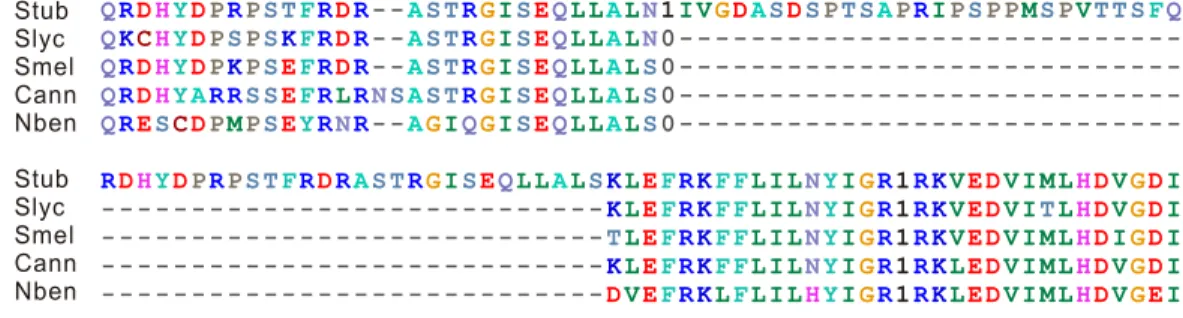
the potato RNA-dependent RNA polymerase (RdRp) genes,PGSC0003DMG402000361
(Fig. 1). TheRdRpgenes encode enzymes that catalyze the replication of RNA from an RNA template, and these genes have been identified in all the major eukaryotic groups and play crucial roles in the regulation of development, maintenance of genome integrity, and defense against foreign nucleic acids (Willmann et al., 2011;Zong et al., 2009). In this study, we confirmed that the new intron was created by the duplication of a gene
segment crossing one intron-exon boundary. The 5′donor site of the new intron was
activated by a cryptic donor site that previously occurred in the exonic region, whereas other splicing signals were inherited from the preexisting intron/exon structure.
MATERIALS AND METHODS
The genome sequences and annotation files of domesticated potatoS. tuberosum
(PGSC_DM_v3), domesticated tomatoS. lycopersicum(ITAG2.3), wild tobaccoNicotiana
benthamiana(version 1.0.1), and wild tomatoSolanum pennellii(spenn_v2.0) were
downloaded from the Sol Genomics Network (Bombarely et al., 2011), and those for
hot pepperCapsicum annuum L. (Zunla-1) were downloaded from the Pepper
Genome Database (Qin et al., 2014). The scaffold sequences of Commerson’s wild potato
(Solanum commersonii,JXZD00000000.1), another wild tomato (Solanum habrochaites, CBYS000000000.1), and eggplant (Solanum melongena,SME_r2.5.1) were downloaded
from the NCBI Genome database (http://www.ncbi.nlm.nih.gov/genome/). The scaffold
sequences and annotation files ofMimulus guttatus(version 2.0) were downloaded from
Phytozome (https://phytozome.jgi.doe.gov/pz/portal.html). The following files were
retrieved from the Sequence Read Archive of the NCBI (http://www.ncbi.nlm.nih.gov/sra/):
SAR files of the whole-genome shotgun (WGS) reads (SRP007439) and the leaf, tuber,
and mixed-tissue transcriptomes (SRP022916,SRP005965,SRP040682, and ERP003480)
ofS. tuberosum; the transcriptomes (SRP015739andSRP018993) ofS. lycopersicum; the transcriptome (SRP067562) ofS. pennellii; the transcriptome (SRP019256) ofC. annuum;
and the transcriptome (SRP018508) ofN. benthamiana. We mapped the RNA-Seq reads
to the genomes using TopHat version 2.0.8 (Kim et al., 2013), whereas BWA (alignment
via Burrows-Wheeler transformation, version 0.5.7) (Li & Durbin, 2009) was used for the WGS reads. We used the default parameters for both programs, although the minimum intron length was adjusted to 20 bp for TopHat.
The orthologous genes ofPGSC0003DMG402000361were identified using the best
reciprocal BLAST hits with a threshold E value of < 10-10. In addition, the orthologous
relationship between the genes inS. tuberosumandS. lycopersicumwas confirmed by their
synteny using SynMap (http://genomevolution.org/CoGe/SynMap.pl). Using the
RNA-Seq data, we examined the available annotations of theRdRpgenes inS. lycopersicum,
N. benthamianahave been confirmed, and those inS. lycopersicumandC. annuumhave been revised (Data S1). The orthologous sequences inS. commersonii,S. habrochaites, and
S. melongenawere manually annotated with references to the annotations inS. lycopersicum,
C. annuum, andN. benthamiana. The annotation files are provided inData S1.
According to the annotation files of the domesticated potato genome, PGSC_DM_v3,
the 3′end of the gene PGSC0003DMG402000361overlaps with the 5′end of the
downstream genePGSC0003DMG401000361(Fig. S1). The orthologous genomic regions
ofC. annuum,M. guttatus,N. benthamiana,S. lycopersicum, andS. pennelliipresent a long gene sequence rather than two overlapping genes. We examined the annotation of this
overlapping region using the RNA-Seq data ofS. tuberosumand found a paired read
(Read ID: 127022 in SRR866275) that crosses the overlapping region. It appears that a long transcript similar to the orthologs in other species occurs inS. tuberosum. In
addition, the 3′end of the coding sequence of the genePGSC0003DMG402000361,
GTAATCTGA, has been annotated as the beginning of the ninth intron of the longer
transcript (Fig. S1). In total, we found 37 RNA-Seq reads that support the removal of
the ninth intron from certain mature mRNA molecules and four RNA-Seq reads supporting the presence of the small segment GTAATCTGA in other mature mRNA molecules. In addition, we found transcription termination signals at the ends of both transcripts using POLYAH (Salamov & Solovyev, 1997). It appears that the
potato RdRpgenePGSC0003DMG402000361undergoes alternative cleavage and
polyadenylation during transcription, which produces two isoforms with different
lengths. We named the shorter onePGSC0003DMG402000361.Sand the longer one
PGSC0003DMG402000361.L. The newly identified intron is spliced from the identical region of these two transcripts; therefore, potential annotation errors in either transcript do not affect the validity of the identification of the new intron. For convenience, we
presentPGSC0003DMG402000361.L in this paper.
We found that the intron gain involved duplication using a BLAT search (Kent, 2002)
and then identified the exact duplicated sequences using the programs REPuter (Kurtz
et al., 2001) and Tandem Repeats Finder (Benson, 1999). Stub
Slyc Smel Cann Nben
Stub Slyc Smel Cann Nben
QRDHYDPRPS TFRDR- -AS TRGISEQL LALN1I VGDASDSPT SAPRIPSP PMSPVT T SFQ QKCHYDPSPSKFRDR- -AS TRGISEQL LALN0 -QRDHYDPKPSEFRDR- -AS TRGISEQL LALS0 -QRDHYAR RS SEFRLRNSAS TRGISEQL LALS0 -QRESCDPMPSEYRNR- -AGIQGISEQL LALS0
-1
RDHYDPRPS TFRDRAS TRGISEQL LALSKLEFRKF FL I LNYIGR RKVE DV I M LHDVGDI
1
- - - -KLEFRKF FL I LNYIGR RKVE DV ITLHDVGDI
1
- - - -TLEFRKF FL I LNYIGR RKVE DV I M LHDIGDI - - - -KLEFRKF FL I LNYIGR1RKLE DV I M LHDVGDI
1
- - - -DVEFRKLFL I LHYIGR RKLE DV I M LHDVGEI
We searched the 5′splicing sites, the branch sites, the polypyrimidine tracts, and the 3′
splicing sites according toIrimia & Roy (2008)andSchwartz et al. (2008). The exonic splicing enhancers (ESEs) ofArabidopsis thalianawere identified byPertea, Mount & Salzberg (2007)and used as the query in a search of the 50 bp exonic sequences upstream and downstream of the target intron.
The phylogenetic tree was constructed using MEGA 6.0 by employing the maximum
likelihood method with the Tamura-Nei substitution model and uniform rates (Tamura
et al., 2013). The number of bootstrap replications was 1,000. The schematic diagram of
the gene structures was constructed using the program GSDraw (Wang et al., 2013).
RESULTS AND DISCUSSION
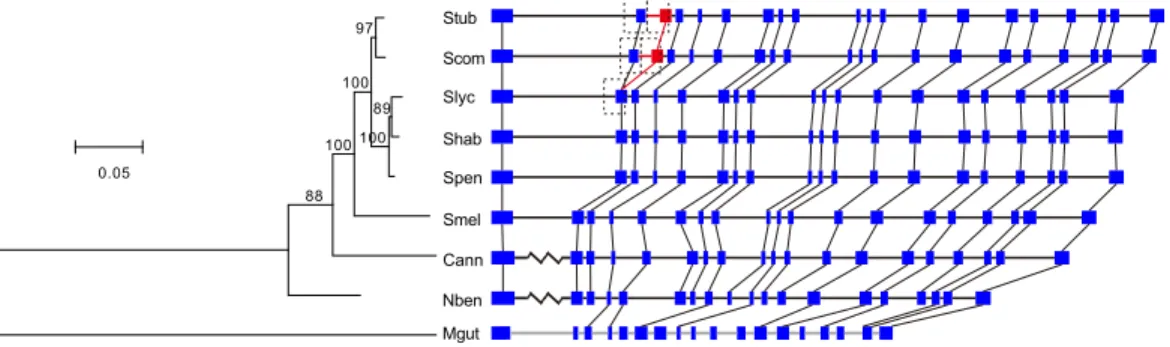
Among the cluster of orthologous genes forRdRp, the members ofS. tuberosumand
S. commersoniihave 20 exons and those of the other Solanaceae species have 19 exons.
A comparison of the annotations clearly showed that the second introns ofS. tuberosum
andS. commersoniiare absent from the other Solanaceae genomes (Fig. 2). By analyzing
the transcriptomic data of S. tuberosum, we found 106 RNA-Seq reads that were
exclusively mapped to the annotated exon-exon boundary (Table S1;Fig. S2), which
confirmed the annotation of this intron. Based on the phylogenetic tree constructed using
the genePGSC0003DMG402000361.Land its orthologs (Fig. 2), there were two possible
explanations for the presence/absence of the intron: the gain of a new intron in the
common ancestor ofS. tuberosumandS. commersonii, or four independent intron loss
events in the other four evolutionary branches (S. lycopersicum–S. habrochaites–S.
pennellii;S. melongena;C. annuum; andN. benthamiana). According to the principle of
parsimony, we concluded that the second intron of the genePGSC0003DMG402000361.L
was gained after the divergence of potato (S. tuberosumandS. commersonii) from other
Solanumplants but prior to the divergence between S. tuberosumandS. commersonii. The new intron and the inserted exonic sequence were used as a query sequence to search against the entire genome ofS. tuberosum. We found that this insertion is a tandem
genomic duplication (Fig. 2). The major part of the new intron and inserted exon region
was a direct duplicate of the upstream intron-exon structure (Fig. 2). In addition, 10 nucleotides at the 5′end of the new intron were recruited from the upstream exon (Fig. 2). Because two nearly identical regions in a reference genome might represent a true duplication or a false result caused by errors in genome assembly, we verified the duplication by examining the following three sources of evidence inS. tuberosum. First, 53 WGS reads were exclusively mapped crossing the three boundaries of two duplicates (Figs. S3–S5;Table S2). Second, 106 RNA-Seq reads were exclusively mapped crossing
the mature mRNA exon boundary (Fig. S2;Table S1), which would not be observed in
mature mRNA if the duplication had not occurred. Third, ten nucleotides were different between the duplicates (Fig. 3).
Kapusta & Feschotte, 2014). Therefore, the production of functional proteins by spliced RNA molecules should not be considered as a prerequisite for identifying a sequence spliced out of RNA molecules as a new intron. In this study, our search for evidence of
88 100 97 100 89 100 Stub Scom Slyc Shab Spen Smel Cann Nben Mgut 0.05
Figure 2 Identification of the intron gain in potatoes.The phylogenetic tree was constructed using the coding sequences of the genePGSC0003DMG402000361.Land its orthologs Solyc12g008410.1inS. lycopersicum,Sopen12g003370.2inS. pennellii,Capana09g000243inC. annuum,Niben101Scf04189g00002 in N. benthamiana, and Migut.K00531inM. guttatusas well as the orthologous regions manually annotated inS. commersonii,S. habrochaites, andS. melongena. Numbers above the branches indicate the percentage of bootstrap support after 1,000 replicates. In the schematic diagram of the gene structures, the presented sequences start from the initiation codon ATG, the boxes represent exons, and the horizontal lines represent introns. Because of space limitations, the extraordinarily long introns are not scaled according to their lengths, and they are represented by broken lines. To avoid crowding together the slashed lines, the introns ofM. guttatushave been scaled up by a factor of two. The new intron/exon structure is marked in red. Abbreviations: Stub,S. tuberosum; Scom,S. commersonii; Slyc, S. lycopersicum; Shab,S. habrochaites; Spen,S. pennellii; Smel,S. melongena; Cann,C. annuum; Nben, N. benthamiana; Mgut,M. guttatus.
Downstream Upstream
a t t a g t t t a g g c t t a a t g a a g a a c t t g t t c a att t t t t t a t t g g t t g c g a t c t c t t c t t c a t t a g t t t a g g c t t a a t g a a g a a c t t g t t c a aat t t t t t a t t g g t t g c g a t c t c t t c t t c
c-t t t t t t t g c a t a t t t a c a a c t c t a c a t g t a a a c t a t g t t g c t c g g a c t c t c a a a a a c t ctt t t t t t t g c a t a t t t a c a a c t c t a c a t g t a a a c t a t g t t g c t c g g a c t c t c a a a a a c t
g t t g a a c c c g t g t t g g a t t c t c c a a a a t g c a c t a c t t t t g g a g t a t t c g a t a c a c a c t t t g t t g a a c c c g t g t t g g a t t c t c c a a a a t g c a c t a c t t t t g g a g t a t t c g a t a c a c a c t t t
t g a a g a g t ccg a a c a a c a c a a c a t g t-a at gt a c t c a g a c c t t t c a aga a t t c t a g t t t a t g a a g a g t ctg a a c a a c a c a a c a t g taa ac at a c t c a g a c c t t t c a aaa a t t c t a g t t t a
c c a a t g a t g g t c t t c c a a t g c c tgc a g A C A T A G T A G G T G A T G C A T C T G A T T C T C C T A C A T c c a a t g a t g g t c t t c c a a t g c c tac a g A C A T A G T A G G T G A T G C A T C T G A T T C T C C T A C A T
C A G C T C C A C G A A T A C C A T C A C C T C C A A T G A G T C C A G T G A C A A C T A G C T T T C A A A G A G A T C C A G C T C C A C G A A T A C C A T C A C C T C C A A T G A G T C C A G T G A C A A C T A G C T T T C A A A G A G A T C
A T T A C G A T C C T A G G C C A T C T A C A T T C A G A G A C A G G G C C A G C A C A C G A G G A A T A A G T G AGC A T T A C G A T C C T A G G C C A T C T A C A T T C A G A G A C A G G G C C A G C A C A C G A G G A A T A A G T G AAC
A G T TAC T G G C A C T C A G T A A G C T T G A A G T TGC T G G C A C T C Ag t a a g c t t g a Downstream Upstream Downstream Upstream Downstream Upstream Downstream Upstream Downstream Upstream Downstream Upstream Downstream Upstream
intron gains is limited to whether the intron sequence occurred in the potato genome and whether the intron sequence has been removed from the mature mRNA. Although the WGS and RNA-Seq reads could demonstrate that the duplication is real and the intron is spliced, the best method of validating this assumption would be to perform a PCR assay for the genomic DNA and RT-PCR on RNA. This methodology underlies the objectives of our study.
According toLogsdon, Stoltzfus & Doolittle (1998), strong evidence of intron gain must satisfy two conditions. The first is a clear phylogeny that provides support for the intron gain, and the second is an identified source element for the gained intron. Because of the clear phylogeny and the identity of the source sequence, we consider the second
intron of the potato genePGSC0003DMG402000361.Lto be a well-supported case of a
newly gained intron.
According to the tandem genomic duplication model originally proposed byRogers
(1989), tandem duplication of an exonic segment harboring the AGGT sequence generates two splice sites for the new intron, 5′-GT and 3′-AG, and a new intron is derived from the duplication of the exonic sequence. However, the two splice sites do not contain
sufficient information to unequivocally determine the exon-intron boundaries (Lim &
Burge, 2001). Accurate recognition and efficient splicing of an intron also requires a
polypyrimidine tract, an adenine nucleotide at the branch site, and many othercis-acting
regulatory motifs (Schwartz et al., 2009;Spies et al., 2009;Wang & Burge, 2008;Wang et al., 2004). In addition, introns are often remarkably richer in A and U compared with exons (Amit et al., 2012), and this difference is considered a requirement for efficient splicing (Carle-Urioste, Brendel & Walbot, 1997;Luehrsen & Walbot, 1994). At first glance, it appears unlikely that a coding segment will have a full set of splicing signals. However, the intronization of coding regions has been observed in several different organisms, including animals and plants (Irimia et al., 2008;Kang et al., 2012;Szczesniak et al., 2011; Zhan et al., 2014;Zhu, Zhang & Long, 2009). These observations indicate that it is possible for certain coding sequences to contain a full set of cryptic splice signals. Furthermore,
an experimental duplication of a coding segment of the vertebrate gene ATP2A2,
which harbors the AGGT sequence, has been shown to generate the new intron (Hellsten
et al., 2011). Therefore, a full set of the splicing signals required for active splicing is
present in the coding sequence of the geneATP2A2. Although a full set of the splicing
signals may have been contained in the coding sequences, we believe that utilization of the active splicing signals of the parental intron/exon structure represent a more frequent
method of intron gain. In the potato gene PGSC0003DMG402000361.L, the duplication
includes the 3′side sequence of an intron and the 5′side of the downstream exon (Fig. 2).
The 3′splicing site signal (CAG), the polypyrimidine tract (TCTTCCAATGCCT), and
model should not be narrowly considered according to its original proposal 27 years ago (Rogers, 1989).
CONCLUSIONS
In the last common ancestor of domesticated potatoS. tuberosumand wild potato
S. commersonii, a tandem duplication event in the genePGSC0003DMG402000361.L
created a novel intron. The duplicate includes the 3′side sequence of an intron and the 5′
side of the downstream exon. Most splicing signals that included a putative branch site,
a polypyrimidine tract, a 3′splicing site, two putative ESEs, and GC contents that were
differentiated between the intron and exon inherited from the parental intron/exon structure. However, the widely cited model of intron gain includes the tandem duplication of an exonic segment containing AGGT, which would create the GT and AG splicing sites. The case of intron gain observed here illustrates that the tandem duplication model of intron gain should be diversified so that the proper splicing signals can be obtained.
ACKNOWLEDGEMENTS
We are thankful to the anonymous referees for their useful comments and Sidra Aslam for her help improving the English in this paper.
ADDITIONAL INFORMATION AND DECLARATIONS
Funding
This work was supported by the National Natural Science Foundation of China (grant numbers 31421063 and 31371283) and the Fundamental Research Funds for the Central Universities. The funders had no role in study design, data collection and analysis, decision to publish, or preparation of the manuscript.
Grant Disclosures
The following grant information was disclosed by the authors:
National Natural Science Foundation of China: 31421063 and 31371283.
Competing Interests
The authors declare that they have no competing interests.
Author Contributions
Ming-Yue Ma analyzed the data, wrote the paper, prepared figures and/or tables,
reviewed drafts of the paper.
Xin-Ran Lan analyzed the data, reviewed drafts of the paper.
Deng-Ke Niu conceived and designed the experiments, wrote the paper, prepared
figures and/or tables, reviewed drafts of the paper.
Data Deposition
The following information was supplied regarding data availability:
Supplemental Information
Supplemental information for this article can be found online athttp://dx.doi.org/
10.7717/peerj.2272#supplemental-information.
REFERENCES
Amit M, Donyo M, Hollander D, Goren A, Kim E, Gelfman S, Lev-Maor G, Burstein D, Schwartz S, Postolsky B, Pupko T, Ast G. 2012.Differential GC content between exons and introns establishes distinct strategies of splice-site recognition.Cell Reports1(5):543–556
DOI 10.1016/j.celrep.2012.03.013.
Benson G. 1999.Tandem repeats finder: a program to analyze DNA sequences.Nucleic Acids Research27(2):573–580DOI 10.1093/nar/27.2.573.
Bombarely A, Menda N, Tecle IY, Buels RM, Strickler S, Fischer-York T, Pujar A, Leto J, Gosselin J, Mueller LA. 2011.The Sol Genomics Network (solgenomics.net): growing tomatoes using Perl.Nucleic Acids Research39(Suppl 1):D1149–D1155
DOI 10.1093/nar/gkq866.
Carle-Urioste JC, Brendel V, Walbot V. 1997.A combinatorial role for exon, intron and splice site sequences in splicing in maize.The Plant Journal11(6):1253–1263
DOI 10.1046/j.1365-313X.1997.11061253.x.
Collemare J, Beenen HG, Crous PW, de Wit PJGM, van der Burgt A. 2015.Novel introner-like elements in fungi are involved in parallel gains of spliceosomal introns.PLoS ONE10(6):
e129302DOI 10.1371/journal.pone.0129302.
Csuros M, Rogozin IB, Koonin EV. 2011.A detailed history of intron-rich eukaryotic ancestors inferred from a global survey of 100 complete genomes.PLoS Computational Biology7(9):
e1002150DOI 10.1371/journal.pcbi.1002150.
Denoeud F, Henriet S, Mungpakdee S, Aury J-M, Da Silva C, Brinkmann H, Mikhaleva J, Olsen LC, Jubin C, Canestro C, Bouquet J-M, Danks G, Poulain J, Campsteijn C,
Adamski M, Cross I, Yadetie F, Muffato M, Louis A, Butcher S, Tsagkogeorga G, Konrad A, Singh S, Jensen MF, Cong EH, Eikeseth-Otteraa H, Noel B, Anthouard V, Porcel BM, Kachouri-Lafond R, Nishino A, Ugolini M, Chourrout P, Nishida H, Aasland R, Huzurbazar S, Westhof E, Delsuc F, Lehrach H, Reinhardt R, Weissenbach J, Roy SW, Artiguenave F, Postlethwait JH, Manak JR, Thompson EM, Jaillon O, Du Pasquier L, Boudinot P,
Liberles DA, Volff J-N, Philippe H, Lenhard B, Crollius HR, Wincker P, Chourrout D. 2010.
Plasticity of animal genome architecture unmasked by rapid evolution of a pelagic tunicate.
Science330(6009):1381–1385DOI 10.1126/science.1194167.
Derrien T, Johnson R, Bussotti G, Tanzer A, Djebali S, Tilgner H, Guernec G, Martin D, Merkel A, Knowles DG, Lagarde J, Veeravalli L, Ruan X, Ruan Y, Lassmann T, Carninci P, Brown JB, Lipovich L, Gonzalez JM, Thomas M, Davis CA, Shiekhattar R, Gingeras TR, Hubbard TJ, Notredame C, Harrow J, Guigo´ R. 2012.The GENCODE v7 catalog of human long
noncoding RNAs: analysis of their gene structure, evolution, and expression.Genome Research
22(9):1775–1789DOI 10.1101/gr.132159.111.
Fablet M, Bueno M, Potrzebowski L, Kaessmann H. 2009.Evolutionary origin and functions of retrogene introns.Molecular Biology and Evolution26(9):2147–2156
DOI 10.1093/molbev/msp125.
Gao X, Lynch M. 2009.Ubiquitous internal gene duplication and intron creation in eukaryotes.
Proceedings of the National Academy of Sciences of the United States of America
Guttman M, Amit I, Garber M, French C, Lin MF, Feldser D, Huarte M, Zuk O, Carey BW, Cassady JP, Cabili MN, Jaenisch R, Mikkelsen TS, Jacks T, Hacohen N, Bernstein BE, Kellis M, Regev A, Rinn JL, Lander ES. 2009.Chromatin signature reveals over a thousand highly conserved large non-coding RNAs in mammals.Nature458(7235):223–227
DOI 10.1038/nature07672.
Hankeln T, Friedl H, Ebersberger I, Martin J, Schmidt ER. 1997.A variable intron distribution in globin genes ofChironomus: evidence for recent intron gain.Gene205(1–2):151–160
DOI 10.1016/S0378-1119(97)00518-0.
Hellsten U, Aspden JL, Rio DC, Rokhsar DS. 2011.A segmental genomic duplication generates a functional intron.Nature Communications2:454DOI 10.1038/ncomms1461.
Hooks KB, Delneri D, Griffiths-Jones S. 2014.Intron evolution in saccharomycetaceae.Genome Biology and Evolution6(9):2543–2556DOI 10.1093/gbe/evu196.
Irimia M, Roy SW. 2008.Evolutionary convergence on highly-conserved 3′intron structures in intron-poor eukaryotes and insights into the ancestral eukaryotic genome.PLoS Genetics4(8):
e1000148DOI 10.1371/journal.pgen.1000148.
Irimia M, Roy SW. 2014.Origin of spliceosomal introns and alternative splicing.Cold Spring Harbor Perspectives in Biology6(6):a016071DOI 10.1101/cshperspect.a016071.
Irimia M, Rukov JL, Penny D, Vinther J, Garcia-Fernandez J, Roy SW. 2008.Origin of introns by ‘intronization’ of exonic sequences.Trends in Genetics24(8):378–381
DOI 10.1016/j.tig.2008.05.007.
Jayakodi M, Jung JW, Park D, Ahn Y-J, Lee S-C, Shin S-Y, Shin C, Yang T-J, Kwon HW. 2015.
Genome-wide characterization of long intergenic non-coding RNAs (lincRNAs) provides new insight into viral diseases in honey beesApis ceranaandApis mellifera.BMC Genomics
16(1):680DOI 10.1186/s12864-015-1868-7.
Kang L-F, Zhu Z-L, Zhao Q, Chen L-Y, Zhang Z. 2012.Newly evolved introns in human retrogenes provide novel insights into their evolutionary roles.BMC Evolutionary Biology
12(1):128DOI 10.1186/1471-2148-12-128.
Kapusta A, Feschotte C. 2014.Volatile evolution of long noncoding RNA repertoires: mechanisms and biological implications.Trends in Genetics30(10):439–452DOI 10.1016/j.tig.2014.08.004.
Kent WJ. 2002.BLAT–the BLAST-like alignment tool.Genome Research12(4):656–664
DOI 10.1101/gr.229202.
Kim D, Pertea G, Trapnell C, Pimentel H, Kelley R, Salzberg SL. 2013.TopHat2: accurate alignment of transcriptomes in the presence of insertions, deletions and gene fusions.Genome Biology14(4):R36DOI 10.1186/Gb-2013-14-4-r36.
Knowles DG, McLysaght A. 2006.High rate of recent intron gain and loss in simultaneously duplicatedArabidopsisgenes.Molecular Biology and Evolution23(8):1548–1557
DOI 10.1093/molbev/msl017.
Kurtz S, Choudhuri JV, Ohlebusch E, Schleiermacher C, Stoye J, Giegerich R. 2001.REPuter: the manifold applications of repeat analysis on a genomic scale.Nucleic Acids Research
29(22):4633–4642DOI 10.1093/nar/29.22.4633.
Li H, Durbin R. 2009.Fast and accurate short read alignment with Burrows-Wheeler transform.
Bioinformatics25(14):1754–1760DOI 10.1093/bioinformatics/btp324.
Li W, Tucker AE, Sung W, Thomas WK, Lynch M. 2009.Extensive, recent intron gains inDaphnia
populations.Science326(5957):1260–1262DOI 10.1126/science.1179302.
Li WL, Kuzoff R, Wong CK, Tucker A, Lynch M. 2014.Characterization of newly gained introns inDaphniapopulations.Genome Biology and Evolution6(9):2218–2234
Lim LP, Burge CB. 2001.A computational analysis of sequence features involved in recognition of short introns.Proceedings of the National Academy of Sciences of the United States of America
98(20):11193–11198DOI 10.1073/pnas.201407298.
Logsdon JM Jr, Stoltzfus A, Doolittle WF. 1998.Molecular evolution: recent cases of spliceosomal intron gain?Current Biology8(16):R560–R563DOI 10.1016/S0960-9822(07)00361-2.
Luehrsen KR, Walbot V. 1994.Addition of A- and U-rich sequence increases the splicing efficiency of a deleted form of a maize intron.Plant Molecular Biology24(3):449–463
DOI 10.1007/BF00024113.
Ma M-Y, Che X-R, Porceddu A, Niu D-K. 2015a.Evaluation of the mechanisms of intron loss and gain in the social amoebae Dictyostelium.BMC Evolutionary Biology15(1):286
DOI 10.1186/s12862-015-0567-y.
Ma M-Y, Zhu T, Li X-N, Lan X-R, Liu H-Y, Yang Y-F, Niu D-K. 2015b.Imprecise intron losses are less frequent than precise intron losses but are not rare in plants.Biology Direct10(1):24
DOI 10.1186/s13062-015-0056-7.
Pertea M, Mount SM, Salzberg SL. 2007.A computational survey of candidate exonic splicing enhancer motifs in the model plantArabidopsis thaliana.BMC Bioinformatics8(1):159
DOI 10.1186/1471-2105-8-159.
Qin C, Yu C, Shen Y, Fang X, Chen L, Min J, Cheng J, Zhao S, Xu M, Luo Y, Yang Y, Wu Z, Mao L, Wu H, Ling-Hu C, Zhou H, Lin H, Gonza´lez-Morales S, Trejo-Saavedra DL, Tian H, Tang X, Zhao M, Huang Z, Zhou A, Yao X, Cui J, Li W, Chen Z, Feng Y, Niu Y, Bi S, Yang X, Li W, Cai H, Luo X, Montes-Herna´ndez S, Leyva-Gonza´lez MA, Xiong Z, He X, Bai L, Tan S, Tang X, Liu D, Liu J, Zhang S, Chen M, Zhang L, Zhang L, Zhang Y, Liao W, Zhang Y, Wang M, Lv X, Wen B, Liu H, Luan H, Zhang Y, Yang S, Wang X, Xu J, Li X, Li S, Wang J, Palloix A, Bosland PW, Li Y, Krogh A, Rivera-Bustamante RF, Herrera-Estrella L, Yin Y, Yu J, Hu K, Zhang Z. 2014.Whole-genome sequencing of cultivated and wild peppers provides insights intoCapsicumdomestication and specialization.Proceedings of the National Academy of Sciences of the United States of America111(14):5135–5140DOI 10.1073/pnas.1400975111.
Rogers JH. 1989.How were introns inserted into nuclear genes.Trends in Genetics5:213–216
DOI 10.1016/0168-9525(89)90084-X.
Roy SW, Gilbert W. 2005.Rates of intron loss and gain: implications for early eukaryotic evolution.Proceedings of the National Academy of Sciences of the United States of America
102(16):5773–5778DOI 10.1073/pnas.0500383102.
Roy SW, Penny D. 2006.Smoke without fire: most reported cases of intron gain in nematodes instead reflect intron losses.Molecular Biology and Evolution23(12):2259–2262
DOI 10.1093/molbev/msl098.
Salamov AA, Solovyev VV. 1997.Recognition of 3’-processing sites of human mRNA precursors.
CABIOS13(1):23–28DOI 10.1093/bioinformatics/13.1.23.
Schwartz S, Gal-Mark N, Kfir N, Oren R, Kim E, Ast G. 2009.Aluexonization events reveal features required for precise recognition of exons by the splicing machinery.PLoS
Computational Biology5(3):e1000300DOI 10.1371/journal.pcbi.1000300.
Schwartz SH, Silva J, Burstein D, Pupko T, Eyras E, Ast G. 2008.Large-scale comparative analysis of splicing signals and their corresponding splicing factors in eukaryotes.Genome Research
18(1):88–103DOI 10.1101/gr.6818908.
Simmons MP, Bachy C, Sudek S, van Baren MJ, Sudek L, Ares M Jr, Worden AZ. 2015.
Intron invasions trace algal speciation and reveal nearly identical arctic and antarctic micromonas populations.Molecular Biology and Evolution32(9):2219–2235
Spies N, Nielsen CB, Padgett RA, Burge CB. 2009.Biased chromatin signatures around
polyadenylation sites and exons.Molecular Cell36(2):245–254DOI 10.1016/j.molcel.2009.10.008.
Szczesniak MW, Ciomborowska J, Nowak W, Rogozin IB, Makalowska I. 2011.Primate and rodent specific intron gains and the origin of retrogenes with splice variants.Molecular Biology and Evolution28(1):33–37DOI 10.1093/molbev/msq260.
Tamura K, Stecher G, Peterson D, Filipski A, Kumar S. 2013.MEGA6: molecular evolutionary genetics analysis version 6.0.Molecular Biology and Evolution30(12):2725–2729
DOI 10.1093/molbev/mst197.
Torriani SFF, Stukenbrock EH, Brunner PC, McDonald BA, Croll D. 2011.Evidence for extensive recent intron transposition in closely related fungi.Current Biology21(23):2017–2022
DOI 10.1016/j.cub.2011.10.041.
van der Burgt A, Severing E, de Wit PJGM, Collemare J. 2012.Birth of new spliceosomal introns in fungi by multiplication of introner-like elements.Current Biology22(13):1260–1265
DOI 10.1016/j.cub.2012.05.011.
Verhelst B, Van de Peer Y, Rouze P. 2013.The complex intron landscape and massive intron invasion in a picoeukaryote provides insights into intron evolution.Genome Biology and Evolution5(12):2393–2401DOI 10.1093/gbe/evt189.
Wang Y, You FM, Lazo GR, Luo MC, Thilmony R, Gordon S, Kianian SF, Gu YQ. 2013.PIECE: a database for plant gene structure comparison and evolution.Nucleic Acids Research41(D1):
D1159–D1166DOI 10.1093/nar/gks1109.
Wang ZF, Burge CB. 2008.Splicing regulation: from a parts list of regulatory elements to an integrated splicing code.RNA14(5):802–813DOI 10.1261/rna.876308.
Wang ZF, Rolish ME, Yeo G, Tung V, Mawson M, Burge CB. 2004.Systematic identification and analysis of exonic splicing silencers.Cell119(6):831–845DOI 10.1016/j.cell.2004.11.010.
Willmann MR, Endres MW, Cook RT, Gregory BD. 2011.The functions of RNA-dependent RNA polymerases inArabidopsis.The Arabidopsis Book9:e146DOI 10.1199/tab.0146.
Yenerall P, Krupa B, Zhou L. 2011.Mechanisms of intron gain and loss inDrosophila.BMC Evolutionary Biology11(1):364DOI 10.1186/1471-2148-11-364.
Yenerall P, Zhou L. 2012.Identifying the mechanisms of intron gain: progress and trends.
Biology Direct7(1):29DOI 10.1186/1745-6150-7-29.
Zhan LL, Meng QH, Chen R, Yue Y, Jin YF. 2014.Origin and evolution of a new retained intron on the vulcan gene in Drosophila melanogaster subgroup species.Genome57(10):567–572
DOI 10.1139/gen-2014-0132.
Zhang L-Y, Yang Y-F, Niu D-K. 2010.Evaluation of models of the mechanisms underlying intron loss and gain inAspergillusfungi.Journal of Molecular Evolution71(5–6):364–373
DOI 10.1007/s00239-010-9391-6.
Zhu T, Niu D-K. 2013a.Frequency of intron loss correlates with processed pseudogene abundance: a novel strategy to test the reverse transcriptase model of intron loss.BMC Biology11(1):23
DOI 10.1186/1741-7007-11-23.
Zhu T, Niu D-K. 2013b.Mechanisms of intron loss and gain in the fission yeast
Schizosaccharomyces.PLoS ONE8(4):e61683DOI 10.1371/journal.pone.0061683.
Zhu ZL, Zhang Y, Long MY. 2009.Extensive structural renovation of retrogenes in the evolution of thePopulusgenome.Plant Physiology151(4):1943–1951DOI 10.1104/pp.109.142984.