Theoretical and methodological aspects of innovative economic development
THEORETICAL AND METHODOLOGICAL ASPECTS
OF INNOVATIVE ECONOMIC DEVELOPMENT
This article addresses the problem of def-inition and identification of clusters as lo-calised mesoeconomic systems with fuzzy boundaries that stimulate the development of these systems. The author analyses the influ-ence of the inductive approach to the forma-tion of cluster theory and juxtaposes different typologies of clusters and other types of local-ised economic systems. The article offers an overview of the existing methodological ap-proaches to the problem of cluster identifica-tion and emphasises the major role of institu-tional dimension in the identification (and functioning) of clusters, especially in com-parison to cluster formation theory based on the technological connection of adjacent units. The author comes to a conclusion that, without the inclusion of institutional factors, alongside localising and technological ones (demonstrated through different variables), it is virtually impossible to develop an inde-pendent cluster theory, different from the ge-neral agglomeration theory. For the first time, a hierarchy of institutions affecting the forma-tion of local economic systems is considered against the background of the identification of institutional levels, whose full development makes it possible to speak of the formation of clusters as most successful mesoeconomic sys-tems. At the same time, the author emphasises that, in economies gravitating towards the market type of organisation, the development of mesoeconomic systems is closely connected to competition for innovative rent. The article outlines the methodology for cluster studies, which makes it possible to consider such rela-tively new to the regional science phenomena as innovative and “transborder” clusters.
Key words: clusters, mesoeconomics, me-soeconomic system, regional development CLUSTERS
IN THE INSTITUTIONAL PERSPECTIVE:
ON THE THEORY AND METHODOLOGY OF LOCAL
SOCIOECONOMIC
DEVELOPMENT
T.
R. Gareev
**
Immanuel Kant Baltic Federal University
14, A. Nevski St.,
Kaliningrad, 236041, Russia
Received on May 15, 2012.
Introduction
It has become common practice to begin any talk on economic clusters with admitting that there is no adequate, universally accepted definition of the cluster. In spite of that, the copious literature on cluster approach is ex-panding [32—45].
L. Markov and M. Yagoltser [7] give a comprehensive overview of over-seas research containing substantiated definitions of the cluster. The reviews of cluster typologies and methodology of cluster identification can be found in [4; 10; 13].
Regarding cluster formation in Russia, a chapter in the CEMI RAS mon-ograph is worth mentioning. It is devoted to the development of meso-economic systems [8, pp. 687—700], and surmises that the necessity to use the cluster approach is widely admitted and discussed; however, methodolo-gies of defining clusters on the regional level are non-existent.
This article addresses several issues hampering the formation of the ter theory; it also substantiates a research methodology for innovative clus-ters with transborder elements [38].
We suggest that such a methodology is to meet the conditions as follows: firstly, a workable cluster model is impossible as long as the institutional dimension of cluster formation and functioning is ignored; secondly, in the market-oriented (competitive) socio-economic context sustainable clusters of non-innovative type cannot be viable.
Here, clusters are defined as localized meso-economic systems with fuzzy borders, consisting of interconnected heterogeneous agents and spe-cific local institutions determining the roles of these agents and stimulating innovative development of these systems.
In order to characterize the elements of the instrumental definition of the cluster and the imposed restrictions [6] we suggest putting clusters in an ap-propriate (institutional) context; review the existing approaches to cluster identification; reveal their limitations, and outline the methodology of inno-vative cluster research.
The concept of institution needs clarification in the context of economic system. We take institutions as perceptions of the role of agents in social system. Therefore, institutions are not exclusively viewed as external or exo-genic factors perform the role of 'the rule of the game', or yet that of mecha-nisms forcing the agents to abide by the system. Although the concrete mani-festations of institutions can be deduced through analysis, it mainly concerns formal North-esque institutions. With the definition of the institution being vague and ambiguous (see Markusen — Lagendijk debate)1, the borders of social systems described through the concept of the institution will remain
1
blurred. Such fuzziness, however, should be preferred to multiple attempts to classify the variety of mesoeconomic systems in the geo-industrial perspec-tive, vague as it is.
The existing perceptions based on the stimulus-reaction type and beha-vioural characteristics of agents (their perception of each other) determine the complexity [39, p.1] of the social system, including the cluster.
Lastly, the mesoeconomic system is viewed here as a system of eco-nomic agents functioning as vehicles of specific institutions. Following the evolutionists, we consider the meso-level as an institutional ecosystem thus restraining the technological (industrial) basis for classification.
Thus the concept of cluster (as well as of any economic system falling between micro- and macro-levels) is viewed as, and analysed according to, the intensity of three factors: local (geographical), industrial (technological), and institutional. Such an approach is seldom implemented in full because of its complexity. In other words, the approach could be summed up in this way: the institutions are important, but the ways they are mounted into the system are still more important.
Induction and fuzzy definitions as a basis for the descriptive theory of clusters
The section of regional economy dealing with localized economic sys-tems (A. Marshall is assumed to be the founder of the theory) is developing in cycles and is prone to vi issitudes of fashion for terms and concepts. The above does not mean that these systems are not given to changes — on the contrary, as a rule, researchers use an inductive approach to track these changes; further, and they attempt to design a theory that could justify the changes embracing a wide range of phenomena. At the next stage of forma-lization the new theory abandons its initial specific features, which eventu-ally leads either to a theoretical reduction or to its political escalation, in practice resulting in profanation2.
Whatever conventional a split, many theories of spatial development are known to have been conceived inductively (for overview see [2]). This ap-proach could be illustrated by the basics of the theory of industrial districts by A. Marshall and the growth pole theory by F. Perroux. The Standort theo-ries of I. von Thünen or A. Weber, who relied more on deduction, could be viewed as counter-illustrative. It was the Soviet school of
2
graphical location of production forces (N. Baransky, A. Granberg, et al.) that claimed the deductive (alias scientific) approach to the territorial organi-zation of production. An important feature of the deductive approach is use of the methodology of economic-mathematical modelling, primarily the ag-gregation and input-output model and systemic approach to the planning of territorial complexes (TIC).
Now viewed as traditional, the theory of industrial clusters whose for-bearer3 and promoter4 was M. Porter [12, . 205—292], formed as an induc-tive theory. In his classical work M. Porter maintains:
“Geographic concentration magnifies the power of domestic rivalry (Emphasis added — T.G.). This pattern is amazingly common around the world... the more localized the rivalry, the more intense. And the more in-tense, the better”.
Ironically, it is also vigorous domestic competition within the state that ultimately pressures domestic companies to look at global markets and toughens them to succeed in them [11, p. 564].
The methods of quantitative assessment of clustering on the interregional level (USA economy used as an example) claiming the scope of deductive generalization is quoted in Porter [12].
We maintain that the influence of induction on cluster theory leads to the repercussions as follows:
1. The principal fuzziness of the definition of cluster proceeding from the fuzziness of the underlying concepts ("How do I know the cluster when I see it?") [30]).
2. The subjective (normative political, or, more precisely, axiological) ap-proach to the concept of cluster as a preferred type of meso-economic system reflecting the conflicting traits of the globally dominant socio-economic system.
As a result, two approaches to defining clusters become apparent. The first one treats the cluster as a generic notion, i.e. a type of local economic systems normative-wise, enjoying the preferred quality of increased com-petitiveness. In the second case, the cluster is viewed as a specific concept for all types of local production systems; hence different systems are re-garded as clusters of different types.
3
However, the concept cluster had featured in publications before M. Porter, which the latter admits.
4
We adhere to the first point of view, because in the second case the con-cept of cluster is equalled to a more general notion of local production (eco-nomic) system thus rendering the very concept of 'cluster' identical with the concept of 'grouping' and therefore pointless for analysis. For the institu-tional approach it is the matter of principle. According to A. Shastitko, "ap-plying different approaches to the analysis of the same subject may appear useful for demonstrating the similarities and differences in methods; howe-ver, it can hardly yield any unambiguous operational conclusions as to the nature and forms of clusters, and their possible ways of development" [13].
It is of importance that once clusters are logically differentiated from non-clusters, they are further subdivided into types of clusters. Given the fuzziness of definitions, there is always a risk to treat a non-cluster as a type of cluster. There is also another risk of singling out Italianate districts as specific, pertaining exclusively to Italy, industrial systems, which should not be referred to as clusters (we do not share this point of view). We maintain that, alongside the geographical proximity principle, it is the institutional dimension that underlies the division into clusters and non-clusters. Techno-logical relatedness (industrial profile) or economic efficiency permits a more precise identification of types of meso-economic systems.
Common inductive features of clusters
Inductively, like all other local production systems, clusters consist of multiple juridically independent inter-related agents forming groups and coa-litions and various hybrid coordination forms. To tell clusters from other lo-cal systems, they are inductively ascribed a set of features typical of more successful economic systems of the given period (as a rule, of the most com-petitive economies of capitalist type).
In our opinion, the better part of research (starting from Porter [11; 12]) demonstrates the approach that could be summed up in five major principles5:
Firstly, the geographical concentration of the institutions forming the cluster profile;
Secondly, the competitive basis for the general type of economic ac-tivity and competition between companies (creation of a dynamic network of interior suppliers);
Thirdly, cooperation between companies going both vertically and horizontally, alongside the formation of specialized economic and market infrastructure;
Fourthly, common communication policy (information and advertising strategy) aimed at popularization of the brand;
5
Fifthly, competence of human resources in a specialized cluster in a given geographical area.
In other words, the concept of cluster should embrace a local production system enjoying all the above mentioned characteristics. The fuzziness and subjectivity of threshold values of multiple indices reflecting the above fea-tures create numerous methodological problems. Even with a considerable role of state in local economic systems, (the Silicon Valley phenomenon is worth mentioning here), their commercial subsystem, however, possesses all the necessary features that enable them to incessantly generate commercially suc-cessful innovations. This is why most researchers will agree that clusters are dynamic, commercially efficient competitive systems with high innovation po-tential even in spite of a heavy involvement of the state.
A. Shastitko [13] gives a thorough analysis of variations and groupings of the clusters' features and indicators. He draws attention to the fact that institu-tional features seldom feature in the characterizations of clusters and, to our knowledge; he is the first to consider clusters in the context of the new institu-tional economic theory (NIET)6.
The strength of such an approach may consist in providing a more sub-stantial theoretical basis for clusters through NIET, which views clusters as hybrid forms of transaction coordination. However, in our opinion, it allows a broader treatment of cluster, for hybrid cluster forms inconsistent with the tra-ditional criteria are readily available. Nevertheless, the research methodology in the framework of institutional theoretical platform appears to be quite promi-sing (the treatment of clusters in terms of the theory of the company or the theory of contracts).
Along with the above said, institutional comparative studies (the analysis of specific features of local systems in various institutional environments) have a great potential. Pragmatically, including institutions into cluster re-search may suggest that in different types of economy homonymous micro-agents and meso-structures conceal different economic implications. For exam-ple, more often than not, special economic zones in Eastern Europe, China, Latin America and Russia have nothing in common but the term per se. Ano-ther example: the attempts to abstractly single out Porter-esque clusters in the economies with state-paternalist types of constitution generally lead to the identification of the legacy of territorial-industrial complexes (TIC).
Essential for this study is the hypothesis that it is their institutional nature that makes it possible to foreground clusters against the backdrop of all classes of local industrial systems. The substantiation of the institutional nature of in-novative clusters makes it possible to shed light on such phenomena as quasi-clusters of post-Soviet era, trans-border international quasi-clusters and many others.
Typology of clusters: various approaches
As has been said above, cluster typology basically rests on the techno-logical interdependence (industrial specialization and size), alongside geo-graphical proximity of economic agents. Here we will focus on most
6
while typologies among many, as they give grounds for both assessing the versatility of classifications and judging the depth of research into institu-tional parameters.
The range of typologies is broad and versatile [7]; however, they could be reduced to the well-known typology of industrial districts by A. Markusen [30 who proposed to count, apart from the Marshal-lian districts, hub-and-spoke ones and satellite platforms (Fig. 1).
Marshal-lian districts Hub-and-spoke districts Satellite platforms
Fig. 1. Types of districts of local and non-local acceleration7 [30, p. 297]
Terminological disagreement apart, the important feature of Markusen's typology is that the author regards local vs. non-local embeddedness of in-dustrial groups, and attempts to take this opposition into account in the uni-versal classification8. Another merit of this classification is distinguishing a new type of state-anchored districts (they do not feature in the chart above).
Although Markusen finds examples of same-type districts in different natio-nal systems, it happens because sticky mixes are highly recurrent. Therefore, her recommendations are aimed at expanding the role of comparative institutional analysis. In particular, this study is very critical of the fashion to use the model of "new industrial districts," particularly in relation to American economy, for which 'hub-and-spoke districts' and 'satellite platforms' are more typical.
According to L. Markov and M. Yagolnitser, E. Marcuse's typology rai-ses questions about the effectiveness of local political initiative and various models explaining the relationship of innovation and territories [7, p. 34].
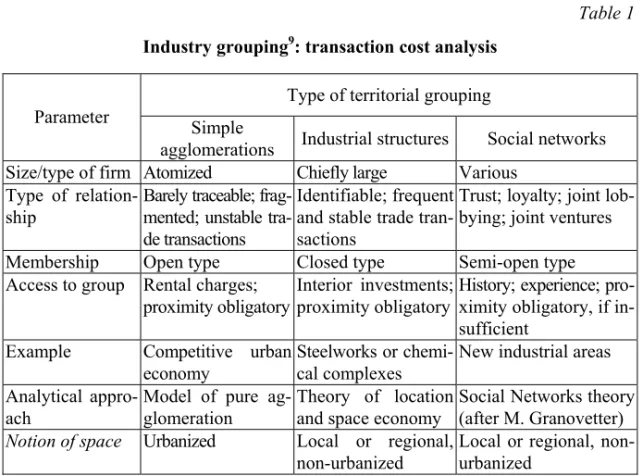
An effective typology of clusters is contained in S. Yammarino and F. McCann [26]. They note that in the framework of spacial economy three implicit abstract types of inter-firm groups have formed (Table 1).
The use of the cluster as a specific concept for the analysis of different meso-economic systems is an easily removable flaw in this typology; mean-while, the typology's worth lies in the fact that it takes us back to the notion of a simple agglomeration as a typical form of meso-economic systems (es-pecially in emerging and post-Soviet economies).
7
Medium circle: a large-size local lead enterprise; small circle: a small-size local firm; square: subsidiary industry.
8
Table 1 Industry grouping9: transaction cost analysis
Type of territorial grouping Parameter
Simple
agglomerations Industrial structures Social networks Size/type of firm Atomized Chiefly large Various
Type of relation-ship
Barely traceable; frag-mented; unstable tra-de transactions
Identifiable; frequent and stable trade tran-sactions
Trust; loyalty; joint lob-bying; joint ventures
Membership Open type Closed type Semi-open type Access to group Rental charges;
proximity obligatory
Interior investments; proximity obligatory
History; experience; pro-ximity obligatory, if in-sufficient
Example Competitive urban
economy
Steelworks or chemi-cal complexes
New industrial areas
Analytical appro-ach
Model of pure ag-glomeration
Theory of location and space economy
Social Networks theory (after M. Granovetter) Notion of space Urbanized Local or regional,
non-urbanized
Local or regional, non- urbanized
Compiled on the basis of [26, p. 1029].
Another important feature of the typology is its singling out industrial complexes, which are also partially retained in resource-based and state-run economies. The combination of simple agglomerations and transformed ter-ritorial-industrial complexes can be regarded as the prototype of the local economic system of contemporary Russian economy. Including the attitude to the rent in the analysis is crucial, for it opens up the way to a broader in-stitutional assumption and to a typology of economies.
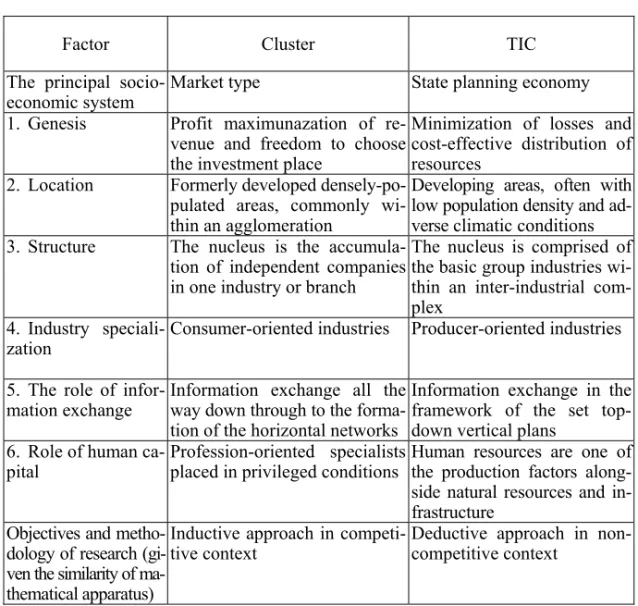
It is a matter of principle for domestic researchers [9, 10] to distinguish between complexes and clusters, because otherwise the former TPC readily fit the definition of cluster (Table 2). As will be seen in the next chapter on the methodology of cluster identification, before 1980-s seminal western re-search did not focus on this distinction, virtually ignoring the contribution of Soviet experts [19].
From the normative and practical points of view, these differences may prove very useful in avoiding inappropriate and ineffective lobbying, which attempts to use cluster policy tools for their own purposes10. However, it is probably only relevant for policy makers and researchers of transition
9
'Clusters’ in the original; however, the term ‘grouping’ is used here to distinguish between ‘clusters’ and ‘simple agglomerations'.
10
mies. In our opinion, a more relevant question for transition economies is whether the formation of clusters based on the transformation of TPCs is possible in principle, and whether such transformations could be carried out without the participation of leading multinational corporations (MNCs).
Table 2 Principal differences in territorial-industrial complexes
Factor Cluster TIC
The principal socio-economic system
Market type State planning economy
1. Genesis Profit maximunazation of re-venue and freedom to choose the investment place
Minimization of losses and cost-effective distribution of resources
2. Location Formerly developed densely-po-pulated areas, commonly wi-thin an agglomeration
Developing areas, often with low population density and ad-verse climatic conditions 3. Structure The nucleus is the
accumula-tion of independent companies in one industry or branch
The nucleus is comprised of the basic group industries wi-thin an inter-industrial com-plex
4. Industry speciali-zation
Consumer-oriented industries Producer-oriented industries
5. The role of infor-mation exchange
Information exchange all the way down through to the forma-tion of the horizontal networks
Information exchange in the framework of the set top-down vertical plans
6. Role of human ca-pital
Profession-oriented specialists placed in privileged conditions
Human resources are one of the production factors along-side natural resources and in-frastructure
Objectives and metho-dology of research (gi-ven the similarity of ma-thematical apparatus)
Inductive approach in competi-tive context
Deductive approach in non-competitive context
Based on: [9; 10].
The role of transnational corporations in the formation of clusters quite surprisingly appears to be one of the unexplored aspects, and not for transi-tion economies alone (ironically, nowadays they provide experimental fideli-ty in mezo-economics).
Fig. 2. Cluster types viewed through the participation of TNCs [38]
This classification [38] stresses the institutional role of TNCs, but the term "cross-border cluster" is used to describe their international engagement in a broader sense, beyond cross-border relations. It is noteworthy that E. Mar-kusen also pays considerable attention to the role of international actors (es-pecially in the satellite platforms model); however, for her, industrial plat-forms characterize the model of global outsourcing, which is inherently clo-ser to the model of agglomeration or a complex.
Another important property of clusters is their innovative nature. A. La-gendiyk's graph represents the family of "territorial innovation models" (TIM) (Fig. 3), whose development marks a shift from "interest from spatial and economic contradictions and class-struggle to knowledge-based compe-titiveness, and to associational approaches, with growing interest to the so-cial and institutional underpinning of the “economic” [27, p. 722].
TIM synthesis of the models of regional innovative development "in which local institutional dynamics plays a significant role" [34, p. 291]. In our opi-nion, the term local production systems (LPS)11is more appropriate as a gene-ralizing concept to form typologies; however, this aspect can be the subject of a separate discussion. It is noteworthy that TIM have been developing since the late 1980's, therefore the researchers are primarily interested in the innova-tive types of local systems (often a technocratic approach to innovations is pre-vailing, and endogenous sources of competitiveness are considered)12. Con-ceptual models of regional economy have often been criticized for their eco-nomic determinism and a tendency to "quickly create a theory".
11
In spite of its recurrence, the term LPS (Fr. — SPL) does not enjoy any authoro-zed interpretation (probably due to the vagueness of rather general terms local and system). Therefore, there is a possiblity to use the term local economic system to de-scribe various meso-level economic systems relating to the regional science (another branch of meso-economic systems deals with the objects of the theory of industrial markets). In our view, it is a convinient term, because at the macrolevel the accepted term is 'economic systems', (in terms of economic comparative studies), while on micro-level economic systems are firms.
12
Fig. 3. Territorial Innovative Models (TIM) [27, p. 722] Neoclassical
economics
Evolutionary economics
Other (Sub) discipline Explanatory concept Spatial/regional concept
Transaction costs (Williamson)
Technological trajectories/
divides
Embedding networking
Collective learning
Spatial fix (Harvey)
Flexible production (Californian
School)
Flexible Specialization (MIT School)
Innovative milieus (GREM)
Non-ubiquitous assets (Maskell) Untraded
interdepend-encies/ conventions
Industrial districts New industrial
spac-es Core-periphery/ areas
of deindustrialization Regional innovation Learning Regions/
Systems
Regional Worlds (Storper)
Competence/ resource based theory of the region
Marxist approaches Regulation approach Socio-economics/ sociology organization economics Institutional/
Cognitive approaches
(e.g. tacitknowledge)
Resource based organizational
approach Institutions
of social regulation
Part of the cluster theory criticism derives from the fuzziness of the geo-graphical dimension [32] underlying this or that theory. As shown in the TIM pattern, many of these concepts are hardly identifiable in terms of di-mension. The traditional theory of clusters faces the same problem.
More often than not, the concept of geographical proximity is blurred; however, this concept actually distinguishes the cluster from network analy-sis13.
R. Boshma argues that, firstly, for economies' functioning various forms of proximity are of importance (geographical proximity not being a defining form); and secondly, there are problems of excessive proximity, which are manifested in a variety of lock-ins and can hinder innovation [17]. Geo-graphical (spatial) proximity is considered by them as a complementary fac-tor in the formation of organizational, social, institutional and finally, cogni-tive proximity (Table 3).
Table 3
Proximity forms, acc. to R. Bomche [17, р. 71]
Forms of proximity
Key dimension
Lack of proximity
Excessive
proximity Possible solutions
1. Cognitive Knowledge
gap
Miscomprehen-sion
Lack of innova-tion sources
Common knowledge base with different, if complementary capa-bilities
2. Organizati-onal
Control Opportunism Bureaucracy Loosely connected
systems
3. Social Trust based on
social relations
Opportunism Lack of
econo-mic justification
Blend of traditional and market relations 4. Institutional Trust based on
common insti-tutions
Opportunism Blocking an
inertia
Institutional audit and balancing
5. Geographical Distance Absence of
exter-nal spacial effects
Lack of geogra-phical openness
Blend of local and ex-ternal connections
Discussing the role of institutional factors, R. Boshma actually means the aggregate of organizational, social and institutional proper ones in the core sense of the word "proximity" [17, p. 68]. The organizational aspect as-sumes the established perceptions and beliefs of the level of opportunism and the need for control. The social aspect reflects primarily informal rela-tionships between agents at the micro-level, i.e. the level of trust, on which the quality of communication depends (willingness to share implicit knowl-edge). The North-esque institutional dimension characterizes the institutional environment on the macro-level (codes of conduct).
13А
However, as we can see, even the most successful modern typologies of clusters (and local production systems) are based primarily on geographical and technological principles of classification, and only in rare cases a sepa-rate institutional component is highlighted.
As geographical proximity is rather a trivial (if by far not unambiguous) factor, the vast majority of existing technical approaches to the identification of clusters is based on the analysis of technological links.
Cluster analysis has been far from a new topic in research since the post-war years. To quote a landmark review of the work by Chamanski S. and L. Ab-lasa on the identification of clusters and complexes, this to this day has not lost its relevance [19, p. 62]:
Considerable confusion exists in the literature concerning the related con-cepts of industrial clusters, industrial complex, growth pole and growth cen-tres and central locations. <...> the cluster means a subset of industries linked by the more powerful flows of goods and services are than those (flows) link-ing them to other sectors of the national economy.
According to Chama ski S. and L. Balsa’s take on clusters, the latter are devoid of geographic (spatial) dimensions. It is noteworthy that in the re-search literature, this view of the cluster is very common, as it most readily lends itself to quantified analysis [14]. More precisely, the spatial dimension, as it were, is present by the level of aggregation (of geographical dimen-sion), for which a corresponding table of the MPS is compiled (as a rule, it is the level of a country)14.
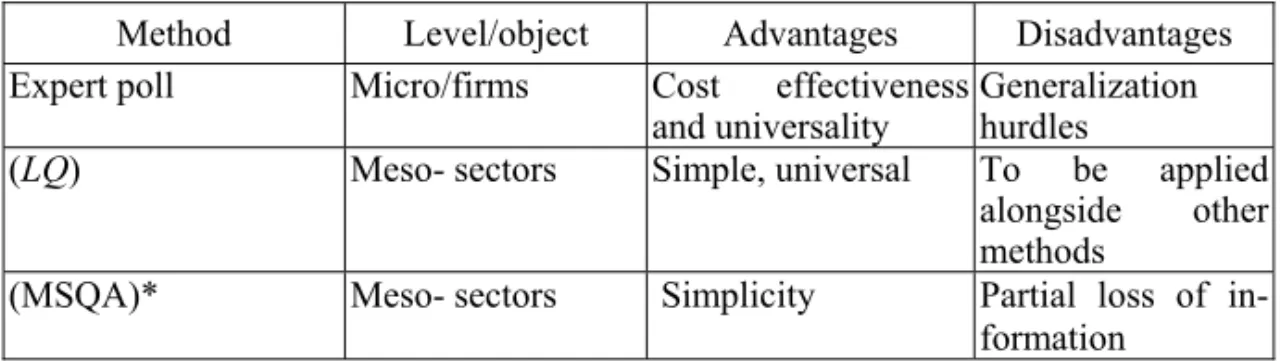
Local production systems "suspected" of belonging to clusters are usu-ally selected on the basis of the analysis of the above normal employment by the sector, as well as the correlation between sectors, based on MPS. Since the scope of this article does not allow us to consider the diversity of meth-ods for the identification of clusters, here in Table 4 we present only the general approaches, each consisting of many individual techniques and com-binations. Some of them may partially solve the fundamental problem of tak-ing into account the barely formalizable and measurable parameters, but so far they have not been applied to Russian economy (probably due to the lack of a reliable MRD base).
Table 4 Methodological approaches to cluster identification
Method Level/object Advantages Disadvantages
Expert poll Micro/firms Cost effectiveness and universality
Generalization hurdles
(LQ) Meso- sectors Simple, universal To be applied alongside other methods
(MSQA)* Meso- sectors Simplicity Partial loss of in-formation
14
End of table 4
Method Level/object Advantages Disadvantages
IO on material flows Meso- sectors Main source of detai-led data
Dated data; preset choice of sectors (IO) on tangible flows Meso- or
micro-sectors or firms
Theoretical justifica-tion
High requirements to data
Graph theory / network analysis (NA)
Meso or micro-sec-tors or firms
Visualisation Abstraction
(Q-analysis)* Meso or micro-sec-tors or firms
Universality and user-friendly analysis
Partial loss of in-formation (MAS)* Micro-firms Control over
comple-xity
High level of ab-straction
Fuzzy clusters* Meso-sectors Flexibility; concep-tual justification
Problems with data selection
Special examination Meso or micro-sec-tors or firms
Flexibility, pragma-tism
Expensiveness; re- source-intensive-ness
* Correlation-regres-sive analysis
Meso or micro-sec-tors or firms
Universality; variety of modifications
Problems with gen-eralizations; faulty connections
Obviously, Porter was familiar with the literature, in which clusters and complexes were analysed at the industry level; therefore he chose the con-cept of cluster reflecting the phenomenon of geographical concentration of the most successful companies in the framework of the "diamond of na-tional competitive advantage."
Conceptually, Porter's take on clusters has two main distinctive fea-tures: first, clusters, although considered at the industry level, are, in fact, disaggregated to the level of firms and organizations, and secondly, in spite of being tools for national competitiveness, clusters are localized on the regional level (actually, confined to the area covered by several nearby ag-glomerations). The presence of an oligopolistic structure serves as prereq-uisite for this analysis, the central focus on the competitiveness of inter-company cluster chains being its result. This approach corresponds well with the level of regional policy, which allowed Porter and his followers to deploy the "Harvard" project on clusters and competitiveness. The en-hanced vagueness of the concept of cluster, for which it is subjected to crit-icism in scholarly literature, is, however, the downside of the otherwise popular Harvard approach15. This is not surprising, since Porter's
15
tual course went contrary to the rather long tradition of quantitative analy-sis of complexes and clusters based on the MPS, but met the needs of poli-titians.
In response to the criticism on the lack of quantitative methods and abuse of fuzzy concepts, Porter developed a method for the quantitative identification of clusters in several stages. According to Porter, regional economies are comprised of three types of sectors (Table 5). He draws a boundary between clusters and other types of meso-economic systems as follows [37].
Table 5 M. Porter's classification of economic sectors
(proportions for the U.S., 1996)
Sector type Indicator
raded Resource-driven Local Number of SIC industries
Including producing ones 590 241 48
Commodities 441 7 37
Services 149 234 11
Share of Employment in Private
Sector,% 31,8 67,4 0,8
Patents per 10,000 Employees 21,1 1,3 7,0
Inspired by: [37, p. 559—560].
According to Porter, clusters differ from the model of global outsourcing and vertical integration. Obviously, Porter recommends focusing on the seg-ment of tradable (export) goods, within which traded clusters are formed, since they are the drivers of growth, productivity and innovation.
Harvard-style cluster analysis is most common on micro-level and, as a rule, is formalized in case studies. This method of accumulating empirical evidence apparently inherits all the weaknesses of phenomenological ap-proach; it is not immune to mistakes of types I and II; however, against the background of initial vagueness of the theory, it is consistent with the practi-cal needs of the regional policy.
Here again we are faced with a typical trap in cluster studies — the gap between the conceptual framework of clusters on micro- and macro levels and quantitative methods of their identification on meso- and macro-levels. Quantitative methods are chiefly based on the correlational analysis of "input — output" tables and the subsequent data processing with the use of statistical factor analysis.
Institutional variables of clustering
has been shown in [17], the variables can influence each other both posi-tively and negaposi-tively (Table 6). It is the negative correlations that are signifi-cantly underestimated (it is noteworthy that the exclusion of institutions from the analysis reduces the number of possible combinations) [6].
Table 6
Factors of clustering
Projection
of Cluster Localization Technology Institutions
Localization — — Technology + —
Institutions + +
Note: this matrix is formed of two symmetrical matrices.
Table 7 shows the possible interpretation of the institutional factor. In our opinion, in a dense network of institutional levels, there are configura-tions confirming the possibility of cluster formation in our interpretation.
Table 7
Conditions for Cluster Formation from the Institutional Point of View
Level
of institution Institution type
Characterization of the environment for innovative
cluster formation Collective perceptions of
tech-nological level of the nation and quality of its resources
Agents believe that their products, or-ganizations and themselves could be best in the world
Meta- institutions
State of empathy in society: agents' stereotypes and poli-cies towards each other
A high empathy level stimulating cooperative behavior
Formalized na-tional institutions
Legislation protects property rights
Highly developed legislation, law-enforcement practice and judicial defence
Non-formalized national instituti-ons
Division of power and prop-erty; level of corruption
Moderate corruption level in the context of historical specificity and evolution of market relations Formalized local
institutions
Specific stimulating legisla-tion and regional state-gua-ranteed order
Risk of stimuli distortion (possible at early stages)
Non-formalized local institutions
Level of trust and mutual ex-change of specific knowledge
Level of trust sufficient for mutual exchange of specific innovation-stimulating knowledge
Locally specific in-stitutions
In our classification, meta-institutions reflect the influence of old institu-tional traditions and relate to cultural studies (least formalizable) variables.
The concept of "formalizability" of institutions shows the ability of agents at least to roughly assess the balance of costs and benefits from the use of this institution. As a rule, the agents have an adequate understanding of the direct action law (especially when it comes to precise quantitative cri-teria of encumbrance and sanctions). It is more difficult to determine the im-pact of formalized rules (for example, in respect of corruption rent when ne-cessary resources are allocated), as results from a higher level of uncertainty. There exists quite an extensive literature devoted to the study of internal, locally specific institutions that form within clusters. Among the institutional variables of local cluster development the concepts of cooperation and
partnership [trust] [34, p. 291] are most recurrent. It is the presence of such
locally specific institutions that, in our view, makes it possible to correctly identify the cluster in agreement with the suggested definition. Examples of such institutions could be found in the forms of trust in contractual relations between firms, local business reputation, vision of professional standards, the collective perception of the role of authorities and other organizations [6].
The proposed scheme suggests that the localized meso-economic sys-tems evolutionize from simple agglomeration to innovation clusters with cross-border participation. Favourable state and institutional metainstitutions and those of national level provide conditions for their formation. Moreover, for simple agglomerations institutional and technological dimensions are usually not crucial (for business networks, it is localization that is not a mat-ter of principle) If the conditions are met, the presence of a clusmat-ter can be confirmed by the presence of locally-specific institutions.
In general, "“Thus, it is implied that the understanding of institutions, which at present revolves to a large extent around single-typed and single-level units, needs to be developed further towards multi-level and multi-unit phenomena” (Emphasis added — T.G.) [39, p. 5].
Instead of a conclusion
In the context of cluster studies two major positive tasks come forth: the identification and modelling of clusters. Normative-wise, there is a twofold challenge: promotion and formation of clusters.
At its present stage, the theory’s attempts of modelling lead to the emas-culation of essentially "fuzzy" definition of cluster. In our view, this issue is related to the difficulty of formalization of institutions which earmark clus-ters among other types of local economies16. Available models, as a rule, can
16
identify technological forms of exchange on the basis of aggregate data (sometimes intangible), and estimate the localization coefficients; however, they are ineffectual in the analysis of aggregate institutionalized factors.
The traditional approach to the understanding of clusters is based on the theory of competitiveness and the national level of aggregation of economic data. Most of the acknowledged cluster typologies have been elaborated for developed capitalist economies (of liberal, socio-corporate or corporate-paternalistic type) [5, p. 101—102].
That entails the question whether the complexity of economic, social an institutional factors and processes that explain the dynamics of clusters can be reduced to the concept of competitiveness. [32, p. 14]
The purpose of developing the theory and methodology of cluster identi-fication consists in introducing an institutional dimension to the geographic and technological approaches in the cluster characterization [6].
The basic hypothesis is that not every social and economic system allows the creation of mesa-economic systems that meet the accepted definition of the cluster. The strong assertion is that the main feature of cluster formation is the presence of locally specific institutionsformed by the clusters.
This approach, in our view, can, on the one hand, explain the possibility of cross-border clusters, (Medicon Valley, for example); on the other hand, it makes it clear why there is no qualitative cluster formation in transitive post-Soviet economies and accounts for the role of transnational corporations in the development of clusters.
References
1. Gareev, T. R. 2007, «Voshodjawie» modeli regional'nogo razvitija, lokal'nye proizvodstvennye sistemy i razvitie malogo i srednego biznesa [«Rising» model of regional development, local production systems and development of small and me-dium businesses]. In: Kaliningradskaja oblast': na puti k regional'nym programmam MBA/MPA [Kaliningrad region: towards regional programs MBA / MPA], Kalinin-grad, Izd-vo RGU im. I. Kanta, p. 76—113.
2. Gareev, T. R. 2010, Instituty i jekonomicheskoe razvitie na subregional'nom (mezo-) urovne [Institutions and economic development at the subregional (meso) level], Obwestvennye nauki i sovremennost' [Social Sciences and the present], no. 5, p. 45—58.
3. Gareev, T. R. 2010, Regional'nyj institucionalizm: terra incognita ili terra fic-ta? [Regional institutionalism: terra incognita or terra ficfic-ta? Journal of Institutional Studies, Vol. 2, no. 2, p. 27—37.
4. Kutsenko, E. S. 2009, Klastery v jekonomike: praktika vyjavlenija. Obob-wenie zarubezhnogo opyta [Clusters in the economy: the practice of identification. Generalization of international experience], Obozrevatel' — Observer, no. 10 (237), p. 109—126.
5. Levin, S. N. 2007, Formirovanie konstitucionnyh pravil v jekonomike Rossii [The formation of the constitutional rules in the Russian economy], Kemerovo, Kuzbassvuzizdat.
7. Markov, L. S., Yagolnitser, M. A. 2008, Mezojekonomicheskie sistemy: problemy tipologii [Mesoeconomic system: problems of typology], Region: jeko-nomika i sociologija [Region: Economics and Sociology], no. 1, p. 18―44.
8. Mezojekonomika razvitija [Mezoekonomika development], 2011, CJeMI RAN, Moscow, Nauka.
9. Pilipenko, I. V. 2011, Klastery i territorial'no-proizvodstvennye kompleksy v regional'nom razvitii, Regional'noe razvitie i regional'naja politika Rossii v pere-hodnyj period [Clusters and territorial-industrial complexes in regional develop-ment, regional development and regional policy in Russia during the transition pe-riod], Moscow, Izd-vo MGTU im. N. Je. Baumana, p. 191―208.
10. Pilipenko, I. V. 2004, Principial'nye razlichija v koncepcii promyshlennyh klasterov i territorial'no-proizvodstvennyh kompleksov [The principal differences in the concept of industrial clusters and territorial production complexes], Vestnik Moskovskogo Universiteta. Ser. 5, Geografija [Moscow University Geography Bul-letin], no. 5, p. 3―9.
11. Porter, M. 2006, Konkurentnye preimuwestva stran [The competitive advan-tages of countries]. In: Vehi jekonomicheskoj mysli, T. 6, Mezhdunarodnaja jeko-nomika [Landmarks of Economic Thought, T. 6, International Economics], Moscow, TEIS, p. 549—581.
12. Porter, M. 2003, Konkurencija [ ompetition], Moscow, Izdatel'skij dom «Vil'jams».
13. Shastitko, A. Ye. 2009, Clusters as a Form of Spatial Organisation of Eco-nomic Activity: Theory and Practical Observations, Baltic Region, no. 2, p. 7—25. doi: 10.5922/2079-8555-2009-2-2.
14. Bergman, E., Feser, E. 1999, Industrial and Regional Clusters: Concepts and Comparative Applications, Morgantown, Regional Research Institute, West Vir-ginia University.
15. Berry, B. 1964, Approaches to regional analysis: A synthesis, Annals of the Association of American Geographers, no. 54, p. 2―11.
16. Brachert, M., Titze, M., Kubis, A. 2011, Identifying industrial clusters from a multidimensional perspective: Methodical aspects with an application to Germany, Papers in Regional Science, Vol. 90, no. 2, p. 419―439.
17. Boschma, R. 2005, Proximity and Innovation: A Critical Assessment, Re-gional Studies, Vol. 39 (1), p. 61―74.
18. Potter J., Miranda, G. (ed). 2009, Clusters, Innovation and Entrepreneurship, OECD.
19. Czamanski, S., Ablas, L. 1979, Identification of Industrial Clusters and Com-plexes: a Comparison of Methods and Findings, Urban Studies, no. 16, p. 61—80.
20. Diaz, B., Moniche, L., Morillas, A. 2006, A Fuzzy Clustering Approach to the Key Sectors of the Spanish Economy, Economic Systems Research, Vol. 18, no. 3, p. 299—318.
21. Diaz, B., Morillas, A. 2008, Robust Statistics and Fuzzy Industrial Clustering. In: Forging the New Frontiers: Fuzzy Pioneers II, Springer-Verlag, p. 219 —236.
22. Dridi, Ch., Hewings, G. 2003, Sectors associations and similarities in input-output systems: An application of dual scaling and fuzzy logic to Canada and the United States, The Annals of Regional Science, no. 37, p. 629―656.
23. Enright, M. 2000, Regional clusters and multinational enterprises: Inde-pendence, dependence or interdependence? International Studies of Management and Organization, no. 30(2), p. 114—138.
25. Feser, E., Renski, H., Goldstein, H. 2008, Clusters and Economic Develop-ment Outcomes: An Analysis of the Link between Clustering and Industry Growth, Economic Development Quarterly, no. 22, p. 324―344.
26. Iammarino, S., McCann, Ph. 2006, The structure and evolution of industrial clusters: Transactions, technology and knowledge spillovers, Research Policy, Vol. 35 (7), p. 1018―1036.
27. Lagendijk, A. 2003, Towards Conceptual Quality in Regional Studies: The Need for Subtle Critique — A Response to Markusen, Regional Studies, Vol. 37 (6—7), p. 719—727.
28. Manning, S. 2008, Customizing Clusters: On the Role of Western Multina-tional Corporations in the Formation of Science and Engineering Clusters in Emer-ging Economies, Economic Development Quarterly,Vol. 2, no. 4, p. 316—323.
29. Markusen, A. 1999, Fuzzy concepts, scanty evidence, policy distance: the case for rigour and policy relevance in critical regional studies, Regional Studies, no. 33(9), p. 869—884.
30. Markusen, A. 1996, Sticky places in slippery space: a typology of industrial districts, Economic Geography,Vol. 72 (3), p. 293―313.
31. Martin, P., Mayer, T., Mayneris, F. 2011, Public support to clusters: a firm level study of French «Local Productive Systems», Regional Science and Urban Economics, no. 41, p. 108—123.
32. Martin, R., Sunley, P. 2003, Deconstructing clusters: chaotic concepts or policy panacea? Journal of Economic Geography, no. 3, p. 5—35.
33. Morillas, A., Robles, L., Diaz, B. 2011, I-O coefficients importance: a fuzzy logic approach, International Journal of Uncertainty, Fuzziness and Knowledge-Ba-sed Systems,Vol. 19, no. 6, p. 1013−1031.
34. Moulaert, F., Sekia, F. 2003,Territorial innovation models: a critical survey, Regional Studies, Vol. 37(3), p. 289—302.
35. Oksanen, E., Williams, J. 1992, An Alternative Factor-analytic Approach to Aggregation of Input—Output Tables, Econiomic Systems Research, no. 4(3), p. 245―256.
36. Pickernell, D., Rowe, P., Christie, M., Brooksbank, D. 2007, Developing a Framework for Network and Cluster Identification for Use in Economic Develop-ment Policy-Making, Entrepreneurship and Regional Development, no. 19, p. 339―358.
37. Porter, M. 2003, The Economic Performance of Regions, Regional Studies, Vol. 37, no. 6—7, p. 549—578.
38. Rugman, A., Verbeke, A. 2003, Multinational Enterprises and Clusters: An Organizing Framework, MIR: Management International Review,Vol. 43, no. 3, p. 151―169.
39. Schenk, K.-E. 2003, Economic institutions and complexity: structures, inte-ractions, and emergent Properties, Edward Elgar Publishing Limited.
40. Sonis, M., Hewings, J., Guo, D. 2008, Industrial clusters in the input—out-put economic system. In: Handbook of Research on Cluster Theory, Edward Elgar, p. 153―168.
41. Steiner, M., Hartmann, C. 2006, Organizational learning in clusters: A case study on material and immaterial dimensions of cooperation, Regional Studies, Vol. 40, p. 493―506.
43. Titze, M., Brachert, M., Kubis, A. 2011, The Identification of Regional In-dustrial Clusters Using Qualitative Input—Output Analysis (QIOA), Regional Stud-ies, Vol. 45, no. 1, p. 89―102.
44. Vishvanath, A., Chen, H. 2006, Technology Clusters: Using Multidimen-sional Scaling to Evaluate and Structure Technology Clusters, Journal Of The Ame-rican Society For Information Science And Technology, no. 57(11), p. 1451―1460.
45. Yang, G., Stough, R., Haynes, K. 2008, Spatial and functional clustering: a comparative analysis of the Baltimore and Washington DC metropolitan regions in the US. In: Handbook of Research on Innovation and Clusters: Cases and Policies, Edward Elgar, p. 343―358.
About the author
Dr Timur R. Gareev, Head of the Department of Economics of the Firm and Markets, Vice-Rector for Innovation Development, Immanuel Kant Baltic Federal University.
![Fig. 2. Cluster types viewed through the participation of TNCs [38]](https://thumb-eu.123doks.com/thumbv2/123dok_br/18146674.327088/10.892.191.701.134.428/fig-cluster-types-viewed-participation-tncs.webp)
![Fig. 3. Territorial Innovative Models (TIM) [27, p. 722]](https://thumb-eu.123doks.com/thumbv2/123dok_br/18146674.327088/11.1263.168.1098.115.656/fig-territorial-innovative-models-tim-p.webp)
![Table 3 Proximity forms, acc. to R. Bomche [17, р. 71]](https://thumb-eu.123doks.com/thumbv2/123dok_br/18146674.327088/12.892.135.765.568.895/table-proximity-forms-acc-r-bomche-р.webp)