RESEARCH ARTICLE
Mass Extinction and the Disappearance of
Unknown Mammal Species: Scenario and
Perspectives of a Biodiversity Hotspot
’
s
Hotspot
Antonio Rossano Mendes Pontes1¤
*, Antonio Carlos Mariz Beltrão1, Iran
Campello Normande2, Alexandre de Jesus Rodrigues Malta3, Antonio Paulo da Silva Júnior4, André Maurício Melo Santos5
1Universidade Federal de Pernambuco, Centro de Ciências Biológicas, Departamento de Zoologia, R. Prof.
Moraes Rego, 1235, Cidade Universitária, Recife, Pernambuco—PE, Brazil,2Instituto Chico Mendes de Conservação da Biodiversidade—ICMBio, Estrada do Forte Orange, S/N, Caixa-postal: 01, Itamaraca,
Pernambuco—PE, Brazil,3Universidade Federal de Pernambuco, Centro de Ciências Biológicas,
Departamento de Zoologia, R. Prof. Moraes Rego, 1235, Cidade Universitária, Recife, Pernambuco—PE,
Brazil,4Instituto Tecnológico do Estado de Pernambuco–ITEP, Avenida Professor Luiz Freire, 500—
Cidade Universitária, Recife, Pernambuco—PE, Brazil,5Universidade Federal de Pernambuco, Núcleo de Biologia–Centro Acadêmico de Vitória, UFPE. Rua do Alto do Reservatório, S/N, Bela Vista, Vitória de Santo
Antão, PE, Brazil
¤ Current address: Instituto Nacional de Pesquisas da Amazônia—INPA, Núcleo de Pesquisas de Roraima,
Rua Coronel Pinto, 315, Centro, Boa Vista, Roraima—RR, Brazil *[email protected]
Abstract
We aimed to determine the conservation status of medium- and large-sized mammals and evaluate the impact of 500 years of forest fragmentation on this group of animals in the Per-nambuco Endemism Center, in the biogeographical zone of the Atlantic forest north of the São Francisco River in northeastern Brazil. Line transect surveys were performed in 21
for-est fragments, resulting in a checklist of the mammals of the entire Pernambuco Endemism Center area. We ran a generalized linear model (Factorial ANCOVA) to analyze to what extent the vegetation type, fragment area, isolation, sampling effort (as total kilometers walked), or higher-order interactions predicted (a) richness and (b) sighting rates. To deter-mine if the distribution of the species within the forest fragments exhibited a nested pattern, we used the NODF metric. Subsequently, we performed a Binomial Logistic Regression to predict the probability of encountering each species according to fragment size. Out of 38 medium- and large-sized mammal species formerly occurring in the study area, only 53.8% (n = 21) were sighted. No fragment hosted the entire remaining mammal community, and only four species (19%) occurred in very small fragments (73.3% of the remaining forest fragments, with a mean size of 2.8 ha). The mammalian community was highly simplified, with all large mammals being regionally extinct. Neither the species richness nor sighting rate was controlled by the vegetation type, the area of the forest fragments, isolation or any higher-order interaction. Although a highly significant nested subset pattern was detected, it was not related to the ranking of the area of forest fragments or isolation. The probability of
PLOS ONE | DOI:10.1371/journal.pone.0150887 May 18, 2016 1 / 26
OPEN ACCESS
Citation:Mendes Pontes AR, Beltrão ACM, Normande IC, Malta AdJR, Silva Júnior APd, Santos AMM (2016) Mass Extinction and the Disappearance of Unknown Mammal Species: Scenario and Perspectives of a Biodiversity Hotspot’s Hotspot. PLoS ONE 11(5): e0150887. doi:10.1371/journal. pone.0150887
Editor:Govindhaswamy Umapathy, Centre for Cellular and Molecular Biology, INDIA
Received:August 21, 2015
Accepted:February 19, 2016
Published:May 18, 2016
Copyright:© 2016 Mendes Pontes et al. This is an open access article distributed under the terms of the Creative Commons Attribution License, which permits unrestricted use, distribution, and reproduction in any medium, provided the original author and source are credited.
Data Availability Statement:All relevant data are within the paper and its Supporting Information.
the occurrence of a mammal species in a given forest patch varied unpredictably, and the probability of detecting larger species was even observed to decrease with increasing patch size. In an ongoing process of mass extinction, half of the studied mammals have gone extinct. The remaining medium-sized mammal community is highly simplified and homoge-nized. The persistence of these species in a forest patch is determined by their ability to adapt to a novel simplified diet, the efficient use of the surrounding matrix without being engulfed by the sink effect, and escaping hunting. Our results suggest that the 21stcentury
medium-sized mammalian fauna of this region will comprise only four species unless strict conservation measures are implemented immediately and every forest fragment is effec-tively protected.
Introduction
The biodiversity crisis that threatens the planet can be considered the sixth major extinction event [1], and tropical forest deforestation is causing extinctions at unprecedented rates [2,3]. The biota of the future, or the subset of species that will remain after extinction-debts have played out, therefore, has already established itself in several areas of the world [4,5], presenting considerably simplified communities whose future is not assured.
Mammal species respond in different ways to fragmentation. Generalists are favored by the absence of larger predators and by their ability to exploit alternative resources [6,7,8,9,10]. In contrast, large predators, which require extensive home ranges, and have fewer individuals, are the first to disappear [11,12,13,14]. Additionally, fragmentation leads to the imminent risk of the sink effect [15], in which individuals try to cross the open matrix in search of suitable habi-tats, and are killed, which drives the remaining species to extinction. The number of species will therefore decline, reaching a new, less diverse state ([16,17]).
The Brazilian Atlantic forest is considered one of the most important biodiversity hotspots on the planet [18]. Within this forest, one of the important biogeographical regions is the Per-nambuco Endemism Center (herein, CEPE). Located in northeastern Brazil north of the São Francisco river [19,20,21,22], the CEPE hosts a high number of endemic species, suggesting that it is a hotspot within a hotspot, i.e., the Pernambucorefugium[23,24].
Unfortunately, the CEPE has lost 94.4% of its forest cover [25,26] (this study), no longer has a large continuous forest, and most of its fragments are smaller than 10 ha [27], isolated in a non-forested matrix and exposed to severe human pressure [27,28,29]. A scenario inadequate to support the current mammalian fauna [30,7].
The CEPE biota have a comparatively longer history of human exploitation [7,31], which began earlier than the colonization process, as stated by Gandavo in 1575 and by Salvador in 1627, but it appears to have been intensified by the arrival of the first colonizers who were recorded exchanging goods for animals [32,33]. This long-term exploitation has resulted in a mass extinction without precedent in modern history [3,14,34,35], and the“living dead” spe-cies [15] that have persisted have suffered dramatic changes in their ecology and behavior [27,29,30,36,37,38].
As shown by Lees and Pimm [39] species are being lost in the Atlantic forest of northeastern Brazil soon after they are described, and in some cases, even before they were described, being known only from paintings from the first colonizers or oral testimonies. As they highlight, these species are presumed to go extinct quickly, unless extraordinary efforts are made to save them.
Mammal Mass Extinction in a Hotspot´s Hotspot
PLOS ONE | DOI:10.1371/journal.pone.0150887 May 18, 2016 2 / 26
In order to confirm the occurrence of those mammals referred in the old literature as once occurring in the CEPE we decided to build a checklist of the medium- and large-sized mam-mals. Thus, between 2000 and 2008 we carried out a thorough review of the literature on the occurrence of these mammals in the region, using sources reaching back to the start of the colo-nization process in the 1500s. This provided unprecedented access to the first and only records of many medium- and large-sized mammals from the CEPE, some of which are currently extinct, and some others that have never been seen by contemporary scientists
[32,33,40,41,42,43,44].
We also thoroughly surveyed 21 forest fragments from sites widely distributed within the highly fragmented landscape of the CEPE. These covered a range of sizes from 4 to 3,478.3 ha (the latter being the largest of the CEPE), and determined mammal species richness and abun-dance in each [8,10,14,35,45,46,47]. During these surveys we discovered the dwarf porcupine, Coendou speratus[48].
We found that the occurrence of some of the mammals referred in the old, previously unknown literature from the 16thand 17thcentury, and still considered widespread in the CEPE, have, in fact, not been validated by contemporary scientists (e.g. spotted paca,Cuniculus paca); were recognized as occurring in the CEPE only in the turn of the 21st century (e.g. tayra, Eira barbara), when they had already gone regionally extinct (e.g. bush dog,Speothos venati-cus), or were never seen, such as a rufous long-tailed spider monkey (Atelessp.) referred by Barlaeus in 1647 [42], a total novel contribution of this study to contemporary science.
Additionally, no fragment held the entire mammal community expected, most fragments had less than half of the mammals and no large mammals were found, namely, deer (Mazama spp.), white-lipped peccary (Tayassu pecari), jaguar (Panthera onca), puma (Puma concolor), Brazilian tapir (Tapirus terrestris), and giant anteater, (Myrmecophaga tridactyla), revealing an ongoing unprecedented mass extinction in the CEPE [8,10,14,35,45,46,47]. Our novel, unprec-edented findings [35] were recently confirmed by Canale et al. [49], who interviewed local resi-dents living in the vicinity of forest fragments of the nearby Bahia Endemism Center (herein, CEBA), another important hotspot within the Atlantic forest of northeastern Brazil. Again, interviewees had never seen jaguar (Panthera onca), giant anteater (Myrmecophaga tridactyla), white-lipped peccary (Tayassu pecari), and Brazilian tapir (Tapirus terrestris), reinforcing our unprecedented findings.
Thus, in order to test the hypothesis that it was the case of the entire remaining ~50 km2of this hotspot´s hotspot, we compiled the two decades of systematic surveys that we had carried out in the various different landscapes of the CEPE [35], and aimed to answer the following questions: (1) Is the current number of species of medium- and large-sized mammals in the CEPE significantly reduced in comparison with that recorded by the first colonizers?; (2) To what extent do the vegetation type, fragment area, fragment isolation or any interactions among these factors predict the species richness and abundance of medium- and large-sized mammals in this severely fragmented area?; (3) Are the medium- and large-sized mammal spe-cies assemblages subsets of successively larger ones as a consequence of the ongoing selective extinction and isolation process [50,51]?; (4) How does each mammal species respond to varia-tions in fragment size in terms of its probability of encounter?
Materials and Methods
Study area
This study was part of a larger research project, entitled: Biological Diversity and Conservation of the Atlantic Forest North of the São Francisco River, financed by the Probiota program (PROBIO), of the National Research Council (CNPq), of the Ministry of Environment
Mammal Mass Extinction in a Hotspot´s Hotspot
(MMA), with which the project coordinator signed the agreement that allowed us to carry out the surveys. No licences were required to this specific study, or subproject, since we only observed the animals along pre-established trails and did not influence or interact with them in any invasive way (e.g. trapping, collecting, experimental manipulation, or sacrificing). Thus, we were allowed to carry out our observational field studies in all the areas, independently from its status, as part of the larger research team.
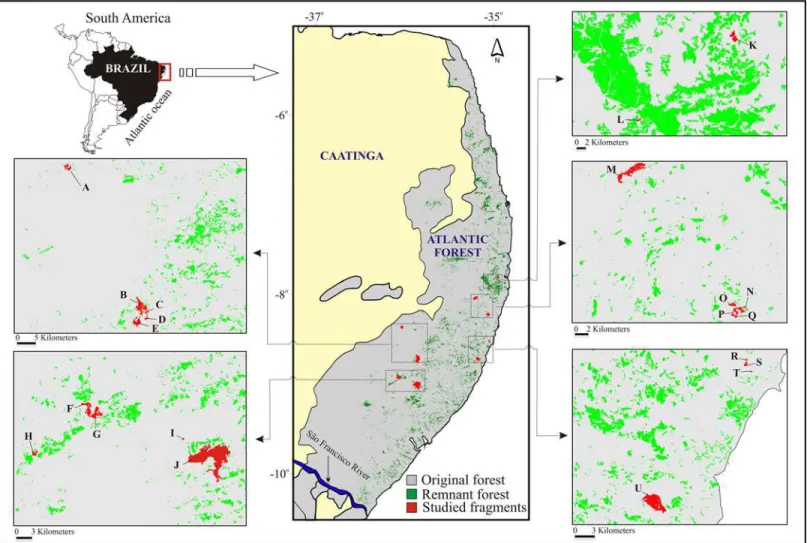
The study was carried out between 2000 and 2008 in 21 forest fragments within the CEPE (Fig 1). The fragments were classified as very small (10 ha), small (10.1–100 ha), medium-sized (100.1–1,000 ha), or large (>1,000 ha; the largest is only 3,478.3 ha). The forest fragments were located in four of the best-protected forest archipelagos of the CEPE: the Gurjaú Ecologi-cal Reserve (1,077.10 ha), Usina Frei Caneca Mill (630.42 ha), Usina Serra Grande Mill (8,000 ha), and Usina Salgado Mill (1,000 ha) (Fig 1). We also studied three other officially protected
Fig 1. The study area in the Atlantic forest of northeastern Brazil, specifically, the Pernambuco Endemism Center–CEPE, showing its current and
former forested area and the studied forest fragments (due to some fragments being too small, they do not appear individually) (Spatial database provided by Fundanção SOS Mata Atlântica / INPE, under a CC BY license).A—Brejo dos Cavalos (08°22'48"S; 36°02'24"W); B—Quengo (08°43'04"S;
35°50'27"W); C—Espelho (08°43'12"S; 35°50'40"W); D—Ageró (08°44'16"S; 35°50'33"W); E—Fervedouro (08°45'08"S; 35°51'36"W); F—Capoeirão (08°
55'1"S; 36°04'17"W); G—Cachoeira (08°56'44"S; 36°03'36"W); H—Bom Jesus (09°01'16"S; 36°10'32"W); I—Aquidabã(08°58'53"S; 35°54'25"W); J—
Coimbra (08°59'42"W; 35°50'27‴S); K—Charles Darwin (07°48'56"S; 34°57'11"W); L—Vale das Águas (7°54'49"S; 35°3'25,4"W); M—Tapacurá (08° 03'00"S; 34°55'00"W); N—Café (08°14'12"S; 35°02'60"W); O—São Braz (08°13'28"S; 35°04'03"W); P—Cuxiu (08°13'38"S; 35°03'45"W); Q—Xangô (08°
14'23"S; 35°03'56"W); R—Mingú (08°31'02"S; 35°03'15"W); S—Gengibre (08°31'33"S; 35°03'16"W); T—Bulandi (08°32'10"S; 35°02'50"W); U—Saltinho
(08°45'00"S; 35°10'00"W).
doi:10.1371/journal.pone.0150887.g001
Mammal Mass Extinction in a Hotspot´s Hotspot
areas: the Brejo dos Cavalos Ecological Park (354 ha), Tapacurá Ecological Station (382 ha), and Saltinho Biological Reserve (548 ha).
Additionally, two non-protected urban forest fragments in the cities of Camaragibe (8 ha) and Igarassu (60 ha) were included in the analyses (Fig 1). Finally, we opportunistically recorded all sightings in the surrounding matrix or open areas, which were used in producing the checklist of occurring species.
The investigated forest fragments measured from a minimum of 4 to a maximum of 3,478.3 ha. Following the classification of Oliveira & Fontes [52], these occurred in the following habi-tat types: lowland evergreen forest (n = 11), submontane semi-deciduous forest (n = 7), sub-montane evergreen forest (n = 2), or low subsub-montane semi-deciduous forest (n = 1) (Fig 1). There is no continuous forest or control fragment, and all of the fragments have experienced some degree of human interference, such as hunting, the presence of feral dogs, forest clearing, selective cutting, or intentional fires, in addition to being bisected by roads used by people and domestic animals.
We calculated the total number of forest fragments for each size class in the entire remain-ing CEPE usremain-ing ArcGis 9.2 software from supervised classifications of LANDSAT 3 and 4 (dated between 1973 and 1979) and 5 and 7 (dated between 2001 and 2007) satellite images (Instituto Nacional de Pesquisas Espaciais—INPE), selected for least cloud cover. Lastly, we created a 1,000 m buffer around each studied fragment to evaluate the degree of isolation, mea-sured as the percentage of area covered by other fragments present within that buffer.
Former mammalian community of the CEPE
Using past and present literature [10,32,33,40,41,42,43,44,53,54,55], we built a checklist of the medium- and large-sized mammalian species that, unless human action had caused their extir-pation, could be expected to be found in the CEPE. The current conservation status of extant and known species is according to the Brazilian List of Threatened Species [56] and IUCN Red List [57].
Line transect surveys and additional methods
Surveys of medium-sized (5 kg, excluding mice and marsupials) and large (>5 kg) mammals were carried out between January 2000 and January 2008 using the line transect method [58] throughout the entire year but only on sunny days (e.g., if it rained during a survey, the results were discarded). A single 1-m wide transect was arbitrarily cut in each fragment, measuring between 150 and 4,000 m in length, depending on the size and shape of the fragment as well as accessibility. Diurnal walks were carried out between 5:00 and 17:00 h at a speed of 1 km/h, with nocturnal surveys performed between 18:00 and 23:00 h, following Mendes Pontes [59]. Sample size depended on the size and shape of the fragments.
For each sighting of an individual or group, we recorded all of the standard information necessary for the calculation of abundance indexes [58,60], but due to the limited number of sightings, we could not calculate group or individual densities. We therefore used sighting rates [7,8,14]. Additionally, we estimated group size and the total kilometers walked each day. We classified the species according to their occurrence in specific sizes of forest fragments as fol-lows: (1) rare, when species occurred in only one fragment size class; (2) occasional, when found in two or three fragment size classes; or (3) common, when found in more than three size classes. We considered a species to be extinct in a forest fragment when we did not detected it during the systematic surveys or in occasional encounters because the fragments are so small, isolated, lacking in food, simplified, and secondarized [22,29,61] that it was almost impossible
Mammal Mass Extinction in a Hotspot´s Hotspot
that the species remained undetected in the fragment. Reinforcing our findings, no new species was added to the checklist based on spoor or dung.
Data Analysis
We used a one-way Chi-Square Goodness of Fit statistic to test the hypothesis that the current number of species of medium-sized mammals in the CEPE is significantly lower than that reg-istered prior to Brazilian colonization. Subsequently, we ran a Generalized Linear Model (GLZ) to analyze to what extent the vegetation type, fragment area, fragment isolation (as the percent-age of forest cover in a 1,000 m buffered area), and sampling effort (as total kilometers walked), or higher-order interactions predicted the response variables (a) richness and (b) sighting rates. Explicitly considering forest type as a categorical independent variable (factor) and three continuous predictor variables as covariates (area, isolation and effort), we also employed a Linear Analysis of Covariance Model (ANCOVA). Specifically, we used a factorial ANCOVA, as we included three two-way interactions and one three-way interaction in the model [62]. The continuous covariate effort was added to the model as a weight variable only to control for response variables. We excluded the submontane evergreen and low montane semi-deciduous forest types from the GLZ analysis because of small sample size (two and one forest fragments, respectively).
Before running the models, we performed Kolmogorov-Smirnov tests to check which theo-retical distribution best fit our response variables (richness and sighting rates). Richness showed a distribution that was far from a normal distribution, even after several transforma-tion attempts, but which fitted well to a Poisson distributransforma-tion (Lambda = 3.33; d = 0.297; p<0.10). Thus, we employed a Poisson distribution with a log link-function to run this model, using Pearson’s chi-square as an overdispersion parameter estimate. Sighting rates fit-ted well to a log-normal distribution. Thus, the log-transformed sighting rates exhibifit-ted a nor-mal distribution (d = 0.159; p = ns; Lilliefors p = ns). We then used a nornor-mal distribution with an identity link-function to run the GLZ for the log-transformed sighting rates. After running the models, we performed a residual analysis (raw residual normality and leverage). All GLZ analyses were carried out using IBM SPSS Statistics 19 [63].
We used the NODF nestedness metric [64] to determine whether the actual distribution of the mammalian species within the studied forest fragments exhibited a nested pattern. In a hypothetical perfect nested pattern, the set of species in any forest fragment will be a perfect subset of all of the species that precede it in a hierarchically arranged forest fragment [64]. We used a 21x21 (“fragments”x“mammal species”) presence-absence matrix and generated 1,000 random matrices to contrast the nestedness hypothesis against the null hypothesis that the dis-tribution of the mammals among the forest fragments is stochastic. Because the NODF method is dependent on the arrangement of the matrix [64], we performed three analyses, one using a best-ordered matrix, one ordering the matrix according to the area of the fragment, and another one ordering the matrix according to the isolation of the fragment. Once we were only mainly concerned with the nestedness among fragments, rather than among species or within the entire matrix, we also explicitly reported results of the analysis using only the columns of the matrix. The NODF analysis was performed using ANINHADO software [65].
Finally, we performed a Binomial Logistic Regression [62] to predict the probability of encounter for each species according to fragment size. Because effort was not the same in all fragments we then used the kilometers walked as a weight factor controlling for the different efforts in each fragment. The data used for the above mentioned analysis are inS1 Table.
Mammal Mass Extinction in a Hotspot´s Hotspot
Results
The former and current mammalian fauna richness in the CEPE
The former mammalian community of the CEPE included 43 medium- and large-sized mam-mal species, whereas the current mammam-malian fauna comprised only 51.2% (n = 22) of those species (χ2= 10.2; df = 1; p<0.01) (Table 1), including a new dwarf porcupine,Coendou spera-tus, recently described by the first author [48], as well as those species that went extinct before description or even before being depicted by the first colonizers. Among the total number of species that appeared to be extinct in the CEPE (48.8%; n = 21) since the beginning of coloniza-tion, 41.2% (n = 7) are not referred to either in the ICMBIO list of threatened species [56] or the IUCN Red List [57], while 47% (n = 8) are included in both lists, 5.9% (n = 1) are included only in the IUCN list, and 5.9% (n = 1) only in the ICMBIO list, respectively (Table 1).
Some of these species have been referred to the CEPE in the old literature and paintings of the first colonizers in the 16thand 17thcentury [32,33,40,41,42,43,44], but not by contemporary scientists [53,54,55,56,57], despite the fact that they are currently widespread in the region (e.g. Cuniculus paca) [10] (Fig 2A–2K) (Table 1).
Some other species had not been referred to the CEPE until the turn of the 21thcentury, such asEira barbara,Nasua nasua, andSpeothos venaticus[66,67], although in the case of the latter species, it was already regionally extinct and threatened of extinction in the remainder of their range [56,57] when recognized as occurring in the region (Fig 2A–2K) (Table 1).
All the large-sized mammals are currently extinct in the CEPE, namely white-lipped peccary (Tayassu pecari), jaguar (Panthera onca), puma (Puma concolor), Brazilian tapir (Tapirus ter-restris), and giant ant-eater (Myrmecophaga tridactyla) (Table 1). They were documented and depicted by the first colonizers when they arrived in the Atlantic coast of northeastern Brazil and inferred to occur in the CEPE by contemporary scientists, but went extinct before they could be registered or any specimens collected [10] (Fig 2A–2K). In the case of the deer (Mazamaspp.) their occurrence was never documented by contemporary scientists; they went extinct without being registered.
Gandavo, in 1575 [32], and Salvador, in 1627 [33] also referred to a yellow-olive squirrel monkey (probably aSaimirisp.), and in 1647, Barlaeus [42] referred to a rufous long-tailed spi-der monkey (probably aAtelessp.) as also occurring in the CEPE, but no illustrations or any subsequent records of these species were found for the region. The newly described dwarf por-cupine (Coendou speratus), has already been classified as endangered by the Brazilian authori-ties [56] due to its very restricted distribution, and highly fragmented and declining
population, although it has still not been evaluated by IUCN [57]. Current records of a squirrel monkey (Saimirisp.), from the Saltinho Biological Reserve, are of an introduced Amazonian species, individuals of which were confiscated by the National Environment Office (IBAMA) and accidentally released in the reserve some 30 years ago (Table 1).
No individual fragment hosted the entire remaining mammal community. In the largest fragment, the Coimbra forest, we found the largest number of species (95.2%, n = 20). We observed 14 species in the medium-sized fragments, (66.7%), 9 species (42.8%) in the small fragments, and only 4 (19%) in the very small fragments. The common marmoset (Callithrix jacchus) and the common squirrel (Guerlinguetus alphonsei) were found in all fragment size classes. The common marmoset and 10 other species (52.4% in total) were also found in the open surrounding matrix (Table 2).
Out of 21 species present in the studied fragments (excluding the non-forested matrix), 5 species (23.8%) were rare, occurring in only the single largest forest fragment; 14 species (66.7%) were occasional, occurring in two or three fragment size classes; and only two species (9.5%) were common and were found in all four fragment size classes. Thus, the data suggest
Mammal Mass Extinction in a Hotspot´s Hotspot
Table 1. Former and current mammalian fauna of northeastern Brazil in the Pernambuco Endemism Center (CEPE) and their conservation status. Species ICMBIO (2014) IUCN (2015) Mentioned by
first colonizers from 16th /17th
century only: extinct even before depicted or seen Mentioned / depicted by
first colonizers from 16th/ 17th
century: Extinct before
species confirmed
Mentioned / depicted by
first colonizers from 16th/
17thcentury
Referred as occurring by
scientists from 20th
century based on indirect evidence Referred as occurring by scientists from
20thcentury
based on indirect evidence—
Extinct before species confirmed
Referred as occurring by scientists from 21th
century based on indirect evidence Referred as occurring by scientists from
21thcentury
based on indirect evidence-Extinct before
species confirmed
Referred as occurring by scientists from 20thand
21thcentury
based on direct evidence
Depicted byfirst colonizers from
16th/ 17th
century; Remained unkown to science for ~400
yrs; Re-discovered during this study
Newly described
byfirst author (21th
century)
Artiodactyla Cervidae
Mazamasp. EX BK1
EX BK*1 ✓ ✓ ✓
Mazamasp. EX BK2
EX BK*1 ✓
Tayassuidae
Tayassu pecari VU A2abcde +3abcde VU A2bcde +3bcde ✓ ✓
Pecari tajacu*2 ✓ ✓ ✓
Carnivora Canidae
Cerdocyon thous*3 ✓ ✓ ✓
Speothos venaticus VU C1 NT ✓
Felidae
Leopardus pardalis VU A4c ✓ ✓ ✓
L.tigrinus EN C1 VU A3c ✓ ✓ ✓
L.wiedii VU C1 NT ✓ ✓ ✓
Panthera onca A2bcd +3cd; C1
NT ✓ ✓
Puma concolor VU C1 ✓ ✓ ✓
P.yagouaroundi VU C1 ✓ ✓
Mustelidae
Conepatus semistriatus
✓
Eira barbara*4 ✓
Galictis c.f.
vittata*5 ✓ ✓ ✓
Lontra longicaudis NT ✓
Procyonidae
Nasua nasua*4 ✓
Potosflavus ✓ ✓
Procyon cancrivorus ✓ ✓ ✓ Cingulata Dasypodidae Cabassous unicinctus ✓ ✓ Dasypus novemcinctus ✓ ✓ ✓
D.septemcinctus ✓
Euphractus sexcinctus
✓ ✓ ✓
(Continued)
Table 1. (Continued) Species ICMBIO (2014) IUCN (2015) Mentioned by
first colonizers from 16th /17th
century only: extinct even before depicted or seen Mentioned / depicted by
first colonizers from 16th/ 17th
century: Extinct before
species confirmed
Mentioned / depicted by
first colonizers from 16th/
17thcentury
Referred as occurring by
scientists from 20th
century based on indirect evidence Referred as occurring by scientists from
20thcentury
based on indirect evidence—
Extinct before species confirmed
Referred as occurring by scientists from 21th
century based on indirect evidence Referred as occurring by scientists from
21thcentury
based on indirect evidence-Extinct before
species confirmed
Referred as occurring by scientists from 20thand
21thcentury
based on direct evidence
Depicted byfirst colonizers from
16th/ 17th
century; Remained unkown to science for ~400
yrs; Re-discovered during this study
Newly described
byfirst author (21th
century)
Tolypeutes tricinctus*6
EN A2cd VU
A2cd ✓ ✓
Perissodactyla Tapiridae
Tapirus terrestris VU A2cd +3cd +4cd ✓ ✓ ✓ Pilosa Bradipodidae Bradypus variegatus ✓ ✓ ✓ Cyclopedidae
Cyclopes didactylus ✓ ✓ ✓
Myrmecophagidae
Myrmecophaga tridactyla
VU A2d VU A2c ✓ ✓ ✓
Tamandua tetradactyla
✓ ✓ ✓
Primate Atelidae
Alouatta belzebul*7 ✓ ✓ ✓
Atelessp. EX BK3 EX BK*1 ✓
Callithrichidae
Callithrix jacchus ✓ ✓
Cebidae
Cebus apella*8 ✓ ✓ ✓
Saimirisp. EX BK4 EX BK*1 ✓
Saimiri sciureus Accidentally introduced
Sapajusflavius*9 A2cd; B2ab(ii, iii); C2a(i)
CE C2a
(i) ✓ ✓
Rodentia Cuniculidae
Cuniculusc.f.
paca*3,*10 ✓
Dasyproctidae Dasyprocta prymnolopha ✓ ✓ ✓ Erethizontidae Coendou
prehensilis*11 ✓ ✓ ✓
Coendou speratus EN B1ab
(iii) ✓
Hydrochaeridae
(Continued)
Table 1. (Continued) Species ICMBIO (2014) IUCN (2015) Mentioned by
first colonizers from 16th /17th
century only: extinct even before depicted or seen Mentioned / depicted by
first colonizers from 16th/ 17th
century: Extinct before
species confirmed
Mentioned / depicted by
first colonizers from 16th/
17thcentury
Referred as occurring by
scientists from 20th
century based on indirect evidence Referred as occurring by scientists from
20thcentury
based on indirect evidence—
Extinct before species confirmed
Referred as occurring by scientists from 21th
century based on indirect evidence Referred as occurring by scientists from
21thcentury
based on indirect evidence-Extinct before
species confirmed
Referred as occurring by scientists from 20thand
21thcentury
based on direct evidence
Depicted byfirst colonizers from
16th/ 17th
century; Remained unkown to science for ~400
yrs; Re-discovered during this study
Newly described
byfirst author (21th
century) Hydrochoerus hydrochaeris ✓ ✓ ✓ Sciuridae Guerlinguetus alphonsei ✓ ✓ ✓ Lagomorpha Sylvilagus brasiliensis ✓ ✓ ✓
*1: Extinct Before Known; We propose this category to distinguish it from the other IUCN categories and criteria, which do not include species that went extinct before known or scientifically described
*2: Last time seen in 2006. A new effort tofind them and collect hair samples for genetic studies failed
*3: Two morphotypes occur: the'cat-faced'and the'dog-faced'crab-eating fox. Urgent molecular studies needed
*4: Currently common widespread despite not listed to the region in the key publications. As a result of this study we extended its distributional range to the CEPE
*5: During this study we saw, and also found a dead specimen in a burnt sugar-cane plantation, and concluded that the species is notG. vittata. Until urgent molecular studies are carried out, we assume it isG.c.f.cuja
*6: Until recently this species was considered endemic to the dry-scrub caatinga forests of northeastern Brazil; During this long-term study we found out that the species once extended its distributional range into the CEPE and that it had been extinct before present-day scientists knew they occurred there.
*7: Vocalizations assumedly from this species has been heard by local primatology student, but subsequent efforts to locate the group did not succeed *8: Since this species occurs in the contiguous dry-scrub caatinga forests, it may have been sympatric withSapajusflaviusin the CEPE
*9: Single group discovered isolated for over 30 years in the smallest and last fragment studied (4 ha) [83]
*10: From the Amazonia to the Atlantic forest the genusCuniculushas the same two morphotypes, the'deep chin','pitbull'or'ladle paca', which is larger and has much deeper and wider zygomatic arch, and the 'commom', which has it much less conspicuous; Preliminary molecular analysis has shown that in the CEPE it is a different, therefore new species; Description in progress.
*11: This is the correct species referred and depicted by thefirst colonizers from the type locality Pernambuco State in the 17th century, upon which Linnaeus (1758) based his description; This species is endemic to the CEPE and other species described outside this distributional range needs revision [84]
Mammal Mass Extinction in a Hotspot´s Hotspot
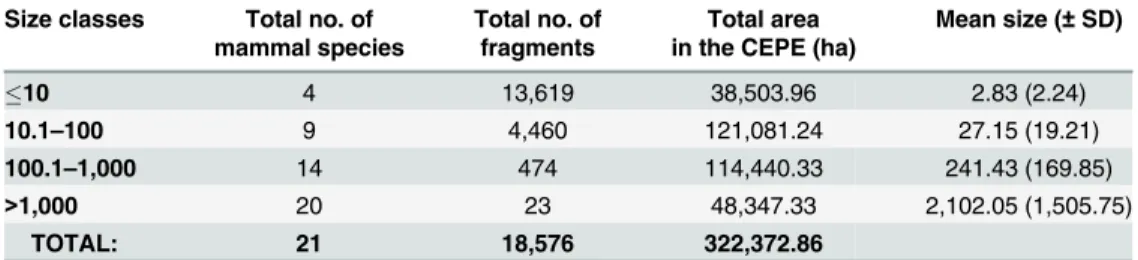
that 73.3% of the remaining forest fragments of the CEPE (very small fragments, with a mean size of 2.8 ha) host only four species of medium-sized mammals:Callithrix jacchus, Guerlingue-tus alphonsei, the brown-throated three-toed sloth (Bradypus variegatus) and the blond capu-chin (Sapajus flavius) (Table 3). In 24% of the remaining fragments (small fragments, with a mean size of 27 ha), nine species were registered; in 2.5% (medium-sized fragments, with a mean size of 241 ha), 14 species were registered; and in only 0.2% (large fragments, with a mean size of c.a. 2,100 ha), 20 species were registered (Table 3).
Abundance of the current mammalian fauna in the CEPE
Independent of the number or type of forest fragments, the most abundant species was the common marmoset (Callithrix jaccchus), which was sighted at a rate of 74.6 individuals/10 km walked. The tayra (Eira barbara) was the next most abundant, with 12 ind/10 km, followed by the squirrelGuerlinguetus alphonsei, with 6.6 ind/10 km. The least abundant species were the
Fig 2. Extinct large mammal species depicted by the first colonizers of the Atlantic coast of northeastern Brazil.A and B) c.f.Mazama americana; C) Tayassu pecari; D)Panthera onca; E)Puma concolor; F)Lutra longicaudis; G) PossiblyCabassous unicinctus(Emmons and Feer, 1997: 10–13 movable
bands; tail narrow and long; ears large, funnel-like), but about which Marcgrave says:“This is armoured animals and are able to pull the head and paws, doubling themselves into a ball". Since the only armadillos capable of rolling into a ball are those of the genusTolypeutes(Eisenberg and Redford, 1999), we assume that Marcgrave was not sure about the distinction betweenT.tricinctusand other armadillo species; H)Tolypeutes tricinctus; I)Tapirus terrestris; J)
Myrmechophaga tridactyla; K)Alouatta belzebul.
doi:10.1371/journal.pone.0150887.g002
Table 2. Occurrence of the medium- and large-sized mammals in the different size classes of the stud-ied forest fragments in northeastern Brazil.
Species 10
(ha)
10.1–100
(ha)
100.1–1,000
(ha)
3,478.3 (ha)
Surrounding non-forested matrix
Bradypus variegatus X X X
Callithrix jacchus X X X X X
Cerdocyon thous X X X X
Coendou prehensilis X X X
Cuniculus paca X
Dasyprocta prymnolopha
X X X X
Dasypus novemcinctus
X X
Eira barbara X X X
Euphractus sexcinctus X X
Galictis vittata X X
Guerlinguetus alphonsei
X X X X
Hydrochoerus hydrochaeris
X X X
Leopardus pardalis X
L.tigrinus X
Nasua nasua X X X X
Pecari tajacu X X
Procyon cancrivorous X X X
Puma yaguarondi X X
Sapajusflavius X X X
Sylvilagus brasiliensis X X X
Tamandua tetradactyla X X
Total: 4 9 14 20 11
doi:10.1371/journal.pone.0150887.t002
Mammal Mass Extinction in a Hotspot´s Hotspot
crab-eating raccoon (Procyon cancrivorous), the jaguarondi (Puma yagouaroundi) and the common rabbit (Sylvilagus brasiliensis), which were observed only occasionally and always out-side systematic surveys, suggesting sighting rates below a detectable level (Table 4).
Environmental determinants of the richness and abundance of the
mammalian fauna in the forest fragments of the CEPE
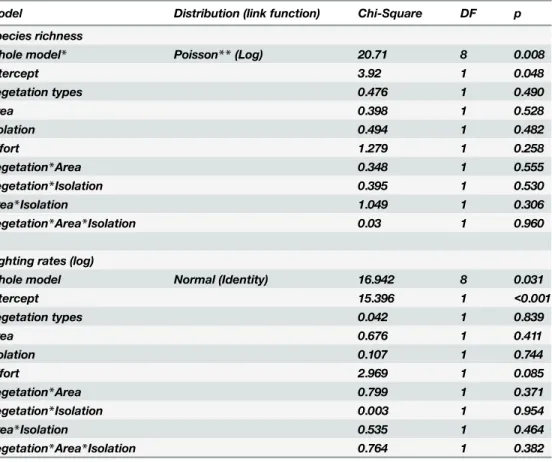
The Linear Analysis of Covariance (ANCOVA) showed that neither the species richness nor the sighting rate is controlled by vegetation type, fragment area, fragment isolation, or any interaction among these factors (Table 5).
The NODF metric revealed that the medium- and large-sized mammal assemblages were significantly nested, independent of the prior matrix ordering (Table 6). This finding indicated that the degree of nestedness of the mammals among fragments was higher than the degree of nestedness obtained from 1,000 random samples, even when we arranged the presence/absence according to the best-ordered matrix, area, or isolation. However, when taking into consider-ation only the fragments in the matrix (our main aim) and using a null model based on ran-domness assigned within the rows, the NODF analysis showed that the mammal assemblages are not more nested than the random matrices (Table 7). That is to say, nestedness is not related to the area of the fragments.
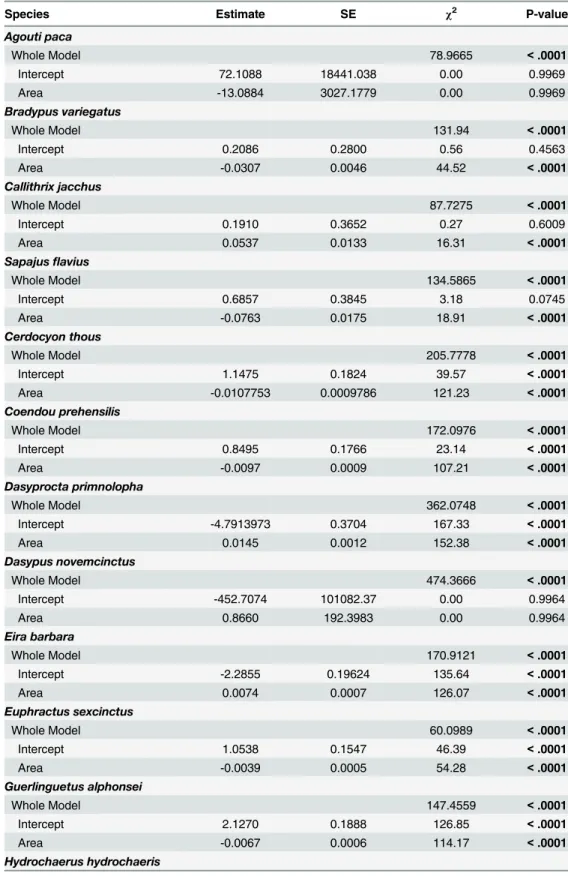
The probability of encounter for the studied species varied widely. According to a binomial logistic analysis,Callithrix jacchusandNasua nasuashowed increased chances of being detected with increased fragment size, and in all fragment sizes, these species had>50% chance of being detected;Hydrochaerus hydrochaerisandSylvilagus brasiliensisalso exhibited an increased chance of being detected with increased fragment size, though their chance of detec-tion was<50% in all cases.Dasyprocta prymnolophaandEira barbarapresented increased chances of detection with increased fragment size, but were more likely to be found (>50% chance) in fragments larger than 300 ha. In contrast,Sapajus flaviusandBradypus variegatus, in addition to showing a reduced chance of being detected with increased fragment size, had detection probabilities of<50% in all cases.Cerdocyon thousandCoendou prehensilisalso showed a reduced chance of being detected with increased fragment size and were more likely to be found (>50% chance) in fragments smaller than 100 ha; the same trend was found for Euphractus sexcinctus,Pecari tajacu,Procyon cancrivorous, andGuerlinguetus alphonsei, though these species were more likely to be found in fragments smaller than 300 ha (Table 8; Fig 3A and 3B). The other recorded species did not have any significant trend.
Discussion
After more than 500 years of colonization, the Atlantic forest of northeastern Brazil, specifically the CEPE, has lost at least half of its medium-sized and all large-sized mammals. The richness
Table 3. Remaining forest fragments of the Pernambuco Endemism Center (CEPE) and their medium-and large-sized mammalian richness.
Size classes Total no. of Total no. of Total area Mean size (±SD)
mammal species fragments in the CEPE (ha)
10 4 13,619 38,503.96 2.83 (2.24)
10.1–100 9 4,460 121,081.24 27.15 (19.21)
100.1–1,000 14 474 114,440.33 241.43 (169.85)
>1,000 20 23 48,347.33 2,102.05 (1,505.75)
TOTAL: 21 18,576 322,372.86
doi:10.1371/journal.pone.0150887.t003
Mammal Mass Extinction in a Hotspot´s Hotspot
Table 4. Abundance of the medium- and large-sized mammals in the Pernambuco Endemism Centre, Brazil.
Forest type / Area (ha) of
Transect Degree of
ha(%) ∑ ∑ Speciesa Sightings/ Mean Sighting
fragment fragment (meters) isolation surveyed Sightings Species species group size
rate
SUBMONTANE EVERGREEN
Coimbra 3 478.3 4,000 6.92 20 (0.6%) 28 20 Agouti paca 1 1 0.03
(08°59'42"W; 35°50'27‴S) Bradypus variegatus 0 0 0
Callithrix jacchus 0 0 0
Cerdocyon thous 0 0 0
Coendou prehensilis 0 0 0
Dasyprocta primnolopha
10 1 0.3
Dasypus novemcinctus
0 0 0
Eira barbara 1 1 0.03
Euphractus sexcinctus
3 1 0.04
Galictis vittata 1 1 0.03
Guerlinguetus alphonsei
4 1.2 0.12
Hydrochaerus hydrochaeris
0 0 0
Leopardus pardalis 1 1 0.01
Leopardus tigrinus 1 1 0.01
Nasua nasua 5 4.7 0.15
Pecari tajacu 1 6 0.03
Procyon cancrivorus 0 0 0
Puma yaguarondi 0 0 0
Sylvilagus brasiliensis 0 0 0
Tamandua tetradactyla
0 0 0
0.75
Aquidabã 24 830 0.89 4.1
(17.1%)
1 1 Callithrix jacchus 1 1 0.9
(08°58'53"S; 35°54'25"W) 0.9
LOWLAND EVERGREEN
Saltinho 548 3,175 1.87 31.7
(5.7%) 74 7
Callithrix jacchus 53 4.2 6.8
(08°45'00"S; 35°10'00"W) Dasyprocta
prymnolopha
11 1 1.41
Dasypus novemcinctus
1 1 0.08
Eira barbara 1 1 0.13
Nasua nasua 5 2.6 0.64
Saimiri sciureus 1 20 0.13
Tamandua tetradactyla
2 1.5 0.16
9.35
Tapacurá 382 2,000 1.67 20 (5.2%) 115 2 Callithrix jacchus 115 2.4 11.5
(08°03'00"S; 34°55'00"W) Dasyprocta
prymnolopha
0 0 0
(Continued) Mammal Mass Extinction in a Hotspot´s Hotspot
Table 4. (Continued)
Forest type / Area (ha) of
Transect Degree of
ha(%) ∑ ∑ Speciesa Sightings/ Mean Sighting
fragment fragment (meters) isolation surveyed Sightings Species species group size
rate
11.5
Cuxiu 118 900 8 2.2 (1.8%) 4 1 Callithrix jacchus 4 1.75 4
(08°13'38"S; 35°03'45"W) 4
Charles Darwin 60 1,500 15.76 4.5 (7.5%) 5 5 Callithrix jacchus 4 3.25 1.95
(07°48'56"S; 34°57'11"W) Bradypus variegatus 0 0 0
Cerdocyon thous 0 0 0
Dasyprocta prymnolopha
0 0 0
Guerlinguetus alphonsei
1 1 0.5
2.45
São Braz 37 700 10.52 4.3
(11.6%) 11 2
Callithrix jacchus 10 2.1 10
(08°13'28"S; 35°04'03"W) Guerlinguetus
alphonsei
1 1 1
11
Gengibre 19.8 250 2.12 2.5
(12.6%) 2 2
Sapajusflavius 1 12 1
(08°31'33"S; 35°03'16"W) Eira barbara 1 1 1
2
Mingú 13 250 6.39 2.5
(18.6%)
2 2 Sapajusflavius 1 18 1
(08°31'02"S; 35°03'15"W) Nasua nasua 1 1 1
2
Xangô 9 500 13.8 2.5 (28%) 13 2 Bradypus variegatus 2 1 2
(08°14'23"S; 35°03'56"W) Callithrix jacchus 11 2.2 11
13 Vale das
Aguas 8 350 56.75 0.8 (10%) 3 2
Callithrix jacchus 2 3.5 4
(7°54'49"S; 35°3'25,4"W) Guerlinguetus
alphonsei
1 1 2
6
Café 7 450 13.94 2.2
(32.3%) 9 2
Bradypus variegatus 2 1 1
(08°14'12"S; 35°02'60"W) Callithrix jacchus 7 2.1 7
8
Bulandí 4 150 4.44 1.5
(37.5%)
4 4 Sapajusflavius 3 22.3 4.2
(08°32'10"S; 35°02'50"W) Nasua nasua 1 1 1.4
Callithrix jacchus 0 0 0
Agouti paca 0 0 0
5.6 SUBMONTANE SEMI-DECIDUOUS
Quengo 500 1,900 5.94 3.2 (0.6%) 3 3 Callithrix jacchus 1 2 1.25
(08°43'04"S; 35°50'27"W) Dasyprocta
prymnolopha
0 0 0
Nasua nasua 2 1 2.5
(Continued) Mammal Mass Extinction in a Hotspot´s Hotspot
Table 4. (Continued)
Forest type / Area (ha) of
Transect Degree of
ha(%) ∑ ∑ Speciesa Sightings/ Mean Sighting
fragment fragment (meters) isolation surveyed Sightings Species species group size
rate
3.75
Fervedouro 300 1,000 2.58 0.6 (0.2%) 2 2 Callithrix jacchus 2 2 2.86
(08°45'08"S; 35°51'36"W) Guerlinguetus
alphonsei
0 0 0
2.86
Cachoeira 271 3,000 12.89 15 (5.5%) 14 9 Callithrix jacchus 0 0 0
(08°56'44"S; 36°03'36"W) Eira barbara 1 1 0.06
Euphractus sexcinctus
2 1 0.07
Hydrochaerus hydrochaeris
1 3 0.04
Nasua nasua 7 4 0.41
Pecari tajacu 1 3 0.06
Procyon cancrivorus 0 0 0
Guerlinguetus alphonsei
2 1 0.12
Sylvilagus brasiliensis 0 0 0
0.75
Capoeirão 122 1,500 15.12 7.5 (6.1%) 9 8 Cerdocyon thous 1 1 0.04
(08°55'1"S; 36°04'17"W) Coendou prehensilis 1 1 0.1
Euphractus sexcinctus
1 1 0.04
Nasua nasua 4 4.5 0.25
Guerlinguetus alphonsei
1 1 0.06
Pecari tajacu 1 5 0.06
Procyon cancrivorus 0 0 0
Callithrix jacchus 0 0 0
0.55
Ageró 50 500 6.4 2.8 (5.6%) 4 3 Callithrix jacchus 4 1.6 5.33
(08°44'16"S; 35°50'33"W) Coendou prehensilis 0 0 0
Dasyprocta prymnolopha
0 0 0
5.33
Espelho 50 1,000 19.58 5.6
(11.2%) 2 2
Guerlinguetus alphonsei
2 1 2.9
(08°43'12"S; 35°50'40"W) Callithrix jacchus 0 0 0
2.9
Bom Jesus 41 500 24.3 2.5 (6%) 6 2 Callithrix jacchus 2 2.5 2.9
(09°01'16"S; 36°10'32"W) Nasua nasua 4 1 5.7
8.6 LOW MONTANE SEMI-DECIDUOUS
Brejo dos Cavalos
354 2,400 3.23 24 (6.7%) 23 2 Callithrix jacchus 22 3.3 5.1
(08°22'48"S; 36°02'24"W) Eira barbara 1 1 0.23
5.33
aIncluding species that were sighted outside of systematic surveys in the surrounding matrix
doi:10.1371/journal.pone.0150887.t004
Mammal Mass Extinction in a Hotspot´s Hotspot
and abundance of the remaining mammals are not predicted by the fragment area, fragment isolation, vegetation type or any interaction among these factors. In addition, neither fragment area nor fragment isolation accounts for the detected nestedness pattern. For the within-group analyses, some species did not occur as would be expected according to the variation in the fragment area.
Table 5. Whole models (comparing the fitted model against the intercept-only model) and model effect decompositions for each of the two response factors (species richness and sighting rates) according to the Generalized Linear Model analysis (Factorial Analysis of Covariance—ANCOVA).
Model Distribution (link function) Chi-Square DF p
Species richness
Whole model* Poisson**(Log) 20.71 8 0.008
Intercept 3.92 1 0.048
Vegetation types 0.476 1 0.490
Area 0.398 1 0.528
Isolation 0.494 1 0.482
Effort 1.279 1 0.258
Vegetation*Area 0.348 1 0.555
Vegetation*Isolation 0.395 1 0.530
Area*Isolation 1.049 1 0.306
Vegetation*Area*Isolation 0.03 1 0.960
Sighting rates (log)
Whole model Normal (Identity) 16.942 8 0.031
Intercept 15.396 1 <0.001
Vegetation types 0.042 1 0.839
Area 0.676 1 0.411
Isolation 0.107 1 0.744
Effort 2.969 1 0.085
Vegetation*Area 0.799 1 0.371
Vegetation*Isolation 0.003 1 0.954
Area*Isolation 0.535 1 0.464
Vegetation*Area*Isolation 0.764 1 0.382
Significant values are presented in bold.
*Overdispersion parameter estimated by Pearson’s chi-square
**Over-dispersion = 0.787
doi:10.1371/journal.pone.0150887.t005
Table 6. Measure of nestedness for the medium- and large-sized mammal assemblages in the 21 for-est fragments studied according to the arrangement of three matrices.
Whole matrix N_Total NODF(Er) P(Er) NODF(Ce) P(Ce)
Best-ordered matrix 58.35 20.49 <0.001 29.96 <0.001
Area-ordered matrix 29.11 10.08 <0.001 14.18 <0.001
Isolation-ordered matrix 34.68 10.65 <0.001 16.8 <0.001
N_total: total matrix nestedness; NODF(Er): nestedness of the null model in which presences are randomly assigned to any cell within the matrix; P(Er): significance of NODF based on this null model; NODF(Ce):
nestedness of the null model in which the probability of a cell, aij, showing a presence is (Pi/C þPj/R)/2, where Pi represent the number of presences in row i, Pj the number of presences in column j, C the number of columns, and R the number of rows; P(Ce): the significance of NODF based on this null model.
doi:10.1371/journal.pone.0150887.t006
Mammal Mass Extinction in a Hotspot´s Hotspot
During our surveys in forest fragments of the remaining 5.6% of the CEPE, more than 500 years after the beginning of the colonization process, we still observed intense human interfer-ence, especially hunting, with or without feral dogs [68], which have led to the extinction of all large mammals of this hotspot. Despite the fact that deer (Mazamaspp.), white-lipped peccary (Tayassu pecari), jaguar (Panthera onca), puma,Puma concolor, Brazilian tapir (Tapirus terres-tris), and giant anteater (Myrmecophaga tridactyla) have been reported and/or depicted by the first colonizers [32,33,40,41,42,43,44], and even referenced in current literature
[53,54,55,56,57], they have never been seen in the wild or collected by contemporary scientists working in the CEPE.
Considering that white-lipped peccaries, jaguars, Brazilian tapirs, and giant anteaters are confirmedly extinct in both CEPE (this study) and CEBA [49], this indicates a total decrease of almost 90.000 km2in the former geographic range of these extinct large mammals and high-lights the critical importance of regional extinctions for effective species conservation.
The populations of other species, such as medium-sized cats (e.g., jaguarondi,Puma yaguar-ondi, ocelot,Leopardus pardalis, oncilla,Leopardus tigrinus), the much-hunted river otter (Lontra longicaudis), the collared peccary (Pecari tajacu) and the critically endangered blonde capuchin (Sapajus flavius) are not sustainable in the long term. They are“living dead”species, which will most probably become extinct in the next decades [69,70,71] unless very effective conservation measures are implemented. Some of these species are not referred to in the global, national or international lists of threatened species, and at the same time, some of these lists are not congruent with each other, which can greatly impede their effective use as a conserva-tion tool.
Extinctions of species that used to live in small forest patches, soon after they are described, is already expected, such as happened with the Pernambuco pigmy-own (Glaucidium moor-eorum) in the same forest fragments as in this study [39]. This should be the case of the recently described dwarf porcupine (Coendou speratus), still not evaluated by the IUCN [57] and the recently redescribed blond capuchin (Sapajus flavius), which live in isolated and small forest patches. But besides the expected extinctions, the current profound changes in species compo-sition may further harm other species. This could be the case of the two most abundant species, the common marmoset (Callithrix jacchus) and the tayra (Eira barbara), which can become powerful predators.
The two unprecedented references to the Amazonian primatesSaimirisp. andAtelessp. as occurring in the CEPE [32,33] provide remarkable evidence that a number of species may have gone extinct in this hotspot´s hotspot before contemporary scientists could describe them. This could be the case of the deer (Mazamaspp.) of the region, which were referenced and depicted by the first colonizers, but went extinct before they could be described, as there are no contemporary reports of these species in the CEPE [72]. Similarly, Lees and Pimm [39] have
Table 7. Measure of column-only nestedness for the medium- and large-sized mammal assemblages in the 21 forest fragments studied according to the arrangement of three matrices.
Column-only analysis N_Columns P(col) P(Li)
Best-ordered matrix 52.53 <0,001 0.004
Area-ordered matrix 15.63 <0,001 0.82
Isolation-ordered matrix 25.96 <0,001 0.086
N_columns: total column nestedness; P(Col): significance of NODF assuming that the presences are
randomly assigned within the columns; P(Li): significance of NODF assuming that the presences are
randomly assigned within the rows.
doi:10.1371/journal.pone.0150887.t007
Mammal Mass Extinction in a Hotspot´s Hotspot
Table 8. Whole models (comparing the fitted model against the intercept-only model) and the effect of the fragment area on the probability of medium-sized mammal species encounters according to the Binomial Logistic Regression.
Species Estimate SE χ2 P-value
Agouti paca
Whole Model 78.9665 <.0001
Intercept 72.1088 18441.038 0.00 0.9969
Area -13.0884 3027.1779 0.00 0.9969
Bradypus variegatus
Whole Model 131.94 <.0001
Intercept 0.2086 0.2800 0.56 0.4563
Area -0.0307 0.0046 44.52 <.0001
Callithrix jacchus
Whole Model 87.7275 <.0001
Intercept 0.1910 0.3652 0.27 0.6009
Area 0.0537 0.0133 16.31 <.0001
Sapajusflavius
Whole Model 134.5865 <.0001
Intercept 0.6857 0.3845 3.18 0.0745
Area -0.0763 0.0175 18.91 <.0001
Cerdocyon thous
Whole Model 205.7778 <.0001
Intercept 1.1475 0.1824 39.57 <.0001
Area -0.0107753 0.0009786 121.23 <.0001
Coendou prehensilis
Whole Model 172.0976 <.0001
Intercept 0.8495 0.1766 23.14 <.0001
Area -0.0097 0.0009 107.21 <.0001
Dasyprocta primnolopha
Whole Model 362.0748 <.0001
Intercept -4.7913973 0.3704 167.33 <.0001
Area 0.0145 0.0012 152.38 <.0001
Dasypus novemcinctus
Whole Model 474.3666 <.0001
Intercept -452.7074 101082.37 0.00 0.9964
Area 0.8660 192.3983 0.00 0.9964
Eira barbara
Whole Model 170.9121 <.0001
Intercept -2.2855 0.19624 135.64 <.0001
Area 0.0074 0.0007 126.07 <.0001
Euphractus sexcinctus
Whole Model 60.0989 <.0001
Intercept 1.0538 0.1547 46.39 <.0001
Area -0.0039 0.0005 54.28 <.0001
Guerlinguetus alphonsei
Whole Model 147.4559 <.0001
Intercept 2.1270 0.1888 126.85 <.0001
Area -0.0067 0.0006 114.17 <.0001
Hydrochaerus hydrochaeris
(Continued) Mammal Mass Extinction in a Hotspot´s Hotspot
shown that this is also the case of some species of birds, which the first colonizers depicted for the northeastern Atlantic forest, and that went extinct before they could be described (e.g. a curassow,Crax, with a yellow beak), their paintings being the only record available.
The remaining medium-sized mammal community is highly simplified and homogenized in comparison to the previous mastofauna described in the literature [14,40,44,53,54,55]. The same is true for small mammals [3] and trees [29,61,73]. We hypothesize that if the ongoing reduction in size and loss of existing fragments continue in the same rate the 21stcentury medium-sized mammalian fauna of this region (73.3% of which is formed by forest fragments with a mean size of 2.8 ha (n = 13,619)) should comprise only four species:Callithrix jacchus, Guerlinguetus alphonsei,Bradypus variegatusandSapajus flavius.
We considered some species to be extinct from a forest fragment when we did not detected them during the systematic surveys, occasional encounters or based on spoor or dung because despite the limitations inherent to the inference that a species may be extinct [74], the frag-ments are so small (seeTable 3), isolated, lacking in food, simplified, and secondarized [29,61,73] that it is almost impossible that these species would remain undetected in the area. Our findings are also supported by Canale et al. [61] who came to the same conclusion in the nearby CEBA using only interviews with locals.
Melo et al. [68] found that hunting pressure, determined based on gun shots heard, the pres-ence of humans, hunting trails, hunting platforms, and the prespres-ence of feral dogs, was posi-tively related to species diversity and sighting rates. This suggests that higher richness and abundance resulted in higher hunting pressure, contradicting previous findings [75,76].
Table 8. (Continued)
Species Estimate SE χ2 P-value
Whole Model 5.4490 0.0196
Intercept -1.3226 0.1672 62.55 <.0001
Area 0.0013 0.0006 5.46 0.0195
Nasua nasua
Whole Model 5.0445 0.0247
Intercept 0.5271 0.1520 12.03 0.0005
Area 0.0012 0.0005 4.94 0.0262
Pecari tajacu
Whole Model 60.0989 <.0001
Intercept 1.0538 0.1547 46.39 <.0001
Area -0.0039 0.0005 54.28 <.0001
Procyon cancrivorus
Whole Model 60.0989 <.0001
Intercept 1.0538 0.1547 46.39 <.0001
Area -0.0039 0.0005 54.28 <.0001
Sylvilagus brasiliensis
Whole Model 5.4489 0.0196
Intercept -1.3226 0.1672 62.55 <.0001
Area 0.0013 0.0005 5.46 0.0195
Tamandua tetradactyla
Whole Model 474.3666 <.0001
Intercept -452.7074 101082.37 0.00 0.9964
Area 0.8660 192.3982 0.00 0.9964
Significant values are presented in bold.
doi:10.1371/journal.pone.0150887.t008
Mammal Mass Extinction in a Hotspot´s Hotspot
Although the mammal distribution conforms to the principle of nested subsets [77], this nest-edness was not related to fragment size or isolation, as would be expected [7,31]. The existence of these fragments depends on the landowner and the local people who exploit them
Fig 3. Positive (a) and negative (b) effects of the area of the fragments on the probability of encountering medium-sized mammal species in the CEPE, according to a Binomial Logistic Regression.
doi:10.1371/journal.pone.0150887.g003
Mammal Mass Extinction in a Hotspot´s Hotspot
unsustainably and arbitrarily. After 500 years of systematic destruction, the northeastern Atlantic forest of Brazil is in a post-nestedness state in regard to fragment area, since any spe-cies can be found in any size of forest fragment.
The remaining living-dead species did not conform to the expected pattern in which the probability of occurrence increases with increasing patch area [78,79,80], and larger species with lower abundances are at higher risk of extinction [81,82]. Their occurrence varied unpre-dictably, with larger species even showing a decreased probability of detection with increasing patch size. This is most likely determined by their ability to adapt to a novel simplified diet, to efficiently use the surrounding matrix without being engulfed by the sink effect [83,84], and to escaping rampant hunting [68].
The 21stcentury medium-sized mammalian fauna in this hotspot comprises only three or four species that can survive in very small fragments and that do not depend on crossing the open matrix to maintain viable populations. These are the species that have survived genera-tions of“relaxation”[2]. The population sink effect [15] also plays an important role in the CEPE, since approximately 50% of the recorded mammals were observed in the open matrix.
Finally, the mammalian community of the CEPE has suffered a mass extinction of all large and some medium-sized species, and even the medium-sized remaining community is small and includes below minimum viable populations [69]. These populations are genetically isolated, sub-jected to the sink effect, unpredictable from an ecological perspective and consist mostly of“ liv-ing dead”species [15]. The species that remain are unpredictably distributed in the different sizes of forest fragments, and their future appears to be highly uncertain. Therefore, the biota of the CEPE may represent a typical example of what will happen to preserved or less severely frag-mented forests worldwide in the near future, where very strict conservation measures will have to be taken into account to ensure the long-term maintenance of wildlife populations.
Supporting Information
S1 Table. Vegetation type, fragment name and area, sighting rate, richness, effort, frag-ment isolation, and presence / absence matrix of the 21 studied medium-sized mammals distributed in 21 forest fragments in the Pernanmbuco Endemism Center, Atlantic forest of northeastern Brazil.Ordered according to fragment size.
(XLS)
Acknowledgments
We thank the owners and heads of Frei Caneca Mill, Salgado Mill, and Serra Grande Mill, Charles Darwin Ecological Refuge, Gurjaú Ecological Reserve—CPRH, Brejo dos Cavalos Ecological Park, Saltinho Biological Reserve, and Tapacurá Ecological Station for permission to work in their areas and for logistical support. J. M. C. da Silva and L. P. Pinto made important suggestions for this manuscript. We also thank the following institutions for crucial financial support: the Fundação O Boticário de Proteção à Natureza, National Research Council (CNPq), Probiota program (PRO-BIO), Conservation International Brazil (CI) Brazil, and Brazilian Post-Graduate Council
(CAPES). Adrian A. Barnett helped with the English. We thank K. Frankowicz from Jagiellonska library from the University Jagiellonski, Poland, for permission to reproduce the animal images.
Author Contributions
Conceived and designed the experiments: ARMP. Performed the experiments: ARMP ACMB ICN AJRM APSJ. Analyzed the data: ARMP AMMS. Contributed reagents/materials/analysis tools: ARMP AMMS. Wrote the paper: ARMP. Old literature search: ACMB.
Mammal Mass Extinction in a Hotspot´s Hotspot
References
1. Pimm SL, Raven P. Extinction by numbers. Nature. 2000; 403: 843–845. PMID:10706267 2. Brooks TM, Pimm SL, Oyugi JO. Time lag between deforestation and bird extinction in tropical forest
fragments. Conserv Biol. 1999; 13(5): 1140–1150.
3. Asfora PH, Mendes Pontes AR. The small mammals of the highly impacted northeastern Atlantic forest of Brazil, Pernambuco Endemism Center. Biota Neotrop. 2009; 9(1): 31–35.
4. Brook BW, Sodhi NS, Ng PKL. Catastrophic extinctions follow deforestation in Singapore. Nature. 2003; 424: 420–423. PMID:12879068
5. Thomas JA, Telfer MG, Roy DB, Preston CD, Greenwood JJD, Asher J, et al. Comparative losses of British butterflies, birds, and plants and the global extinction crisis. Science. 2004; 303: 1879–1881. PMID:15031508
6. Scanlon CE, Chalmers NR, Monteiro da Cruz MAO. Home range use and the exploitation of gum in the marmosetCallithrix jacchus jacchus. Int J Primatol. 1989; 10: 123–136.
7. Chiarello AG. Effects of fragmentation of the Atlantic forest on mammal communities in south-eastern Brazil. Biol Conserv. 1999; 89: 71–82.
8. Fernandes ACA. Censo de Mamíferos em Alguns Fragmentos de Floresta Atlântica no Nordeste do Brasil. M.Sc. Thesis, Universidade Federal de Pernambuco. 2003. Available:http://repositorio.ufpe. br:8080/xmlui/handle/123456789/879.
9. Mendes Pontes AR, Soares ML. Sleeping sites of common marmosets (Callithrix jacchus) in defau-nated urban forest fragments: a strategy to maximize food intake. J. Zool. 2005; 266: 1–9.
10. Mendes Pontes AR, Peres PHA, Normande IC, Brazil CM. Mamíferos. In: Porto KC, Almeida-Cortez JS, Tabarelli M, editors. Diversidade biológica e conservação da floresta Atlântica ao norte do São
Francisco. Brasília: Ministério do Meio Ambiente-Série Biodiversidade; 2006. pp. 10–50.
11. McNab BK. Bioenergetics and the determination of home range size. Am Nat. 1963; 97: 133–140. 12. Redford KH, Robinson JG. Park size and the conservation of forest mammals in Latin America. In:
Mares MA, Schmidly DJ, editors. Latin American mammalogy, history, biodiversity, and conservation. Norman: University of Oklahoma Press; 1991. pp. 227–234.
13. Watling JI, Donnelly MA. Multivariate correlates of extinction proneness in a naturally fragmented land-scape. Divers Distrib. 2007; 13: 372–378.
14. Silva AP Júnior, Mendes Pontes AR. The effect of a mega-fragmentation process on large mammal assemblages in the highly-threatened Pernambuco Endemism Center, north-eastern Brazil. Biodivers Conserv. 2008; 17(6): 1455–1464.
15. Woodroffe R, Ginsberg JR. Edge effects and the extinction of populations inside protected areas. Sci-ence. 1998; 280: 2126–2128. PMID:9641920
16. MacArthur RH, Wilson EO. The theory of island biogeography. Princeton: Princeton University Press; 1967.
17. Harris LD. The fragmented forest, island biogeography theory and the preservation of biotic diversity. Chicago: University of Chicago Press; 1984.
18. Myers N, Mittermeier RA, Mittermeier CG, Fonseca GAB, Kent J. Biodiversity hotspots for conservation priorities. Nature. 2000; 403: 853–858. PMID:10706275
19. Prance GT. Forest refuges: evidences from woody angiosperms. In: Prance GT, editor. Biological diversification in the tropics. New York: Columbia University Press; 1982. pp. 137–158.
20. Prance GT. Biogeography of neotropical plants. In: Prance GT, editor. Biogeography and quaternary history in tropical America. Oxford: Clarendon Press; 1987. pp. 175–196.
21. Silva JMC, Casteletti CHM. Status of the biodiversity of the Atlantic forest of Brazil. In: Galindo-Leal C, Câmara IG, editors. The Atlantic forest of South America: biodiversity status, threats, and outlook. Washington, DC: CABS and Island Press; 2003. pp. 43–59.
22. Santos BA, Peres CA, Oliveira MA, Grillo A, Alves-Costa CP, Tabarelli M. Drastic erosion in functional attributes of tree assemblages in Atlantic forest fragments of northeastern Brazil. Biol Conserv. 2008; 141: 249–260.
23. Punde S, Godbole A, Sarnaik J. Searching for hotspots within a hotspot–using global prioritization schemes at a regional level. An example from the Northern Western Ghats. 10 June 2008 [Cited 7 June 2014]. In:conbio.com. Available:http://conbio.org/images/content_conferences/2008_Abstract_Book. pdf.
24. Carnaval C, Moritz C. Predicting diversity within hotspots to enhance conservation. Science. 2009; 323: 785–789. doi:10.1126/science.1166955PMID:19197066
Mammal Mass Extinction in a Hotspot´s Hotspot
25. Viana VM, Tabanez AJ, Batista JL. Dynamics and restoration of forest fragments in the Brazilian Atlan-tic moist forest. In: Laurance WF, Bierregaard RO Jr., editors. Tropical forest remnants: ecology, man-agement, and conservation of fragmented communities. Chicago: University of Chicago Press; 1997. pp. 351–365.
26. Ribeiro MC, Metzger JP, Martensen AC, Ponzoni FJ, Hirota MM. The Brazilian Atlantic forest: how much is left, and how is the remaining forest distributed: implications for conservation. Biol Conserv. 2009; 142: 1141–1153.
27. Ranta P, Bloom T, Niemela J, Joensuu E, Siitonen M. The fragmented Atlantic rain forest of Brazil: size, shape and distribution of forest fragments. Biodivers Conserv. 1998; 7: 385–403.
28. Brown KS Jr, Brown GG. Habitat alteration and species loss in Brazilian forests. In: Whitmore TC, Sayer JA, editors. Tropical deforestation and species extinction. London: Chapman and Hall; 1992. pp. 119–142.
29. Silva JMC, Tabarelli M. Tree species impoverishment and the future flora of the Atlantic forest of north-eastern Brazil. Nature. 2000; 404: 72–74. PMID:10716443
30. Mendes Pontes AR, Normande IC, Fernandes ACA, Rosas-Ribeiro PF, Soares ML. Fragmentation causes rarity in common marmosets in the Atlantic forest of northeastern Brazil. Biodivers Conserv. 2006; 16: 1175–1182.
31. Michalski F, Peres CA. Disturbance-mediated mammal persistence and abundance-area relationship in Amazonian forest fragments. Conserv Biol. 2007; 21: 1626–1640. doi:10.1111/j.1523-1739.2007. 00797.xPMID:18173486
32. Gandavo PM. Tratado da terra do Brasil; história da província Santa Cruz. Rio de Janeiro, Fundação
Biblioteca Nacional (original edition by Gandavo, 1576); 1980.
33. Salvador FV. História do Brasil: 1500 a 1627. Brasilia (original edition by Salvador, 1627): Melhoramen-tos; 1975.
34. Mendes Pontes AR, Jordani RA, Ribeiro PFR, Normande IC, Fernandes ACA, Soares ML, et al. Ocor-rência e abundância de primatas em fragmentos florestais no Centro de Endemismo Pernambuco. In:
Bicca-Marques JC, editor. A primatologia no Brasil. Rio Grande do Sul: PUC-RS; 2007. pp. 193–206.
35. Mendes Pontes AR, Gadelha R, Melo ERA, Loss ACC, Leite YLR. Uncontrollable hunting, extinctions and the disappearance of unknown mammal species: scenario and perspectives of a hotspot’s hotspot
(Pernambuco Endemism Centre). Interactions in a changing world: the Brazilian Atlantic Forest–a case study on direct and indirect human impacts on a threatened ecosystem Symposium. Proceedings of the 46th Joint Meeting of the Society for Tropical Ecology & Association for Tropical Biology and Con-servation, 2009. ATBC/GTO 2009. Marburg, Germany. p. 231.
36. Harrington GN, Irvine AK, Crome FHJ, Moore A. Regeneration of large-seeded trees in Australian rain-forest fragments: a study of higher-order interactions. In: Laurence WF, Bierregaard RO Jr, editors. Tropical forest remnants: ecology, management, and conservation of fragmented communities. Chi-cago: University of Chicago Press: 1997. pp. 292–303.
37. Roda SA, Mendes Pontes AR. Polygyny and infanticide in common marmosets in a fragment of the Atlantic forest of Brazil. Folia Primatol. 1998; 69: 372–376. PMID:9885340
38. Melo L, Mendes Pontes AR, Monteiro da Cruz MAO. Infanticide and cannibalism in wild common mar-mosets. Folia Primatol. 2003; 74: 48–50. PMID:12606850
39. Lees AC, Pimm SL. Species, extinct before we know them? Current Biol. 2015; 25: 177–180.
40. Marcgraf G, Piso W. Historia naturalis brasiliae. São Paulo (original edition by Marcgraf and Piso, 1648,
Amsterdam): Official State Press; 1942.
41. Falcão EC. Zacharias Wagener. Zoobiblion. Livro dos animais do Brasil. São Paulo: Brasiliensia
Docu-menta (original edition by Wagener, 1641); 1964.
42. Brandão C. Gaspar Barlaeus. História dos fatos recentemente praticados durante oito anos no Brasil.
Recife: Fundação de Cultura Cidade do Recife (original edition by Barlaeus, 1647); 1980.
43. Vasconcelos MN. Joan Nieuhof. Memorável Viagem Marítima e Terrestre ao Brasil. São Paulo (original
edition by Nieuhof, 1682, Amsterdam): Martins Press; 1981.
44. Marcgraf G. Icones Animalium Brasiliae. In: Mentzel DC, editor. Theatrum rerum naturalium brasiliae. Rio de Janeiro (original edition by Marcgraf, 1639, Berlin): Index Press; 1995. pp. 1–68.
45. Mendes Pontes AR. Working to save the 'living dead' in the Atlantic forest, an interview with Antonio Rossano Mendes Pontes; 2009 September 23 [cited 20 November 2014]. In:mongabay.com. Avail-able:http://news.mongabay.com/2009/0922-hance_pontes.html
46. Mendes Pontes AR. Amazonia and other forests of Brazil. London: Janus Publishing; 2009.
Mammal Mass Extinction in a Hotspot´s Hotspot