Influence of Li
2CO
3and V
2O
5combined additions on the sintering and
dielectric properties of Ca
0.5Sr
0.5TiO
3ceramics prepared from
powders synthesized by sol-gel method
Nouara Lamrani
1,∗, Ahcène Chaouchi
1, Jerôme Bernard
2, Brahim Itaalit
2, David Houivet
2,
Jean Marie Haussonne
2, Mohamed Aliouat
11Laboratoire de Chimie Appliquée et Génie chimique de l’Université Mouloud Mammeri de Tizi-Ouzou. Route
de Hasnaoua BP. 17 RP 15000, Tizi-Ouzou, Algeria
2Laboratoire Universitaire des Sciences Appliquées de Cherbourg (LUSAC) EA4253, Université de Caen
Basse-Normandie (UCBN), Site Universitaire, B.P. 78, 50130 Cherbourg-Octeville, France
Received 20 February 2014; Received in revised form 3 April 2014; Received in revised form 18 May 2014; Accepted 20 June 2014
Abstract
In this work, we have studied the influence of lithium carbonate (Li2CO3) associated with the vanadium oxide (V2O5) on sintering and dielectrics properties of Ca0.5Sr0.5TiO3ceramic materials obtained from nanopow-der synthesized by sol-gel method. The nanopownanopow-der was obtained by controlled mixing of titanium butoxide dissolved in butanol-2 and acetic acid with a saturated aqueous solution of calcium acetate and strontium carbonate and subsequent drying of the formed gel at 80 °C and calcination at 1100 °C. The synthesized nanopowder was mixed with different amount of additives, and then uniaxally pressed and sintered in air at-mosphere at temperature determined by dilatomertic measurements. The pure Ca0.5Sr0.5TiO3sample obtained by this process required a sintering temperature around 1500 °C. The addition of Li2CO3combined with V2O5 improved sinterability and caused a shift of dilatimeric shrinkage curve to much lower temperatures. Thus, dense ceramics (98% of theoretical density) were obtained at sintering temperature≤ 1300 °C. The effect of
adding Li2CO3-V2O5on the structure of ceramics and the dielectric properties is discussed and show that type I dielectric properties (linear variation of the permittivity) are conserved, but with an increase of dielectric loss.
Keywords: perovskite Ca0.5Sr0.5TiO3ceramic, sol-gel synthesis, sintering aids, dielectric properties
I. Introduction
Perovskite type oxides of general formula ABO3[1] are well known in material sciences due to their good electrical properties, magneto-resistivity and ability to immobilize high-activity radioactive waste [2–5]. They are also known for their phase transitions which may strongly affect the physical and chemical properties [5].
Several authors have also studied the system CaTiO3 -SrTiO3[5–12]. According to the results of Ballet al.[6] and Cehet al.[7] these two perovskite oxides are com-pletely miscible and form Ca1-xSrxTiO3(CST) solid so-lution. CaTiO3exhibits the orthorhombic structure with
∗Corresponding author: tel:+213 779 357 486 e-mail:[email protected]
space groupPbnmorPnma[8], while SrTiO3 has a cu-bic structure with space groupPm3m[9] at room tem-perature. Recently, Ballet al. [6] reported the follow-ing phase transitions with increasfollow-ing the amount of Sr in CST: orthorhombicPnmafor 0≤x≤0.40 to ortho-rhombicBmmb for 0.45≤ x≤ 0.6, then to tetragonal I4/mcmfor 0.65≤x≤0.90 and finally to cubicPm3mfor x≥0.95. However, Ranjanet al.[10] confirmed that the structure remains orthorhombic at x ≤ 0.88. Recently, Carpenteret al.[11,12] proposed phase diagram of CST solution showing the sample compositions at different
room temperatures.
high sintering temperature can be decreased by a liq-uid phase sintering with sintering agents such as lithium salts, vanadium oxide etc. [13–15]. Thus, previous stud-ies [16–18] have shown the important role of lithium for a low sintering temperature of BaTiO3, SrTiO3 or gen-erally all ABO3 perovskites. Two mechanisms can oc-cur simultaneously [16]. In the first, lithium might be, together with fluorine, introduced into the perovskite BaTiO3 lattice, and form solid solution with the gen-eral formula BaTi1-xLix03-3xF3x. According to the sec-ond, it has been stated that lithium might be introduced in the perovskite structure and it can be described by the formula A(B1-xLix)O3-3x/2. Thus, LiO4tetrahedra can be
created by simple elimination of rows of oxygen atoms along the<110>direction. Moreover, the ability of
ti-tanium to take a square pyramidal coordination sug-gests that oxygen vacancies might also appear in the TiO6octahedra, due to the introduction of lithium. It is most probable that isolated LiO4 tetrahedra as well as TiO5pyramides are formed simultaneously in the struc-ture and that anionic vacancies are randomly distributed, leading to a low temperature densification of the mate-rial. Vanadium, can also have two effects: the first one is
the low melting point of V2O5(Tm=690 °C) which can
lead to a lowering of sintering temperature; the second one is the small radius in coordinence 6 of V5+ (r
V5+ = 0.54 Å) [16–18] which could facilitate its inclusion
in the Ca1-xSrxTiO3 structure and enhance diffusion in
the cationic B sublattice (rTi4+ = 0.72 Å). In addition, a combined effect of vanadium with lithium cannot be
excluded. The literature [19–24] suggests V2O5 to be a promising sintering aid for the densification at relatively low temperatures. For example, it allows the sintering of Li2O-Nb2O5-5TiO2at 900 °C, Li1+x-yNb1-x-3yTix+4yO3at
900 °C, 5Li2O-0.583Nb2O5-3.248TiO2 at 920 °C, and MgTiO3-CaTiO3 at 1300 °C. Its effectiveness has been
also demonstrated, when associated with Bi2O3 and
CuO in ZnNb2O6system by Huanget al.[20] and Guet al.[21].
The effects of combined addition of Li2CO3 and
V2O5 on the sintering behaviour of Ca1-xSrxTiO3 have not yet been thoroughly investigated. In this paper, we report on the possibility of lowering the sintering tem-perature of Ca0.5Sr0.5TiO3 ceramics by co-addition of Li2CO3 (Tm = 720 °C) and V2O5 (Tm = 690 °C) with
equal amount of two oxides or by addition of the eu-tectic 0.38 Li2O-0.62 V2O5 composition (Tm = 550 °C
[25]). In the first one, the sintering will occur with an excess of lithium, however with the eutectic composi-tion the sintering process will be held with an excess of vanadium. The effect of those sintering aids on
sin-terability and dielectric properties of Ca0.5Sr0.5TiO3 ce-ramics were investigated in terms of microstructure and structure analysis.
II. Experimental
The pure Ca0.5Sr0.5TiO3(denoted as CST50) powder was prepared by the sol-gel method. It is well known that titanium alkoxides are highly reactive in the pres-ence of water and under uncontrolled conditions might cause rapid formation of hydrated titanium oxide by condensation between Ti-OH or Ti-O-Ti. Because of that titanium butoxide (97%, Aldrich) was diluted in butanol-2 (98%, Prolabo) and acetic acid (96%, Pro-labo), then a saturated aqueous solution of calcium acetate (99%, Merck) and strontium carbonate (99%, Merck) were added quickly to increase the number of hydrolysis centres and therefore prevent crystallization. The precursors (Ti(Bu−O)
4, Ca(C2H3O2)2 and SrCO3)
were mixed in stoichiometric amounts, i.e. (Ca+Sr)/Ti =1. Acetic acid was also added to stabilize the titanium
precursor by increasing the Ti coordinence and delay the hydrolysis of acetate groups and thus activate reactions with different cations from Ca- and Sr-precursors and
formation of Ti-O-M bonds. The increase of the viscos-ity of the mixture, maintained at 60 °C, led to the for-mation of homogeneous gel which was dried in an oven for 24 hours at 80 °C. After drying, the product was cal-cined at 1100 °C in order to obtain the Ca0.5Sr0.5TiO3 phase. The calcined Ca0.5Sr0.5TiO3ceramic powder was milled with different amounts of Li2CO3 and V2O5 in
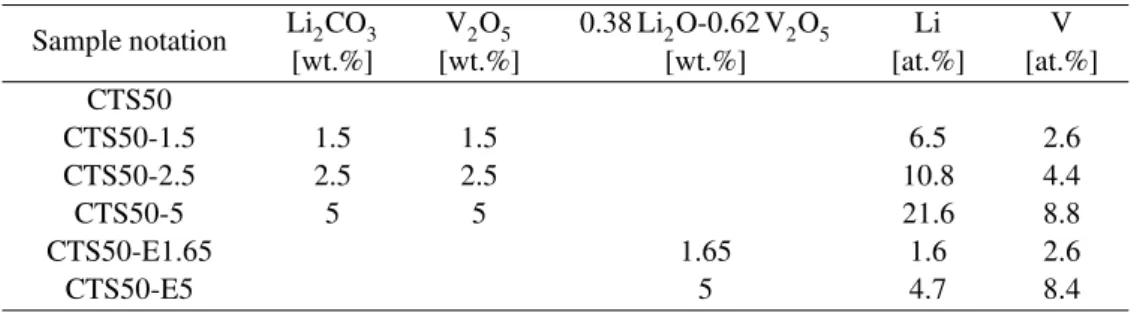
alcohol for 1 h with a Fritsch Pulverisette. Two types of samples were prepared (Table 1): the first one with equivalent mass of Li2CO3 and V2O5 and the second one with the eutectic 0.38 Li2O-0.62 V2O5composition. After drying, an organic binder (polyvinyl alcohol APV 7.5% aqueous) was added and powders were then un-axially pressed with a force of 20 kN, into pellets with diameter of 10 mm and thickness of 2–3 mm. Sintering was performed in a Pyrox furnace in air atmosphere at temperature determined according to dilatometric mea-surements with a ramp rate of 150 °C/h and a dwell time
of 2 hours.
Table 1. Composition of Ca0.5Sr0.5TiO3samples containing different amounts of additives:
Li2CO3, V2O5and eutectic mixture (0.38 Li2O-0.62 V2O5)
Sample notation Li2CO3 V2O5 0.38 Li2O-0.62 V2O5 Li V
[wt.%] [wt.%] [wt.%] [at.%] [at.%]
CTS50
CTS50-1.5 1.5 1.5 6.5 2.6
CTS50-2.5 2.5 2.5 10.8 4.4
CTS50-5 5 5 21.6 8.8
CTS50-E1.65 1.65 1.6 2.6
Figure 1. SEM micrograph of calcined Ca0.5Sr0.5TiO3
powder
Figure 2. Diffractogram of calcined Ca0.5Sr0.5TiO3powder
The crystalline phases of the sintered ceramics were determined by X-ray diffractometry (SIEMENS D5005
X-Ray Diffractometer) using Cu Kα1 radiation and a
step of 0.02 for 2θwith an acquisition time of 5 second per step. The shrinkage behaviour was studied in situ by TMA using a Setaram TMA92. Surface and cross-section microstructure of the sintered samples were ob-served by SEM (Hitashi S-3400N). The sample compo-sitions were measured with EDX Thermonoran system six. The porosity is calculated from the apparent den-sity (ρa p p) relative to the absolute density (ρabs), which
is determined with helium pycnometer (Accupyc 1330, Micrometric).
Gold electrodes are deposited using a brush on both sides of the pellets. To promote adherence the ceramic
Figure 3. Dilatometric curves of Ca0.5Sr0.5TiO3prepared with various amounts of Li2CO3and V2O5: CTS50 (a),
CST50-1.5 (b), CST50-2.5 (c) and CST50-5 (d)
samples coated with gold are annealed at 850 °C. The dielectric properties were measured as a function of temperature using a RLC meter (Fluka PM306) and re-sistivity is determined by using a Megohmeter (Sefelec).
III. Results and discussion
3.1. Structural characterization
Mean particle diameter of the calcined CTS50 pow-der, measured by laser granulometry, is around 70 nm. When observed by SEM (Fig. 1) the CTS50 powder (calcined at 1100 °C) seems to be agglomerated. X-ray diffraction pattern (Fig. 2) indicates the presence of
per-ovskite Ca0.5Sr0.5TiO3phase (JCPDF 89-8032) with an orthorhombic structure and a surprisingly intensive 101 peak at 2θ = 19.744°. Even the intensity of this peak
might indicate incomplete phase formation we have not heated the powder at higher temperature in order to pre-vent the increasing of grains size.
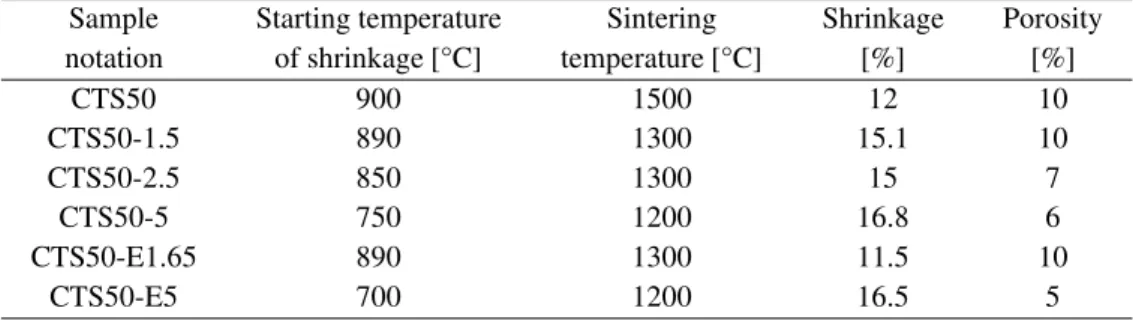
Figure 3 shows the shrinkage behaviour of Ca0.5Sr0.5TiO3 ceramics with various amounts of Li2O and V2O5. For the CST50 sample without any
sintering aids (Fig. 3, curve a), it can be seen that densification starts around 900 °C and is nearly com-pleted at 1500 °C (Table 2). An attempt of sintering at this temperature indicates a value of densification of 97 %TD (theoretical value).
TMA curves of Ca0.5Sr0.5TiO3 with addition of equivalent mass of Li2CO3and V2O5 (Fig. 3, curves b-d) show a real efficiency of the additions. The beginning
of the shrinkage is shifted to lower temperatures when the amount of Li2CO3and V2O5is increased. More
pre-Table 2. Summary of sintering conditions and densification properties
Sample Starting temperature Sintering Shrinkage Porosity notation of shrinkage [°C] temperature [°C] [%] [%]
CTS50 900 1500 12 10
CTS50-1.5 890 1300 15.1 10
CTS50-2.5 850 1300 15 7
CTS50-5 750 1200 16.8 6
CTS50-E1.65 890 1300 11.5 10
Figure 4. Dilatometric curves of Ca0.5Sr0.5TiO3prepared
with various amounts of eutectic mixture: CST50-1.5 (b), CST50-E1.65 (e) and CST50-E5 (f)
cisely we can notice that with addition of 1.5 wt.% of Li2CO3 and V2O5 (the sample CST50-1.5) the shrin-kage starts at 890 °C and continues slowly until 1000 °C.
The shrinkage rate reaches a maximum at 1150 °C and the densification is completed at 1300 °C. At higher temperatures secondary porosity appears. Concerning the addition of 2.5 wt.% of Li2CO3and V2O5(the sam-ple CST50-2.5) shrinkage begins at around 850 °C and strongly accelerates from this temperature up to 1000 °C where shrinkage slows down. Full densification occurs around 1300 °C. According to the obtained results the ceramics prepared with addition of 1.5 and 2.5 wt.% of Li2CO3and V2O5were sintered at 1300 °C (Table 2).
In the case of the sample with addition of 5 wt.% of Li2CO3 and V2O5 (CST50-5) the TMA exhibits a beginning of densification at 750 °C. Then the shrink-age continues until 1250 °C where full densification is obtained. Thus, the sample CST50-5 was sintered at a slightly lower temperature, i.e. at 1200 °C (Table 2) in order to avoid coarsening of grains and the appearance of secondary porosity.
(a) (b)
(c) (d)
Table 3. Pointed EDS analyses (from Fig. 5d)
Element line Li-K Ca-K Ti-K V-K Sr-K
Cation content [at.%] 0.00 0.62 99.16 0.19 0.03 Error,+/−1 Sigma 0.00 0.13 0.53 0.17 0.09
Figure 4 shows the TMA curves of Ca0.5Sr0.5TiO3 ceramics obtained with different amounts of the
eutec-tic 0.38 Li2O-0.62 V2O5composition. The shrinkage of
the sample CST50-E1.65 with 1.65 wt.% of the eutec-tic composition (curve e) starts at 950 °C. The samples CST50-E1.65 and CST50-1.5 have the same amount of vanadium and similar TMA curves in temperature in-terval between 950 °C and 1135 °C (Fig. 4 curves b and e). However, at higher temperature the sintering of the CST50-E1.65 is slower. Thus, the sample CST50-E1.65 was sintered at 1300 °C (Table 2).
High amount of the eutectic mixture (5 wt.%) leads to a premature shrinkage compared to the previous ones. It starts at 700 °C and continues progressively until 1200 °C where full densification is obtained. According to this, sintering temperature of the sample CST50-E5 was 1200 °C (Table 2).
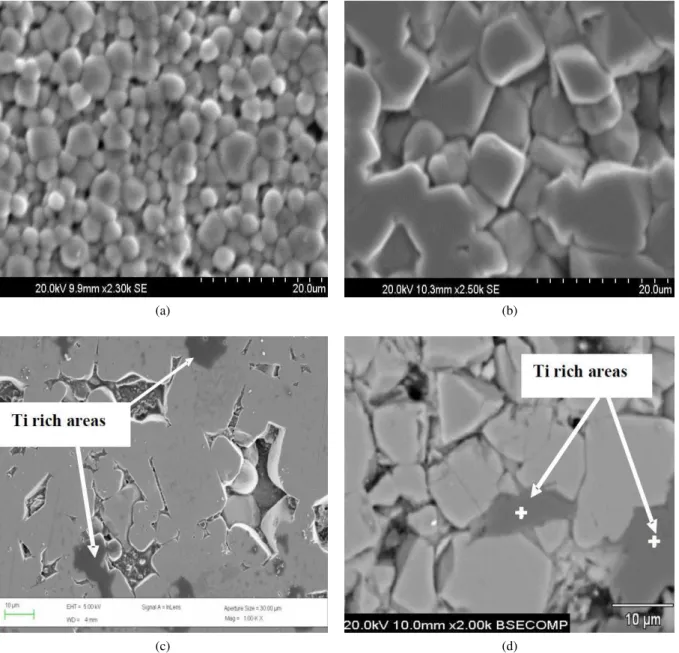
SEM micrographs of polished surface of the sin-tered samples are presented in Fig. 5. All ceramics have a dense structure and small amount of intergranular porosity (Table 2). It is clear that the grains have diff
er-ent sizes and shapes (2–12 microns). The small grains are inserted properly between large grains thus reduc-ing porosity.
Pointed EDS analyses show the presence of titanium very rich phase (Fig. 5c,d) with more than 98 at.% Ti as showing in the pointed analysis data illustrated in Table 3. This indicates that Ti could be expulsed from perovskite cell. It is not surprising when considering the mechanism of densification in the perovskite in the pres-ence of Li [16]. Because of the very close energy of Ti and V lines, EDS analyses can’t be helpful to study the repartition of V. We can’t reject the hypothesis that V5+ can enter in the perovskite cell, especially as the radius of V5+ in 6 coordination is 0.54 Å and 0.61 Å for Ti4+ in the same coordination [30–32]. These substitutions
Figure 6. Diffraction pattern of Ca0.5Sr0.5TiO3prepared with different amount of Li2CO3and V2O5
could lead to some compensation phenomenon. If Li+ substitutes Ti4+ it can play the role of acceptor and if V5+also substitutes Ti4+it can be considered as a donor. These substitutions can limit the number of oxygen va-cancies in the perovskite structure and may allow the obtaining of good dielectric properties [26]. The pres-ence of Ti rich phase is also revealed for the samples with additives with the eutectic composition (Fig. 5d), but in that case we observe an increasing of grain size may be due to too high sintering temperature.
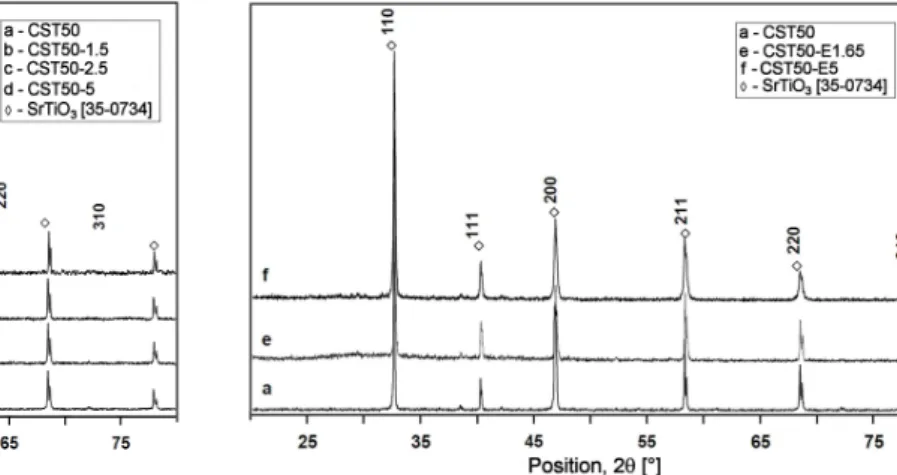
X-ray diffraction patterns of the sintered ceramics
with various amounts of Li2CO3 and V2O5 (Fig. 6) are similar and can be indexed in perovskite cubic cell ac-cording to JCPDF: 35-0734. Not any secondary phase was observed. It confirms that additives don’t destabi-lize the structure. If we index the cell according to cubic Pm3mit leads to:a=3.872 Å instead of 3.905 Å for the
pure SrTiO3 (JCPDF: 35-0734). The amounts of
addi-tives don’t modify the cell parameter. It let us think that if Li+or (and) V5+enter the perovskite cell it may be in very limited amount otherwise parameters cell will be different for each amount and secondary phase(s) will
certainly be observed for high amount of additives. The cell with the same lattice parameter (a = 3.872 Å) is
also observed for eutectic additives (Fig. 7), so even if EDS analyses present a Ti rich phase, it doesn’t seem to be demonstrated that cations Li+ and V5+ replace Ti4+ in the perovskite cell. The densification of these sam-ples could also be due to some liquid phases as shown in phase diagram Li2O/V2O5or in systems Ca/Sr/V
ox-ides [25].
3.2. Dielectric properties
Dielectric properties of Ca0.5Sr0.5TiO3ceramics pre-pared with addition of equivalent mass of Li2CO3 and V2O5 are presented in Fig. 8. The pure Ca0.5Sr0.5TiO3
(a) (b)
Figure 8. Dielectric properties of Ca0.5Sr0.5TiO3prepared with different amounts of Li2CO3and V2O5:
a) dielectric constant and b) dielectric loss
(a) (b)
Figure 9. Dielectric properties of Ca0.5Sr0.5TiO3prepared with different amounts of eutectic composition:
a) dielectric constant and b) dielectric loss
ceramic (CST50) has the highest dielectric constant at all investigated temperatures. With 1.5 and 2.5 wt.% of Li2CO3and V2O5(the samples 1.5 and CST50-2.5) dielectric constant decreases, but addition of 5 wt.% of Li2CO3and V2O5(the sample CST50-5) cause an in-crease of permittivity. This lowering of the permittivity value is accompanied by an increase of dielectric loss, indicating the increased conductivity. It is noteworthy that increase of dielectric loss is also not directly corre-lated to the amount of Li2CO3and V2O5.
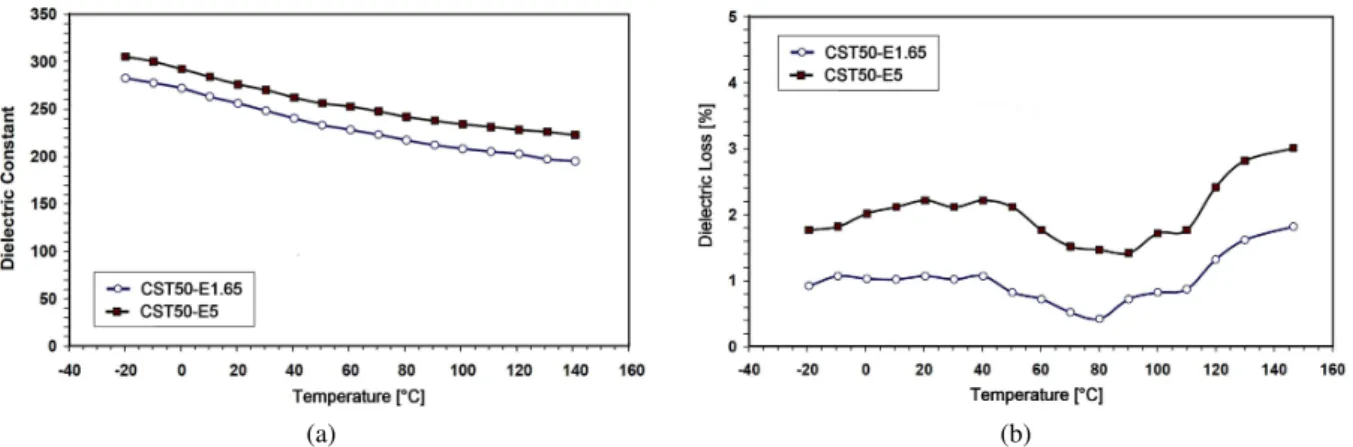
Concerning the Ca0.5Sr0.5TiO3 with addition of the eutectic composition an increase of dielectric constant at lower temperatures, and its decreases at higher tem-peratures are observed (Fig. 9a). However, addition of the eutectic composition cause considerable increase of dielectric loss (Fig. 9b). Dielectric loss also indicates the presence of semi-conduction at high temperature simi-lar to the Ca0.5Sr0.5TiO3 ceramics obtained with addi-tion of Li2CO3 and V2O5. These properties might be optimised by adjustment of appropriate sample compo-sition and one interesting way would be the study of addition of those sintering additives which could form structure with Ti vacancies. This could improve densi-fication and make easier the insertion of acceptor/donor
pair in Ti site [17].
The addition of Li-compound to dielectric materials can exacerbate moisture sensitivity [27–29]. In order to investigate this behaviour, we have measured dielectric properties of the same samples but without any regu-lation of humidity in the measuring unit. In dry atmo-sphere the samples with addition of eutectic composi-tion (CTS50-E1.65 and CTS50-E5) indicate a resistiv-ity greater than 1011Ω·cm. However, dielectric loss of
the Ca0.5Sr0.5TiO3 ceramics prepared with addition of
Figure 10. Dielectric loss measured at uncontroled humidity of Ca0.5Sr0.5TiO3prepared with different amounts of
the eutectic composition (Fig. 10) clearly shows an in-crease, which might be correlated to the increase of hu-midity in the oven. This clearly confirms that the studied samples with additives are sensitive to humidity levels in air.
This fact can also be amplified by porosity (ratio of geometric density and helium pycnometry density) of these materials. It is observed that porosity decreases with increasing the amounts of Li2CO3and V2O5(Table 2). In addition, according to dielectric measurements, given in Fig. 10, the sample CTS50-E1.65 with addition of 1.65 wt.% of the eutectic composition is more sensi-tive to humidity than the sample CTS50-E5 with 5 wt.% of the eutectic composition. However, this sample is also more porous: about 10% for the sample CTS50-E1.65 in comparison to 5% for the sample CTS50-E5. So sensitivity to humidity is not simply correlated with the amount of Li and V [27].
IV. Conclusions
This study clearly shows the efficiency of Li2O/V2O5
addition on the densification of Ca0.5Sr0.5TiO3since sin-tering temperature can be lowered to 1200 °C for the ce-ramic prepared with 5 wt.% Li2CO3 and 5 wt.% V2O5. Dense samples with little porosity were obtained with this co-addition. Best results are obtained with the addi-tion of these elements in the form of the eutectic mixture (0.38 Li2O-0.62 V2O5). The addition of 5 wt.% of the eutectic mixture allows the obtaining of material with only 5% of porosity. The cubic structure seems to be stabilised by the addition. In both cases type I dielectric properties are conserved with dielectric constant around 240 (Ri>1011Ω·cm) and an increase of dielectric loss.
The Li2CO3and V2O5addition leads also to an increase of sensitivity to humidity. This sensitivity is correlated to the presence of residual porosity. The study of den-sification optimisation by adjusting the Ti amount and sensitivity to humidity is in progress and will be pub-lished soon.
References
1. P.M. Woodward, “Octahedral tilting in perovskites, II. Structure stabilizing forces”, Acta Crystallogr. Sect.,B53[1] (1997) 44–66.
2. H. Yoshioka, “Structure and electrical properties of A-site-deficient perovskite compounds in the La2/3TiO3-La1/3NbO3 system”,J. Am. Ceram. Soc., 85[5] (2002) 1339–1342.
3. L. Zhou, P.M. Vilarinho, J.L. Baptista, “Solubility of bismuth oxide in barium titanate”,J. Am. Ceram. Soc.,82[4] (1999) 1064–1066.
4. D. Kolar, M. Trontelj, Z. Stadler, “Influence of inter-diffusion on solid solution formation and sintering in
the system BaTiO3-SrTiO3”,J. Am. Ceram. Soc.,65 [10] (1982) 470–474.
5. S. Qin, A.I. Becerro, F. Seifert, J. Gottsmann, J. Jiang, “Phase transitions in Ca1-xSrxTiO3
perovskites; effects of composition and
tempera-ture”,J. Mater. Chem.,10[7] (2000) 1609–1615. 6. C.J. Ball, B.D. Begg, D.J. Cookson, G.J.
Thoro-good, E.R. Vance, “Structures in the system CaTiO3/SrTiO3”, J. Solid State Chem., 139 [2] (1998) 238–247.
7. M. Ceh, D. Kolar, L. Golic, “The phase diagram of CaTiO3-SrTiO3”,J. Solid State Chem.,68[1] (1987) 68–72.
8. S. Sasaki, C.T. Prewitt, J.D. Bass, W.A. Schulze, “Orthorhombic perovskite CaTiO3 and CdTiO3: structure and space group”, Acta Cryst., C43 [9] (1987) 1668–1674.
9. R.H. Buttner, E.N. Maslen, “Structural study of the low-temperature phase transition in Cs3D(SeO4)2”, Acta Crystal. Sect.,B48[5] (1992). 633–639. 10. R. Ranjan, D. Pandey, V. Siruguri, P.S.R. Krishna,
S.K. Paranjpe, “Novel structural features and phase transition behaviour of (Sr1-xCax)TiO3 II. X-ray
diffraction studies”,J. Phys. Conensed Matter., 11 [10] (1999) 2247–2258.
11. J.N. Walsh, P.A. Taylor, A. Buckley, T.W. Darling, J. Schreuer, M.A. Carpenter, “Elastic and anelastic anomalies in (Ca,Sr)TiO3perovskites: Analogue be-haviour for silicate perovskites”,Phys. Earth Planet. Int.,167[1-2] (2008) 110–117.
12. M.A. Carpenter, C.J. Howard, K.S. Knight, Z. Zhang, “Structural relationships and a phase dia-gram for (Ca,Sr)TiO3 perovskites”, J. Phys.
Con-dens. Matter,18[48] (2006) 10725–10749.
13. R. Li, Q. Tang, S. Yin, H. Yamane, T. Sato, “Sinter-ing and characterization of Ca0.9Sr0.1TiO3 ceramics with sintering additive”,Mater. Sci. Eng.,A373 [1-2] (2004) 175–179.
14. Q.L. Zhang, H. Yang, H.P. Sun, “A new microwave ceramic with low-permittivity for LTCC applica-tions”,J. Eur. Ceram. Soc.,28[3] (2008) 605–609. 15. M.J. Laurent, G. Desgardin, B. Raveau, J.M.
Haus-sonne, J. Lostec, “Sintering of strontium titanate in the presence of lithium salts in a reducing atmo-sphere”,J. Mater. Sci.,23[12] (1988) 4481–4486. 16. J.M. Haussonne, G. Desgardin, PH. Bajolet, B.
Raveau, “Barium titanate perovskite sintered with lithium fluoride”,J. Am. Ceram. Soc.,66[11] (1983) 801–807.
17. J.M. Haussonne, O. Regreny, J. Lostec, G. Des-gardin, M. Halmi, B. Raveau, “Sintering of var-ious perovskites with lithium salts”, 6th Interna-tional Meeting on Modern Ceramics Technologies. (CIMTEC) World Congress on High Tech. Ceramics, Milan, Italy, Elsevier, Amsterdam , Vol. 38 A-B-C [1-9] (1987) 1515–1524.
18. K. Cvetkovic, A. Petric, “Periodic table of the ox-ides”,Am. Ceram. Soc. Bul.,79(2000) 65–69. 19. Y. Zhang, Z. Hue, Z. Gui, L. Li, “Low
20. C.L. Huang, C.H. Shen, C.L. Pan, “Characteriza-tion and dielectric behavior of V2O5-doped MgTiO3 -CaTiO3 ceramic system at microwave frequency”, Mater. Sci. Eng.,B145[1-3] (2007) 91–96.
21. Y.J. Gu, J.L. Huang, Q. Li, D.M. Sun, H. Xu, “Low-temperature firing and microwave dielectric proper-ties of 16 CaO-9 Li2O-12 Sm2O3-63 TiO2 ceramics with V2O5 addition”, J. Eur. Ceram. Soc., 28 [16] (2008) 3149–3153.
22. Q. Zeng, W. Li, J.L. Shi, X.L. Dong, J.K. Guo, “In-fluence of V2O5additions to 5 Li2O-1 Nb2O5-5 TiO2 ceramics on sintering temperature and microwave dielectric properties”, J. Am. Ceram. Soc., 90 [7] (2007) 2262–2265.
23. A.Y. Borisevich, P.K. Davies, “Effect of V2O5
dop-ing on the sinterdop-ing and dielectric properties of M-phase Li1+x-yNb1-x-3yTix+4yO3 ceramics”,J. Am. Ce-ram. Soc.,87[6] (2004) 1047–1052.
24. Q. Zeng, W. Li, J.L. Shi, J.K. Guo, “Microwave dielectric properties of 5 Li2O-0.583 Nb2O5
-3.248 TiO2 ceramics with V2O5”, J. Am. Ceram. Soc.,89[10] (2006) 3305–3307.
25. A.A. Fotiev, “System V2O5-LiVO3”,Russ. J. Inorg. Chem.,13[7] (1968) 1007–1010.
26. K. Albertsen, D. Hennings, O. Steigelmann, “Donor-acceptor charge complex formation in barium ti-tanate ceramics: role of firing atmosphere”,J. Elec-troceram.,2[3] (1998) 193–198.
27. J. Bernard, D. Houivet, M. Hervieu, J.M. Haussonne, “Evidence of the formation of a new rock-salt type compound Li2MgTiO4 and of its role on the prop-erties of the Li doped MgTiO3”, Sol. State Sci., 8 (2006) 598–605.
28. E. Traversa, “Ceramic sensors for humidity detec-tion: The state of the art and future developments”, Sensors Actuators,B23(1995) 135–156.