ISSN 1553-345X
© 2012 Science Publications
Corresponding Author: Ompe Aime Mudimu, Cologne University of Applied Sciences, Cologne, Germany
Overview of Membrane Processes for the
Recovery of Polyphenols from Olive Mill Wastewater
Ompe Aime Mudimu, Martin Peters, Florian Brauner and Gerd Braun
Cologne University of Applied Sciences, Cologne, Germany
Abstract:Problem statement: Olive Mill Wastewater (OMW) is an ambivalent by-product of the olive oil production, which appears in huge amounts every year after the olive-harvest in the production countries, mainly in the Mediterranean region. OMW is characterized by a high organic load and i.a. contains considerable amounts of phytotoxical polyphenols, which cause important environmental problems. Approach: Due to their antioxidant properties the use of these polyphenols is also popular in several industry branches, which results in high sale values for this group of chemicals. The removal of polyphenols from biological wastewaters like OMW does not only reduce the pollutant load but also shows great potential for a beneficial recovery of these antioxidants. This is the reason why a growing number of studies deal with a combined wastewater treatment, which, besides water purification, also regards the ability of recovering polyphenols. This article is an overview of reports concerning polyphenol recovery from OMW via membrane technologies. Results: Patents and studies, which appeared in literature, are reviewed in order to identify the potential of membranes as well as making comparisons possible. Some pretreatments, feasible for membrane processes, are covered. Depending on the initial wastewater and its polyphenol content the concentration in the obtained solution ranges from 0.5-19.3 g L−1 polyphenols. An example mentioned in WO2005/123603 even obtains a concentration of 30 g L−1. Polyphenols such as hydroxytyrosol, protocatechuic acid, tyrosol, caffeic acid and oleuropein were found in this concentrate and make it suitable for the use in industry. Conclusion: The membrane processes in sequential design in particular show good results and offer an alternative to other OMW treatments especially in terms of polyphenol recovery.
Key words: Olive mill, membrane processes, polyphenol recovery, mill wastewater, polyphenol content, protocatechuic acid, polyphenol recovery
INTRODUCTION
The production of olive oil, extracted from the olive fruit, involves the generation of several wastes of solid, liquid and semi-solid type. Especially the liquid fraction, called Olive Mill Wastewater (OMW), causes adverse effects on the environment, due to its phytotoxical compounds (mainly polyphenols) and because it occurs in great quantities and in a short period of time after the oliveharvest in November (Torrecilla, 2010).
A large number of small olive mills, spread across the Mediterranean region, produce about 97% of the total olive oil production worldwide. A lot of these small enterprises, deterred by the high investment costs of purification plants, still spread their wastewater on the fields or discharge it into open waters, despite its environmental impact (Paraskeva and Diamadopoulos, 2006).
However, there have been efforts to solve these environmental problems in the past few decades
(Niaounakis and Halvadakis, 2006) and scores of references and patents concerning various wastewater treatments, including physical, physicochemical, thermal and biological processes, have been published worldwide.
phenols can be found e.g., in varnishes, pesticides and in the production processes of drugs, cosmetics and synthetics. The use in different branches of industry cause high sale values (Obied et al., 2005) and make the recovery of these components from OMW attractive.
Membrane separation is one technique, which besides purifying the wastewater, is also able to recover polyphenols from OMW. The small area-requirement and low energy-consumption of this operation make it popular in water treatment and feasible for OMW treatment as well. The specific separation limits of sequent membrane processes allow adjusting this treatment with regard to the particular wastewater, whose characteristics vary with olive origin, extraction method and other factors.
Membranes separate different components, e.g., in a solution by means of their unequal particle sizes (Microfiltration, Ultrafiltration and Nanofiltration) or differences in other characteristics, which affect their permeability, such as molecular weight (Reverse Osmosis) or state of aggregation (Membrane Distillation and Osmotic Distillation) (Crittenden, 2005).
The wastewater treatment via membrane techniques obtains two phases: One which passes through the membrane (permeate) and one which remains on the feed side of the membrane (concentrate or retentate). In case of OMW that means that larger parts such as suspended solids (and therewith great amounts of organic carbon) can be separated from the wastewater by Microfiltration (MF) or Ultrafiltration (UF) and then can be found in the membrane’s retentate. Polyphenols have molecular weights (MW) ranging from 138,164 g mL−1 (tyrosol) to 540,514 g m L−1 (oleuropein) and can pass these types of membranes more or less unhindered. Then, after separating the phenolic compounds from the other organic constituent parts, Nanofiltration (NF) and Reverse Osmosis (RO) can be used for further treatment. Due to its smaller molecular weight cut-off, these membranes are able to retain polyphenols in great amounts and in that way produce a concentrated solution of polyphenols. The permeate, which is cleaned of other constituent parts, then is a harmless water and can be used for internal processes in the olive mill or for instance for irrigation. The membrane processes, presented in this study, partially have been used already for the OMW treatment or even have been patent-registered. Others just have been tested in laboratory scale only. Not all studies give numerical results and the variable composition of OMW samples complicate the comparison of given results even more. Still, the aim of this study is to provide an overview of membrane processes, which might be useable for the
treatment of OMW including polyphenol recovery and to allow comparisons between diverse plants and equipment. Takac and Karakaya (2009) argue that membranes in a sequential design seem to be the “future direction” of OMW processing and recovery of antioxidants (Takac and Karakaya, 2009).
COD reduction: In order to obtain a polyphenol concentrate, the wastewater’s pollution load has to be minimized in the first instance. Great parts of the organic substances are included in the suspended solids. That is why it is reasonable to achieve a reduction of the Chemical Oxygen Demand (COD) by retaining the suspended solids for instance via micro- or ultrafiltration. These procedures can be supported optionally by a prior enzymatic treatment. The following studies gave examples for COD reducing pretreatments.
In the eldest publication which is treated in this study Canepa et al. (1988) described a preliminary ultra-filtration of the raw wastewater to reduce the COD. The UF pilot unit was made of four multiple modules in series with three tubular membranes each for a total surface area of 2 m² and was equipped with polysulfone membranes with a nominal cut-off of 20 kDa. For the complete procedure, the temperature was kept constant at 20°C, operating pressure at 3×1.02 bar and flow rate at 3 m s−1. This UF step removed parts of the organic content (suspended solids) and showed a total COD reduction of about 63%.
In patent WO2005/123603 from 2005 Pizzichini and Russo (2005) used a combination of centrifugation, MF and UF to obtain a reduction in COD which was supported by a prior pH-adjustment and an enzymatic hydrolysis. The pH-adjustment to a value within 3 and 4.5 avoided the oxidation of the polyphenolic compounds, favoured the transformation of oleuropein into hydroxytyrosol and moreover created the optimal conditions for the following enzymatic treatment. The enzymatic hydrolysis degraded and separated organic compounds such as cellulose out from the wastewater to allow a further separation via centrifugation and to reduce the clogging effect on the membranes due to solid components. The liquid stream from the centrifugation step was then subjected to MF, which was carried out with ceramic membranes with separation limits ranging from 0.1-1.4 m and a surface area of 0.35 m² per ceramic block. Then the MF permeate was proceeded by an UF step, which used spiral-wound polymeric membranes with cut-offs ranging between 1 and 20 kDa.
polyphenol concentrate. Membranes with differential cutoffs and made of diverse materials were tested with fixed process parameters and without preliminary centrifugation but with a prior pH-adjustment to pH = 3.5 to prevent phenols oxidation. The MF process was declared as the “critical section of the process” due to fouling effects. Thus three different membranes were tested for this process, comparing productivity and fouling effects (Table 1).
The polymeric 500 kDa membrane showed a quick decreasing of the permeate flux of more than 70% due to fouling. The ceramic membranes had smaller fouling indexes than the polymeric one and were both of the same order of magnitude. The smallest fouling index was measured for the 0.45 m membrane. Although the fouling processes were still high, this membrane was pointed out to be the preferential one for the MF operation. The concentration of free low molecular weight polyphenols was 55.38 ppm in the untreated OMW in this study and grew to a value of 349.18 ppm in the MF 0.45 m permeate. With a concentration of 266.679 ppm, hydroxytyrosol accounts for 76% thereof. Other polyphenols (such as oleuropein, tyrosol, protocatechuic acid and caffeic acid) had concentrations of about 20 ppm. Alternatively to the MF process, four UF membranes were analyzed treating the same feed solution: Three polymeric membranes, supplied by GE Osmonics with cut-offs of 80, 20 and 6 kDa and then a ceramic membrane, supplied by TAMI (cut-off = 1 kDa), which further treated the permeate, produced by the kDa UF membrane (Table 2).
The combination of UF 6 kDa and UF 1 kDa was pointed out to be the most effective treatment in this process step. Amongst others, UF 6 kDa on MF 0.45 m permeate showed a rejection of about 45% of free polyphenols. The rejection of oleuropein reached 75% and hydroxytyrosol of about 45% as well. Then again UF 1 kDa on UF 6 kDa permeate reached rejections of free polyphenols and hydroxytyrosol of 32, 31% respectively. Then UF 6 kDa permeate and UF 1 kDa permeate showed a concentration of free low MW polyphenols of 230.413 ppm and 170.053 ppm, respectively.
Paraskeva (2007) described a study, which used UF for the reduction of organic substances (COD). The OMW samples, prefiltered with a polypropylene screen (80 m) to remove suspended solids, were poured onto an UF membrane made of zirconium oxide with pore sizes of 100 nm and a surface area of 0.24 m². This UF step achieved reductions of 97% Total Suspended Solids (TSS), 17% Total Organic Carbon (TOC), 21% COD and 34% phenols using a pressure of 1.75 bar. While great parts of the organic pollution could be retained, the main part of the phenolic compounds passed the UF membrane and were available for further operation steps.
Table 1: MF membranes tested by Russo
MF Membrane Material Cut-off Area (m²)
Ceramic Tami Zirconium oxide 0.80 m 0.35
Ceramic Tami Zirconium oxide 0.45 m 0.35
Polymeric Nadir Spiral-wound PE 500 kDa 3.80
(Data: Russo, 2007, p. 242)
Table 2: UF membranes tested by Russo
UF Membrane Material Cut-off Area (m²)
Polymeric GE Osmonics Spiral-wound PS 80 kDa 5.00 Polymeric GE Osmonics Spiral-wound PS 20 kDa 5.00 Polymeric GE Osmonics Spiral-wound PS 6 kDa 8.36
Ceramic Tami Zirconium oxide 1 kDa 0.35
PS = Polysulfone; PES = Polyethersulfone (Data: Russo, 2007, p. 242)
A combination of UF and NF processes for OMW treatment was investigated by Stoller (2008). First the critical fluxes were determined and the appropriate operating conditions for the UF and the NF process were calculated. In the UF step the OMW, pretreated by an aerobic biological operation, was filtered using the GE Osmonics GM4040F membrane (composite thin-film Desal-5). The temperature in the feed vessel was maintained with a heat exchanger between 16-18°C. The permeate flux was calculated as 6.25 l/ (h m²), the pressure values were adjusted (2.2-2.5 bar) to keep this flow rate constant. The NF process was then fed with the UF permeate using the GE Osmonics DK4040F membrane (also composite thin-film Desal-5). The temperature in the feed vessel was again kept between 16-18°C. For the NF process, Stoller calculated a permeate flux of 4.21 l/ (m² h) to be effective. By adjusting the operating pressure, this value was maintained constant. The UF step showed rejection values of 50% for COD and 47% for polyphenols and delivered a residue with a content of 15.65 mg L−1 polyphenols (initial value was 3.1 mg L−1). The NF observed a rejection value of 77 for COD and 97% for polyphenols. The NF residue contained a polyphenolic content of 16.0 mg L−1 (feed concentration was 1.64 mg L−1). As the UF step already severely reduced the amount of contained polyphenols (only 53 % pass the membrane) the concentration factor for further treatments is limited. It was noted that the NF permeate was a harmless water, which could be used for irrigation or be discharged in the municipal sewer system.
membrane. The UF membranes in the final unit had cut-offs of about 120-20 kDa and 20-1 kDa and areas both of 1.6 m². COD reduction values were not specified.
In an integrated membrane system for the polyphenol recovery Garcia-Castello et al. (2010) used MF and NF steps as pretreatments for reduction of the organic pollution. For the MF a laboratory pilot unit (supplied by Verind SpA, Milano, Italy) was equipped with a tubular membrane made of Al2O3 (pore sizes 200 nm, surface area 48 cm²) supplied by Inopor GmbH (Hermsdorf, Germany). Operating with a transmembrane pressure (TMP) of 0.72+/-1 bar and a temperature of 22 +/-0.01°C, the feed flow rate achieved 760 l/h. Starting with a feed solution containing 20.19 g L−1 TOC, the MF process reduced the TOC to a value of 15.01 g L−1. The amount of suspended solids was even reduced from 17.6 g kg L−1 -1.6 g kg L−1. The NF process was performed with a laboratory plant supplied by Matrix esalination Inc. (USA), equipped with a Nadir N30F spiral-wound membrane made of polyethersulfone (surface area of 1.6 m², MWCO 578 Da), supplied by Microdyn-Nadir GmbH (Venlo, Netherlands). Operating temperature was 20°C and TMP about 8 bar. The content of TOC was further reduced by the NF step and reached a value of only 5.57 g L−1.
Recently Servili et al. (2011) described a three-phase membrane system in industrial scale which used a consecutive filtration with MF and UF in combination with an enzymatic treatment to reduce the OMW pollution. Heat exchangers kept a constant temperature of 20°C for the whole treatment and a nitrogen-atmosphere in the storage vessels reduced the content of oxygen. The MF process was performed by a tubular Poly-Propylene (PP) membrane with a cut-off ranging from 0.1-0.3 m and a total surface area of 8 m². The UF process consisted of two spiral membranes made of polyamide and traces of polysulfone and treated the MF permeate. The MWCO of this membrane was stated as 7 kDa and the total surface area was 16 m². The entire process which included a final RO step for concentration, reduced the initial COD of 12.9 g L−1 with a drawdown of 98% to a COD value of 2.47 g L−1. Values for the separate membrane steps were not given.
Recovery of phenolic compounds: After separating the organic load from the wastewater, the phenolic compounds with less molecular weights can be recovered and concentrated by use of NF and RO because their cut-offs are even smaller. Most studies which were mentioned in the previous chapter also covered several options for the recovery of polyphenols via membrane technologies.
After the pretreatment for COD reduction Canepa et al. (1988) described a combination of RO and adsorbing on porous polymers for the phenol recovery. The adsorbing step showed good retention qualities for polyphenols, but is not noted in detail at this point. The focus of attention is on the reverse osmosis operation, which used the resins effluent as feed solution. The RO step consisted of two units working in series and equipped with spiral-wound modules: (1) with a nominal rejection of 97% to NaCl, working with a TMP of 0.4 bar and (2) with a nominal rejection of 95% to NaCl and anoperating pressure of 1.02 bar. Both membranes were made of polypiperazine amide and worked at a constant temperature of 20°C. This RO process showed a concentration of phenolic compounds from index 86 (RO feed) to 490 (RO retentate). Besides a further COD reduction of 93% and TSS (total suspended solids) reduction of 99% was shown.
The description in Patent No. WO2005/123603 (Pizzichini and Russo, 2005), which used MF and UF for COD reduction, arranged the phenol recovery by subsequent NF and RO. The NF worked with spiral-shaped polymeric membranes having cut-offs ranging from 150-250 Da. The NF permeate, which contained great amounts of polyphenolic compounds, was then given to the final RO operation, which was characterized by spiral-shaped polymeric membranes made of composite polyamide having high saline rejections. This final operation yielded a concentrate rich in polyphenolic compounds and a permeate consisting of purified water. The entire process can be supported by Diafiltration to improve the benefit. Examples with this operation set-up, which was fed with 200 l OMW, coming from a three-phase system, obtained about 12 l of concentrate, which contained around 30 g L−1 total polyphenols.
The experimental study of Russo (2007) concerning removal efficiencies of several MF and UF membranes concentrated the recovered polyphenols by using a final RO consisting of a polymeric Hydronautics membrane (composite polyamide) with an area of 7 m². With a concentration factor of 2.5, the RO membrane produced a retentate containing 464.870 ppm free low MW polyphenols composed of 390.449 ppm hydroxytyrosol, 27.400 ppm tyrosol, 14.968 ppm oleuropein, 14.329 ppmcaffeic acid and 17.724 ppm protocatechuic acid. Because of preliminary treatments, fouling problems were minimized and the membrane regeneration was obtained by washing with water.
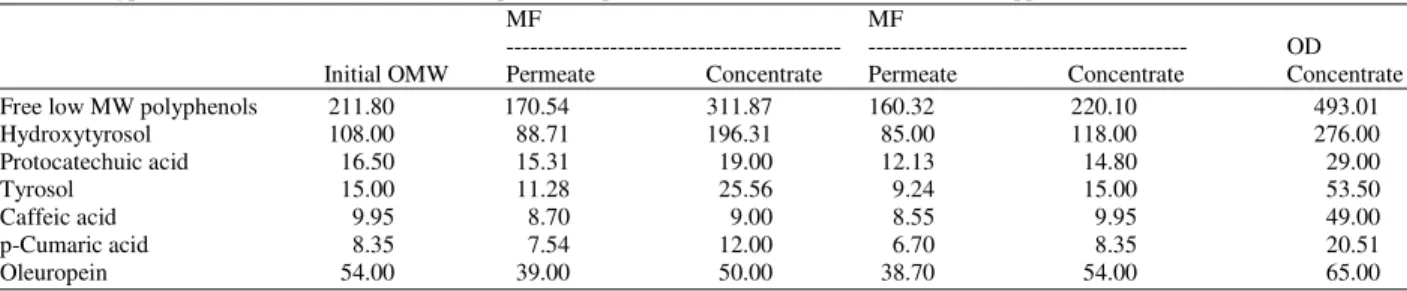
Table 3: Polyphenol concentration found in several process steps in Garcia-Castello et al. (2010) (data in ppm)
MF MF
--- --- OD
Initial OMW Permeate Concentrate Permeate Concentrate Concentrate
Free low MW polyphenols 211.80 170.54 311.87 160.32 220.10 493.01
Hydroxytyrosol 108.00 88.71 196.31 85.00 118.00 276.00
Protocatechuic acid 16.50 15.31 19.00 12.13 14.80 29.00
Tyrosol 15.00 11.28 25.56 9.24 15.00 53.50
Caffeic acid 9.95 8.70 9.00 8.55 9.95 49.00
p-Cumaric acid 8.35 7.54 12.00 6.70 8.35 20.51
Oleuropein 54.00 39.00 50.00 38.70 54.00 65.00
(Data: Garcia-Castello et al., 2010, p. 3888)
Operating pressure was between 10-30 bar for the NF between 30-40 bar for RO. Feeding with the UF permeate, the NF step showed reduction efficiencies of 99 TSS, 97 TOC, 97 COD and 98% phenols. While most phenols could pass the prior UF membrane, they were retained by the NF membrane. The NF retentate contained a concentration of 9.962 g L−1 of phenols (with respect to a feed concentration of 0.725 g L−1). Alternatively operating the UF permeate with the RO membrane obtained similar reduction results. The content of polyphenols in the RO concentrate was then determined as 6.782 g L−1 (feed had 1.018 g L−1).
Nunes et al. (2007) described the production of a hydroxytyrosol concentrate by use of nanofiltration and reverse osmosis procedures in patent number WO2007/013032. An aqueous extract (olive cake plus water) was given to a NF membrane Desal DK type (supplied by GE Osmonics) with a MWCO of 250 Da at a pressure difference of 10 bar. This process yielded a recovery of hydroxytyrosol of about 70%. The following RO process further concentrated the obtained NF retentate using a Dow Filmtec SW 30 membrane (from Dow) operating at 25 bar.
The use of Direct Contact Membrane Distillation (DCMD) for the concentration of phenolic compounds was investigated by El-Abbassi et al. (2009) taking OMW samples (press) from the region of Marrakech (Morocco). Two commercial flat-sheet hydrophobic membranes were compared to each other:
• Gelman TF200 made of PTFE
• (Polytetrafluoroethylene), mean pore size: 198.96 nm
• Millipore GVHP made of PVDF
• Polyvinylidene fluoride), mean pore size: 283.15 nm
With a concentration factor of 1.72, the TF200 membrane obtained a retentate, which had a polyphenol content of about 6.88 g L−1 (initial value was 4 g L−1). However the Millipore GVHP membrane showed a concentration factor of 1.4 and thus a polyphenol content of only 5.6 g L−1 was reached. Furthermore it was found that the TF200 showed a higher permeate flux (7.68±0.22 l/(h m²)) than the GVHP membrane.
Villanova (2008) described one NF and one RO module for the concentration of the pretreated OMW. Placed in the third unit after two UF modules, the NF membrane (area of 2.5 m², 1000-350 kDa cut-off) and following RO membrane (area of 2.5 m², 350 kDa cutoff) yielded concentrations of hydroxytyrosol of more than 1 g L−1 (initial OMW had 0.26 g L−1) and tyrosol of morethan 0.6 g L−1 (initial was 0.08 g L−1).
detailed concentrations of the main polyphenols can be found in Table 3.
The recent study of Servili et al. (2011) described a RO process using a spiral thin-film membrane made of DurasanTM and polysulfone for the concentration after pretreatments with MF and UF. The cut-off was determined to be approximately 100 Da, the total surface area was 9 m2. The content of total phenols rose from 4.9 g L−1 (initial OMW)-19.3 g L−1 in the RO concentrate. Particularly this concentration was made up of 3, 4-DHPEA (0.03 g L−1), p-HPEA (0.01 g L−1), 3, 4-DHPEA-EDA (16.9 g L−1) and verbascoside (2.4 g L−1).
CONCLUSION
Whereas the environmental impact of olive mill wastewater worsened in the past decades due to industrialization and the involving growth of olive by-products, the recovery of useful components such as antioxidant phenol compounds from OMW showed great potential to refinance the high costs of the wastewater treatment.
The described studies have proved that membrane separation is an effective technological solution for the ecological problematic olive mill wastewater and involves the recovery of polyphenols and a reduction of the environmental pollution, caused by OMW.
In general, the mentioned studies used MF and/or UF for the reduction of COD by retaining the suspended solids, which generally contain great parts of the organic substances. Moreover, enzymatic pretreatment was shown as an effective operation to support the COD reduction (Pizzichini and Russo, 2005; Servili et al., 2011). The adjustment of the OMW’s pH value was used repeatedly to avoid the oxidation process of the phenolic compounds and therewith guaranteed the quality of the final product. NF and RO showed their potential for the concentration of the phenolic compounds in the pretreated wastewater. Depending on the initial concentration the final concentrate contained between 0.5 and 30 g L−1 total polyphenols. As mentioned by Russo (2007) a concentrate with a polyphenol content of 0.5 g L−1 can be used in industry already. Thus, the concentration factor has a greater importance than the final concentration value itself. Furthermore, regarding the results it should be considered, that some experiments used small-scale set-ups and thus are not always significant for real operating conditions.
All in all membrane systems presented sustainable solutions for the pollution problem of OMW and produced polyphenol concentrates, which are valuable for several industry branches.
REFERENCES
Canepa, P., N. Marignetti,U. Rognoni and S. Calgari, 1988. Olive mills wastewater treatment by combined membrane processes. Water Res., 22: 1491-1494. DOI: 10.1016/0043-1354(88)90160-1 Crittenden, J., 2005. Water Treatment: Principles and
Design. 2nd Edn., John Wiley and Sons, Hoboken, N.J., ISBN:0471110183, pp: 1948.
El-Abbassi, A., A. Hafidi, M.C. Garcia-Payo and M. Khayet, 2009. Concentration of olive mill wastewater by membrane distillation for polyphenols recovery. Desalination, 245: 670-674. DOI: 10.1016/j.desal.2009.02.035
Garcia-Castello, E.,A. Cassano, A. Criscuoli, C. Conidi and E. Drioli, 2010. recovery and concentration of polyphenols from olive mill wastewaters by integrated membrane system. Water Res., 44: 3883-3892. DOI: 10.1016/j.watres.2010.05.005 Kapellakis, I.E., K.P. Tsagarakis, C. Avramaki and
A.N. Angelakis, 2006. Olive mill wastewater management in river basins: A case study in Greece. Agric. Water Manage., 82: 354-370. DOI: 10.1016/j.agwat.2005.08.004
Marco, E.D., M. Savarese, A. Paduano and R. Sacchi, 2007. Characterization and fractionation of phenolic compounds extracted from olive oil mill wastewaters. Food Chem., 104: 858-867. DOI: 10.1016/j.foodchem.2006.10.005
Niaounakis, M. and C.P. Halvadakis, 2006. Olive Processing Waste Management: Literature Review and Patent Survey. 2nd Edn., Elsevier, Amsterdam, London, ISBN: 0080448518, pp: 498.
Nunes, A.V.M.M., J.P.S.G. Crespo, J.C.D. Santos, A.F. Matias and C.M. Duarte et al., 2007. Method of obtaining a natural hydroxytyrosol-rich concentrate from olive tree residues and subproducts using clean technologies. IP Monitor.
Obied, H.K., M.S. Allen, D.R. Bedgood, P.D. Prenzler and K. Robards et al., 2005. Bioactivity and analysis of biophenols recovered from olive mill waste. J. Agric. Food Chem., 53: 823-837. DOI: 10.1021/jf048569x
Paraskeva, C.A., V.G. Papadakis, E. Tsarouchi, D.G. Kanellopoulou and P.G. Koutsoukos, 2007. Membrane processing for olive mill wastewater fractionation. Desalination, 213: 218-229. DOI: 10.1016/j.desal.2006.04.087
Pizzichini, M. and C. Russo, 2005. Process for recovering the components of olive mill wastewater with membrane technologies. WIPO.
Russo, C., 2007. A new membrane process for the selective fractionation and total recovery of polyphenols, water and organic substances from Vegetation Waters (VW). J. Membrane Sci., 288: 239-246. DOI: 10.1016/j.memsci.2006.11.020 Servili, M., S. Esposto, G. Veneziani, S. Urbani and A.
Taticchi et al., 2011. Improvement of bioactive phenol content in virgin olive oil with an olive-vegetation water concentrate produced by membrane treatment. Food Chem., 124: 1308-1315. DOI: 10.1016/j.foodchem.2010.07.042 Stoller, M., 2008. Technical optimization of a dual
ultrafiltration and nanofiltration pilot plant in batch operation by means of the critical flux theory: A case study. Chem. Eng. Proces.: Process Intensificat., 47: 1165-1170. DOI: 10.1016/j.cep.2007.07.012
Takac, S. and A. Karakaya, 2009. Recovery of phenolic antioxidants from olive mill wastewater. Recent Patents Chem. Eng., 2: 230-237.
Torrecilla, J.S., 2010. Phenolic compounds in olive oil mill wastewater, olive and olive oil in health and disease prevention. Amsterdam.
Villanova, L., L. Villanova, G. Fasiello and A. Merendino, 2008. Process for the recovery of tyrosol and hydroxytyrosol from oil mill wastewaters and catalytic oxidation method in order to convert tyrosol in hydroxytyrosol. US Patent Application.