John H. Miller Jr.1*, Kimal I. Rajapakshe1,2
, Hans L. Infante1, James R. Claycomb1,3
1Department of Physics and Texas Center for Superconductivity, University of Houston, Houston, Texas, United States of America,2Department of Molecular and Cellular Biology, Baylor College of Medicine, Houston, Texas, United States of America,3Department of Mathematics and Physics, Houston Baptist University, Houston, Texas, United States of America
Abstract
FO-ATP synthase (FO) is a rotary motor that converts potential energy from ions, usually protons, moving from high- to low-potential sides of a membrane into torque and rotary motion. Here we propose a mechanism whereby electric fields emanating from the proton entry and exit channels act on asymmetric charge distributions in thec-ring, due to protonated and deprotonated sites, and drive it to rotate. The model predicts a scaling between time-averaged torque and proton motive force, which can be hindered by mutations that adversely affect the channels. The torque created by thec-ring of FO drives thec-subunit to rotate within the ATP-producing complex (F1) overcoming, with the aid of thermal fluctuations, an opposing torque that rises and falls with angular position. Using the analogy with thermal Brownian motion of a particle in a tilted washboard potential, we compute ATP production ratesvs. proton motive force. The latter shows a minimum, needed to drive ATP production, which scales inversely with the number of proton binding sites on thec-ring.
Citation:Miller JH Jr, Rajapakshe KI, Infante HL, Claycomb JR (2013) Electric Field Driven Torque in ATP Synthase. PLoS ONE 8(9): e74978. doi:10.1371/ journal.pone.0074978
Editor:Wolfgang Rudolf Bauer, University Hospital of Wu¨rzburg, Germany
ReceivedMarch 14, 2013;AcceptedAugust 13, 2013;PublishedSeptember 10, 2013
Copyright:ß2013 Miller et al. This is an open-access article distributed under the terms of the Creative Commons Attribution License, which permits unrestricted use, distribution, and reproduction in any medium, provided the original author and source are credited.
Funding:State of Texas, Texas Center for Superconductivity at the University of Houston, http://www.tcsuh.com/. National Institutes of Health (NIH), NCI, R21CA133153, http://www.cancer.gov/. The funders had no role in study design, data collection and analysis, decision to publish, or preparation of the manuscript.
Competing Interests:The authors have declared that no competing interests exist.
* E-mail: [email protected]
Introduction
Living organisms rely on molecular machines and pumps [1] that transport ions through membranes, enable movement, and carry out myriads of other activities. Such machines usually extract their energy from adenosine triphosphate (ATP), consisting of adenosine bound to three phosphate groups. Ion-driven rotary motors, by contrast, are driven by an electric potential and ion gradient across a membrane, somewhat like a battery-powered electric motor. There are three known types of rotary electric motors/pumps in biology [2]: the FO-portion (FO) of ATP synthase (F-ATPase, the smallest known rotary electric motor), the bacterial flagellar motor, and the V0-portion of V-type ATPases. They contain a rotor (c-,MS-, orK-ring) embedded in a membrane. The rotor can be driven to rotate by ions moving from high to low potential or, in some cases and especially in V-type ATPases, by extracting energy from ATP hydrolysis as they pump protons or other ions ‘‘uphill’’ against the concentration gradient and/or membrane potential.
During ATP synthesis, the ion motive force across a mitochon-drial, bacterial, or thylakoid membrane drives the c-ring of FO ATP synthase to rotate [3–5]. Protons, or occasionally sodium ions, enter a half-channel in the stator (a-subunit [6]) and are directed onto aspartate or glutamate binding sites (cAsp-61 forE. coli, glutamate for mitochondria) on the c-ring (Fig. 1). After completing nearly one revolution, each ion is expelled from its respective subunit into the exit half-channel coupling to the low-potential side of the membrane in Fig. 1. Thec-ring drives thec -subunit to rotate like a camshaft within F1, structurally supported by the b-subunit [7], as it extracts and releases three ATP molecules per cycle from their catalytically active sites after
phosphorylating ADP. Unless inhibited, for example by the inhibitor protein IF1 [8], FOF1 ATP synthase can also use the energy from ATP hydrolysis in F1 to drive FO to pump protons ‘‘uphill’’ against the membrane potential and concentration gradient.
The model proposed here provides an intuitively clear mechanism for torque generation and rotation in the c-ring of FO. It is partly motivated by the fact that, in biology, electromagnetism plays the dominant role among the four forces of nature. Previous models of F-type ATPases [9–13] rely on complex computer simulations that fail to provide a clear picture of the torque–generation mechanism. Kaim and Dimroth [14] find that, in mitochondria, the membrane potential itself drives FO even in the absence of a significant proton gradient, suggesting that the electric field emanating from the channels plays a key role. ATP synthase is highly relevant to medicine due to its crucial bioenergetic role in humans, and its dysfunction has been implicated in cancer [15–19], neurodegenerative diseases [20,21], and other illnesses. The discussions below will thus treat the ions binding to thec-ring as protons, which are relevant to mitochondrial ATP synthase in humans and other eukaryotic organisms.
Results and Discussion
offset half-channels allowing entry and exit of protons that bind to the rotor (Fig. 1). Protons enter one half-channel in thea-subunit of theab2stator on the high-potential side of the membrane (top of Fig. 1), bind to the rotatingc-ring (e.g.,c10rotor forE. coli), and exit the half-channel on the low-potential side of the membrane (bottom of Fig. 1).
The two offset proton channels couple to high- and low-potential sides of the mitochondrial or bacterial inner membrane. The high-potential side also often has a higher proton concentra-tion, resulting in a pH gradient that contributes to the overall proton motive force (pmf). The proton channels are water-accessible pathways [23–25] that act as proton selective water wires [26]. Because of this proton selectivity, even when the membrane potential is reduced by compensating ion gradients (Na+, K+, Cl2, etc.), the average effective potential difference between the termini of the proton half-channels is expected to be comparable to the total pmf or difference in proton chemical potentials, Dp. This is similar to the measured voltage across an electronic device (e.g., diode, tunnel junction, or battery) being the difference in electron chemical potentials (< Fermi energies for
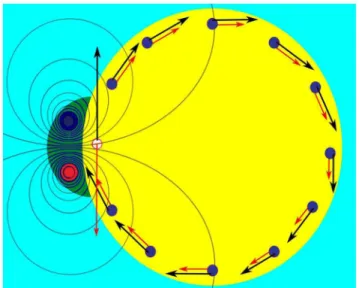
metals or semiconductors). The imbalance of protons and potentials between the proton half-channels creates an electric dipole moment that generates electric field lines going around the c-ring and between channels, as shown in Fig. 2. The field emanating from the half-channels can only generate a net torque if, on average over time, one or more proton binding sites on the c-ring immediately between the half-channels aredeprotonatedwhile most of the remaining sites going around thec-ring areprotonated. Without this charge imbalance the torques would cancel out.
Figure 2 shows cross-sections of the resulting equipotential surfaces (black lines) and tangential electric field components (red arrows), superimposed on an idealized cross section of the c-ring (yellow) anda-subunit (green). The proton channel cross sections
in thea-subunit are colored to depict the differences in potentials, with dark blue and red representing the channels coupled to high-and low-potential sides of the membrane, respectively. The protonated sites on the c-ring are shown as dark blue circles, while the light circle represents a deprotonated site. The black arrows represent tangential forces due to the field acting on protonated and deprotonated sites. Crucially, both can make positive contributions to the torque since opposite field directions are counterbalanced by opposite charges. Moreover, while the aArg-210 residue (E. colinumbering) on thea–subunit creates a barrier to positive charge that encourages deprotonation of the c-ring, it acts as a narrow potential well to negative charge, allowing ballistic transport of valence electrons that screen the deprotonated site as thec-ring rotates.
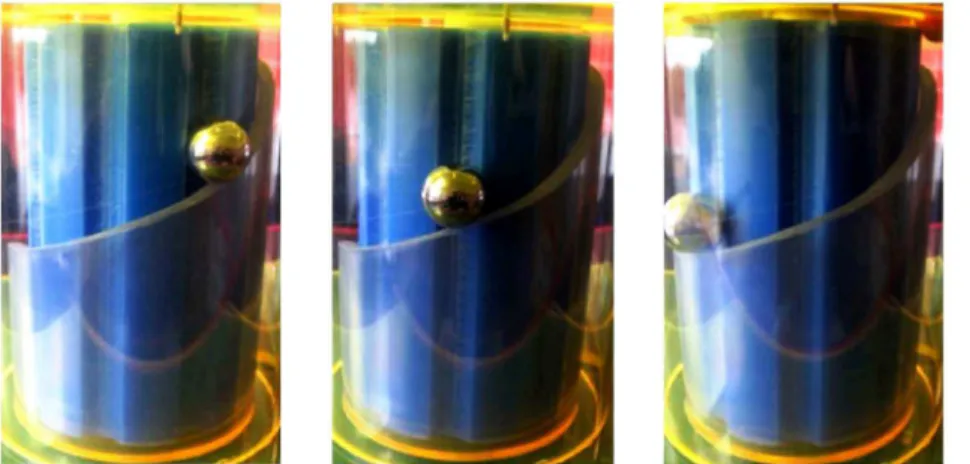
The orientation of Fig. 1, with the high-potential side on top, enables one to envision a gravity-driven mechanical model of FO -ATP synthase, as shown in Fig. 3. One or more balls (‘‘protons’’) enter a channel, roll down a spiral ramp like the walkway in New York City’s Guggenheim museum [27] while pushing against the ‘‘c-ring,’’ and emerge from an exit channel. The downward slope of the ramp depicts the negative gradient of electric potential (electric field) between the high- and low-potential channels. The model makes the direction of rotation intuitively obvious. It also shows that torque is maximized provided, most of the time on average, any sites between the channels are deprotonated while most sites going around thec-ring are protonated. In this picture, improperly protonating a site immediately between channels would be equivalent to trying to lift a ball up a much steeper ramp, representing the large, oppositely directed electric field between channels. Clearly such a ball would prefer to roll backwards down the ramp and would thus contribute negatively to the torque. This intuitive picture of FOdiffers from models that rely primarily on Brownian ratchet-like fluctuations to drivec-ring torque, e.g. [28], although both pictures predict the same direction of rotation. Thermal fluctuations, however, are crucial to overcoming the rather large energy barriers to release ATP from F1. Any
small-Figure 1. Side view of F1FOATP synthase, oriented with
high-potential side on top, showing the half-channels in the stator
a-subunit,c-ring rotor of FO(c10forE. coli), and F1 complex,
within which the c-subunit rotates to release three ATP
molecules per cycle [adapted from Fillingame[5]with permis-sion].
doi:10.1371/journal.pone.0074978.g001
Figure 2. Top view of thec-ring (yellow) and statora-subunit (green) of FO, showing equipotential surface cross-sections
(curved lines) perpendicular to the electric field emanating from the half-channels (blue and red circles) in thea-subunit.
step jerky behavior of FO, resulting from the binding and unbinding of protons from thec-ring, will thus be dominated by the much larger 120u steps in the FOF1 motor. Our subsequent discussions, which include coupling to F1, explicitly treat the role of thermal fluctuations in overcoming the energy barriers in F1.
The gravity-driven model, unfortunately, cannot capture the effects of negative charge of the deprotonated site(s) between channels (white circle in Fig. 2). The deprotonated site(s) also likely play important, if not dominant, roles in generating torque since the negative charge couples to an enormous electric field going between the two half channels. Moreover, it is immaterial whether any excess positive and negative charges are concentrated on the protonated and deprotonated binding sites themselves or distrib-uted more broadly in the c-ring. The crucial idea is that, on average, there should be a suitable electrostatic charge imbalance on thec-ring resulting, averaged over time, from protonation and deprotonation at appropriate locations. Disruptions of the proton entry and exit channels caused by mutations of the mitochondrial geneATP6 in humans can shunt protons in a possible water wire leak between the channels and/or improperly protonate and deprotonate the c-ring. This can lead to sometimes devastating neurodegenerative and other diseases in which the ability to produce ATP is greatly impaired [15–21].
In order to compute the net torque from FO, the residual charge of each protonated site on the c-ring of Fig. 2 is taken to be ae, where a is expected to range from zero to one and e~1:60|10{19C, while the charge of each deprotonated site is
taken to be –(1-a)e. As discussed in Methods, summing the
torques due to field-induced forces, using a continuum approxi-mation for the charge on thec-ring, the time-averaged torquetis found independently ofato scale withDpas:
t ~ ne 2pDp. (1)
Herenis the total number of proton binding sites on thec-ring. The work to complete one revolution,W ~2pt, equals the free energyneDpgiven up by the protons as they move from high- to low-potential, so Eq. (1) represents an upper bound of 100% efficiency fortvs.Dp.
When the c-ring couples to F1 via the c-subunit, the FO -generated torque works against an opposing torque and potential due to F1, as illustrated in Fig. 4a, due to the energy needed to release ATP and overcome an additional energy barrier. Three ATP molecules are synthesized per rotation [29] as the c-stalk rotates in 120u(2p/3 radian) steps within thea-bhexamer of F1
(green & orange ‘‘lollipop’’ in Fig. 1). The free energy DG required to synthesize ATP is expected to lie in the range 34–57 kJ/mol (0.35–0.59 eV/molecule) for ATP/ADP ratios ranging from 1021
to 103 [30]. The ATP/ADP ratio is likely close to one within the catalytically active portion of the F1 complex. Equating DG, depicted in bottom plot of Fig. 4(a), to release ATP from its catalytically active binding site in F1[31] to the work to drive the torque through a 120u(2p/3 radian) angle, W~t Dh~tð2p=3Þ, yields a critical torque tc needed to sustain ATP production in the range 27–45 pN?nm. This does not include any additional torque needed to overcome the energy barrier in F1shown in Fig. 4(a), which is typically aided by thermal fluctuations as will be discussed. Moreover, this barrier is much larger than the barrier for proton entry and exit from thec-ring and any step-like behavior of the motor is thus dominated by the 120usteps of F1[32,33], showing Brownian ratchet-like behavior.
Figure 3. Gravity-driven mechanical model of FO, where the ball rolling down the ramp depicts a proton moving to lower potential
energy, driving the blue ‘‘c-ring’’ to rotate, before emerging from the ‘‘exit channel’’ hole.
doi:10.1371/journal.pone.0074978.g003
Figure 4. Torque from the c-ring drives rotation and ATP production by overcoming the periodic energy barrier in F1
with the aid of thermal fluctuations. (a)Tilted washboard potential Uð Þh as the driving torque t from FO works against the opposing
torquetczt1sinðh=3Þfrom F1.Top:Torque exceeds the critical value
(twtc) needed to release ATP from F1 with the aid of thermally
activated hopping.Bottom:Plot shows the case where F1uses energy
from ATP hydrolysis to drive thec-ring backwards and pump protons across the membrane.(b)Computed thermally assisted ATP production (rotation) ratesfvs. pmfDp, using the tilted washboard potential in Fig. 4(a), at various temperatures and(inset) f vs. temperature for two different pmf’s, using the values n= 8, tc= 40 pN?nm, and t1= 20
pN?nm.
which also results from energy conservation. In the case of mammalian mitochondria, it has recently been found that the c-ring has only 8c-ring subunits and proton (glutamate) binding sites [34], as compared ton= 10 forE. coliand yeast mitochondria [35]. Takingn= 8 andDG= 0.45 eV yields Dpc= 169 mV. IfDpfalls belowDpc, oxidative ATP production comes to halt.
Torque measurements on F1show that its energy landscape is a periodic [32,33] function of thec-subunit rotational angleh, with a dominant period of 120uor 2p/3 radians. In our calculations of ensemble-averaged rotation and ATP production rates for FOF1 we assume a sinusoidal energy landscape (Fig. 4(a)), with an opposing torque from F1of the form:tczt1sinw, wherew~3h.
Heretcis the critical torque needed to release ATP from the F1 binding site with the aid of thermal fluctuations, and t1 results from the washboard potential barrier in Fig. 4(a) revealed by torque measurements [32]. Dissipative effects and thermal fluctuations can be modeled using a Langevin equation equivalent to Brownian motion of a particle in a tilted washboard potential. Whent.tc(top of Fig. 4(a)), thermally activated hopping enables the system to overcome the barrier at a rate that increases with temperature. Moreover, the highly viscous environment in which ATP synthase is embedded replaces any inertial response IL2w
Lt2 (I being a scaled moment of inertia) with a damped response,gLw=Lt, wheregis a damping coefficient. The result is the following Langevin equation [36]:
gww_ ~ t{tc{t1sinw z
ffiffiffiffiffiffiffiffiffiffiffi 2gkT p
jð Þt . (3)
Here k is Boltzmann’s constant and j(t) represents thermal fluctuations assumed to be Gaussian white noise (seeMethods).
To compute the ensemble average rotation rate vs. torque, Eq. (3) is converted to an equation for a probability distributionP(Q,t), which is solved numerically, as discussed inMethods. Sincej(t) is
random, the time-averaged rotation rate obtained from Eq. (3) reduces to the following simple linear form whent1= 0:
gSww_T~t{tc. (4)
SinceQ= 3hand three ATP molecules are released per cycle in a properly functioning molecule, in the presence of substrate the time-averaged ATP production rate is given by:
SATTPT_ ~S_wwT 2p. (5)
The average rotation and ATP production rates, in the presence of substrate, can thus be scaled to a dimensionless form using the following definition:
f:gStww_T
c . (6)
All but two of the plots in the following discussions assume tc= 40 pN?nm. Thus we use the definition:f:gSww_T
.
t40, where
t40;40 pN?nm, in order to show apples-to-apples comparisons in our plots of rotation and ATP production rates. After the
to have a nonlinear thermally activated form vs. absolute temperature T for values of Dpslightly above Dpc, the increase from 2uC to 80uC only represents a 28% increase in absolute temperature (275 – 353 K). Thus the rotation rate vs. temperature appears rather linear over this limited range, as the inset to Fig. 4(b) indicates.
One of the most dramatic effects of the scaling law in Eq. (1) is to cause a wide variation in the minimumDpneeded to drive ATP production for different organisms, assuming the minimum energy and torque to release ATP remain roughly constant. Structural studies to date show numbers of c-ring subunits and ion (e.g., proton) binding sites ranging from n= 8 for mammalian mitochondria [34] to n= 15 for the ATP synthasec-ring in the photosynthetic thylakoid membrane ofSpirulina platensis[37].
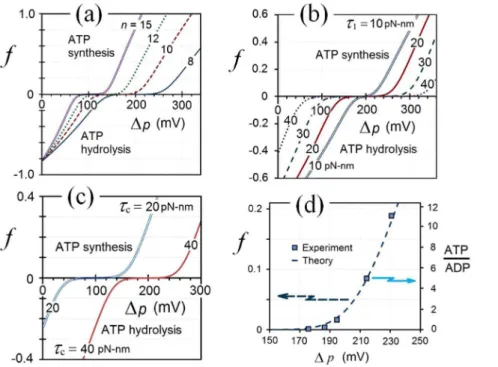
The effect of this variation innis shown in Fig. 5(a), which plots fvs.Dpfor several values ofnranging from 8 to 15. All of the plots assume a temperature of 37uC and values oftc= 40 pN?nm and t1= 20 pN?nm. The negative values of f represent backward rotation of thec-ring, where ATP hydrolysis in F1provides energy to pump the protons against the membrane potential and pH gradient. Such proton pumping processes are usually inhibited by IF1in ATP synthase motors of mammalian mitochondria [8], but likely play a crucial role in maintaining the needed membrane potentials of prokaryotic organisms. A key result depicted by Fig. 5(a) is the nearly factor of two variation in minimumDpneeded to yield a positivef. From an evolutionary perspective, there may be a tradeoff between having a smaller minimumDpto drive oxidative ATP production (large n) vs. requiring fewer protons per ATP molecule (small n). Alternatively, perhaps there are selective advantages to the values of membrane potential maintained by different organisms and organelles for their specific environments. Finally, some variations innandDpcould merely be evolutionary accidents to which various types of organisms and organelles have managed to adapt.
Since there may also be some variation in the minimum energy and energy barrier to release ATP, caused by slight structural variations in F1and other factors, we have also computedfvs.Dp for fixed n ( = 8) and several values of t1 and tc, keeping the temperature fixed at 37uC, as shown in Figs. 5(b) and 5(c). Fig. 5(b) shows that increasing t1, proportional to the potential energy barrier in Fig. 4(a), increases the spread in Dp between ATP synthesis and ATP hydrolysis. By contrast, changingtc, propor-tional to the free energyDGto phosphorylate and release ATP, simply shifts the overall f vs. Dp curve to the left or right, as illustrated by Fig. 5(c).
forceDpobtained from rat liver mitochondria [38], we find that the ATP production rate computed using our model fits the reported data at room temperature (24uC) using n= 8, tc= 31 pN?nm, andt1= 17 pN?nm, as shown in Fig. 5(d). One usually measures the membrane potentialDyusing a voltage sensitive dye such as TMRM or TMRE [39] rather than the total proton motive force Dp. Unlike thylakoid membranes in chloroplasts where the pH gradient usually dominatesDp[40], the membrane potential Dy often dominates Dp (Dy . 70% of Dp) in mitochondria [30].
The need to maintain adequate Dp to produce ATP via oxidative phosphorylation has enormous medical consequences. Inadequacy of mitochondrial membrane potential and pH gradient likely play important roles in the latter stages of a failing heart [41] and other problems resulting from accumulated mitochondrial mutations due to aging [42]. Mitochondrial complex I deficiency [43] is a frequently reported cause or contributor to cardiomyopathies and neurodegenerative disorders. Dysfunction of complex I and other mitochondrial complexes upstream from ATP synthase, and their inability to maintain adequate Dp, almost certainly results in inadequate ATP production. The simple ATP synthase model discussed here could thus provide a conceptual framework to study a range of effects of mitochondrial dysfunction, by incorporating it into a more comprehensive model of the respiratory chain.
Methods
A. Electric Field Driven Torque in FO-ATP Synthase The equipotential surface cross-sections (curved lines) in Fig. 2 were calculated using QuickField finite-element method software. Figure 6 shows a simplified geometry illustrating the proton
channel andc-ring cross sections. Following our discussion in the previous section regarding the proton selectivity of the two channels then, if one labels the two channel positions asAandB, the electric field inside the membrane is expected to satisfy:
ðB
A
E:dr ~ {Dp, whereDpis the proton motive force. Though
not essential for subsequent derivations, one can obtain a convenient approximate analytical expression for the field in the middle of the membrane by treating the channels (cross sections shown in Fig. 6) as long cylinders of radiusawith centers separated by distanced, charge per unit volume6ryielding charge per unit length6l=6pa2r, and assuminga,,d,,r, whereris the radius of the c-ring. A rather lengthy calculation (e.g., see [44]), taking the vector sum of the electric fields, then yields: Eh~ ld
8per2
tan2ðh=2Þz1
, whereeis the dielectric constant andhis defined in Fig. 6. Here we hypothesize that the pmf Dp across the membrane (see discussion of proton selectivity in Results and Discussion) is equivalent to the effective potential difference DVbetween channels. Thus, by equatingDVto the negative line integral of the field between channels yields:Dp~DV~
lln 4=ð2peÞ[l~2peDp=ln 4. Substituting this result into ex-pression forEhabove yields the following simple expression for the
tangential field component:
Eh ~ E0 tan2
h
2 z1
~ E0 tan2dz1
, (M-1)
where the angles are defined in Fig. 6 and E0 ~ Dp d4 ln 4r2.
At this stage we take the number of normally occupied ion (usually proton) binding sites in thec-ring to bep, the number of normally unoccupied sites to beq, and the total number of ion
Figure 5. Plots show the predictedc-ring rotation rates vs. proton motive force for various values ofn,tc, andt1. (a)Predicted rotation ratef(see text) vs. pmf,Dp, takingtc= 40 pN-nm andt1= 20 pN-nm, for various numbersnof proton binding sites on thec-ring. Positive and
negative rotation rates correspond to ATP synthesis and ATP hydrolysis, respectively.(b)Theoretical rotation ratefvs.Dp, assumingtc= 40 pN-nm
andn= 8, for various values oft1.(c)Predicted rotation ratefvs.Dp, assumingt1= 20 pN?nm andn= 8, for two values oftc.(d)Theoretical ATP
production rate (dashed line) vs.Dp(usingtc= 31 pN?nm andt1= 17 pN?nm), as compared to maximum intracellular ATP/ADP ratios (squares)
reported by Nicholls [38].
binding sites to ben=p+q. In the case of F0,qis usually,1-2, whilenranges from 8 to 15 [34,37]. The tangential force acting on each occupied site (p-site) will then beFph ~ aeEh, where
e= 1.60610219
C andarepresents the fraction of uncompensated positive charge, where 0#a#1. Similarly, the tangential force acting on each unoccupied site (q-site) will be Fqh ~ {ð1{aÞeEh. In order to compute time-averaged torque
(smoothing out stepping motion), we make a continuum approx-imation, where any residual positive charge in the occupied sites is distributed uniformly around thec-ring perimeter, and similarly for any net negative charge in the unoccupied site(s). Additionally, we assume that the half channels are (optimally) positioned such that d=2pr~q=n. Within these approximations, the average charge per unit length outside (in thep-sites) and between (q-sites) half channels are given by rp~nae=ð2prÞ and
rq~ {nð1{aÞe=ð2prÞ. Finally, we note that the proton motive
force satisfies:Dp~
ð
outside path
Eout:dr~
ð
inside path
Ein:dr, where the line
integrals are from the positive to the negative half channel around the ring (outside path) or between half channels (inside path). The total field-induced torque, averaged over time, then becomes:
t~r Ð
outside path
rpEout:dr{r
Ð
inside path
rqEin:dr~rne
2pr½aDpzð1{aÞDp.(M-2)
Eq. (M-2) does not depend on the detailed form of the electric field (e.g., Eq. (M-1) or not) provided we take rp and rq to be constant in the regions of interest. Doing the appropriate cancellations in Eq. (M-2) yields the scaling law, Eq. (1), between torque and proton motive force, which is repeated here for convenience:
t ~ ne
2pDp: ðM3Þ
Herenis the total number of ion (proton) binding sites on the rotor. The work to complete one revolution isW ~2pt. This, according to Eq. (M-3), is precisely the energyneDpgiven up by the protons as they translocate across the membrane, so the scaling law represents the upper bound of 100% efficiency in converting
the number of revolutions per unit time:
J ~ ne hh_
2p ~ G0Dp, ðM4Þ
whereG0~n2e2
4p2g0
is the conductance of FOassuming any central hole in the c-ring is plugged by the ce subunit. Equation (M-4) is consistent with the experimentally observed ohmic conductance [45] in the proton-driven rotor of FO-ATP synthase in the absence of F1.
If the average occupancypo/pof ideally occupiedp-sites is less thanone, and similarly with the numberqeof emptyq-site(s), then the torque will be reduced, as follows:
t ~ ne 2p
po
p z
qe
q {1
Dp, ðM5Þ
which simplifies to Eq. (M-3) (Eq. (1)) whenpo/p= 1 andqe/ q= 1. One can see from the above equation, Eq. (M-5), that improper protonation and deprotonation of the c-ring due to mutations or other factors will reduce the torque vs. proton motive force efficiency.
B. Coupling to the F1-ATP Synthase Energy Landscape When FO is coupled to F1 via the c-subunit, the torque generated by FOworks against an opposing torque and potential due to F1, as illustrated in Fig. 4(a). Three ATP molecules are synthesized per rotation [29] as thec-stalk rotates in 120u steps within thea-bhexamer of F1(green & orange ‘‘lollipop’’ in Fig. 1). Equating the free energyDGto release ATP from its binding site in F1 [31] to the work, W~tDh~tð2p=3Þ, done by the driving torque through a 120u (2p/3 radian) angle, yields a minimum torque tc= 3DG/2p to sustain ATP production. Measurements of torque [32,33], produced by F1when hydrolyz-ing ATP or required to drive F1 to phosphorylate ADP, yield values in the ranges discussed in the previous section. Combining DG=tc(2p/3) with equation (M-3) yields a critical proton motive force – the minimum needed to drive ATP synthesis at finite temperatures – given by:
Dpc ~ 3DG
ne , ðM6Þ
which also results from energy conservation. Takingn= 10 (e.g., forE. coli) andDG= 0.45 eV, yieldsDpc= 135 mV. Importantly,
Figure 6. Geometry ofc-ring and stator half channels, showing the geometrical parameters used to express the tangential field component in Eq. (M-1).
equations (M-3) and (M-6) universally apply to all three domains of life. If Dp falls below Dpc, ATP production via oxidative phosphorylation comes to halt.
Torque measurements [32,33] on F1also show that its energy landscape is periodic, with a dominant periodicity of 120u. When coupling F0to F1, we assume a sinusoidal energy landscape (Fig. 4(a)), with an opposing torque of the form: tczt1sin 3h. The
equation of motion for the rotor-ce assembly then becomes: g0hh_ ~ t{tc{t1sin 3h ~ ðne=2pÞDm{tc{t1sin 3h. At
finite temperatures, allowing thermally activated hopping over the barrier, the critical proton motive force is simply:Dpc~2ptc=ne, where tc~ð3=2pÞDG. Making the substitutions, w~3h and
g~g0=3, leads to the following equation of motion:
gdw
dt ~ t{tc{t1sinw, ðM7Þ
which describes a particle in a tilted washboard potential. At finite temperatures, Brownian fluctuations can be modeled using a Langevin equation [36]:
gdw
dt ~ t{tc{t1sinw z ffiffiffiffiffiffiffiffiffiffiffi 2gkT p
jð Þt ðM8Þ
where k is Boltzmann’s constant and j(t) is assumed to be Gaussian white noise, Sjð Þt jð Þt1 T~dðt{t1Þ. Equation (M-8) is
equivalent to Brownian motion of a particle in a tilted washboard potential, for which a kinetic theory has been developed in the context of condensed matter systems [46–48].
At finite temperatures, following Ambegaokar and Halperin [46] (also see [49]), the Fokker-Planck equation resulting from equation (M-8) reduces in the overdamped limit to the Smoluchowski equation for a distribution functionP(Q,t):
LP
Lt ~ { 1 g
L
Lw ðt{tc{t1sinwÞP{kT
LP
Lw
: {LW
Lw :ðM9Þ
In Eq. (M-9), the fluxW~Sww_T.2pis equivalent to the
time-averaged ATP production rate. The steady state case,LP=Lt~0, leads to the following first-order differential equation:
dP dw z
1
kT½t{tc{t1sinwP ~ g
kT W, ðM10Þ
where W is now constant. The rotation rateSww_T~2pW is determined by finding the solution P(Q), and applying the
normalization, ðp
{p
Pð Þw ~1, and periodicity condition,
Pð{pÞ~Pð Þp , with the result [38] (definingt’;t–tc):
Sqq_T~
2pkT
g 1{exp {
2pt0 kT
2ðp
0
F xð ,0Þ ð xz2p
x
Fð0,yÞdy 0 @ 1 Adx 2 4 3 5 {1 ,
ðM11Þ
where
F kð ,lÞ ~ exp { 1
kT ðl
k
t0{t
1sinz
½ dz
2
4
3
5: ðM12Þ
The steady state flux in equations (M-11) and (M-12) is a solution of the 1-D Smoluchowski equation for cyclic diffusion paths reported by Stratonovich [50] and used to characterize diffusion in tilted periodic potentials [51]. When kT and t’ are both small compared to t1, the above integrals reduce to the following analytical expression [52,53]:
Sqq_T~
2
g
ffiffiffiffiffiffiffiffiffiffiffiffiffiffi t2
1{t02
q
exp {
ffiffiffiffiffiffiffiffiffiffiffiffiffiffi t2
1{t02
q
kT {
t0 kTsin
{1t0
t1 8 < : 9 = ; sinh pt 0 2kT :
ðM13Þ
The results discussed in the previous section are obtained by numerically integrating Eqs. (M-11) and (M-12), enabling com-putation of rotation and ATP production rates vs. torque. The scaling relation between torque andDp(Eq. (1) or Eq. (M-3)) then enables plots of ATP production rate vs. proton motive forceDp, with finite-temperature results shown in Figs. 4(b) and 5.
Concluding Remarks
The field-driven torque model proposed here suggests a simple mechanism by which a membrane potential and ion gradient can drive a rotary motor such as ATP synthase. When FO-ATP synthase is coupled to F1, the model shows that ATP synthase exhibits highly nonlinear behavior, with a critical proton motive force needed to drive ATP production that depends strongly on the number of proton binding sites on thec-ring. An increased, but not infinite, periodic potential barrier in F1in the absence of ADP [32] suggests that ATP synthase itself acts as a mitochondrial ‘‘uncoupler’’ when the proton motive force is high. Proton flux could drive the c-ring and c-subunit of FOF1-ATP synthase to rotate even without producing ATP [32], thus dissipating some of the excess membrane potential that would otherwise produce deleterious reactive oxygen species when the mitochondrial membrane potential is sufficiently high.
5. Fillingame RH (2000) Getting to the bottom of the F1-ATPase. Nat Struct Biol 7: 1002–1004.
6. Zhang D, Vik SB (2002) Helix Packing in Subunit a of the Escherichia coli ATP Synthase as Determined by Chemical Labeling and Proteolysis of the Cysteine-Substituted Protein{. Biochemistry 42: 331–337.
7. Motz C, Hornung T, Kersten M, McLachlin DT, Dunn SD, et al. (2004) The Subunit b Dimer of the FoF1-ATP Synthase: Interaction with F1-ATPase as Deduced by Site-Specific Spin-Labeling. Journal of Biological Chemistry 279: 49074–49081.
8. Campanella M, Casswell E, Chong S, Farah Z, Wieckowski MR, et al. (2008) Regulation of Mitochondrial Structure and Function by the F1Fo-ATPase Inhibitor Protein, IF1. Cell Metabolism 8: 13–25.
9. Aksimentiev A, Balabin IA, Fillingame RH, Schulten K (2004) Insights into the molecular mechanism of rotation in the F0sector of ATP synthase. Biophys J 86: 1332–1344.
10. Bustamante C, Keller D, Oster G (2001) The physics of molecular motors. Acc Chem Res 34: 412–420.
11. Elston T, Wang H, Oster G (1998) Energy transduction in ATP synthase. Nature 391: 510–513.
12. Oster G, Wang H, Grabe M (2000) How Fo-ATPase generates rotary torque. Philos Trans R Soc Lond B Biol Sci 355: 523–528.
13. Xing J, Wang H, von Ballmoos C, Dimroth P, Oster G (2004) Torque generation by the Fo motor of the sodium ATPase. Biophys J 87: 2148–2163. 14. Kaim G, Dimroth P (1998) Voltage-generated torque drives the motor of the
ATP synthase. EMBO J 17: 5887–5895.
15. Arnold RS, Sun CQ, Richards JC, Grigoriev G, Coleman IM, et al. (2009) Mitochondrial DNA mutation stimulates prostate cancer growth in bone stromal environment. The Prostate 69: 1–11.
16. Dasgupta S, Yung RC, Westra WH, Rini DA, Brandes J, et al. (2009) Following Mitochondrial Footprints through a Long Mucosal Path to Lung Cancer. PLoS ONE 4: e6533.
17. Petros JA, Baumann AK, Ruiz-Pesini E, Amin MB, Sun CQ, et al. (2005) mtDNA mutations increase tumorigenicity in prostate cancer. Proceedings of the National Academy of Sciences of the United States of America 102: 719–724. 18. Plak K, Czarnecka AM, Krawczyk T, Golik P, Bartnik E (2009) Breast cancer as
a mitochondrial disorder (Review). Oncology Reports 21: 845–851. 19. Shidara Y, Yamagata K, Kanamori T, Nakano K, Kwong JQ, et al. (2005)
Positive Contribution of Pathogenic Mutations in the Mitochondrial Genome to the Promotion of Cancer by Prevention from Apoptosis. Cancer Research 65: 1655–1663.
20. Mattiazzi M, Vijayvergiya C, Gajewski CD, DeVivo DC, Lenaz G, et al. (2004) The mtDNA T8993G (NARP) mutation results in an impairment of oxidative phosphorylation that can be improved by antioxidants. Human Molecular Genetics 13: 869–879.
21. Sgarbi G, Baracca A, Lenaz G, Valentino LM, Carelli V, et al. (2006) Inefficient coupling between proton transport and ATP synthesis may be the pathogenic mechanism for NARP and Leigh syndrome resulting from the T8993G mutation in mtDNA. Biochemical Journal 395: 493–500.
22. Junge W, Sielaff H, Engelbrecht S (2009) Torque generation and elastic power transmission in the rotary FOF1-ATPase. Nature 459: 364–370.
23. Angevine CM, Fillingame RH (2003) Aqueous Access Channels in Subunit a of Rotary ATP Synthase. Journal of Biological Chemistry 278: 6066–6074. 24. Gohlke H, Schlieper D, Groth G (2012) Resolving the Negative Potential Side
(n-side) Water-accessible Proton Pathway of F-type ATP Synthase by Molecular Dynamics Simulations. Journal of Biological Chemistry 287: 36536–36543. 25. Steed PR, Fillingame RH (2008) Subunit a Facilitates Aqueous Access to a
Membrane-embedded Region of Subunit c in Escherichia coli F1F0 ATP Synthase. Journal of Biological Chemistry 283: 12365–12372.
26. Schmitt UW, Voth GA (1999) The computer simulation of proton transport in water. The Journal of Chemical Physics 111: 9361–9381.
27. Guggenheim Museum, New York, website. Available: http://www.guggenheim. org/new-york/visit. Accessed 2013 August 14.
28. Bauer WR, Nadler W (2008) Dynamics and efficiency of Brownian rotors. The Journal of Chemical Physics 129: 225103–225114.
Viscoelastic Dynamics of Actin Filaments Coupled to Rotary F-ATPase: Angular Torque Profile of the Enzyme. Biophysical Journal 81: 1220–1233. 34. Watt IN, Montgomery MG, Runswick MJ, Leslie AGW, Walker JE (2010)
Bioenergetic cost of making an adenosine triphosphate molecule in animal mitochondria. Proceedings of the National Academy of Sciences 107: 16755– 16756.
35. Dautant A, Velours J, Giraud M-F (2010) Crystal Structure of the Mg? ADP-inhibited State of the Yeast F1c10-ATP Synthase. Journal of Biological Chemistry 285: 29502–29510.
36. Machura L, Kostur M, Talkner P, Luczka J, Hanggi P (2006) Quantum diffusion in biased washboard potentials: strong friction limit. Phys Rev E Stat Nonlin Soft Matter Phys 73: 031105.
37. Pogoryelov D, Yu J, Meier T, Vonck J, Dimroth P, et al. (2005) The c15 ring of the Spirulina platensis F-ATP synthase: F1/F0 symmetry mismatch is not obligatory. EMBO Reports 6: 1040–1044.
38. Nicholls DG (2004) Mitochondrial membrane potential and aging. Aging Cell 3: 35–40.
39. Scaduto Jr RC, Grotyohann LW (1999) Measurement of Mitochondrial Membrane Potential Using Fluorescent Rhodamine Derivatives. Biophysical Journal 76: 469–477.
40. Berg JM, Tymoczko JL, Stryer L (2002) Biochemistry, 5th Edition. New York: W. H. Freeman.
41. Rosca MG, Hoppel CL (2010) Mitochondria in heart failure. Cardiovascular Research 88: 40–50.
42. Wallace DC (2005) A Mitochondrial Paradigm of Metabolic and Degenerative Diseases, Aging, and Cancer: A Dawn for Evolutionary Medicine. Annual Review of Genetics 39: 359–407.
43. Fassone E, Rahman S (2012) Complex I deficiency: clinical features, biochemistry and molecular genetics. Journal of Medical Genetics 49: 578–590. 44. Jackson JD (1999) Classical Electrodynamics - Third Edition. New York: John
Wiley & Sons, Inc.. 808 p.
45. Feniouk BA, Kozlova MA, Knorre DA, Cherepanov DA, Mulkidjanian AY, et al. (2004) The Proton-Driven Rotor of ATP Synthase: Ohmic Conductance (10 fS), and Absence of Voltage Gating. Biophysical journal 86: 4094–4109. 46. Ambegaokar V, Halperin BI (1969) Voltage Due to Thermal Noise in the dc
Josephson Effect. Physical Review Letters 22: 1364–1366.
47. Bardeen J, Ben-Jacob E, Zettl A, Gru¨ner G (1982) Current Oscillations and Stability of Charge-Density-Wave Motion in NbSe_{3}. Physical Review Letters 49: 493–496.
48. Gru¨ner G, Zawadowski A, Chaikin PM (1981) Nonlinear Conductivity and Noise due to Charge-Density-Wave Depinning in NbSe_{3}. Physical Review Letters 46: 511–515.
49. Gitterman M, Berdichevsky V (2001) Effect of noise on a particle moving in a periodic potential. Physical Review E 65: 011104.
50. Stratonovich RL (1965) English translation of Radiotekh. Elektron. (Moscow) 3, 497 (1958). In: Kuznetsov PI, Stratonovich RL, Tikhonov VI, editors. Non-Linear Transformations of Stochastic Processes. Oxford: Pergamon. 51. Reimann P, Van den Broeck C, Linke H, Ha¨nggi P, Rubi JM, et al. (2002)
Diffusion in tilted periodic potentials: Enhancement, universality, and scaling. Physical Review E 65: 031104.
52. Ambegaokar (1969) Voltage due to Thermal Noise in the DC Josephson Effect. PRL 22: 1364 – 1366.
53. Gitterman M, Berdichevsky V (2002) Effect of noise on a particle moving in a periodic potential. Physical Review E 65.
54. Corte´s-Herna´ndez P, Va´zquez-Memije ME, Garcı´a JJ (2007) ATP6 Homo-plasmic Mutations Inhibit and Destabilize the Human F1F0-ATP Synthase without Preventing Enzyme Assembly and Oligomerization. Journal of Biological Chemistry 282: 1051–1058.
55. Solaini G, Harris DA, Lenaz G, Sgarbi G, Baracca A (2008) The study of the pathogenic mechanism of mitochondrial diseases provides information on basic bioenergetics. Biochimica et Biophysica Acta (BBA) - Bioenergetics 1777: 941– 945.
with the T8993G or T8993C mitochondrial DNA mutations. Journal of Inherited Metabolic Disease 21: 829–836.