Research article
A Study of Relation of Stature with Foot Length in Natives of Gujarat State
Utsav Parekh*, Reekee Patel*, Pratik Patel**
*Resident, **Professor and Head, Smt. N.H.L. Municipal Medical College, Ahmedabad.
Abstract
Establishment of an identity is very much important in both civil and criminal cases. Stature is one of the criteria of personal identification. Many studies have shown that limbs exhibit consistent ratios relatives to the total height of a person. A very little work has been done for stature estimation from foot length in Gujarat state. So, the present study was carried out for estimation of stature from the foot length of total 200 medical students (116 Males and 84 Females) in 17-21 years age group in dept of Forensic Medicine and Toxicology, Smt. N. H. L. Municipal Medical College, Ahmedabad, Gujarat. Stature and foot length measurements of each one of them were taken using standard instruments. Foot length was defined as straight distance from the most prominent part of the heel backwards (pternion) to the most distal part of the longest toe (acropodian). Data was analyzed and a good correlation was observed and it was statistically highly significant (p<0.001). It was concluded that there is positive correlation between stature and foot length in a particular population and the estimation of stature among the population can be carried out using foot length. The result of the present study would be useful for anthropologists and Forensic Medicine Experts.
Key Words
Foot length, Gujarat, Identification, Stature.
Introduction
The identification of a dead body is required in cases of sudden and unexpected death, fires, explosions, railway or aircraft accidents and decomposed skeletal remains.1Estimation of stature becomes equally important along with other parameters like age, sex, race, etc. The forensic scientists are well aware of the fact that the complete skeleton is rarely available at the scene of crime. Thus the scientists may have no choice than to use mathematical method of stature reconstruction. This is of obvious advantage that it is workable even if a part of upper or lower extremity is available for examination.2
Estimation of stature from measurements of upper limb and lower limb bones has been attempted by many scientists with varying degree of accuracy.3It has been universally concluded that the Linear Regression Equation provides best estimates for stature estimation from bone length.4 Kulthanan, Rutishauser, Ozden, Philip et al have studied the
reliability of prediction of height from foot length.5It has been shown that the reliability of prediction of height from foot measurements was as high as that from long bones.6
Most studies since that time have stressed that regression formula for stature estimation should be population-specific and gender specific.7 Ossification and maturation in the foot occurs earlier than the long bones and therefore, during adolescence age, height could be more accurately predicted from foot measurement as compared to that from long bones. However, a little work has been done for estimation of stature from foot length in Gujarat state. So, this study was conducted to study at which extent stature can be estimated from foot length and to yield population and gender specific linear regression equation for stature estimation from foot length in natives of Gujarat state.
Material and Methods:
A study was carried out among two hundred (200) medical students (116 Males and84 Females) aged between 17-21 years who are natives of Gujarat state, in Dept. of Forensic Medicine, Smt. N. H. L. Municipal Medical College, Ahmedabad, Gujarat. Subjects with deformities of vertebral column or limbs and with chronic illness were excluded. Informed, written, witnessed consent in vernacular of each subject was taken and in case of minor, informed written consent of legally acceptable representative was taken. Measurements in female subjects were taken in presence of female attendant.
Stature was measured in standing posture using the methods described by Cameron et al.8 The subject was instructed to stand barefooted on the board of a standard height measuring instrument with both feet in close contact with each other, trunk braced along the vertical board and head oriented in Frankfort horizontal plane. The measurement was taken in centimetres by bringing the horizontal sliding bar to the vertex.
The foot length is defined as straight distance from the most prominent part of the heel backwards (pternion) to the most distal part of the longest toe (acropodian). The measurement was made on the standing subject, his right leg being slightly bent and drawn backward so that the body-rested mainly on the left foot, which one was to be measured. The caliper was horizontally placed along the medial border of the foot. The fixed part of the outer jaw
of the caliper was applied to the pternion and the mobile part of the outer jaw was approximated to the acropodian and measurements were taken. In the same way, the measurements were taken on the other foot.
All the measurements were taken by the same observer and with the same instrument, to avoid any technical and/or inter-observer error and to maintain reproducibility. To eliminate discrepancy due to diurnal variation the measurements were taken at fixed time between 2pm – 5pm. The measurements were taken three times and their mean value was considered. Data so collected were entered in a master chart in Microsoft® Excel and were analyzed using the SPSS version 17.0.
Result:
Total 200 subjects were included in the study. Out of this 116 (58%) were Males and 84 (42%) were Females with the Male: Female ratio of the population being 1:0.72. The Range of Age for the study subjects was from 17-21 years. Mean Age of Males was 19.14years with Standard Deviation (SD) of 1.171whereas Mean Age of Females was 19.02 years with Standard Deviation (SD) of1.222. This difference in age was statistically not significant with p>0.05.
Table 1: Distribution of subjects according to age group and gender
Age group Male Female
17-18 12 9
18-19 23 22
19-20 31 23
20-21 50 30
Total 116 84
Stature in Males varied from 150 cm to 174 cm with Mean value of 161.73 cm and Standard deviation (SD) of 6.988 cm. Median of stature being 162.56 cm. Stature in Females varied from 137 cm to 163 cm with Mean value of 149.89 cm and Standard deviation (SD) of 6.604 cm, Median of stature standing at 150.08 cm. This difference in Mean stature between Males and Females was statistically highly significant (p<0.001).
There was statistically no significant difference in the lengths of right and left foot in Males and Females (p>0.05), so right foot length was used in both subjects for further calculations. Foot length in Males varied between 22.1 to 28.7 cm with Mean value of 25.42cm and Standard deviation of 2.020 cm. Median was 25.50 cm. In females range of Foot length was from 20.7 to 27.1cm with Mean value and Standard deviation of 23.91 cm and 1.807 cm respectively. Median was 23.85 cm. This difference observed in Mean Foot length was statistically highly significant (p<0.001).
Scattered graph: Stature vs. Foot length in Males and Females
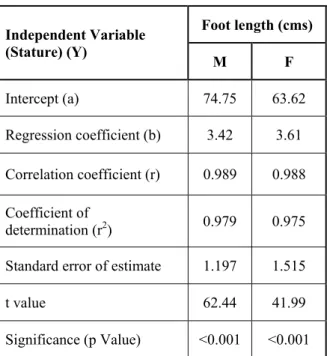
Scattered diagram of Foot length versus Stature showed a positive correlation as shown in above figure with R2 = 0.873. T-test for correlation coefficient is applied to test statistical significance of correlation and for both two variables namely Foot length in males and Foot length in females. The values were calculated as statistically highly significant indicating very strong positive correlation between Stature and Foot length in males and females.
Table 2: Statistical Values for stature vs. foot length
Independent Variable (Stature) (Y)
Foot length (cms) M F
Intercept (a) 74.75 63.62
Regression coefficient (b) 3.42 3.61
Correlation coefficient (r) 0.989 0.988
Coefficient of
determination (r2) 0.979 0.975
Standard error of estimate 1.197 1.515
t value 62.44 41.99
Significance (p Value) <0.001 <0.001
Simple regression formula is Y = a + bX therefore, where Y is dependant variable that is Stature and X is independent variable that in our study is Foot length.
1. Estimated height of Males for Foot length Ym = 74.75 + 3.42 x Xm
2. Estimated height of Females for Foot length Yf= 63.62 + 3.61 x Xf
3. Estimated height of combined (Males and Females) for Foot length
Yc = 56.18 + 4.06 x Xc
Standard error estimation was also done so as to find out 95% confidence limit for both variables as follows:
1. 95% confidence interval of Height of Males for Foot length
Ym = [74.75 + 3.42 x Xm] ± (2.33)
2. 95% confidence interval of Height of Females for Foot length
Yf = [63.62 + 3.61 x Xf] ± (2.95)
3. 95% confidence interval of height of combined (Males and Females) for Foot length
Yc = [56.18 + 4.06 x Xc] ± (5.35)
Discussion:
Estimation of stature from anthropometric measurements is an area of interest for Forensic Experts for the purpose of Identification. Then data derived from entirely different population cannot be used for height assessment for all types of population hence the baseline data shall be derived from local population so that they can be used for the height assessment amongst them.
In the present study, mean values of stature are greater for Males then Female with statistically significant difference. Mean values of foot length are greater for Males than Females with statistically significant difference. There was no statistically significant bilateral difference for foot length in both subjects.
Qamra et al (1979) studied on height and foot length in Northwest Indian population and derived a regression equation concluding a strongly positive correlation with correlation coefficient of 0.69 for Males and 0.70 for Females.9 Patel SM et al (2007) studied on 502 Males and Females of 17 to 22 years of age for estimation of height from left foot length in Gujarat. They found the correlation coefficient 0.65 for Males and 0.8 for Females.10 In this study the correlation coefficient for height and foot length for Males is0.989 and for Females is 0.988. Correlation coefficient in this study was near +1 and p<0.0001, which proves that there is a strong positive correlation between height and foot length, similar to previous studies.
There is a difference between correlation coefficient of Males and Females as in other previous studies, which sought for the need of gender specific regression equation. The correlation coefficient of the present study for both sexes is not in accordance with the correlation coefficient of the similar studies conducted in the other regions, which highlights the need for population specific regression equation.
Conclusion:
It was concluded that the estimation of stature among the population can be carried out using foot length and there is positive correlation between stature and foot length in a particular population.
References:
1. Modi JP. A Textbook of Medical Jurisprudence and Toxicology. 24th ed. Haryana: LexisNexis; 2012.
2. Bhavna S,Nath S. Use of Lower Limb
Measurements in Reconstructing Stature among Shia Muslims. The internet Journal of Biological Anthropology.2009; Vol. 2(2).
3. Athwale MC. Anthropological study of height from length of forearm bones. A study of one hundred Maharastrian male adults of ages between twenty five and thirty years. American Journal of Physical Anthropology.1963; 21: 105-12.
4. Krishan.Limb bilateral asymmetry and
footprints of male adult Gujjar population in parts of Punjab and Haryana (Unpublished PhD Dissertation), Panjab University, Chandigarh, India, 2002.
5. Kulthanan T, Techakampuch S, Bed ND. A study of foot prints in athletes and non-athletic people. J Med Assoc Thai.2004; 87:788-93. 6. Rutishauser IHE. Prediction of height from
foot length. Archives of Disabled Child.1968; 43: 310-15.
7. Krogman WM, Iscan MY. The human skeleton in forensic medicine. 2nd ed. Springfield: Charles C Thomas; 1986.
8. Cameron N, Hiernaux J, Jarman S, Marshall WA, Tanner JM, Whitehouse RH. Anthropometry. In: Weiner JS, Lourie JA, editors. Practical human biology. London: Academic Press; 1981: 25–52.
9. Qamra S, Inderjit and Deodhar SD. A model for reconstruction of height from foot measurement in adult population of Northwest India. Indian J Med Res. 1980; 71:77-83.
10. Patel SM. Estimation of height from
measurement of foot length in Gujarat region. J Anat Soc India. 2007; 56(1): 25-27.