Corresponding Author: Maria Chiara Zanetti, DITAG (Dipartimento del Territorio, dell’Ambiente e delle Geotecnologie) Politecnico di Torino, c.so Duca degli Abruzzi 24, 10129 - Torino, Italy
Lab Tests for the Remediation of a PCE Polluted Site by Means of HRC Reactant
Maria Chiara Zanetti, Silvia Fiore
DITAG – Dipartimento del Territorio, dell’Ambiente e delle Geotecnologie Politecnico di Torino – C.so Duca degli Abruzzi 24, 10129 - Torino, Italy
Abstract: The injection of reactants is a remediation technology that may be applied both in the vadose zone and in groundwater. In this work a new reagent is examined for the remediation of the vadose zone and groundwater of an industrial site polluted by perchloroethylene (PCE). The tested reactant is the HRC (Hydrogen Release Compound, Regenesis, USA), a reducing agent which enhances the biological and chemical dechlorination of PCE. Some laboratory column and batch tests were performed on soil coming from the polluted site applying different fluid dynamic conditions, with the aim to evaluate the efficiency of the hypothesized remediation technology on the aquifer and the vadose zone and the eventual degradation products deriving from PCE or HRC.
The performed tests confirmed HRC efficiency in PCE remediation. The modelling of the injected reactant both in the aquifer and in the vadose zone was performed.
Keywords: Groundwater remediation, vadose zone remediation, HRC, perchloroethylene, PCE, soil flushing.
INTRODUCTION
Soil flushing is a remediation technology based on the extraction/chemical/ biodegradation phenomena in soil by means of an aqueous phase injected in trenches or wells. This remediation technology usually foresees the addition of reactants to the extracting liquid phase. Since water solubility of the pollutant is the controlling remediation mechanism, the applied reactants are typically surfactants and solvents to remove organic substances; acids, bases, oxidizing/reducing compounds or chelating agents are employed [1-5]. Sometimes once the pollutants are dissolved and transferred into the groundwater, it is then extracted and treated.
The effectiveness of a soil flushing remediation process depends on the hydro geologic characteristics of the polluted site (better results are obtained on soil characterized by a permeability value higher than 10-3 cm/s), and on the physical chemical properties of the pollutants (mainly water solubility).
In this work a soil flushing remediation intervention together with the injection of reactants in groundwater is proposed taking into account an industrial site polluted by perchloroethylene (PCE). The employment of HRC (Hydrogen Release Compound, Regenesis, USA), a reducing agent which enhances the biological and chemical dechlorination of PCE was studied. The considered site, extended to about 14000 m2, is located in the west northern Italy and belongs to a firm producing metal/rubber gaskets for the automotive industry. The main pollutant in soil and groundwater is perchloroethylene (PCE), used between 1975 and 1985
in degreasing operations performed on the metallic components; although a PCE recovery and recycling system was provided, the contamination was found to follow the path of the industrial degreasing wastewaters: they were collected in an underground tank, together with rainwater, and then pumped to the municipal wastewater pipeline. By means of a careful geological and chemical characterization of the site the underground storage tank was singled out as the contamination source, due to the significant degradation of its concrete basement. Therefore the polluted vadose zone was characterized by a total area about equal to 20 m2 (the tank area is equal to 12 m2 but there is a lateral spreading due to the polluted water flow in the subsoil) and a total depth of about 20 m, equal to the piezometric surface depth. Some hydro geological characteristics and PCE concentration values in soil (referred to samples collected during the excavation of a piezometer in the proximity of the underground tank) and groundwater are reported in Table 1.
152 The need of treating the groundwater enriched in pollutants produced by a soil flushing process may be avoided using an extracting aqueous phase containing a not toxic reactant, able to convert the undesired substances to non toxic products. HRC (Hydrogen Release Compound, Regenesis, USA) is a viscous liquid made of glycerol and a polylactate ester that slowly releases lactic acid, which acts as an electron donor and carbon source for reductive biodegradation processes. In fact lactic acid is biologically degraded under anaerobic conditions into pyruvic and acetic acids with the production of hydrogen, which is then employed in the abiotic reductive dechlorination of PCE to ethene and chloride ions.
In this work the authors propose HRC for the remediation of soil and groundwater. Particularly the vadose zone remediation may be performed by means of the injection of a solution made of water and HRC at the basis of the underground storage tank.
Some batch and column tests were performed at laboratory scale in different fluid dynamic conditions on soil coming from the vadose zone and the aquifer of the polluted site. The results of the laboratory tests were analyzed and discussed, in order to evaluate the efficiency of the hypothesized remediation technologies and the eventual existence of some degradation products deriving from PCE or HRC. The numerical modelling of the proposed intervention was performed in order to realize a correct intervention dimensioning.
MATERIALS AND METHODS
HRC reactant was studied by means of batch tests and column tests. Batch tests, performed on unpolluted soil sampled in the considered site, were aimed at investigating the involved degradation phenomena considering the interactions among the reactant, the soil and the pollutant in aerobic conditions and in presence/absence of soil and pollutant. Column tests, performed on polluted soil coming from different depths, were useful to investigate the possible HRC application for the vadose zone an groundwater remediation.
Batch tests were performed in 20 ml glass headspace vials at a temperature of 20 °C with the addition of: B1) 15 ml of 3.3 g/l HRC aqueous solution; B2) 15 ml of 3.3 g/l HRC aqueous solution and 1 g of clean soil; B3) 15 ml of 3.3 g/l HRC aqueous solution containing 6 mg/l of PCE, and 1 g of clean soil. The employed HRC concentration was given by Regenesis protocols. Column tests were performed by means of a Plexiglas leaching column (1 m length, 5·10-2 m external diameter, 4·10-2 m internal diameter). In the first test (performed for the vadose zone remediation applying saturated conditions) the column was filled, starting from the bottom to the top, with 5·10-2 m of sand, 30·10-2 m of polluted soil (4959 mg/kg PCE) and 65·10 -Table 1: Hydro geological characteristics of the polluted site and PCE concentration values in soil and groundwater.
Aquifer characteristics
Freatic aquifer (depth from the surface: 20 m, thickness: 4-5 m) Well flow rate: Q = 740 m3/d
Hydraulic gradient: i = 0.006, direction West-East Hydraulic conductivity: kh,s=7.6 10-4 m/s
kv,s/ kh,s = 0.1
Trasmissivity: T=0.004 m2/s Effective porosity: Se=0.3
Longitudinal dispersivity :Dx= 7.0 m
Lateral dispersivity: Dy= 1.4 m
Van Genuchten coefficients: α = 2.32 1/m; n=1.52; l = 0.5
Soil depth PCE (mg/kg)
4-5 m 1.00
8-9 m 4863
10-11 m 33990
11-12 m 7744
13-14 m 4959
15-16 m 1571
20.5-21.5 m 0.026
24-25 m 0.316
26-27 m 0.352
Italian law limits (residential/industrial uses) 0.5/20
Groundwater
pH = 6.90, Eh = 337 mV, CE = 317 µS/cm (near the underground tank)
PCE (µg/kg)
near the underground tank 5391
On site 11-60
aqueous solution, was fed from the bottom to the top by means of a HDPE tank (70 l) connected to a peristaltic pump (ISMATEC ISM 827) adopting a flow rate equal to 0.167·10-7 m3·s-1, in order to simulate the vertical flow under the storage tank in saturated conditions. The test performed in saturated conditions lasted 53 days. In the second column test (performed for the vadose zone remediation applying unsaturated conditions) the column was filled, starting from the bottom to the top, with 5·10-2 m of sand, 29·10-2 m of polluted soil (7458 mg/kg) and 23·10-2 m of sand. The liquid phase, made of a 2.5 g/l HRC aqueous solution (the proper volume to obtain a S/L ratio equal to 1:4), was fed by gravity from the top of the column exploiting a hydraulic load equal to 0.1 m until the total saturation was reached, then the solution leaching was allowed. The test performed in unsaturated conditions lasted 30 days. In the third test (performed for the groundwater remediation therefore applying saturated conditions) a soil layer coming from the aquifer of the polluted site was introduced in the plexiglass column till reaching a total thickness equal to 0.75 m. A 0.15 m gravel layer was located under the soil column and a 0.05 m gravel layer above the soil column. At the height of 0.225 m from the basis of column (0.15 m of gravel and 0.075 m of soil) 80 g of HRC were introduced and then the column was completed. The feed was a water solution with the same physical and chemical characteristics of the polluted site: it was prepared by means of CaCl2
addition, with a pH equal to 7, an electric conductivity equal to 345 µS/cm and a redox potential equal to 525 mV. The PCE concentration was equal to 6527 µg/l. The polluted water solution, contained in a tedlar bag of a total volume equal to 60 l , was fed from the bottom to the top by means of a peristaltic pump (ISMATEC ISM 827) adopting a flow rate equal to 0.167·10-7 m3·s
-1
, in order to simulate the groundwater flow. The PCE concentration in the outflow was measured starting from 10 days after the beginning of the test in order to achieve stationary conditions.
The HRC, lactic, pyruvic and acetic acid concentrations in water were measured by means of a Solid Phase Extraction method (ENVI-Chrom P chartridges, Supelco, 0.5 g/6 ml) and a GCD 1800C Agilent gaschromatograph, equipped with a mass spectrometer detector and a J&W DB-624 column (30mx0.25mmx1.25 µm). PCE analyses in the aqueous phase were executed by means of static headspace and a HP4890 gaschromatograph, equipped with an ECD detector and a HP5 comlumn (15mx0.53mmx1.5µm). The pH and redox parameters were measured too, respectively by means of an Orion 420A pH-meter and an Orion SA520 voltmeter.
The numerical modelling of the actual pollution conditions of the groundwater was performed by means of the FEFLOW code (WASY, Germany) and the employed calibration data were gathered in may 2004. The main hypotheses were:
5 m;
- the PCE degradation rate was hypothesized equal to zero.
The model calibration was performed by means of a trial and error procedure. The employed data, obtained by field measures are reported in Table 1. The same modelling parameters and numerical code were employed in order to foresee the dynamic of HRC injection in the groundwater. On the grounds of the performed laboratory tests and producer data HRC in water releases lactic acid and glycerol: the lactic acid concentration near the injection point, on the grounds of lab tests results, was hypothesised about equal to 160 mg/l and no degradation rate was assumed.
The modelling of the vadose zone remediation was performed in order to single out the more convenient hydraulic head in tank for HRC injection. The hypothesized hydraulic head for HRC injection is constant and it was assumed equal to 0.1 m or 0.7 m. In fact during the remediation the tank will be covered in order to avoid the meteoric waters arrival in the polluted vadose zone. The water content in depth was measured by means of the georadar cross-hole technology. In fact the propagation velocity of electromagnetic waves is a function of the subsoil properties: electromagnetism, electric conductivity, magnetic and electric permittivity. The employment of useful correlations allows to determine the volumetric water content in rocks and soils. The modeling of the infiltration of the water and HRC solution in the subsoil was performed by means of the VS2DI 1.2 software (U.S. Geological Survey) and the employed soil parameters are reported in Table 1.
RESULTS AND DISCUSSION
154 1a 0 1 2 3 4 5 6 7
0 5 10 15 20 25
days
pH
HRC (aerobic conditions) HRC+soil+PCE (aerobic conditions) HRC+soil (aerobic conditions)
1b 0 100 200 300 400 500 600 700
0 5 10 15 20 25
days Eh ( m V )
HRC (aerobic conditions) HRC+soil+PCE (aerobic conditions) HRC+soil (aerobic conditions)
Fig. 1: pH and redox potential values measured during batch tests.
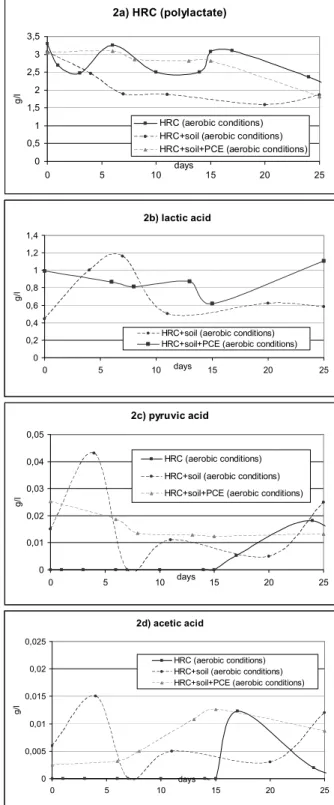
batch tests performed in presence of soil and pollutant, the trends are similar until about 7 days; later pyruvic acid concentration remains constant (see Figure 2c). Pyruvic acid production appears inhibited in absence of soil and pollutant: the compound appears after 17 days from the beginning of the test. Acetic acid release follows trends very similar to the above mentioned concerning pyruvic acid (see Figure 2d).
The results of the column test for the vadose zone remediation performed in saturated conditions are reported in Table 2. PCE underwent to an efficient degradation in soil (from about 5 g/kg to 3 µg/kg in 53 days). The starting PCE concentration in aqueous phase, due to mass transfer phenomena, is 20 µg/l but at the end of the test, because of the PCE concentration decreasing in soil, it becomes 0.5 µg/l. No PCE degradation products were found. The values displayed in Table 2 show the establishment of reducing conditions, the occurrence of the dechlorination process and the failure of the soil in buffering the pH in the flow conditions typical of a column test in saturated conditions.
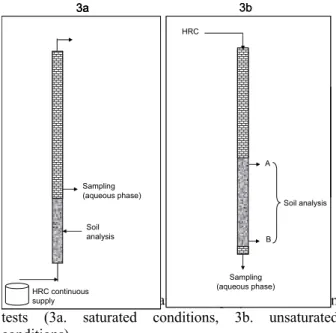
The results of the column test for the vadose zone remediation performed in unsaturated conditions are reported in Table 3. The apparatus employed for the column tests is schematized in Figure 3.
Considering a starting contamination value of about 7.5 g/kg, PCE degradation appears higher in column head than in its tail because of PCE evaporation phenomena happening at the column head, in both cases reaching values that don’t comply Italian law limits (see Table 1). The soil buffer effect takes place and Eh values show the variation to less reducing conditions. In this test the efficiency of the proposed treatment, performed
2a) HRC (polylactate)
0 0,5 1 1,5 2 2,5 3 3,5
0 5 10 15 20 25
days
g/
l
HRC (aerobic conditions) HRC+soil (aerobic conditions) HRC+soil+PCE (aerobic conditions)
2b) lactic acid
0 0,2 0,4 0,6 0,8 1 1,2 1,4
0 5 10 days 15 20 25
g/
l
HRC+soil (aerobic conditions) HRC+soil+PCE (aerobic conditions)
2c) pyruvic acid
0 0,01 0,02 0,03 0,04 0,05
0 5 10 days 15 20 25
g/
l
HRC (aerobic conditions)
HRC+soil (aerobic conditions)
HRC+soil+PCE (aerobic conditions)
2d) acetic acid
0 0,005 0,01 0,015 0,02 0,025
0 5 10 15 20 25
days
g/
l
HRC (aerobic conditions) HRC+soil (aerobic conditions) HRC+soil+PCE (aerobic conditions)
Fig. 2: HRC hydrolysis products
employing a HRC concentration lower than Regenesis protocol, is again proved, but it isn’t enough to hypothesize the vadose zone remediation in these conditions.
Table 2: Results of the column test performed in saturated conditions
starting PCE concentration in soil: 4959 mg/kg
time (days)
ppb PCE in aqueous
phase
Eh (mV) pH
Cl
-(mg/l)
0 21.3 644 2.70 0.44
0.4 19.2 3 9.6 4 9.0 5 6.2 6 4.5
7 3.4 547 68.29
10 2.8 542 12.27
12 1.9 562 0.43
14 2.2 554 1.08
17 1.1 556 0.43
20 0.6 562 0.65
26 0.5 557 0.46
32 <0.5 566 2.83
39 <0.5 570
46 <0.5 562
52 <0.5 560
final PCE concentration in soil (after 53 days): 3 µg/kg
µg/l to 18 µg/l, with a good remediation efficiency. No PCE degradation products were found. The redox potential value in the outflow progressively decreases because of the reducing conditions due to the HRC reactant.
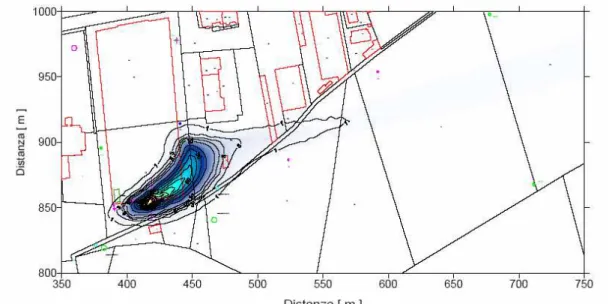
The simulation results of the HRC injection in groundwater, performed by means of the FEFLOW model, after 1 year of continuous reactant release are reported in Figure 4.
The obtained results concerning the modelling of the vadose zone intervention, performed by means of the VS2DI 1.2 software are shown in Fig. 5 . Employing an hydraulic head equal to 0.1 m four days will be employed by the HRC solution to reach groundwater instead, with an hydraulic gradient equal to 0.7 m, 35 hours are required. The total volume of the injected solution is 50 – 60 m3for a length equal to 1 m of the considered tank. The hydraulic gradient equal to 0.1 m guarantees a higher influence volume of the remediation intervent and a better contact between the soil and the liquid solution than the 0.7 m hydraulic gradient.
Fig 3: Experimental apparatus employed for column tests (3a. saturated conditions, 3b. unsaturated conditions)
Besides the 0.1 m hydraulic gradient doesn’t allow the reaching of total saturation conditions in the vadose zone with minimum noises to the piezometric level. On the grounds of the performed batch tests, by means of a gaschromatograph equipped with a mass detector it was possible to investigate the biochemical by-products generation due to the HRC reactant employment. Some non toxic products such as lactic acid, glycerol, pyruvic and acetic acid were measured. The generation of pyruvic and acetic acid is due to the anaerobic fermentation happening in the batch reactors. The production of pyruvic and acetic acids is delayed of 15 days in reactors without any soil content because of the absence ready available biomass. The redox potential decrease, characteristic of the anaerobic fermentation (reactors with soil) is maximized in vials with PCE because of the huge presence of electron acceptors. Anyway the anaerobic fermentation with the following of pyruvic acid and acetic acid is registered also for redox potential values about equal to 600 mV.
The column tests were performed in two different fluid dynamic conditions. The first one was performed in saturated conditions for 53 days with a HRC concentration equal to 3.3 g/l and it was successful. The second one was performed in saturated/unsaturated conditions for 30 days with a HRC concentration equal to 2.5 g/l and the achieved PCE degradation was partial.
Table 3. Results of the column test performed in unsaturated conditions
Starting PCE concentration in soil: 7458 mg/kg Starting aqueous phase: 2.5 g/l HRC, S/L 1:4, pH 3.80, Eh 565 mV
Time (days) pH Eh (mV) HRC (g/l) Pyruvic acid (g/l) Acetic acid (g/l)
1 6.30 334
3 6.38 174 0.66 <0.006 0.02
6 6.80 331
7 6.89 508
9 7.44 516
0.36 <0.004 0.09
Final PCE concentration in soil (after 30 days): 616 mg/kg at column head, 3483 mg/kg at column tail
HRC continuous supply
Sampling (aqueous phase)
Soil analysis 3a
HRC
Sampling (aqueous phase)
A
B
Soil analysis 3b
HRC continuous supply
Sampling (aqueous phase)
Soil analysis 3a
HRC continuous supply
Sampling (aqueous phase)
Soil analysis 3a
HRC
Sampling (aqueous phase)
A
B
156 Table 4. Leaching column test results for the groundwater remediation
Contaminated solution: PCE 6527 ppb, pH 7, CE 345 µS/cm, Eh 525 mV
Time (days) PCE (µg/l ) Eh (mV)
10 692 599
18 849 517
25 357 458
26 199 453
32 98 463
35 49 455
49 18 436
In these two cases no PCE degradation products were found.
On the grounds of these results a saturation condition of the vadose zone at last equal to three-four days is suggested for good remediation intervention results, even if other lab tests are required to confirm the validity of this hypothesis. On the basis of vadose modelling results employing a hydraulic head equal to 0.1 m a total volume of HRC solution about equal to 300 m3 is required (50 m3x 6 m, the meteoric tank length with an injection time equal to four days).
The leaching column test for the groundwater remediation has shown a good PCE abatement in 50 days. No PCE degradation products were found. Fig. 4: Modeling results of HRC injection in the aquifer after 1 year of continuous release (HRC concentrations are expressed in µg/l)
In je c tio n (h y d ra u lic lo a d e q u a l to 0 ,7 m )
0 0.2 0.4 0.6 0.8 1
In je c tio n (h y d r a u lic lo a d e q u a l to 0 ,1 m )
0 0.2 0.4 0.6 0.8 1
the main polluted zone of the site is interested by the HRC injection.
By means of the performed lab tests and modelling results the HRC employment seems to be a good solution for the remediation of the considered polluted site.
REFERENCES
1. Martel, R., Gélinas, P.J., desnoyers, J.E. 1998. “Aquifer washing by micellar solutions: 1 Optimization of alcohol-surfactant-solvent solutions.” Journal of Contaminant Hydrology, Elsevier, 29 (4), 319-346.
2. Mulligan, C.N., Yong, R.N., Gibbs, B.F. 2001. “Surfactant-enhanced remediation of contaminated soil: a review.” Engineering Geology, Elsevier, 60 (1-4), 371-380.
3. Lee, M., Kang, H., Do, W. 2005. “Application of non-ionic surfactant-enhanced in situ flushing to a diesel contaminated site.” Water Research, Elsevier, 39 (1), 139-146.
4. Zhou, Q., Sun, F., Liu, R. 2005. “Joint chemical flushing of soils contaminated with petroleum hydrocarbons.” Environment International, Elsevier, 31 (6), 835-839.
5. Ferguson, J.F., Pietari, J.M.H. 2000. “Anaerobic transformations and bioremediation of chlorinated solvents.” Environmental Pollution, Elsevier, 107 (2), 209-215.