Submitted22 August 2015
Accepted 3 March 2016
Published31 March 2016
Corresponding author
Boon Pin Kee, [email protected]
Academic editor
Yeong Yeh Lee
Additional Information and Declarations can be found on page 12
DOI10.7717/peerj.1843
Copyright
2016 Chua et al.
Distributed under
Creative Commons CC-BY 4.0
OPEN ACCESS
Association of
NOD1
,
CXCL16
,
STAT6
and
TLR4
gene polymorphisms with
Malaysian patients with Crohn’s disease
Kek Heng Chua1, Jin Guan Ng2, Ching Ching Ng2, Ida Hilmi3, Khean Lee Goh3
and Boon Pin Kee1
1Department of Biomedical Science, Faculty of Medicine, Universiti Malaya, Kuala Lumpur, Malaysia 2Division of Genetics and Molecular Biology, Institute of Biological Science, Faculty of Science,
Universiti Malaya, Kuala Lumpur, Malaysia
3Division of Gastroenterology and Hepatology, Department of Medicine, Faculty of Medicine,
Universiti Malaya, Kuala Lumpur, Malaysia
ABSTRACT
Crohn’s disease (CD) is a prominent type of inflammatory bowel disease (IBD) that can affect any part of the gastrointestinal tract. CD is known to have higher prevalence in the Western countries, but the number of cases has been increasing in the past decades in Asia, including Malaysia. Therefore, there is a need to investigate the underlining causes of CD that may shed light on its prevention and treatment. In this
study, genetic polymorphisms in NOD1(rs2075820), CXCL16 (rs2277680),STAT6
(rs324015) andTLR4(rs4986791) genes were examined in a total of 335 individuals
(85 CD patients and 250 healthy controls) with PCR-RFLP approach. There was no
significant association observed betweenNOD1rs2075820 andSTAT6rs324015 with
the onset of CD in the studied cohort. However, the G allele of CXCL16 rs2277680
was found to have a weak association with CD patients (P=0.0482;OR=1.4310).
TheTLR4rs4986791 was also significantly associated to CD. Both the homozygous
C genotype (P=0.0029;OR=0.3611) and C allele (P=0.0069;OR=0.4369) were
observed to confer protection against CD. On the other hand, the heterozygous C/T genotype was a risk genotype (P=0.0015;OR=3.1392). Further ethnic-stratified
analysis showed that the significant associations in CXCL16 rs2277680 and TLR4
rs4986791 were accounted by the Malay cohort. In conclusion, the present study reported two CD-predisposing loci in the Malay CD patients. However, these loci were not associated to the onset of CD in Chinese and Indian patients.
SubjectsGenetics, Molecular Biology, Gastroenterology and Hepatology, Medical Genetics
Keywords NOD1,CXCL16,STAT6,TLR4, SNP, Crohn’s disease
INTRODUCTION
UC displays relatively restricted clinical manifestations, which are always localised at colon and rectum. To date, there is yet a cure for both CD and UC. Treatments and medical procedures are given to patients mainly for symptomatic relief and maintaining remission, which may also come with the cost of side effects, such as nausea and skin rashes (Sandborn et al., 2007).
Despite numerous extensive research studies that were conducted to find the etiology of CD in the past decades, the exact cause of CD remains inconclusive. However, it is generally accepted that, like other autoimmune diseases, the onset of CD could be triggered by the interaction of two major factors, i.e., genetic and environment (Baumgart & Carding,
2007). The increased disease concordance rate in monozygotic twins and higher risk of
disease development in siblings of affected individuals highlight the importance of genetic predisposition in the disease development (Orholm et al., 2000). A number of genes have been identified through large scale Genome Wide Association Studies (GWAS) and meta-analysis to have significant linkage with the development of CD in the past (Duerr et al., 2006;Hampe et al., 2007). However, none of these genes was found as the sole contributor to the disease, suggesting polygenic traits in the disease development and progression.
CD are commonly observed in the Western countries, e.g. northern Europe, United Kingdom, and North America (Hilmi, Tan & Goh, 2006). The prevalence rate of CD has been relatively low in developing countries in Asia. Until recently, several studies had
reported a rising trend of CD in Sri Lanka, Hong Kong, Japan, and Singapore (Morita et
al., 1995;Lee et al., 2000;Niriella et al., 2010). Scientists postulate that this phenomenon
might result from the adoption of modern lifestyles from Western counterparts (Thia
et al., 2008). The overall prevalence rates of CD in Malaysia are 26 per 100,000 person (Tan & Goh, 2005;Hilmi, Tan & Goh, 2006). The prevalence rate differs among the three main ethnic groups that make up the multiracial society of Malaysia, i.e., Malay, Chinese, and Indian. CD appears most commonly in Indians, followed by Chinese and Malays, with prevalence rates of 52.6, 26.9, and 9.2 per 100,000 person respectively (Tan & Goh, 2005;Hilmi, Tan & Goh, 2006). Some gene and CD association studies have also been conducted previously (Chua et al., 2011;Chua et al., 2012;Chua et al., 2015); however, the actual genetics architecture of CD in the Malaysian populations still remains unclear.
Nucleotide-binding Oligomerization Domain-containing 1 (NOD1) protein is a member
of NOD-like receptor (NLR) family. It is involved in the activation of NF-κB and caspase-9
that are important to cellular apoptosis and immune response, respectively (Inohara et al.,
1999).NOD1 recognises the invasion of bacteria by reacting with a unique dipeptide,
γ-D-glutamyl-meso-diaminopimelic acid (iE-DAP), that is present in the bacterial
peptidoglycan (Chamaillard et al., 2003). The gene that encodesNOD1protein is located on chromosome 7p14. Genetic variations in this gene have been associated to asthma and IBD (Hysi et al., 2005;McGovern et al., 2005). TheNOD1 rs2075820 involves the replacement of glutamic acid (E) by lysine (K) at amino acid position-266. This SNP has been shown to increase the susceptibility of gastric mucosal inflammation followingHelicobacter pylori
infection, possibly due to altered plasma level of NF-κB (Kara et al., 2010).
Chemokine (C-X-C motif) Ligand 16 (CXCL16) protein is produced by dendritic cells
interacts with CXC chemokine receptors 6 (CXCR6) during inflammation and recruits the CXCR6 expressing cells, such as naive CD8 cells, intraepithelial lymphocytes, natural killer T cells, activated CD8 and CD4 T cells, to the affected site (Matloubian et al., 2000).CXCL16
is constantly expressed in human cells in two forms, i.e., membrane-bound and soluble
forms. The membrane-boundCXCL16 aids the adhesion of bacteria for phagocytosis,
whereas the soluble form induces the migration of activated T-cells (Abel et al., 2004;
Gough et al., 2004;Nakase et al., 2012). The gene for humanCXCL16 is on chromosome
17p13. Study has found that the serum level of soluble form ofCXCL16 was increased
more than 10 times in CD patients compared to controls (Lehrke et al., 2008). Previous
study has demonstrated the association ofCXCL16 Ala181Val (rs2277680) variant with
severe disease phenotype in young CD patients (Seiderer et al., 2008).
Signal Transducer and Activator of Transcription 6 (STAT6) is a transcription factor
in STAT family (Hamlin et al., 1999). Unlike other members in the family, STAT6 is
activated by interleukin-4 (IL-4) through tyrosine phosphorylation. The phosphorylated STAT6 dimerizes and translocates to cell nucleus. It binds to specific DNA and activates the transcription of certain IL-4-induced genes, which leads to the initiation of humoral immunity respond by T-helper 2 (Th2) cell. Th2 cells promote the production of IgE and the proliferation of mast cells/eosinophils, leading to inflammation (Romagnani, 1999). TheSTAT6gene is located on chromosome 12q13. Studies had shown that the G2964A variation (rs324015) within its 3′ untranslated region (UTR) was related to familial CD (Klein et al., 2005).
Toll-Like Receptor 4 (TLR4) gene is located on chromosome 9q33. TLR4protein
is highly conserved and functions as a mediator for production of cytokines in innate
immune system. It also plays a vital role in pathogen recognition. TLR4 senses the
lipopolysaccharides (LPS) from Gram-negative bacteria. Binding of the bacterial LPS
toTLR4, together with other accessory proteins such as LPS-binding protein, MD2, and
CD14, activates the production of NF-κB and other cytokines (Philpott & Girardin, 2004; Lavelle et al., 2010). Alteration of the protein structure, due to mutations or SNP, results in
differential responsiveness to LPS and may induce massive inflammatory reaction.TLR4
T399I (rs4986791) was related to weakened LPS response and other diseases, i.e., diabetes, rheumatoid arthritis, Alzheimer’s disease, renal and cardiovascular disease (Arbour et al., 2000;O’Neill, Bryant & Doyle, 2009). It was also found to associate with the development of CD and UC (Torok et al., 2004;Zouiten-Mekki et al., 2009).
In the present study, we aim to investigate the distribution of four SNPs in NOD1
(rs2075820),CXCL16 (rs2277680),STAT6 (rs324015) andTLR4(rs4986791) genes in
Malaysian patients with CD. We reported the association of alleles and genotypes of these SNPs with the onset of CD in the Malaysian population.
MATERIALS AND METHODS
Subject recruitment
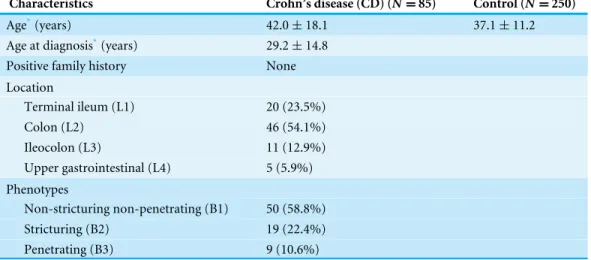
Table 1 Clinical characteristics of CD patients in the present study according to the Vienna classifica-tion system.
Characteristics Crohn’s disease (CD) (N=85) Control (N=250)
Age*(years) 42.0±18.1 37.1±11.2
Age at diagnosis*(years) 29.2±14.8
Positive family history None
Location
Terminal ileum (L1) 20 (23.5%) Colon (L2) 46 (54.1%) Ileocolon (L3) 11 (12.9%) Upper gastrointestinal (L4) 5 (5.9%)
Phenotypes
Non-stricturing non-penetrating (B1) 50 (58.8%) Stricturing (B2) 19 (22.4%) Penetrating (B3) 9 (10.6%)
Notes.
*Mean±standard deviation
85 CD patients (20 Malays, 27 Chinese, 38 Indians) and 250 (74 Malays, 86 Chinese, 90 Indians) healthy controls were recruited in this study. All patients were diagnosed at University Malaya Medical Centre (UMMC), Kuala Lumpur, Malaysia, based on Vienna classification (Table 1). The research methods in this study were approved by UMMC Ethics Review Board (MEC reference number: 472.55) and informed consents were obtained from all participants prior to blood sample collection.
SNP genotyping
Blood sample was collected from each participant in an EDTA tube. Genomic DNA was
extracted from all samples via a conventional phenol-chloroform extraction method (Chua
et al., 2009). Post-extraction quality check was carried out with spectrophotometry to ensure high-quality DNA for the subsequent genotyping experiments.
SNP genotyping was carried out via polymerase chain reaction-restricted fragment length polymorphism (PCR-RFLP) method. The amplification of DNA regions covering the SNPs of interest was conducted with a standard PCR in a thermal cycler (Veriti; Life
Technologies, Carlsbad, CA, USA). The final reaction mixture contained 1XTaqbuffer,
0.375µM of respective forward and reverse primers, 0.075 mM dNTP mix, 0.75 unit ofTaq
DNA polymerase, 100 ng of template DNA, and topped up to a final volume of 20µl with
sterile distilled water. A universal PCR cycling parameter was used: initial denaturation at 95 ◦C for 12 min, followed by 35 cycles of 94 ◦C for 30 s, 60 ◦C (TLR4rs4986791),
64 ◦C (NOD1rs2075820 andCXCL16 rs2277680), or 68 ◦C (STAT6rs324015) for 30 s,
and 72 ◦C for 30 s, final extension at 72 ◦C for 7 min. The amplified products were
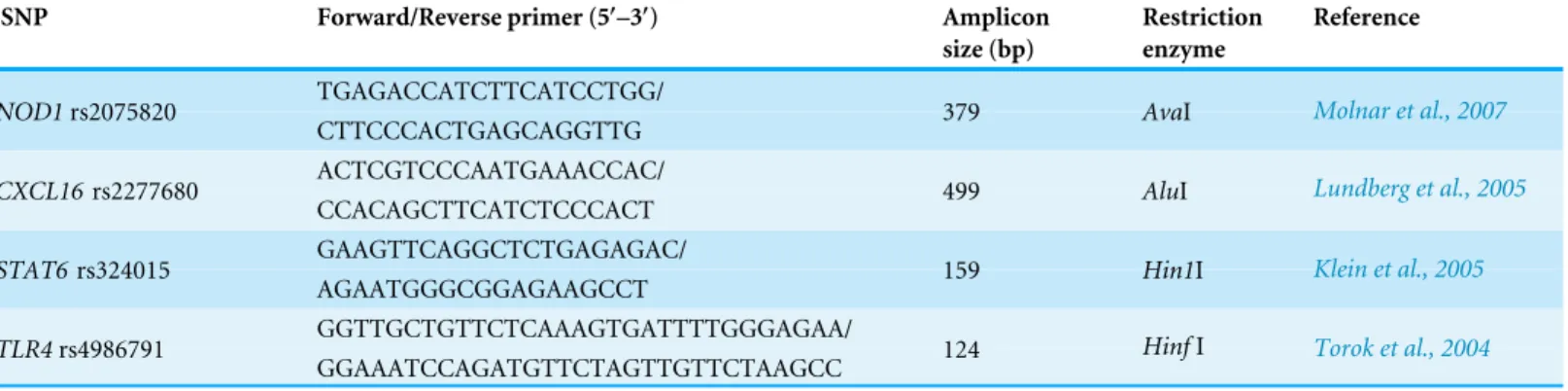
subjected to digestion with 5 unit of respective restriction enzymes at 37 ◦C for overnight. Primer sequences, amplicon sizes, and restriction enzymes used for SNP genotyping are
summarised inTable 2. The digested products were applied on a 2.5% (w/v) agarose gel
Table 2 Primer sequences, amplicon sizes, and restriction enzymes used for the PCR-RFLP study.
SNP Forward/Reverse primer (5′–3′) Amplicon
size (bp)
Restriction enzyme
Reference
TGAGACCATCTTCATCCTGG/
NOD1rs2075820
CTTCCCACTGAGCAGGTTG 379 AvaI Molnar et al., 2007 ACTCGTCCCAATGAAACCAC/
CXCL16rs2277680
CCACAGCTTCATCTCCCACT 499 AluI Lundberg et al., 2005 GAAGTTCAGGCTCTGAGAGAC/
STAT6rs324015
AGAATGGGCGGAGAAGCCT 159 Hin1I Klein et al., 2005 GGTTGCTGTTCTCAAAGTGATTTTGGGAGAA/
TLR4rs4986791
GGAAATCCAGATGTTCTAGTTGTTCTAAGCC 124 HinfI Torok et al., 2004
Validation of the genetic data generated from the PCR-RFLP method was conducted via a PCR-resequencing approach. Representative samples of each observed genotype for the four studied SNPs were selected and amplified in standard PCR reactions using SNP-specific primers. The amplified products were purified and subjected to DNA sequencing reaction. The genotype of each selected sample was determined based on the signal patterns at the particular SNP location in the electropherograms.
Statistical analysis
The allelic and genotypic frequencies of these polymorphisms were calculated. Deviation
from Hardy–Weinberg equilibrium was assessed via Arlequin V3.11 software (Excoffier
& Lischer, 2010). The power of statistics was calculated with Quanto V1.2 (USC Biostats, Los Angeles, CA, USA), based on overall disease risk, allelic and genotypic frequencies. Fisher’s exact test, odds ratio (OR), and 95% confidence interval (CI) were analysed to correlate the polymorphisms to the onset of CD in Malaysian population. The significant level was set atP<0.05. Correction ofPvalues for multiple comparison was also calculated
based on Bonferroni and False Discovery Rate (FDR) (Dunn, 1961;Benjamini & Hochberg, 1995).
RESULTS
NOD1rs2075820 G/A polymorphism
No significant association was observed for rs2075820 G/A polymorphism inNOD1gene
in the present study based on the allelic and genotypic data (Table 3). Both G and A alleles were evenly distributed in CD patients and controls. Although the homozygous A genotype was found two times higher in the controls (12.0%) compared to patients (5.9%), the distribution was not significant (P=0.1498). Further statistical analysis was performed
based on stratification of samples to the three main ethnic groups, i.e., Chinese, Malay, and Indian (Table 4). Despite the observation of over three times higher frequency of the homozygous A genotype in the Indian CD patients, no significant association was observed.
CXCL16 rs2277680 A/G polymorphism
As shown inTable 5, the G allele ofCXCL16 rs2277680 was observed to have a weak
Table 3 Genotypic and allelic distribution ofNOD1rs2075820 polymorphism in Malaysian Crohn’s disease (CD) patients and control individuals.
NOD1rs2075820 Frequency,n(%)
CD (N=85) Control (N=250) Pvalue OR (95% CI)
Genotype
G/G 33 (38.8) 98 (39.2) 1.0000 0.9843 (0.5942–1.6305) G/A 47 (55.3) 122 (48.8) 0.3174 1.2977 (0.7916–2.1274) A/A 5 (5.9) 30 (12.0) 0.1498 0.4583 (0.1719–1.2220) Allele
G 113 (66.5) 318 (63.6) 1.1346 (0.7862–1.6374) A 57 (33.5) 182 (36.4) 0.5179 0.8814 (0.6107–1.2720)
Notes.
OR, odds ratio; CI, confidence interval.
Table 4 Genotypic and allelic distribution ofNOD1rs2075820 polymorphism in Chinese, Malays, and Indians.
Ethnic group Frequency,n(%) Pvalue OR (95% CI)
Chinese Genotype CD (N=27) Control (N=86)
G/G 12 (44.4) 38 (44.2) 1.0000 1.0105 (0.4232–2.4127) G/A 14 (51.9) 41 (47.7) 0.8260 1.1820 (0.4975–2.8084) A/A 1 (3.7) 7 (8.1) 0.6775 0.4341 (0.0510–3.6955) Allele
G 38 (70.4) 117 (68.0) 1.1165 (0.5735–2.1736) A 16 (29.6) 55 (32.0) 0.8668 0.8957 (0.4601–1.7438) Malay Genotype CD (N=20) Control (N=74)
G/G 10 (50.0) 36 (48.6) 1.0000 1.0556 (0.3930–2.8350) G/A 8 (40.0) 30 (40.5) 1.0000 0.9778 (0.3569–2.6787) A/A 2 (10.0) 8 (10.8) 1.0000 0.9167 (0.1787–4.7011) Allele
G 28 (70.0) 102 (68.9) 1.0523 (0.4918–2.2514) A 12 (30.0) 46 (31.1) 0.5179 0.9503 (0.4442–2.0332) Indian Genotype CD (N=38) Control (N=90)
G/G 11 (28.9) 24 (26.6) 0.8298 1.1204 (0.4825–2.6017) G/A 25 (65.8) 51 (56.7) 0.4313 1.4706 (0.6679–3.2380) A/A 2 (5.3) 15 (16.7) 0.0949 0.2778 (0.0603–1.2803) Allele
G 47 (61.8) 99 (55.0) 1.3260 (0.7665–2.2940) A 29 (38.2) 81 (45.0) 0.3359 0.7281 (0.4191–1.2651)
Notes.
OR, odds ratio; CI, confidence interval.
dismissed after the correction by Bonferroni and FDR. There was strong significant correlation observed for the genotypes, except the homozygous G genotype, which
has a borderline P value of 0.0713. These observations suggest that the G allele may
Table 5 Genotypic and allelic distribution ofCXCL16rs2277680 polymorphism in Malaysian Crohn’s disease (CD) patients and control individuals.
CXCL16rs2277680 Frequency,n(%)
CD (N=85) Control (N=250) Pvalue OR (95% CI)
Genotype
A/A 23 (27.1) 89 (35.6) 0.1832 0.6711 (0.3895–1.1563) A/G 41 (48.2) 122 (48.8) 1.0000 0.9776 (0.5974–1.5997) G/G 21 (24.7) 39 (15.6) 0.0713 1.7752 (0.9745–3.2337) Allele
A 87 (51.2) 300 (60.0) 0.6988 (0.4925–0.9916) G 83 (48.8) 200 (40.0) 0.0482
*
1.4310 (1.0085–2.0306)
Notes.
*P<0.05.
OR, odds ratio; CI, confidence interval.
supported by ethnic-stratified analysis (Table 6). Significant associations were found in the Malay cohort for both G allele (P=0.0306;OR=2.2227) and homozygous G
genotype (P=0.0154;OR=4.4423). However, the statistical power computed by Quanto
software was only 0.5931 for the association. In addition, the correctedP values for both G allele and homozygous G genotype were not significant (P>0.05). On the other hand,
no significant association was observed in Chinese and Indian CD patients.
STAT6 rs324015 A/G polymorphism
Similar toNOD1rs2075820, there was no significant association observed in CD patients
for both allelic and genotypic distribution (Tables 7and8). The A and G alleles were found almost equally in patients and control group. Although the homozygous A genotype present in higher percentage in the control individuals, and it was over two times higher in the Malay healthy controls than patients, no significant relationship was seen in Chinese, Malays, and Indian.
TLR4 rs4986791 C/T polymorphism
There were strong associations observed for theTLR4rs4986791 with the Malaysian CD
patients (Table 9). The C allele (P=0.0069; OR=0.4369) and homozygous C genotype
(P=0.0029; OR=0.3611) were found to confer protective effect against the onset of CD.
On the other hand, the heterozygous C/T genotype present with higher percentage in CD patients (22.4%) than controls (8.4%) and significant association was observed (P=0.0015;
OR=3.1392). These significant associations were supported by high statistical power as
calculated by Quanto based on the sample size, i.e., 0.9691 and 0.9993 for homozygous C genotype and heterozygous C/T genotype respectively. Further stratification analysis showed that these significance were contributed by the Malay ethnic group, but not Chinese and Indian (Table 10). The C allele (P=0.0003; OR=0.0646) and homozygous C
genotype (P=0.0002; OR=0.0516; Quanto=0.8807) were found to be protective in the
Malays. In contrast, the heterozygous C/T genotype was significantly associated to Malay
Table 6 Genotypic and allelic distribution ofCXCL16rs2277680 polymorphism in Chinese, Malays, and Indians.
Ethnic group Frequency,n(%) Pvalue OR (95% CI)
Chinese Genotype CD (N=27) Control (N=86)
A/A 10 (37.0) 36 (41.8) 0.8227 0.8170 (0.3352–1.9913) A/G 11 (40.8) 41 (47.7) 0.6588 0.7546 (0.3141–1.8130) G/G 6 (22.2) 9 (10.5) 0.1890 2.4444 (0.7817–7.6443) Allele
A 31 (57.4) 113 (65.7) 0.7037 (0.3769–1.3141) G 23 (42.6) 59 (34.3) 0.3304 1.4210 (0.7609–2.6536) Malay Genotype CD (N=20) Control (N=74)
A/A 4 (20.0) 26 (35.1) 0.2812 0.4615 (0.1397–1.5249) A/G 9 (45.0) 40 (54.1) 0.6149 0.6955 (0.2578–1.8764) G/G 7 (35.0) 8 (10.8) 0.0154* 4.4423 (1.3707–14.3976)
Allele
A 17 (42.5) 92 (62.2) 0.4499 (0.2213–0.9146) G 23 (57.5) 56 (37.8) 0.0306
*
2.2227 (1.0933–4.5186) Indian Genotype CD (N=38) Control (N=90)
A/A 9 (23.7) 27 (30.0) 0.5247 0.7241 (0.3024–1.7341) A/G 21 (55.3) 41 (45.6) 0.3390 1.4763 (0.6889–3.1639) G/G 8 (21.1) 22 (24.4) 0.8204 0.8242 (0.3297–2.0604) Allele
A 39 (51.3) 95 (52.8) 0.9431 (0.5515–1.6129) G 37 (48.7) 85 (47.2) 0.8913 1.0603 (0.6200–1.8134)
Notes.
*P<0.05.
OR, odds ratio; CI, confidence interval.
Table 7 Genotypic and allelic distribution ofSTAT6rs324015 polymorphism in Malaysian Crohn’s disease (CD) patients and control individuals.
STAT6rs324015 Frequency,n(%)
CD (N=85) Control (N=250) Pvalue OR (95% CI)
Genotype
A/A 14 (16.5) 53 (21.2) 0.4328 0.7329 (0.3832–1.4017) A/G 42 (49.4) 115 (46.0) 0.6161 1.1466 (0.7006–1.8765) G/G 29 (34.1) 82 (32.8) 0.8940 1.0610 (0.6306–1.7853) Allele
A 70 (41.2) 221 (44.2) 0.8837 (0.6210–1.2575) G 100 (58.8) 279 (55.8) 0.5310 1.1316 (0.7952–1.6103)
Notes.
OR, odds ratio; CI, confidence interval.
to be monomorphic in the Chinese cohort, where all individuals were homozygous C genotype. The homozygous T genotype was only seen in Indian, with less than 5%. All the
significant associations observed in TLR4rs4986791 polymorphisms remain significant
Table 8 Genotypic and allelic distribution ofSTAT6rs324015 polymorphism in Chinese, Malays, and Indians.
Ethnic group Frequency,n(%) Pvalue OR (95% CI)
Chinese Genotype CD (N=27) Control (N=86)
A/A 7 (25.9) 24 (27.9) 1.0000 0.9042 (0.3389–2.4122) A/G 15 (55.6) 36 (41.9) 0.2689 1.7361 (0.7261–4.1508) G/G 5 (18.5) 26 (30.2) 0.3241 0.5245 (0.1791–1.5361) Allele
A 29 (53.7) 84 (48.8) 1.2152 (0.6585–2.2428) G 25 (46.3) 88 (51.2) 0.6401 0.8229 (0.4459–1.5187) Malay Genotype CD (N=20) Control (N=74)
A/A 2 (10.0) 16 (21.6) 0.3437 0.4028 (0.0844–1.9210) A/G 11 (55.0) 31 (41.9) 0.3213 1.6953 (0.6270–4.5839) G/G 7 (35.0) 27 (36.5) 1.0000 0.9373 (0.3334–2.6350) Allele
A 15 (37.5) 63 (42.6) 0.8095 (0.6585–2.2428) G 25 (62.5) 85 (57.4) 0.5126 1.2353 (0.6023–2.5335) Indian Genotype CD (N=38) Control (N=90)
A/A 5 (13.2) 13 (14.4) 1.0000 0.8974 (0.2960–2.7207) A/G 16 (42.1) 48 (53.3) 0.3335 0.6364 (0.2959–1.3684) G/G 17 (44.7) 29 (32.2) 0.2267 1.7028 (0.7826–3.7050) Allele
A 26 (34.2) 74 (41.1) 0.7449 (0.4258–1.3030) G 50 (65.8) 106 (58.9) 0.3286 1.3425 (0.7675–2.3485)
Notes.
OR, odds ratio; CI, confidence interval.
Table 9 Genotypic and allelic distribution ofTLR4rs4986791 polymorphism in Malaysian Crohn’s disease (CD) patients and control individuals.
TLR4rs4986791 Frequency,n(%)
CD (N=85) Control (N=250) Pvalue OR (95% CI)
Genotype
C/C 65 (76.4) 225 (90.0) 0.0029* 0.3611 (0.1886–0.6914)
C/T 19 (22.4) 21 (8.4) 0.0015* 3.1392 (1.5931–6.1859)
T/T 1 (1.2) 4 (1.6) 1.0000 0.7321 (0.0807–6.6423) Allele
C 149 (87.6) 471 (94.2) 0.4369 (0.2419–0.7890)
T 21 (12.4) 29 (5.8) 0.0069
*
2.2891 (1.2676–4.1338)
Notes.
*P<0.05.
OR, odds ratio; CI, confidence interval.
Validation study and Hardy–Weinberg equilibrium
The accuracy of the present PCR-RFLP study was validated by PCR-resequencing approach. Fifteen representative samples from each genotype (except for the only five homozygous
Table 10 Genotypic and allelic distribution ofTLR4rs4986791 polymorphism in Chinese, Malays, and Indians.
Ethnic group Frequency,n(%) Pvalue OR (95% CI)
Chinese Genotype CD (N=27) Control (N=86)
C/C 27 (100.0) 86 (100.0) 1.0000 N/A C/T 0 (0.0) 0 (0.0) 1.0000 N/A T/T 0 (0.0) 0 (0.0) 1.0000 N/A Allele
C 54 (100.0) 172 (100.0) N/A T 0 (0.0) 0 (0.0) 1.0000 N/A Malay Genotype CD (N=20) Control (N=74)
C/C 13 (65.0) 72 (97.3) 0.0002* 0.0516 (0.0096–0.2765)
C/T 7 (35.0) 2 (2.7) 0.0002* 19.3846 (3.6170–103.8874)
T/T 0 (0.0) 0 (0.0) 1.0000 N/A Allele
C 33 (82.5) 146 (98.6) 0.0646 (0.0128–0.3251) T 7 (17.5) 2 (1.4) 0.0003
*
15.4848 (3.0759–77.9549) Indian Genotype CD (N=38) Control (N=90)
C/C 25 (65.8) 67 (74.4) 0.3901 0.6602 (0.2906–1.4999) C/T 12 (31.6) 19 (21.1) 0.2592 1.7247 (0.7364–4.0392) T/T 1 (2.6) 4 (4.4) 1.0000 0.5811 (0.0628–5.3769) Allele
C 62 (81.6) 153 (85.0) 0.7815 (0.7815–1.5892) T 14 (18.4) 27 (15.0) 0.5760 1.2796 (0.6292–2.6020)
Notes.
*P<0.05.
OR, odds ratio; CI, confidence interval.
conventional PCR. The amplicons were purified and subjected to bi-directional sequencing reactions. The genotype of all examined samples were determined based on the fluorescence signal on electropherograms (Figs. S5–S8). There was no discrepancy observed between the genotype determined by PCR-RFLP and PCR-resequencing methods. Hardy–Weinberg equilibrium was also computed for control groups of all three ethnic groups (Chinese, Malay, and Indian) and no deviation from the equilibrium was reported.
DISCUSSION
The investigation ofNOD1rs2075820 in Malaysian CD patients showed that there was no
significant association between the SNP with the onset of CD. Our result is in contrast to a genetic study conducted on Hungarian population, where the A allele was significantly observed in CD patients (Molnar et al., 2007). The rs2075820 presents in an evolutionary conserved region that consists of 171 amino acids. It interacts with a number of other domains such as CARD, WD40 repeat and LRR. It functions to hydrolyze ATP or GTP (Koonin & Aravind, 2000). The A allele was suggested to decrease the helix-formatting
potential and affect the binding affinity of ATP or GTP to the domain (Molnar et al.,
Helicobacter pyloriinfection, such as duodenal ulcer and gastritis (Hofner et al., 2007;Kara et al., 2010). Therefore,NOD1polymorphisms may not be related directly to the onset of CD, but through a complicated mechanism that is triggered by infection.
TheCXCL16 rs2277680 was significantly associated to CD patients in the Malaysian cohort. Overall, the G allele was found to have a weak predisposing effect on CD. When the data was analyzed according to ethnic group, significant association was only observed in the Malays. The G allele and homozygous G genotype carriers exerted two- and four-fold higher risk to develop CD in the Malay cohort. The statistical power of the sample size
and correctedPvalues however, did not support the association. Therefore, more Malay
CD patients could be recruited in future study to confirm this observation. There was no significant association established between the G allele with Chinese and Indian CD patients. This could be due to the difference in genetic background of these ethnic groups. Increased
serum level ofCXCL16 has been reported in CD patients, suggesting a pro-inflammatory
effect ofCXCL16 through the stimulation of C-reactive protein (Lehrke et al., 2008). The
CXCL16 rs2277680 involves the substitution of Alanine by Valine, which may enhance
the efficiency of CXCL16 protein and lead to the development of CD. The SNP was
also reported to have no association to the susceptibility of CD in Caucasian population (Seiderer et al., 2008). However, it was shown to influence the clinical development of the disease, such as early age of onset.
TheSTAT6 gene is situated well withinIBD2 susceptibility locus on chromosome 12. It is also one of the components in the pathway that triggers T-cell differentiation in inflammatory responses. Therefore, it may be a potential predisposing gene to the development of CD. In the present study, we did not observe significant association of
rs324015 polymorphism, located in the 3′UTR region ofSTAT6, with the establishment
of CD in Malaysian cohort. Similar findings were also reported in Caucasian patients with CD from the Netherlands (De Jong et al., 2003;Xia et al., 2003). Interestingly, the G allele and homozygous G genotype were found significantly increased in CD patients
without any variation in CARD15gene (Klein et al., 2005). The relationship ofSTAT6
rs324015 with Asthma was also studied extensively but thus far, no significant association has been reported (Li et al., 2013;Qian et al., 2014). Based on these genetic studies, it
is plausible to suggest thatSTAT6 may not have a leading role in the development of
inflammatory diseases.
In the overall Malaysian cohort, theTLR4rs4986791 polymorphism was shown to have
very strong association to CD. The homozygous C genotype confers protection against the disease, whereas the heterozygous C/T carriers were seen to have three-fold higher chance to contract CD. Stratification analysis revealed that these associations were actually attributed to the Malay ethnic group, which showed more stringent levels of significance (P<0.0003). Computation via Quanto software indicates that the sample size is sufficient
to express high statistical power for the association analysis. In addition, the correctedP
values for all associations remain significant. These further strengthen the association of the
TLR4polymorphisms with the onset of CD in the Malay population. However, there was no
significant association observed in the Chinese and Indian cohorts. It is interesting to note
in the Chinese, where only homozygous C genotype was detected. Only two genotypes, homozygous C and heterozygous C/T, were seen in the Malays, and all three genotypes were observed in Indians. This may due to the discrepancy in genetic background of different ethnic groups and provide a likely explanation to many controversial case-control studies of
TLR4rs4986791 on diverse populations. Many genetic studies could not establish the link
betweenTLR4rs4986791 polymorphism and IBD patients from various Asian and Western
countries (Browning et al., 2007). Several meta-analysis studies however, concluded that the T allele increases the risk of CD and/or UC, especially in Caucasian populations (Shen et al., 2010; Senhaji et al., 2014; Cheng et al., 2015). The T allele was suggested
to impact the TLR4protein by affecting the transcription and expression of the gene
(Cheng et al., 2015).
In conclusion, we reported significant associations of two loci (CXCL16 rs2277680 and
TLR4rs4986791) with Malay CD patients in Malaysia. However, there was no significant
association observed for Chinese and Indian patients. A limitation of the current study was the small sample size of the CD patient cohort, particularly for the Malay ethnic group. Another limitation was the unknowing sub-ethnicity stratification within each of the three studied ethnic groups that may lead to ambiguous associations.
ADDITIONAL INFORMATION AND DECLARATIONS
Funding
This study was supported by High Impact Research MoE Grant UM.C/625/1/HIR/MoE/ E000044-20001, University of Malaya Research Grant (RG274/10HTM) and Universiti Malaya Research Fund Assistance (BK027/2015). The funders had no role in study design, data collection and analysis, decision to publish, or preparation of the manuscript.
Grant Disclosures
The following grant information was disclosed by the authors:
High Impact Research MoE Grant: UM.C/625/1/HIR/MoE/E000044-20001. University of Malaya Research Grant: RG274/10HTM.
Universiti Malaya Research Fund Assistance: BK027/2015.
Competing Interests
The authors declare there are no competing interests.
Author Contributions
• Kek Heng Chua and Ching Ching Ng conceived and designed the experiments, analyzed
the data, contributed reagents/materials/analysis tools, reviewed drafts of the paper.
• Jin Guan Ng performed the experiments, analyzed the data, wrote the paper, prepared
figures and/or tables.
• Ida Hilmi and Khean Lee Goh contributed reagents/materials/analysis tools, reviewed
drafts of the paper.
Human Ethics
The following information was supplied relating to ethical approvals (i.e., approving body and any reference numbers):
The research methods in this study were approved by UMMC Ethics Review Board (MEC reference number: 472.55) and informed consents were obtained from all participants prior to blood sample collection.
Data Availability
The following information was supplied regarding data availability:
Raw data has been uploaded asSupplemental Information.
Supplemental Information
Supplemental information for this article can be found online athttp://dx.doi.org/10.7717/
peerj.1843#supplemental-information.
REFERENCES
Abel S, Hundhausen C, Mentlein R, Schulte A, Berkhout TA, Broadway N, Hartmann D, Sedlacek R, Dietrich S, Muetze B, Schuster B, Kallen KJ, Saftig P, Rose-John
S, Ludwig A. 2004.The transmembrane CXC-chemokine ligand 16 is induced
by IFN-gamma and TNF-alpha and shed by the activity of the disintegrin-like
metalloproteinase ADAM10.Journal of Immunology 172:6362–6372
DOI 10.4049/jimmunol.172.10.6362.
Arbour NC, Lorenz E, Schutte BC, Zabner J, Kline JN, Jones M, Frees K, Watt JL,
Schwartz DA. 2000.TLR4mutations are associated with endotoxin
hyporesponsive-ness in humans.Nature Genetics25:187–191 DOI 10.1038/76048.
Baumgart DC, Carding SR. 2007.Inflammatory bowel disease: cause and
immunobiol-ogy.Lancet 369:1627–1640DOI 10.1016/S0140-6736(07)60750-8.
Benjamini Y, Hochberg Y. 1995.Controlling the false discovery rate: a practical and
powerful approach to multiple testing.Journal of the Royal Statistical Society Series B: Methodological57:289–300.
Browning BL, Huebner C, Petermann I, Gearry RB, Barclay ML, Shelling AN, Ferguson
LR. 2007.Has toll-like receptor 4 been prematurely dismissed as an inflammatory
bowel disease gene? Association study combined with meta-analysis shows strong evidence for association.American Journal of Gastroenterology102:2504–2512
DOI 10.1111/j.1572-0241.2007.01463.x.
Chamaillard M, Hashimoto M, Horie Y, Masumoto J, Qiu S, Saab L, Ogura Y, Kawasaki A, Fukase K, Kusumoto S, Valvano MA, Foster SJ, Mak TW, Nunez G, Inohara
N. 2003.An essential role forNOD1in host recognition of bacterial peptidoglycan
containing diaminopimelic acid.Nature Immunology4:702–707DOI 10.1038/ni945.
Cheng Y, Zhu Y, Huang X, Zhang W, Han Z, Liu S. 2015.Association between TLR2 and
TLR4gene polymorphisms and the susceptibility to inflammatory bowel disease: a
Chua KH, Hilmi I, Lian LH, Patmanathan SN, Hoe SZ, Lee WS, Goh KL. 2012. Associa-tion between inflammatory bowel disease gene 5 (IBD5) and interleukin-23 receptor
(IL23R) genetic polymorphisms in Malaysian patients with Crohn’s disease.Journal
of Digestive Diseases13:459–465DOI 10.1111/j.1751-2980.2012.00617.x.
Chua KH, Kee BP, Tan SY, Lian LH. 2009.Interleukin-6 promoter polymorphisms (-174
G/C) in Malaysian patients with systemic lupus erythematosus.Brazilian Journal of Medical and Biological Research42:551–555DOI 10.1590/S0100-879X2009000600012.
Chua KH, Lian LH, Kee BP, Thum CM, Lee WS, Hilmi I, Goh KL. 2011.Identification
of DLG5 and SLC22A5 gene polymorphisms in Malaysian patients with Crohn’s dis-ease.Journal of Digestive Diseases12:459–466DOI 10.1111/j.1751-2980.2011.00533.x.
Chua KH, Lian LH, Khor WC, Lee WS, Hilmi I, Goh KL, Kee BP. 2015.Association
between genetic polymorphisms in interferon regulatory factor 5 (IRF5) gene and Malaysian patients with Crohn’s disease.Journal of Digestive Diseases16:205–216
DOI 10.1111/1751-2980.12229.
De Jong DJ, Franke B, Naber AH, Willemen JJ, Heister AJ, Brunner HG, De Kovel
CG, Hol FA. 2003.No evidence for involvement of IL-4R and CD11B from the
IBD1 region and STAT6 in the IBD2 region in Crohn’s disease.European Journal of
Human Genetics11:884–887DOI 10.1038/sj.ejhg.5201058.
Duerr RH, Taylor KD, Brant SR, Rioux JD, Silverberg MS, Daly MJ, Steinhart AH, Abraham C, Regueiro M, Griffiths A, Dassopoulos T, Bitton A, Yang H, Targan S, Datta LW, Kistner EO, Schumm LP, Lee AT, Gregersen PK, Barmada MM, Rotter
JI, Nicolae DL, Cho JH. 2006.A genome-wide association study identifies IL23R as
an inflammatory bowel disease gene.Science314:1461–1463
DOI 10.1126/science.1135245.
Dunn OJ. 1961.Multiple comparisons among means.Journal of the American Statistical
Association56:52–64DOI 10.1080/01621459.1961.10482090.
Excoffier L, Lischer HE. 2010.Arlequin suite ver 3.5: a new series of programs to
perform population genetics analyses under Linux and Windows.Molecular Ecology
Resources10:564–567DOI 10.1111/j.1755-0998.2010.02847.x.
Gough PJ, Garton KJ, Wille PT, Rychlewski M, Dempsey PJ, Raines EW. 2004.A
disintegrin and metalloproteinase 10-mediated cleavage and shedding regulates
the cell surface expression of CXC chemokine ligand 16.Journal of Immunology
172:3678–3685DOI 10.4049/jimmunol.172.6.3678.
Hamlin PJ, Komolmit P, Bransfield K, Jones PF, Smith NR, Aldersley MA, Howdle
PD, Markham AF, Robinson PA. 1999.Identification of multiple candidate genes
for IBD susceptibility using high-density transcript mapping in the IBD2 locus on
chromosome 12q.Gastroenterology117:1029–1031
DOI 10.1016/S0016-5085(99)70376-8.
variant for Crohn disease in ATG16L1.Nature Genetics39:207–211
DOI 10.1038/ng1954.
Hilmi I, Tan YM, Goh KL. 2006.Crohn’s disease in adults: observations in a multiracial
Asian population.World Journal of Gastroenterology12:1435–1438
DOI 10.3748/wjg.v12.i9.1435.
Hofner P, Gyulai Z, Kiss ZF, Tiszai A, Tiszlavicz L, Toth G, Szoke D, Molnar B,
Lonovics J, Tulassay Z, Mandi Y. 2007.Genetic polymorphisms ofNOD1and
IL-8, but not polymorphisms ofTLR4genes, are associated with Helicobacter
pylori-induced duodenal ulcer and gastritis.Helicobacter12:124–131
DOI 10.1111/j.1523-5378.2007.00481.x.
Hysi P, Kabesch M, Moffatt MF, Schedel M, Carr D, Zhang Y, Boardman B, Von Mutius E, Weiland SK, Leupold W, Fritzsch C, Klopp N, Musk AW, James A,
Nunez G, Inohara N, Cookson WO. 2005.NOD1variation, immunoglobulin E and
asthma.Human Molecular Genetics14:935–941DOI 10.1093/hmg/ddi087.
Inohara N, Koseki T, Del Peso L, Hu Y, Yee C, Chen S, Carrio R, Merino J, Liu
D, Ni J, Nunez G. 1999.Nod1, an Apaf-1-like activator of caspase-9 and
nuclear factor-kappaB.Journal of Biological Chemistry274:14560–14567
DOI 10.1074/jbc.274.21.14560.
Kara B, Akkiz H, Doran F, Bayram S, Erken E, Gumurdullu Y, Sandikci M. 2010.The
significance of E266K polymorphism in theNOD1gene on Helicobacter pylori
infection: an effective force on pathogenesis?Clinical and Experimental Medicine
10:107–112DOI 10.1007/s10238-009-0077-6.
Klein W, Tromm A, Folwaczny C, Hagedorn M, Duerig N, Epplen J, Schmiegel W,
Griga T. 2005.The G2964A polymorphism of the STAT6 gene in inflammatory
bowel disease.Digestive and Liver Disease37:159–161DOI 10.1016/j.dld.2004.10.011.
Koonin EV, Aravind L. 2000.The NACHT family—a new group of predicted NTPases
implicated in apoptosis and MHC transcription activation.Trends in Biochemical
Sciences25:223–224 DOI 10.1016/S0968-0004(00)01577-2.
Lavelle EC, Murphy C, O’Neill LA, Creagh EM. 2010.The role of TLRs, NLRs, and
RLRs in mucosal innate immunity and homeostasis.Mucosal Immunology3:17–28
DOI 10.1038/mi.2009.124.
Lee YM, Fock K, See SJ, Ng TM, Khor C, Teo EK. 2000.Racial differences in the
prevalence of ulcerative colitis and Crohn’s disease in Singapore.Journal of Gastroen-terology and Hepatology 15:622–625DOI 10.1046/j.1440-1746.2000.02212.x.
Lehrke M, Konrad A, Schachinger V, Tillack C, Seibold F, Stark R, Parhofer IG, Broedl
UC. 2008.CXCL16 is a surrogate marker of inflammatory bowel disease.
Scandina-vian Journal of Gastroenterology43:283–288DOI 10.1080/00365520701679249.
Li B, Nie W, Li Q, Liu H, Liu S. 2013.Signal transducer and activator of transcription 6
polymorphism and asthma risk: a meta-analysis.International Journal of Clinical and Experimental Medicine6:621–631.
Lundberg GA, Kellin A, Samnegard A, Lundman P, Tornvall P, Dimmeler S, Zeiher
is associated with a polymorphism in theCXCL16/SR-PSOX gene.Journal of Internal Medicine257:415–422 DOI 10.1111/j.1365-2796.2005.01469.x.
Matloubian M, David A, Engel S, Ryan JE, Cyster JG. 2000.A transmembrane CXC
chemokine is a ligand for HIV-coreceptor Bonzo.Nature Immunology1:298–304
DOI 10.1038/79738.
McGovern DP, Hysi P, Ahmad T, Van Heel DA, Moffatt MF, Carey A, Cookson WO,
Jewell DP. 2005.Association between a complex insertion/deletion polymorphism in
NOD1(CARD4) and susceptibility to inflammatory bowel disease.Human Molecular
Genetics14:1245–1250DOI 10.1093/hmg/ddi135.
Molnar T, Hofner P, Nagy F, Lakatos PL, Fischer S, Lakatos L, Kovacs A, Altorjay I, Papp M, Palatka K, Demeter P, Tulassay Z, Nyari T, Miheller P, Papp J, Mandi Y,
Lonovics J, Hungarian IBDSG. 2007.NOD1gene E266K polymorphism is
associ-ated with disease susceptibility but not with disease phenotype or NOD2/CARD15 in Hungarian patients with Crohn’s disease.Digestive and Liver Disease39:1064–1070
DOI 10.1016/j.dld.2007.09.003.
Morita N, Toki S, Hirohashi T, Minoda T, Ogawa K, Kono S, Tamakoshi A, Ohno
Y, Sawada T, Muto T. 1995.Incidence and prevalence of inflammatory bowel
disease in Japan: nationwide epidemiological survey during the year 1991.Journal of Gastroenterology30(Suppl 8):1–4DOI 10.1007/BF01211367.
Nakase H, Matsuura M, Mikami S, Uza N, Chiba T. 2012.Role of the CXC12-CXCR4
Axis andCXCL16 in Inflammatory Bowel Disease.Intestinal Research10:125–133
DOI 10.5217/ir.2012.10.2.125.
Niriella MA, De Silva AP, Dayaratne AH, Ariyasinghe MH, Navarathne MM, Peiris RS, Samarasekara DN, Satharasinghe RL, Rajindrajith S, Dassanayake AS,
Wickramasinghe AR, De Silva HJ. 2010.Prevalence of inflammatory bowel disease
in two districts of Sri Lanka: a hospital based survey.BMC Gastroenterology10:32
DOI 10.1186/1471-230X-10-32.
O’Neill LA, Bryant CE, Doyle SL. 2009.Therapeutic targeting of Toll-like receptors
for infectious and inflammatory diseases and cancer.Pharmacological Reviews
61:177–197DOI 10.1124/pr.109.001073.
Orholm M, Binder V, Sorensen TI, Rasmussen LP, Kyvik KO. 2000.Concordance of
inflammatory bowel disease among Danish twins: results of a nationwide study.
Scandinavian Journal of Gastroenterology35:1075–1081
DOI 10.1080/003655200451207.
Philpott DJ, Girardin SE. 2004.The role of Toll-like receptors and Nod proteins in
bacterial infection.Molecular Immunology41:1099–1108
DOI 10.1016/j.molimm.2004.06.012.
Qian X, Gao Y, Ye X, Lu M. 2014.Association of STAT6 variants with asthma
risk: a systematic review and meta-analysis.Human Immunology 75:847–853
DOI 10.1016/j.humimm.2014.06.007.
Romagnani S. 1999.Th1/Th2 cells.Inflammatory Bowel Diseases5:285–294
Sandborn WJ, Hanauer SB, Rutgeerts P, Fedorak RN, Lukas M, MacIntosh DG,
Panaccione R, Wolf D, Kent JD, Bittle B, Li J, Pollack PF. 2007.Adalimumab
for maintenance treatment of Crohn’s disease: results of the CLASSIC II trial.Gut
56:1232–1239DOI 10.1136/gut.2006.106781.
Seiderer J, Dambacher J, Leistner D, Tillack C, Glas J, Niess JH, Pfennig S, Jurgens M, Muller-Myhsok B, Goke B, Ochsenkuhn T, Lohse P, Reinecker HC, Brand S.
2008.Genotype-phenotype analysis of theCXCL16p.Ala181Val polymorphism in
inflammatory bowel disease.Clinical Immunology127:49–55
DOI 10.1016/j.clim.2007.11.016.
Senhaji N, Diakite B, Serbati N, Zaid Y, Badre W, Nadifi S. 2014.Toll-like receptor
4 Asp299Gly and Thr399Ile polymorphisms: new data and a meta-analysis.BMC
Gastroenterology14:206DOI 10.1186/s12876-014-0206-x.
Shen X, Shi R, Zhang H, Li K, Zhao Y, Zhang R. 2010.The Toll-like receptor 4 D299G
and T399I polymorphisms are associated with Crohn’s disease and ulcerative colitis:
a meta-analysis.Digestion81:69–77DOI 10.1159/000260417.
Tan YM, Goh KL. 2005.Ulcerative colitis in a multiracial Asian country: racial
dif-ferences and clinical presentation among Malaysian patients.World Journal of Gastroenterology11:5859–5862DOI 10.3748/wjg.v11.i37.5859.
Thia KT, Loftus Jr EV, Sandborn WJ, Yang SK. 2008.An update on the epidemiology
of inflammatory bowel disease in Asia.American Journal of Gastroenterology
103:3167–3182DOI 10.1111/j.1572-0241.2008.02158.x.
Torok HP, Glas J, Tonenchi L, Mussack T, Folwaczny C. 2004.Polymorphisms of the
lipopolysaccharide-signaling complex in inflammatory bowel disease: association of a mutation in the Toll-like receptor 4 gene with ulcerative colitis.Clinical Immunology112:85–91DOI 10.1016/j.clim.2004.03.002.
Wilbanks A, Zondlo SC, Murphy K, Mak S, Soler D, Langdon P, Andrew DP, Wu
L, Briskin M. 2001.Expression cloning of the STRL33/BONZO/TYMSTRligand
reveals elements of CC, CXC, and CX3C chemokines.Journal of Immunology
166:5145–5154DOI 10.4049/jimmunol.166.8.5145.
Xia B, Crusius JB, Wu J, Zwiers A, Van Bodegraven AA, Pena AS. 2003.Signal
transducer and activator of transcription 6 gene G2964A polymorphism and
inflammatory bowel disease.Clinical and Experimental Immunology131:446–450
DOI 10.1046/j.1365-2249.2003.02079.x.
Zouiten-Mekki L, Kharrat M, Karoui S, Serghimi M, Fekih M, Matri S, Kallel L,
Boubaker J, Filali A, Chaabouni H. 2009.Tolllike receptor 4 (TLR4) polymorphisms
in Tunisian patients with Crohn’s disease: genotype-phenotype correlation.BMC