“Mircea cel Batran” Naval Academy Scientific Bulletin, Volume XIX – 2016 – Issue 2
The journal is indexed in: PROQUEST / DOAJ / Crossref / EBSCOhost / INDEX COPERNICUS / DRJI / OAJI / JOURNAL INDEX / I2OR / SCIENCE LIBRARY INDEX / Google Scholar / Academic Keys/ ROAD Open Access /
Academic Resources / Scientific Indexing Services / SCIPIO / JIFACTOR
CALCULATION OFDRAG FORCE OF TYPE 22 FRIGATE USING
PTC MATHCAD PROGRAM
Andra NEDELCU1 Alecu TOMA2
1
Eng. „Mircea cel Batran” Naval Academy, Constanța, România, [email protected]
2
Eng.PhD, „Mircea cel Batran” Naval Academy, Constanța, România, [email protected]
Abstract: One of the basic problems of design, construction and operation of the ship is about ensuring the evolutionary qualities. This qualities depend largely on hydro and aerodynamic forces acting on the ship` s body and its movement which oppose.
The theme of the study is to calculate the drag force of a ship caused by the waves, the wind, and also the ship towing power calculation, power efficiency propeller, and propeller machine. The specific characteristics of the ship belong to frigates class type 22. The calculation for case study was executed in Mathcad program.
Key words: drag, frigate, Froude number, wave, wind.
Introduction
A ship should be designed to move efficiently through the water with a minimum of external forces which oppose.
Over a ship, moving through water at a certain speed, act the following categories of forces:
• gravity forces, whose resultant is
g
F
for size Δ; • hydrostatic pressure forces whose resultant isp
F
for size γV;• hydrodynamic forces;
• inertial force
F
i of mass vessel and entrainedwater moving determined by the speed variation in time;
• thrust force
T
of propellant (for motor vessels)or traction of cable trailer (for towed vessels).
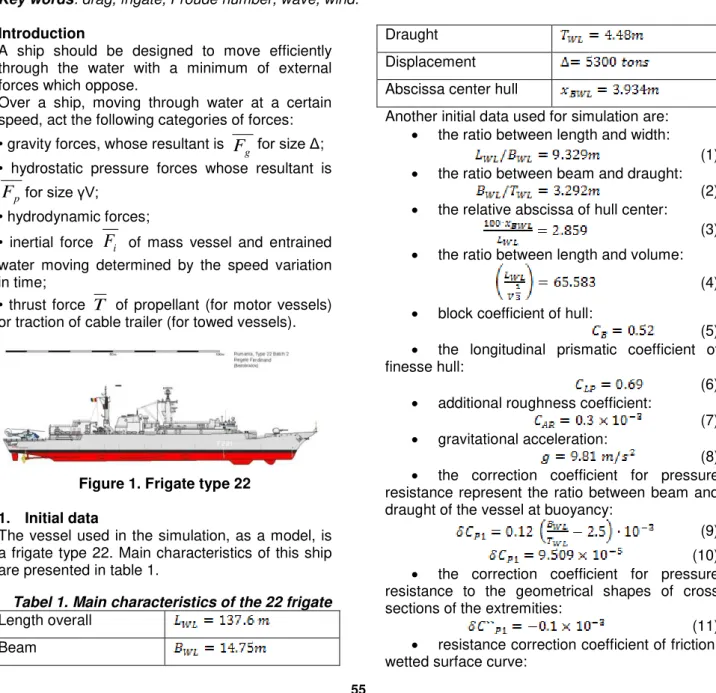
Figure 1. Frigate type 22
1. Initial data
The vessel used in the simulation, as a model, is a frigate type 22. Main characteristics of this ship are presented in table 1.
Tabel 1. Main characteristics of the 22 frigate Length overall
Beam
Draught
Displacement
Abscissa center hull
Another initial data used for simulation are:
• the ratio between length and width:
(1)
• the ratio between beam and draught:
(2)
• the relative abscissa of hull center:
(3)
• the ratio between length and volume:
(4)
• block coefficient of hull:
(5)
• the longitudinal prismatic coefficient of
finesse hull:
(6)
• additional roughness coefficient:
(7)
• gravitational acceleration:
(8)
• the correction coefficient for pressure
resistance represent the ratio between beam and draught of the vessel at buoyancy:
(9)
(10)
• the correction coefficient for pressure
resistance to the geometrical shapes of cross sections of the extremities:
(11)
• resistance correction coefficient of friction,
wetted surface curve:
55 DOI: 10.21279/1454-864X-16-I2-008
“Mircea cel Batran” Naval Academy Scientific Bulletin, Volume XIX – 2016 – Issue 2
The journal is indexed in: PROQUEST / DOAJ / Crossref / EBSCOhost / INDEX COPERNICUS / DRJI / OAJI / JOURNAL INDEX / I2OR / SCIENCE LIBRARY INDEX / Google Scholar / Academic Keys/ ROAD Open Access /
Academic Resources / Scientific Indexing Services / SCIPIO / JIFACTOR (12)
2. Case study
We will determine the drag force parameters using Mathcad PTC program [5]. In practice, the
main drag force, is determined
corresponding to a range of speeds, ,
which includes the speed required by the design theme.
Determination of the main drag force is based on the equation (13):
(13)
where
(14)
[m2] (15)
– coefficient for main drag force;
– thesurface of the wetted hull, using Munaghan `s formula;
– coefficient of friction resistance of the hull; – coefficient for pressure resistance. We introduce in Mathcad the following relation:
• Reynolds number:
(16)
• resistance friction coefficient of plate
smooth equivalent:
(17)
• resistance friction coefficient of the hull:
(18)
• Froude number:
(19)
• the difference of relative abscesses:
= [%] (20)
• correction for the position of the center of
hull length:
(21) Using the relation (21), the correction for vessel shape is:
(22) The coefficient of pressure resistance is:
= (23)
Using the relations (18), (23), we determinate the coefficient for main drag force:
= (24)
The main drag force result from (15), (24):
= [kN] (25)
The resistance due to appendices, where :
= [kN] (26)
The drag force generated by waves, where is :
[kN] (27)
The drag force generated by the wind, where is:
[kN] (28)
Using relations (26), (27), (28), the supplementary resistance force is:
= [kN] (29)
The total dragforce is:
= [kN] (30)
Power towing vessel using (30) is:
[kW] (31) Using relation (30), we determinate:
• the power of the propeller:
[CP] (32), where the efficiency propeller
is .
• the power on the axis of the propeller:
[CP] (33), where the efficiency
propeller axis is .
• the effective power to the main machine
flange: [CP] (34), where the efficiency
reversing device and reduced rotational speed is .
• the power indicated on the main machine:
[CP](35), where the machine's
mechanical efficiency is .
The results for different value of speed, are systematically presents in table 2.
Table 2 Results using Mathcad PTC[5]
5 kts 7 kts 10 kts 15 kts 20 kts
56 DOI: 10.21279/1454-864X-16-I2-008
“Mircea cel Batran” Naval Academy Scientific Bulletin, Volume XIX – 2016 – Issue 2
The journal is indexed in: PROQUEST / DOAJ / Crossref / EBSCOhost / INDEX COPERNICUS / DRJI / OAJI / JOURNAL INDEX / I2OR / SCIENCE LIBRARY INDEX / Google Scholar / Academic Keys/ ROAD Open Access /
Academic Resources / Scientific Indexing Services / SCIPIO / JIFACTOR
CONCLUSION
The drag force of a ship depends on her velocity. Therefore, drag force is always specified at a particular velocity. Furthermore, we understand that the drag will depend on the condition of the sea. We cannot expect that the drag force of a ship in a rough sea to be the same as the drag force of the ship in a calm sea. Also, operating conditions for ship must be specified. Therefore, drag force of a ship is defined as the force required towing the ship in calm water at a constant velocity.
The table 2 shows that at a slow or medium speed of frigate, the wavemaking resistance is small compared with frictional resistance. At high speeds, the wavemaking resistance increases and can be 50 - 60% of total drag force.
An additional resistance, which may be considerable, is the wind force acting on the ship` s body. Even is a small resistance component, it is important because it could influence the aerodynamic shape.
Figure 2 The graphic of total resistance of the frigate
Using the relation (31), thefigure 2, shows that for a speed of 5 or 7 knots, the variation oftotal drag forceis not major. Starting with 13 knots speed, the resistanceforce is tripled, reaching 30 times higher.
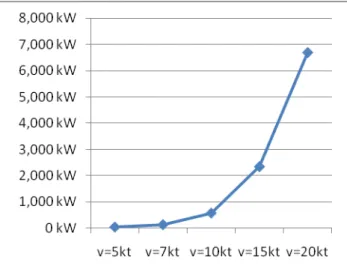
Figure 3 The graphic of effective power of the frigate
The drag force variation caused by the variation of the speed, waves, the wind etc., further lead to a change in the propeller's speed and, consequently, the drive power[3].Figure 3 shows a different value of power for different value of speed. For example, for 5 knots, the power used is 45 kW, but once we increase the speed (for 10 knots we have 570 kW), the power increases too. This is the reason that the ship's propulsion system
57 DOI: 10.21279/1454-864X-16-I2-008
“Mircea cel Batran” Naval Academy Scientific Bulletin, Volume XIX – 2016 – Issue 2
The journal is indexed in: PROQUEST / DOAJ / Crossref / EBSCOhost / INDEX COPERNICUS / DRJI / OAJI / JOURNAL INDEX / I2OR / SCIENCE LIBRARY INDEX / Google Scholar / Academic Keys/ ROAD Open Access /
Academic Resources / Scientific Indexing Services / SCIPIO / JIFACTOR
should be adapted to these changes in load because once increased the speed of frigate, the power of towing, the power of propeller and machine increase too.
This type of calculation of the drag force of a ship is necessary for choose the drive motor and the main elements of the axial line.
BIBLIOGRAPHY
[1] V. Maier, Mecanica si constructia navei, Editura Tehnica
[2] C. Năstase, Calcululșiconstrucția navei, Editura Didactica șiPedagogică,București, 1964 [3] G. Kuiper, Resistance and Propulsion of Ships, Technical University Delft, 1991
[4] J. Holtrop, A Statistical Re-Analysis of Resistance and Propulsion Data, International Shipbuilding Progress, 1984
[5] PTC Mathcad program
58 DOI: 10.21279/1454-864X-16-I2-008
![Table 2 Results using Mathcad PTC[5]](https://thumb-eu.123doks.com/thumbv2/123dok_br/18130906.325319/2.892.95.807.90.1161/table-results-using-mathcad-ptc.webp)