H VM BI OFLUX
H u m a n & V e t e r in a r y M e dicin e
I n t e r n a t ion a l Jou r n a l of t h e Bioflu x Socie t y
An t ibiot ic r e sidue s in m ilk from M olda v ia ,
Rom a n ia
1
Andrei C.
Grădinaru,
2Ovidiu Popescu, and
1Gheorghe Solcan
1
Facult y of Vet erinary Medicine, Univ ersit y of Agricult ural Sciences and Vet erinary
Medicine of I aşi, Rom ania.
2
Vet erinary School, Purdue Univ ersit y , West Lafayet t e, I ndiana, USA.
Corresponding aut hor: A. C. Grădinaru, andre_gradinaru@y ahoo. com
Abst r a ct.The pr esent paper is a st udy based on t he det er m inat ion of ant ibiot ic r esidues in m ilk sam ples collect ed fr om far m s in t he NE Rom ania ( Moldavia) . Cont am inat ion seasonalit y and t he cor r elat ions wit h SCC and TBC values wer e invest igat ed. Out of 2 78 5 t ot al m ilk sam ples, 124 w er e posit ive ( + ) ( 4. 45% ) and 13 0 sam ples wer e uncer t ain ( ± ) ( 4. 67% ) . The pr esence of ant ibiot ics was confir m ed in 109 p osit ive ( + ) sam ples ( 87. 9% ) and 24 uncer t ain ( ± ) sam ples ( 18. 46% ) , t he differ ence being false- posit ive r eact ions. Bet alact am s wer e ident ified in 27. 90% of t he sam ples, at an aver age concent r at ion of 26.6 5
µg/kg. Gentamicin/neomycin were identified in 25% of samples, at an average concent r at ion of 198. 68
µg gentamicin/kg and 2048.53 µg neomycin/kg. Tetracyclines were identified in 24.42% of the samples, at an average concentration of 271.43 µg/kg. Gentamicin/streptomycin were identified in 15.11% of the
sam ples, at an aver age concent r at ions of 198.68 µg gentamicin/kg and 280.61 µg streptomycin/kg. The m acr olides wer e ident ified in 7. 56% of t he sam ples, at an average concentration of 97.87 µg tylosin/kg. The ant ibiot ic cont am inat ion of m ilk was low in Januar y ( csi = 0. 51) and July ( csi = 0.59) , and incr eased
in Apr il ( csi = 1. 77) and May ( csi = 1. 43) . The m ilk cont am in at ion wit h ant ibiot ics was associat ed wit h
incr eased SCC and TBC valu es.
Ke y w or ds: ant ibiot ic r esidues, m ilk, st at ist ical analysis.
Abbr e v ia t ion k e y: ADI = accept able daily int ake; cfu = colony for m ing unit ; csi = seasonalit y fact or;
MRL = m axim um r esidue lim it s; SCC = som at ic cell count ; TBC = t ot al bact er ia count .
I n t r odu ct ion. I n sm all quant it ies and long int ak e, ant ibiot ics can hav e undesirable effect s on hum ans and anim als. The undesirable effect s on consum er healt h can be direct and m anifest as allergic or t ox ic react ions. The indirect effect s are also im port ant by t he creat ing ant ibiot ic- resist ant organism s ( Allison 1985; Bishop & Whit e 1984; Popescu & Enache 1996) . Som e st udies show ed t hat m ilk pollut ed wit h ant ibiot ics w hich w as obt ained from 20 cow s delay ed or st opped t he ferm ent at ion processes of t he m ilk collect ed from anot her 25,000 cow s ( Râpeanu 1975) . Moreov er, t he sam ples wit h ant ibiot ic residues are accom panied by an increase of t he t ot al num ber of som at ic cells and of t he t ot al num ber of germ populat ions ( Ruegg & Tabone 2000; Van Schaik et al 2002) .
I n t his cont ex t , t he cont rol of t he ant ibiot ic presence in m ilk is an im port ant issue,
becom ing m andat ory in all milk processing units (Grădinaru 2010).
M a t e r ials a n d Me t h ods. I nv est igat ions w ere conduct ed during 2006 - 2009 on 2785 m ilk sam ples harv est ed from som e m ilk collect ing cent ers and dairy farm s locat ed in NE Rom ania ( Moldavia) ( Fig. 1) .
The sam pling w as done according t o norm s in force ( Com m ision Direct iv e 1987;
SR EN 2000) . Sam ples of 500 t o 1000 m L of m ilk w ere collect ed in dry clean plast ic
Figure 1. Geographical locat ion of t he st udy.
The perform ance crit eria described by t he Com ision Decision 180/ 1991 and t he Com ision Decision 657/ 2002 w ere used for t he st udy. The ident ificat ion of ant ibiot ic residues w as
based on a st andardized m et hod, wit h spores of Bacillus st earot herm ophilus calidolact is
v ariet y ; t he presence of ant ibiot ics in t he analy zed sam ples im paired/ halt ed t he ferm ent at ion of t he t est m icroorganism . Posit iv e ( + ) and uncert ain ( ± ) sam ples w ere
heat t reat ed at 820C for 10 m inut es t o elim inat e false- posit iv e result s due t o nat ural
inhibit ors (ly sozy m e, lact oferin, lact operoxidase). Nex t , t he confirm ed posit ive sam ples w ere sem iquant it at iv ely analy zed t o ident ify t he fam ilies of ant ibiot ics ( t he necessary equipm ent w as provided by Charm Science I nc) .
The det erm inat ion of t he ant ibiot ic fam ilies w as m ade t hrough a com pet it ive enzy m e im m unoassay m et hod ( ELI SA) , based on t he principle of t he ant igen - ant ibody react ion. The det erm inat ion of som at ic cells w as based on t he m icroscopic procedure, com put er equipm ent being used for st aining and reading t he m icroscope slides. The t ot al num ber of germ s w as det erm ined by a colorim et ric m et hod.
The int erpret at ion of t he inv est igat ion dat a inv olved t he use of som e basic st at ist ical indicat ors, such as m inim um , m axim um , m ean v alue, st andard deviat ion, coefficient of v ariat ion, confidence int erv al of t he m ean v alue. For t he seasonalit y
calculat ion ex pressed as csi, t he arit hm et ic m et hod w as used ( Badea & Georgescu 2003;
Jaba 2006) . Seasonal fact ors w ere est ablished using a series of m ont hly dat a for t he four y ears of st udy . An av erage v alue w as calculat ed for each m ont h ( Eq. 1) w hich w as com pared wit h an ov erall average v alue of t he period ( Eq. 2) , achieving t he v alue of seasonalit y fact or ( Eq. 3) .
_
Xi = (Σnj = 1 xij ) / n ( 1) _ _
XG = (Σmi= 1 Xi ) / m ( 2) _ _
csi = Xi / XG ( 3)
w here: csi - seasonalit y fact or for t he i m ont h;
_
Xi - arit hm et ic m ean of t he i m ont hs of t he four y ears of t he st udy ;
_ _
XG - arit hm et ic av erage based on t he Xi av erages; xij - v alues for t he i m ont hs of t he j y ear;
n - num ber of y ears;
m - num ber of m ont hs of t he st udy period.
_ _
Whet her Xi > XG it result ed a csi > 1 and t he seasonal v ariat ion w as considered posit iv e.
REGION
For Xi < XG it result ed a csi < 1 and t he seasonalit y w as bad, t he m ont hs av erage w as
sm aller t han t he ov erall period av erage.
The consist ency det erm inat ion w as m ade using t he χ2 t est ( chi- square) . The observ ed
frequencies of t he ant ibiot ic cont am inat ions w ere com pared wit h t he ex pect ed ones ( Eq. 4) .
χ2 = Σl
i= 1 Σcj = 1[ ( ƒoij - ƒaij)2 / ƒaij] ( 4)
w here: ƒoij = t he observ ed frequencies for t he i line and j colum n;
ƒaij = t he ex pect ed frequencies for t he i line and j colum n;
l = t he num ber of row s in t he t able ( or t he num ber of classes of t he effect fact or) ;
c = t he num ber of colum ns in t he t able ( or t he num ber of classes of t he act iv e fact or) .
I f t here w as no dependence t rend, χ2 v alue w as 0, and if t here w as a dependence
tendency the χ2
v alue w as great er as t he dependence t rend w as st ronger. To count er t he
trend of artificially increasing of the χ2 coefficient value, the use of the Φ2
point er w as
im posed; t his is obt ained by dividing the χ2 quot ient t o t he cells num ber of Table ( Eq. 5) .
Φ2 = χ2
/ n ( 5)
Re su lt s a n d D iscu ssion. The result s obt ained using t he m icrobial qualit y t est t o ident ify t he ant ibiot ic residues in t he inv est igat ed sam ples are present ed in Table 1.
Table 1 Qualit at iv e m icrobial ident ificat ion t est for ant ibiot ic residues
Year of st udy Analyzed sam ples Result s of t he ident ificat ion ant ibiot ic r esidues
( + ) sam ples ( ± ) sam ples ( - ) sam ples
no. % no. % no. % no. %
2006 782 100 41 5. 24 43 5. 50 698 89. 26
2007 734 100 32 4. 36 34 4. 63 668 91. 01
2008 756 100 31 4. 10 32 4. 23 693 91. 67
2009 513 100 20 3. 89 21 4. 09 472 92. 02
Throughout t he st udy period, 2785 m ilk sam ples w ere analy zed, of w hich 124 sam ples ( 4. 45% ) w ere cont am inat ed wit h ant ibiot ic residues ( + ) , 130 sam ples ( 4. 67% ) had an uncert ain react ion t o t he t est ( ± ) and 2531 sam ples ( 90. 88% ) were free of ant ibiot ic residues ( - ) .
Ot her st udies also show ed t hat in som e m ilk m ark et s t he ant ibiot ic residues m ay exist in approx im at ely 8- 15% of t he processed m ilk ( Bay nes et al 1999; Shit andi & St ernesj o 2004) . Chung et al ( 2009) ident ified 21 ant ibiot ic cont am inat ed sam ples out of 269 analy sed m ilk sam ples, represent ing 7. 8% of t he t ot al. Khask heli et al ( 2008) ,
analy sing 137 m ilk sam ples and using t he qualit at iv e m icrobial m et hod wit h Bacillus
subt ilis in plat es for bet alact am s det ect ion, ident ified 87 sam ples ( 63. 5% ) as negat iv e and 50 sam ples ( 36. 5% ) w ere considered posit ive w it h m ean inhibit ion zones of 8. 91 ± 0. 37 m m .
The m ilk sam ples wit h ant ibiot ic residues ( + ) and t hose w it h uncert ain result s ( ± )
w ere heat ed at 820C for 10 m inut es. The sam ples wit h ant ibiot ic residues ( + ) w ere
confirm ed at t he following rat es: 87. 8% in 2006, 87. 5% in 2007, 87. 1% in 2008 and
90% in 2009. Am ong t he sam ples wit h uncert ain result s ( ± ) t o t he qualit y m icrobial t est , 18. 6% w ere confirm ed as posit iv e in 2006, 17. 65% in 2007, 18. 75% in 2008 and 19. 05% in 2009. Considering t he ent ire st udy period, 87. 9% of t he init ially posit ive ( + ) sam ples and 18. 46% of t he init ially uncert ain ( ± ) ones w ere confirm ed by applying t he heat t reat m ent ; t he difference represent ed t he false- posit iv e react ions.
t he easiest w ay s t o elim inat e false- positive result s. Thus, Tyler et al ( 1992) ident ified 45% of t he false- posit ive m ilk sam ples collect ed from cow s w it h m ast it is ex perim ent ally induced by endot oxin; Van Eenennaam et al ( 1993) found t hat , in t he nat urally occurring
m ast it is cases, 37. 7% false- posit iv e responses were ident ified. The m ixig of t he m ilk in
t ank obviously lead t o t he dilut ion of t he m ilk originat ed from cow s wit h different form s of m ast it is, w hich cont ain a num ber of nat ural inhibit ors usually high ( Kang et al 2005; Kosik ow ski & O´ Leary 1963) . Kosik ow ski & O´ Leary ( 1963) st at ed t hat w ere able t o neut ralize all nat ural inhibit ors in 11 m ilk sam ples by using t he heat t reat m ent , t he subsequent applicat ion of t he m icrobiological m et hod in plat es leading t o negat iv e result s.
According t o t he obj ect iv es of t he st udy , a st at ist ical int erpret at ion of result s based on t he seasonalit y fact or calculat ion w as perform ed, using an arit hm et ical m et hod ( Badea & Georgescu 2003; Jaba 2006) . The av erage num ber of sam ples cont am inat ed
w it h ant ibiot ics, according t o t he sam ple collect ing season, and csi v alues are also
present ed in Table 2.
Table 2 The seasonal v ariat ion of t he ant ibiot ic posit iv e ( + ) sam ples
Mont h Posit ive sam ples ( + ) num ber Mont hly
aver age
Seasonalit y coefficient
2006 2007 2008 2009
Januar y 2 2 2 0 1. 50 0. 51
Febr uar y 3 2 1 2 2. 00 0. 67
Mar ch 3 3 3 2 2. 75 0. 93
Apr il 6 5 6 4 5. 25 1. 77
May 5 4 3 5 4. 25 1. 43
June 4 3 4 2 3. 25 1. 10
July 2 1 2 2 1. 75 0. 59
August 3 2 3 2 2. 50 0. 84
Sept em ber 4 3 2 3 3. 00 1. 01
Oct ober 5 4 2 - 3. 67 1. 24
Novem ber 3 3 3 - 3. 00 1. 01
Decem ber 4 2 2 - 2. 67 0. 90
TOTAL 44 34 33 22 12. 00
Gener al aver age
2. 97
An increasing num ber of sam ples cont am inat ed wit h ant ibiot ic residues w as found in lat e w int er - early spring wit h a m axim um in April. By early sum m er t here w as a decrease in t he num ber of cont am inat ed sam ples. During t he last m ont hs of sum m er - early aut um n t here w as a furt her increase in t he num ber of cont am inat ed sam ples.
0,51 0,67 0,93 1,43 1,10 0,59 0,84 1,01 1,24 1,01 0,90 0,00 0,50 1,00 1,50 2,00 seasonal c o efficient Janu ary Febr uary Mar ch Apr il
May June July Aug ust Sept embe r Oct ober Nov embe r Dec embe r period
The seasonal coefficient variation
Figure 2. Season v ariat ion of t he ant ibiot ic posit ive ( + ) sam ples.
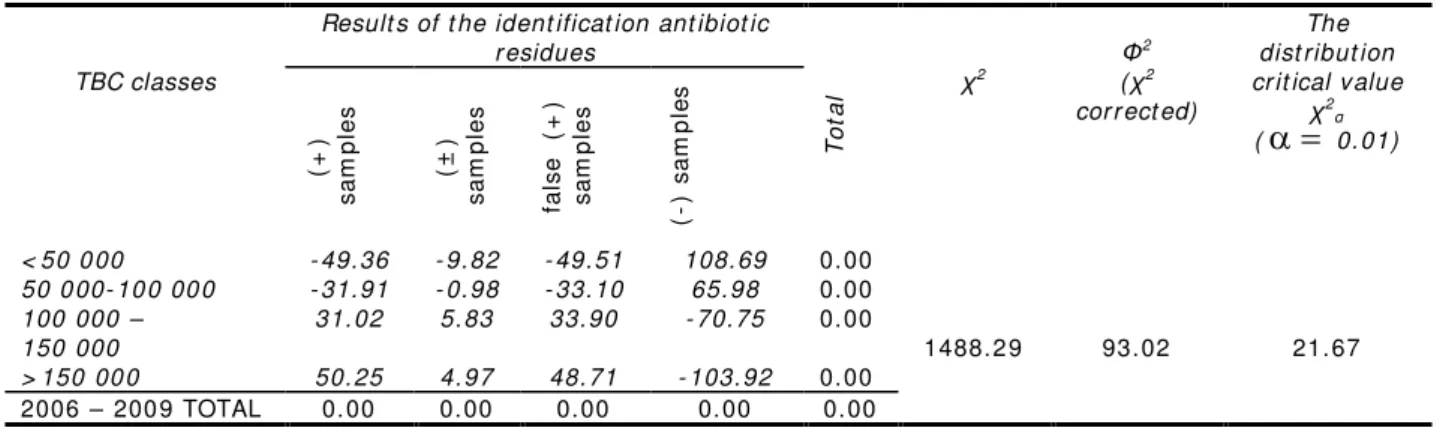
The differences bet w een t he observ ed and ex pect ed frequencies of t he cont am inat ions
with antibiotic residues, in according to SCC and TBC classes, with χ2, Φ2 (χ2
correct ed)
coefficient v alues and the χ2 reference value at a α = 0.01 probabilit y , are present ed in
Tables 3 and 4.
Table 3 I nt erpret at ion of t he m at ch t est bet ween t he ant ibiot ic
cont am inat ion and t he som at ic cell count s
SCC classes
Result s of t he ident ificat ion ant ibiot ic r esidues
T
o
ta
l χ2
Φ2 (χ2
cor r ect ed)
The dist ribut ion
cr it ical
value χ2
α (
0. 01) (+ ) s a m p le s (± ) s a m p le s fa ls e ( + ) s a m p le s (-) s a m p le s< 200 00 0 - 48. 82 - 10. 70 - 59. 90 119. 42 0. 00
1927. 5 6 120. 47 21. 67
200 000- 400 000
- 31. 04 - 2. 23 - 44. 35 77. 62 0. 00
400 000- 600 000
30. 31 8. 11 31. 33 - 69. 75 0. 00
> 600 00 0 49. 54 4. 81 72. 93 - 127. 29 0. 00
2006 – 200 9 TOTAL
0. 00 0. 00 0. 00 0. 00 0. 00
The χ2 and Φ2 indicators are higher than the χ2α critical value of the theo
ret ical
dist ribution (α = 0.01) . This show s t hat am ong t he inv est igat ed indicat ors ( ant ibiot ic
residues v s. SCC and TBC v alues) is a st rong correlat ion. Essent ially, t he ant ibiot ic
residue sam ples ( + ) had m ore t han 600 000 cells/ m L [ ( ƒoij - ƒaij) = 49. 54] and m ore
t han 150, 000 cfu/ m L [ ( ƒo
ij - ƒaij) = 50. 25] ; t he uncert ain ( ± ) sam ples cont ained bet w een
400, 000 and 600, 000 cells/ m L [ ( ƒoij - ƒaij) = 8. 11] and 100 000 t o 150 000 cfu/ m L [ ( ƒoij -
ƒaij) = 5. 83] ; t he false- posit iv e sam ples cont ained ov er 600 000 cells/ m l [ ( ƒoij - ƒaij) =
73.93] and m ore t han 150 000 cfu/ m L [ ( ƒoij - ƒaij) = 48. 71] ; sam ples wit h no ant ibiot ic
I nt erpret at ion of t he m at ch t est bet ween t he ant ibiot ic cont am inat ion and t he t ot al bact erial count
TBC classes
Result s of t he ident ificat ion ant ibiot ic r esidues
T
o
ta
l χ
2
Φ2
(χ2
cor r ect ed)
The dist ribut ion cr it ical value
χ2
α
(
0. 01)(+ ) s a m p le s (± ) s a m p le s fa ls e (+ ) s a m p le s (-) s a m p le s
< 50 0 00 - 49. 36 - 9. 82 - 49. 51 108. 69 0. 00
1488. 2 9 93. 02 21. 67
50 0 00- 10 0 00 0 - 31. 91 - 0. 98 - 33. 10 65. 98 0. 00
100 000 – 150 000
31. 02 5. 83 33. 90 - 70. 75 0. 00
> 150 00 0 50. 25 4. 97 48. 71 - 103. 92 0. 00
2006 – 200 9 TOTAL 0. 00 0. 00 0. 00 0. 00 0. 00
Result s sim ilar t o t hose obt ained in t his st udy on t he correlat ion bet w een t he cont am inat ion of m ilk w it h ant ibiot ics and ot her risk fact ors w ere report ed by Rüegg & Tabone ( 2000) w ho observ ed an increase of t he som at ic cell populat ions in sam ples cont am inat ed wit h ant ibiot ic residues. I n t hat research, t he m ilk from A class wit h 700,000 cells/ m L present ed a risk of cont am inat ion wit h ant ibiot ic residues approx im at ely sev en t im es higher t han t hat wit h less t han 250,000 cells/ m L. Also, t he residual out runs risk w as about 2. 5 t im es higher for t he m ilk wit h less t han 700,000 som at ic cells/ m L com pared t o t hat w it h 551, 000 t o 700,000 cells/ m L. For t he m ilk from B class, t he ant ibiot ic cont am inat ion rat e w as about 5. 5 t im es higher in sam ples wit h m ore t han 700,000 cells/ m L com pared t o t hose wit h less t han 250,000 cells/ m L. I n cont rast , t he out runs risk of ant ibiot ic residues in t he m ilk wit h m ore t han 700,000 cells/ m L w as approx im at ely 1. 2 t im es great er t han in t hat w hich cont ains bet w een 551,000 and 700,000 cells/ m L.
Aft er applying t he Charm I I t est t he following ant ibiot ic fam ilies w ere ident ified ( see Table 5) .
Table 5 Fam ilies of ant ibiot ics ident ified in t he sam ples confirm ed
Year of st udy bet alact am s gent am icin/
neom ycin
gent am icin/ st r ept om ycin
m acr olides t et r acyclines TOTAL
no. % no. % no. % no. % no. % no. %
2006 17 29. 31 12 20. 69 10 17. 24 5 8. 62 14 24. 14 58 100 2007 13 29. 54 12 27. 27 5 11. 36 3 6. 82 11 25. 00 44 100 2008 9 20. 93 11 25. 58 8 18. 60 3 6. 97 12 27. 91 43 100
2009 9 33. 33 8 29. 63 3 11. 11 2 7. 41 5 18. 52 27 100
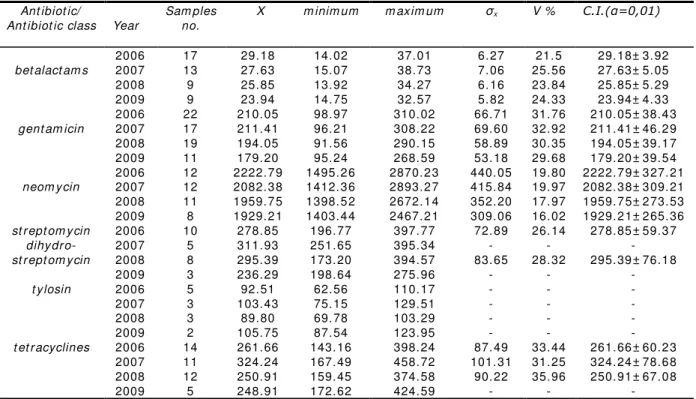
During t he four y ears of st udy , t he bet alact am s hav e been ident ified in 27. 90% of sam ples ( n = 48) , t he gent am icin/ neom y cin am inogly cosides in 25. 00% of sam ples ( n = 43) , t he t et racy clines in 24. 42% of t he sam ples ( n = 42) , t he gent am icin/ st rept om y cin in 15. 11% of sam ples ( n = 26) and t he m acrolides in 7. 56% of sam ples ( n = 13) . The result s obt ained applying t he Charm I I t est t o ident ify t he ant ibiot ic fam ilies confirm ed som e t reat m ent pract ices used in t he cat t le farm s. Thus, t he bet alact am s are t he m ost used ant ibiot ics t o t reat infect ious diseases; due t o low er cost s, t hese are included in a significant num ber of drug com binat ions. These m olecules w ere also ident ified in ot her inv est igat ions ( Ghidini et al 2002; Heeschen & Suhren 1996; McEw en et al 1991) . The gent am icin/ neom y cin and t et racy clines w ere also ident ified in a significant num ber of sam ples; t his is closely relat ed t o t heir use in t he t reat m ent of t he m ast it is.
The quant it at iv e det erm inat ions of ant ibiot ic residuesin m ilk ( µg/ kg)
Ant ibiot ic/
Ant ibiot ic class Year
Sam ples no.
X m inim um m axim um σx V % C.I.(α=0,01)
bet alact am s
2006 17 29. 18 14. 02 37. 01 6. 27 21. 5 29. 18± 3. 92 2007 13 27. 63 15. 07 38. 73 7. 06 25. 56 27. 63± 5. 05 2008 9 25. 85 13. 92 34. 27 6. 16 23. 84 25. 85± 5. 29 2009 9 23. 94 14. 75 32. 57 5. 82 24. 33 23. 94± 4. 33
gent am icin
2006 22 210. 05 98. 97 310. 02 66. 71 31. 76 210. 05 ± 38. 4 3 2007 17 211. 41 96. 21 308. 22 69. 60 32. 92 211. 41 ± 46. 2 9 2008 19 194. 05 91. 56 290. 15 58. 89 30. 35 194. 05 ± 39. 1 7 2009 11 179. 20 95.24 268. 59 53. 18 29. 68 179. 20 ± 39. 5 4
neom ycin
2006 12 2222. 7 9 1495. 2 6 2870. 2 3 440. 05 19. 80 2222. 7 9± 3 27. 21 2007 12 2082. 3 8 1412. 3 6 2893. 2 7 415. 84 19. 97 2082. 3 8± 3 09. 21 2008 11 1959. 7 5 1398. 5 2 2672. 1 4 352. 20 17. 97 1959. 7 5± 2 73. 53 2009 8 1929. 2 1 1403. 4 4 2467. 2 1 309. 06 16. 02 1929. 2 1± 2 65. 36
st r ept om ycin dihydr o-st r ept om ycin
2006 10 278. 85 196. 77 397. 77 72. 89 26. 14 278. 85 ± 59. 3 7
2007 5 311. 93 251. 65 395. 34 - - -
2008 8 295. 39 173. 20 394. 57 83. 65 28. 32 295. 39 ± 76. 1 8
2009 3 236. 29 198. 64 275. 96 - - -
t ylosin 2006 5 92. 51 62. 56 110. 17 - - -
2007 3 103. 43 75. 15 129. 51 - - -
2008 3 89. 80 69. 78 103. 29 - - -
2009 2 105. 75 87. 54 123. 95 - - -
t et r acyclines 2006 14 261. 66 143. 16 398. 24 87. 49 33. 44 261. 66 ± 60. 2 3
2007 11 324. 24 167. 49 458. 72 101. 31 31. 25 324. 24 ± 78. 6 8 2008 12 250. 91 159. 45 374. 58 90. 22 35. 96 250. 91 ± 67. 0 8
2009 5 248. 91 172. 62 424. 59 - - -
The bet alact am s w ere det erm ined at av erage concent rat ions of 23. 94 - 29.18 µg/kg.
Gent am icin w as det erm ined at av erage concent rat ions of 179. 20 - 211. 41 µg/kg.
Neom y cin w as det erm ined at av erage concent rat ions ranging bet w een 1929. 21 and
2222.79 µg/kg. Streptomycin/dihydrostreptomycin residues were determined at av erage
concent rat ions of 236. 29-311.93 µg/kg. Tylosin was determined at average
concent rat ions of 89. 80-105.75 µg/kg. Tetracyclines were found at av erage
concent rat ions of 248. 91-324.24 µg/kg.
The m ost concent rat ions of ant ibiot ics did not ex ceed t he accept able daily int ak es or t he m ax im um lim it s t o be t ak en w it h foods by an adult , ex cept penicillins, for w hich
w as not est ablished an accept able daily int ak e ( Table 7). How ev er, t he sam ples wit h
ant ibiot ic residues aft er t he m icrobial qualit y t est applicat ion are not direct ed for hum an consum pt ion. Moreov er, t he int roduct ion of m ilk cont am inat ed wit h ant ibiot ics in t he t echnological flow processing w ould be cont rary t o t he int erest s of producers t o obt ain appropriat e product s, k nowing t hat t hese drugs int erfere w it h t he coagulat ion processes based on lact ic bact eria act ivit y.
Table 7 Lim it s of t he ant ibiot ic residues in m ilk for hum an consum pt ion
Ant ibiot ic r esidues Lim it s
MRL in m ilk
µg/kg Nor m in for ce µg/kg ADI
bodyweight
Nor m in for ce
Penicillin G, am oxicillin, am picillin. 4 Council Regulat ion, 1990
NSVFSA Or d. , 2005
- -
Cloxacillin, dicloxacillin, nafcillin,
oxacillin. 30 - -
Gent am icin 100 0 - 4 WHO, 1995
Neom ycin 1500 60 WHO, 2003
St r ept om ycin /
dihydr ost r ept om ycin 200 50 WHO, 2000
Tylosin 50 6 WHO, 2008
considered sat isfact ory, giv en t he int erest of farm ers and processors t o obt ain t he least cont am inat ed product s and ev en organic ones is m ore and m ore obv ious.
Ack n ow le dge m e n t s. The research present ed was funded by PN2 51- 004/ 2007 grant and research cont ract no. 77/ 15. 09. 2008, TD- 286 code. Aut hors are t hank ful t o t he Charm Sci. I nc people w ho provided t he equipm ent for t he ident ificat ion of t he ant ibiot ic fam ilies.
Re fe r en ce s
Allison J. R. D. , 1985 Ant ibiot ic residues in m ilk. Br Vet J 1 4 1: 121- 124.
Badea P. , Georgescu D. , 2003 [ I nt roduct ion t o Biost at ist ics] . Univ ersit y Medical Publishing House, Craiov a, Rom ania. [ I n Rom anian]
Bay nes R. E. , Ly m an R., Andreson K. L., Brow nie C. F., 1999 A prelim inary surv ey of ant ibiot ic residues and viable bact eria in m ilk from t hree Caribbean Basin count ries.
J Food Prot ect 6 2( 2) : 177- 180.
Bishop J. R., Whit e C. H. , 1984 Ant ibiot ic residue det ect ion in m ilk – a review . J Food
Prot ect 4 7: 647- 652.
Chung H. H. , Lee J. B. , Chung Y. H., Lee K. G. , 2009 Analy sis of sulfonam ide and quinolone ant ibiot ic residues in Korean m ilk using m icrobial assays and high
perform ance liquid chrom at ography . Food Chem ist ry . 1 1 3( 1) : 297- 301.
Com m ision Decision 180, 1991 Cert ain m et hods of analy sis and t est ing of raw m ilk and
heat - t rat ed m ilk . Official Journal of t he European Com m unit ies L9 3: 1- 48.
Com m ision Decision 657, 2002 I m plem ent ing Council Direct iv e 96/ 23/ EC concerning t he perform ance of analy t ical m et hods and t he int erpret at ion of result s. Official Journal
of t he European Com m unit ies L2 2 1: 8- 36.
Com m ision Direct iv e 524, 1987 Com m unit y m et hods of sam pling for chem ical analy sis for t he m onit oring of preserv ed m ilk product s. Official Journal of t he European
Com m unit ies L3 0 6: 24- 31.
Council Regulat ion 2377, 1990 Com m unit y procedure for t he est ablishm ent of m axim um residue lim it s of v et erinary m edicinal product s in foodst uffs of anim al origin. Official
Journal of t he Eur opean Com m unit ies L2 2 4: 1- 8.
Ghidini S. , Zanardi E. , Varisco G. , Chizzolini R. , 2002 Prevalence of m olecules of bet alact am ant ibiot ics in bovine m ilk in Lom bardia and Em ilia Rom agna ( I t aly ) .
Annali della Facolt à di Medicina Vet erinaria, Univ ersida di Parm a, 2 3: 245- 252.
Grădinaru A. C. , 2010 Assessm ent of ant ibiot ic and elem ent ary x enobiot ic residues in
m ilk and m ilk product s and t heir risk for consum ers. PhD t hesis, Facult y of
Vet erinary Medicine, UASVM I aşi, Rom ania. [ I n Rom anian]
Heeschen W. H., Suhren G. , 1996 Principles of pract ical ex periences wit h an int egrat ed
sy st em for det ect ion of ant im icrobials in m ilk . Milchw issenschaft 5 1( 3) : 154- 160.
Jaba E. , 2006 [ Fundam ent als of St at ist ics]. Editura Universităţii "Al. I. Cuza" Iaşi,
Rom ania. [ I n Rom anian]
Kang J. H., Jin J. H. , Kondo F. , 2005 False- posit iv e out com e and drug residue in m ilk
sam ples ov er wit hdraw al t im es. J Dairy Sci 8 8: 908–913.
Khask heli M. , Malik R. S., Arain M. A., Soom ro A. H. , Arain H. H., 2008 Det ect ion of Bet
a-Lact am ant ibiot ic residues in m ark et m ilk. Pakist an J Nut r 7( 5) : 682–685.
Kosik ow ski F. V., O'Leary M., 1963 Nat ural inhibit ory charact eristics of som e I rish
m anufact uring. J Dairy Sci 4 6( 2) : 89- 94.
McEw en S. A. , Meek A. H. , Black W. D., 1991 A dairy farm surv ey of ant ibiot ic t reat m ent pract ices, residue cont rol m et hods and associat ions w it h inhibit ors in m ilk . J Food
Prot ect 5 4( 6) : 454- 459.
NSVFSA Order 82, 2005 The approv al of Sanit ary Vet erinary Norm on t he superv ision
and cont rol m easures of cert ain subst ances and t heir residues in live anim als and t heir product s and of t he vet erinary drugs residues in anim al product s. Official
Monit or I: 832.
Rom ania. [ I n Rom anian]
Ruegg P. L. , Tabone T. J. , 2000 The relat ionship bet w een ant ibiot ic residue violat ions and
som at ic cell count s in Wisconsin Dairy Herds. J Dairy Sci 8 3( 12) : 2805–2809.
Shit andi A. , St ernesj o A. , 2004 Fact ors cont ribut ing t o t he occurence of ant im icrobial
drug residues in Keny an m ilk. J Food Prot ect 6 7: 399- 402.
SR EN 707, 2000 [ Milk and m ilk product s. Guidelines for sam pling] . [ I n Rom anian]
Tyler J. W. , Cullor J. S., Erskine R. J. , Sm it h W. L. , Dellinger J., McClure K. , 1992 Milk ant im icrobial drug residue assay result s in cat t le wit h ex perim ent al endot ox
in-induced m ast it is. JAVMA 2 0 1: 1378- 1382.
Van Eenennaam A. L. , Cullor J. S. , Perani L. , Gardner I . A. , Sm it h W. L., Dellinger J. , Gut erbock W. M. , Jensen L. , 1993 Ev aluat ion of m ilk ant ibiot ic residue screening
t est s in cat t le wit h nat urally occurring clinical m ast it is. J Dairy Sci 7 6( 10) :
3041-3053.
Van Schaik G., Lot em M., Schuk k en Y. H., 2002 Trends in som at ic cell count s, bact erial count s, and ant ibiot ic residue violat ions in New York St at e during 1999 – 2000. J
Dairy Sci 8 5( 4) : 782–789.
WHO, 1995 Ev aluat ion of cert ain v et erinary drug residues in food, Fort y- t hird report of t he j oint FAO/ WHO Ex pert Com m it t ee on Food Addit iv es, Tehnical Report Series no. 855, Genev a.
WHO, 2000 Ev aluat ion of cert ain v et erinary drug residues in food, Fift y- second report of t he j oint FAO/ WHO Ex pert Com m it t ee on Food Addit ives, Tehnical Report Series 893, Genev a.
WHO, 2003 Ev aluat ion of cert ain v et erinary drug residues in food, Sixt iet h report of t he j oint FAO/ WHO Ex pert Com m it t ee on Food Addit iv es, Tehnical Report Series 918, Genev a.
WHO, 2008 Ev aluat ion of cert ain v et erinary drug residues in food, Sev ent iet h report of t he j oint FAO/ WHO Ex pert Com m it t ee on Food Addit ives, Tehnical Report Series 954, Genev a.
* * * w w w . fda. gov / Anim alVet erinary / New sEvent s/ CVMUpdat es/ ucm 136851. ht m
Received: 19 June 2 011. Accept ed: 17 August 20 11. Published online: 02 Sept em ber 2011. Aut hor s:
Andrei Cristian Grădinaru, Univer sit y of Agr icult ur al Sciences and Vet er inar y Medicine of I asi, Facult y of Vet er inar y Medicine, 8 Sadoveanu Alley, 7004 89, I asi, Rom ania; andr e_gr adinar u@yahoo. com
Ovidiu Popescu, Pur due Univer sit y, Vet er inar y School, 625 Har r ison St r eet , West Lafayet t e, I N 479 07 USA ( 765) 494- 7 607.
Gheor ghe Solcan, Univer sit y of Agr icult ur al Sciences and Vet erinar y Medicine of I asi, Facult y of Vet er inar y Medicine, 8 Sadoveanu Alley, 70 048 9, I asi, Rom ania.
How t o cit e t his ar t icle:
Grădinaru A. C., Popescu O., Solcan G., 2011 Ant ibiot ic r esidues in m ilk fr om Moldavia, Rom ania. HVM Bioflux